If you’ve been searching for an Arabic tutor online, Preply has probably come up more than once. It’s one of the most visible tutoring platforms on the internet — but does visibility mean it’s actually the right choice for learning Arabic?
This review breaks down exactly how Preply works for Arabic learners: what it does well, where it falls short, and — critically — whether a general tutoring marketplace is the right tool when your goal is structured, meaningful Arabic learning.
What you’ll learn in this article
- Whether Preply is good for learning Arabic and who it suits best
- The real disadvantages of Preply that most reviews gloss over
- How Preply’s tutor model compares to a specialist Arabic academy
- How to find the right tutor on Preply if you decide to use it
- What to look for if your goal is fluency — not just conversation practice
Is Preply Good for Learning Arabic?
Preply is a legitimate and functional platform for Arabic learners — with one important condition: the quality of your experience depends almost entirely on which tutor you select.
Preply is a tutor marketplace, not a language school. It connects you with individual instructors who set their own prices, design their own lessons, and define their own teaching approach.
There is no standardized curriculum for Arabic, no progression framework, and no guarantee that one tutor’s “beginner course” looks anything like another’s.
For some learners, that flexibility is exactly what they want. For others — especially beginners, children, or anyone who needs a clear path from zero to functional Arabic — it can be disorienting.
That said, Preply does offer real advantages. Hourly rates range from $3 to $20+ depending on the tutor’s background and region. You can filter by dialect — Egyptian, Levantine, Gulf, Moroccan, or Modern Standard Arabic (Fusha) — and book trial lessons at reduced prices before committing.
The virtual classroom includes a whiteboard, screen sharing, and file sharing, which is more than most marketplace platforms offer.
Bottom line: Preply is good for learning Arabic if you need conversational practice, dialect exposure, or flexible one-on-one sessions with a native speaker. It is less suited for learners who need structured grammar instruction, a defined curriculum, or consistent pedagogical quality.
Read Also: Is Italki Good for Arabic Learning
What Are the Real Disadvantages of Preply?
Most Preply reviews focus on the pros. This section focuses on what the platform itself won’t tell you — the practical limitations that affect Arabic learners specifically.
1. Tutor Quality Is Uneven, And Finding The Right One Takes Time
Preply has thousands of Arabic tutors, but the vetting process is limited. Some tutors are qualified, experienced teachers with formal Arabic education backgrounds.
Others are native speakers who are good conversationalists but have no formal teaching structure, no lesson progression, and — as users on Reddit have noted — some have been observed relying on AI tools to answer grammar questions during sessions.
The trial lesson system helps, but it means you may go through two or three tutors before finding one whose style matches your goals. Each trial takes time and, even at reduced rates, costs money.
2. There Is No Curriculum — Which Is A Genuine Problem For Beginners
This is the most under-discussed disadvantage of Preply for Arabic specifically. Arabic is a grammatically complex language. Classical Arabic (Fusha/MSA) has a dual form, a broken plural system, root-pattern morphology, and case endings that don’t exist in most European languages.
A marketplace tutor can teach you phrases and conversation, but without a structured curriculum, you may spend months in lessons without ever gaining a systematic understanding of how Arabic actually works.
A specialist Arabic academy builds your skills in sequence — phonetics, then script, then grammar, then reading, then composition — and measures your progress against defined benchmarks. Preply doesn’t offer that architecture.
3. No Vocabulary Tools, No Progress Tracking, And No Community Features For Arabic
Preply’s mobile app includes a vocabulary section for major languages like English and French, but it is absent for Arabic.
There is also no forum, no language exchange feature, and no community element — your only touchpoint with the platform is your one-on-one tutor. If your tutor cancels or you decide to switch, there’s no continuity mechanism to carry your progress forward.
4. Last-Minute Cancellations And Scheduling Inconsistency
User accounts consistently mention last-minute cancellations as a pain point. While Preply’s policy allows you to switch tutors if you’re unhappy, each switch resets the relationship — and with a language like Arabic where consistency is critical to retention, repeated disruptions genuinely slow progress.
Read Also: Is Loecsen Good for Learning Arabic
Preply Vs. A Specialist Arabic Academy: What’s The Actual Difference?
Preply — along with platforms like italki and AmazingTalker — is a general tutoring marketplace. It covers hundreds of languages and thousands of subjects. Arabic is one option among many, and there is no institutional expertise in Arabic pedagogy behind the platform itself.
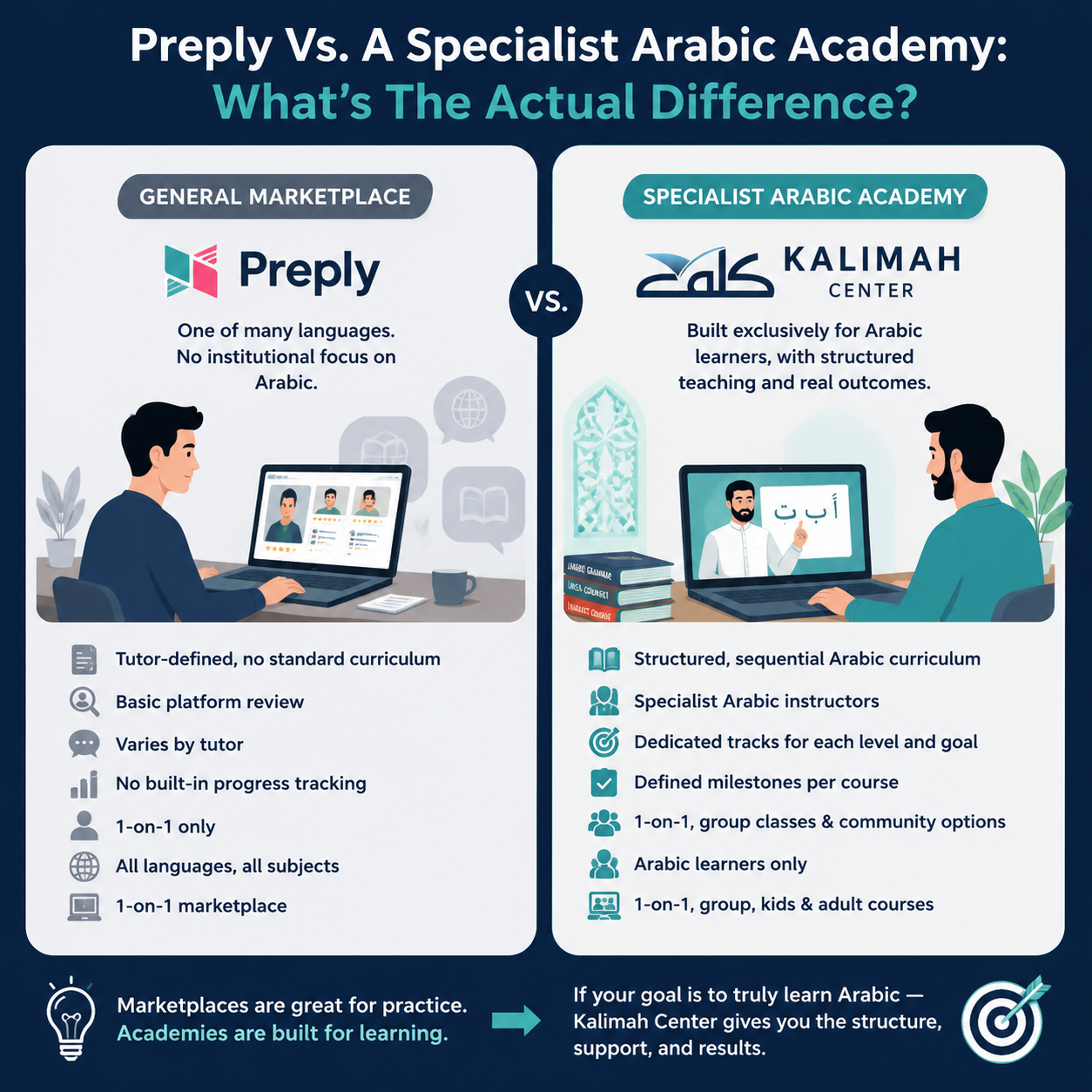
Kalimah Center is a specialist Arabic academy — designed exclusively for Arabic learners, with structured courses, qualified instructors, defined learning tracks, and a curriculum built around how Arabic is actually acquired. The difference is not small.
| Feature | Preply | Kalimah Center |
| Curriculum | Tutor-defined, no standard | Structured, sequential Arabic curriculum |
| Teacher vetting | Basic platform review | Specialist Arabic instructors |
| Dialect and MSA coverage | Varies by tutor | Dedicated tracks for each level and goal |
| Progress tracking | None built in | Defined milestones per course |
| Community and support | 1-on-1 only | Group classes and community options |
| Target audience | All languages, all subjects | Arabic learners only |
| Class formats | 1-on-1 marketplace | 1-on-1, group, kids, adult courses |
The honest practitioner observation here: a marketplace tutor is excellent for practicing a language you’ve already partly learned. It is a weaker tool for building the language from the ground up — because building requires sequence, and sequence requires curriculum.
If your goal is to genuinely learn Arabic — not just get comfortable in conversation, but understand its grammar, read it, and use it accurately — a structured program at Kalimah Center gives you that architecture from day one.
Experience Kalimah Center Classes
Watch real excerpts from our live sessions at Kalimah Center and see how we bring learning to life. These clips highlight our interactive, student-centered teaching approach across all our courses—designed to keep learners engaged, motivated, and actively involved every step of the way.
Master Arabic with Kalimah Center
Join our expert-led online classes and start your journey toward Arabic fluency today.
Book Your Free TrialHow To Get The Most Out Of Preply For Arabic (If You Use It)
If you’ve decided Preply suits your current needs, these steps will help you get real results.
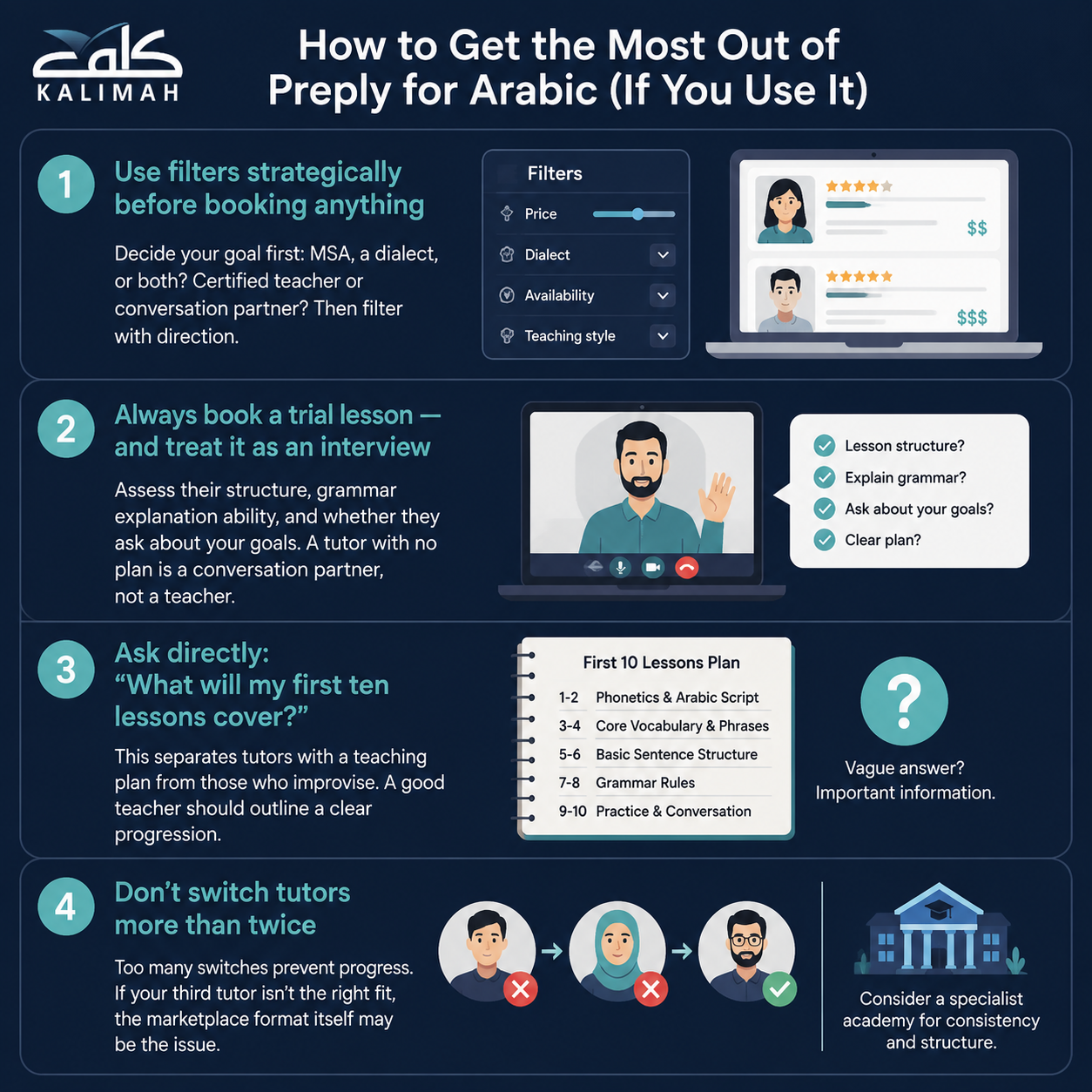
1. Use Filters Strategically Before Booking Anything
Preply’s filter system lets you narrow by price, dialect, availability, and teaching style. Before you search, decide: do you want Modern Standard Arabic, a specific dialect, or both? Do you need a certified teacher or a native-speaker conversation partner? Knowing the answer before you filter saves you from browsing 200 profiles with no direction.
2. Always Book A Trial Lesson And Treat It As An Interview
The trial lesson is not just a “first class.” Use it to assess whether the tutor has a lesson structure, whether they can explain grammar rules (not just demonstrate them), and whether they ask about your goals before jumping into content.
A tutor who starts with “what would you like to talk about today?” with no further plan is a conversation partner, not a language teacher.
3. Ask Directly: “What Will My First Ten Lessons Cover?”
This single question separates tutors who have a teaching plan from those who improvise session to session.
Any qualified Arabic teacher should be able to describe a rough progression — phonetics and script first, then core vocabulary and sentence structure, then grammar rules. If the answer is vague, that’s important information.
4. Don’t Switch Tutors More Than Twice
Switching tutors when there’s a mismatch is sensible. Switching repeatedly prevents the accumulated familiarity that makes lessons more efficient.
If your third tutor isn’t the right fit, consider whether the marketplace format itself is the issue — rather than searching for tutor number four.
Read Also: Arabic Immersion Magnet School
Start Learning Arabic with a Structured Curriculum at Kalimah Center
Preply gives you access to tutors. Kalimah Center gives you a system.
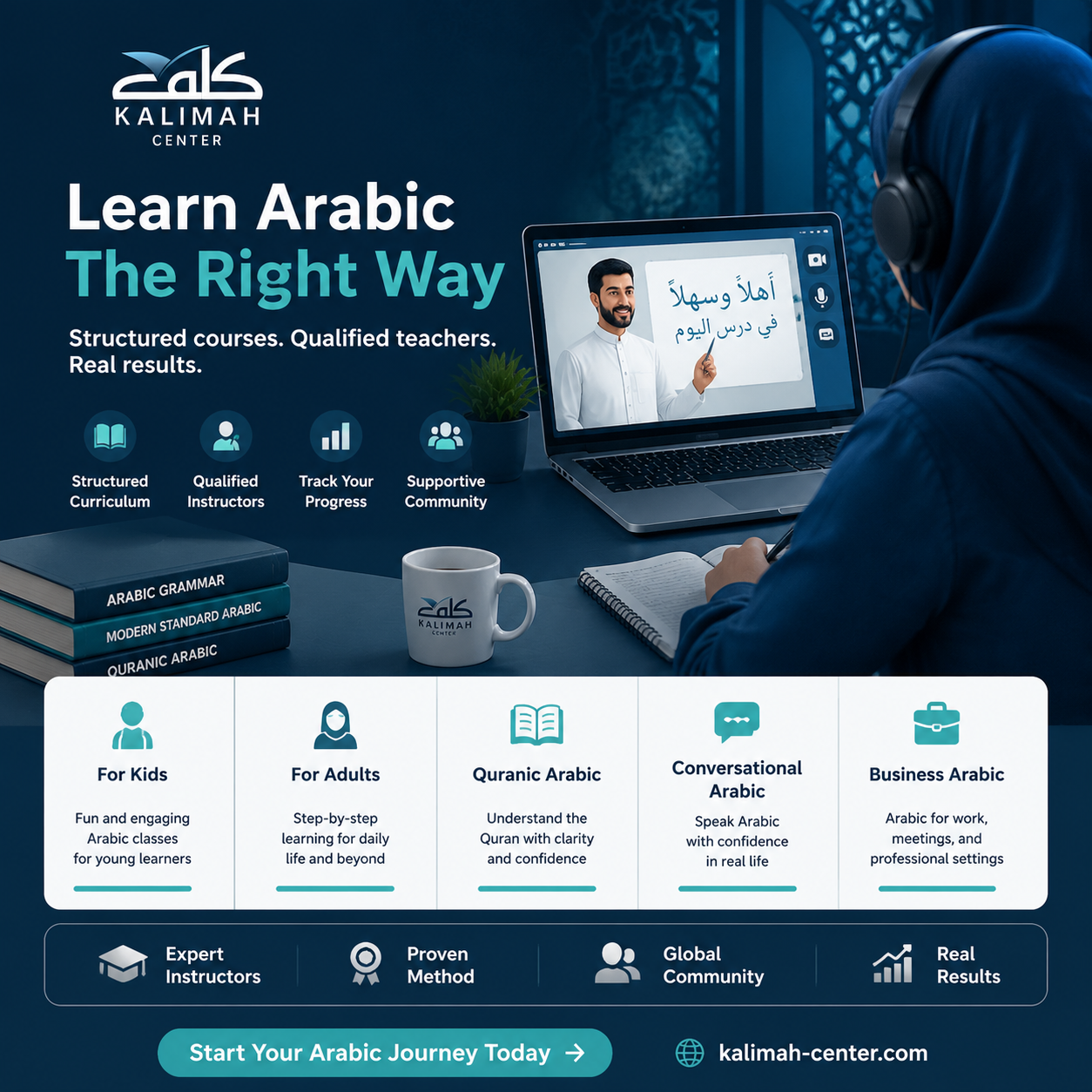
If you’re serious about learning Arabic — whether you’re an adult starting from zero, a parent looking for the right path for your child, or someone who tried apps and marketplace tutors and wants real progress — Kalimah Center is built for exactly that goal.
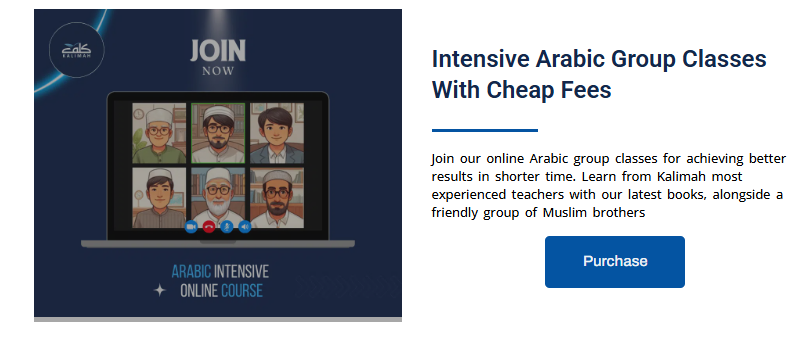
Kalimah Center offers specialist Arabic instruction across every level and format: individual courses, group classes with affordable fees, and dedicated programs for children.
Every course follows a structured curriculum taught by qualified Arabic instructors, so your progress is measurable and your lessons build on each other — lesson by lesson, week by week.
Explore Our Courses:
- Best Online Arabic Classes for Adults: for adults who want intensive, structured progress.
- Intensive Arabic Group Classes: for learners who want affordable group learning.
- Learn Arabic Online for Kids: for children beginning their Arabic journey.
Inside Kalimah Center: Moments from Our Courses
Get a glimpse into the vibrant learning experience at Kalimah Center. These snapshots capture real moments from our live classes—where students engage deeply, connect with passionate instructors, and grow in a welcoming, supportive environment.
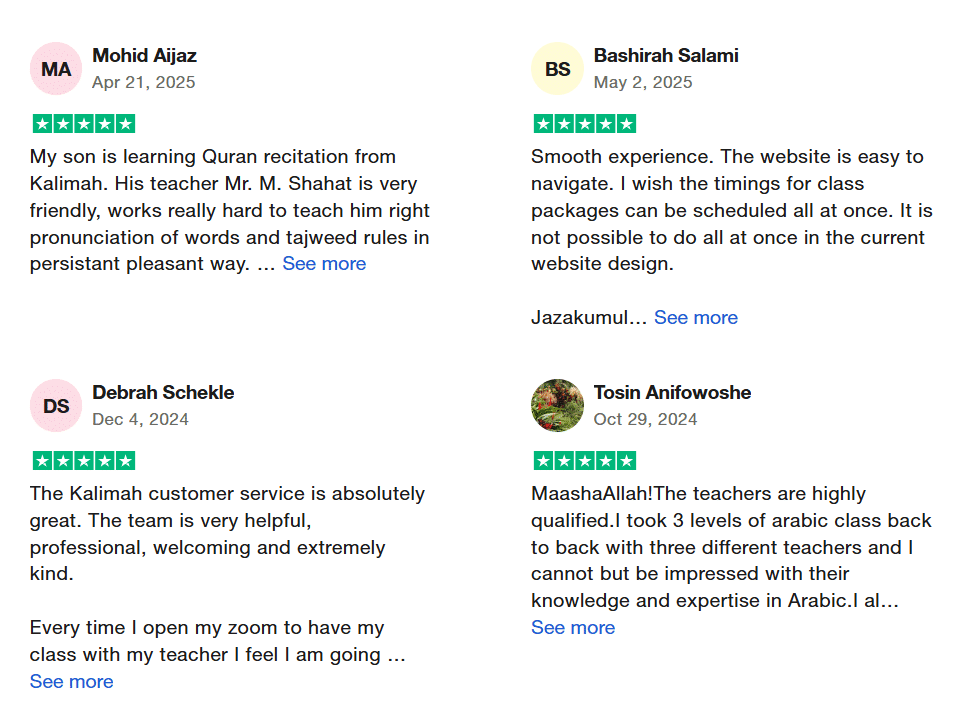
Here Are The Reviews On Our Courses:
Our students frequently commend the excellence of our courses and the commitment shown by our instructors. You can read their complete reviews on Trustpilot.
Read more reviews on Trustpilot
🚀 Start Your Free Trial Today! 🚀
Don’t miss out on this life-changing opportunity to deepen your faith and knowledge. Sign up now for your free trial and take the first step towards becoming a better practicing Muslim with Kalimah Center!
Master Arabic with Kalimah Center
Join our expert-led online classes and start your journey toward Arabic fluency today.
Book Your Free TrialConclusion
So — is Preply good for learning Arabic? The honest answer is: it depends on what you mean by “learning Arabic.”
For flexible conversation practice, dialect exposure, or occasional one-on-one sessions with a native speaker, Preply works. The pricing is accessible, the tutor variety is wide, and the trial lesson system lets you test the fit before committing.
But Preply’s core disadvantages — no standardized curriculum, uneven tutor quality, missing Arabic vocabulary tools, and no structured progress tracking — make it a poor foundation if your goal is genuine Arabic fluency.
You can spend months on Preply and get better at chatting in Egyptian Arabic without ever understanding why sentences are structured the way they are.
That gap is exactly where specialist instruction matters. Kalimah Center’s approach is built around structured Arabic acquisition — the kind that produces readers, writers, and confident speakers, not just conversation partners. If you want to learn Arabic online with a real system behind you, that’s where to start.
Frequently Asked Questions
Below are answers to the questions Arabic learners most commonly ask about Preply — covering pricing, quality, and how it compares to dedicated academies.
Is Preply good for learning Arabic as a complete beginner?
Preply can work for beginners, but only if you find a tutor who follows a structured lesson plan and explicitly teaches script, pronunciation, and grammar in sequence — not just conversation. Without a built-in curriculum, beginners often progress slowly or inconsistently. A dedicated Arabic program gives beginners a clearer path.
What is the disadvantage of Preply for Arabic learners?
The main disadvantages of Preply for Arabic learners are: no standardized curriculum, uneven tutor quality, no Arabic vocabulary tools in the mobile app, no community or forum features, and no built-in progress tracking. Finding a consistently strong tutor takes time and multiple trial lessons.
How much does Preply cost for Arabic lessons?
Preply Arabic tutors charge between $3 and $20+ per hour depending on their experience, qualifications, and region. Tutors from Arab countries tend to charge lower rates. Most offer discounted trial lessons. Regular weekly lessons can add up quickly compared to structured course-based programs.
Is Preply better than italki for Arabic?
Both are general tutoring marketplaces, so the comparison is close. Preply has a more advanced virtual classroom (whiteboard, file sharing, screen sharing). italki has a slightly larger tutor base for Arabic. Neither offers a structured Arabic curriculum — that’s the key limitation both share, and the reason specialist academies like Kalimah Center offer a fundamentally different experience.
Can I learn a specific Arabic dialect on Preply?
Yes. Preply’s search filters let you find tutors who specialize in Egyptian, Levantine, Gulf, Moroccan, or other dialects, as well as Modern Standard Arabic. This dialect flexibility is one of Preply’s genuine strengths for learners with a specific regional focus.
How do I find a good Arabic tutor on Preply?
Filter by dialect and price, then read written student reviews carefully — not just the star rating. Watch the tutor’s intro video to assess their teaching style and clarity. Book a trial lesson and ask: “What will our first ten sessions cover?” A tutor with a clear answer has a teaching plan. A tutor without one is improvising.