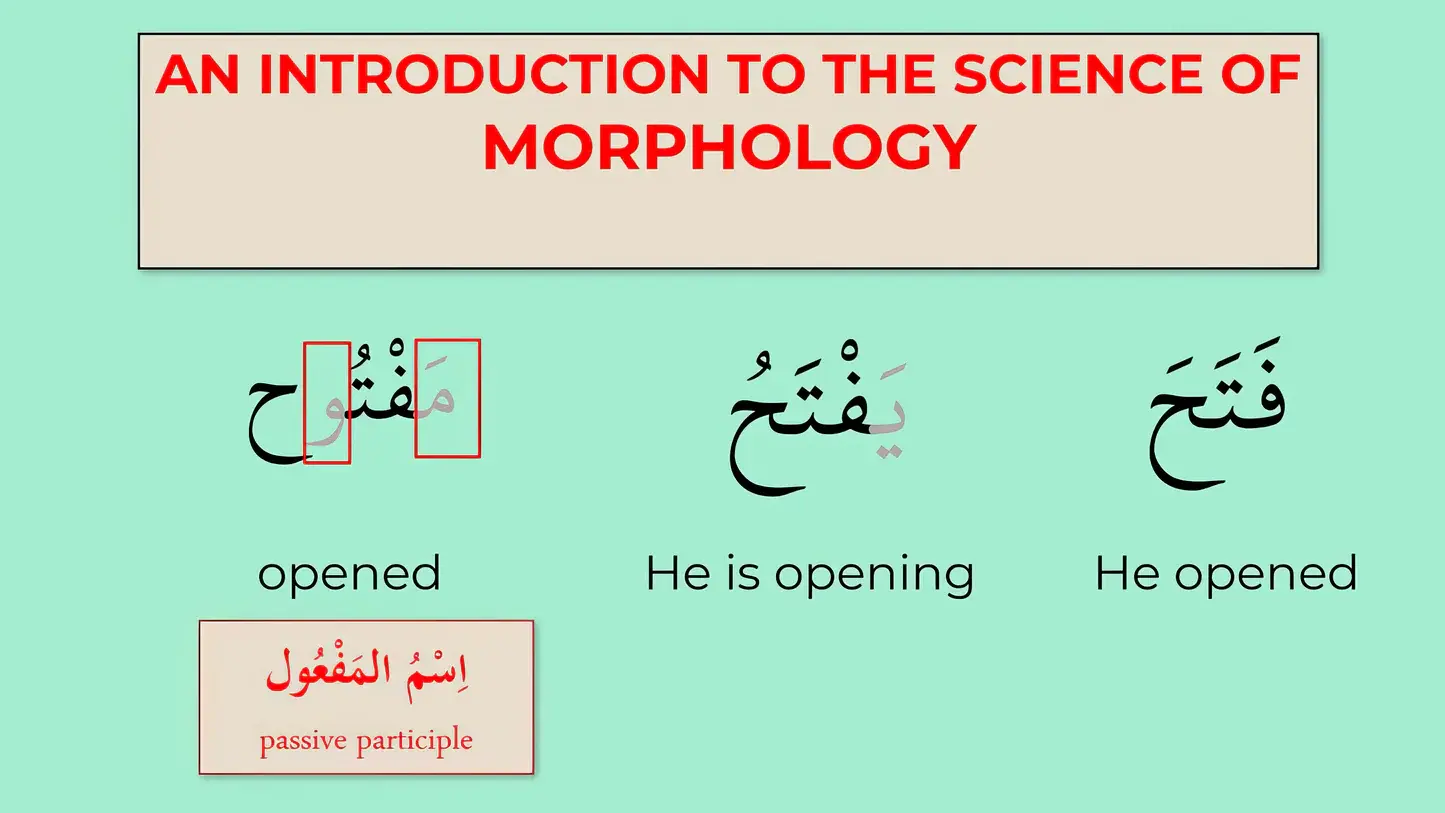
Have you ever wondered why “كَتَبَ” (he wrote) and “مَكْتُوب” (written) share the same three letters but mean different things? The answer lies in arabic morphology, the branch of Arabic linguistics that explains how words change shape to create new meanings.
If you’re learning Quranic Arabic or trying to read classical texts, understanding this system isn’t optional homework, it’s the key that unlocks the entire language.
Arabic morphology for beginners can feel intimidating at first, with its scales, patterns, and grammatical terms. But once you grasp the core logic, you’ll start recognizing word patterns everywhere you look.
What You’ll Learn in This Article
| 1 | What Arabic morphology (sarf) actually studies, and what it doesn’t. |
| 2 | How the morphological scale (الميزان الصرفي) works to identify root letters. |
| 3 | The difference between bare (مجرد) and augmented (مزيد) words. |
| 4 | How derivation (الاشتقاق) builds new words — from active participles to instrumental forms. |
| 5 | Practical resources to move from theory to real application. |
What Is Arabic Morphology (Sarf)?
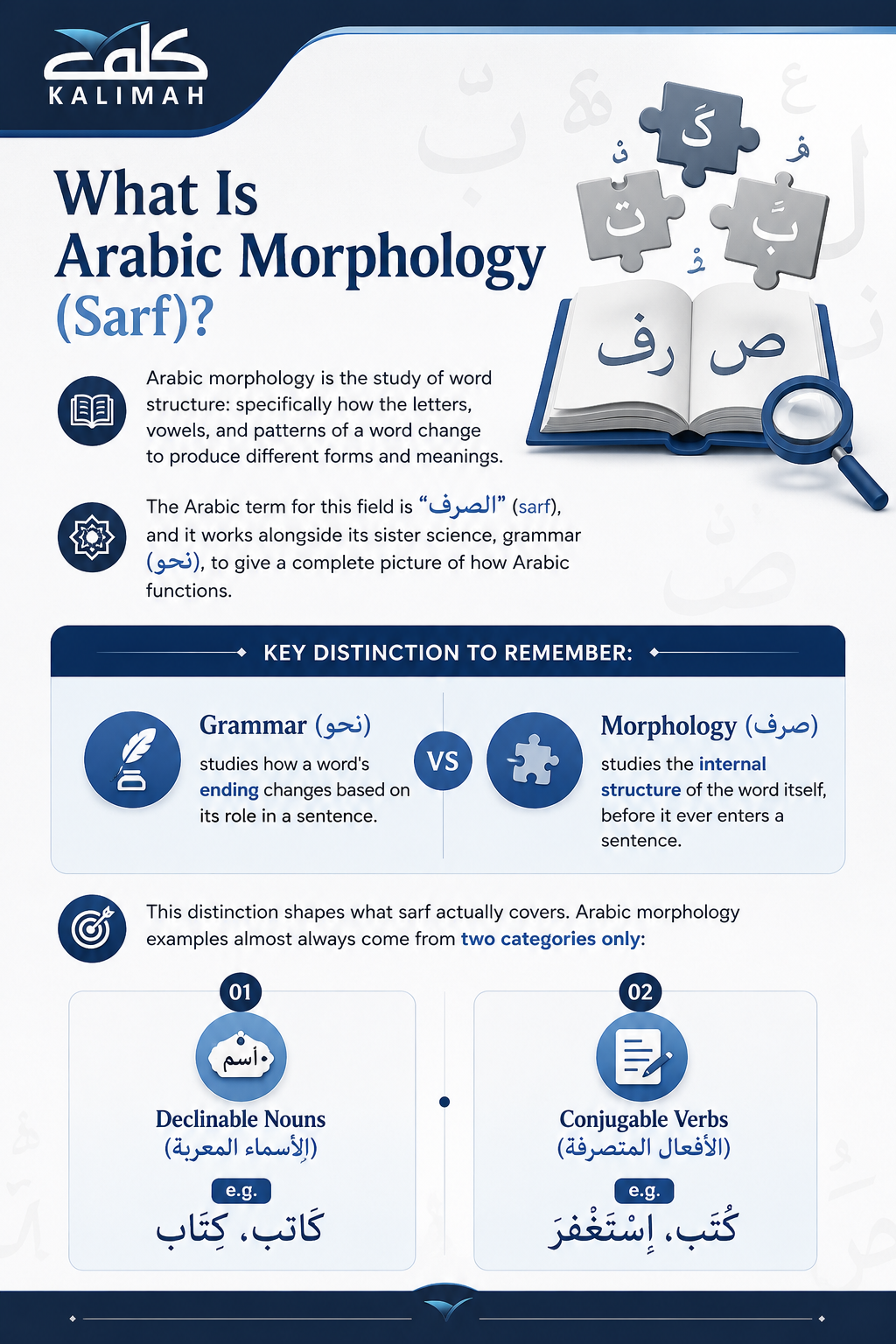
Arabic morphology is the study of word structure: specifically how the letters, vowels, and patterns of a word change to produce different forms and meanings.
The Arabic term for this field is “الصرف” (sarf), and it works alongside its sister science, grammar (نحو), to give a complete picture of how Arabic functions.
Key distinction to remember:
- Grammar (نحو) studies how a word’s ending changes based on its role in a sentence.
- Morphology (صرف) studies the internal structure of the word itself, before it ever enters a sentence.
This distinction shapes what sarf actually covers. Arabic morphology examples almost always come from two categories only:
- Declinable nouns (الأسماء المعربة) — e.g. كاتب، كتاب
- Conjugable verbs (الأفعال المتصرفة) — e.g. كتب، استغفر
What Is Not Studied in Sarf?
Not every Arabic word falls under the study of morphology. Some words remain fixed regardless of context, so morphological analysis does not apply to them.
The following categories are generally excluded:
| Included in Sarf | Excluded from Sarf |
| Declinable nouns (زيد، كتاب) | Particles (في، هل، لم) |
| Conjugable verbs (كتب، يستغفر) | Indeclinable nouns (هذا، الذي، أنا) |
| Words that change form for new meanings | Frozen verbs (عسى، ليس، نِعْمَ) |
Why Are Frozen Words Excluded?
The reasoning is practical: particles, indeclinable nouns, and frozen verbs never change their form regardless of meaning or context, so there’s nothing for morphology to analyze.
A frozen verb like “عسى” always looks the same whether it’s expressing hope in the past, present, or future, because its meaning doesn’t shift with time the way a regular verb does.
The Morphological Scale: Your Roadmap to Word Roots
The Morphological Scale (الميزان الصرفي) is the main tool used in Arabic morphology to identify a word’s root letters and distinguish them from any added letters.
Once you understand the scale, it becomes much easier to analyze Arabic words, recognize patterns, and understand how meanings develop from a single root.
What Is the Morphological Scale?
The morphological scale is a standard pattern that uses the letters ف – ع – ل as placeholders for the root letters of a word.
When you compare a word to this scale, each root letter takes the position of one of these three letters:
- ف represents the first root letter.
- ع represents the second root letter.
- ل represents the third root letter.
This system allows learners to quickly identify the structure of a word and understand how it was formed.
How Does the Morphological Scale Work?
The process is simple. You match each root letter of a word to its corresponding position on the scale.
For example:
| Word | Pattern |
| ضَرَبَ | فَعَلَ |
| كَتَبَ | فَعَلَ |
| سَمِعَ | فَعِلَ |
In the word ضَرَبَ, the letter ض corresponds to ف, and ر corresponds to ع, and ب corresponds to ل, producing the pattern فَعَلَ.
Using the Scale with Longer Words
The importance of the morphological scale becomes clearer when analyzing words that contain more than three letters.
The scale helps determine whether additional letters belong to the original root or were added later to create a new meaning or grammatical form.
| Word Type | Scale Pattern | Example |
| Three-letter root | فَعَلَ | كَتَبَ |
| Four-letter root | فَعْلَلَ | دَحْرَجَ |
| Root with added letters | اِسْتَفْعَلَ | اِسْتَغْفَرَ |
By comparing the word to the scale, you can immediately see which letters belong to the root and which letters were added.
Identifying Added Letters in a Word
Many Arabic words contain extra letters that modify the meaning without changing the original root.
For example, the word اِسْتَغْفَرَ consists of six letters, but its root is only: غ – ف – ر
The letters: ا – س – ت
were added to the beginning of the word. As a result, the pattern becomes: اِسْتَفْعَلَ
The scale mirrors the exact structure of the word, making added letters easy to identify.
A Simple Trick for Finding the Root
A practical way to identify a root is to remove the letters that seem extra and look for the core meaning that remains.
If the remaining three or four letters still carry the basic meaning of the word, you have most likely found the root.
This skill becomes extremely valuable when studying Arabic morphology, understanding Quranic vocabulary, and recognizing related words that share the same linguistic origin.
Bare and Augmented Forms
Every Arabic noun or verb belongs to one of two categories: bare (مُجَرَّد) or augmented (مَزِيد). The difference depends on whether all the letters in the word are original root letters or whether additional letters have been added to the root.
Understanding this distinction makes it easier to analyze Arabic words, recognize patterns, and understand how meanings develop from a single root.

What Is a Bare Word المجرد)؟)
A bare word contains only the original root letters. If you remove any letter from the word, the root structure and its core meaning are lost.
Arabic morphology classifies bare words into two main types:
| Bare Type | Number of Original Letters | Example |
| Three-letter root (الثلاثي المجرد) | 3 letters | فَهِمَ |
| Four-letter root (الرباعي المجرد) | 4 letters | زَلْزَلَ |
In these examples, every letter is part of the original root, so no letter can be removed without changing the identity of the word.
Read also about: Arabic Language Basics
Experience Kalimah Center Classes
Watch real excerpts from our live sessions at Kalimah Center and see how we bring learning to life. These clips highlight our interactive, student-centered teaching approach across all our courses—designed to keep learners engaged, motivated, and actively involved every step of the way.
Master Arabic with Kalimah Center
Join our expert-led online classes and start your journey toward Arabic fluency today.
Book Your Free TrialWhat Is an Augmented Word المزيد)؟)
Augmented words add one or more letters to the root, altering its pattern to form a new word. These extra letters often introduce a new meaning, emphasis, or grammatical function.
The root remains the foundation of the word, while the added letters modify how that meaning is expressed.
| Augmented Type | Letters Added | Example | Root |
| Augmented by one letter | 1 | أَكْرَمَ | ك ر م |
| Augmented by two letters | 2 | تَعَلَّمَ | ع ل م |
By identifying the root first, learners can easily see which letters were added and understand how the word was developed.
Read also: The Imperative In Arabic – A Complete Guide With To Forms and Usages Examples
Why Are Augmented Forms Important?
Added letters are not random. In Arabic, they often carry specific meanings that help learners understand the function of a word before even looking it up.
For example, certain augmented patterns frequently indicate:
- Causing an action to happen.
- Requesting or seeking something.
- Participation between two people.
- Repetition or intensity of an action.
As learners become familiar with these patterns, they start recognizing meaning clues directly from the structure of the word.
How to Identify Whether a Word Is Bare or Augmented
The easiest method is to look for the root letters first. If all the letters belong to the root, the word is bare. If extra letters appear around the root, the word is augmented.
A simple comparison makes this clear:
| Word | Root | Type |
| فَهِمَ | ف ه م | Bare |
| أَفْهَمَ | ف ه م | Augmented |
| عَلِمَ | ع ل م | Bare |
| تَعَلَّمَ | ع ل م | Augmented |
This skill is one of the foundations of Arabic morphology because it helps learners connect related words, expand vocabulary faster, and understand how Arabic builds multiple meanings from a single root.
Derivation in Arabic Morphology: How One Root Creates Many Words
Derivation (الاشتقاق) generates a family of related words by expanding a single root. It is one of the most important concepts in Arabic morphology because it explains how Arabic builds a large vocabulary from a relatively small number of roots.
Once you understand derivation, you can recognize connections between words and often predict their meanings even if you have never seen them before.
Learn more about our: online Arabic grammar course
What Is Derivation (الاشتقاق)?
Derivation means taking a root word and forming new words that remain connected to the original meaning while serving different grammatical functions.
For example, the root:
ك ت ب
carries the general meaning of writing. From this single root, Arabic creates many related words that revolve around the same core idea.
Examples of Derived Words from One Root
The root ك ت ب produces a complete family of words, each with a specific meaning and function.
| Derivation Type | Arabic Term | Example | Meaning |
| Active Participle | اسم الفاعل | كَاتِب | Writer |
| Passive Participle | اسم المفعول | مَكْتُوب | Written |
| Place or Time Noun | اسم الزمان والمكان | مَكْتَب | Office or place of writing |
| Instrument Noun | اسم الآلة | مِفْتَاح | Key or tool used for opening |
Although these words serve different purposes, they are all linked through a common root and a shared semantic connection.
How Patterns Help You Predict Meaning
One of the strengths of Arabic morphology is that its patterns are highly systematic.
When learners recognize both the root and the pattern, they can often infer the meaning of a new word without memorizing it first.
For example:
| Pattern | Example | Expected Meaning |
| فَاعِل | كَاتِب | The doer of the action |
| مَفْعُول | مَكْتُوب | The receiver of the action |
| مِفْعَال / مِفْعَل | مِفْتَاح | A tool used for the action |
If you already know that ك ت ب relates to writing and you recognize the pattern فَاعِل, it becomes easy to understand that كَاتِب means “writer.”
Why Is Derivation Important for Learning Arabic?
Derivation helps learners expand their vocabulary much faster because they no longer study every word as a completely separate item.
Instead, they learn a root and then recognize dozens of related words built from it. This approach improves reading comprehension and makes unfamiliar vocabulary easier to understand.
For example, when you know the root ع ل م relates to knowledge, you can quickly connect words such as:
- عَلِمَ (he knew)
- عَالِم (scholar)
- مَعْلُوم (known)
- تَعْلِيم (education)
- تَعَلُّم (learning)
Rather than memorizing each word independently, you understand them as members of the same word family.
The Role of Derivation in Quranic Arabic
Derivation is especially valuable for students of Quranic Arabic because the Quran frequently uses groups of words that share the same root.
When you recognize these root families, you begin to see connections between verses and understand vocabulary more efficiently. Learning one root often unlocks the meanings of several related words, making Quran study deeper and more rewarding.
Moving from Theory to Practice
Reading about arabic morphology for beginners is a useful first step, but sarf is fundamentally a skill built through repetition, not a body of facts memorized once.
The scale, the bare/augmented distinction, and the derivation patterns all become intuitive only after you’ve applied them to dozens, then hundreds, of real words.
A few resources worth keeping nearby:
- “التطبيق الصرفي” (Morphological Application) by Abduh Al-Rajihi — structured drills for testing scale skills
- “الصرف الصغير” by Sulaiman Al-Uyouni — a condensed overview for quick review
- Simplified guides covering the branches of sarf in more depth, to bridge the gap between this overview and full textbook study
Self-study through books has a real limitation, though: there’s no one to catch your mistakes in real time or answer the “why does this pattern work this way” questions that inevitably come up.
Inside Kalimah Center: Moments from Our Courses
Get a glimpse into the vibrant learning experience at Kalimah Center. These snapshots capture real moments from our live classes—where students engage deeply, connect with passionate instructors, and grow in a welcoming, supportive environment.
Here Are The Reviews On Our Courses:
Our students frequently commend the excellence of our courses and the commitment shown by our instructors. You can read their complete reviews on Trustpilot.
Read more reviews on Trustpilot

Read also: Arabic Root Letters: The System Behind Every Arabic Word
Master Arabic Morphology for Beginners — Fast, Clear, and Practical
Arabic morphology for beginners is your fast track to understanding how Arabic words are built and to reading with confidence; at Kalimah Centre we teach it through bite‑size lessons, interactive drills, and one‑to‑one coaching so you apply rules immediately to reading, grammar, and Quran recitation.
Courses at Kalimah
Get structured one‑to‑one lessons that make real improvement feel natural.
At Kalimah we combine clear pedagogy, certified teachers, and interactive tools so adults and children progress confidently — whether your goal is fluent Arabic, correct Quran recitation, or both.
1. Online Arabic Course (Adults)
A progressive 16‑level Arabic courses (400+ hours) of personalised one‑to‑one classes. Each level builds practical grammar and reading skills using interactive whiteboards, targeted exercises, and tutor corrections so you can read, speak, and comprehend Arabic with confidence.
2. Online Quran with Tajweed
Designed for non‑Arabic speakers, this 13‑level course teaches correct Quran reading and tajweed from basics to advanced recitation.
Quran courses Taught by Ijazah‑certified instructors, lessons focus on accurate articulation, gradual memorization pathways, and a respectful, spiritually focused classroom atmosphere.
3. Online Arabic for Kids
A fun, curriculum‑based series across 24 levels (primary to secondary) with teachers trained in child pedagogy.
Online Arabic For Kids Sessions use interactive activities and age‑appropriate pacing to build strong foundations and a lasting love of Arabic.
Watch our class video and try a free lesson
See how lessons look live — click the video to experience Kalimah’s teaching style, then book your free trial lesson to test the method with your own teacher.
Chapter 1:Acquaintance lesson 1-4
Master Arabic with Kalimah Center
Join our expert-led online classes and start your journey toward Arabic fluency today.
Book Your Free TrialFrequently Asked Questions
What is the difference between sarf and nahw in Arabic?
Sarf (morphology) studies the internal structure of a single word, including its root letters, patterns, and how it changes to create new meanings.
Nahw (grammar) studies how a word’s ending changes based on its grammatical role within a sentence. Sarf deals with the word in isolation; nahw deals with the word in context.
Why doesn’t Arabic morphology study particles like “في” or “هل”?
Particles, frozen verbs, and indeclinable nouns never change their structural form regardless of meaning or context, so there’s no internal variation for morphology to analyze.
Sarf only applies to words capable of structural change: declinable nouns and conjugable verbs.
How does the morphological pattern (الميزان الصرفي) reveal a word’s root letters?
The scale uses the template ف ع ل to map onto any word, showing which letters correspond to original root positions and which were added.
By comparing a word against this template, you can separate the core meaning-bearing letters from grammatical additions.
What is the easiest way to start learning Arabic morphology as a beginner?
Start by mastering the three-letter root scale and practicing with simple bare verbs before moving to augmented forms.
Pairing this with guided instruction, rather than self-study alone, helps you catch errors early and builds intuition faster than memorization.