When someone dies, it’s hard to know what to say. For centuries, Arabic sayings about death have helped people find the right words. Some come from the Quran. Others come from the Prophet ﷺ, his Companions, old poets, or simple folk proverbs.
You might be here because a friend just lost someone. You might need a few words for a card, or a dua to say at a funeral. Or you might just be curious about how Muslims think about death.
Each saying below comes in Arabic, with a simple way to say it and what it means. You’ll also see where it comes from. That matters more than you’d think, because a lot of “Arabic” quotes online aren’t Arabic at all.
Arabic Sayings About Death From the Quran
The Quran is the first and strongest source of Arabic sayings about death. Muslims believe it is the word of Allah. Its verses teach two things: death comes to all, and Allah comforts those left behind.
A quick note on how to read the sounds. They are written in plain English letters. An apostrophe (‘) means a small stop in the throat. “Dh” sounds like “th” in “this,” and “kh” sounds like a soft throat-clearing.
Quran Verses That Say Death Comes to Everyone
The Quran talks about death many times, and it never softens the truth. These four verses make it clear that no one, rich or poor, young or old, can escape it.
| Arabic | Pronunciation | Meaning | Source |
| كُلُّ نَفْسٍ ذَائِقَةُ الْمَوْتِ | Kullu nafsin dha’iqatul-mawt | Every soul will taste death. | Quran 3:185 |
| إِنَّكَ مَيِّتٌ وَإِنَّهُم مَّيِّتُونَ | Innaka mayyitun wa innahum mayyitun | You will die, and they will die too. | Quran 39:30 |
| أَيْنَمَا تَكُونُوا يُدْرِككُّمُ الْمَوْتُ | Aynama takunu yudrikkumul-mawt | Death will find you wherever you are. | Quran 4:78 |
| قُلْ إِنَّ الْمَوْتَ الَّذِي تَفِرُّونَ مِنْهُ فَإِنَّهُ مُلَاقِيكُمْ | Qul innal-mawtal-ladhi tafirruna minhu fa-innahu mulaqikum | Say: the death you run from will meet you. | Quran 62:8 |
- The first verse is the best-known line about death in Islam. It uses the word “taste.” That word tells you each person will feel death for themselves. No one can take your turn.
- The second verse speaks to the Prophet ﷺ. That is a big detail. If the most loved man in Islam would die, then nobody is left out.
- The third verse goes on to say “even if you were in high towers.” Money cannot stop death. Guards cannot stop it. Strong walls cannot push it back by one minute.
- The fourth verse shows a strange truth. People try to run from death. But the verse says death is not behind them. It is waiting ahead, on the very road they are running down.
Together, these verses give one clear message. Death is not bad luck. It is a promise Allah made to every living soul.
Notice that none of these verses tell you when or how you will die. Allah keeps that hidden. Scholars say this is a mercy. If you knew your date, you might waste every year before it.
Quran Verses That Bring Comfort After a Loss
Allah doesn’t only remind us that death is coming. He also speaks to the people left behind, and these verses are some of the gentlest words a grieving heart can hear.
| Arabic | Pronunciation | Meaning | Source |
| وَلَنَبْلُوَنَّكُم بِشَيْءٍ مِّنَ الْخَوْفِ وَالْجُوعِ وَنَقْصٍ مِّنَ الْأَمْوَالِ وَالْأَنفُسِ | Wa lanabluwannakum bi-shay’in minal-khawfi wal-ju’i wa naqsin minal-amwali wal-anfus | We will test you with some fear, hunger, and loss of money and lives. | Quran 2:155 |
| أُولَٰئِكَ عَلَيْهِمْ صَلَوَاتٌ مِّن رَّبِّهِمْ وَرَحْمَةٌ | Ula’ika ‘alayhim salawatun min rabbihim wa rahmah | Those people get blessings and mercy from their Lord. | Quran 2:157 |
| يَا أَيَّتُهَا النَّفْسُ الْمُطْمَئِنَّةُ ارْجِعِي إِلَىٰ رَبِّكِ رَاضِيَةً مَّرْضِيَّةً | Ya ayyatuhan-nafsul-mutma’innah, irji’i ila rabbiki radiyatan mardiyyah | O calm soul, go back to your Lord, happy and pleasing to Him. | Quran 89:27-28 |
- The first verse calls the loss of lives a test. This helps a lot when you are grieving. Your pain does not mean Allah has left you. He told you about this test long before it came.
- The second verse is the promise that comes after. It is for people who stay patient when loss hits. They get blessings and mercy straight from their Lord.
- The third verse is often read at funerals. It speaks to the soul of a good believer at the end. The soul is not dragged away in fear. It is invited home, calm and welcome.
Many families hold on to this verse. It turns a funeral from an ending into a return.
These verses do not ask you to stop feeling sad. Sadness and patience can live in the same heart. Patience means you keep trusting Allah while the tears still fall.
If these verses touch your heart, you will like Kalimah Center’s collection of Quran quotes in Arabic and English. It shares more verses on patience, hope, and trust in Allah.
Hadith About Death: What the Prophet ﷺ Said
Hadith are the words of the Prophet ﷺ, written down by the people who heard him. They come second after the Quran. His words about death are practical. They show you how to think about death on a normal day, not only at a funeral.
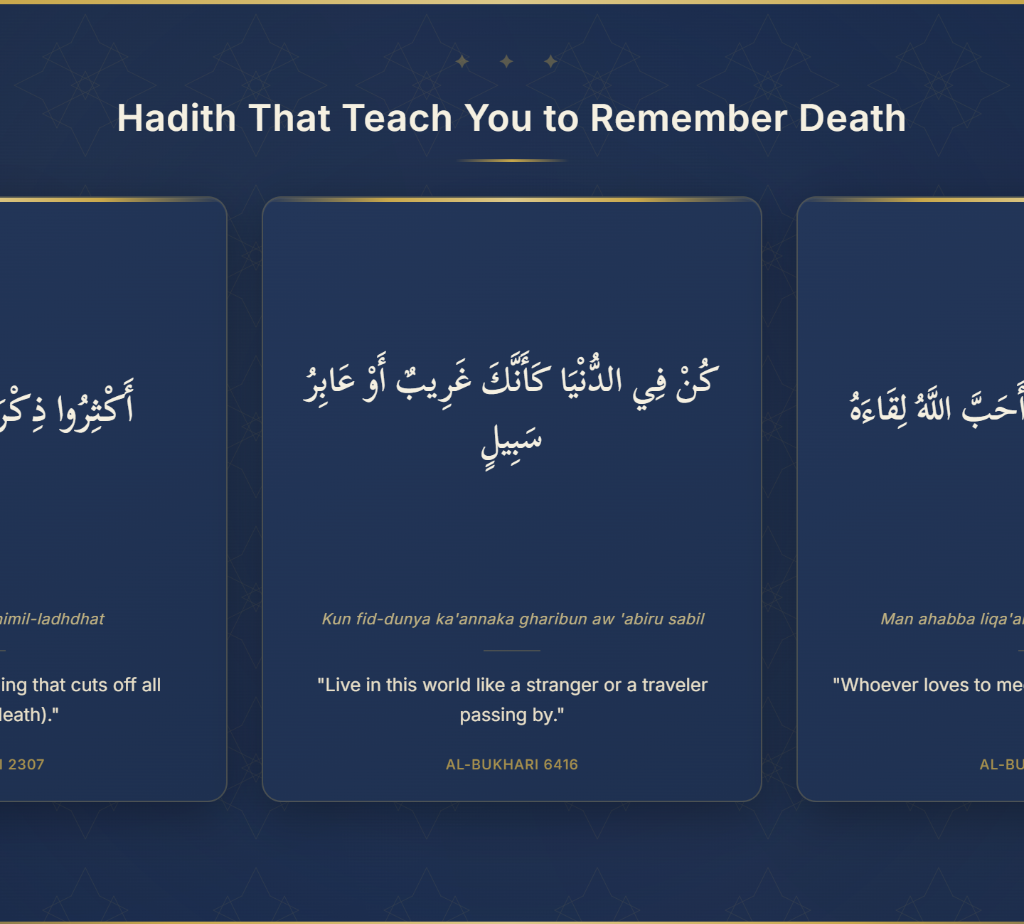
Hadith That Teach You to Remember Death
The Prophet ﷺ didn’t want people to think about death only at funerals. He taught his Companions to keep it in mind on ordinary days, because it changes how you live.
| Arabic | Pronunciation | Meaning | Source |
| أَكْثِرُوا ذِكْرَ هَاذِمِ اللَّذَّاتِ | Akthiru dhikra hadhimil-ladhdhat | Remember often the thing that cuts off all pleasures (death). | at-Tirmidhi 2307 |
| كُنْ فِي الدُّنْيَا كَأَنَّكَ غَرِيبٌ أَوْ عَابِرُ سَبِيلٍ | Kun fid-dunya ka’annaka gharibun aw ‘abiru sabil | Live in this world like a stranger or a traveler passing by. | al-Bukhari 6416 |
| مَنْ أَحَبَّ لِقَاءَ اللَّهِ أَحَبَّ اللَّهُ لِقَاءَهُ | Man ahabba liqa’allahi ahabbal-lahu liqa’ah | Whoever loves to meet Allah, Allah loves to meet him. | al-Bukhari 6507 |
Look closely at the spelling in the first hadith. Scholars say the right word is هاذم, with the letter dhal. It means “the one that cuts off.” Many websites write هادم, with dal, which means “the one that knocks down.” The meaning shifts a little, so the spelling matters.
The second hadith comes with a sweet scene. The Prophet ﷺ held young Abdullah ibn Umar by the shoulder as he said it. Ibn Umar never forgot. Years later, he told people: in the evening, don’t wait for morning, and in the morning, don’t wait for evening.
Think about how a traveler lives. He packs light. He does not build a palace at a rest stop. That is the picture the Prophet ﷺ wanted you to carry.
The third hadith is full of hope. When a good believer is dying, he is shown good news. So he wants to meet Allah. And Allah wants to meet him too.
These three hadith work as a team. The first tells you to remember death. The second tells you how to live. The third tells you how it can end.
Hadith About Crying and Hard Days
The Prophet ﷺ knew loss firsthand, and he buried several of his own children. His words below speak to anyone who is hurting and wondering how a believer should grieve.
| Arabic | Pronunciation | Meaning | Source |
| إِنَّ الْعَيْنَ تَدْمَعُ وَالْقَلْبَ يَحْزَنُ وَلَا نَقُولُ إِلَّا مَا يَرْضَى رَبُّنَا | Innal-‘ayna tadma’u wal-qalba yahzanu wa la naqulu illa ma yarda rabbuna | The eye cries and the heart is sad, but we only say what pleases our Lord. | al-Bukhari 1303 |
| لَا يَتَمَنَّيَنَّ أَحَدُكُمُ الْمَوْتَ لِضُرٍّ نَزَلَ بِهِ | La yatamannayanna ahadukumul-mawta li-durrin nazala bih | None of you should wish to die because of a hardship. | al-Bukhari 5671, Muslim 2680 |
The first hadith came on one of the saddest days of the Prophet’s ﷺ life. His baby son Ibrahim had just died. Tears ran down his face. A Companion was surprised to see him cry.
So the Prophet ﷺ explained. Tears are mercy, not weakness. What is wrong is screaming, tearing clothes, or words that complain about Allah’s choice.
This gives every grieving Muslim a gift. You are allowed to cry. You do not have to act strong to prove your faith. In some families, men still feel shame if they cry at a funeral. This hadith shows the opposite. The best man who ever lived cried openly, in front of his Companions.
The second hadith is for very dark days. Some people in deep pain wish they could die. The Prophet ﷺ said no to that wish.
He taught a better prayer in its place: “O Allah, keep me alive as long as life is good for me, and take me when death is good for me.” It hands the choice back to Allah, who knows best.
Read also: Arabic Sayings about Friendship
Sayings of the Sahaba and Early Scholars About Death
After the Quran and hadith come the words of the Sahaba, the Prophet’s ﷺ Companions. Then come the early scholars, called the Salaf. Their words are not holy texts. But they are wise, tested by real life, and kept in old Islamic books like al-Ghazali’s Ihya Ulum al-Din.
What the Sahaba Said About Death
The Sahaba learned about death straight from the Prophet ﷺ, and many of them faced it with calm and courage. Their words are short, but each one carries a lesson they lived by.
| Arabic | Pronunciation | Meaning | Who Said It |
| كَفَى بِالْمَوْتِ وَاعِظًا | Kafa bil-mawti wa’iza | Death is enough to teach you a lesson. | Abu ad-Darda |
| إِذَا ذَكَرْتَ الْمَوْتَى فَعُدَّ نَفْسَكَ أَحَدَهُمْ | Idha dhakartal-mawta fa-‘udda nafsaka ahadahum | When you think of the dead, count yourself as one of them. | Abu ad-Darda |
| كُلُّ امْرِئٍ مُصَبَّحٌ فِي أَهْلِهِ وَالْمَوْتُ أَدْنَى مِنْ شِرَاكِ نَعْلِهِ | Kullum-ri’in musabbahun fi ahlihi, wal-mawtu adna min shiraki na’lih | Each man wakes up with his family, but death is closer than his sandal strap. | Said by Abu Bakr, al-Bukhari 3926 |
| مَرْحَبًا بِالْمَوْتِ، زَائِرٌ مُغِبٌّ | Marhaban bil-mawt, za’irun mughibb | Welcome, death, a guest I waited for. | Mu’adh ibn Jabal |
The sandal-strap line has a story. Abu Bakr did not write it. It is a line of old poetry. He said it while he lay sick with a high fever, soon after moving to Madinah. His daughter Aisha heard it and reported it in al-Bukhari.
Mu’adh ibn Jabal spoke his line on his deathbed. He was not scared. He said he had feared Allah all his life, and now, at the end, he had hope in Him. Abu ad-Darda was known as one of the wisest Companions. When a funeral passed by, he would say: “Go in the morning, for we will follow in the evening.”
His two sayings in the table are short and sharp. The second one asks you to do something real. Next time you hear of a death, picture your own name in its place.
Aisha also gave advice about death. A woman told her that her heart felt hard. Aisha told her to think about death often. The woman tried it. Her heart turned soft again, and she came back to say thank you.
What Early Muslim Scholars Said About Death
The scholars who came after the Sahaba spent their lives studying the Quran and the Prophet’s ﷺ teachings. When they spoke about death, they turned that knowledge into plain advice you can use today.
| Arabic | Pronunciation | Meaning | Who Said It |
| فَضَحَ الْمَوْتُ الدُّنْيَا فَلَمْ يَتْرُكْ لِذِي لُبٍّ فَرَحًا | Fadahal-mawtud-dunya fa-lam yatruk li-dhi lubbin farahan | Death showed the truth about this world, so a wise person is not fooled by it. | al-Hasan al-Basri |
| مَنْ عَرَفَ الْمَوْتَ هَانَتْ عَلَيْهِ مَصَائِبُ الدُّنْيَا | Man ‘arafal-mawta hanat ‘alayhi masa’ibud-dunya | If you truly know death, life’s problems feel small. | al-Hasan al-Basri |
| كُلُّ عَمَلٍ كَرِهْتَ الْمَوْتَ مِنْ أَجْلِهِ فَاتْرُكْهُ | Kullu ‘amalin karihtal-mawta min ajlihi fatruk-hu | Leave any habit that makes you afraid to die. | Abu Hazim |
| إِضَاعَةُ الْوَقْتِ أَشَدُّ مِنَ الْمَوْتِ | Ida’atul-waqti ashaddu minal-mawt | Wasting time is worse than death. | Ibn al-Qayyim |
Abu Hazim’s saying works like a quick test. Ask yourself: would I be ashamed to die while doing this? If the answer is yes, drop that habit. He said that once you do this, it won’t matter when death comes.
Ibn al-Qayyim gave a clear reason for his words. Death only cuts you off from this world. Wasted time cuts you off from Allah and the next life. So the second loss is bigger.
Al-Hasan al-Basri lived through hard times in Basra. His sayings are about seeing life as it really is. Once you understand death, a lost job or a bad day stops feeling like the end of the world.
Umar ibn Abdul-Aziz, the fair caliph, noticed a double effect. If your life is hard, thinking of death makes it lighter. If your life is easy, it keeps you humble.
These lines sound strong in English. In Arabic, they rhyme and hit even harder. Kalimah Center’s online Quran and Arabic course can teach you to read words like these on your own, with a native teacher guiding each step.

Inside Kalimah Center: Moments from Our Courses
Get a glimpse into the vibrant learning experience at Kalimah Center. These snapshots capture real moments from our live classes—where students engage deeply, connect with passionate instructors, and grow in a welcoming, supportive environment.
Master Arabic with Kalimah Center
Join our expert-led online classes and start your journey toward Arabic fluency today.
Book Your Free TrialRead also: Arabic Sayings About Family
Short Arabic Sayings About Death: Old Proverbs
Short Arabic sayings about death often come as proverbs. A proverb is a short saying that parents pass to their kids. Proverbs are not part of Islam’s holy texts. They are the wisdom of everyday people. And many proverbs you see online are not Arabic at all.
Real Arabic Proverbs About Death
These are proverbs Arabs have used for generations, and you’ll still hear them in homes and markets today. Each one packs a big idea about death into just a few words.
| Arabic | Pronunciation | Meaning |
| الْمَوْتُ حَقٌّ | Al-mawtu haqq | Death is true and sure to come. |
| رُبَّ مَوْتٍ كَالْحَيَاةِ | Rubba mawtin kal-hayah | Some deaths are like life. |
| اسْتِقْبَالُ الْمَوْتِ خَيْرٌ مِنِ اسْتِدْبَارِهِ | Istiqbalul-mawti khayrun min istidbarih | Facing death is better than running from it. |
| الْجَهْلُ مَوْتُ الْأَحْيَاءِ | Al-jahlu mawtul-ahya’ | Not knowing is death for the living. |
“Al-mawtu haqq” is heard in almost every Arab home after a death. People say it softly to each other. It is a way to accept the news without a long speech.
“Some deaths are like life” is about a good name. Picture a person who died with honor. Or someone who left behind knowledge that still helps people. Their body is gone, but their good work keeps them alive in people’s hearts.
“Facing death is better than running from it” is about courage. Old Arabs said it before battles. Today, people use it to mean: face hard facts instead of hiding.
The last proverb uses death in a new way. A person who refuses to learn is alive in body. But their mind has stopped growing, and the proverb calls that a kind of death. It is often said to push young people to study.
Notice how short these proverbs are. Most are only two to four words in Arabic. That is why people remember them so easily, even small children.
Famous Sayings That Are Not Really Arabic
Some of the most shared “Arabic sayings” about death were born in other languages. Here are five you’ve likely seen, and where each one really comes from.
| Saying (as shared in Arabic) | Meaning | Where It Really Comes From |
| يموت الحصان ويبقى سرجه، ينتهي الإنسان ويبقى اسمه | The horse dies and its saddle stays; a man dies and his name stays. | Turkish proverb |
| ليس الموت وراء الجبال، بل وراء الأكتاف | Death is not behind the mountains, but right behind your shoulders. | Russian proverb |
| يجعلنا الموت نتساوى في القبر وليس في الأبدية | Death makes us equal in the grave, not forever after. | Portuguese proverb |
| الحياة حلم يوقظنا منه الموت | Life is a dream, and death wakes us up. | Persian proverb |
| يموت الجبناء مرات عديدة قبل أن يأتي أجلهم | Cowards die many times before they really die. | Shakespeare, Julius Caesar |
These sayings fill Arabic quote pages. Even the Arabic quote site Wikiquote lists them by their real country. Yet many English articles still call them “Arabic sayings.”
How did they end up there? Many were translated into Arabic in old books and newspapers. Over time, people forgot where they came from and shared them as local wisdom. That does not make them bad sayings. Many teach the same lesson Islam teaches.
Does it matter? Sometimes, yes. Posting a Turkish proverb on social media does no harm. But using one in a Friday talk or a school paper as “Islamic wisdom” gives people wrong facts.
Some sites go even further. They say these lines came from the Prophet ﷺ. That is a serious mistake in Islam. The fix is easy. Enjoy these sayings for what they are. Just call them by their real names: a Turkish proverb, a Russian proverb, a line from Shakespeare.
Arabic Poems About Death From Classic Poets
Old Arabic poetry is full of lines about death. Many lines people quote today come from poets who lived over 1,000 years ago. Most people repeat them without knowing who wrote them.
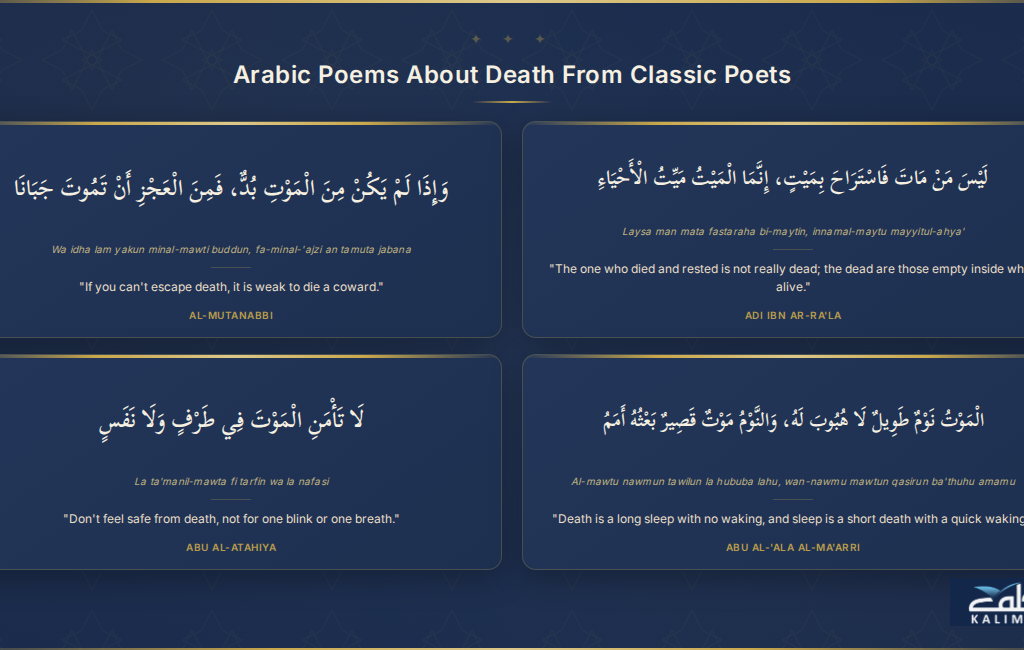
Famous Lines and the Poets Behind Them
Arab poets wrote about death with courage, sadness, and sometimes a hard truth. Below are four lines still quoted today, along with the poet who wrote each one.
| Arabic | Pronunciation | Meaning | Poet |
| وَإِذَا لَمْ يَكُنْ مِنَ الْمَوْتِ بُدٌّ، فَمِنَ الْعَجْزِ أَنْ تَمُوتَ جَبَانَا | Wa idha lam yakun minal-mawti buddun, fa-minal-‘ajzi an tamuta jabana | If you can’t escape death, it is weak to die a coward. | al-Mutanabbi |
| لَيْسَ مَنْ مَاتَ فَاسْتَرَاحَ بِمَيْتٍ، إِنَّمَا الْمَيْتُ مَيِّتُ الْأَحْيَاءِ | Laysa man mata fastaraha bi-maytin, innamal-maytu mayyitul-ahya’ | The one who died and rested is not really dead; the dead are those empty inside while alive. | Adi ibn ar-Ra’la |
| لَا تَأْمَنِ الْمَوْتَ فِي طَرْفٍ وَلَا نَفَسٍ | La ta’manil-mawta fi tarfin wa la nafasi | Don’t feel safe from death, not for one blink or one breath. | Abu al-Atahiya |
| الْمَوْتُ نَوْمٌ طَوِيلٌ لَا هُبُوبَ لَهُ، وَالنَّوْمُ مَوْتٌ قَصِيرٌ بَعْثُهُ أَمَمُ | Al-mawtu nawmun tawilun la hububa lahu, wan-nawmu mawtun qasirun ba’thuhu amamu | Death is a long sleep with no waking, and sleep is a short death with a quick waking. | Abu al-‘Ala al-Ma’arri |
- Al-Mutanabbi was the most famous poet of his day. His line is about courage. Death will come anyway, he says, so why live in fear? People still quote it in speeches.
- Adi ibn ar-Ra’la’s line is often shared after a death. It turns the focus to the living. The person who died is at rest. The real worry is for people who are alive but empty inside.
- Abu al-Atahiya wrote many poems about how short life is. His line is a warning. Guards and walls give no safety, because death can come in a blink.
- Al-Ma’arri used a simple picture a child can understand. Every night, sleep gives us a tiny taste of death. Every morning, waking up is a small return.
Arabic even has a name for poems of mourning. They are called ritha’. The most famous ritha’ poet was al-Khansa, a woman who wrote about her lost brothers. She later became a Muslim and met the Prophet ﷺ.
A Famous Line Most People Quote Wrong
One line about death is shared millions of times. It goes: ومن لم يمت بالسيف مات بغيره، تعددت الأسباب والموت واحد. It means: “Whoever does not die by the sword dies by something else. The causes are many, but death is one.” Most people say al-Mutanabbi wrote it. He did not. The real poet is Ibn Nubata as-Sa’di.
There is a second mistake too. The poet’s own words end differently: تنوعت الأسباب والداء واحد (tanawwa’atil-asbabu wad-da’u wahidu). That means “the causes vary, but the illness is one.” Over the years, people swapped “the illness” for “death.” It still rhymed, so hardly anyone noticed.
How does this happen? For hundreds of years, poems spread by memory. Small changes crept in. Then a famous name got stuck to a famous line. So if you love a line of poetry, check the poet’s own book, called a diwan. A quote website is not enough.
Arabic Sayings About Death of a Loved One: What to Say
Arabic sayings about death of a loved one have a special job. They comfort people who are hurting right now. Some come from the Quran and hadith. Others are customs that grew in different Arab countries.
Words to Say When You Hear Someone Died
The moment you hear sad news, Islam gives you words ready to say. You don’t have to search for them, and both phrases below take only a few seconds.
| Arabic | Pronunciation | Meaning | Source |
| إِنَّا لِلَّهِ وَإِنَّا إِلَيْهِ رَاجِعُونَ | Inna lillahi wa inna ilayhi raji’un | We belong to Allah, and to Him we will return. | Quran 2:156 |
| رَحِمَهُ اللَّهُ / رَحِمَهَا اللَّهُ | Rahimahullah / Rahimahallah | May Allah have mercy on him / on her. | Common Muslim saying |
The first words a Muslim says after hearing of a death come from the Quran. This verse sits right between the two comfort verses you saw earlier. Allah praises the people who say it when loss strikes.
Listen to what the words really mean. Everything you love belongs to Allah. He lent it to you for a while. Now He has taken it back, and one day you will go back to Him too.
The second phrase is a short prayer for the person who died. Say rahimahullah for a man and rahimahallah for a woman.
Many Muslims use it in place of “RIP.” The reason is simple. “RIP” is only a wish. Rahimahullah is a real prayer to Allah, and it can help the person who passed away.
Want more phrases like these? Kalimah Center’s guide to Muslim words and their meanings explains the everyday Islamic phrases you hear at home, at the mosque, and at funerals.
Words to Say to the Grieving Family
Visiting a family after a death can feel awkward, especially when you’re afraid of saying the wrong thing. These three phrases are simple, kind, and used by Muslims all over the world.
| Arabic | Pronunciation | Meaning | Source |
| إِنَّ لِلَّهِ مَا أَخَذَ وَلَهُ مَا أَعْطَى، وَكُلُّ شَيْءٍ عِنْدَهُ بِأَجَلٍ مُسَمًّى | Inna lillahi ma akhadha wa lahu ma a’ta, wa kullu shay’in ‘indahu bi-ajalin musamma | What Allah took is His, what He gave is His, and everything has a set time with Him. | al-Bukhari 1284 |
| أَعْظَمَ اللَّهُ أَجْرَكَ وَأَحْسَنَ عَزَاءَكَ وَغَفَرَ لِمَيِّتِكَ | A’zamallahu ajrak, wa ahsana ‘aza’ak, wa ghafara li-mayyitik | May Allah give you a great reward, good comfort, and forgive your loved one. | Advised by scholars like an-Nawawi |
| الْبَقَاءُ لِلَّهِ | Al-baqa’u lillah | Only Allah lasts forever. | Custom in Egypt and the Levant |
- The first phrase is the best one you can say. It comes from the Prophet ﷺ. His daughter’s young child was dying, and she sent for him. He sent back this message and added: “So be patient and hope for reward” (Sahih al-Bukhari 1284).
- The second phrase packs a full prayer into one breath. It asks for three things: reward for the family, comfort for their hearts, and forgiveness for the one who died. Imam an-Nawawi recommended it in his book al-Adhkar.
- The third phrase is heard in Egypt, Syria, Lebanon, and nearby lands. It is a custom, not a hadith. It reminds everyone that people pass, but Allah stays.
When should you visit? Many scholars say the first three days are best. But if you were away, you can still come later. Kind words are welcome at any time.
Don’t worry if your Arabic is weak. You can say these phrases in English, and the family will still feel your care. Short and sincere is always better than long and stiff.
How the Family Replies and Other Ways to Help
Comfort goes both ways, and the family usually answers your kind words with a short prayer of their own. Here are the two replies you’ll hear most often.
| Arabic | Pronunciation | Meaning |
| جَزَاكَ اللَّهُ خَيْرًا | Jazakallahu khayran | May Allah reward you with good. |
| شَكَرَ اللَّهُ سَعْيَكَ | Shakarallahu sa’yak | May Allah thank you for coming. |
When you comfort a family, they will often reply with one of these two phrases. Neither is fixed by hadith. They are kind customs that show thanks. When you thank a woman, the endings change: say jazakillahu khayran and shakarallahu sa’yik. If you are the one grieving, you do not need perfect words. A nod is fine. A quiet “jazakallahu khayran” is enough. People understand.
Words are not the only way to help. When news came that Ja’far ibn Abi Talib was killed, the Prophet ﷺ told people to cook food for his family. He said grief had left them too busy to cook (Sunan Abi Dawud 3132).
This is still a beautiful habit today. Bring a meal. Watch the kids for an hour. Sit quietly with the family. Small acts often mean more than long speeches.
In many Arab countries, the family also holds a gathering called the ‘aza’. People come, sit for a short time, listen to Quran, and leave. Keep your visit short, so the family can rest.
Islamic Quotes for Death of a Loved One: Duas for the Person Who Passed
Islamic quotes for death of a loved one are very often duas. A dua is a prayer, in your own words or in words the Prophet ﷺ taught. Some duas are for the one who died. Others are for you, the one left behind.
Duas to Say for the Person Who Died
The best gift you can give someone who has died is your prayer. Each dua below fits a different moment, from the funeral prayer to a quiet visit to the grave.
| Arabic | Pronunciation | Meaning | When to Say It |
| اللَّهُمَّ اغْفِرْ لَهُ وَارْحَمْهُ وَعَافِهِ وَاعْفُ عَنْهُ | Allahummaghfir lahu warhamhu wa ‘afihi wa’fu ‘anh | O Allah, forgive him, have mercy on him, keep him safe, and pardon him. | Funeral prayer, Muslim 963 |
| اللَّهُمَّ اغْفِرْ لِـ[الاسم] وَارْفَعْ دَرَجَتَهُ فِي الْمَهْدِيِّينَ | Allahummaghfir li-[name] warfa’ darajatahu fil-mahdiyyin | O Allah, forgive [name] and raise his level among the rightly guided. | Right after death, Muslim 920 |
| اسْتَغْفِرُوا لِأَخِيكُمْ وَسَلُوا لَهُ التَّثْبِيتَ | Istaghfiru li-akhikum wa salu lahut-tathbit | Ask forgiveness for your brother, and ask Allah to keep him firm. | After burial, Abu Dawud 3221 |
| السَّلَامُ عَلَيْكُمْ أَهْلَ الدِّيَارِ مِنَ الْمُؤْمِنِينَ وَالْمُسْلِمِينَ، وَإِنَّا إِنْ شَاءَ اللَّهُ بِكُمْ لَلَاحِقُونَ | As-salamu ‘alaykum ahlad-diyari minal-mu’minina wal-muslimin, wa inna in sha’allahu bikum lalahiqun | Peace be on you, believers who rest here. We will join you, if Allah wills. | Visiting graves, Muslim 975 |
For a woman, change the end sounds. Say: Allahummaghfir laha warhamha wa ‘afiha wa’fu ‘anha (Sahih Muslim 963). Many people read the male form for a woman by mistake. It is one of the most common slips at funerals.
The second dua was first said for Abu Salamah, a close friend of the Prophet ﷺ (Sahih Muslim 920). You can put any name in the blank. That makes the dua personal and warm.
The third one comes with a moving scene. After a burial, the Prophet ﷺ stood by the grave. He told the people to pray for their brother, because he was being questioned at that very moment (Sunan Abi Dawud 3221).
You can also pray for your loved one in the quiet of the night. Kalimah Center’s guide to the Tahajjud dua shares prayers from those late hours, a special time for duas.
A child’s prayer is especially powerful. The Prophet ﷺ said that a good child who prays for a parent is one of three things that keep helping a person after death (Sahih Muslim 1631).
A Dua for You When You Lose Someone
Grief can leave you so tired that even praying feels hard. When that happens, one short dua is enough to start with.
| Arabic | Pronunciation | Meaning | Source |
| اللَّهُمَّ أْجُرْنِي فِي مُصِيبَتِي وَأَخْلِفْ لِي خَيْرًا مِنْهَا | Allahumma’jurni fi musibati wa akhlif li khayran minha | O Allah, reward me in my loss and give me something better after it. | Muslim 918 |
This dua is for the person who is grieving. The Prophet ﷺ taught it. You say it right after inna lillahi wa inna ilayhi raji’un.
Its story is one of the most touching in this whole guide. Umm Salamah lost her husband, Abu Salamah. She loved him very much. She remembered this dua and said it, but a question stayed in her heart: who could be better than Abu Salamah?
Then Allah answered. The Prophet ﷺ asked to marry her. She said later that Allah truly gave her someone better. Her story shows how this dua works. You do not need to feel hopeful when you say it. You only need to say it. The hope can come later.
You may also pray in your own language. Allah understands every tongue. Still, many people feel extra peace in the exact words the Prophet ﷺ used.
Many learners at Kalimah Center say the best part of studying was finally understanding the duas they had said for years. You can read their stories in Kalimah Center’s student reviews on Trustpilot, where the academy holds a TrustScore of 4.5 out of 5.

Arabic Words for Death and What They Mean
Arabic has many words for death, and each has its own feeling. Knowing them helps you understand every saying in this guide.
- Mawt (موت) is the everyday word. You will see it in most verses and proverbs.
- Wafat (وفاة) is the polite word used in death notices. It comes from a root that means “paid in full.” The idea is that the soul goes back to Allah, complete.
- Ajal (أجل) means the set time of a life. Muslims believe no one dies one second before or after their ajal.
- Maniyya (منيّة) and radā (ردى) are older words. You will mostly find them in poems.
Old Arabs even gave death colors. “Red death” meant being killed. “White death” meant dying in bed. “Black death” meant dying from being choked.
How to Pick the Right Arabic Saying About Death
You now have dozens of Arabic sayings about death to choose from. The last step is choosing well, because a beautiful line at the wrong time can hurt instead of heal. Follow these six steps before you share any saying.
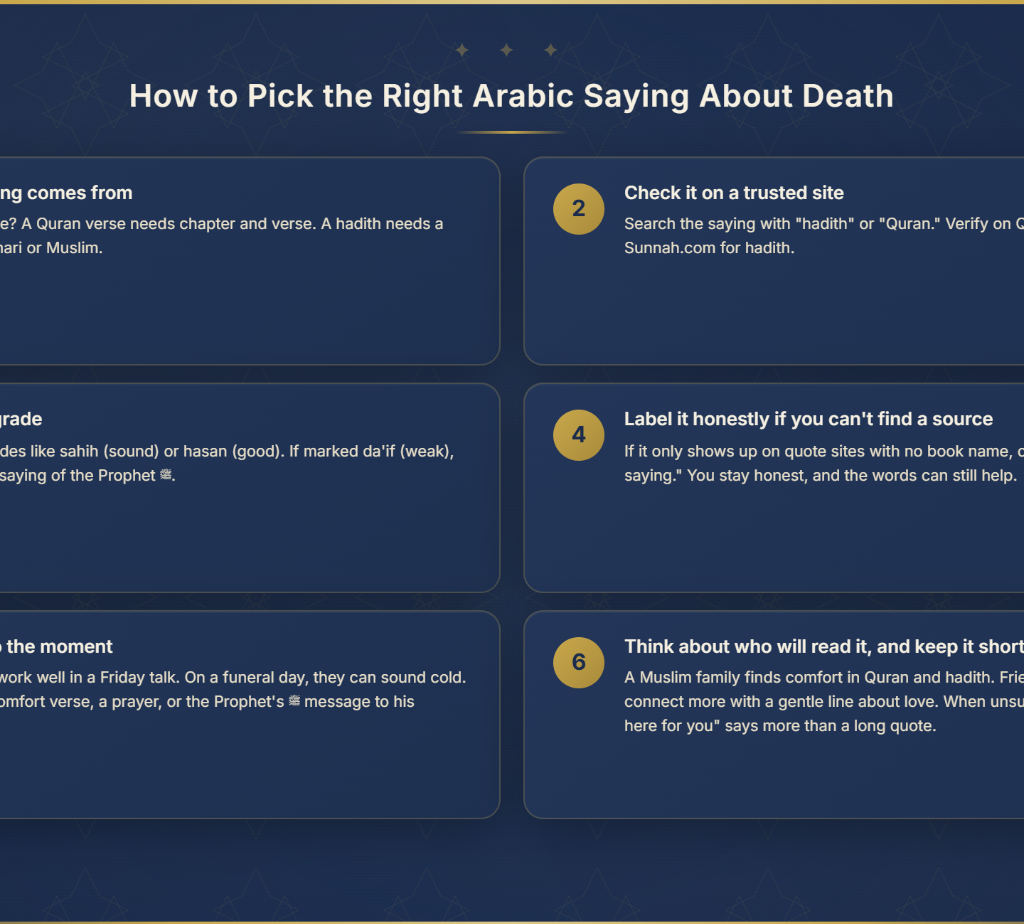
- Find where the saying comes from. Ask yourself: can I name its source? A Quran verse should have a chapter and verse number. A hadith should have a book name, like al-Bukhari or Muslim.
- Check it on a trusted site. Search the saying with the word “hadith” or “Quran.” Then look it up on Quran.com for verses or Sunnah.com for hadith.
- Look at the hadith grade. Sunnah.com shows a grade for each hadith, like sahih (sound) or hasan (good). If a hadith is marked da’if (weak), don’t share it as a sure saying of the Prophet ﷺ. In Islam, saying he said something he never said is a serious sin, far worse than a typing error.
- Label it honestly if you can’t find a source. If the line only shows up on quote sites with no book name, call it “a proverb” or “a wise saying.” You stay honest, and the words can still help.
- Match the saying to the moment. Warning-style sayings work well in a Friday talk or a note to yourself, because they push you to fix your habits. On the day of a funeral, though, they can sound cold to a crying mother. That day, choose soft words: a comfort verse, a prayer for the one who died, or the Prophet’s ﷺ message to his daughter.
- Think about who will read it, and keep it short. A Muslim family will feel the most comfort from the Quran and hadith. Friends from other faiths may connect more with a gentle line about love and a good name. When you’re not sure, a simple “Rahimahullah, I’m here for you” often says more than a long quote.
Watch a real lesson before you book
Not sure what online Arabic classes look like? This short clip gives you a feel for our teaching style and how each class is built around the student.
Master Arabic with Kalimah Center
Join our expert-led online classes and start your journey toward Arabic fluency today.
Book Your Free TrialStart Reading These Sayings in Arabic With Kalimah Center Today
A translation gives you the meaning. Arabic gives you the full feeling. You hear the rhyme. You catch the small word endings. You notice when a famous poem has been changed.
Kalimah Center helps you get there, step by step. Here is why students choose it:
- It has years of real teaching behind it. Kalimah Center started in mid-2011 as an institute teaching Arabic to foreigners in Egypt, and had taught 7,000 students by 2017. In 2018, it took that same method online for learners worldwide.
- Every teacher speaks Arabic as a first language. Each tutor is a native Arabic speaker and holds a recognized teaching certification.
- You can pick a male or a female teacher. The academy keeps a full team of certified female tutors for Quran, Tajweed, Hifz, and Arabic.
- You learn one-on-one, live, from home. Classes are for adults, children, and families, with flexible times and no travel.
- The books are made for you. Kalimah Center wrote its own curriculum for learners whose first language is not Arabic.
- You can see your progress. Students get a certificate after each program level.
- Your first class is free. You can try a lesson, see how they teach, and check your level with no commitment.
Book your free trial class today, and read your first Quran verse about death in Arabic, with full understanding.

Explore Our Courses:
- Online Arabic Course: Tailored to your level, our comprehensive Arabic program includes 16 teaching levels and 400+ hours of personalized sessions.
- Online Quran With Tajweed Course: Perfect for non-Arabic speakers, our course spans 13 levels and equips you with Tajweed mastery from beginner to advanced.
- Online Arabic Course For Kids: Nurture your child’s love for Arabic with our engaging and structured program, available in 24 levels for primary, intermediate, and secondary stages.
Conclusion
Arabic sayings about death come from many places, and each place has its own weight. The Quran tells you death comes to every soul. It also promises blessings and mercy to anyone who stays patient through loss.
The hadith bring that message into daily life. They ask you to remember death often, to live like a traveler, and to never wish for death in hard times. They also give you a gentle gift: permission to cry when someone you love is gone.
The Sahaba and early scholars turn those lessons into simple habits. Abu Hazim’s test is worth keeping in your pocket: drop any habit that would make you ashamed to die. Ibn al-Qayyim adds a warning about time, which may be the easiest thing in life to waste.
Proverbs and poems bring the voice of ordinary people and great poets. They are beautiful, but they also hold the most mistakes. Some “Arabic” proverbs are really Turkish, Russian, or Persian. And the best-known line about death is often given to the wrong poet, with its last word changed.
When someone you love dies, start with the words of revelation. Say inna lillahi wa inna ilayhi raji’un. Pray for the person who passed. Tell the family that what Allah took is His. Then help in small, real ways, like a warm meal or an hour of quiet company.
Last of all, check the source of any Arabic saying about death before you share it. Fit it to the moment, and think of the person who will read it. When you do that, a few short words can carry real comfort to someone who needs it most.
FAQs
People often have questions about Arabic sayings about death and how to use them well. Here are short, clear answers to the ones asked most.
What Is a Short Arabic Saying About Death?
A short Arabic saying about death is “Kullu nafsin dha’iqatul-mawt” (كل نفس ذائقة الموت), meaning “Every soul will taste death.” It comes from Quran 3:185.
What Do Muslims Say When Someone Dies?
Muslims say “Inna lillahi wa inna ilayhi raji’un,” which means “We belong to Allah, and to Him we will return.” Then they say “rahimahullah” for a man or “rahimahallah” for a woman.
What Is the Best Islamic Quote for the Death of a Loved One?
The best Islamic quote for the death of a loved one is the Prophet’s ﷺ message: “What Allah took is His, and what He gave is His.” It is found in Sahih al-Bukhari 1284.
What Dua Do You Say for Someone Who Has Died?
The main dua for someone who has died is “Allahummaghfir lahu warhamhu wa ‘afihi wa’fu ‘anh.” It means “O Allah, forgive him, have mercy on him, keep him safe, and pardon him,” and it comes from the funeral prayer in Sahih Muslim.
Is It Okay to Cry When Someone Dies in Islam?
Yes, crying when someone dies is allowed in Islam. The Prophet ﷺ cried when his son Ibrahim died, but screaming and words that complain about Allah’s choice are not allowed.
What Do You Say Back When Someone Gives You Condolences?
You can reply with “Jazakallahu khayran,” which means “May Allah reward you with good.” Another common reply is “Shakarallahu sa’yak,” meaning “May Allah thank you for coming.”
Is “The Horse Dies and Its Saddle Remains” an Arabic Saying?
No, “the horse dies and its saddle remains” is a Turkish proverb. It became popular in Arabic, but Arabic quote collections list it as Turkish.
Who Wrote “Whoever Does Not Die by the Sword Dies by Something Else”?
The line “whoever does not die by the sword dies by something else” was written by Ibn Nubata as-Sa’di, not al-Mutanabbi. Its original ending is “the illness is one,” not “death is one.”