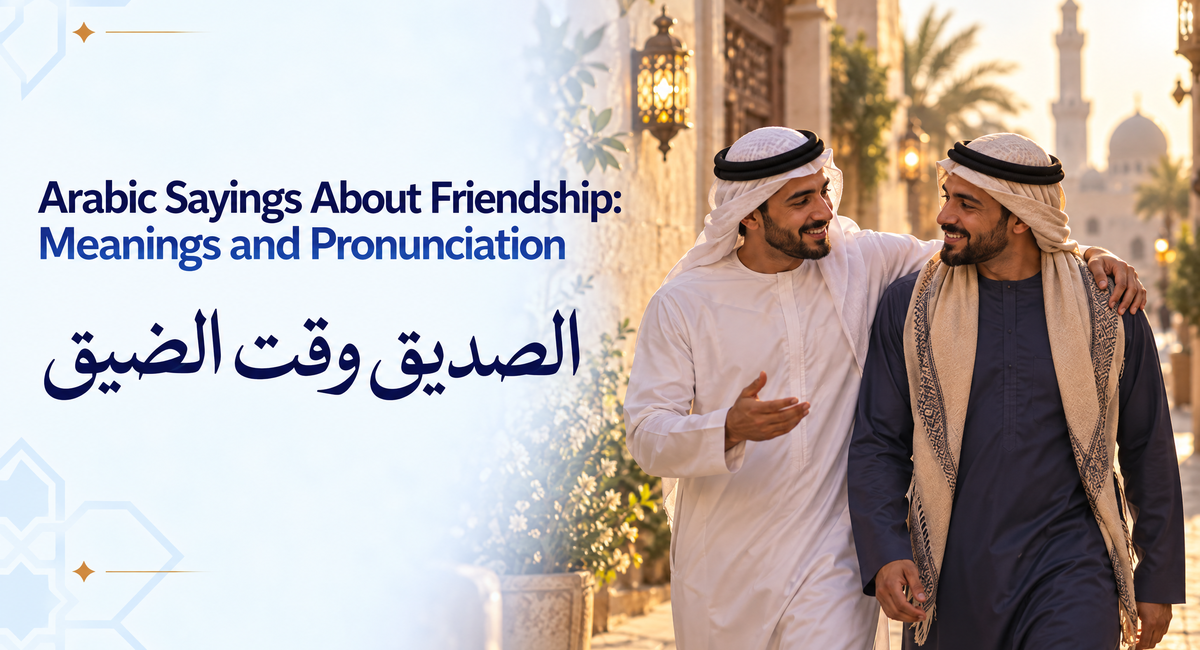
Ask anyone who grew up in an Arab home what a true friend is, and you’ll probably hear “as-sadeeq waqt ad-deeq.” It’s one of the oldest Arabic sayings about friendship, and it means a real friend is the one who shows up when life gets hard. Arabic has many lines like it, short enough to remember after one listen.
We’ve gathered the best ones here and sorted them by theme: loyalty, good advice, and the funny ones people still laugh at over tea. For each saying, you’ll get the Arabic, a simple way to say it, and what it really means in English. We also tell you where it comes from, because some “old Arabic proverbs” online are really modern quotes or translations.
Along the way, you’ll hear the stories behind lines from Imam Ali, Imam al-Shafi’i, and al-Mutanabbi, the poet many Arabs call the greatest of them all.
a. Arabic Sayings About Friendship On Loyalty And Trust
These sayings answer one question: how do you know a friend is real? Each one gives a different test. Every saying comes with a “say it” line, and you’ll find a step-by-step pronunciation guide after the sayings.

1. A Real Friend Shows Up In Hard Times
If you learn only one Arabic saying about friendship, make it this one. You’ll hear it at weddings, at funerals, and in almost every story about a friend who didn’t walk away.
الصديق وقت الضيق
as-sadeeq waqt ad-deeq
A real friend is there when times are hard.
Old proverb
It’s close to the English line “a friend in need is a friend indeed.” The word deeq means a tight, narrow place. So the saying paints a picture: life squeezes you, and your friend steps in. And it’s easy to remember, because sadeeq and deeq rhyme.
You’ll also hear people say:
عند الشدائد تُعرف الإخوان
‘inda ash-shadaa’id tu’raf al-ikhwaan
Hard times show you who your real brothers are.
Old proverb
There’s an old line of poetry on the same idea, usually credited to Ali ibn Abi Talib, the Prophet’s cousin:
فما أكثر الإخوان حين تعدهم … ولكنهم في النائبات قليل
fa-maa akthara al-ikhwaana heena ta’udduhum, wa laakinnahum fin-naa’ibaati qaleel
Count your friends and you’ll think you have plenty. Then something goes wrong, and you find out how few there really are.
Classic poem (credited to Imam Ali)
Lots of sayings have been credited to Ali over the years, so it’s safer to say “credited to” than “written by.” If a friend stayed with you through a rough patch, this is the saying to send them.
2. A True Friend Tells You The Truth
Some friends make you feel good. This old proverb is about the friend who makes you better, even when the truth is hard to hear.
صديقك مَن صَدَقَك، لا مَن صَدَّقَك
sadeequka man sadaqaka, laa man saddaqaka
Your friend is the one who is honest with you, not the one who agrees with everything you say.
Old proverb
This saying is a small word game. Look at the last two words. They have the same letters, and the only change is a tiny mark called a shadda (ّ), which doubles a letter.
Sadaqaka means “he told you the truth.” Saddaqaka means “he believed you.” So the proverb says a real friend will tell you the hard truth, while a weak friend just nods along.
Picture a friend who tells you your plan has a big hole in it. That might sting today. But that friend just saved you from a bad tomorrow.
Write this saying without the shadda, and the whole point is gone. Small marks like this are where many learners slip. In the Online Arabic Course at Kalimah Center, native tutors check your reading and writing in every one-on-one lesson, so you learn to spot these marks early, before bad habits set in.
3. A Friend Can Be Closer Than A Brother
Not every brother is born into your family. Arabs have an old line for the friend who becomes one anyway.
رُبَّ أخٍ لك لم تلده أمك
rubba akhin laka lam talidhu ummuk
You may have a brother your mother never gave birth to.
Old proverb
The first word, rubba, means “many a.” It tells you this happens more often than you might think. Arabic often talks about friends in family words. In many Arab homes, a close friend is called “my brother” or “my sister.” That friend sits with the family at weddings, helps out at funerals, and visits on Eid. The title isn’t just a sweet word. It’s a real place in the family.
There’s also a version for women: رُبَّ أختٍ لكِ لم تلدها أمكِ (rubba ukhtin laki lam talidhaa ummuki). It means “you may have a sister your mother never gave birth to.”
This saying works beautifully in a birthday card or a wedding speech for a friend who feels like family. It’s warm, it’s short, and it’s easy to explain to people who don’t speak Arabic.
4. A True Friend Protects You When You Are Not There
Being a good friend is easy when you’re in the same room. This saying, linked to Imam Ali, tests what a friend does when you’re gone.
لا يكون الصديق صديقًا حتى يحفظ أخاه في ثلاث: في نكبته، وغيبته، ووفاته
laa yakoonu as-sadeequ sadeeqan hattaa yahfaza akhaahu fee thalaath: fee nakbatihi, wa ghaybatihi, wa wafaatihi
A friend is not a true friend until he looks after his brother at three times: in his hard times, when he is away, and after he dies.
Classic saying (linked to Imam Ali)
This line appears in Nahj al-Balagha, a well-known book of sayings linked to Ali ibn Abi Talib. It gives you three tests, and each one is harder than the last.
The first test is hard times: a true friend stands by you when things go wrong. The second is when you’re away: a true friend defends your name when others gossip, even though you’ll never hear about it. The third is after you die: a true friend prays for you, checks on your family, and keeps your memory kind.
That last test is the one that gets people. In many Arab families, an old friend of a father who has passed away still visits his children on Eid, years later. Use this saying to thank a friend who stood up for you behind your back.
Read also: Arabic Sayings About Family
A quick look at learning with us
See how a live class works, from the teacher’s explanation to the student’s recitation. It’s a simple way to know what to expect before your first lesson.
Master Arabic with Kalimah Center
Join our expert-led online classes and start your journey toward Arabic fluency today.
Book Your Free Trialb. Arabic Sayings About Friendship On Choosing Friends Wisely
The sayings in this group are advice. They tell you how to pick friends, how to treat them, and how to keep a friendship safe.

5. Pick Your Friend Before You Start The Trip
Long before road trips and plane tickets, the people you traveled with could decide whether you made it home. This old proverb comes straight out of that world.
الرفيق قبل الطريق
Ar-rafeeq qabl at-tareeq
Choose your travel partner before you set out.
Old proverb
Arabs once crossed long, dry roads in groups called caravans. A bad travel partner could waste your water, slow you down, or even leave you behind. So picking the right partner came first. The road came second.
The word rafeeq means a friend who walks the road with you, which is why it fits here better than sadeeq. You’ll see a newer version online, “as-sadeeq qabl at-tareeq,” but the older and more correct form uses rafeeq.
The saying often comes with a twin: الجار قبل الدار (al-jaar qabl ad-daar). It means “check the neighbor before you buy the house.”
Today, people use it for any big step you take with someone else: a roommate, a study partner, a business partner. Before you sign anything, ask yourself one thing. Is this the right person for this road?
6. Your Friends Shape Who You Become
Ask any Muslim parent how to pick friends, and they’ll likely quote this Hadith. It’s short, it’s clear, and it’s more than 1,400 years old.
الرجل على دين خليله، فلينظر أحدكم من يخالل
Ar-rajulu ‘alaa deeni khaleelihi, fal-yanzur ahadukum man yukhaalil
A man follows the way of his close friend, so each of you should look carefully at who he takes as a friend.
Hadith
The Prophet ﷺ said these words, and you can read them in Sunan Abi Dawud and Jami’ al-Tirmidhi. Here, deen means more than religion. It means your whole way of living: your habits, your words, your choices. Slowly, without noticing, you start to talk, act, and think like the people closest to you.
The Prophet ﷺ also gave a picture to go with it. A good friend is like a perfume seller, as reported in Sahih al-Bukhari, hadith 5534. He might give you some perfume, or sell you some, or at the very least, you walk away smelling nice. A bad friend is like a blacksmith working his bellows. He might burn your clothes, or you’ll leave with a bad smell clinging to you.
A bad friend is like a blacksmith. His fire might burn your clothes, or at least you leave with a bad smell. This one is also in Sahih Muslim.
These are among the first lines Muslim children learn about friends. They’re also great reading practice if you’re learning everyday Islamic words.
7. Being Alone Beats Bad Company
Sometimes the bravest choice is to walk away from a group. This saying gives you permission to do it.
الوحدة خير من جليس السوء
Al-wahda khayr min jalees as-soo’
Being alone is better than sitting with a bad friend.
Early Muslim saying
This line is often linked to Abu Dharr al-Ghifari, one of the Prophet’s Companions, known for his plain and honest way of life. Most people quote only the first half. But the full saying has a second part: والجليس الصالح خير من الوحدة (wal-jalees as-saalih khayr min al-wahda). It means “and a good friend is better than being alone.”
So it isn’t telling you to stay away from people. It’s giving you a ranking. A good friend comes first. Being alone comes second. Bad company comes last.
Keep it in mind when you feel stuck in a group that gossips, wastes your time, or pushes you toward bad habits. Leaving may feel lonely at first. But a quiet night alone beats a loud one that leaves you worse off, and in time, you’ll find better friends.
8. Give Your Friend The Benefit Of The Doubt
Most friendships don’t end with one big fight. They end with a small story nobody checked, and this saying is the cure.
لعل لأخي عذرًا لا أعلمه
la’alla li-akhee ‘udhran laa a’lamuh
Maybe my brother has an excuse that I don’t know about.
Early Muslim scholar
These words come from Abu Qilaba, an early Muslim scholar from Basra in Iraq. His advice came in steps. If you hear something bad about a friend, first look hard for an excuse. If you can’t find one, say this sentence to yourself.
It’s a rule worth keeping. Think about how most fights start. Your friend didn’t reply to your message. Someone told you your friend said something about you. Before you get angry, the saying asks you to slow down.
Here’s the simple version: ask before you blame. Call your friend and ask what happened. Nine times out of ten, the answer is a busy week, a dead phone, or a story that changed as it got passed along.
This one short line has saved a lot of friendships. It’s also a great one to teach kids, because it builds patience and kindness.
9. Be Close As Brothers, But Clear With Money
Money has ended more friendships than most arguments ever could. This proverb shows how to keep the two apart.
تعاشروا كالإخوان وتعاملوا كالغرباء
ta’aasharoo kal-ikhwaan wa ta’aamaloo kal-ghurabaa’
Live together like brothers, but deal with money like strangers.
Old proverb
It sounds cold at first. Why treat a friend like a stranger? But the goal is to protect the friendship, not to hurt it. Think about lending a friend money, splitting rent, or opening a shop together. If everything rests on a handshake, small gaps can grow. One person remembers “a loan.” The other remembers “a gift.” Soon, both feel hurt.
The saying gives a simple fix. Keep your hearts close, like brothers. Keep your deals clear, like strangers would. Write down the amount. Agree on a date. Keep the receipt.
The French have a similar proverb: “good accounts make good friends.” Both teach the same lesson. Clear deals keep friendships safe, because there’s nothing left to fight about. And a friend who loves you will never mind a clear note.
Read also: Arabic Sayings About Love
c. Funny Arabic Sayings About Friendship
Funny Arabic sayings about friendship often come with a sharp edge. They joke about how rare loyal friends are, or how much trouble a friend can cause. Here are four that Arabic speakers still say with a smile.

10. The Three Impossible Things
This one starts like a list of monsters and ends with a punchline. Arabs have been laughing at it for centuries.
المستحيلات ثلاثة: الغول والعنقاء والخل الوفي
Al-mustaheelaat thalaatha: al-ghool wal-‘anqaa’ wal-khill al-wafee
There are three impossible things: the ghoul, the phoenix, and the loyal friend.
Old proverb
The ghoul is a monster from old Arab desert stories. The ‘anqaa’ is a giant bird from legend, a lot like the phoenix. Nobody has ever seen either one, and the proverb puts the loyal friend right next to them.
That’s the joke. A truly loyal friend is so rare he belongs on a list of make-believe creatures. Plenty of websites quote only the last part, “al-khill al-wafee,” as a sweet way to say “loyal friend.” That’s fine, but it misses the humor of the full line.
Arabs use this saying two ways. When a friend lets them down, they sigh and quote it. When a friend proves loyal, they flip it into praise: “You’re the third impossible thing.” Your friend will laugh and feel proud at the same time. It’s one of the funniest ways to say thank you in Arabic.
11. “Protect Me From My Friends”
Some of the best Arabic sayings sound like prayers. This one sounds serious for about three seconds, until you hear the second half.
اللهم اكفني شر أصدقائي، أما أعدائي فأنا كفيل بهم
Allaahumma ikfinee sharra asdiqaa’ee, ammaa a’daa’ee fa-anaa kafeelun bihim
O God, protect me from my friends. As for my enemies, I can handle them myself.
Old proverb
It makes people laugh because it flips what you expect. Most people pray for help against their enemies. This one asks for help against friends.
There’s real sense behind the joke, though. You can see an enemy coming, so you stay careful around him. A friend, on the other hand, knows your secrets, your plans, and your weak spots. If a friend turns on you, the damage can be far worse. Even a careless mistake from a friend can hurt a lot.
People usually say it after a friend does something silly. Maybe your friend told the guest of honor all about the surprise party. Maybe he posted your worst photo in the family group chat. You shake your head and say, “God protect me from my friends.”
A few European languages have a similar saying, which tells you how universal this feeling is.
12. More Friends, More Enemies
Most people think more friends is always better. A witty poet from Baghdad disagreed, and he made his point with a joke about food.
عدوك من صديقك مستفادٌ … فلا تستكثرنَّ من الصِّحابِ
‘aduwwuka min sadeeqika mustafaadun, falaa tastakthiranna min as-sihaabi
Your enemies come from your friends, so don’t collect too many companions.
Classic poem
This line is usually credited to Ibn al-Rumi, a poet who lived in Baghdad from 836 to 896 CE and was known for his sharp, funny verses.
The next line is the punchline: فإن الداء أكثر ما تراه يكون من الطعام أو الشراب (fa-inna ad-daa’a akthara maa taraahu, yakoonu min at-ta’aami aw ash-sharaabi). It means “most sickness you see comes from food or drink.”
That’s the joke. You get sick from what you eat, not from food you never touch. In the same way, enemies rarely come from strangers. They come from people who were once close enough to fall out with you.
The lesson is simple: keep a small circle of good friends. And quote this line the next time someone brags about having a thousand friends online.
13. A Smart Enemy Beats A Foolish Friend
Every friend group has one person who means well but makes things worse. This proverb is about him.
عدو عاقل خير من صديق جاهل
‘aduwwun ‘aaqil khayrun min sadeeqin jaahil
A smart enemy is better than a foolish friend.
Old proverb
At first, it sounds strange. How can an enemy be better than a friend? The answer sits in two words: ‘aaqil (smart) and jaahil (foolish). A smart enemy acts in ways you can predict. You know where he stands, and you can plan around him. A foolish friend loves you, but he doesn’t think before he acts. He can hurt you while trying to help.
Picture a friend who posts your good news online before you’re ready to share it. Or one who “fixes” your problem by making an angry phone call on your behalf. He meant well. Now you’ve got a bigger mess.
People laugh at this saying because it’s so true. It’s a light way to remind friends to think first and help second, and a reminder to choose friends who are wise, not just kind.
Master Arabic with Kalimah Center
Join our expert-led online classes and start your journey toward Arabic fluency today.
Book Your Free Triald. Arabic Sayings About Friendship From Famous Poets And Scholars
These lines come from some of the biggest names in Arab history. People quote them in speeches, school books, and family advice. Knowing who said each one helps you use it with care.

14. Imam Al-Shafi’i On The Friend Worth Keeping
Some of the best lines on friendship come from people famous for something else entirely. This one comes from one of the greatest scholars in Islamic history.
سلامٌ على الدنيا إذا لم يكن بها … صديقٌ صدوقٌ صادقُ الوعدِ منصفا
Salaamun ‘alad-dunyaa idhaa lam yakun bihaa, sadeequn sadooqun saadiqu al-wa’di munsifaa
Goodbye to this world if it has no honest friend who keeps his promises and treats you fairly.
Classic poem
Imam al-Shafi’i died in 820 CE. He founded one of the four main schools of Islamic law, and many people don’t know he was also a fine poet.
In this line, he lists what a real friend must have. First, honesty. Second, he keeps his word. Third, he’s fair, even when it costs him. Without a friend like that, he says, the world isn’t worth much.
Al-Shafi’i is also reported to have given his student Yunus some advice: if you have a good friend, hold on to him with both hands, because making a friend is hard and losing one is easy.
Put the two together and the advice is clear. Look for honesty, loyalty, and fairness. When you find them, don’t let that friend go over small things. A small fight is easy to fix. A lost friend is hard to replace.
15. People Judge You By Your Friends
Before Islam, Arab poets were the teachers and the newsmen of their tribes. One of them left us a line about friends that still holds up today.
عن المرء لا تسأل وسل عن قرينه … فكل قرين بالمقارن يقتدي
‘an al-mar’i laa tas’al wa sal ‘an qareenihi, fa-kullu qareenin bil-muqaarini yaqtadee
Don’t ask about a man. Ask about his friend, because every friend follows the one he walks with.
Classic poem
These lines come from Adi ibn Zayd, a Christian Arab poet who lived in the 500s CE, before Islam. He came from al-Hira, an old city in what is now Iraq. So this idea runs very deep in Arab culture.
His point is about your name and how others see you. If people want to know what kind of person you are, they don’t need to ask you. They just look at who you spend your time with.
That’s why Arab families often ask about a young person’s friends before a wedding, and some even ask before offering a job. Your friends tell people a lot.
English has a similar line: “Tell me who your friends are, and I’ll tell you who you are.” Adi ibn Zayd said it in Arabic many centuries earlier. When you choose your friends, you’re also choosing how the world sees you.
16. The Worst Place Is A Place With No Friend
Even the greatest poets get lonely. Al-Mutanabbi wrote this line at a time when he felt it badly.
شرُّ البلادِ مكانٌ لا صديقَ به
Sharru al-bilaadi makaanun laa sadeeqa bihi
The worst place on earth is a place where you have no friend.
Classic poem
Al-Mutanabbi lived from 915 to 965 CE, and many Arabs call him the greatest Arab poet of all time. The line comes from a famous poem he wrote at the court of Sayf al-Dawla, the ruler of Aleppo. Al-Mutanabbi felt unwanted there. People who once praised him had turned cold, and in this poem he describes feeling alone in a rich, busy city.
His message is simple. A city can be big, beautiful, and full of people. If no one there is truly your friend, it feels like the worst place in the world.
This line hits home for anyone who has moved to a new country for school or work. Home isn’t only a place. It’s also the people who stand with you. If you live far from home, it’s a lovely line to send to the friend who made a new city feel kind.
e. Modern Arabic Sayings About Friendship And Translated Quotes
A lot of “Arabic” friendship quotes online are new, and some aren’t Arabic at all. “A friend is one soul in two bodies,” for example, comes from the Greek thinker Aristotle. Here are two modern quotes you’ll see often, with their real sources.
17. Listening To A Quiet Friend
Not every friendship quote comes from an old desert proverb. This one comes from a 20th-century book that’s still sold all over the world.
إذا صمت صديقك ولم يتكلم فلا ينقطع قلبك عن الإصغاء إلى صوت قلبه
Idhaa samata sadeequka wa lam yatakallam, falaa yanqati’ qalbuka ‘an al-isghaa’ ilaa sawti qalbih
When your friend is quiet, let your heart keep listening to his heart.
Modern quote (Gibran Khalil Gibran)
Gibran Khalil Gibran was a Lebanese writer who lived in the United States. He wrote this idea in English, in his famous book The Prophet, in 1923. The Arabic version came later, as a translation. That’s why it feels so different from the old proverbs. It’s long, it doesn’t rhyme, and it sounds soft and dreamy rather than short and punchy.
The meaning is lovely, though. A good friend doesn’t need words to know something’s wrong. When your friend goes quiet, you notice. You check in. You stay close.
It fits well in a message to a friend going through a hard time. Just be fair to Gibran and call it a modern quote, not an old Arabic proverb. That small label shows your readers you know your sources, and it keeps the old proverbs and the new quotes from getting mixed up.
18. One Friend Can Be Your Whole World
You’ve probably seen this line on a birthday post or a WhatsApp status. What most people don’t know is where it really comes from.
زهرة واحدة تستطيع أن تكون حديقتي، وصديق واحد يستطيع أن يكون عالمي
Zahratun waahida tastatee’u an takoona hadeeqatee, wa sadeequn waahid yastatee’u an yakoona ‘aalamee
One flower can be my garden, and one friend can be my world.
Modern quote (translated from English)
Many people share it as an old Arabic proverb. It’s actually a translation. The English version is usually credited to Leo Buscaglia, an American writer known for his books on love and kindness. Its message is that one good friend is enough. You don’t need a crowd. One true person can fill your life.
Go ahead and use it. It’s short and warm. Just don’t call it “an old Arab saying.” If you want a line that’s truly Arabic, pick one of the classic sayings above. Getting the source right matters, especially when Arabic speakers read your post. They’ll notice, and they’ll trust you more when your labels are right.
f. Short Arabic Sayings About Friendship For Captions And Cards
Short Arabic sayings about friendship are perfect for captions, cards, and quick messages. Here are four short lines you haven’t seen yet in this guide.
| Arabic | Say it | Meaning | Type |
| خير الإخوان أقدمهم | khayr al-ikhwaan aqdamuhum | The best friends are the oldest ones | Old proverb |
| إن أخاك من آساك | inna akhaaka man aasaak | Your true brother is the one who shares what he has with you | Old proverb |
| المرء كثير بأخيه | al-mar’u katheerun bi-akheeh | With a brother at your side, you are many | Old proverb |
| شدة الألفة تزيل الكلفة | shiddat al-ulfa tuzeel al-kulfa | Close friends don’t need to be formal | Old proverb |
How To Use A Short Saying In A Caption Or Message
A short saying lands best when it fits the moment. Here’s how to get it right.
- Pick a saying that matches the moment. “Khayr al-ikhwaan aqdamuhum” is perfect under a photo with a childhood friend. “Inna akhaaka man aasaak” fits a thank-you note to a friend who helped you out with money or a place to stay. “Shiddat al-ulfa tuzeel al-kulfa” works for a relaxed photo of friends hanging out at home.
- Put the Arabic on its own line. Let it stand by itself so people actually notice it.
- Add the meaning underneath. If some of your friends don’t read Arabic, a short English line below helps them get it.
- Copy the Arabic carefully. Go letter by letter. One wrong letter can turn it into a different word.
- Check where it comes from. Before you call something “an old Arabic proverb,” make sure it really is. As you saw above, plenty of popular quotes are modern or translated.
Want more lines you can use every day? Take a look at these useful Arabic phrases and sentences with pronunciation. They go well with the sayings in this guide.
How To Pronounce Arabic Sayings About Friendship, Step By Step
You don’t need to read Arabic script to say these sayings well. Just follow the “say it” line under each one, using the six steps below. If the Arabic letters are new to you, start with this guide to learning Arabic basics from scratch.
- Read slowly, one word at a time. The hyphens split each word into easy parts, so “as-sadeeq” is just “as” plus “sadeeq.”
- Stretch the double vowels. Say aa like the “a” in “father,” ee like “see,” and oo like “moon.” Holding them longer matters, because it can change the meaning of a word.
- Pause at the apostrophe. The ‘ is a short stop in the throat, like the break in “uh-oh.” You hear it in ‘aduwwun and asdiqaa’ee.
- Practice the four new sounds. Kh is like the end of “Bach.” Gh is like a French “r.” Q is a “k” said deep in the throat. Dh is the “th” in “this.”
- Let “al” blend into the next word. Before some letters, the “l” in “al” (the) disappears, so “al-sadeeq” becomes “as-sadeeq.” The “say it” lines already show this, so just read them as written.
- Record yourself and compare. Say the saying out loud, play it back, and compare it with a native speaker. Fix one sound at a time, not all of them at once.
What happens in a Kalimah Center class?
This short sample shows you a real lesson in action, with clear explanations, live practice, and gentle correction from the teacher.
How To Remember Arabic Sayings about Friendship: The Root, Rhyme, Room method
Read a long list of proverbs once and most of it is gone by the next morning. The Root, Rhyme, Room method fixes that by asking three quick questions about each saying, so it actually sticks.
Root: Find The Word Family
Most Arabic words grow from a root of three letters. Words that share a root share a meaning, so once you spot the root, the saying starts to make sense.
Take the word for friend, sadeeq. Its root is s-d-q, the same root as sidq, which means truth. So in Arabic, a friend is literally “a true one.” Look back at al-Shafi’i’s line: sadeeq, sadooq, saadiq. All three come from that one root.
Arabic has other words for friend too, and each has its own shade of meaning:
- Khaleel (خليل): a very close friend. Prophet Ibrahim is called Khaleel Allah, the close friend of God.
- Saahib (صاحب): a companion. The word sahaba, the Companions of the Prophet, comes from the same root.
- Rafeeq (رفيق): a friend on the road. Its root also gives rifq, which means gentleness.
Here’s how to use roots when you learn a new saying:
- Pick out the main word. Usually it’s the word for friend, brother, or companion.
- Find its three root letters. For sadeeq, that’s s-d-q.
- Think of other words from the same root. Sidq (truth) and saadiq (truthful) both come from s-d-q.
- Link the meanings together. A friend and the truth sharing a root makes the saying easy to remember.
Rhyme: Use The Rhyming Words To Remember Each Saying
Many old Arabic sayings rhyme on purpose. Long ago, most people couldn’t read or write. They passed wisdom on by word of mouth, and a saying that rhymed was much easier to remember and repeat.
You’ve already met a few pairs in this guide: sadeeq and deeq, rafeeq and tareeq, ulfa and kulfa. Some sayings even repeat a sound across the whole line, like ta’aasharoo and ta’aamaloo.
That’s exactly how many native speakers learned these sayings as kids: they heard them again and again at home until the words stuck. You can do the same in a few minutes a day:
- Say the saying out loud three times. Go slowly the first time, then a little faster.
- Tap your hand on the rhyming words. The beat helps your ear lock onto the sound.
- Write it once by hand. Writing it out fixes the words in your memory.
- Say it again the next day. A quick repeat is what turns it into long-term memory.
Room: Match The Saying To The Setting
Every saying has a “room” where it fits best. A Hadith or a classic poem suits a formal speech, a religious talk, or a printed card. A funny proverb like “protect me from my friends” belongs in a chat with friends over tea. A short old proverb works almost anywhere, from a birthday post to a wedding toast.
Before you use a saying, run through these steps:
- Think about who will hear it. Family elders, close friends, and coworkers each call for a different tone.
- Check the mood of the setting. Serious moments call for classic lines. Relaxed ones leave room for the funny proverbs.
- Decide if you need to explain it. If your listeners might not know the classic words, add a short English meaning.
- Pick the saying that fits all three. If it feels out of place, choose a different one.
The best way to build this sense is to read real Arabic often, in lots of different styles.
Kalimah Center’s book shop sells the academy’s own Arabic books, written by its own teachers, with graded readings and exercises you can work through at home between lessons. The more you read, the easier it gets to tell which words belong in which room.

Master Arabic with Kalimah Center
Join our expert-led online classes and start your journey toward Arabic fluency today.
Book Your Free TrialStart Learning Arabic with Kalimah Center Today
A translation gives you the idea. The Arabic gives you the rhyme, the word games, and the humor that kept these sayings alive for centuries. Kalimah Center helps you read them in the original, with real teachers by your side.
Here’s what you get at Kalimah Center:
- Native Arabic tutors. Learn with certified native teachers, including Azhari teachers, and choose a male or female teacher.
- One-on-one lessons. Your teacher focuses only on you, and you book classes at times that suit you. Group classes are available too.
- A clear path. The Online Arabic Course has 16 levels and more than 400 hours of one-on-one lessons.
- Proof of progress. You get a certificate for each level you pass.
- Its own books and lessons. Kalimah wrote its own course and books, based on years of teaching Arabic to non-Arabs.
- Practice that sticks. Every lesson has interactive exercises, your teacher fixes mistakes on the spot, and your course material is open day and night.
- Years of experience. Kalimah began in Egypt in 2011 and taught more than 7,000 students there before moving online in 2018.
- Courses for kids. The kids’ Arabic course has 24 levels, with teachers trained to work with children.
Try your first lesson for free and see how fast Arabic starts to make sense.

Explore Our Courses:
- Online Arabic Course: Tailored to your level, our comprehensive Arabic program includes 16 teaching levels and 400+ hours of personalized sessions.
- Online Quran With Tajweed Course: Perfect for non-Arabic speakers, our course spans 13 levels and equips you with Tajweed mastery from beginner to advanced.
- Online Arabic Course For Kids: Nurture your child’s love for Arabic with our engaging and structured program, available in 24 levels for primary, intermediate, and secondary stages.
Conclusion
Arabic sayings about friendship pack a lot of wisdom into very few words. The loyalty sayings teach you to judge a friend by hard times and hard truths, not by easy days. A real friend shows up when life gets tight, tells you what you need to hear, and protects your name even when you’re not in the room.
The advice sayings help you choose good friends and keep them. Pick your partner before the road. Remember that friends shape who you become. Walk away from bad company, give your friends the benefit of the doubt, and keep money matters clear.
The funny sayings add a smile and a warning. They joke about the loyal friend who’s as rare as a phoenix, the friend who causes more trouble than an enemy, and the person who collects too many friends. And the great poets give all of it its deepest roots, from al-Shafi’i’s honest friend to al-Mutanabbi’s lonely city.
Finally, knowing where each saying comes from helps you use it well. Some are old proverbs, some come from the Hadith and great poets, and some are modern or translated quotes.
Learn the root, hear the rhyme, pick the right room, and these Arabic sayings about friendship stop being a list you read once. They become words you actually use.
FAQs
These are the questions people ask most about Arabic sayings about friendship. Each answer is short, so you can find what you need fast.
What Is the Arabic Word for Loyalty?
The Arabic word for loyalty is wafaa’ (وفاء). A loyal friend is called sadeeq wafee (صديق وفي). Arabs see loyalty as the clearest sign of a true friend.
How Do You Say Friend in Arabic?
You say sadeeq (صديق) for a male friend and sadeeqa (صديقة) for a female friend. The plural is asdiqaa’ (أصدقاء). You may also hear saahib (صاحب), which means companion.
How Do You Say Best Friend in Arabic?
You can say a’azz sadeeq (أعز صديق), which means “dearest friend.” For a woman, say a’azz sadeeqa (أعز صديقة). Both are used across the Arab world.
Does the Quran Talk About Friendship?
Yes, the Quran talks about friendship. One verse says that on the Day of Judgment, close friends will become enemies, except the righteous (Surah Az-Zukhruf 43:67). It shows that only friendship built on goodness lasts.
Is “Whoever Lives With a People for Forty Days Becomes One of Them” a Hadith?
No, it isn’t a proven Hadith. It’s a popular saying about how the people around you change you. The proven Hadith on this idea is “ar-rajulu ‘alaa deeni khaleelih.”
Are Arabic Sayings About Friendship the Same in Every Arab Country?
Yes, Standard Arabic sayings like the ones in this guide are understood in every Arab country. Each country also has its own local sayings in dialect, which change from place to place. That’s why this guide sticks to Standard Arabic.
Can Beginners Read These Sayings in Arabic?
Yes, beginners can read them once they know the Arabic letters and short vowel marks. Most proverbs are short, so they make great reading practice. Start with short ones like “as-sadeeq waqt ad-deeq” and build up from there.