Famous Arabic proverbs have a way of saying a lot with very little. Tell an Arab friend “the pot found its lid,” and they’ll smile, because they know you’re talking about a couple who fit together perfectly.
Some of these sayings go back more than 1,400 years. Others you’ll still hear today in a Cairo taxi or a Beirut café.
I’ve grouped the proverbs by theme, so you can jump straight to the ones you care about. For each one, you’ll get the Arabic, a simple way to say it, what the words mean, and what people actually mean when they use it.
A small label also tells you whether it’s understood everywhere or mostly in one country.
The best part is the stories. A lot of these proverbs started with a real person and a real moment, like a shoemaker’s trick or a king’s betrayal. Once you know the story, you won’t forget the saying.
What You Will Learn in This Article
- Famous Arabic proverbs about patience, friendship, time, wisdom, and human nature.
- How to read and say each proverb out loud.
- The true stories behind the best-known sayings.
- How to tell classical proverbs from regional ones.
- How to use proverbs in real talk without mistakes.
A. Famous Arabic Proverbs About Patience
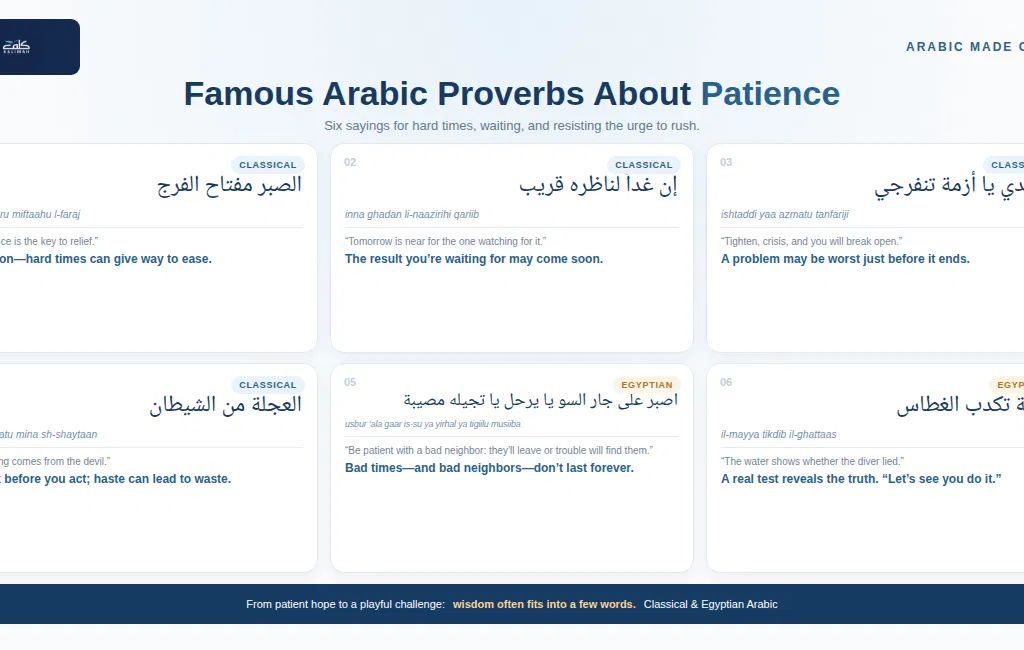
Patience is one of the most loved values in Arab life. These six proverbs are what people say when someone is having a hard time, waiting on news, or about to rush into something. Some are gentle and kind, and one is a playful jab.
| Arabic | Say It Like This | Word for Word | What It Means | Type |
| الصبر مفتاح الفرج | as-sabru miftaahu l-faraj | Patience is the key to relief | Hard times end if you hold on. | Classical |
| إن غداً لناظره قريب | inna ghadan li-naazirihi qariib | Tomorrow is close for the one watching for it | You’ll see the result soon. | Classical |
| اشتدي يا أزمة تنفرجي | ishtaddi yaa azmatu tanfariji | Get tighter, crisis, and you will break open | A problem is worst right before it ends. | Classical |
| العجلة من الشيطان | al-‘ajalatu mina sh-shaytaan | Rushing comes from the devil | Think before you act. | Classical |
| اصبر على جار السو يا يرحل يا تجيله مصيبة | usbur ‘ala gaar is-su ya yirhal ya tigiilu musiiba | Be patient with a bad neighbor: he moves or trouble finds him | Bad times don’t last forever. | Egyptian |
| المية تكدب الغطاس | il-mayya tikdib il-ghattaas | The water shows the diver lied | A real test shows the truth. | Egyptian |
The first proverb carries the same hope as a well-known Quran verse. “With hardship comes ease” is said two times in a row in Surah al-Sharh, verses 5 and 6. That’s why it feels so natural to say to someone who is sick or has lost a job.
“Rushing comes from the devil” is part of a longer line: taking your time is from God, and rushing is from the devil. It’s reported in Sunan al-Tirmidhi, number 2012, though scholars differ on how strong its chain is. It works a lot like the English “haste makes waste,” but it feels heavier.
The diver proverb is the fun one in this group. Egyptians say it to someone who brags about a skill. It simply means “Let’s see you do it.”
B. Famous Arabic Proverbs About Friendship and Relationships
These proverbs are about the people closest to you: friends, neighbors, and partners. They show that Arabs judge a friend by two things, honesty and who stays when life goes wrong. A couple of them are also fun to say at weddings.
| Arabic | Say It Like This | Word for Word | What It Means | Type |
| رُبّ أخٍ لك لم تلده أمك | rubba akhin laka lam taliduhu ummuk | Many a brother was not born to your mother | A close friend can be like family. | Classical |
| الصديق وقت الضيق | as-sadiiqu waqta d-diiq | The friend at the time of trouble | You find true friends in hard times. | Classical |
| أخوك من صَدَقك لا من صدّقك | akhuuka man sadaqaka laa man saddaqak | Your brother is who is honest with you, not who believes you | An honest friend beats one who just agrees. | Classical |
| وافق شنٌّ طبقة | waafaqa shannun tabaqah | Shann matched Tabaqa | Two people or things that fit perfectly. | Classical |
| الجار قبل الدار | al-jaaru qabla d-daar | The neighbor before the house | Check your neighbors before you pick a home. | Classical |
| طنجرة ولقت غطاها | tanjara w la’at ghataaha | The pot found its lid | Two people who suit each other, often a couple. | Levantine |
| الغايب حجته معاه | il-ghaayib huggitu ma’aah | The absent one has his excuse with him | Don’t judge someone who isn’t here. | Egyptian |
The third proverb hides a clever joke. “Sadaqaka” means “told you the truth.” “Saddaqaka,” with one doubled letter, means “believed you.” English can’t show this, so you only catch it in Arabic. Small sound details like this are exactly what you practice with a native teacher in the Kalimah Center Online Arabic Course.

“The neighbor before the house” is still real advice in the Arab world. Many families ask around about the people next door before they rent or buy.
“The pot found its lid” is warm and a little teasing. You’ll hear it at engagements and weddings in Syria, Lebanon, Jordan, and Palestine.
Master Arabic with Kalimah Center
Join our expert-led online classes and start your journey toward Arabic fluency today.
Book Your Free TrialC. Famous Arabic Proverbs About Time and Action
Arabs have a lot of proverbs that warn against wasted chances. Others praise hard work and good timing. A few even give simple advice about money and rest.
| Arabic | Say It Like This | Word for Word | What It Means | Type |
| الصيفَ ضيّعتِ اللبن | as-sayfa dayya’ti l-laban | In summer you wasted the milk | You lost your chance, and now it’s too late. | Classical |
| الوقت كالسيف إن لم تقطعه قطعك | al-waqtu ka-s-sayf, in lam taqta’hu qata’ak | Time is a sword: if you don’t cut it, it cuts you | Use your time, or it will hurt you. | Classical |
| رجع بخُفَّي حُنين | raja’a bi-khuffay hunayn | He came back with Hunayn’s two shoes | He went home with nothing. | Classical |
| اضرب ما دام الحديد حامياً | idrib maa daama l-hadiidu haamiyan | Strike while the iron is hot | Act at the right moment. | Classical |
| من جدّ وجد | man jadda wajad | Whoever works hard finds | Hard work pays off. | Classical |
| على قد لحافك مد رجليك | ‘ala ‘add lihaafak midd riglayk | Stretch your legs only as far as your blanket | Spend only what you have. | Egyptian |
| اللي فات مات | illi faat maat | What passed is dead | Leave the past behind. | Spoken everywhere |
| الصباح رباح | is-sabaah rabaah | Morning brings profit | Sleep on it. Things look better tomorrow. | Spoken everywhere |
“Strike while the iron is hot” is one of the few proverbs that says the exact same thing in Arabic and English. That makes it a great first proverb for beginners.
“Man jadda wajad” is only two words. Teachers across the Arab world write it on classroom walls, and many kids learn it before any other proverb.
“Morning brings profit” is often used to end a late-night argument. It’s a polite way of saying, “Let’s stop here and talk again tomorrow.”
D. Famous Arabic Proverbs About Wisdom and Knowledge
These proverbs praise asking for advice, speaking less, and learning while you’re young. Some are tied to famous people from old Arabia. You’ll find their stories later in this article.
| Arabic | Say It Like This | Word for Word | What It Means | Type |
| ما خاب من استشار | maa khaaba mani stashaar | Whoever asks for advice never fails | Ask others before big choices. | Classical |
| خير الكلام ما قلّ ودلّ | khayru l-kalaami maa qalla wa dall | The best words are few and clear | Keep it short and to the point. | Classical |
| إذا كان الكلام من فضة فالسكوت من ذهب | idhaa kaana l-kalaamu min fidda fa-s-sukuutu min dhahab | If talk is silver, silence is gold | Sometimes it’s smarter to say nothing. | Classical |
| العلم في الصغر كالنقش على الحجر | al-‘ilmu fi s-sighari ka-n-naqshi ‘ala l-hajar | Learning when young is like carving on stone | What kids learn stays for life. | Classical |
| أبصر من زرقاء اليمامة | absaru min zarqaa’i l-yamaama | Sharper-eyed than Zarqa of al-Yamama | Someone who sees trouble coming. | Classical |
| القول ما قالت حذام | al-qawlu maa qaalat hadhaami | The true word is what Hadham said | Trust the person known to be right. | Classical |
| أكبر منك بيوم أعرف منك بسنة | akbar minnak bi-yoom a’raf minnak bi-sana | One day older than you, a year wiser | Listen to people with more experience. | Spoken everywhere |
| اللي ما يعرفش يقول عدس | illi ma yi’rafsh yi’uul ‘ads | Whoever doesn’t know says “lentils” | People judge without the facts. | Egyptian |
Arabic has plenty of ways to tell someone to be quiet, from very polite to very rude. If “silence is gold” made you curious, see our guide on how to say shut up in Arabic.
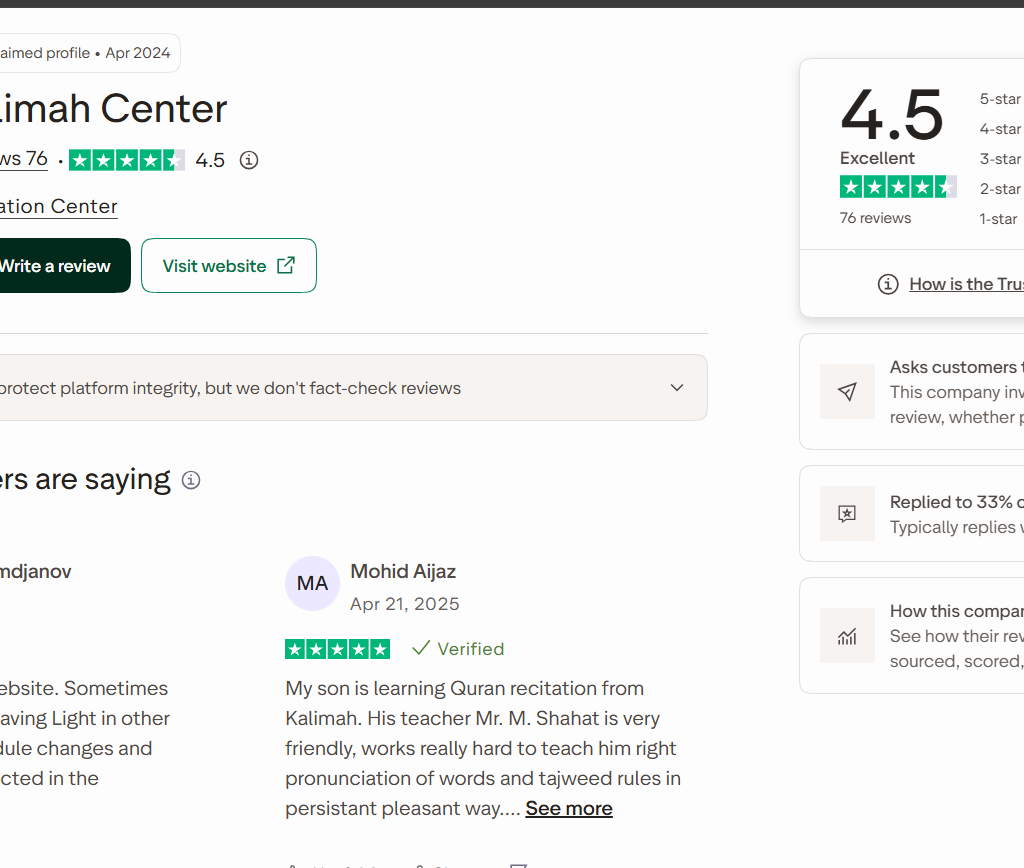
“One day older, a year wiser” is about trusting people who have walked the road before you. The same goes for learning a language. If you want to hear from students who have already studied with Kalimah Center, you can read their reviews on Trustpilot.
E. Famous Arabic Proverbs About Human Nature
This is the biggest group, and the most honest one. These proverbs talk about lies, bad excuses, fake smiles, and people who cause their own trouble. Many of them are funny, but they also hit close to home.
| Arabic | Say It Like This | Word for Word | What It Means | Type |
| جزاء سِنِمّار | jazaa’u sinimmaar | The reward of Sinimmar | Being hurt in return for doing good. | Classical |
| تسمع بالمعيدي خير من أن تراه | tasma’u bil-mu’aydiyyi khayrun min an taraah | Better to hear of al-Mu’aydi than to see him | His fame is bigger than the real man. | Classical |
| استنوق الجمل | istanwaqa l-jamal | The camel turned into a she-camel | Mixed-up thinking. | Classical |
| لا ناقة لي فيها ولا جمل | laa naaqata lii fiihaa wa laa jamal | I have no she-camel or camel in it | This isn’t my business. | Classical |
| عذر أقبح من ذنب | ‘udhrun aqbahu min dhanb | An excuse uglier than the mistake | The excuse makes it worse. | Classical |
| حبل الكذب قصير | hablu l-kidhbi qasiir | The rope of lies is short | The truth always comes out. | Spoken everywhere |
| إذا رأيت نيوب الليث بارزة فلا تظنن أن الليث يبتسم | idhaa ra’ayta nuyuuba l-laythi baarizatan fa-laa tazunnanna anna l-layth yabtasim | If you see a lion’s teeth, don’t think it’s smiling | A friendly face can hide danger. | Classical (poem) |
| لا يُلدغ المؤمن من جحر مرتين | laa yuldaghu l-mu’minu min juhrin marratayn | A believer isn’t stung from the same hole twice | Don’t fall for the same trick again. | Hadith |
| ضربني وبكى وسبقني واشتكى | darabni w baka w saba’ni w ishtaka | He hit me, cried, and complained first | The attacker acts like the victim. | Egyptian |
| القرد في عين أمه غزال | il-‘ird fi ‘een ummu ghazaal | A monkey is a gazelle in its mother’s eyes | Love hides faults. | Egyptian and Levantine |
| ابن الوز عوّام | ibn il-wizz ‘awwaam | A baby goose is a swimmer | Like father, like son. | Egyptian |
| جاجة حفرت على راسها عفرت | jaaje hafarit ‘ala raasha ‘afarit | The hen dug and threw dirt on her own head | People cause their own trouble. | Levantine |
| اللي ما يعرف الصقر يشويه | illi ma yi’rif is-sagir yishwiih | Whoever doesn’t know the falcon grills it | People who can’t see value waste it. | Gulf |
| اللي اختشوا ماتوا | illi ikhtashu maatu | Those who were shy died | Said about someone with no shame. | Egyptian |
Two lines here aren’t folk sayings at all. The lion line comes from a poem by al-Mutanabbi, one of the greatest Arab poets. The line about being stung twice is a saying of the Prophet ﷺ, recorded in Sahih al-Bukhari, number 6133.
The camel proverb began with a child. As the story goes, the young poet Tarafa heard a man describe a male camel with a feature only female camels have. He shouted, “The camel became a she-camel!” and people never forgot it.
The falcon proverb makes more sense once you know how much falcons matter in the Gulf. A trained falcon is a prized and costly bird, so treating it like a chicken is the worst way to miss something’s worth.
Watch a real lesson before you book
Not sure what online Arabic classes look like? This short clip gives you a feel for our teaching style and how each class is built around the student.
Read also: Arabic Sayings About Love
The Stories Behind the Most Famous Arabic Proverbs
Many famous Arabic proverbs only make sense once you hear the story that started them. Below are seven of the best-known ones, from old Arabian kings and poets to Egyptian folk tales. Each story is short, and each one shows you when to use the proverb today.

1. جزاء سنمار | Jazaa’u Sinimmaar | The Reward of Sinimmar
Sinimmar was a gifted builder. Al-Nu’man, the king of al-Hira in old Iraq, hired him to build a palace called al-Khawarnaq. The work took years, and the finished palace was stunning.
When it was done, the king stood with Sinimmar on the roof. Sinimmar felt proud of his work. He told the king a secret: one single brick held the whole palace together. If anyone pulled it out, the building would fall.
The king didn’t like hearing that. He didn’t want anyone else to learn the secret. He also didn’t want Sinimmar to build an even better palace for another king.
So he pushed Sinimmar off the roof, and the builder died.
Sinimmar gave his best work and got death in return. That’s why “the reward of Sinimmar” means being hurt by the very person you helped. You might say it about a worker who gets fired right after saving a big project.
The opposite of Sinimmar’s reward is a simple, warm thank you. To learn the most common way Muslims thank each other, read our guide to Jazakallah Khair in Arabic.
2. رجع بخفي حنين | Raja’a Bi-Khuffay Hunayn | He Came Back With Hunayn’s Slippers
Hunayn was a shoemaker in al-Hira. One day, a desert traveler on a camel stopped at his shop.
The man argued about the price for a long time. In the end, he left without buying anything. Hunayn was angry and wanted to teach him a lesson.
He ran ahead on the road the traveler would take. He dropped one shoe on the path. Then he walked much farther and dropped the other one. After that, he hid and waited.
The traveler saw the first shoe and said, “That looks like Hunayn’s shoe, but one shoe is useless.” Then he found the second shoe. Now he wished he had picked up the first. He left his camel and walked back to get it.
While he was gone, Hunayn took the camel and everything on it. The man went home on foot. His people asked, “What did you bring back from your trip?” He said, “Hunayn’s two shoes.”
Today, Arabs say this about anyone who tries hard and comes home with nothing.
3. الصيف ضيعت اللبن | As-Sayfa Dayya’ti l-Laban | In Summer You Wasted the Milk
A woman named Dakhtanus was married to a rich man named Amr. He was much older than her. She didn’t want to stay with an old man, so she asked him for a divorce.
He agreed, and they split up in the summer. She then married a younger man. He was kind, but he was poor. Winter came, and food got scarce. Milk was hard to find, and her family needed it. So she sent someone to her old husband to ask for a little.
Amr answered in four words: “In summer you wasted the milk.” He meant that she had walked away from everything he could give her. Now it was too late to ask for it back.
Arabs still say this to anyone who throws away a good chance and then wants it later. Think of a student who skipped class all year and asks for help the night before the final exam.
The closest English saying is “You made your bed, now lie in it.” The Arabic one stings a little more, because the whole story is packed into those few words.
4. وافق شن طبقة | Waafaqa Shannun Tabaqah | Shann Matched Tabaqa
Shann was a smart man who made a promise. He would only marry a woman who was as clever as he was. So he set out to travel and find her.
On the road, he met a man and walked with him. Shann asked, “Will you carry me, or shall I carry you?” The man thought it was a silly question. Shann really meant, “Shall we talk to make the road feel shorter?”
They passed a field of crops. Shann asked, “Has this been eaten yet?” He meant, “Has the farmer already sold it?” Then they saw a funeral. Shann asked, “Is the man in the coffin alive or dead?” He meant, “Did he leave children behind?”
The man went home and told his daughter about this strange traveler. Her name was Tabaqa. She explained every question right away. When Shann heard about her, he knew he had found his match, and he married her.
That’s why Arabs say “waafaqa shannun tabaqah” about two people who fit together. You’ll hear it at weddings, but it isn’t only for couples. People also say it about two close friends who think alike, or two business partners who work well together.
5. أبصر من زرقاء اليمامة | Absaru Min Zarqaa’i l-Yamaama | Sharper-Eyed Than Zarqa al-Yamama
Zarqa lived in al-Yamama, in the middle of the Arabian Peninsula. She was famous for her amazing eyes. People said she could see riders coming from three days away.
One day, an enemy army planned to attack her people. The soldiers had heard about Zarqa. So each rider cut a tree branch and held it up in front of him. They hoped she would see only trees.
Zarqa looked out and said, “I see trees walking toward us.” Her people laughed. Trees don’t walk, they told her. Nobody got ready to fight.
The army arrived and beat them badly. Zarqa had been right the whole time. This story gives the proverb two lessons. On the surface, “sharper-eyed than Zarqa” is praise for someone with great sight or great sense. Underneath, the story warns us to listen when a wise person tells us something strange.
You can say it about a friend who saw a problem coming long before anyone else did.
6. اللي ما يعرفش يقول عدس | Illi Ma Yi’rafsh Yi’uul ‘Ads | Whoever Doesn’t Know Says Lentils
This Egyptian folk tale is about a man who sold lentils in a small shop. He had to leave on a trip to buy more goods. He trusted his wife to watch the shop while he was gone.
When he came back, he found a stranger with his wife. The stranger had wronged the family. The shop owner got angry and chased him into the street.
The stranger tripped over a big sack of lentils. The sack split open, and lentils flew everywhere. People in the street saw the shop owner shouting at the man on the ground.
They thought the fight was about the lentils. “Have you no mercy?” they said. “You chase a man over a few lentils?” The shop owner couldn’t tell the shameful truth in front of everyone. So he just said, “Whoever doesn’t know says lentils.”
Today, Egyptians use this line when people take sides in a fight without knowing what really happened. It’s a quick way of saying, “You don’t know the whole story.”
7. اللي اختشوا ماتوا | Illi Ikhtashu Maatu | Those Who Were Shy Died
This Egyptian saying comes from a folk story about an old public bathhouse. Bathhouses like this were common in Egypt long ago. Women went there to wash, chat, and relax together.
One day, a fire broke out inside. Smoke filled the rooms fast, and everyone had to get out right away.
Some women ran into the street without their clothes. They cared more about living than about being seen. Other women were too shy to go outside uncovered. They stayed behind, and the fire killed them.
People later said, “Those who were shy died.” Over time, the meaning turned into a dark joke. The idea is that all the shy people are gone, so only the bold ones are left.
Now Egyptians say it about someone who acts with no shame at all. You’ll hear it when someone cuts in line, asks for way too much, or brags with no manners.
It’s a sharp line, so save it for friends who will laugh, not for someone you want to impress.
Classical vs. Dialect Arabic Proverbs: How to Tell Them Apart
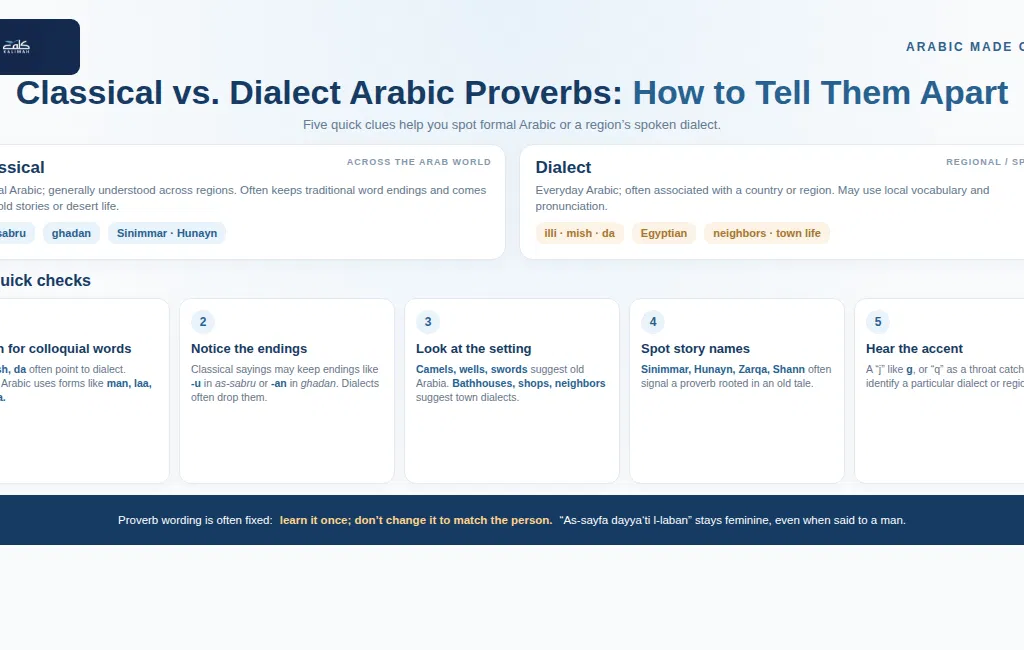
Every table in this article labels each proverb as “Classical” or with a region, like “Egyptian.” Classical proverbs are in formal Arabic and are understood across the Arab world. Dialect proverbs are in spoken Arabic and usually belong to one country or region.
Read also: Arabic Sayings About Family
How to Tell If a Proverb Is Classical or Dialect
You don’t need to be an expert to tell them apart. These five quick checks will get you the right answer most of the time.
- Look for spoken-Arabic words. Dialect proverbs use everyday words like “illi” (who, that), “mish” (not), and “da” (this). Formal Arabic uses words like “man,” “laa,” and “haadha” instead. If you see “illi,” you’re almost always looking at a dialect proverb.
- Listen for formal endings. Classical proverbs keep the old word endings, like the “-u” in “as-sabru” or the “-an” in “ghadan.” Spoken Arabic drops most of these endings.
- Check what the proverb talks about. Camels, milk, swords, wells, and desert travel point to old Arabia, so the proverb is likely classical. Bathhouses, lentil shops, cooking pots, and neighbors point to town life, so it’s likely a dialect proverb.
- Ask if it has a famous name in it. Proverbs built around names like Sinimmar, Hunayn, Zarqa, or Shann come from old Arab stories. They’re almost always classical.
- Notice the accent. If a “j” sounds like “g,” or a “q” turns into a little catch in the throat, the proverb is coming from a dialect. The table below shows which region each sound belongs to.
Why Classical Proverbs Never Change Their Words
Old Arab scholars noticed a simple rule. A proverb stays tied to the first moment that created it. Because of that, people never change its words, even when the grammar no longer fits the person they’re talking to.
“As-sayfa dayya’ti l-laban” “In summer you wasted the milk,” is the best example. The verb is feminine because the line was first said to a woman. Arabs still say it exactly the same way to a man. If you “fix” it to the masculine, native speakers will hear the mistake right away.
This rule actually makes things easier for you as a learner. You don’t have to adjust a proverb for each person. You learn it once, and you say it the same way every time.
Dialect proverbs are a little looser. People sometimes swap a word or two depending on the city or the family. Classical ones stay fixed.
How to Read the Pronunciation in the Tables
You don’t need to know the Arabic alphabet to say these proverbs out loud. Just follow these six steps, and the “Say It Like This” column will make sense right away.
- Hold the double vowels longer. “Aa,” “ii,” and “uu” are long sounds, like in “sabaah” and “qariib.”
- Say “kh” from the back of your throat. It sounds like the “ch” in “loch,” as in “khayru.”
- Say “gh” like a French “r.” You’ll hear it in “ghadan.”
- Make “q” a deep “k.” Push it far back in your throat, as in “qawlu.”
- Pause on the ‘ mark. It’s a short catch, like the break in “uh-oh,” as in “‘ird.”
- Check the “Type” column for the accent. In Egypt, ج sounds like “g” (“jaar” becomes “gaar”). In Egypt and the Levant, ق becomes a throat catch (“qird” becomes “‘ird”). In the Gulf, ق sounds like “g” (“saqr” becomes “sagir”).
How to Learn an Arabic Proverb Step by Step
The easiest way to learn a proverb is the Story, Meaning, Moment method. Here’s how it works, using “رجع بخفي حنين” (raja’a bi-khuffay hunayn), “He came back with Hunayn’s slippers.”
- Learn the story. Read the tale of Hunayn and the traveler. A story gives your brain a picture to hold on to, so the words come back faster.
- Write the meaning in plain words. Here, it’s simply “He got nothing.” Put that short meaning next to the Arabic in your notebook.
- Pick one real moment to use it. Maybe a friend went to five job interviews this month and didn’t get a single offer. That’s a Hunayn moment.
- Say it out loud. Use the spelling in the tables, and repeat it until it feels natural.
- Test yourself. If you can’t think of a moment to use the proverb, go back to step 3 before you move on.
- Repeat with three proverbs a week. After a month, you’ll have a dozen sayings you can really use.
How to Avoid the Five Most Common Mistakes In Using Arabic Proverbs
Even good learners slip up when they start using proverbs. Follow these steps, and you’ll sound natural instead of awkward.
- Match the tone to the setting. An Egyptian street saying in a formal speech sounds odd, and a classical line in a joke can sound stiff.
- Use local proverbs in the right place. A Levantine saying may confuse someone in the Gulf. When you’re not sure, pick a classical one, since people everywhere know them.
- Share the meaning, not the words. “استنوق الجمل” (istanwaqa l-jamal), “The camel became a she-camel,” means nothing to an English speaker. Explain what it means instead.
- Treat religious lines with respect. Lines from the Quran and hadith are often used like proverbs, so never use them as jokes.
- Use one proverb at a time. One good proverb makes you sound smart. Five in a row make you sound like a textbook.
If you want more ways to practice between lessons, check our list of the best websites to learn Arabic online.
A quick look at learning with us
See how a live class works, from the teacher’s explanation to the student’s recitation. It’s a simple way to know what to expect before your first lesson.
Master Arabic with Kalimah Center
Join our expert-led online classes and start your journey toward Arabic fluency today.
Book Your Free TrialStart Learning Arabic With Kalimah Center Today
Reading a list of proverbs is a good start. Saying them with the right sound, the right tone, and at the right moment takes a real teacher. That’s where Kalimah Center comes in.
- You learn from native speakers. Kalimah Center’s teachers are native Arabic speakers with years of teaching experience and degrees in Arabic and Islamic studies.
- You join a school with a long record. Kalimah started in 2011 as an institute in Egypt teaching formal Arabic to people from around the world, and by 2017 it had taught 7,000 students.
- You study from a program made for learners. Kalimah built its own curriculum and runs its own Arabic and Quran bookstore.
- You choose who teaches you. There are both male and female Arabic and Quran tutors.
- You study the way that suits you. Pick one-on-one lessons or group classes, and learn online from home on your own schedule.
- You learn the Arabic you need. Courses cover formal Arabic, spoken dialects, Quranic Arabic, and Arabic for business and travel.
You can try it before you pay anything. Kalimah Center offers a free trial lesson, so you can meet your teacher and see how classes work. Book your free trial now and start speaking Arabic with confidence.

Explore Our Courses:
Start today and don’t wait for the perfect moment, because it may never come. Browse our courses and click Free Trial.
- Online Arabic Course: Tailored to your level, our comprehensive Arabic program includes 16 teaching levels and 400+ hours of personalized sessions.
- Online Quran With Tajweed Course: Perfect for non-Arabic speakers, our course spans 13 levels and equips you with Tajweed mastery from beginner to advanced.
- Online Arabic Course For Kids: Nurture your child’s love for Arabic with our engaging and structured program, available in 24 levels for primary, intermediate, and secondary stages.
Conclusion
Famous Arabic proverbs are tiny stories with big lessons inside. In just a few words, they show how Arabs think about patience, friendship, time, wisdom, and the way people really behave.
The patience proverbs give hope when life is hard and remind you not to rush. The friendship proverbs say an honest friend is worth more than one who only agrees with you. The time and action proverbs push you to grab your chances before they slip away.
The wisdom proverbs ask you to speak less, listen more, and learn while you’re young. The human nature proverbs, from Sinimmar’s sad reward to the falcon on the grill, show both the best and worst in people.
The labels matter too. Classical proverbs work everywhere and never change their words. Dialect proverbs from Egypt, the Levant, and the Gulf bring humor and local flavor, but they sound best in their own regions.
Don’t try to learn all 43 at once. Pick a few from each theme, learn the story behind them, and find one real moment to use each one. Say them out loud, try them with Arab friends, and notice the smiles you get.
Bit by bit, famous Arabic proverbs will stop being a list you read. They’ll become part of how you speak, and that’s when Arabic really starts to feel like your own.
FAQs
Once people start learning Arabic proverbs, a few questions come up again and again. Here are short, clear answers to the ones we hear most.
How Many Arabic Proverbs Are There?
There are thousands of Arabic proverbs, and nobody has an exact count. Old scholars filled whole books with them, like the one you can find on the Internet Archive, and sites like Mawdoo3 keep adding new spoken ones.
What Is the Arabic Word for Proverb?
The Arabic word for proverb is “mathal,” and the plural is “amthal.” Arabs say a proverb is “struck” (yudrabu) when they use it for a new situation.
What Is the Difference Between a Proverb and a Wise Saying in Arabic?
A proverb (mathal) comes from a real event and gets repeated for similar events. A wise saying (hikma) is a general truth with no story behind it.
Does the Quran Use Proverbs?
Yes, the Quran uses many parables, also called amthal, to explain its message. One example compares people who carry knowledge but don’t use it to a donkey carrying books, in Surah al-Jumu’ah, verse 5.
Do Arab Writers Still Use Proverbs Today?
Yes, Arab writers and journalists still use classical proverbs in news stories, speeches, and books. A writer might say “the flood has reached the hilltops” (balagha s-saylu z-zubaa) when a problem gets out of hand.
Can Beginners Learn Arabic Proverbs?
Yes, beginners can learn Arabic proverbs if they start with short ones. Two- or three-word sayings like “man jadda wajad” are great for practicing sounds and new words.
Which Dialect Proverbs Do Most Arabs Understand?
Egyptian proverbs are the most widely understood across the Arab world. Egyptian films, songs, and TV shows have carried them into almost every Arab home for decades.