Want to know how to say good day in Arabic? Most of the time, you’ll say يوم سعيد (yawm saʿīd), which means “a happy day.” If you want the full “have a good day,” you’ll say أتمنى لك يومًا سعيدًا (atamannā laka yawman saʿīdan).
That’s the quick answer. The longer one is more fun, because Arabic doesn’t stop there. The words shift with the person you’re talking to (a man, a woman, or a group), and they sound different in Cairo than they do in Beirut or Dubai.
Below, you’ll get each phrase in Arabic script, a simple way to say it, and short real-life talks so you can hear how it fits. Just follow the five steps.
Step 1: Pick The Right Phrase To Say Good Day In Arabic
Before you pick a phrase, ask yourself one thing: are you saying hello, saying goodbye, or writing something formal? Each moment has its own phrase. All of the phrases below are Modern Standard Arabic (MSA), so every Arabic speaker will understand you.
Saying A Quick Hello Or Signing Off? Use يوم سعيد (Yawm Saʿīd)
When you just want a short, friendly line, say يَوْمٌ سَعِيدٌ (yawm saʿīd). It means “a happy day,” and it’s the closest thing to a simple “good day.”
Use it in moments like these:
- Writing on a birthday card or a thank-you card
- Ending a social media post or a short group message
- Adding a cheerful extra after “good morning” at work
The best part is that it never changes. You say the same two words to a man, a woman, or a whole room. Dictionaries like Almaany explain that a happy day also means a blessed and pleasant one, so it feels warm even though it’s short.
Just don’t lean on it in a long face-to-face goodbye. A Reddit user quoted by AlifBee noted that it’s not very common to say out loud on its own. For that moment, use the next phrase.
Saying Goodbye To Someone? Use أتمنى لك يومًا سعيدًا (Atamannā Laka Yawman Saʿīdan)
When you’re leaving, hanging up, or ending an email, say أَتَمَنَّى لَكَ يَوْمًا سَعِيدًا (atamannā laka yawman saʿīdan). It means “I wish you a happy day,” and it’s the real Arabic version of “have a nice day.”
Use it in moments like these:
- Hanging up a phone call
- Signing off an email or a text
- Walking out of a shop or a café
It’s easy once you split it up: atamannā (I wish), laka (for you), yawman (a day), saʿīdan (happy). Unlike yawm saʿīd, this phrase changes a little depending on who you’re talking to. You’ll see how in Step 2.
Writing Something Formal Or Polite? Use طاب يومك (Ṭāba Yawmuka)
When you want to sound respectful and a bit elegant, use طَابَ يَوْمُكَ (ṭāba yawmuka). It means “may your day be good.” AlifBee calls it a graceful, old-fashioned way to say good day.
Use it in moments like these:
- Writing a thank-you email to a teacher
- Sending a note to an older relative or someone you respect
- Opening a formal message, as a polite hello
It works as both a hello and a goodbye, but mostly in writing. Out loud, and especially with close friends, it can sound stiff. With friends, use a dialect phrase from Step 4 instead.
Quick Guide: What To Say And When
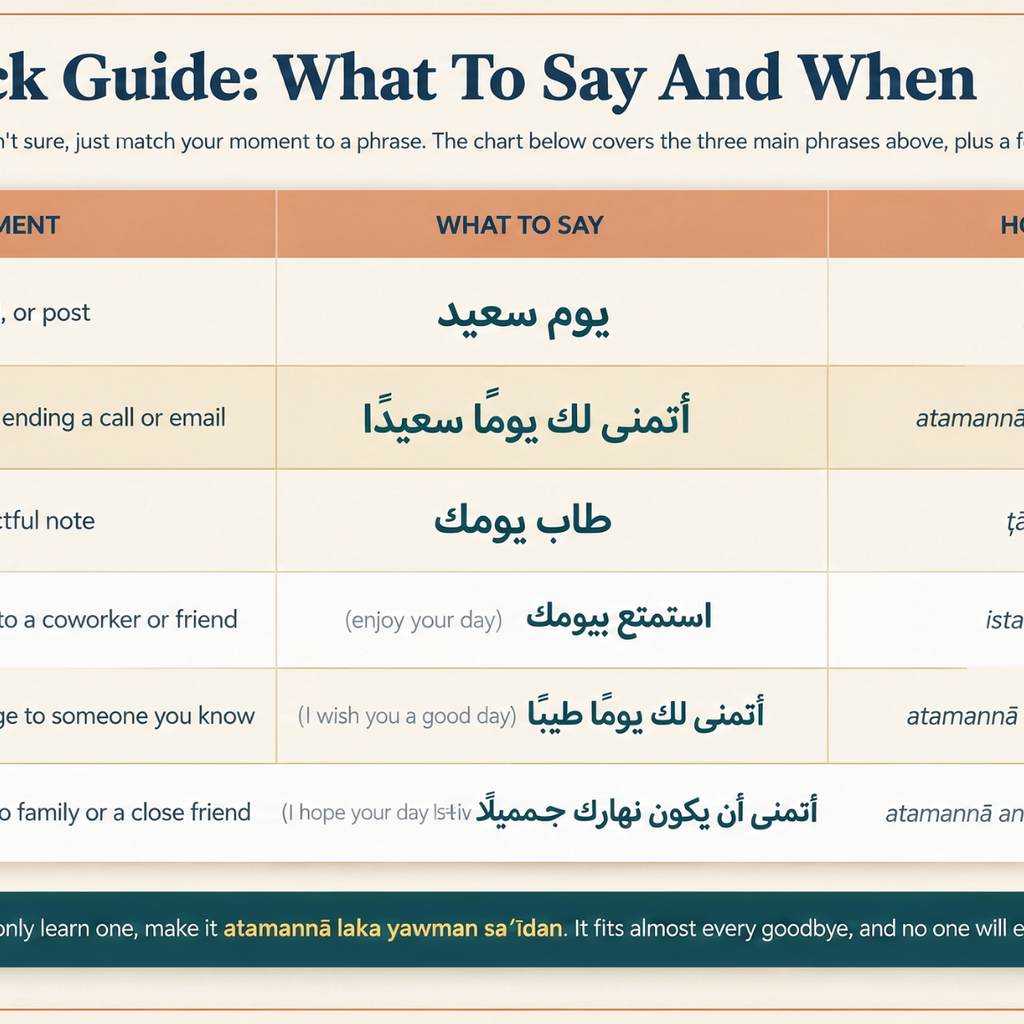
If you still aren’t sure, just match your moment to a phrase. The chart below covers the three main phrases above, plus a few extras for specific moods.
| Your moment | What to say | How to say it |
| Quick hello, card, or post | يوم سعيد | yawm saʿīd |
| Saying goodbye, ending a call or email | أتمنى لك يومًا سعيدًا | atamannā laka yawman saʿīdan |
| Formal or respectful note | طاب يومك | ṭāba yawmuka |
| Casual goodbye to a coworker or friend | استمتع بيومك (enjoy your day) | istamtiʿ bi-yawmik |
| Soft, kind message to someone you know | أتمنى لك يومًا طيبًا (I wish you a good day) | atamannā laka yawman ṭayyiban |
| Sweet message to family or a close friend | أتمنى أن يكون نهارك جميلًا (I hope your day is beautiful) | atamannā an yakūna nahāruka jamīlan |
If you only learn one, make it atamannā laka yawman saʿīdan. It fits almost every goodbye, and no one will ever find it odd.
Read also: Good Afternoon in Arabic
Step 2: Check Who You Are Talking To
Say laka to a man, laki to a woman, and lakum to a group. Arabic is a gendered language, so the word for “you” changes with the person in front of you. A lot of phrase lists only give the version for a man, which leaves you stuck the first time you talk to a woman.
Good Day In Arabic To A Woman
To wish a woman a good day, you only change one sound. Laka (for you, said to a man) becomes laki (for you, said to a woman).
So the full wish becomes أتمنى لكِ يومًا سعيدًا (atamannā laki yawman saʿīdan). The same thing happens elsewhere: ṭāba yawmuka turns into ṭāba yawmuki, and “enjoy your day” becomes استمتعي بيومكِ (istamtiʿī bi-yawmiki).
If you want one rule to remember, it’s this. In MSA, “you” and “your” end in -ka for a man and -ki for a woman. In most of these phrases, that’s the only thing that changes.
Writing adds a small twist. Without vowel marks, لك and يومك look identical for men and women, so the difference only shows up when you speak. If you want to be clear in a text, add the little vowel mark: لكِ for a woman, لكَ for a man.
Good Day In Arabic To A Group
For a group, the ending becomes -kum. Laka turns into lakum (for you all), and the full wish is أتمنى لكم يومًا سعيدًا (atamannā lakum yawman saʿīdan).
If the group is mixed, men and women together, you still use -kum. That’s just how Arabic grammar works, and nobody will think it’s rude. For a group of only women, there’s a special form, -kunna (lakunna), but in everyday life you’ll hear -kum far more often.
Here’s a quick chart with each main phrase for a man, a woman, and a group. Keep it close until the endings come out without thinking.
| Phrase | To a man | To a woman | To a group |
| Have a happy day | أتمنى لكَ يومًا سعيدًا (laka) | أتمنى لكِ يومًا سعيدًا (laki) | أتمنى لكم يومًا سعيدًا (lakum) |
| May your day be good | طاب يومُكَ (yawmuka) | طاب يومُكِ (yawmuki) | طاب يومُكم (yawmukum) |
| Enjoy your day | استمتعْ بيومِك (istamtiʿ) | استمتعي بيومِكِ (istamtiʿī) | استمتعوا بيومِكم (istamtiʿū) |
Watch a real lesson before you book
Not sure what online Arabic classes look like? This short clip gives you a feel for our teaching style and how each class is built around the student.
Read also: Assalamualaikum in Arabic & Walaikum Assalam in Arabic
Step 3: Say The Hard Sound Right
Make the ع in saʿīd deep in your throat, so it doesn’t come out as “sa-eed.” The good news is that most of these words are easy for English speakers. Only two sounds give people real trouble: ع (ʿayn) and ط (ṭāʾ).
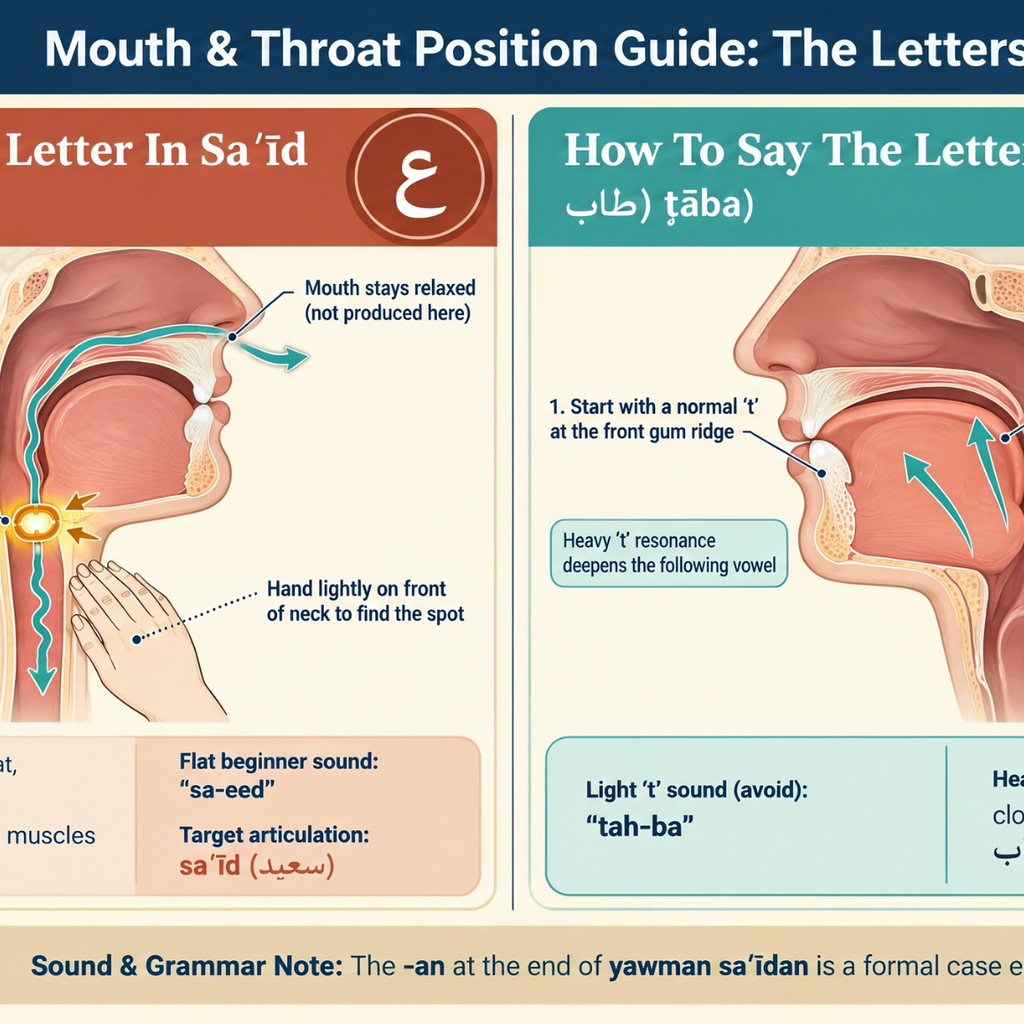
How To Say The Letter ع In Saʿīd
The ع in سعيد (saʿīd) doesn’t exist in English, so it’s normal if it feels strange at first. Most beginners skip it and say “sa-eed.” People will still understand you, but it sounds flat. These five steps will get you there.
- Find the spot. Put your hand lightly on the front of your neck. The ع comes from deep in your throat, right about where your hand is, not from your mouth.
- Squeeze your throat. Tighten the muscles there, a little like the start of a gag. Keep your voice going while you squeeze, so you hear a soft, strained sound.
- Check it in a mirror. Watch your neck as you make the sound. You should feel a small tight spot low in your throat, and your lips and tongue should stay relaxed.
- Put it in the word. Say “sa,” squeeze your throat, then say “eed.” Go slowly, five times in a row, then try it faster until it flows as one word: saʿīd.
- Practice it in other words. Use the same squeeze in istamtiʿ (enjoy) and yisʿid (make happy). Do this for a few minutes a day, and within a few days the sound stops feeling odd.
Once you can say it in saʿīd, every other word with ع gets easier.
How To Say The Letter ط In Ṭāba
The ط in طاب (ṭāba) is a “heavy” t. If you say it like an English t, people will still understand you, but the word loses its real sound. These four steps will help.
- Start with a normal t. Say “t” the way you do in English, with the tip of your tongue just behind your top teeth.
- Lift the back of your tongue. Keep the tip where it is, and pull the back of your tongue up toward the roof of your mouth. Your mouth should feel fuller, as if the sound is coming from further back.
- Let the vowel go deep. Say the “a” after it with your tongue still raised. The vowel gets darker on its own, so ṭāba sounds closer to “taw-ba” than “tah-ba.”
- Compare the two sounds. Say “tah-ba” with a normal t, then “taw-ba” with the heavy ṭ. Switch back and forth five times until you can hear and feel the difference.
You may also wonder about the -an at the end of yawman saʿīdan. Those are formal case endings. Say them in formal speech and when you read aloud. In casual talk, plenty of people drop them, but as a beginner it’s safer to keep them for now.
Honestly, sounds like ع and ط are hard to pick up from a page. You need someone to listen and catch the small slips before they turn into habits. In the Kalimah Center Online Arabic Course, you work one-on-one with a native tutor in live lessons, so your pronunciation gets fixed while you’re actually speaking.
Master Arabic with Kalimah Center
Join our expert-led online classes and start your journey toward Arabic fluency today.
Book Your Free TrialStep 4: Say Have A Good Day In Your Listener’s Dialect
Use MSA at work and with people you’ve just met. With friends, use a local phrase like yōmak saʿīd in Egypt or nahārak saʿīd in the Levant. Dialects are the Arabic people speak at home and in the street, and they change from one country to the next.
Egyptian Arabic
In Egypt, the go-to wish is يومك سعيد (yōmak saʿīd), “have a happy day.” You’ll also hear يومك جميل (yōmak gamīl), “your day is beautiful.” Listen to the g in gamīl. Egyptians say g where MSA says j, so jamīl becomes gamīl. That one change alone makes you sound a lot more Egyptian.
Talking to a woman? Both phrases switch to yōmik: yōmik saʿīd and yōmik gamīl. For a group, it’s yōmkum saʿīd. Egyptians also use نهارك سعيد (nahārak saʿīd), both as a greeting and as a goodbye. It’s common to hear it as someone walks into a shop or an office in the morning.
Because Egyptian films and TV shows travel all over the Arab world, people outside Egypt usually know these phrases too. That’s why they’re a smart first choice if you’re just starting out.
In Cairo, you’ll often hear يا باشا (ya bāsha) tacked on the end, a friendly word a bit like “boss” or “sir.” So someone might say yōmak saʿīd ya bāsha. Save it for men you know at least a little, since it’s very casual.
Levantine Arabic
The Levant covers Syria, Lebanon, Jordan, and Palestine. Here, the everyday wish is نهارك سعيد (nahārak saʿīd), “have a happy day.” To a woman, you’d say nahārik saʿīd.
You’ll also hear بتمنالك نهار سعيد (btmannālak nahār saʿīd), “I wish you a happy day.” It’s simply the spoken version of the MSA atamannā laka. To a woman, it becomes btmannālik.
Then there’s يومك مبارك (yōmak mbārak), “have a blessed day.” It’s a morning phrase, the kind you’ll hear in markets and small shops as people open up for the day.
Some people add a short prayer to it: يومك مبارك بالصلاة على النبي (yōmak mbārak bi-ṣ-ṣalāh ʿala n-nabī). It asks for blessings by sending prayers on the Prophet Muhammad, and you’ll hear it in Egypt and the Gulf as well.
One thing to know about Lebanon: lots of people mix French words like bonjour into daily speech. AlifBee points out that these can confuse people from other countries. If you want something that works everywhere in the Levant, nahārak saʿīd is the safer bet.
Gulf And Moroccan Arabic
In the Gulf, you’ll hear يومك سعيد (yōmak saʿīd), just like in Egypt. Gulf speakers also love wishes that sound like little prayers, such as الله يسعد يومك (Allah yisʿid yōmak), “may God make your day happy.” To a woman, it’s Allah yisʿid yōmich, because many Gulf speakers turn the k into ch for women. In morning texts, you might also get صباحك سعيد (ṣabāḥak saʿīd), “happy morning to you.”
Morocco has its own dialect, called Darija. A friendly Moroccan wish is نهارك مبروك (nhārek mabrūk), “may your day be blessed,” and you’ll hear it between neighbors and in local shops. Here, mabrūk means blessed. Elsewhere, people often use the same word to say congratulations.
What if you don’t know where someone is from? Just use MSA. Everyone understands atamannā laka yawman saʿīdan. Once you find out their country, try their local phrase next time. People really do notice that effort, and it’s often how a nice conversation gets started.
Step 5: Get Your Reply Ready
If someone wishes you a good day, answer with wa-laka ayḍan (and to you too) or Allah yisʿidak (may God make you happy). Having a reply ready keeps things smooth, and it shows you actually understood what they said.
Formal Replies For Work And Emails
The simplest formal reply is ولكَ أيضًا (wa-laka ayḍan), “and to you too.” To a woman, it’s ولكِ أيضًا (wa-laki ayḍan), and to a group, ولكم أيضًا (wa-lakum ayḍan).
You can put شكرًا (shukran), “thank you,” in front of it. Shukran, wa-laka ayḍan works nicely with a manager or a client. Want something a touch more formal? Try وأنت كذلك (wa-anta ka-dhālik), “and you as well.” To a woman, say wa-anti ka-dhālik. Whatever you choose, keep it short. In Arabic, a quick, warm reply sounds much more natural than a long one.
In an email, the reply fits neatly at the end, just above your name. Write shukran, wa-laka ayḍan, then sign off. It’s a clean way to wrap up a work message.
Everyday Replies With Friends And Family
In everyday talk, the reply you’ll hear most is الله يسعدك (Allah yisʿidak), “may God make you happy.” To a woman, it’s Allah yisʿidik. You’ll hear it in almost every Arab country.
Egyptians and Levantines also say وانت كمان (w-inta kamān), “you too.” To a woman, it’s w-inti kamān. It’s short and friendly, the kind of thing you say with a smile as you head out the door. You can even put the two together: Allah yisʿidak, w-inta kamān. It sounds warm, and very local.
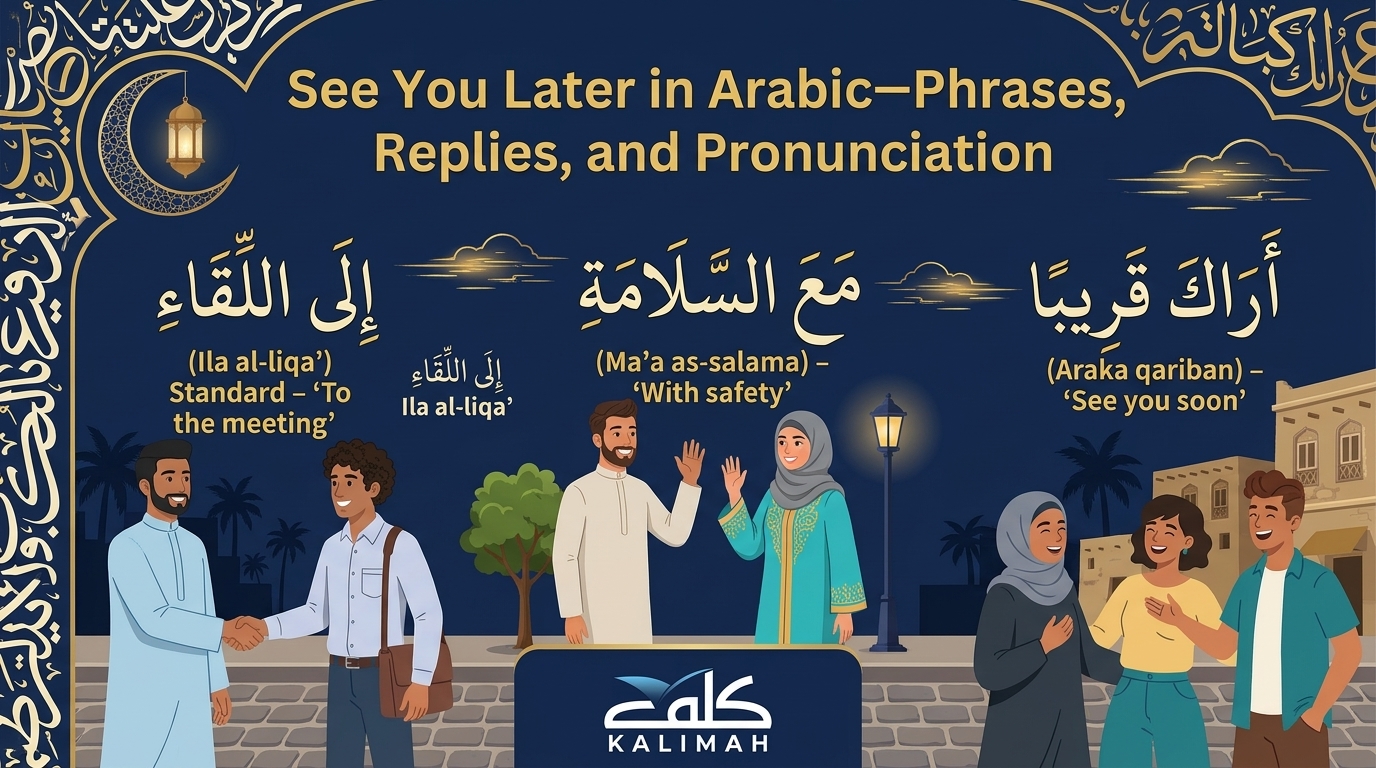
Since a good day wish usually comes right before goodbye, it’s worth learning a few goodbye words too. The most common one is مع السلامة (maʿa as-salāma), “go with safety.” If you want more, this guide on how to say goodbye in Arabic covers plenty of them.
Saying Good Morning And Have A Nice Day In Arabic Together
In Arabic, “good morning” and “have a good day” are separate phrases. Put them together in one line, though, and you get a very natural message.
Joining Good Morning And Have A Nice Day
The standard morning greeting is صباح الخير (ṣabāḥ al-khayr), “morning of goodness.” The usual answer is صباح النور (ṣabāḥ an-nūr), “morning of light.”
To say both at once, start with the greeting and then add the wish. Here are a few lines you can copy and send as they are.
| Arabic text | How to say it | Meaning |
| صباح الخير، أتمنى لك يومًا سعيدًا | ṣabāḥ al-khayr, atamannā laka yawman saʿīdan | Good morning, have a nice day (to a man) |
| صباح الخير، أتمنى لكِ يومًا سعيدًا | ṣabāḥ al-khayr, atamannā laki yawman saʿīdan | Good morning, have a nice day (to a woman) |
| صباح الخير، يومكم سعيد | ṣabāḥ al-khayr, yawmukum saʿīd | Good morning, have a happy day (to a group) |
| صباح الخير، يومك جميل | ṣabāḥ el-kheir, yōmak gamīl | Good morning, have a beautiful day (Egyptian) |
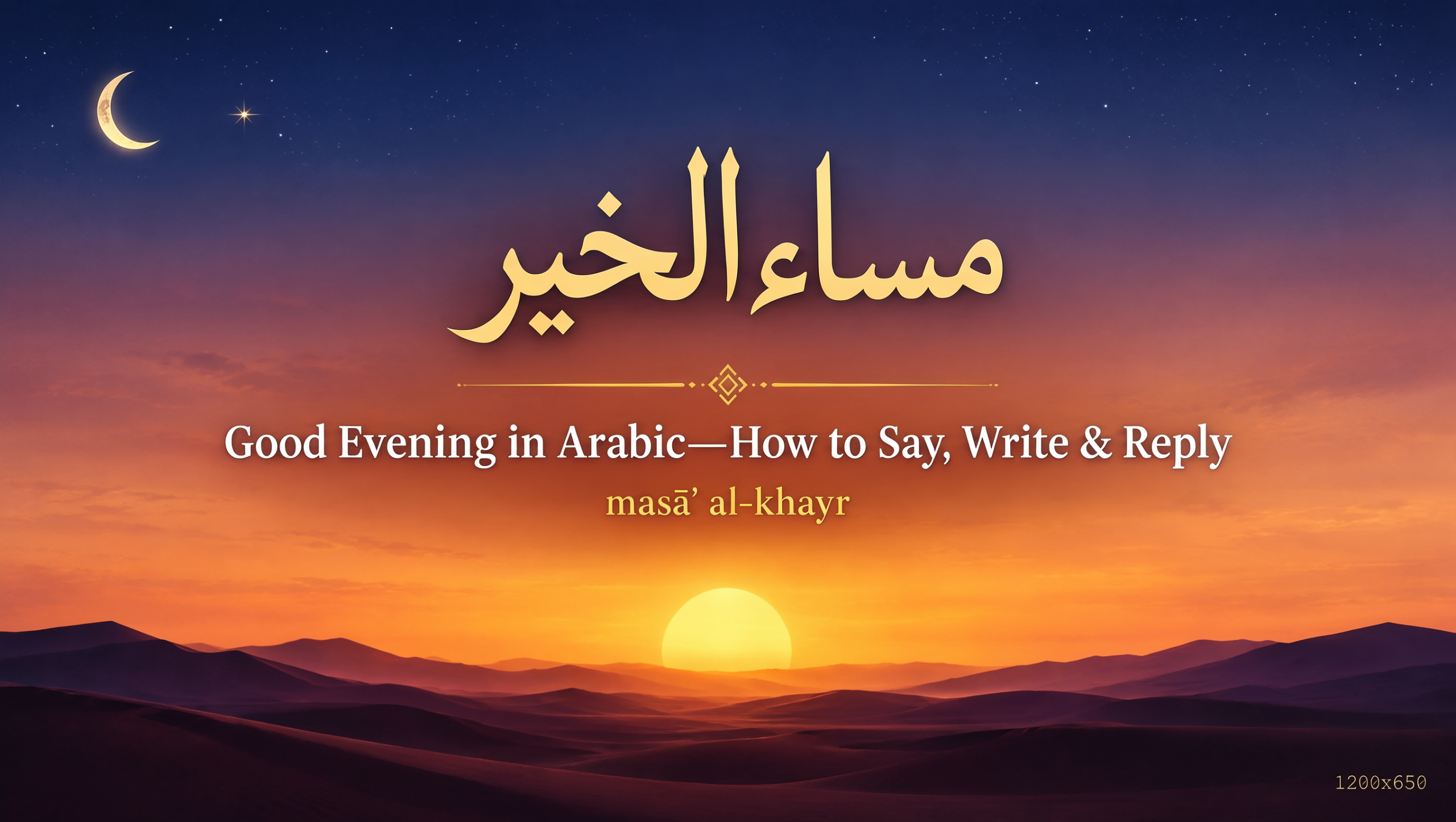
They’re perfect for the morning work chat or the family group. Once it’s past noon, swap the first part for مساء الخير (masāʾ al-khayr), “good evening.”
Example Talks Using Good Day In Arabic
A list tells you what to say. A short conversation shows you when. Each of these is a moment you’re likely to run into.
A Morning Greeting At Work
A: صباح الخير، يوم سعيد! (Ṣabāḥ al-khayr, yawm saʿīd!) Good morning, good day!
B: صباح النور، شكرًا. (Ṣabāḥ an-nūr, shukran.) Good morning, thank you.
Here, yawm saʿīd is just a cheerful extra on top of the morning hello. Person B answers the “good morning” part with ṣabāḥ an-nūr and adds a simple thanks.
It’s a great pattern for your first week at a new job. It’s polite and quick, and it works with anyone: a coworker, the guard at the door, even your manager. If you only take one line away from this article, take this one. And if you’ll need to tell people your name too, read how to introduce yourself in Arabic next.
Saying Goodbye To A Woman In Egypt
A (a man): يلا، مع السلامة. يومك سعيد! (Yalla, maʿa as-salāma. Yōmik saʿīd!) OK, goodbye. Have a happy day!
B (a woman): الله يسلمك، وانت كمان. (Allah yisallimak, w-inta kamān.) God keep you safe, you too.
Look closely at the endings. The man says yōmik, the form for a woman. She answers with w-inta, the form for a man. She also says Allah yisallimak, “God keep you safe,” which is the usual answer to maʿa as-salāma.
It’s a tiny detail, and it’s exactly the one most learners miss. Getting it right shows you care. It’s also much easier to learn with a teacher who hears you and corrects you on the spot.
Students often mention how much they value the teachers and the support team at Kalimah Center, which you can see for yourself in the Kalimah Center reviews on Trustpilot.
A quick look at learning with us
See how a live class works, from the teacher’s explanation to the student’s recitation. It’s a simple way to know what to expect before your first lesson.
Master Arabic with Kalimah Center
Join our expert-led online classes and start your journey toward Arabic fluency today.
Book Your Free TrialStart Speaking Arabic With A Free Trial Class At Kalimah Center
Reading phrases gets you started. Saying them out loud to a real teacher is how they stick, and that’s what you get at Kalimah Center from day one.
When you learn with Kalimah Center, you get:
- Teaching experience since 2011, starting in Cairo before moving online
- Native Arabic tutors with teaching certificates, both male and female
- Live one-on-one lessons, not recorded videos
- A free placement test, so you start at your real level
- A clear path of 16 levels, built on Kalimah Center’s own books
- A certificate after every level you finish
- Flexible lesson times that fit around work and family
You don’t have to pay to find out if it’s right for you. Your first class is free.

Explore Our Courses:
- Online Arabic Course: Tailored to your level, our comprehensive Arabic program includes 16 teaching levels and 400+ hours of personalized sessions.
- Online Quran With Tajweed Course: Perfect for non-Arabic speakers, our course spans 13 levels and equips you with Tajweed mastery from beginner to advanced.
- Online Arabic Course For Kids: Nurture your child’s love for Arabic with our engaging and structured program, available in 24 levels for primary, intermediate, and secondary stages.
Conclusion
So, how do you say good day in Arabic? It really comes down to two phrases. يوم سعيد (yawm saʿīd) is the short “good day,” perfect for cards, posts, and quick sign-offs. أتمنى لك يومًا سعيدًا (atamannā laka yawman saʿīdan) is the full “have a good day,” the one you’ll want for calls, emails, and goodbyes.
In Egypt, try yōmak saʿīd. In the Levant, nahārak saʿīd. In the Gulf, Allah yisʿid yōmak, and in Morocco, nhārek mabrūk. Add ṣabāḥ al-khayr in the morning, and you’ve got a message that sounds like it came from a native speaker.
The little things matter most. Switch -ka to -ki for a woman and to -kum for a group. Give ع and ط their real sounds instead of English stand-ins. And keep a reply in your pocket, like wa-laka ayḍan or Allah yisʿidak, so the conversation doesn’t stall.
Don’t try to learn them all at once. Pick two or three phrases you like and use them this week. Say them out loud, send them in a text, and listen for them in videos and shows. Before long, you’ll know which one fits each moment without having to think about it.
FAQs
Once you start using these phrases, new questions tend to pop up. Here are quick answers to the ones learners ask most.
How Do You Say Have A Great Day In Arabic?
To say have a great day in Arabic, say أتمنى لك يومًا رائعًا (atamannā laka yawman rāʾiʿan). رائع (rāʾiʿ) means great or wonderful, so it sounds more excited than saʿīd.
How Do You Say Good Afternoon In Arabic?
Arabic doesn’t have a separate phrase for good afternoon. From noon on, people say مساء الخير (masāʾ al-khayr), and the reply is مساء النور (masāʾ an-nūr).
How Do You Say Have A Good Night In Arabic?
To say have a good night in Arabic, say تصبح على خير (tuṣbiḥ ʿala khayr), which means “may you wake up to goodness.” The usual reply is وأنت من أهله (wa-anta min ahlih).
How Do You Say Have A Nice Weekend In Arabic?
To say have a nice weekend in Arabic, say عطلة سعيدة (ʿuṭla saʿīda), “a happy holiday.” For a full wish, say أتمنى لك عطلة سعيدة (atamannā laka ʿuṭla saʿīda).
How Do You Say Happy Friday In Arabic?
To say happy Friday in Arabic, say جمعة مباركة (jumʿa mubāraka), “a blessed Friday.” Many Muslims send it to friends and family every week. The usual reply is علينا وعليك (ʿalaynā wa-ʿalayk).
How Do You Say Have A Good Day And Take Care In Arabic?
To say have a good day and take care, say أتمنى لك يومًا سعيدًا، واعتنِ بنفسك (atamannā laka yawman saʿīdan, wa-ʿtani bi-nafsik). To a woman, the last part becomes wa-ʿtanī bi-nafsiki.
Which Letters Spell Good Day In Arabic?
Good day in Arabic is spelled يوم سعيد. The first word uses ي و م (yā, wāw, mīm), and the second uses س ع ي د (sīn, ʿayn, yā, dāl), written from right to left.