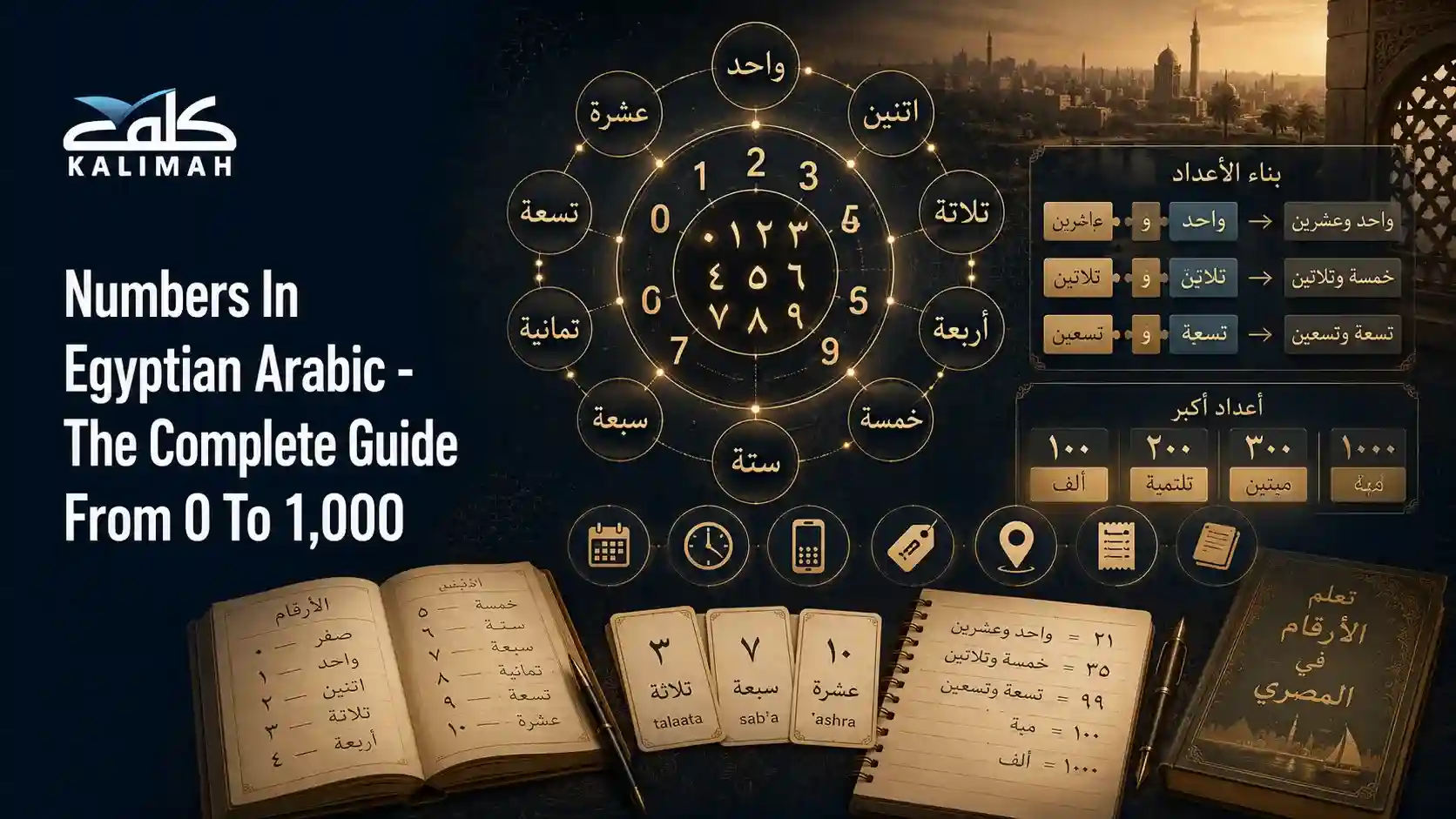
Learning numbers in Egyptian Arabic is one of the first practical skills you need for daily conversation — whether you’re bargaining in a market, telling someone your age, or reading a phone number out loud. Unlike the Arabic alphabet, which reads right to left, Arabic numerals are written and read left to right, with the largest digit first, just like in English.
If you’ve searched for how to say numbers in Egyptian Arabic, or for numbers in the Egyptian language as opposed to Modern Standard Arabic, this guide covers both the differences and the patterns that make them easy to learn.
This guide walks you through numbers in Egyptian Arabic from zero to one thousand, covering cardinals (counting numbers), ordinals (first, second, third), and fractions, plus the pronunciation rules that let you build any number once you know the pattern.
At Kalimah Center, numbers are one of the first topics covered in beginner lessons, because they show up in nearly every real conversation from day one.
Numbers 1–10 In Egyptian Arabic
Numbers 1–10 in Egyptian Arabic are the foundation for every other number in the dialect — once you memorize these ten words, you can build almost any number by combining them with a handful of patterns.
Egyptian Arabic numbers 1–10 are pronounced differently from Modern Standard Arabic in several cases, most noticeably in 3 (talata) and 6 (setta), so it’s worth learning the dialect version separately even if you already know Modern Standard Arabic.
| Number | Arabic | Pronunciation |
| 0 | صفر | sifr |
| 1 | واحد | waahid |
| 2 | اتنين | itneen |
| 3 | تلاتة | talata |
| 4 | أربعة | arba’a |
| 5 | خمسة | khamsa |
| 6 | ستة | setta |
| 7 | سبعة | sab’a |
| 8 | تمانية | tamanya |
| 9 | تسعة | tis’a |
| 10 | عشرة | ashara |
Two of these numbers deserve a closer look because they come up constantly in daily speech. 7 in Egyptian Arabic (sab’a) is used the same way English speakers use “seven” — for the day of the week, a quantity, or a phone number digit.
3 in Egyptian Arabic (talata) also doubles as the word for “Tuesday” (talat) in casual speech, since Arabic weekday names are built from ordinal numbers — a detail that trips up a lot of learners because it looks like a spelling variation rather than a separate word.
One rule that catches beginners off guard: the number “one” has a masculine form (waahid) and a feminine form (wahda), and Egyptian Arabic has no separate word for “a/an.” A book is simply kitaab — the noun stands alone, with no article attached.
If you want a structured way to practice these ten numbers with a native speaker correcting your pronunciation in real time, Kalimah Center’s Best Online Arabic Classes for Adults build numbers into the first few sessions specifically because they get used immediately.
Numbers 11–20 In Egyptian Arabic
Numbers 11 and 12 in Egyptian Arabic don’t follow a predictable pattern and simply need to be memorized as standalone words: hidaashar (11) and itnaashar (12).
From 13 to 19, however, the pattern becomes mechanical — take the base number from 3–9 and add the suffix “-taashar.”
Together, Egyptian numbers 1–20 cover every irregular form you’ll need to memorize by heart; everything past 20 is built from combinations of what you already know.
| Number | Arabic | Pronunciation |
| 11 | حداشر | hidaashar |
| 12 | اتناشر | itnaashar |
| 13 | تلاتاشر | talattaashar |
| 14 | أربعتاشر | arba’tashar |
| 15 | خمستاشر | khamastashar |
| 16 | ستاشر | sittashar |
| 17 | سبعتاشر | saba’tashar |
| 18 | تمنتاشر | tamantashar |
| 19 | تسعتاشر | tisa’tashar |
| 20 | عشرين | ashreen |
Twenty (ashreen) breaks the “-taashar” pattern entirely — it literally translates to “two tens,” which is the same logic used for every multiple of ten from here on.
Recognizing this early saves a lot of confusion, because learners often expect 20 to sound like an extension of 10 (ashara) rather than a new root word.
Read Also: Roman Numerals vs Arabic Numerals
Numbers 20–100 In Egyptian Arabic
Once you know the tens, building any number from 21 to 99 is a matter of combining a single digit with a ten using the word “wa” (و), meaning “and” — the same structure German uses for numbers like “five-and-thirty.”
| Number | Arabic | Pronunciation |
| 20 | عشرين | ashreen |
| 30 | تلاتين | talateen |
| 40 | أربعين | arba’een |
| 50 | خمسين | khamseen |
| 60 | ستين | sitteen |
| 70 | سبعين | saba’een |
| 80 | تمانين | tamaneen |
| 90 | تسعين | tis’een |
| 100 | مية | miya |
A compound number like 21 is built as waahid wa ashreen — literally “one and twenty” — with the smaller digit always stated first, opposite to English word order but matching the way the digits are written (units come before tens in Arabic script, read right to left within the number).
So if someone tells you their age as “ana andi waahid wa ashreen sana,” they’re saying “I am twenty-one years old,” built from ana (I), andi (have), waahid wa ashreen (twenty-one), and sana (year).
A common mistake learners make: they try to say the ten first and the unit second, copying English word order.
In Egyptian Arabic, the smaller number always comes first — get the order backward and native speakers will still understand you, but it marks you immediately as a beginner.
If you’re working through this progression on your own and want feedback on pronunciation patterns like this one, group practice tends to catch these habits faster than solo study. Kalimah Center’s Intensive Arabic Group Classes are built around this kind of peer correction, at a lower cost than private tutoring.
Read Also: Is Glossika good for Arabic?
Egyptian Arabic Numbers 1–100 in Full
For quick reference, numbers in Egyptian Arabic from 1 to 100 follow three combined rules: the base units (1–10), the “-taashar” pattern (11–19), and the tens connected with “wa” (21–99). Below is the extended table covering the full range in ten-number blocks.
Anyone who has searched for Egyptian numbers in English transliteration will notice the same three rules apply whether you’re reading the Arabic script or the Romanized spelling.
| Range | Pattern example |
| 21–29 | واحد وعشرين (21) → تسعة وعشرين (29) |
| 31–39 | واحد وتلاتين (31) → تسعة وتلاتين (39) |
| 41–49 | واحد وأربعين (41) → تسعة وأربعين (49) |
| 51–59 | واحد وخمسين (51) → تسعة وخمسين (59) |
| 61–69 | واحد وستين (61) → تسعة وستين (69) |
| 71–79 | واحد وسبعين (71) → تسعة وسبعين (79) |
| 81–89 | واحد وتمانين (81) → تسعة وتمانين (89) |
| 91–99 | واحد وتسعين (91) → تسعة وتسعين (99) |
Every number in each block follows the exact same construction: unit + wa + tens name. Once you’ve memorized the ten base units and the eight tens words, you effectively know all 100 numbers — there’s no additional vocabulary to learn between 21 and 99.
Inside Kalimah Center: Moments from Our Courses
Get a glimpse into the vibrant learning experience at Kalimah Center. These snapshots capture real moments from our live classes—where students engage deeply, connect with passionate instructors, and grow in a welcoming, supportive environment.
Master Arabic with Kalimah Center
Join our expert-led online classes and start your journey toward Arabic fluency today.
Book Your Free TrialHundreds And Thousands In Egyptian Arabic
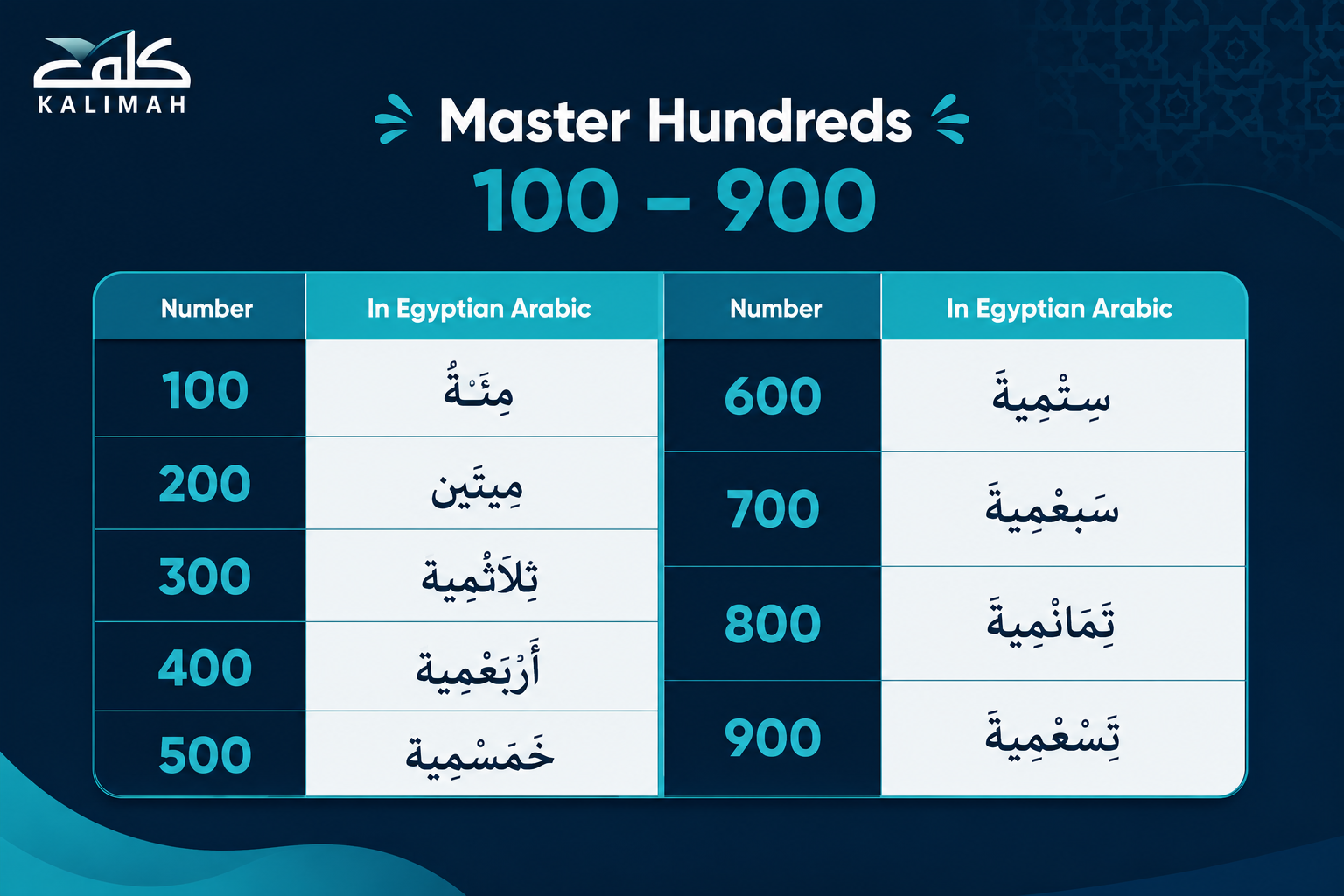
Hundreds in Egyptian Arabic follow their own pattern, separate from the tens. 100 is miya, but from 300 onward, the hundreds use a shortened “prefix” form of the digit combined with “miya,” and every vowel before miya shifts to an “o” sound.
| Number | Arabic | Pronunciation |
| 100 | مية | miya |
| 200 | ميتين | miteen |
| 300 | تلتمية | tultumiya |
| 400 | ربعمية | rub’umiya |
| 500 | خمسمية | khamsumiya |
| 600 | ستمية | suttumiya |
| 700 | سبعمية | subu’miya |
| 800 | تمنمية | tumunumiya |
| 900 | تسعمية | tus’umiya |
| 1,000 | ألف | alf |
| 2,000 | ألفين | alfeen |
How to say 200 in Egyptian Arabic is a common question because it doesn’t follow the “digit + miya” pattern used by 300–900 — it has its own dual form, miteen, the same way “two” (itneen) has a special dual form instead of simply doubling the word.
300 in Egyptian Arabic (tultumiya) is where the shortened prefix pattern starts, and it continues predictably through 900.
When a number combines a hundred with a smaller number — say, 360 — the structure is tultumiya wa sitteen (“three hundred and sixty”), following the same “wa” connector used everywhere else.
Read Also: Learn Arabic with Babbel
Ordinal Numbers in Egyptian Arabic
Ordinal numbers in Egyptian Arabic describe position or sequence — first, second, third — rather than quantity, and they only exist as distinct words from 1 to 10.
From 11 onward, Egyptian Arabic reuses the cardinal number as the ordinal, so “the eleventh day” uses the exact same word as “eleven.”
| Number | Cardinal | Ordinal (m) |
| 1 | واحد | أول (awwil) |
| 2 | اتنين | تاني (taani) |
| 3 | تلاتة | تالت (taalit) |
| 4 | أربعة | رابع (raabi’) |
| 5 | خمسة | خامس (khaamis) |
| 6 | ستة | سادس (saadis) |
| 7 | سبعة | سابع (saabi’) |
| 8 | تمانية | تامن (taamin) |
| 9 | تسعة | تاسع (taasi’) |
| 10 | عشرة | عاشر (aashir) |
Ordinals from 1–9 also change form depending on gender — “the third book” (kitaab il-taalit) uses the masculine taalit, while “the third time” (marra il-talta) uses the feminine talta, since marra (time/occasion) is a feminine noun.
This is a distinction that Modern Standard Arabic learners sometimes miss when they move to the dialect, because Egyptian Arabic keeps gender agreement on ordinals even in casual speech.
Fractions in Egyptian Arabic
Fractions in Egyptian Arabic are short, standalone words rather than compound phrases, and they’re used constantly in cooking, shopping, and giving directions.
| Fraction | Arabic | Pronunciation |
| Half | نص | nooS |
| A third | تلت | tilt |
| A quarter | ربع | rub’a |
| Three quarters | تلات أرباع | talaat arba’a |
Notice that several fractions share a root with their matching ordinal — tilt (a third) and taalit (third) both come from the same three-letter root, t-l-t.
Recognizing these shared roots is one of the fastest ways to expand your vocabulary once you’ve learned the numbers themselves, since Egyptian Arabic — like all Arabic dialects — builds huge families of related words from a small set of root letters.
Read Also: Arabic Numbers History
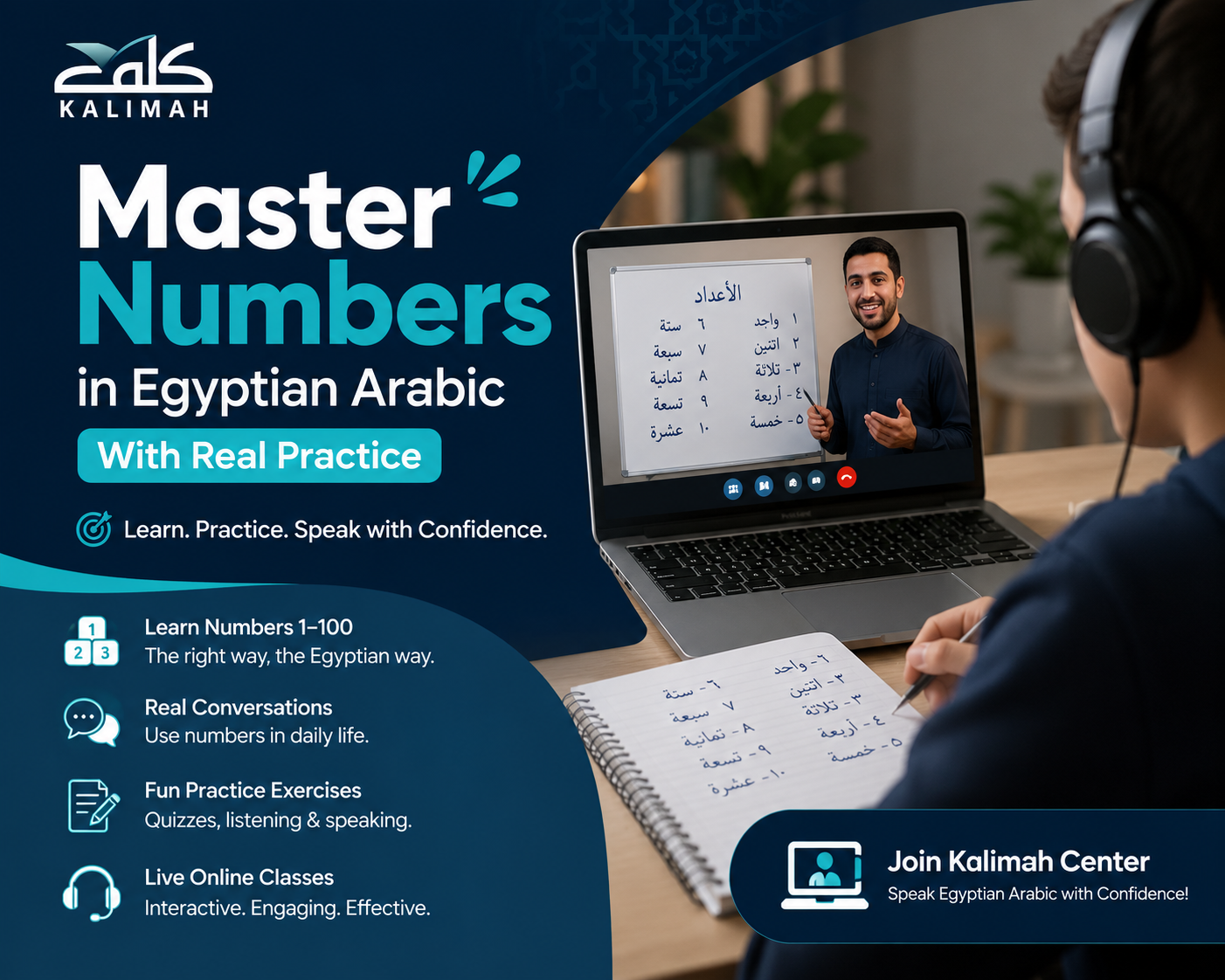
Master Numbers in Egyptian Arabic With Real Practice
Reading a table is not the same as being able to answer a price question at full speed in a Cairo market. The fastest way to make numbers in Egyptian Arabic automatic is through spoken repetition with a teacher who corrects you in the moment, rather than memorization alone.

Kalimah Center’s live courses are built around exactly this kind of active practice, with numbers, dialogue, and real conversation scenarios introduced from the first lessons.
Whether you’re an adult learner starting from scratch or looking for a course to enroll your child in, Kalimah Center has a class format that fits.
Younger learners benefit from the same repetition-based approach, just paced differently. Kalimah Center’s Arabic Program for Kids introduces numbers in Egyptian Arabic through games and songs rather than tables, which tends to stick better for younger age groups.
Inside Kalimah Center: Moments from Our Courses
Get a glimpse into the vibrant learning experience at Kalimah Center. These snapshots capture real moments from our live classes—where students engage deeply, connect with passionate instructors, and grow in a welcoming, supportive environment.
Here Are The Reviews On Our Courses:
Our students frequently commend the excellence of our courses and the commitment shown by our instructors. You can read their complete reviews on Trustpilot.
Read more reviews on Trustpilot

📚 Explore Our Courses:
Online Arabic Course: Tailored to your level, our comprehensive Arabic program includes 16 teaching levels and 400+ hours of personalized sessions.
Online Quran With Tajweed Course: Perfect for non-Arabic speakers, our course spans 13 levels and equips you with Tajweed mastery from beginner to advanced.
Online Arabic Course For Kids: Nurture your child’s love for Arabic with our engaging and structured program, available in 24 levels for primary, intermediate, and secondary stages.
🚀 Start Your Free Trial Today! 🚀
Don’t miss out on this life-changing opportunity to deepen your faith and knowledge. Sign up now for your free trial and take the first step towards becoming a better practicing Muslim with Kalimah Center!
Master Arabic with Kalimah Center
Join our expert-led online classes and start your journey toward Arabic fluency today.
Book Your Free TrialConclusion
Numbers in Egyptian Arabic follow a small set of predictable patterns once you move past the first twenty: units and tens connect with “wa,” hundreds shift their vowels to “miya,” and ordinals only exist as separate words up to ten.
The building blocks are simple — ten base digits, eight tens words, and a handful of connecting rules — but real fluency comes from using them out loud, not just reading them off a page.
Whether you’re learning numbers in Egyptian Arabic for travel, business, or personal study, the same principle applies: repetition in real conversation is what makes the pattern automatic.
If you’re ready to move from recognizing these numbers to using them instantly, structured practice with Kalimah Center is the most direct next step.

Frequently Asked Questions
Here are quick answers to the questions learners most often ask about numbers in Egyptian Arabic.
1. How do you count from 1 to 10 in Egyptian Arabic?
Numbers 1–10 in Egyptian Arabic are: waahid, itneen, talata, arba’a, khamsa, setta, sab’a, tamanya, tis’a, and ashara. These ten words are the foundation for every larger number, since 11 and beyond are built by combining or modifying them.
2. What is 7 in Egyptian Arabic?
7 in Egyptian Arabic is sab’a (سبعة). It’s used the same way in counting, dates, and quantities as in English, with no gender change for most nouns.
3. What is 3 in Egyptian Arabic?
3 in Egyptian Arabic is talata (تلاتة). The same root also appears in “Tuesday” (talat) and in the fraction “a third” (tilt), since Egyptian Arabic numbers and related words often share a common root.
4. How do you say 200 in Egyptian Arabic?
200 in Egyptian Arabic is miteen (ميتين), a dual form rather than a combination of “two” and “hundred.” This is different from 300–900, which combine a shortened digit prefix with miya.
5. What is 300 in Egyptian Arabic?
300 in Egyptian Arabic is tultumiya (تلتمية). From 300 onward, hundreds are formed by joining a modified digit to miya, with the vowel before miya shifting to an “o” sound.
6. How are ordinal numbers different from cardinal numbers in Egyptian Arabic?
Ordinal numbers in Egyptian Arabic (first, second, third) are separate words only from 1 to 10, such as awwil (first) and taalit (third). From 11 onward, Egyptian Arabic reuses the cardinal number itself as the ordinal.