Have you ever recited “Rabbi irhamhuma” without knowing exactly where it comes from in the Quran, or what each Arabic word means? Many Muslims learn this dua as children but have never read the full passage around it.
This guide collects the most important Quran verses about parents in Arabic. Each one has the original text with full tashkeel, a simple transliteration, a clear English meaning, and short notes on the key words. It’s written for adults learning the Quran and for parents teaching their children.
You’ll also find the Quranic duas for parents, the responsibilities the Quran gives fathers and mothers, and practical Tajweed notes, so you can recite these verses correctly and not just read them.
1. Surah Al-Isra 17:23: Treat Your Parents With Ihsan
Among all the Quran verses about parents in Arabic, Surah Al-Isra 17:23 is the best known.. In one decree, Allah joins two commands: worship Him alone, and treat your parents with excellence, especially in old age, when they need you most.
وَقَضَىٰ رَبُّكَ أَلَّا تَعْبُدُوا إِلَّا إِيَّاهُ وَبِالْوَالِدَيْنِ إِحْسَانًا ۚ إِمَّا يَبْلُغَنَّ عِندَكَ الْكِبَرَ أَحَدُهُمَا أَوْ كِلَاهُمَا فَلَا تَقُل لَّهُمَا أُفٍّ وَلَا تَنْهَرْهُمَا وَقُل لَّهُمَا قَوْلًا كَرِيمًا
“And your Lord has decreed that you not worship except Him, and to parents, good treatment. Whether one or both of them reach old age with you, say not to them ‘uff,’ and do not repel them but speak to them a noble word.” (Al-Isra 17:23)
In simple terms, the verse sets a minimum and a goal. The minimum is to avoid any sign of annoyance, even a tired sigh. The goal is ihsan: gentle, generous, and dignified speech, especially in the years when patience is tested most.
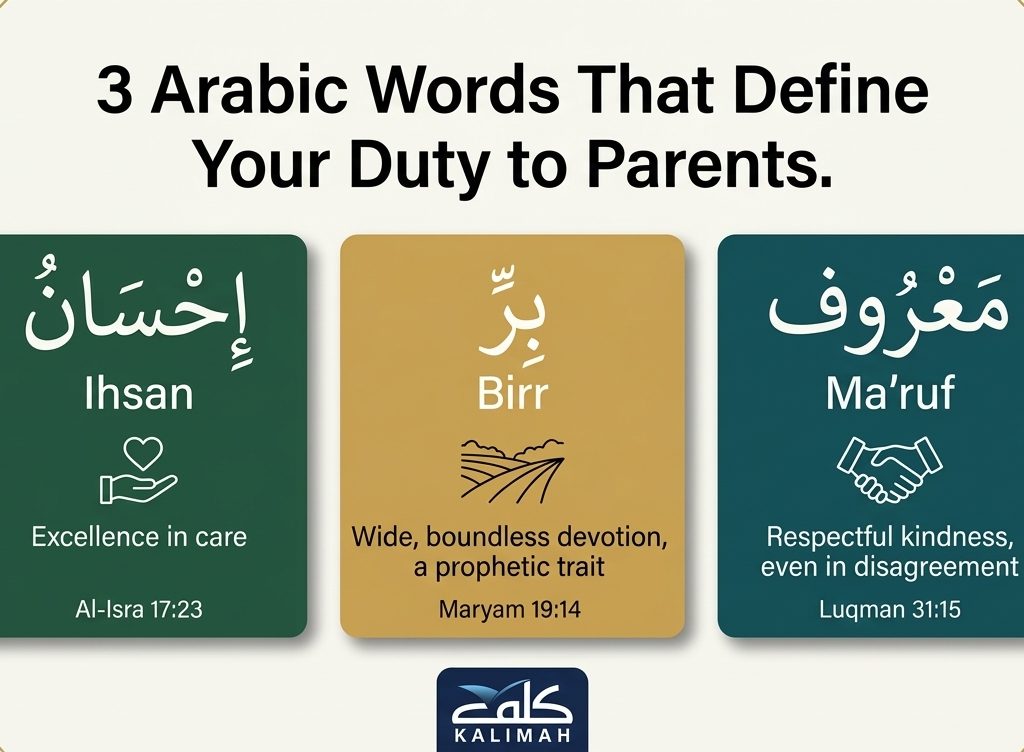
The verb qaḍā (قَضَىٰ) means a binding decree, not a suggestion. Uff (أُفٍّ) is the smallest sound of irritation, and if a sigh is forbidden, raising your voice clearly is too.
2. Surah Al-Isra 17:24: Lower Your Wing of Humility
The next verse moves from words to attitude. After forbidding harsh speech, Allah teaches us how to carry ourselves around our parents, and gives us a short dua Muslims have repeated for centuries, for parents living or deceased.
وَاخْفِضْ لَهُمَا جَنَاحَ الذُّلِّ مِنَ الرَّحْمَةِ وَقُل رَّبِّ ارْحَمْهُمَا كَمَا رَبَّيَانِي صَغِيرًا
“And lower to them the wing of humility out of mercy and say, ‘My Lord, have mercy upon them as they brought me up when I was small.’” (Al-Isra 17:24)
The verse asks for two things: a humble posture and a sincere prayer. Humility here means softness, patience, and putting their comfort before ours. The dua admits that we can never fully repay them, so we ask the Most Merciful to do it for us.
Janāḥ al-dhull (جَنَاحَ الذُّلِّ) is the image of a bird lowering its wing over its young. It describes a humility that comes from mercy, not from weakness.
3. Surah Luqman 31:14: A Mother’s Hardship in Pregnancy and Nursing
Surah Luqman explains why parents hold such a high status. In the middle of Luqman’s advice to his son, Allah pauses to describe what a mother goes through, from pregnancy to nursing, so no child can forget what their life cost her.
وَوَصَّيْنَا الْإِنسَانَ بِوَالِدَيْهِ حَمَلَتْهُ أُمُّهُ وَهْنًا عَلَىٰ وَهْنٍ وَفِصَالُهُ فِي عَامَيْنِ أَنِ اشْكُرْ لِي وَلِوَالِدَيْكَ إِلَيَّ الْمَصِيرُ
“And We have enjoined upon man care for his parents. His mother carried him in weakness upon weakness, and his weaning is in two years. Be grateful to Me and to your parents; to Me is the final destination.” (Luqman 31:14)
Notice that gratitude to parents sits in the same sentence as gratitude to Allah. Wahnan ʿalā wahn describes weakness piling up throughout pregnancy and nursing.
4. Surah Luqman 31:15: When You Should Not Obey Your Parents
Islam doesn’t ask for blind obedience, and this verse draws the line clearly. It covers a hard situation many reverts and families face: parents who push their child away from Allah. Even then, the relationship is never cut off.
وَإِن جَاهَدَاكَ عَلَىٰ أَن تُشْرِكَ بِي مَا لَيْسَ لَكَ بِهِ عِلْمٌ فَلَا تُطِعْهُمَا ۖ وَصَاحِبْهُمَا فِي الدُّنْيَا مَعْرُوفًا
“But if they strive to make you associate with Me that of which you have no knowledge, do not obey them, but accompany them in this world with appropriate kindness.” (Luqman 31:15)
The ruling has two parts. If parents call you to shirk or commit any sin, you refuse politely, because obeying Allah comes first. But you still visit them, serve them, and speak kindly to them, because a difference in faith doesn’t cancel their rights.
This verse sets the balance. Obedience stops at shirk and sin, but ma’ruf (مَعْرُوفًا), respectful kindness, continues. That includes parents who are not Muslim.
Experience Kalimah Center Classes
Watch real excerpts from our live sessions at Kalimah Center and see how we bring learning to life. These clips highlight our interactive, student-centered teaching approach across all our courses—designed to keep learners engaged, motivated, and actively involved every step of the way.
Master Arabic with Kalimah Center
Join our expert-led online classes and start your journey toward Arabic fluency today.
Book Your Free Trial5. Surah Al-Ahqaf 46:15: The 30 Months a Mother Gives Her Child
Surah Al-Ahqaf follows a person’s whole life, from the womb to the age of forty. It shows that duty to parents isn’t a phase of childhood but a lifelong path, and it closes with a beautiful dua for the mature believer.
وَوَصَّيْنَا الْإِنسَانَ بِوَالِدَيْهِ إِحْسَانًا ۖ حَمَلَتْهُ أُمُّهُ كُرْهًا وَوَضَعَتْهُ كُرْهًا ۖ وَحَمْلُهُ وَفِصَالُهُ ثَلَاثُونَ شَهْرًا
“And We have enjoined upon man good treatment to his parents. His mother carried him with hardship and gave birth to him with hardship, and his gestation and weaning is thirty months.” (Al-Ahqaf 46:15)
The verse measures a mother’s effort in months: pregnancy and nursing together take thirty. Scholars read it alongside Al-Baqarah 2:233, which sets nursing at two years. That leaves six months as the shortest possible pregnancy, a precise detail found in the Quran itself.
Kurhan (كُرْهًا) is repeated twice, once for pregnancy and once for childbirth. It honestly names the pain motherhood involves.
6. Surah Maryam 19:14: Prophets Yahya and Isa Were Dutiful to Their Parents
When Allah praises His Prophets in Surah Maryam, He mentions how they treated their parents. Prophet Yahya is called dutiful to both parents, and Prophet Isa, speaking as a baby in the cradle, describes himself as dutiful to his mother.
وَبَرًّا بِوَالِدَيْهِ وَلَمْ يَكُن جَبَّارًا عَصِيًّا (about Yahya)
“And dutiful to his parents, and he was not a disobedient tyrant.” (Surah Maryam 19:14)
وَبَرًّا بِوَالِدَتِي وَلَمْ يَجْعَلْنِي جَبَّارًا شَقِيًّا (Isa speaking from the cradle)
“And [He made me] dutiful to my mother, and He has not made me a wretched tyrant.” (Surah Maryam 19:14)
This is why reading Quran verses about parents in Arabic matters: words like birr carry meanings no translation fully captures, which is why many learners add Fusha Arabic classes online to their Quran study.
Barr (بَرّ) comes from a root meaning wide, open land. Allah describes two Prophets with it, which tells us that devotion to parents belongs to prophetic character.
7. Surah An-Nisa 4:36 and Al-An’am 6:151: Kindness to Parents Comes Right After Tawhid
Two more passages confirm the same pattern. In An-Nisa, kindness to parents opens a long list of social duties. In Al-An’am, it appears among the major commandments the Prophet ﷺ was told to recite to people.
وَاعْبُدُوا اللَّهَ وَلَا تُشْرِكُوا بِهِ شَيْئًا ۖ وَبِالْوَالِدَيْنِ إِحْسَانًا ( An-Nisa 4:36)
“Worship Allah and associate nothing with Him, and to parents do good…”
قُلْ تَعَالَوْا أَتْلُ مَا حَرَّمَ رَبُّكُمْ عَلَيْكُمْ ۖ أَلَّا تُشْرِكُوا بِهِ شَيْئًا ۖ وَبِالْوَالِدَيْنِ إِحْسَانًا (6:151 Al-An’am)
“Say, ‘Come, I will recite what your Lord has prohibited to you: that you not associate anything with Him, and to parents, good treatment…’”
Together, these verses show that faith starts at home. Before neighbors, orphans, or strangers, a believer’s character is tested with the two people closest to them. Honoring parents isn’t optional etiquette; it sits at the core of Islam.
In both passages, honoring parents comes immediately after Tawhid. That repeated placement is one of the clearest themes across all the Quran verses about parents in Arabic.
Quranic Verses on Parents in Arabic: Duas and Parental Duties
The Quran doesn’t only tell children how to treat parents. It also teaches duas to say for them and gives parents responsibilities of their own. These Quranic verses on parents in Arabic complete the picture.
Quranic Duas for Parents in Arabic
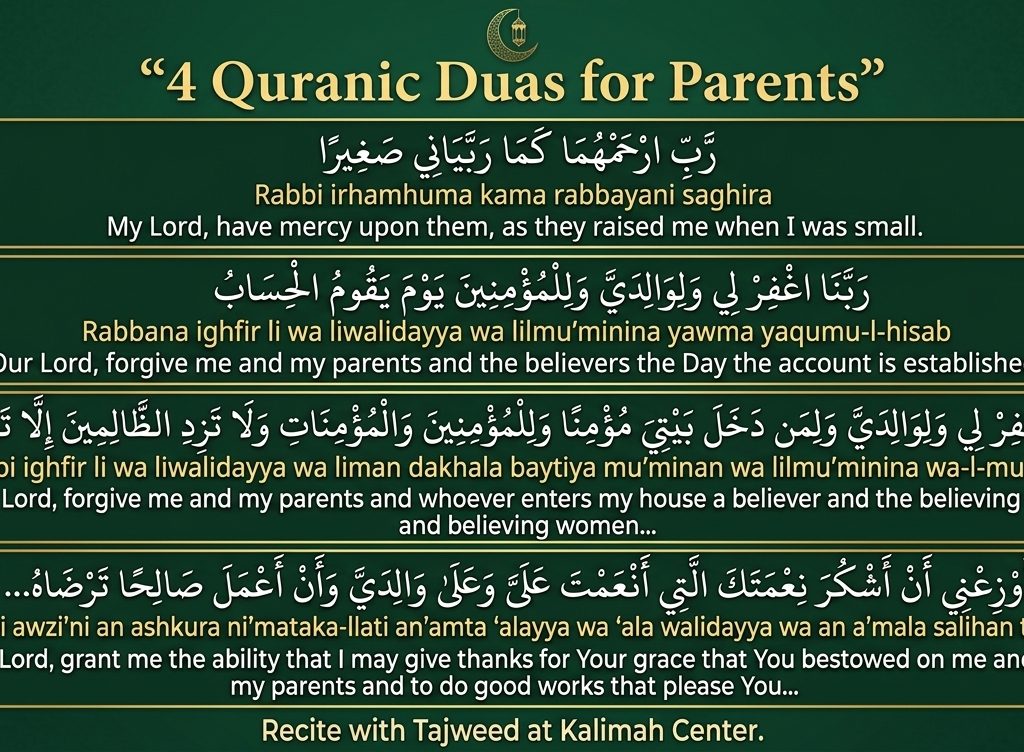
These duas are the most practical Quran verses about parents in Arabic to memorize, and saying them daily is one of the easiest ways to honor your parents, whether they are living or have passed away. If you’d like to go further and memorize full surahs, Hifz classes for adults help you build the habit step by step.
رَّبِّ ارْحَمْهُمَا كَمَا رَبَّيَانِي صَغِيرًا:
“My Lord, have mercy on them as they raised me when I was small.” (17:24)
رَبَّنَا اغْفِرْ لِي وَلِوَالِدَيَّ وَلِلْمُؤْمِنِينَ يَوْمَ يَقُومُ الْحِسَابُ:
“Our Lord, forgive me, my parents and the believers on the Day the account is established.” (Ibrahim 14:41)
رَّبِّ اغْفِرْ لِي وَلِوَالِدَيَّ وَلِمَن دَخَلَ بَيْتِيَ مُؤْمِنًا:
“My Lord, forgive me, my parents and whoever enters my house a believer.” (Nuh 71:28)
رَبِّ أَوْزِعْنِي أَنْ أَشْكُرَ نِعْمَتَكَ الَّتِي أَنْعَمْتَ عَلَيَّ وَعَلَىٰ وَالِدَيَّ:
“My Lord, enable me to be grateful for Your favor upon me and upon my parents.” (46:15, 27:19)
What the Quran Asks of Parents
The Quran doesn’t leave parenting to guesswork — it names the duty directly, and shows exactly how it should be delivered.
يَا أَيُّهَا الَّذِينَ آمَنُوا قُوا أَنفُسَكُمْ وَأَهْلِيكُمْ نَارًا
“O you who believe, protect yourselves and your families from a Fire,” At-Tahrim 66:6).
A parent’s first duty is spiritual protection.
Luqman shows how to do it: يَا بُنَيَّ لَا تُشْرِكْ بِاللَّهِ (31:13). He begins with the tender “yā bunayya” (my dear son), then teaches Tawhid. Warmth comes first, then the lesson.
For families, this is where learning together pays off. When parents and kids study the Quran side by side, for example in Kalimah Center’s online Quran course, both lessons are lived out at home.
Authentic Hadith That Explain These Verses
The Sunnah puts these verses into practice. Asked who most deserves good companionship, the Prophet ﷺ said: “your mother” three times, then “your father” (Bukhari 5971).
He also warned against the person who has a parent reaching old age and still fails to enter Paradise by serving them (Muslim 2551). Old age is presented as an opportunity, not a burden.
Inside Kalimah Center: Moments from Our Courses
Get a glimpse into the vibrant learning experience at Kalimah Center. These snapshots capture real moments from our live classes—where students engage deeply, connect with passionate instructors, and grow in a welcoming, supportive environment.
Master Arabic with Kalimah Center
Join our expert-led online classes and start your journey toward Arabic fluency today.
Book Your Free TrialHow to Recite These Verses Correctly With Tajweed
Knowing the meaning is half the journey. Reciting the Quran verses about parents in Arabic correctly means applying a few Tajweed rules that show up again and again in these passages.
1. Tajweed Notes on Al-Isra 17:23–24
Al-Isra 17:23–24 packs several commonly missed Tajweed rules into just two verses — here’s what to watch for as you recite them:
- وَقُل لَّهُمَا: the sakin lam merges into the next lam (idgham mithlayn), so you say “wa qul-lahumā.”
- أُفٍّ وَلَا: tanween before waw takes idgham with ghunnah, a nasal merge held for two counts.
- قَوْلًا كَرِيمًا: tanween before kaf takes ikhfa, a hidden nasal sound.
- رَبِّ ارْحَمْهُمَا: the hamzat al-wasl is dropped when you join the words: “rabbi-rḥamhumā.”
2. Tajweed Note on Luqman 31:14
وَهْنًا عَلَىٰ وَهْنٍ وَفِصَالُهُ: the first tanween is shown clearly (izhar) before the ʿayn, and the second merges with ghunnah before the waw. Small details like these change how the verse sounds.
These rules are hard to perfect from a page alone. A Tajweed course online with a native Arabic tutor corrects your recitation live, verse by verse. Beginners can start with Tajweed for beginners.
3. Teaching These Verses to Children
When teaching children Quran verses about parents in Arabic, start with 17:24 because it’s short, rhythmic, and full of meaning. Explain one word a day, such as rahmah or janah, and connect it to a real moment of kindness at home.
Children recite more accurately when they get regular feedback. Programs like Tajweed for kids online and the Arabic for children course help them read and understand these verses with confidence.
Learn to Recite Quran Verses About Parents in Arabic at Kalimah Center
Turn these verses from words on a screen into a recitation you’re proud of. Kalimah Center offers live one-on-one Quran, Tajweed, and Arabic classes with professional native Arabic tutors for kids and adults at every level.
You can choose a male teacher or a female teacher for sisters and kids. You can study individually or in group classes, on a schedule that fits your family’s routine.
Explore Our Courses:
- Online Arabic Course: Tailored to your level, our comprehensive Arabic program includes 16 teaching levels and 400+ hours of personalized sessions.
- Online Quran With Tajweed Course: Perfect for non-Arabic speakers, our course spans 13 levels and equips you with Tajweed mastery from beginner to advanced.
- Online Arabic Course For Kids: Nurture your child’s love for Arabic with our engaging and structured program, available in 24 levels for primary, intermediate, and secondary stages.
Want to understand Quran verses about parents in Arabic without relying on translation? Combine Tajweed with Quranic Arabic. Book your free trial lesson today and take the first step with an expert by your side.
Master Arabic with Kalimah Center
Join our expert-led online classes and start your journey toward Arabic fluency today.
Book Your Free TrialConclusion
The Quran verses about parents in Arabic repeat one clear message: honoring parents comes right after worshipping Allah. Al-Isra sets the standard of ihsan, Luqman and Al-Ahqaf honor a mother’s sacrifice, and Maryam shows that birr is a prophetic trait.
The balance is just as important. You don’t obey parents in sin, but kindness (ma’ruf) never ends. Parents also carry a duty: to protect their families spiritually and teach Tawhid gently, as Luqman did.
Main takeaway: memorize at least one dua for your parents, recite it with correct Tajweed, and live its meaning every day. Reading Quran verses about parents in Arabic, exactly as they were revealed, is the most direct way to feel their depth.
FAQs
Here are quick answers to the questions people most often ask about the Quran verses about parents in Arabic.
What is the most important Quran verse about parents in Arabic?
Surah Al-Isra 17:23 is considered the foundational verse. It joins the command to worship Allah alone with the command of ihsan toward parents, and it forbids even saying “uff” to them in old age.
What is the dua for parents in the Quran in Arabic?
The best-known one is رَّبِّ ارْحَمْهُمَا كَمَا رَبَّيَانِي صَغِيرًا (Al-Isra 17:24). Others are رَبَّنَا اغْفِرْ لِي وَلِوَالِدَيَّ (Ibrahim 14:41) and رَّبِّ اغْفِرْ لِي وَلِوَالِدَيَّ (Nuh 71:28).
Does the Quran say to obey parents in everything?
No. Surah Luqman 31:15 and Al-Ankabut 29:8 say not to obey parents if they push you toward shirk or sin. The same verse still commands you to treat them with kindness in worldly matters.
What does the Quran say about mothers specifically?
Luqman 31:14 describes the mother carrying her child “in weakness upon weakness,” and Al-Ahqaf 46:15 mentions hardship in both pregnancy and childbirth. The Sunnah then names the mother three times before the father.
How can I teach my child Quran verses about parents in Arabic?
Start with short verses like 17:24. Explain one Arabic word at a time, practice daily, and use a qualified teacher to correct pronunciation and Tajweed from the beginning.