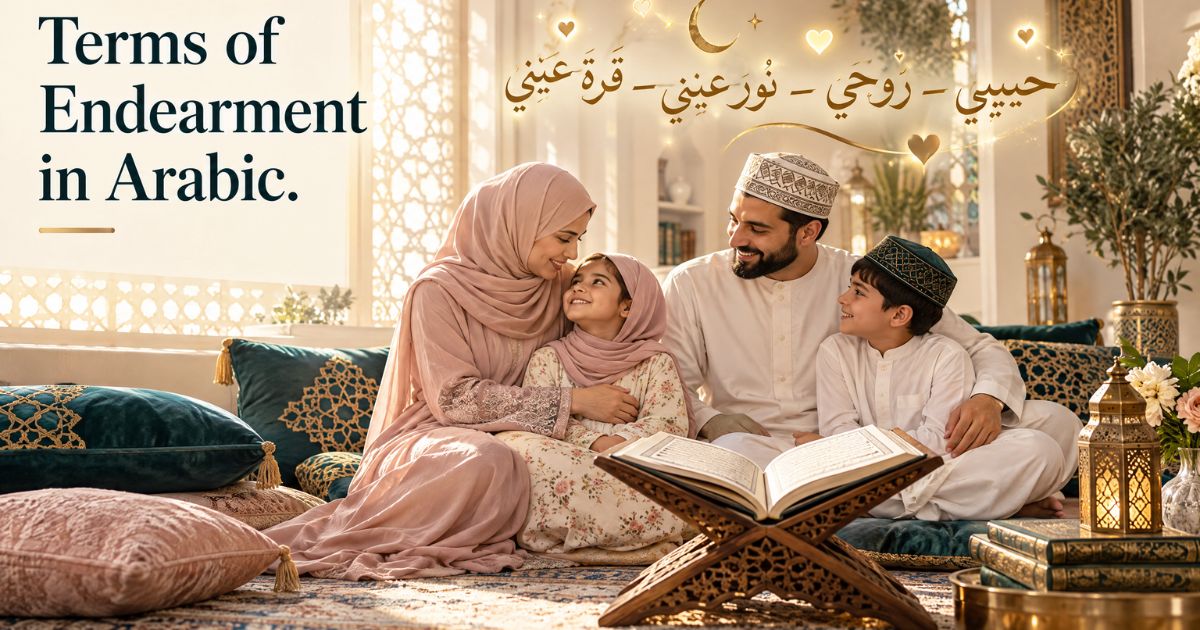
Have you ever heard someone say “habibi” in a song and wondered what it really means? You are not alone. Arabic is one of the richest languages in the world for expressing affection, and its sweet words go well beyond a simple “I love you.”
Learning terms of endearment in Arabic gives you a view into Arab culture, family life, and even the language of the Quran. Many of these expressions name the most precious things a person has, like the soul, the heart, and the eyes, to show how dear someone is.
In this guide, you will find the most common terms of endearment in Arabic, what they mean, and who to say them to: your spouse, your children, your family, and your friends. We also cover popular Egyptian expressions and classical phrases from poetry and the Quran.
Take Away: What You Will Learn
- The most common terms of endearment in Arabic with meaning and pronunciation
- Which terms of endearment in Arabic suit a husband or wife, a child, family members, or friends
- Popular terms of endearment in Egyptian Arabic that you will hear every day
- Beautiful classical and Quranic expressions of love and care
- A simple grammar trick for building your own affectionate phrases
Terms of Endearment in Arabic
Terms of endearment in Arabic are affectionate words and nicknames that show love, care, and respect. They range from deeply romantic phrases between spouses to gentle words for children and warm greetings between friends.
What makes terms of endearment in Arabic special is their imagery. Where English uses “sweetie” or “honey,” Arabic speakers call a loved one “my soul,” “my life,” or “the light of my eye.” The message is clear: you are as precious to me as life itself.
Arabic Words for Love: More Than One Kind
Arabic has many love words, and each one describes a different depth or stage of the feeling. Knowing them helps you see why terms of endearment in Arabic feel so layered.
| Arabic | Transliteration | Meaning |
| حب | ḥubb | Love (general) |
| ودّ | wudd | Warm, gentle affection |
| هوى | hawā | Inclination, attraction |
| شغف | shaghaf | Love that reaches the core of the heart |
| عشق | ʿishq | Passionate love |
| غرام | gharām | Intense, clinging love |
The root of wudd also gives us one of Allah’s beautiful names, Al-Wadūd (The Most Loving), mentioned in Surah Al-Burūj, verse 14. Quran learners will recognize this root in many verses.
A Simple Grammar Tip for Learners
Most terms of endearment in Arabic end with the suffix -ī, which means “my.” For example, rūḥ means “soul,” so rūḥī means “my soul.” Put the calling particle yā in front of it, and you get yā rūḥī, “O my soul.”
Once you know this pattern, you can understand dozens of phrases right away. If you want to build this kind of vocabulary step by step, the Online Arabic Course at Kalimah Center teaches it with native tutors.
Terms of Endearment in Arabic With Meaning
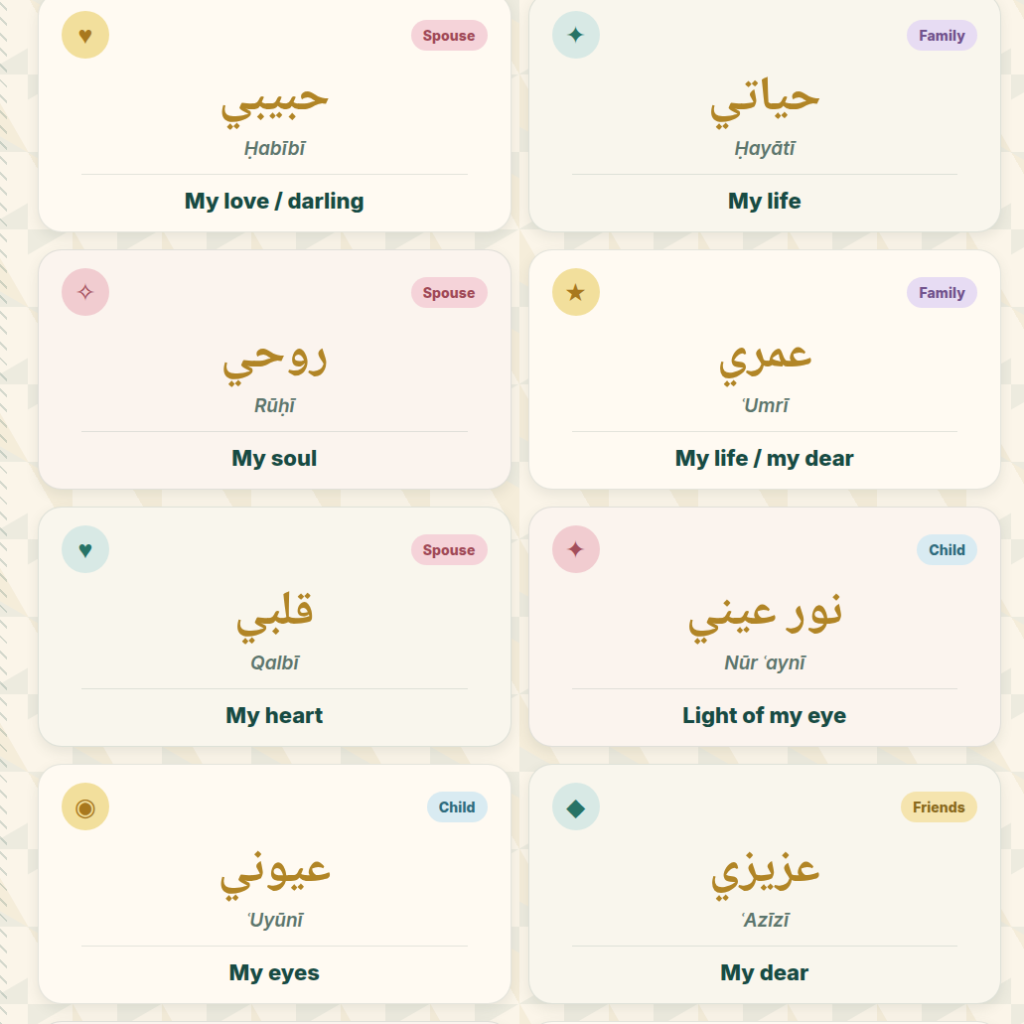
Below are the most widely used terms of endearment in Arabic with meaning. They are understood across the Arab world, in both Modern Standard Arabic and most dialects.
| Arabic | Transliteration | Literal Meaning | Best Used With |
| حبيبي / حبيبتي | ḥabībī / ḥabībtī | My beloved (m/f) | Spouse, children, close friends |
| حياتي | ḥayātī | My life | Spouse |
| روحي | rūḥī | My soul | Spouse, children, parents |
| عمري | ʿumrī | My lifetime | Spouse, children |
| قلبي | qalbī | My heart | Spouse, children |
| نور عيني | nūr ʿaynī | Light of my eye | Children, spouse, parents |
| عيوني | ʿuyūnī | My eyes | Anyone close to you |
| عزيزي / عزيزتي | ʿazīzī / ʿazīzatī | My dear | Formal and friendly settings |
| غالي / غالية | ghālī / ghālya | Precious one | Family and friends |
| يا قمر | yā qamar | O moon | Children, friends, spouse |
For more everyday expressions, read our guide to learning Arabic phrases and sentences.
Experience Kalimah Center Classes
Watch real excerpts from our live sessions at Kalimah Center and see how we bring learning to life. These clips highlight our interactive, student-centered teaching approach across all our courses—designed to keep learners engaged, motivated, and actively involved every step of the way.
Master Arabic with Kalimah Center
Join our expert-led online classes and start your journey toward Arabic fluency today.
Book Your Free TrialTerms of Endearment in Arabic for Husband
Couples in the Arab world use some of the deepest terms of endearment in Arabic. Many of these words work for both a husband and a wife, while a few are specific to one gender.
Romantic Words Between Spouses
Married couples often use these words in daily life, in love letters, and in sweet messages. Each one shows how deeply a spouse is loved and valued.
- Habibi / Habibti (My beloved): The classic word of love, heard in countless songs and love letters.
- Yā rūḥ qalbī (Soul of my heart): Joins “soul” and “heart” for an even deeper meaning.
- Muhjat qalbī (My heart’s blood): A classical phrase meaning the person lives at the very center of your heart.
Words a Wife Can Say to Her Husband
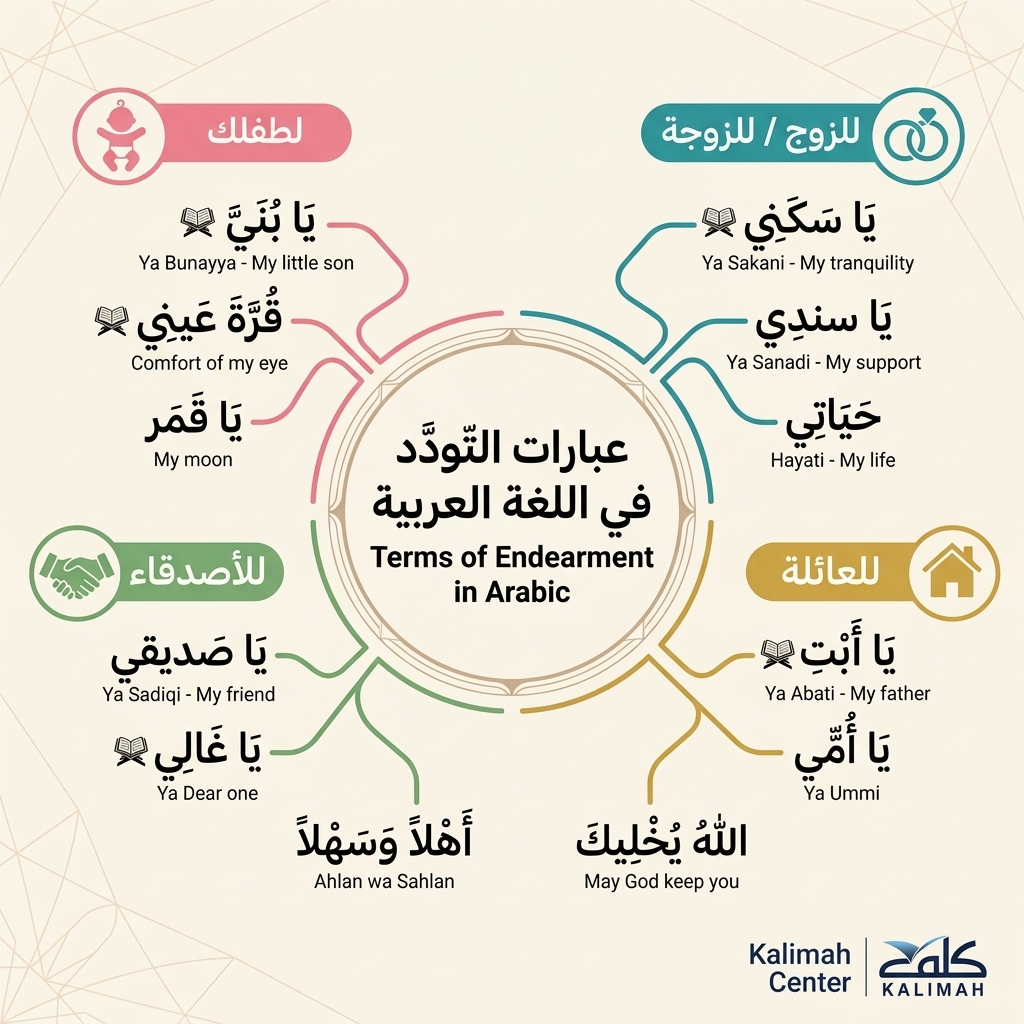
A wife might call her husband yā sanadī (my support) or tāj rāsī (crown of my head) to show respect and pride. Another lovely choice is yā sakanī, “my place of calm.”
This word connects directly to Surah Ar-Rūm, verse 30:21, where Allah describes spouses as a source of sakan, calm and peace, for one another. Few terms of endearment in Arabic carry such a beautiful spiritual meaning.
The Prophet ﷺ also showed affection by shortening his wife’s name, calling Aisha “Yā ʿĀʾish,” as recorded in Sahih al-Bukhari 3768.
Arabic Terms of Endearment for Child
Parents in the Arab world shower their children with love. The Arabic terms of endearment for a child below are gentle, playful, and warm.
Everyday Words for Sons and Daughters
Common choices include yā ḥabībī (my beloved), yā ʿumrī (my life), yā qalbī (my heart), and yā ḥilw / yā ḥilwa (sweet one). Many parents also call a daughter yā ʿaṣfūra (little bird). See more in our list of Arabic words for kids.
Quranic Words Parents Can Use
The Quran itself shows how to speak to children with tenderness. Luqman addresses his son as yā bunayya, “O my dear little son,” in Surah Luqman 31:13. The Prophet ﷺ used the same word with young Anas, as reported in Sahih Muslim 2151.
Another Quranic phrase is qurrat ʿayn (comfort of the eyes), from the well-known dua in Surah Al-Furqān 25:74. Saying yā qurrat ʿaynī to your child is both loving and meaningful.
Children who learn these words through the Quran remember them for life. Our Tajweed for Kids Online program helps young learners recite these verses correctly and understand what they mean.
Arabic Terms of Endearment for Family
Family bonds sit at the heart of Arab culture, so there are many Arabic terms of endearment for family members.
These words show deep respect for parents and grandparents, warmth toward siblings, and the strong family ties that Islam encourages through ṣilat al-raḥim, kindness to relatives.**
For Parents and Grandparents
Children often call their mother yā ummī or yā māmā, and their father yā abī or yā bābā. Grandparents are lovingly called yā jaddī and yā jaddatī, or jiddo and teta in Egyptian and Levantine homes, often with a kiss on the hand as a sign of respect.
In the Quran, Prophet Yusuf calls his father yā abati, “O my dear father” (Surah Yusuf 12:4). This tender form carries extra love and respect, and Prophet Ibrahim uses the same word when he speaks gently to his father in Surah Maryam 19:42.
For Siblings and Relatives
Siblings say yā akhī (my brother) and yā ukhtī (my sister) with real affection**, and close cousins often use the same words. Children call their uncles ʿammū (father’s brother) and khālū (mother’s brother), and their aunts ʿammitū and khālitū, words that carry great warmth.**
Another very common family phrase is Allāh yikhallīk, “May God keep you,” often said with a smile after a kind act. To learn the full vocabulary, see our guide to family members in Arabic and practice these words with your loved ones at home.
Inside Kalimah Center: Moments from Our Courses
Get a glimpse into the vibrant learning experience at Kalimah Center. These snapshots capture real moments from our live classes—where students engage deeply, connect with passionate instructors, and grow in a welcoming, supportive environment.
Master Arabic with Kalimah Center
Join our expert-led online classes and start your journey toward Arabic fluency today.
Book Your Free TrialArabic Terms of Endearment for Friends
Friendship has its own warm vocabulary. Arabic terms of endearment for friends are lighter than romantic words but still full of respect and care.
Common Words Between Friends
Friends often say yā ṣadīqī (my friend), yā akhī (my brother, even without family ties), yā ghālī (precious one), and yā ʿazīzī (my dear). Between close male friends, ḥabībī is also common in casual speech and simply means “my dear friend.”
These words reflect the Islamic value of brotherhood and sincere friendship. The Prophet ﷺ even advised that when you love your brother, you should tell him so, as reported in Sunan Abi Dawud 5124, which makes kind words part of good manners.
Warm Welcoming Phrases
Arabic hospitality shows in its greetings. Ahlan wa sahlan (welcome), ḥayyāk Allāh (may God greet you with life), and ḥalalta ahlan wa waṭiʾta sahlan (you have come to family and stepped onto easy ground) all make a guest feel at home. You can find more in our article on how to say hi in Arabic.
Poetic welcomes are popular too, such as marḥaban bik ʿadad nujūm al-samāʾ, “welcome to you as many times as the stars in the sky.” You can find more friendly greetings in our article on how to say hi in Arabic and use them with friends every day.
Terms of Endearment in Egyptian Arabic
Egyptian Arabic is known across the region thanks to its films and music. Many terms of endearment in Egyptian Arabic sound softer because the letter qāf is usually pronounced as a glottal stop.
Popular Egyptian Expressions
Below are the Egyptian words you will hear most often in Cairo’s streets, in family homes, and in classic movies. Each one is easy to use, and most work for both men and women in daily conversation.
- Yā ʾalbī (My heart): The Egyptian form of qalbī.
- Yā ʾamar (O moon): Said to someone beautiful, especially a child.
- Yā ʿasal (O honey): A sweet word for a lovely person.
- Yā ṣāḥbī (My buddy): A friendly word between friends.
- Yā basha (O pasha): A playful, respectful way to address a friend.
Regional Expressions From Other Dialects
Other regions add their own terms of endearment in Arabic. In the Gulf, yā baʿd ʿumrī means “you are dearer than my life.” In the Levant, tuqburnī means “may you bury me,” because the speaker cannot imagine living without you.
Classical Terms of Endearment in Arabic From Poetry
Classical Arabic offers some of the most elegant terms of endearment in Arabic. You will find them in pre-Islamic and Abbasid poetry, in classical literature, and throughout the hadith collections**, where the Companions expressed their love for the Prophet ﷺ in moving, poetic words.
Timeless Phrases Worth Knowing
Bi-abī anta wa ummī means “may my father and mother be ransomed for you.” The Companions used it to show their deep love for the Prophet ﷺ. Yā rayḥānat al-fuʾād means “O sweet basil of the heart,” comparing a loved one to a fragrant plant.
Understanding these phrases takes strong reading skills in classical Arabic. The Arabic Reading Course at Kalimah Center helps you read these texts confidently, with correct pronunciation.
Start Learning Arabic and Quran With Kalimah Center Today
Terms of endearment in Arabic mean far more when you understand them in their original language. At Kalimah Center, kids and adults learn Arabic and the Quran step by step with qualified native tutors.
Join our Learn Quran Online Course for Tajweed and recitation circles, or choose the Online Arabic Course to speak and read Arabic fluently. Children enjoy fun, structured lessons in our Arabic Course for Kids.
Explore Our Courses:
- Online Arabic Course: Tailored to your level, our comprehensive Arabic program includes 16 teaching levels and 400+ hours of personalized sessions.
- Online Quran With Tajweed Course: Perfect for non-Arabic speakers, our course spans 13 levels and equips you with Tajweed mastery from beginner to advanced.
- Online Arabic Course for Kids: Nurture your child’s love for Arabic with our engaging and structured program, available in 24 levels for primary, intermediate, and secondary stages.
Classes are flexible, available one-on-one or as group classes, and built around your schedule. Book your free trial lesson today and take your first step toward the language of the Quran.
Master Arabic with Kalimah Center
Join our expert-led online classes and start your journey toward Arabic fluency today.
Book Your Free TrialConclusion
Terms of endearment in Arabic are more than sweet nicknames. They reflect a culture that values family, friendship, and close emotional bonds, and they use the soul, the heart, and the eyes to show how precious people are.
You now know which terms of endearment in Arabic suit a husband or wife, a child, family members, and friends. You have also seen popular Egyptian expressions, regional phrases, and classical expressions from poetry, the Quran, and the Sunnah.
The takeaway is simple: learn a few terms of endearment in Arabic and start using them with the people you love. Each word brings you closer to fluent Arabic and a deeper understanding of the Quran.
FAQs
Here are quick answers to the questions learners ask most often about terms of endearment in Arabic.
What is the most common term of endearment in Arabic?
Ḥabībī (for a male) and ḥabībtī (for a female) are the most common. Both mean “my beloved” and are understood in every Arabic dialect and in Modern Standard Arabic.
What do Arabs call their husband?
Wives often call their husbands ḥabībī, ḥayātī (my life), rūḥī (my soul), or yā sanadī (my support). The choice depends on the dialect and the couple’s own style.
What is a cute Arabic nickname for a child?
Popular choices include yā qamar (moon), yā ʿumrī (my life), yā ḥilw (sweet one), and the Quranic yā bunayya (my dear little son).
Can I say habibi to a friend?
Yes. In everyday speech, especially in Egypt and the Levant, ḥabībī is widely used between close friends of the same gender to show friendliness and warmth.
What does “ya rouhi” mean in Arabic?
Yā rūḥī means “O my soul.” It tells someone they are as precious to you as your own soul, and it is used with spouses, children, and parents.