Interrogative particles in Arabic are essential for forming questions, divided into nouns (e.g., “مَنْ” for “who”) and particles (e.g., “هَلْ” for yes/no questions). These particles typically appear at the start of a sentence and are gender-neutral, except “أيّ,” which changes depending on its grammatical role.
In a previous article, we provided a general overview of Arabic particles, briefly touching upon interrogative particles. This article delves deeper into Arabic question words, emphasizing the broader term “tools” or interrogative words to encompass both particle and noun types. Let’s explore these interrogative words in Aarabic.
What Are Interrogative Particles in Arabic?
Arabic grammarians define interrogative words as a specific category of words used at the beginning of a sentence to seek information about an unknown element, be it a person, object, place, time, or manner.
The term استفهام (istifhām) in Arabic comes from the root ف-ه-م (f-h-m), which means understanding. Linguistically, it means “requesting to understand,” while in grammar, it refers to a specific structure used to inquire about something unknown or unclear to the speaker.
How do Interrogative Particles Work in the Arabic Sentence?
Interrogative particles in Arabic always appear at the beginning of an interrogative sentence. They signal to the listener that a question is being asked, just like a question mark does in English.
Let’s look at some examples:
ماذا تريد؟
What do you want?
Here, “ماذا” (matha – what) is at the beginning, signaling the question.
أينَ المسجد؟
Where is the mosque?
Again, “أينَ” (ayna – where) starts the question.
Key Elements of Interrogative Structures in Arabic
To properly construct an interrogative sentence in Arabic, two essential components are needed:
1. Interrogative Particle (أداة الاستفهام)
This is the word used to indicate a question. Examples include ما (mā) and من (man).
2. Subject of the Question (المستفهم عنه)
This is what the question is about, such as a person, thing, or place.
For example:
ما اسمك؟ (Mā ismuka?)
What is your name?
The interrogative particle is ما (mā), the subject of the question is اسم (ism), and the answer might be a name like خالد (Khalid).
Master Arabic with Kalimah Center
Join our expert-led online classes and start your journey toward Arabic fluency today.
Book Your Free TrialFunction of Interrogative Words in Arabic
Arabic interrogative words serve to seek information. They are the tools we use to express our curiosity, to delve into the unknown, and to gain a deeper understanding of the world around us.
But their function goes beyond simply asking questions. They can also be used to express a variety of emotions and intentions. Let’s explore some of these nuances:
- Genuine Inquiry (استفهام حقيقي): This is the most common function. We use interrogative words to genuinely seek information we don’t know.
ما هذا؟
What is this?

* From Kalimah’s online Arabic courses curriculum.
- Figurative Inquiry (استفهام مجازي): Here, we use interrogative words not to seek an answer, but to express a different meaning, such as:
- (التوبيخ) Reproach: ألم أقل لك أن تدرس بجد؟ – Didn’t I tell you to study hard?
(This question expresses disapproval rather than seeking an answer.) - (التنبيه) Alerting: أين تذهب من فعلتك؟ – Where will you go from your deed?
(This question serves as a warning or a reminder of consequences.)
- (التوبيخ) Reproach: ألم أقل لك أن تدرس بجد؟ – Didn’t I tell you to study hard?
Experience Kalimah Center Classes
Watch real excerpts from our live sessions at Kalimah Center and see how we bring learning to life. These clips highlight our interactive, student-centered teaching approach across all our courses—designed to keep learners engaged, motivated, and actively involved every step of the way.
Master Arabic with Kalimah Center
Join our expert-led online classes and start your journey toward Arabic fluency today.
Book Your Free TrialTypes of Interrogative Words in Arabic
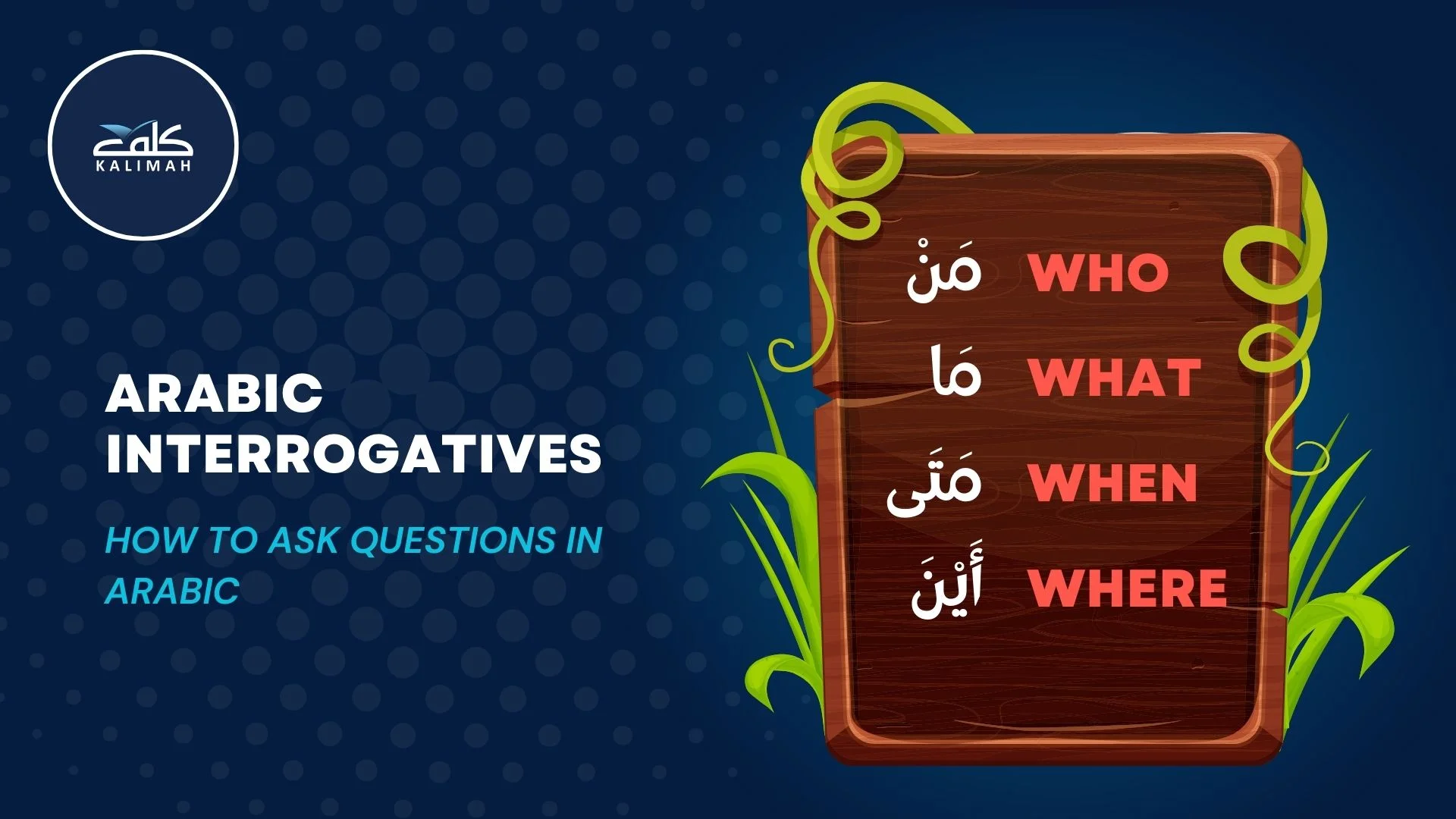
Arabic interrogative words are divided into nouns and particles. Interrogative nouns, like “مَنْ” (who), “مَا” (what), “مَتَى” (when), “أَيْنَ” (where), and “كَيْفَ” (how), are used to ask about people, objects, time, location, and manner. Interrogative particles, such as “هَلْ” (is/are/do) and “الهمزة” (used for direct questions), help form yes/no questions or make inquiries about comparisons. These words are essential for asking questions and forming clear, meaningful communication in Arabic.
Let’s take a closer look at each type:
A. Interrogative Nouns in Arabic (أسماء الاستفهام)
The term “أسماء الاستفهام” literally translates to “nouns of interrogation” or “nouns of questioning.” Interrogative nouns are used to ask about people, objects, time, place, and states. Let us explore these in detail:
1. مَنْ (Who?)
مَنْ is used to ask about a person or people. It applies only to rational beings.
مَنْ كَتَبَ هَذِهِ الرِّوَايَةَ؟
(Who wrote this novel?)
The word مَنْ asks about the doer of the action. In this case, the writer of the novel
مَن أَنتَ
(Who are you?)

2. مَا (What?) and مَاذَا (What?)
مَا and مَاذَا are used to inquire about non-living things or abstract ideas. مَا is often used for short questions, while مَاذَا is more suitable for detailed questions.
ما اسمك؟
(What is your name?)
مَاذَا تُرِيدُ؟
(What do you want?)
3. مَتَى (When?) and أَيَّانَ (When?)
Both inquire about time, though أَيَّانَ is more poetic and rarely used in modern speech.
مَتَى يَبْدَأُ الدَّرْسُ؟
(When does the lesson start?)
“أَيَّانَ يَوْمُ الْقِيَامَةِ” (Alqiyama 75:6)
(When is the Day of Judgment?)
4. أَيْنَ (Where?)
أَيْنَ is used to ask about the location of a person, object, or event.
أَيْنَ تعمل؟
(Where do you work?)
5. أَنَّى (How? / From where?)
أَنَّى can mean “how,” “from where,” or “in what way,” depending on context. It is also poetic and rarely used in modern speech.
أَنَّى لَك هَذَا؟
(From where did you get this?)
أَنَّى تُحْقِقُ الْمُسْتَحِيلَ؟
(How do you achieve the impossible?)
6. كَمْ (How many?)
كَمْ is used to inquire about quantity or number.
كَمْ قلمًا في الحَقيبة؟
(How many pens in the bag?)

7. كَيْفَ (How?)
كَيْفَ asks about the state or manner of something.
كَيْفَ حَالُكَ؟
(How are you?)
8. أَيٌّ (Which?)
أَيٌّ is a flexible interrogative that can inquire about people, things, or even abstract ideas based on its context.
أَيُّ كِتَابٍ تَقْرَأُ؟
(Which book are you reading?)
9. “لماذا” (why)
Use لماذا to ask for explanations or reasons:
لماذا تحب اللغة العربية؟
(Why do you love Arabic?)

B. Interrogative Particles in Arabic (حرفا الاستفهام)
These are simpler than nouns and are used to form yes/no questions or comparisons.
1. هَلْ (Is/Are/Do?)
This particle seeks a confirmation or negation.
هَلْ أَنْتَ طَبِيبٌ؟
(Are you a doctor?)
2. الهمزة (The Hamza)
This is used for sharper, more direct questions.
أَتُرِيدُ أَنْ تَذْهَبَ؟
(Do you want to go?)
Learn Arabic interrogatives and speak Arabic with confidence with us! Join our online group classes and connect with learners worldwide.
Our group classes are 4x cheaper than private lessons.
Pick a time that works for you!

Characteristics of Interrogative Words in Arabic
Now, let’s take a closer look at some of the unique characteristics of these interrogative words (أسماء الاستفهام).
1. Interrogative words in Arabic usually come at the beginning of a sentence
They generally appear at the beginning of a sentence, although there are some exceptions where they might come later for emphasis.
2. Interrogative words in Arabic have no inherent Gender
Unlike many Arabic nouns, interrogative words don’t have a specific gender (masculine/feminine).
3. Most of Interrogative words in Arabic are mabni (مبني)
Most of these words are mabni (مبني), which means their form doesn’t change regardless of their position in the sentence.
Except for “أيّ”: This word is a bit of a rebel! It’s mu’rab (مُعرب), meaning it changes its form depending on its grammatical role in the sentence. It likes to adapt and blend in, like a chameleon changing its colors.
5. Interrogative words in Arabic can follow prepositions:
- Some interrogatives can be combined with prepositions to ask more specific questions. For example:
- بماذا (bimatha)? – With what?
- إلى أين (ila ayna)? – To where?
Exercises of Interrogative Words in Arabic
You must practice using interrogative words to truly master them. Here are some exercises to challenge and refine your understanding:
1. Question Formation:
Transform the following statements into questions using the appropriate interrogative word:
- هو يقرأ كتاباً (He is reading a book.)
- هي ذهبت إلى المدرسة (She went to school.)
- الطعام لذيذ (The food is delicious.)
- الجو بارد اليوم (The weather is cold today.)
- أنا أحب اللغة العربية (I love the Arabic language.)
2. Translate these English questions into Arabic:
- What is your favorite dish?
- Who is your best friend?
- Where did you travel last summer?
- When will you graduate from university?
Master Arabic with Kalimah Center
Join our expert-led online classes and start your journey toward Arabic fluency today.
Book Your Free TrialInside Kalimah Center: Moments from Our Courses
Get a glimpse into the vibrant learning experience at Kalimah Center. These snapshots capture real moments from our live classes—where students engage deeply, connect with passionate instructors, and grow in a welcoming, supportive environment.
Here Are The Reviews On Our Courses:
Our students frequently commend the excellence of our courses and the commitment shown by our instructors. You can read their complete reviews on Trustpilot.

Why Choose Kalimah Center for Learning Arabic Interrogatives?
At Kalimah Center, we specialize in breaking down complex Arabic grammar topics into easy-to-understand lessons. Our online Arabic courses are structured, interactive, and designed to cater to non-native learners.
Don’t just take our word for it—our former students are talking about their progress and the supportive learning environment.

Whether you’re mastering Arabic interrogatives or diving into deeper linguistic concepts, Kalimah Center is here to guide you every step of the way.
📚 Explore Our Courses:
Online Arabic Course: Tailored to your level, our comprehensive Arabic program includes 16 teaching levels and 400+ hours of personalized sessions.
Online Quran With Tajweed Course: Perfect for non-Arabic speakers, our course spans 13 levels and equips you with Tajweed mastery from beginner to advanced.
Online Arabic Course For Kids: Nurture your child’s love for Arabic with our engaging and structured program, available in 24 levels for primary, intermediate, and secondary stages.
🚀 Start Your Free Trial Today! 🚀
Don’t miss out on this life-changing opportunity to deepen your faith and knowledge. Sign up now for your free trial and take the first step towards becoming a better practicing Muslim with Kalimah Center!
Let’s keep learning together. Join us for a FREE trial class.

Conclusion:
Arabic interrogative words are crucial tools for asking questions and gathering information. These words are divided into two categories: nouns (أسماء الاستفهام) and particles (حروف الاستفهام). Interrogative nouns, like “مَنْ” (who), “مَا” (what), “مَتَى” (when), and “أَيْنَ” (where), are used to inquire about people, objects, time, place, and states.
On the other hand, interrogative particles such as “هَلْ” (is/are/do) and “الهمزة” (for direct questions) form yes/no inquiries or comparisons. These words are positioned at the beginning of a sentence and don’t have gender distinctions, except for “أيّ,” which changes form based on its grammatical role.
FAQs about Interrogative Particles in Arabic
Q1: What is the difference between interrogative nouns and particles in Arabic?
A: Arabic question tools are split into nouns (أسماء الاستفهام) and particles (حرفا الاستفهام). Interrogative nouns like مَنْ (who) and أَيْنَ (where) ask for specific data about people or places. Particles, specifically هَلْ and the Hamza (أ), are simpler tools used strictly to form yes/no questions.
Q2: What are the most common interrogative nouns (أسماء الاستفهام) in Arabic?
A: The primary Arabic interrogative nouns include مَنْ (who) for rational beings, مَا and مَاذَا (what) for non-living objects, مَتَى (when) for time, أَيْنَ (where) for location, كَيْفَ (how) for manner, كَمْ (how many) for quantity, لِمَاذَا (why) for reasons, and the flexible chameleon word أَيٌّ (which).
Q3: Where do interrogative particles usually appear in an Arabic sentence?
A: Interrogative particles and nouns almost always appear at the very beginning of an Arabic sentence. They serve as an immediate structural signal to the listener or reader that a question is being asked, acting similarly to how a question mark functions at the end of an English sentence.
Q4: Do Arabic interrogative words change based on gender?
A: No, Arabic interrogative words have no inherent grammatical gender and remain completely neutral whether you are addressing a male or a female. The only exception is the highly flexible word أَيٌّ (which), which alters its form depending on its specific grammatical role in the sentence.
Q5: What does the term Istifham (استفهام) mean in Arabic grammar?
A: In Arabic grammar, Istifham (استفهام) literally translates to “requesting to understand,” originating from the root letters ف-ه-م (f-h-m) meaning comprehension. It refers to the specific sentence structure used by a speaker to seek clarification or gather information about an unknown element.