| Key Takeaways |
| Most Arabic verbs grow from a three-letter root, and fixed patterns turn that one root into dozens of related verbs and nouns. |
| Learners need only Forms I to X in daily Arabic, because Forms XI to XV are rare and appear mainly in classical poetry. |
| Arabic has two verb stems, past and present, and the future simply adds سَـ or سَوْفَ before the present verb. |
| The five verbs (الأفعال الخمسة) drop their final ن after particles like لَنْ and لَمْ, a rule that confuses many beginners. |
Verbs in Arabic are the engine of every sentence. A single verb can tell you who acted, when it happened, how many people were involved, and the gender of the speaker, all inside one word.
That density scares many learners at first, yet the system behind it is remarkably logical. In this guide, KALIMAH Center explains roots, patterns, conjugation, weak verbs, moods, and negation, with 50 common verbs you can start using today.
How Do Verbs In Arabic Work?
Verbs in Arabic work through a root and pattern system. A root of usually three consonants carries the core meaning, and a pattern of vowels, prefixes, and suffixes shapes it into a specific verb, tense, and person.
The verb also sits at the center of Arabic grammar. Arabic dictionaries list it in the past tense, third person masculine singular, such as كَتَبَ (kataba), because Arabic has no infinitive like the English “to write.”
The Root And Pattern System
The root is a skeleton of consonants that never changes order. The patterns, called أوزان (awzaan), wrap around that skeleton and add meaning, so one root can produce a whole family of words.
The root ك-ت-ب (k-t-b), linked to writing, shows how productive this system is:
| Word | Pattern | Meaning |
| كَتَبَ (kataba) | فَعَلَ | he wrote |
| يَكْتُبُ (yaktubu) | يَفْعُلُ | he writes |
| كَتَّبَ (kattaba) | فَعَّلَ | he made someone write |
| كَاتِب (kaatib) | فَاعِل | writer |
| مَكْتُوب (maktuub) | مَفْعُول | written |
| مَكْتَب (maktab) | مَفْعَل | office, desk |
In our experience at KALIMAH Center, students who learn to spot the root early guess the meaning of new words far faster than students who memorize every word separately.
Arabic Verbs And Sentence Order
Formal Arabic often starts a sentence with the verb, then the subject, then the object. This order is called the verbal sentence (الجملة الفعلية), as in كَتَبَ الطَّالِبُ الدَّرْسَ, “The student wrote the lesson.”
One rule surprises learners here. When the verb comes first, it stays singular even with a plural subject, so you say ذَهَبَ الطُّلَّابُ, “The students went.” When the subject comes first, the verb agrees fully: الطُّلَّابُ ذَهَبُوا.
Arabic verbs are also either transitive or intransitive. A transitive verb like فَتَحَ (to open) takes a direct object, while an intransitive verb like نَامَ (to sleep) is complete without one.
KALIMAH Center offers an Online Arabic Course that builds these sentence patterns step by step through live one-on-one sessions, so learners use verbs correctly in real speech from the first levels.

Book Your Free Arabic Lesson Today
50 Common Verbs In Arabic With Present Forms And Masdars
The fastest way to start speaking is to learn the most common verbs in Arabic as complete sets. Each verb below shows its past form, present form, and masdar (verbal noun), because these three forms unlock almost every sentence you will build.
Learning the present form with the past form matters, since the middle vowel of the present cannot always be predicted. The tables group the verbs by everyday use so you can study one group per week.
Everyday Action Verbs
These 17 verbs describe daily routines at home, school, and work. They are usually the first common Arabic verbs that learners need in conversation.
| Past | Present | Masdar | Meaning |
| كَتَبَ (kataba) | يَكْتُبُ (yaktubu) | كِتَابَة | to write |
| قَرَأَ (qara’a) | يَقْرَأُ (yaqra’u) | قِرَاءَة | to read |
| أَكَلَ (akala) | يَأْكُلُ (ya’kulu) | أَكْل | to eat |
| شَرِبَ (shariba) | يَشْرَبُ (yashrabu) | شُرْب | to drink |
| نَامَ (naama) | يَنَامُ (yanaamu) | نَوْم | to sleep |
| جَلَسَ (jalasa) | يَجْلِسُ (yajlisu) | جُلُوس | to sit |
| قَامَ (qaama) | يَقُومُ (yaquumu) | قِيَام | to stand up |
| فَتَحَ (fataha) | يَفْتَحُ (yaftahu) | فَتْح | to open |
| أَغْلَقَ (aghlaqa) | يُغْلِقُ (yughliqu) | إِغْلَاق | to close |
| لَعِبَ (la’iba) | يَلْعَبُ (yal’abu) | لَعِب | to play |
| طَبَخَ (tabakha) | يَطْبُخُ (yatbukhu) | طَبْخ | to cook |
| غَسَلَ (ghasala) | يَغْسِلُ (yaghsilu) | غَسْل | to wash |
| عَمِلَ (‘amila) | يَعْمَلُ (ya’malu) | عَمَل | to work |
| دَرَسَ (darasa) | يَدْرُسُ (yadrusu) | دِرَاسَة | to study |
| اِشْتَرَى (ishtaraa) | يَشْتَرِي (yashtarii) | شِرَاء | to buy |
| بَاعَ (baa’a) | يَبِيعُ (yabii’u) | بَيْع | to sell |
| لَبِسَ (labisa) | يَلْبَسُ (yalbasu) | لُبْس | to wear |
Verbs For Thinking, Feeling, And Speaking
These 17 verbs help you express opinions, emotions, and questions. Several of them are weak or derived verbs, so watch how their present forms change.
| Past | Present | Masdar | Meaning |
| فَهِمَ (fahima) | يَفْهَمُ (yafhamu) | فَهْم | to understand |
| عَرَفَ (‘arafa) | يَعْرِفُ (ya’rifu) | مَعْرِفَة | to know |
| فَكَّرَ (fakkara) | يُفَكِّرُ (yufakkiru) | تَفْكِير | to think |
| تَذَكَّرَ (tadhakkara) | يَتَذَكَّرُ (yatadhakkaru) | تَذَكُّر | to remember |
| نَسِيَ (nasiya) | يَنْسَى (yansaa) | نِسْيَان | to forget |
| أَحَبَّ (ahabba) | يُحِبُّ (yuhibbu) | حُبّ | to love |
| كَرِهَ (kariha) | يَكْرَهُ (yakrahu) | كُرْه | to hate |
| أَرَادَ (araada) | يُرِيدُ (yuriidu) | إِرَادَة | to want |
| شَعَرَ (sha’ara) | يَشْعُرُ (yash’uru) | شُعُور | to feel |
| تَعَلَّمَ (ta’allama) | يَتَعَلَّمُ (yata’allamu) | تَعَلُّم | to learn |
| قَالَ (qaala) | يَقُولُ (yaquulu) | قَوْل | to say |
| تَكَلَّمَ (takallama) | يَتَكَلَّمُ (yatakallamu) | كَلَام | to speak |
| سَأَلَ (sa’ala) | يَسْأَلُ (yas’alu) | سُؤَال | to ask |
| أَجَابَ (ajaaba) | يُجِيبُ (yujiibu) | إِجَابَة | to answer |
| سَمِعَ (sami’a) | يَسْمَعُ (yasma’u) | سَمَاع | to hear |
| رَأَى (ra’aa) | يَرَى (yaraa) | رُؤْيَة | to see |
| اِسْتَطَاعَ (istataa’a) | يَسْتَطِيعُ (yastatii’u) | اِسْتِطَاعَة | to be able |
Movement And Travel Verbs
These 16 verbs cover going, coming, and handling objects. They appear constantly in directions, travel plans, and stories.
| Past | Present | Masdar | Meaning |
| ذَهَبَ (dhahaba) | يَذْهَبُ (yadhhabu) | ذَهَاب | to go |
| جَاءَ (jaa’a) | يَجِيءُ (yajii’u) | مَجِيء | to come |
| رَجَعَ (raja’a) | يَرْجِعُ (yarji’u) | رُجُوع | to return |
| وَصَلَ (wasala) | يَصِلُ (yasilu) | وُصُول | to arrive |
| دَخَلَ (dakhala) | يَدْخُلُ (yadkhulu) | دُخُول | to enter |
| خَرَجَ (kharaja) | يَخْرُجُ (yakhruju) | خُرُوج | to go out |
| مَشَى (mashaa) | يَمْشِي (yamshii) | مَشْي | to walk |
| جَرَى (jaraa) | يَجْرِي (yajrii) | جَرْي | to run |
| سَافَرَ (saafara) | يُسَافِرُ (yusaafiru) | سَفَر | to travel |
| رَكِبَ (rakiba) | يَرْكَبُ (yarkabu) | رُكُوب | to ride |
| نَزَلَ (nazala) | يَنْزِلُ (yanzilu) | نُزُول | to go down |
| طَلَعَ (tala’a) | يَطْلُعُ (yatlu’u) | طُلُوع | to go up |
| وَقَفَ (waqafa) | يَقِفُ (yaqifu) | وُقُوف | to stop, to stand |
| أَخَذَ (akhadha) | يَأْخُذُ (ya’khudhu) | أَخْذ | to take |
| وَضَعَ (wada’a) | يَضَعُ (yada’u) | وَضْع | to put |
| أَرْسَلَ (arsala) | يُرْسِلُ (yursilu) | إِرْسَال | to send |
Example Sentences With Common Arabic Verbs
Seeing verbs inside full sentences helps them stick. These short examples use verbs from the tables above in natural, everyday contexts:
| Arabic Sentence | Transliteration | Meaning |
| أَشْرَبُ القَهْوَةَ كُلَّ صَبَاحٍ. | Ashrabu al-qahwata kulla sabaah. | I drink coffee every morning. |
| ذَهَبَتْ سَارَةُ إِلَى السُّوقِ. | Dhahabat Saaratu ilaa as-suuq. | Sarah went to the market. |
| هَلْ تَفْهَمُ السُّؤَالَ؟ | Hal tafhamu as-su’aal? | Do you understand the question? |
| سَنُسَافِرُ غَدًا. | Sanusaafiru ghadan. | We will travel tomorrow. |
| لَمْ أَنْسَ المَوْعِدَ. | Lam ansa al-maw’id. | I did not forget the appointment. |
The 10 Arabic Verb Forms And Their Meanings
Arabic verb forms are fixed patterns that add a predictable shade of meaning to a root. Western grammars number them with Roman numerals, while Arabic grammarians name each one by its pattern, such as “the تَفَعَّلَ form.”
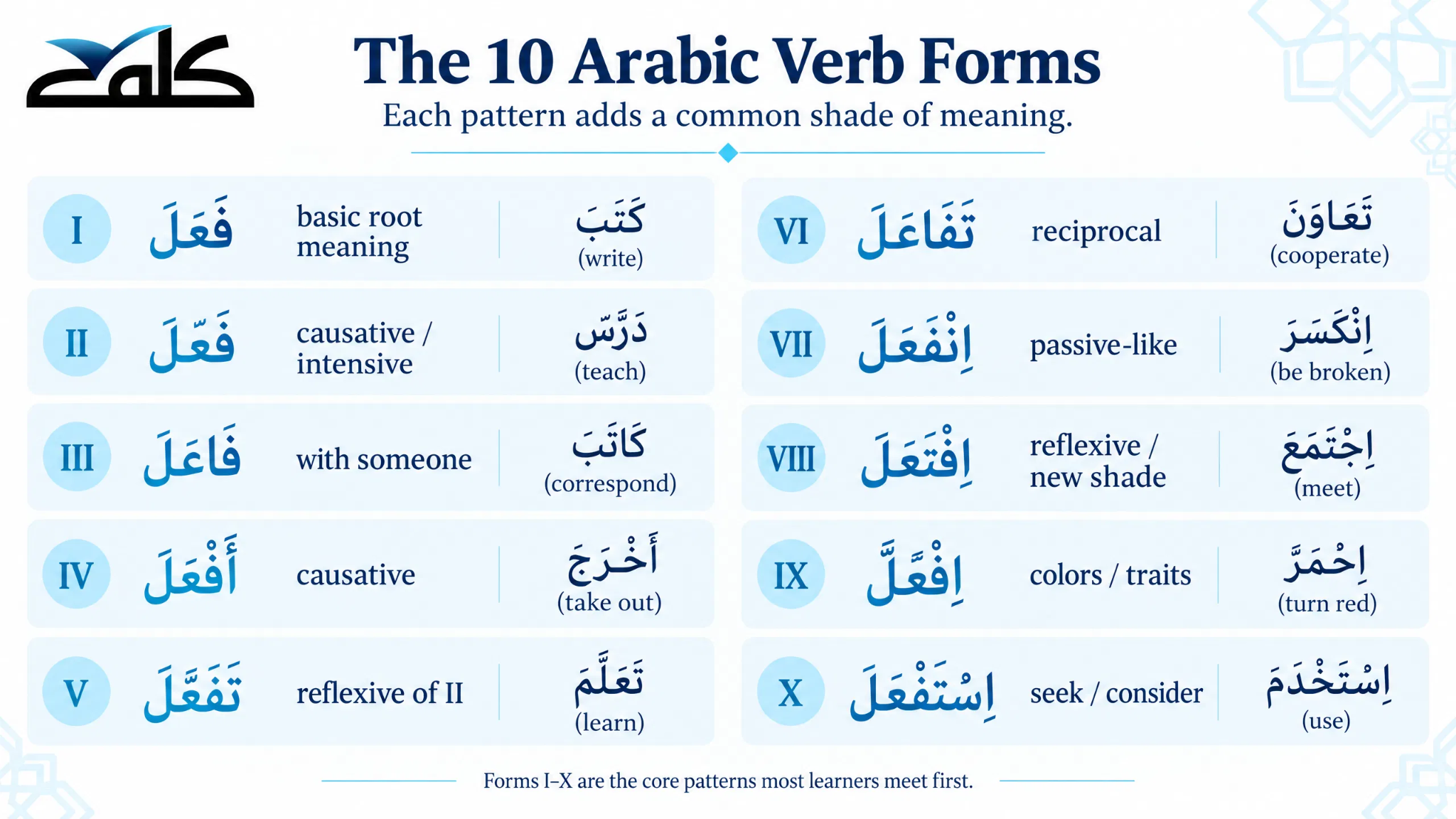
Form I is the bare root, and Forms II to X add letters or double a consonant. Knowing these Arabic verb patterns lets you recognize thousands of verbs from a few hundred roots:
| Form | Pattern | Typical Meaning | Example |
| I | فَعَلَ | basic meaning of the root | كَتَبَ (kataba), to write |
| II | فَعَّلَ | causative or intensive | دَرَّسَ (darrasa), to teach (from دَرَسَ, to study) |
| III | فَاعَلَ | doing something with someone | كَاتَبَ (kaataba), to correspond with |
| IV | أَفْعَلَ | causative, often transitive | أَخْرَجَ (akhraja), to take out |
| V | تَفَعَّلَ | reflexive of Form II | تَعَلَّمَ (ta’allama), to learn |
| VI | تَفَاعَلَ | mutual or reciprocal action | تَعَاوَنَ (ta’aawana), to cooperate |
| VII | اِنْفَعَلَ | passive in meaning | اِنْكَسَرَ (inkasara), to be broken |
| VIII | اِفْتَعَلَ | reflexive, often a new meaning | اِجْتَمَعَ (ijtama’a), to meet, to gather |
| IX | اِفْعَلَّ | colors and physical traits | اِحْمَرَّ (ihmarra), to turn red |
| X | اِسْتَفْعَلَ | seeking or considering | اِسْتَخْدَمَ (istakhdama), to use |
Form IV deserves a note, because many sources describe it wrongly. It adds a hamza (أ) before the first root letter, which then takes a sukoon, giving أَفْعَلَ. Its present tense starts with a damma: يُخْرِجُ (yukhriju).
Form VIII also changes its ت in some roots. After letters like ص or ط, the ت becomes ط, so the root ص-ب-ر gives اِصْطَبَرَ (istabara), “to be patient,” instead of a regular اِصْتَبَرَ.
Rare Forms XI To XV
Forms XI to XV exist, but most learners will rarely meet them outside classical poetry and old dictionaries. They are useful mainly for reading advanced literary texts:
| Form | Pattern | Example | Meaning |
| XI | اِفْعَالَّ | اِحْمَارَّ (ihmaarra) | to turn deep red |
| XII | اِفْعَوْعَلَ | اِخْشَوْشَنَ (ikhshawshana) | to live roughly |
| XIII | اِفْعَوَّلَ | اِجْلَوَّذَ (ijlawwadha) | to gallop fast |
| XIV | اِفْعَنْلَلَ | اِقْعَنْسَسَ (iq’ansasa) | to have a protruding chest |
| XV | اِفْعَنْلَى | اِحْرَنْبَى (ihranbaa) | to become furious |
See Us In Action!
Curious about what our online classrooms look like? Watch the short clips below to see how our interactive, one-on-one sessions bring learning to life with real-time feedback and engaging teaching methods.
Master Arabic with Kalimah Center
Join our expert-led online classes and start your journey toward Arabic fluency today.
Book Your Free TrialArabic Verb Conjugation By Person, Number, And Gender
Arabic verb conjugation changes a verb for 13 subjects: first, second, and third person, in singular, dual, and plural, with separate masculine and feminine forms. The past tense uses suffixes, while the present uses prefixes and suffixes together.
The future needs no new endings, because it simply adds سَـ (sa-) or the separate word سَوْفَ (sawfa) before the present verb. The table shows all three times for كَتَبَ:
| Pronoun | Past | Present | Future |
| أَنَا (I) | كَتَبْتُ (katabtu) | أَكْتُبُ (aktubu) | سَأَكْتُبُ (sa’aktubu) |
| نَحْنُ (we) | كَتَبْنَا (katabnaa) | نَكْتُبُ (naktubu) | سَنَكْتُبُ (sanaktubu) |
| أَنْتَ (you, m.) | كَتَبْتَ (katabta) | تَكْتُبُ (taktubu) | سَتَكْتُبُ (sataktubu) |
| أَنْتِ (you, f.) | كَتَبْتِ (katabti) | تَكْتُبِينَ (taktubiina) | سَتَكْتُبِينَ (sataktubiina) |
| أَنْتُمَا (you two) | كَتَبْتُمَا (katabtumaa) | تَكْتُبَانِ (taktubaani) | سَتَكْتُبَانِ (sataktubaani) |
| أَنْتُمْ (you, m. pl.) | كَتَبْتُمْ (katabtum) | تَكْتُبُونَ (taktubuuna) | سَتَكْتُبُونَ (sataktubuuna) |
| أَنْتُنَّ (you, f. pl.) | كَتَبْتُنَّ (katabtunna) | تَكْتُبْنَ (taktubna) | سَتَكْتُبْنَ (sataktubna) |
| هُوَ (he) | كَتَبَ (kataba) | يَكْتُبُ (yaktubu) | سَيَكْتُبُ (sayaktubu) |
| هِيَ (she) | كَتَبَتْ (katabat) | تَكْتُبُ (taktubu) | سَتَكْتُبُ (sataktubu) |
| هُمَا (they two, m.) | كَتَبَا (katabaa) | يَكْتُبَانِ (yaktubaani) | سَيَكْتُبَانِ (sayaktubaani) |
| هُمَا (they two, f.) | كَتَبَتَا (katabataa) | تَكْتُبَانِ (taktubaani) | سَتَكْتُبَانِ (sataktubaani) |
| هُمْ (they, m.) | كَتَبُوا (katabuu) | يَكْتُبُونَ (yaktubuuna) | سَيَكْتُبُونَ (sayaktubuuna) |
| هُنَّ (they, f.) | كَتَبْنَ (katabna) | يَكْتُبْنَ (yaktubna) | سَيَكْتُبْنَ (sayaktubna) |
The past tense often matches the English simple past, while the present covers both “he writes” and “he is writing.” To say “he was writing,” Arabic combines كَانَ with the present: كَانَ يَكْتُبُ.
For more detail on each time frame, study our dedicated guides to the past tense, the present tense, and the future tense.
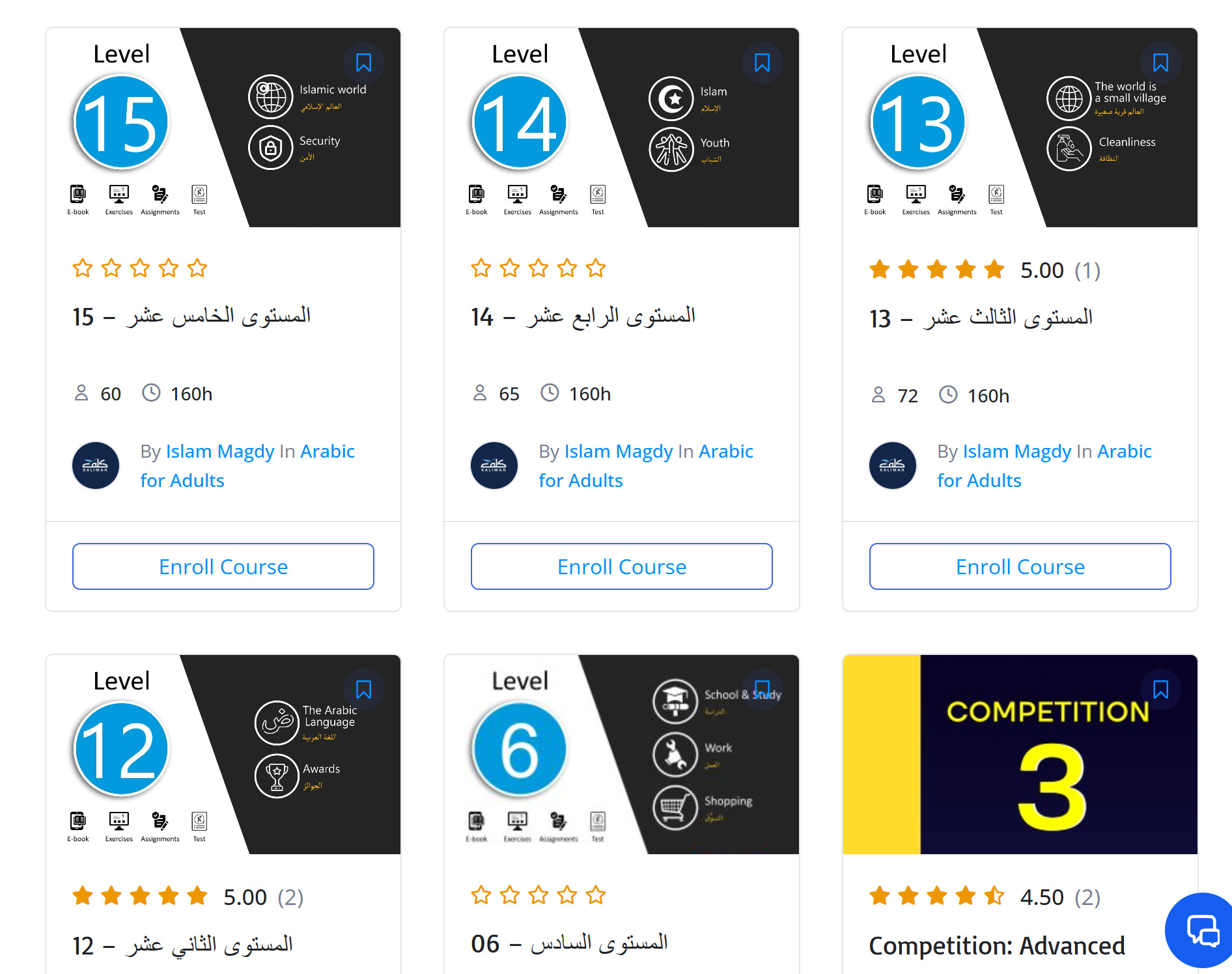
Conjugation tables become automatic only through regular speaking practice. KALIMAH Center lists every program in its Arabic Courses Catalog, where learners can pick a structured path that drills these forms level by level.
Start Practicing Arabic With a Free Trial
Weak Verbs In Arabic And How They Change
Weak verbs in Arabic contain و, ي, or a hamza in their root, or repeat the same letter twice. These letters shorten, drop, or merge in some forms, so the verb looks irregular even though it follows clear rules.
Read Also: Arabic Tenses
Spotting the weak letter is the key skill here. Once you know where it sits in the root, you can predict exactly which forms will change. The five main types are summarized below:
| Type | Weak Position | Past | Present | Changed Form |
| Assimilated (مثال) | first letter و | وَجَدَ (wajada) | يَجِدُ (yajidu) | the و drops in the present |
| Hollow (أجوف) | middle letter و or ي | قَالَ (qaala) | يَقُولُ (yaquulu) | قُلْتُ (qultu), I said |
| Defective (ناقص) | last letter و or ي | مَشَى (mashaa) | يَمْشِي (yamshii) | مَشَيْتُ (mashaytu), I walked |
| Doubled (مضعّف) | second and third letters identical | مَدَّ (madda) | يَمُدُّ (yamuddu) | مَدَدْتُ (madadtu), I extended |
| Hamzated (مهموز) | hamza in the root | أَخَذَ (akhadha) | يَأْخُذُ (ya’khudhu) | خُذْ (khudh), take! |
Hollow Verbs And Their Two Stems
Hollow verbs have a long stem and a short stem. The long stem appears before vowel endings, as in قَالَ and يَقُولُ, and the short stem appears before consonant endings, as in قُلْتُ and يَقُلْنَ.
The verb نَامَ follows the same logic: نَامَ (he slept) becomes نِمْتُ (I slept). Learners who memorize the first person form with the dictionary form avoid most hollow verb mistakes.
Defective Verbs That End In A Vowel
Defective verbs end in a long vowel, so their endings shift. دَعَا (to call) becomes يَدْعُو in the present, مَشَى becomes يَمْشِي, and نَسِيَ (to forget) becomes يَنْسَى.
In the jussive, that final long vowel shortens: لَمْ يَمْشِ (he did not walk) and لَمْ يَنْسَ (he did not forget). This short vowel is a common spelling trap in written exams.
Doubled And Hamzated Verbs
Doubled verbs merge their identical letters when an ending begins with a vowel, as in مَدَّ, and separate them before consonant endings, as in مَدَدْتُ. The verb أَحَبَّ behaves the same way: أَحْبَبْتُ (I loved).
Hamzated verbs are mostly regular in sound, but a few common ones have short imperatives: أَكَلَ gives كُلْ (eat!), and أَخَذَ gives خُذْ (take!). The verb رَأَى also drops its hamza in the present: يَرَى.
Arabic Verb Moods And The Five Verbs
The present tense of Arabic verbs changes its ending according to mood. Grammarians call these states المرفوع (indicative), المنصوب (subjunctive), and المجزوم (jussive), and each one follows specific particles:
| Mood | Ending | Used After | Example |
| Indicative (المرفوع) | ضمة (-u) | no particle, normal statements | يَكْتُبُ (yaktubu), he writes |
| Subjunctive (المنصوب) | فتحة (-a) | أَنْ، لَنْ، كَيْ، حَتَّى | لَنْ يَكْتُبَ (lan yaktuba), he will not write |
| Jussive (المجزوم) | سكون (no vowel) | لَمْ، لا الناهية، لام الأمر، إِنْ | لَمْ يَكْتُبْ (lam yaktub), he did not write |
In spoken dialects, these endings are usually dropped, which is why many learners never notice them. In formal reading, news, and literature, they matter for correct pronunciation and meaning.
The Five Verbs (Al-Af’aal Al-Khamsa) And Their Endings
The five verbs (الأفعال الخمسة) are present tense forms that end in ن after a dual alif, a plural waw, or a feminine yaa. With كَتَبَ, they are يَكْتُبَانِ، تَكْتُبَانِ، يَكْتُبُونَ، تَكْتُبُونَ، تَكْتُبِينَ.
Instead of changing a final vowel, these verbs show mood by keeping or dropping the ن:
| Mood | Rule | Example |
| Indicative | the ن stays | الطُّلَّابُ يَكْتُبُونَ (The students write.) |
| Subjunctive | the ن drops | لَنْ يَكْتُبُوا (They will not write.) |
| Jussive | the ن drops | لَمْ يَكْتُبُوا (They did not write.) |
Notice the silent alif added after the plural waw in يَكْتُبُوا. It is written but never pronounced, and adding or forgetting it is one of the most frequent spelling errors among learners.
Children absorb these patterns best through repetition, songs, and short daily practice. KALIMAH Center offers Arabic Classes For Kids that teach verbs and grammar through interactive, age-appropriate lessons led by native Arabic speakers.

Book Your Child’s Free Arabic Trial
How Do You Negate Verbs In Arabic?
You negate verbs in Arabic by placing a negative particle before the verb, and each particle matches a specific time and mood. Choosing the wrong particle is one of the most common errors in beginner writing:
| Meaning | Particle | Verb Form | Example |
| does not (present) | لا | indicative | لا يَكْتُبُ (laa yaktubu), he does not write |
| did not (past) | لَمْ | jussive | لَمْ يَكْتُبْ (lam yaktub), he did not write |
| did not (past, simpler style) | مَا | past | مَا كَتَبَ (maa kataba), he did not write |
| will not (future) | لَنْ | subjunctive | لَنْ يَكْتُبَ (lan yaktuba), he will not write |
| do not! (prohibition) | لا الناهية | jussive | لا تَكْتُبْ (laa taktub), do not write! |
Notice that لَمْ uses the present verb but gives a past meaning. Formal Modern Standard Arabic prefers لَمْ for the past, while مَا with the past verb is very common in speech and simpler writing.
The Imperative And Passive Voice In Arabic
The imperative and the passive voice are two forms that change the role of the verb. The imperative gives a command, while the passive hides the doer and focuses attention on the action itself.
Forming The Imperative
The imperative comes from the jussive of the present tense. Remove the prefix ت, and if the word now begins with two consonants, add a connecting alif with a vowel that matches the stem:
- If the middle vowel is a damma, the alif takes a damma: تَكْتُبْ becomes اُكْتُبْ (uktub), write!
- If the middle vowel is a fatha or kasra, the alif takes a kasra: تَفْتَحْ becomes اِفْتَحْ (iftah), open!
- Form IV keeps a hamza with a fatha: تُرْسِلْ becomes أَرْسِلْ (arsil), send!
- Hollow and assimilated verbs need no added alif: تَقُلْ becomes قُلْ (qul), say!
The imperative also changes for the person addressed: اُكْتُبْ (to a man), اُكْتُبِي (to a woman), اُكْتُبَا (to two people), اُكْتُبُوا (to a group of men), and اُكْتُبْنَ (to a group of women).
Active And Passive Voice
The passive voice in Arabic is formed by changing vowels, not by adding a helper verb. In the past, the first letter takes a damma and the letter before the last takes a kasra: كَتَبَ becomes كُتِبَ (kutiba), it was written.
In the present, the prefix takes a damma and the letter before the last takes a fatha: يَكْتُبُ becomes يُكْتَبُ (yuktabu), it is written. A full example is كُتِبَتِ الرِّسَالَةُ, “The letter was written.”
Many verbal and grammatical patterns in the Quran become far clearer once a learner recognizes these forms. KALIMAH Center offers an Online Quran Course that pairs accurate recitation with a gradual understanding of the language behind the text.

Try a Free Quran Lesson With KALIMAH Center
Verbal Nouns And Participles From Arabic Verbs
Every Arabic verb produces nouns that describe the action, the doer, and the thing affected. These are the masdar (verbal noun), the active participle (اسم الفاعل), and the passive participle (اسم المفعول).
Read Also: Arabic Grammar
Form I masdars must be memorized, but the derived forms follow fixed patterns. The table shows how three verbs produce their related nouns:
| Verb | Active Participle | Passive Participle | Masdar |
| كَتَبَ (Form I) | كَاتِب (writer) | مَكْتُوب (written) | كِتَابَة (writing) |
| دَرَّسَ (Form II) | مُدَرِّس (teacher) | مُدَرَّس (taught) | تَدْرِيس (teaching) |
| اِسْتَخْدَمَ (Form X) | مُسْتَخْدِم (user) | مُسْتَخْدَم (used) | اِسْتِخْدَام (use) |
In Forms II to X, both participles start with مُـ (mu-). The only difference is the vowel before the last letter: a kasra for the active participle and a fatha for the passive one, as in مُدَرِّس and مُدَرَّس.
Practical Tips To Master Arabic Verbs Faster
Mastering Arabic verbs depends more on method than on memory. These habits come from what consistently works with KALIMAH Center learners at every level:
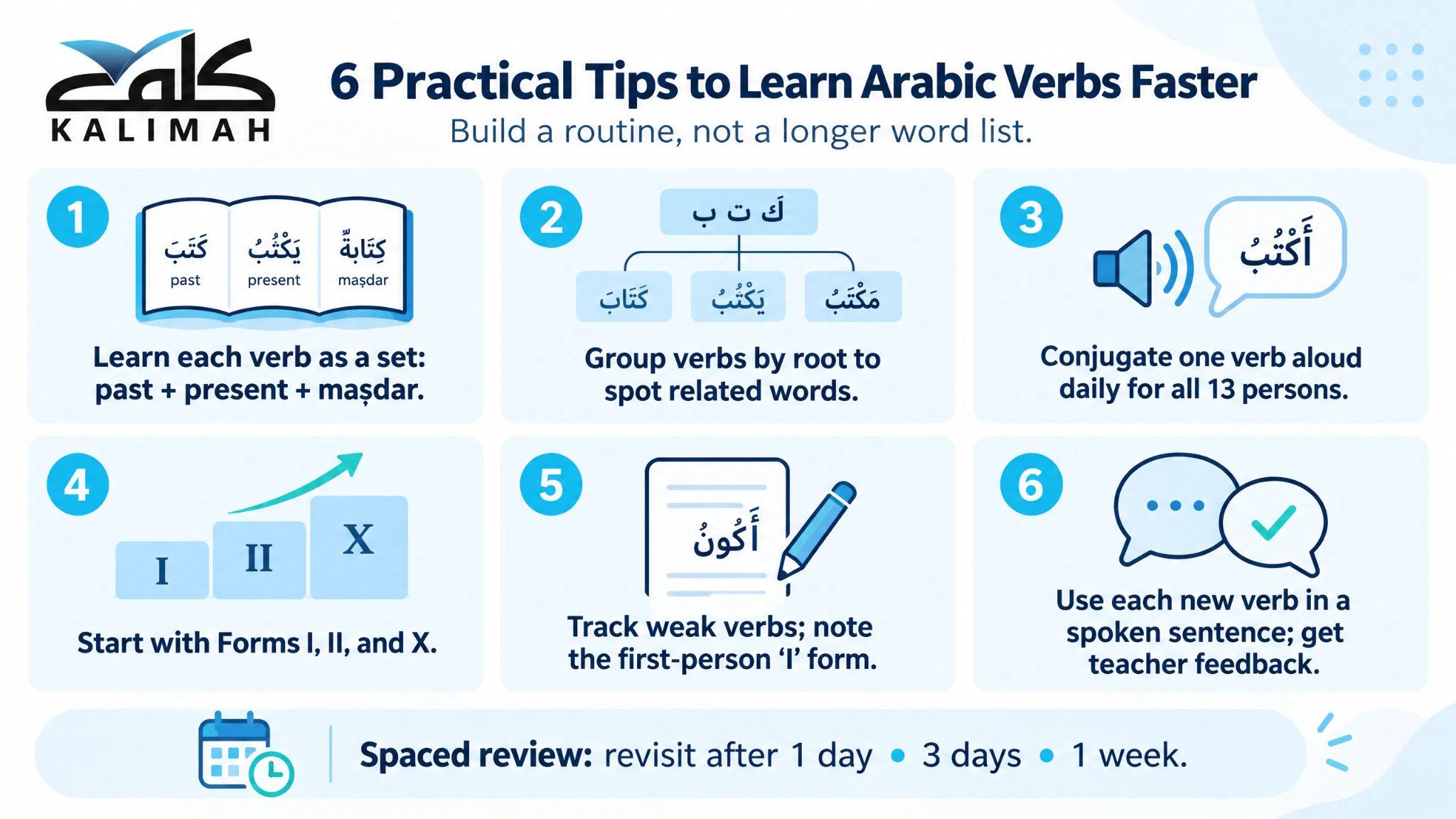
- Learn every new verb as a set of past, present, and masdar, never as a single word.
- Group verbs by root so one meaning helps you guess five or six related words.
- Conjugate one verb aloud each day for all 13 persons until the endings feel automatic.
- Practice Forms I, II, and X first, since they cover a large share of everyday vocabulary.
- Keep a separate list of weak verbs and write their “I” form next to the dictionary form.
- Use each new verb in a short spoken sentence with a teacher who can correct you immediately.
Spaced review matters as much as new input. Revisiting a verb list after one day, three days, and one week moves it into long-term memory far more reliably than a single long study session.
Inside Our Virtual Classrooms
We believe in full transparency and proven quality. Take a look at these actual snippets from our live classes to experience our modern learning platform, patient instructors, and interactive student participation.
Master Arabic with Kalimah Center
Join our expert-led online classes and start your journey toward Arabic fluency today.
Book Your Free TrialMaster Verbs In Arabic With KALIMAH Center Expert Instructors
Reading about verbs in Arabic is the first step, and using them confidently in conversation is the goal. KALIMAH Center connects you with native Arabic tutors who correct your conjugation live and build your skills through a structured, level-based curriculum.
What sets KALIMAH Center apart:
- Live one-on-one sessions with native Arabic speaking instructors.
- A structured program of 16 levels with 400+ hours of personalized teaching.
- Flexible schedules with male and female teachers for adults and children.
Choose the program that fits your goals from our main courses:
- Online Arabic Course.
- Arabic Group Classes.
- Arabic Classes For Kids.
- Online Quran Course.
- Arabic Courses Catalog.
- Premium Trial Lesson.

Conclusion
Verbs in Arabic follow a logic that rewards patience. The root carries the meaning, the ten main forms shape it, and conjugation adds person, number, gender, time, and mood in a single word.
Weak verbs, the five verbs, and negation particles look difficult at first, yet each follows a rule you can learn and apply. Start with the 50 common verbs, practice them aloud daily, and you will read and speak with growing confidence.
FAQs
What Are The Five Verbs In Arabic?
The five verbs (الأفعال الخمسة) are present tense forms ending in ن after a dual alif, a plural waw, or a feminine yaa, such as يَكْتُبَانِ، تَكْتُبَانِ، يَكْتُبُونَ، تَكْتُبُونَ، تَكْتُبِينَ. They drop the ن after particles like لَنْ and لَمْ.
What Are The Basic Verbs In Arabic?
The basic verbs in Arabic are high-frequency Form I verbs used daily, such as كَتَبَ (write), قَرَأَ (read), أَكَلَ (eat), ذَهَبَ (go), and قَالَ (say). Learning them with their present forms gives beginners enough to build simple, useful sentences quickly.
What Are The 10 Forms Of Verbs In Arabic?
The 10 forms of verbs in Arabic are the patterns فَعَلَ، فَعَّلَ، فَاعَلَ، أَفْعَلَ، تَفَعَّلَ، تَفَاعَلَ، اِنْفَعَلَ، اِفْتَعَلَ، اِفْعَلَّ، and اِسْتَفْعَلَ. Each adds a typical meaning, such as causative, reciprocal, reflexive, or seeking, to the original root.
How Do You Conjugate Verbs In Arabic?
You conjugate Arabic verbs by adding suffixes to the past stem and prefixes with suffixes to the present stem. These changes mark 13 subjects by person, number, and gender, for example كَتَبْتُ (I wrote) and يَكْتُبُونَ (they write).
Does Arabic Have A Future Tense?
Yes. Arabic forms the future by adding سَـ (sa-) or سَوْفَ (sawfa) before the present tense verb, as in سَيَكْتُبُ (he will write). The negative future uses لَنْ with the subjunctive: لَنْ يَكْتُبَ (he will not write).