Honoring a mother is not a single command in the Quran. It is a theme woven across multiple surahs, repeated in different contexts to make sure the message cannot be missed.
Anyone searching for quran verses about mothers in Arabic is usually looking for the exact ayat, with their meaning explained clearly, not just a list of references.
This article gathers the core verses on motherhood, gives each one in Arabic with its meaning, and explains why these particular ayat are recited and taught so often.
What you’ll learn in this article
- The main Quran verses about mothers in Arabic, with surah and ayah numbers
- The meaning and context behind each verse
- Why does God single out the mother specifically in verses about parents?
- How these verses are applied in daily Muslim life and worship
- Where to find guided recitation and tafsir for these ayat
Several Quran verses address both parents together using the dual form “والديك” (your two parents), yet the text pauses to single out the mother by name. This is a deliberate linguistic choice, not a repetition for emphasis alone.
The reason given inside the verses themselves is physical and specific: pregnancy, labor, and breastfeeding are described as direct, named hardships the mother carries alone. Quran 31:14 phrases it as “وهنًا على وهن” — weakness upon weakness — a description God attaches to no other relationship in the text.
The Five Core Quran Verses on Motherhood
The five verses below cover the full range of how the Quran addresses motherhood: the mother’s physical hardship, the child’s behavioral duty toward her, a specific timeframe of sacrifice, a prophet’s own example, and the universal starting point of human life.
1. Weakness Upon Weakness
This verse is the clearest example of that linguistic choice in action: gratitude to God is named first, then the text narrows immediately to the mother’s specific physical burden.
“وَوَصَّيْنَا الْإِنْسَانَ بِوَالِدَيْهِ حَمَلَتْهُ أُمُّهُ وَهْنًا عَلَى وَهْنٍ وَفِصَالُهُ فِي عَامَيْنِ أَنِ اشْكُرْ لِي وَلِوَالِدَيْكَ إِلَيَّ الْمَصِيرُ”
Meaning: God commands gratitude toward parents, then immediately narrows to the mother: she carried her child through “weakness upon weakness” and weaned him over two full years. (Surah Luqman 31:14)
The phrase “وهنًا على وهن” is commonly explained as compounding hardship — the physical toll of pregnancy stacked on top of the body’s natural depletion. The verse ties gratitude to God directly to gratitude toward the parents, placing the two side by side rather than separately.
Read Also: Quran Quotes About Life in Arabic
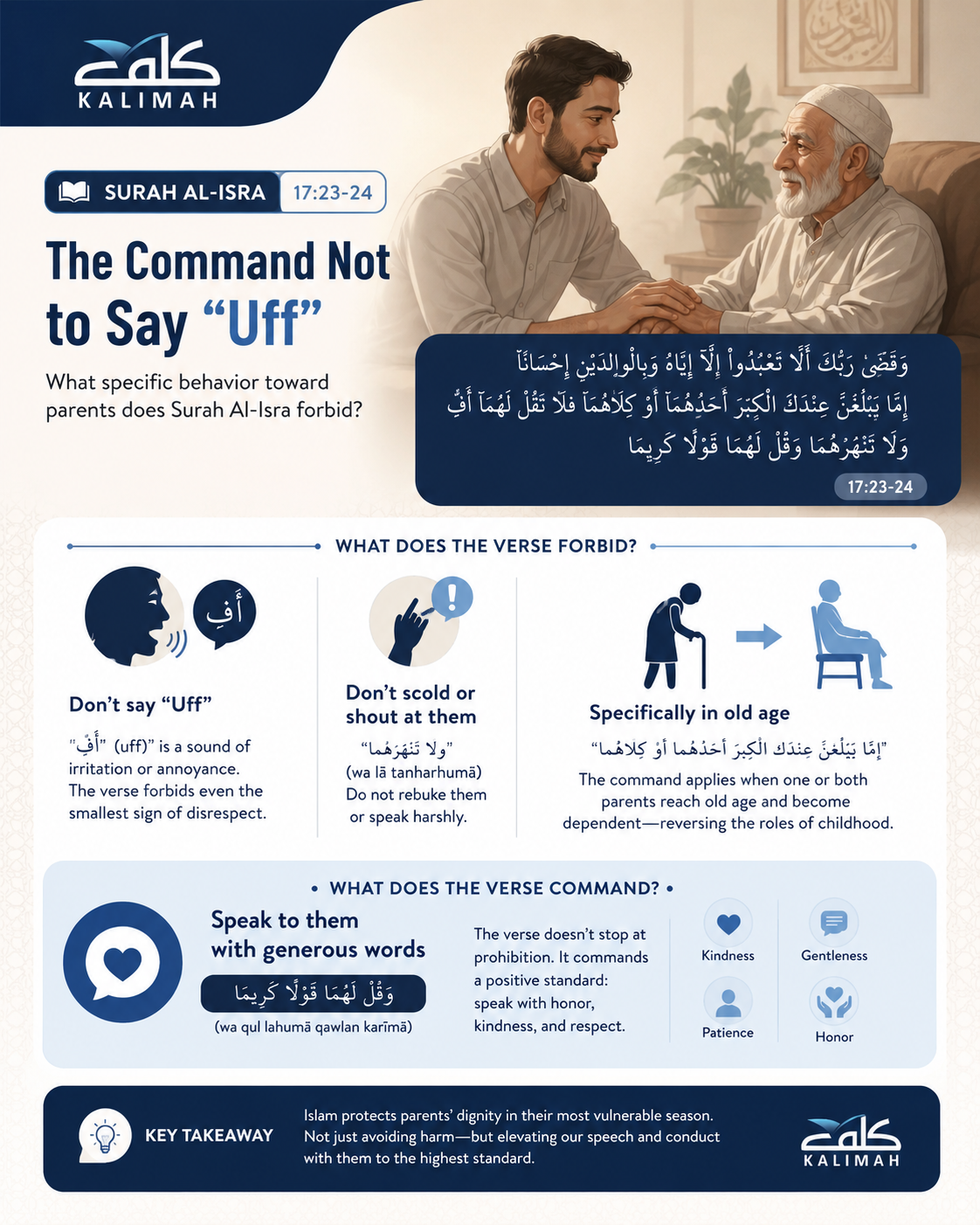
2. The Command Not to Say “Uff”
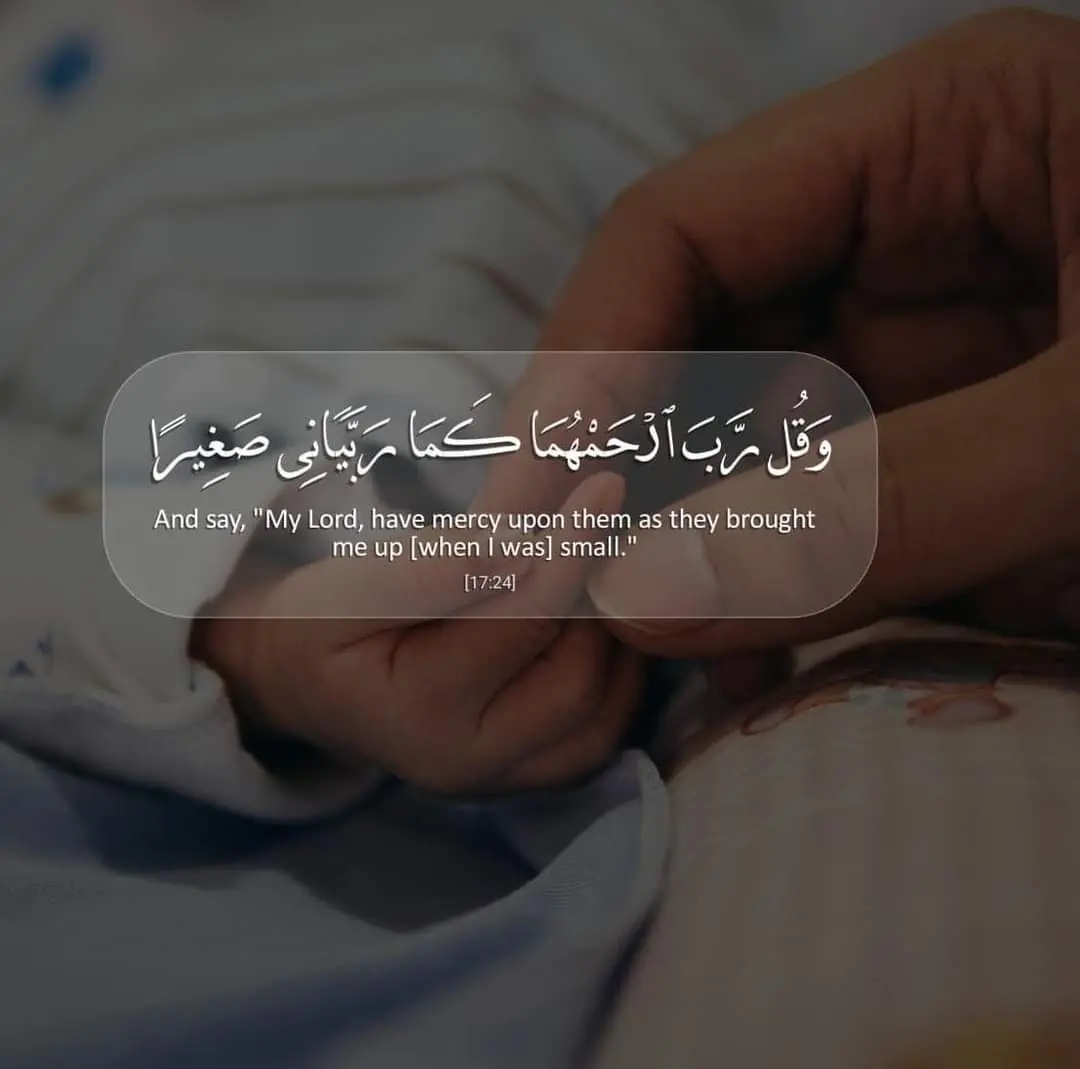
Where Surah Luqman addresses the mother’s physical hardship, this verse turns to the son or daughter’s side of the relationship, setting a behavioral floor that leaves no room for excuses tied to a parent’s old age.
“وَقَضَى رَبُّكَ أَلَّا تَعْبُدُوا إِلَّا إِيَّاهُ وَبِالْوَالِدَيْنِ إِحْسَانًا إِمَّا يَبْلُغَنَّ عِنْدَكَ الْكِبَرَ أَحَدُهُمَا أَوْ كِلَاهُمَا فَلَا تَقُلْ لَهُمَا أُفٍّ وَلَا تَنْهَرْهُمَا وَقُلْ لَهُمَا قَوْلًا كَرِيمًا”
This verse names the smallest possible sign of disrespect — the word “أُفٍّ” (a sound of irritation) — and forbids it outright.
The instruction applies specifically to old age, when a parent becomes dependent again, reversing the caregiving relationship of childhood.
A practical detail often missed in summaries: the verse does not stop at prohibition. It follows the negative command (“don’t say”) with a positive one (“speak to them with generous words”), giving a behavioral standard rather than just a restriction.
3. Thirty Months of Carrying and Weaning
This verse adds something the two above do not: an actual number, turning a description of hardship into something closer to a measurable timeframe.
“وَوَصَّيْنَا الْإِنْسَانَ بِوَالِدَيْهِ إِحْسَانًا حَمَلَتْهُ أُمُّهُ كُرْهًا وَوَضَعَتْهُ كُرْهًا وَحَمْلُهُ وَفِصَالُهُ ثَلَاثُونَ شَهْرًا”
“We have commanded people to honour their parents. Their mothers bore them in hardship and delivered them in hardship. Their ˹period of˺ bearing and weaning is thirty months.” (Surah Al-Ahqaf 46:15)
Classical commentary connects this number to the maximum nine-month pregnancy plus a full twenty-one months of nursing — an arithmetic detail that makes the verse function almost like a biological record inside scripture.
The repetition of “كُرْهًا” (with hardship) for both carrying and giving birth reinforces that this isn’t abstract praise — it names two distinct physical ordeals separately.
Read Also: Why the Quran in Arabic
Experience Kalimah Center Classes
Watch real excerpts from our live sessions at Kalimah Center and see how we bring learning to life. These clips highlight our interactive, student-centered teaching approach across all our courses—designed to keep learners engaged, motivated, and actively involved every step of the way.
Master Arabic with Kalimah Center
Join our expert-led online classes and start your journey toward Arabic fluency today.
Book Your Free Trial4. A Prophet’s Own Words on Devotion to His Mother
Unlike the previous verses, which instruct believers directly, this one is spoken in the first person, by a prophet describing his own life, which gives the command a living example rather than just a rule.
“قَالَ إِنِّي عَبْدُ اللَّهِ آتَانِيَ الْكِتَابَ وَجَعَلَنِي نَبِيًّا * وَجَعَلَنِي مُبَارَكًا أَيْنَ مَا كُنْتُ وَأَوْصَانِي بِالصَّلَاةِ وَالزَّكَاةِ مَا دُمْتُ حَيًّا * وَبَرًّا بِوَالِدَتِي وَلَمْ يَجْعَلْنِي جَبَّارًا شَقِيًّا”
Jesus declared, “I am truly a servant of Allah. He has destined me to be given the Scripture and to be a prophet.He has made me a blessing wherever I go, and bid me to establish prayer and give alms-tax as long as I live,and to be kind to my mother. He has not made me arrogant or defiant. (Surah Maryam 19:30-32)
These verses are spoken in the voice of Prophet Isa (Jesus), describing his own mission. He places devotion to his mother — “بَرًّا بِوَالِدَتِي” — directly alongside prayer and charity, two of the most central obligations in Islam.
The verse closes by linking good treatment of the mother to the opposite of arrogance, framing kindness to a parent as a mark of humility rather than weakness.
5. Born Knowing Nothing
This final verse steps back from individual instruction to describe something universal: the starting condition every human being shares at birth, with the mother’s womb as the point of origin.
“وَاللَّهُ أَخْرَجَكُمْ مِنْ بُطُونِ أُمَّهَاتِكُمْ لَا تَعْلَمُونَ شَيْئًا وَجَعَلَ لَكُمُ السَّمْعَ وَالْأَبْصَارَ وَالْأَفْئِدَةَ لَعَلَّكُمْ تَشْكُرُونَ”
“And Allah brought you out of the wombs of your mothers while you knew nothing, and gave you hearing, sight, and intellect so perhaps you would be thankful.” (Surah An-Nahl 16:78)
This verse describes every human being emerging from the mother’s womb with no knowledge at all, before God grants hearing, sight, and understanding.
The mother’s womb is presented as the starting point of human existence itself, not just a biological detail — the verse uses this image to build toward gratitude as the intended human response.
Reading these verses together with correct pronunciation matters as much as understanding their meaning, since Tajweed rules affect how words like “وَهْنًا” and “كُرْهًا” are properly elongated and stressed.
Kalimah’s certified Quran teachers walk students through both the meaning and the correct recitation of each verse, one-on-one, at a pace that fits the student’s schedule.
How These Verses Are Practiced, Not Just Recited?
These ayat are not reserved for recitation alone — they shape specific, observable behavior. A common point raised in Islamic ethics teaching: birr al-walidain (dutifulness to parents) is treated as a continuous practice, not a one-time gesture, which is why these verses appear in daily reminders, Friday sermons, and parenting guidance rather than only in mourning or commemorative contexts.
One frequent misunderstanding is treating “إحسانًا” (kindness) in these verses as limited to financial support.
Classical scholars read it more broadly — covering tone of voice, patience with repetition or forgetfulness in old age, and physical presence, not just material provision.
For families teaching children to memorize and understand these specific ayat, a structured program makes a measurable difference compared to ad-hoc memorization.
Kalimah offers guided Quran memorization tracks where verses like these are taught alongside their meaning, so children connect the words to real behavior rather than memorizing sound without context.

Inside Kalimah Center: Moments from Our Courses
Get a glimpse into the vibrant learning experience at Kalimah Center. These snapshots capture real moments from our live classes—where students engage deeply, connect with passionate instructors, and grow in a welcoming, supportive environment.
Here Are The Reviews On Our Courses:
Our students frequently commend the excellence of our courses and the commitment shown by our instructors. You can read their complete reviews on Trustpilot.
Read more reviews on Trustpilot
Start Learning These Verses With a Certified Quran Teacher
Reading about these verses is a starting point — reciting them correctly, with proper Tajweed and real understanding, is where the value compounds.
Kalimah connects you with certified, Ijazah-holding teachers for one-on-one online sessions covering Quran reading, memorization, and tafsir, scheduled around your time zone.
Start your Arabic learning journey today with Kalimah Center and take your communication skills to the next level.
Explore Our Courses:
- Online Arabic Course: tailored to your level, with 16 teaching levels and 400+ hours of personalized sessions.
- Online Quran With Tajweed Course: built for non-Arabic speakers, spanning 13 levels from beginner to advanced Tajweed mastery.
- Online Arabic Course for Kids: a structured program in 24 levels covering primary, intermediate, and secondary stages.
Start Your Free Trial Today!
Don’t miss out on this life-changing opportunity to deepen your faith and knowledge. Sign up now for your free trial and take the first step towards becoming a better practicing Muslim with Kalimah Center.
Master Arabic with Kalimah Center
Join our expert-led online classes and start your journey toward Arabic fluency today.
Book Your Free TrialConclusion
The Quran returns to the subject of mothers across several surahs — Luqman, Al-Isra, Al-Ahqaf, Maryam, and An-Nahl — each time adding a different layer: physical hardship, behavioral instruction, prophetic example, or the start of human life itself.
Read together, these quran verses about mothers in Arabic form a consistent instruction: gratitude to God is paired with gratitude to the mother, and that gratitude is expected to show up in speech and action, not sentiment alone.
Learning to recite and understand them correctly, ideally with a qualified teacher, turns these verses from text into daily practice.
Frequently Asked Questions
These are the most common questions readers ask about Quran verses on mothers, covering the most-cited ayat, the breastfeeding timeframe, and how to recite these verses correctly.
1- What is the most well-known Quran verse about mothers?
Surah Al-Isra 17:23-24 is among the most frequently cited, since it gives the specific instruction not to say “uff” to parents in old age and pairs it with a command to speak to them with generous words.
2- Why does the Quran mention the mother separately from the father in some verses?
The Quran singles out the mother in verses like Luqman 31:14 and Al-Ahqaf 46:15 because pregnancy, labor, and breastfeeding are named as hardships unique to her, distinct from the general instruction to honor both parents.
3- Does the Quran specify a time period for breastfeeding?
Yes. Surah Al-Baqarah 2:233 sets two full years as the standard nursing period, and Surah Al-Ahqaf 46:15 combines pregnancy and weaning into a total of thirty months.
4- Is there a Quran verse about mothers spoken by a prophet?
Yes. In Surah Maryam 19:32, Prophet Isa describes himself as devoted to his mother, placing this devotion alongside prayer and charity as part of his prophetic mission.
5- How can I learn to recite these verses correctly?
Correct recitation requires understanding Tajweed rules for elongation and stress on specific letters, which is best learned through guided practice with a certified teacher rather than self-study alone.