Few themes run deeper through the Quran than kindness. Whether you are searching for Quran verses about kindness in Arabic to memorize, teach your children, or draw comfort from in difficult times, the Quran addresses the subject on two levels at once: Allah’s own gentleness toward His creation, and His direct commands to believers to treat others with kindness in speech and in action.
This article gathers the most significant Quranic verses on kindness, presents each in Arabic with its meaning, and explains what scholars and practitioners actually draw from them — so you leave with understanding, not just a list.
What You’ll Learn In This Article
- The difference between verses about Allah’s attribute of kindness (Al-Lateef) and verses commanding human kindness
- The Arabic text and meaning of the most important Quran verses on kindness
- How the Quran promises kindness can transform an enemy into a close friend
- The story of Prophet Yusuf (AS) as the Quran’s most complete illustration of divine kindness
- How to apply Quranic kindness principles in daily speech and relationships
Before reading a list of verses, it helps to know that the Quran addresses kindness through two entirely distinct frameworks — and understanding which category a verse belongs to changes how you reflect on it.
The first category covers Allah’s own name and attribute: Al-Lateef (اللَّطِيف) — the Subtly Kind, the One whose care reaches places the eye cannot see.
The second category contains Allah’s direct commands to believers: speak gently, repel evil with good, say to people only what is best. Most articles on this topic mix the two without distinction, which leaves the reader with a list of verses but no map for understanding them.
Quran Verses About Kindness in Arabic
Al-Lateef appears seven times in the Quran. The Arabic root (l-t-f) carries two interlocking meanings that scholars identify as essential to understanding the name: first, that Allah’s knowledge penetrates to the finest, most hidden realities; second, that He delivers goodness to His servants through paths they do not see coming and do not expect.
Both meanings together produce something remarkable for the believer: you are never in a situation so hidden, so complex, or so apparently hopeless that Allah’s care cannot reach you.
1. Kindness Through Hardship
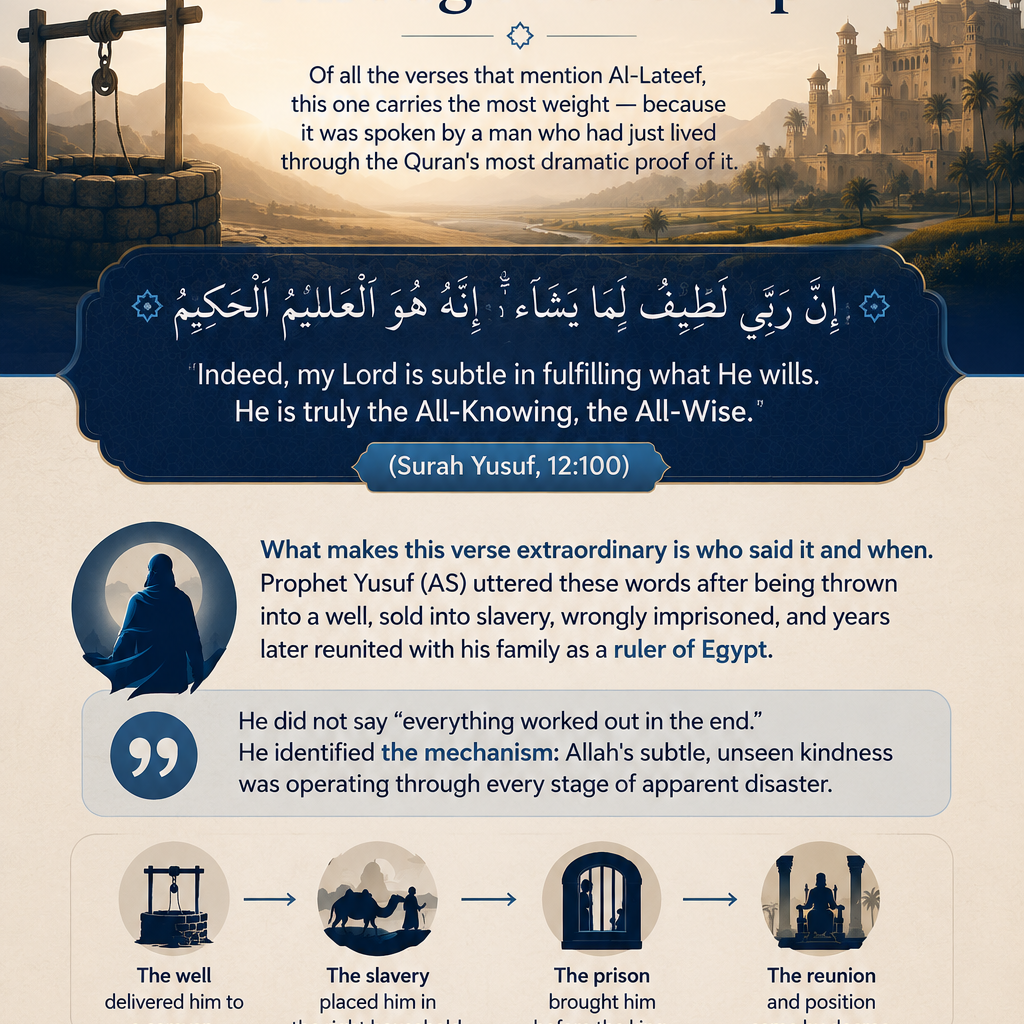
Of all the verses that mention Al-Lateef, this one carries the most weight — because it was spoken by a man who had just lived through the Quran’s most dramatic proof of it.
“إِنَّ رَبِّي لَطِيفٌ لِّمَا يَشَاءُ ۚ إِنَّهُ هُوَ الْعَلِيمُ الْحَكِيمُ”
“Indeed, my Lord is subtle in fulfilling what He wills. He is truly the All-Knowing, the All-Wise.” (Surah Yusuf, 12:100)
What makes this verse extraordinary is who said it and when. Prophet Yusuf (AS) uttered these words after being thrown into a well, sold into slavery, wrongly imprisoned, and years later reunited with his family as a ruler of Egypt.
He did not say “everything worked out in the end.” He identified the mechanism: Allah’s subtle, unseen kindness was operating through every stage of apparent disaster.
The well delivered him to a caravan; the slavery placed him in the right household; the prison brought him before the king. Divine kindness, in the Quran’s own narrative, does not always arrive as comfort — it often arrives as the path through difficulty.
2. Allah Is Gently Kind to His Servants
This verse establishes something that believers in hardship need to hear clearly: Allah’s kindness toward His servants is active and continuous, not conditional on their circumstances improving first.
“اللَّهُ لَطِيفٌ بِعِبَادِهِ يَرْزُقُ مَن يَشَاءُ ۖ وَهُوَ الْقَوِيُّ الْعَزِيزُ”
“Allah is gently kind to His servants — He provides for whoever He wills. He is the Most Powerful, the Almighty.” (Surah Ash-Shura, 42:19)
This verse pairs Al-Lateef with Al-Qawi (the All-Powerful) and Al-Aziz (the Almighty) — a pairing that matters. Allah’s kindness is not the softness of weakness; it is the deliberate, chosen gentleness of the One who has all power and chooses care. His provision reaches servants through channels they recognize and channels they do not.
3. Even What You Cannot See, Allah Knows
This verse uses one of the most vivid images in the Quran to illustrate how Allah’s subtle kindness operates — through processes invisible to the human eye.
“أَلَمْ تَرَ أَنَّ اللَّهَ أَنزَلَ مِنَ السَّمَاءِ مَاءً فَتُصْبِحُ الْأَرْضُ مُخْضَرَّةً ۗ إِنَّ اللَّهَ لَطِيفٌ خَبِيرٌ”
“Do you not see that Allah sends down rain from the sky, and the earth becomes green? Indeed, Allah is Subtle, All-Aware.” (Surah Al-Hajj, 22:63)
The image here is instructive: between the rain falling and the earth greening, there is an invisible process — seeds absorbing water in the dark, roots spreading beneath the surface, life forming before anyone can see it. Allah’s kindness works the same way. Blessings you receive today were set in motion through causes you were not watching.
4. Nothing Is Hidden from His Subtlety
Here the Quran moves from nature to morality — showing that the same divine awareness that reaches hidden seeds also reaches hidden deeds, however small.
“يَا بُنَيَّ إِنَّهَا إِن تَكُ مِثْقَالَ حَبَّةٍ مِّنْ خَرْدَلٍ فَتَكُن فِي صَخْرَةٍ أَوْ فِي السَّمَاوَاتِ أَوْ فِي الْأَرْضِ يَأْتِ بِهَا اللَّهُ ۚ إِنَّ اللَّهَ لَطِيفٌ خَبِيرٌ”
“O my son, even if a deed were the weight of a mustard seed — hidden in a rock or anywhere in the heavens or the earth — Allah will bring it forth. Indeed, Allah is Subtle, All-Aware.” (Surah Luqman, 31:16)
Luqman the Wise spoke these words to his son as a lesson in moral accountability. Allah’s subtle knowledge reaches the mustard seed inside a rock — which is also the believer’s reassurance: no act of goodness, however small and unseen, escapes His awareness or His reward.
5. Eyes Cannot Perceive Him, Yet He Perceives All
This verse closes the theological picture: the very One whose kindness is too subtle for human eyes to trace is also the One whose perception misses nothing.
“لَّا تُدْرِكُهُ الْأَبْصَارُ وَهُوَ يُدْرِكُ الْأَبْصَارَ ۖ وَهُوَ اللَّطِيفُ الْخَبِيرُ”
“No vision can encompass Him, but He encompasses all vision. He is the Subtle, the All-Aware.” (Surah Al-An’am, 6:103)
The pairing of Al-Lateef with Al-Khabeer (the All-Aware) appears across multiple verses — and the connection is intentional. His subtlety is not obscurity; it is a precision of knowledge and care so fine that it operates at levels human perception cannot reach.
Read Also: Quran Verses About Forgiveness in Arabic And English
Quran Verses Commanding Human Kindness in Arabic
Here the Quran moves from describing Allah’s attribute to commanding a practice. The Arabic vocabulary shifts: qawlan layyinan (a gentle word), husnan (what is good and beautiful), allati hiya ahsan (that which is better or best).
These are not vague moral encouragements — they are specific speech standards with identified outcomes.
1. Speak Gently Even to Those Who Wrong You
The Quran does not reserve the command for gentle speech only for easy conversations. Its most striking example involves the hardest possible case: speaking to a tyrant.
“فَقُولَا لَهُ قَوْلًا لَّيِّنًا لَّعَلَّهُ يَتَذَكَّرُ أَوْ يَخْشَىٰ”
“Speak to him gently, so perhaps he may be reminded or may fear.” (Surah Ta-Ha, 20:44)
The context of this verse is one of the most striking in the Quran: Allah is instructing Musa (Moses) and Harun (Aaron) on how to approach Pharaoh — the most arrogant tyrant of their time.
The instruction is not to confront, shame, or accuse. It is to speak gently. Scholars draw from this a principle that applies far beyond prophethood: even when addressing someone who is clearly in the wrong, the manner of speech determines whether the message has any chance of reaching them.
2. Say to People What Is Good
Some Quranic commands are long and layered. This one is five words in Arabic — and its scope is total.
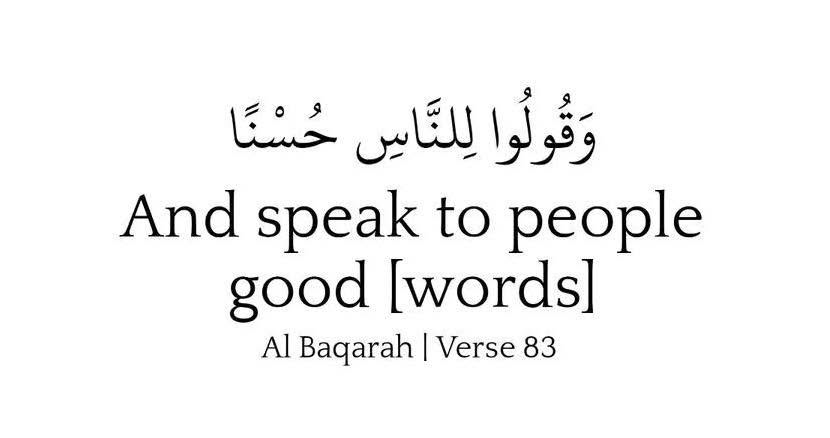
“وَقُولُوا لِلنَّاسِ حُسْنًا”
“And speak to people in a good way.” (Surah Al-Baqarah, 2:83)
This is one of the shortest and most direct commands on human kindness in the entire Quran. The word husnan (حُسْنًا) means goodness, beauty, and excellence all at once. The address is to all people (lin-nas) — not only to Muslims, not only to family and friends. The believer’s default mode of speech toward any human being is meant to be good.
Experience Kalimah Center Classes
Watch real excerpts from our live sessions at Kalimah Center and see how we bring learning to life. These clips highlight our interactive, student-centered teaching approach across all our courses—designed to keep learners engaged, motivated, and actively involved every step of the way.
Master Arabic with Kalimah Center
Join our expert-led online classes and start your journey toward Arabic fluency today.
Book Your Free Trial3. Choose the Better Response
When two possible responses exist — one sharp, one measured — the Quran does not leave the choice to mood or instinct. It makes a direct demand.
“وَقُل لِّعِبَادِي يَقُولُوا الَّتِي هِيَ أَحْسَنُ ۚ إِنَّ الشَّيْطَانَ يَنزَغُ بَيْنَهُمْ”
“Tell My servants to say what is best. Indeed, Satan sows discord among them.” (Surah Al-Isra, 17:53)
The Quran here gives kindness in speech an explicitly strategic dimension: harsh words are the raw material of Shaytan’s work. Choosing the better word — even when a harsher word feels justified — cuts off the avenue through which enmity enters. This is not a call to be dishonest or passive; it is a call to be deliberate about language.
Kindness Turns an Enemy Into a Friend
Most people expect the Quran to say that kindness is the right thing to do. What fewer people expect is that it describes precisely what kindness produces.

“ادْفَعْ بِالَّتِي هِيَ أَحْسَنُ فَإِذَا الَّذِي بَيْنَكَ وَبَيْنَهُ عَدَاوَةٌ كَأَنَّهُ وَلِيٌّ حَمِيمٌ”
“Repel evil with what is better, and the one between you and whom there was enmity will become as though he were a devoted friend.” (Surah Fussilat, 41:34)
This verse from Surah Fussilat is perhaps the most practically powerful verse on kindness in the Quran — and the most overlooked.
It does not say that responding to harm with goodness is the morally superior choice. It describes a real-world outcome: a person who was your enemy becomes like a close, devoted friend. The Arabic waliyyun hameem (وَلِيٌّ حَمِيمٌ) means not just a friend, but a warm, intimate companion — the strongest kind of relational bond.
This transformation principle has a condition, though: the Quran does not say “respond with something good.” It says respond with allati hiya ahsan — with what is better, the best available response in the moment. Generic niceness is not the same as deliberate, chosen goodness that costs you something.
At Kalimah Center, our Quran courses help students move beyond recitation to genuine comprehension of verses like these — building the understanding that makes Quranic values part of how you actually speak and relate to people.
Allah’s Forgiveness as an Expression of Kindness
Among the Quran verses about kindness in Arabic, the forgiveness verses belong in their own category — because here, the kindness being described is directed at believers who have already failed.
“قُلْ يَا عِبَادِيَ الَّذِينَ أَسْرَفُوا عَلَى أَنفُسِهِمْ لَا تَقْنَطُوا مِن رَّحْمَةِ اللَّـهِ إِنَّ اللَّـهَ يَغْفِرُ الذُّنُوبَ جَمِيعًا إِنَّهُ هُوَ الْغَفُورُ الرَّحِيمُ”
“Say: O My servants who have transgressed against themselves — do not despair of Allah’s mercy. Indeed, Allah forgives all sins. He is the Forgiving, the Merciful.” (Surah Az-Zumar, 39:53)
“لا يُكَلِّفُ اللَّـهُ نَفْسًا إِلَّا وُسْعَهَا”
“Allah does not burden a soul beyond that it can bear.” (Surah Al-Baqarah, 2:286)
These two verses together define what divine kindness looks like in the face of human failure: no requirement beyond your actual capacity, and no sin placed beyond His forgiveness if you return to Him. The Quran’s consistent message is that Allah’s kindness is calibrated to human reality — not to an idealized version of it.
Inside Kalimah Center: Moments from Our Courses
Get a glimpse into the vibrant learning experience at Kalimah Center. These snapshots capture real moments from our live classes—where students engage deeply, connect with passionate instructors, and grow in a welcoming, supportive environment.
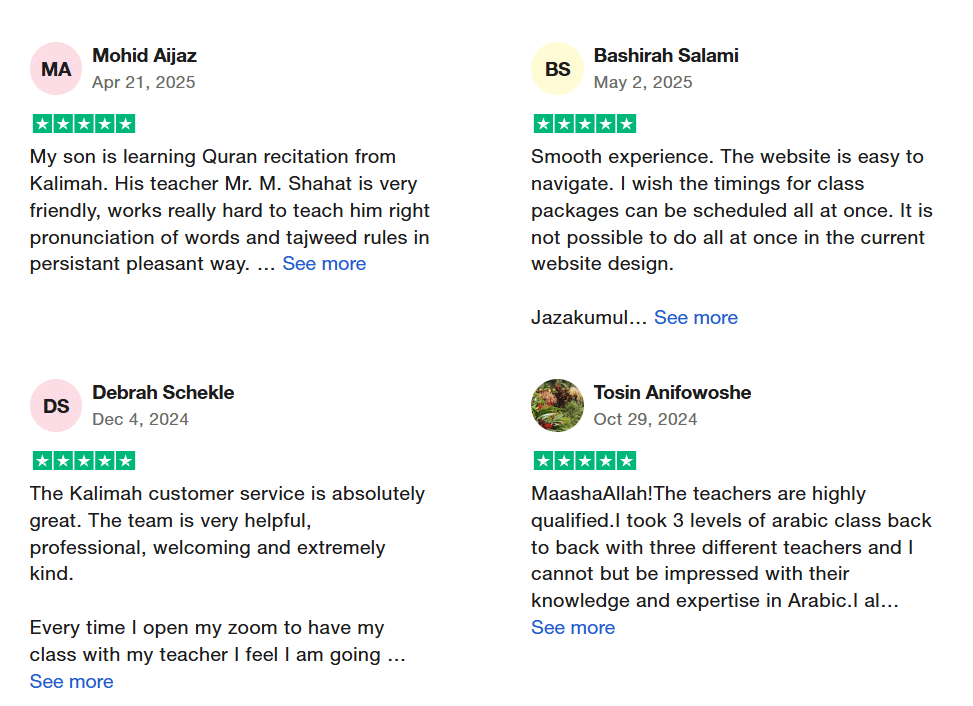
Here Are The Reviews On Our Courses:
Our students frequently commend the excellence of our courses and the commitment shown by our instructors. You can read their complete reviews on Trustpilot.
Read more reviews on Trustpilot
Start Your Quran Journey with Kalimah Center
Understanding these verses in their original Arabic — hearing them recited correctly and knowing what you are reciting — changes how they land in the heart. A translation gives you the meaning; the Arabic gives you the experience.
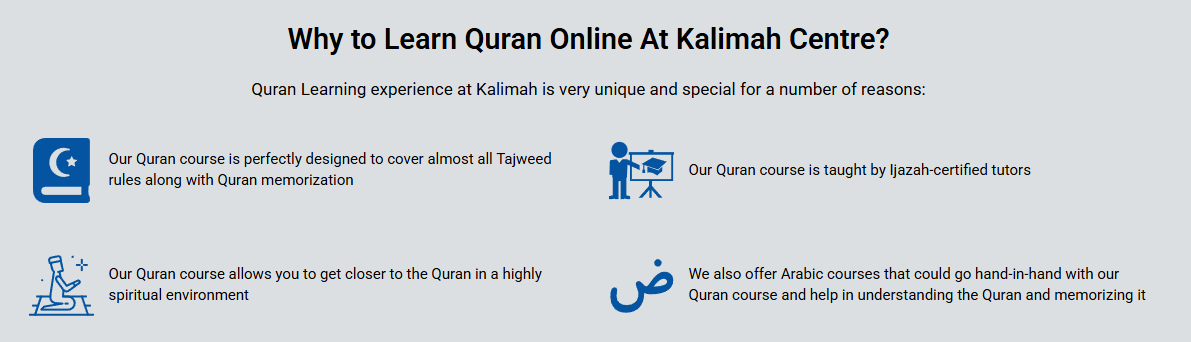
At Kalimah Center, our qualified instructors teach Quran recitation, Tajweed, and Quranic Arabic to students of all levels and ages — whether you are reading Arabic for the first time or deepening a practice you already have. Lessons are live, one-on-one, and scheduled around your life.
Explore Our Courses:
- Online Arabic Course: 16 levels, 400+ hours of one-on-one sessions, structured from complete beginner to advanced.
- Online Quran With Tajweed Course: 13 levels designed for non-Arabic speakers, from first reading to fluent, rule-governed recitation.
- Online Arabic Course for Kids: 24 levels across primary, intermediate, and secondary stages, taught by teachers trained to work with young learners.
Master Arabic with Kalimah Center
Join our expert-led online classes and start your journey toward Arabic fluency today.
Book Your Free TrialStart Your Free Trial Today!
Your free trial is one click away. Start with the verse on kindness that stayed with you and learn exactly what Allah meant when He chose those words.

Conclusion
Quran verses about kindness in Arabic operate on two levels that are worth keeping separate in your mind.
The first is theological: Allah Himself is Al-Lateef — the subtly, gently kind — whose care reaches believers through paths they do not expect, as the story of Yusuf (AS) illustrates in full.
The second is ethical and practical: believers are directly commanded to speak husnan to all people, to choose allati hiya ahsan in their responses, and to understand that a gentle word to the right person at the right moment can produce a close friend from someone who was once an enemy.
The verses gathered here are not decorations. They are a design for how to move through the world.
Read also: Quran Verses About Marriage In Arabic And English
Frequently Asked Questions
The questions below address what readers most commonly ask after encountering these verses — covering meaning, application, and how to take the next step in learning.
1- What is the most important Quran verse about kindness in Arabic?
Many scholars point to Surah Fussilat 41:34 — “Repel with what is better, and the one between you and whom there was enmity will become as though he were a devoted friend” — as the most complete Quranic statement on the practical power of kindness. It alone describes the real-world transformation that deliberate kindness can achieve.
2- What does Al-Lateef mean in the Quran?
Al-Lateef (اللَّطِيف) is one of the 99 names of Allah and carries two meanings: that His knowledge is so precise it reaches the finest hidden realities, and that He delivers goodness and provision to His servants through subtle, unseen means. It appears seven times in the Quran, always paired with Al-Khabeer (All-Aware) or Al-Hakeem (All-Wise).
3- Which surah in the Quran talks about speaking kindly to others?
Several surahs address kind speech directly. Surah Al-Baqarah (2:83) commands believers to “say to people what is good.” Surah Al-Isra (17:53) instructs believers to “say what is best.” Surah Ta-Ha (20:44) commands gentle speech even when addressing someone in serious error, using the example of Musa (AS) speaking to Pharaoh.
4- Is there a Quran verse about kindness to parents?
Yes. Surah Al-Isra 17:23–24 commands believers not to say even “uff” (a sound of impatience) to their parents, and to speak to them with words of honor. The Quran connects kindness to parents directly to worship of Allah, placing them as the second obligation after tawhid.
5- How can I learn these Quran verses in Arabic?
The most reliable method is to study with a qualified teacher who can correct your pronunciation and explain the context. Memorizing verses without understanding their meaning limits how deeply they take root. Kalimah Center offers structured Quran courses — including Quranic Arabic — taught by certified instructors, with a free trial lesson to start.