Can you really learn Arabic in 60 days? Not fluency in the sense of reading classical poetry or debating philosophy — but yes, you can reach a level where you hold real conversations, handle daily situations confidently, and build a foundation strong enough to keep improving on your own. That is a specific, honest, and genuinely achievable goal.
Most guides on learning Arabic in 60 days give you a vague “study every day and use apps” framework. This one is different. It gives you a four-block daily schedule, a phase-by-phase breakdown of what to do each week, the tools that actually move the needle, and the most common mistakes that silently kill progress before the second month even begins.
What variety of Arabic matters too. This guide focuses on Egyptian Arabic — the most widely understood dialect across the Arab world — because it is what you will actually use in daily conversation. Where differences with Modern Standard Arabic (MSA) matter, we flag them clearly.
What You’ll Learn in This Article?
- What “learn Arabic in 60 days” realistically means — and doesn’t mean.
- The exact 4-block daily routine to follow from Day 1 to Day 60.
- A week-by-week phase plan with clear milestones.
- The tools that work versus the ones that waste your time.
- The three mistakes most learners make in the first two weeks.
- A FAQ section answering the most common questions about this goal.
What “Learn Arabic in 60 Days” Actually Means?
Before committing two months of daily effort, define what you are working toward.
What You CAN Achieve in 60 Days?
In 60 days of structured daily practice, a complete beginner can realistically reach a point where they:
- Handle most everyday situations (food, directions, shopping, weather, simple opinions) without needing to know every word.
- Sustain basic back-and-forth conversations with a patient native speaker.
- Read Arabic script slowly but independently.
This puts you around the A2 level on the CEFR scale — elementary communicative ability, with a foundation ready to grow.
What 60 Days Will NOT Give You?
The following goals require six to eighteen months of consistent study beyond this foundation:
- The ability to follow rapid native-to-native conversation.
- Read news articles without a dictionary.
- Produce complex sentences spontaneously.
Know the target going in, and 60 days feels like a real win rather than a disappointment.
Learn Arabic in 60 Days with a Daily Routine
The single biggest factor separating learners who succeed from those who stall is not the apps they use or the books they buy — it is whether they show up every day with a structured block of time.
Key Time Commitments
- 4 hours/day = intensive commitment used in documented 60-day attempts.
- 2 hours/day = extend your timeline to 90–120 days rather than cutting the routine in half.
Consistency matters more than heroic daily totals. Here is the daily routine, broken into four focused blocks.
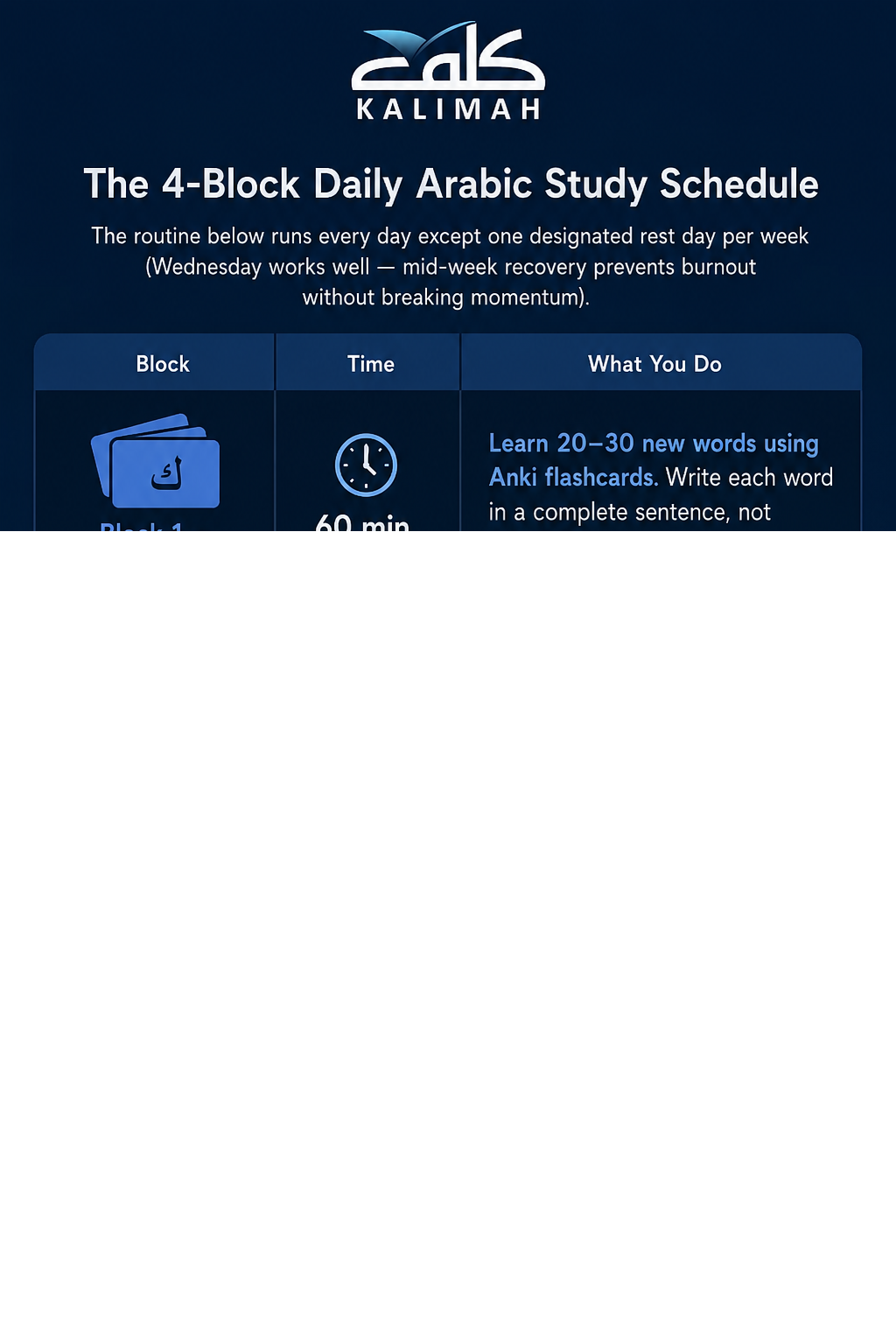
The 4-Block Daily Arabic Study Schedule
The routine below runs every day except one designated rest day per week (Wednesday works well — mid-week recovery prevents burnout without breaking momentum), this aids in How To Learn Arabic Step By Step.
| Block | Time | What You Do |
| Block 1 — Vocabulary | 60 min | Learn 20–30 new words using Anki flashcards. Write each word in a complete sentence, not in isolation. |
| Block 2 — Structure | 60 min | Work through a textbook or structured course. Focus on one grammar point or dialogue at a time. |
| Block 3 — Speaking | 60 min | Live conversation session with a qualified tutor or native speaker via italki. No exceptions. |
| Block 4 — Listening | 60 min | Watch Egyptian TV series or listen to Arabic content — no subtitles after Week 3. |
A single principle runs through all four blocks: active over passive. Recognizing a word when you see it is not the same as producing it under pressure.
Every block should require your brain to retrieve, generate, or respond — not just absorb.
How to Make Each Block Count?
Several practical decisions inside each block determine whether the time is actually productive:
For Block 1
- Enter each new word into Anki as a sentence card, not a word card.
- “The office is on the second floor” sticks far better than the standalone word “office”.
- Aim for 20 words if you are in Weeks 1–2.
- Aim for 30–50 words from Week 3 onward as your retrieval speed improves.
For Block 2
- The Routledge Egyptian Arabic Self-Study series has the clearest structure for beginners choosing this dialect.
- Work one chapter section per session — finishing a section beats starting three.
For Block 3
- The right tutor makes or breaks this block.
- Look for someone who keeps you speaking at least 70% of the session.
- Look for someone who tracks your vocabulary gaps across lessons.
- Look for someone who assigns tasks slightly above your current comfort zone.
- Look for someone who tailors examples to your interests.
- A tutor who lectures at you is a waste of your speaking hour.
For Block 4
- Egyptian TV series are the best listening resource because the dialect is natural.
- The visual context provides comprehension support.
- The content is engaging enough to watch without feeling like homework.
- Cairo Hotel (سر النيل) is an excellent starting point.
The 60-Day Arabic Course Phase by Phase Plan
A good 60-day Arabic course is not 60 identical days — it is three distinct phases, each with its own focus and milestones.
Phase 1 Days 1 to 20 Foundation Script Sounds and Core Vocabulary
The first phase is entirely about eliminating the unfamiliarity of the Arabic script and sound system. Do not try to skip ahead to conversations while letters still feel foreign.
Week 1–2 priorities:
- Master all 28 Arabic letters in isolation and connected forms.
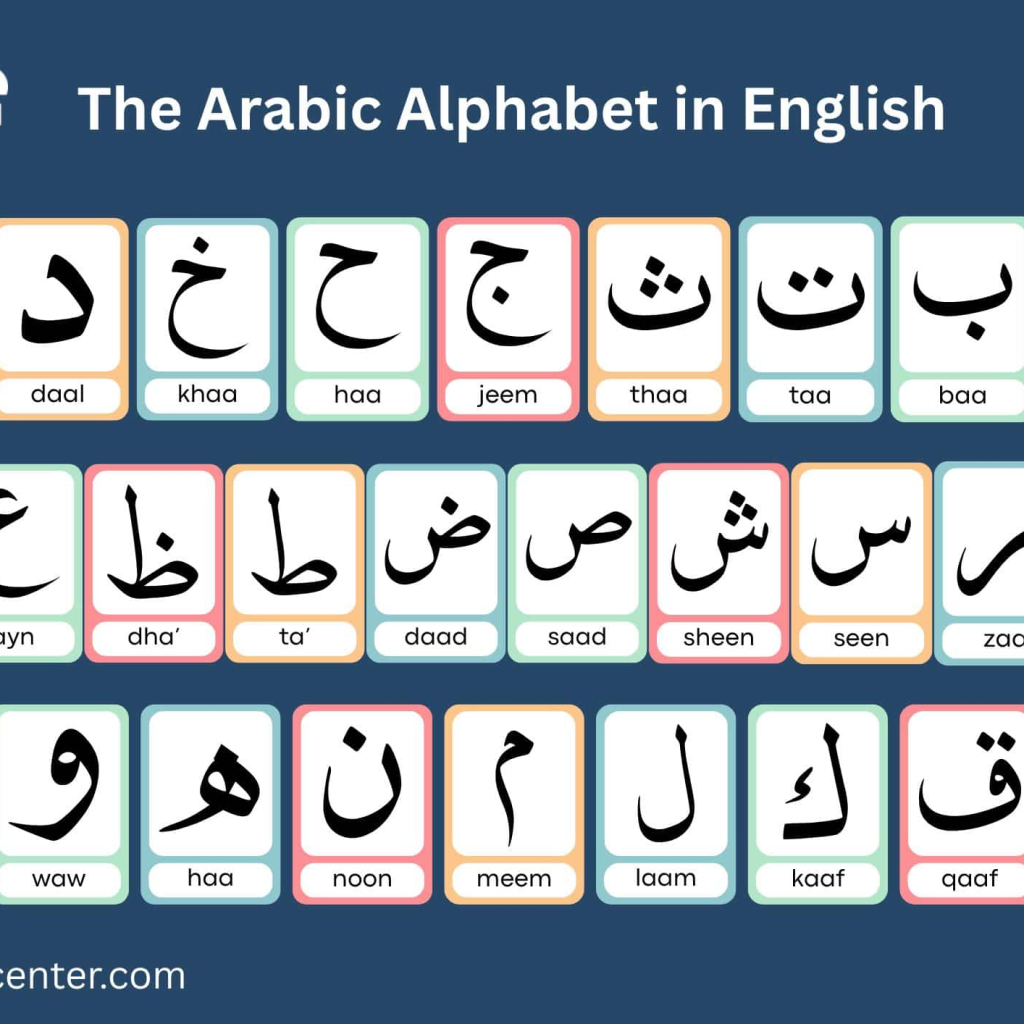
- Drill the sounds that have no English equivalent: ع (Ayn), غ (Ghayn), ح (Haa), خ (Khaa), and the emphatic consonants ص، ض، ط، ظ.
- Build a core bank of 150–200 high-frequency words — greetings, numbers, time expressions, common verbs.
- Start tutor sessions in Week 1, even at the most basic level; waiting until you “know more” delays the most important skill.
By Day 20, you can read Arabic text aloud (slowly), recognize all letters in connected script, and carry a simple greeting exchange without looking at notes.
Read also: Quran Verses About Kindness in Arabic And English
Experience Kalimah Center Classes
Watch real excerpts from our live sessions at Kalimah Center and see how we bring learning to life. These clips highlight our interactive, student-centered teaching approach across all our courses—designed to keep learners engaged, motivated, and actively involved every step of the way.
Master Arabic with Kalimah Center
Join our expert-led online classes and start your journey toward Arabic fluency today.
Book Your Free TrialPhase 2 Days 21 to 45 Interaction Sentences Patterns and Live Use
Arabic in 60 days becomes achievable or impossible depending on what happens in this middle phase. This is where most learners lose momentum because early beginner excitement fades before conversational confidence has arrived.
The structural focus shifts to sentence patterns rather than individual words. Egyptian Arabic uses a small set of core patterns that repeat constantly:
- بحب + noun/verb (I like…)
- عايز/عايزة + verb (I want to…)
- ممكن + verb? (Can I…?)
- كان + adjective (It was…)
Learning these frames and filling them with your vocabulary produces far more usable output than memorizing isolated grammar rules.
This is the Egyptian Arabic equivalent of “sentence mining” — and it is how the dialect actually works in conversation.
Week 3–6 additions:
- 30–50 new vocabulary words per day via Anki.
- Focus tutor sessions on storytelling: describe yesterday, describe a plan, react to a situation.
- Begin watching content without English subtitles — use Arabic subtitles if available.
- Keep a short daily journal in Arabic: 3–5 sentences about your day, however imperfect.
By Day 45, you can communicate in most daily situations, express basic opinions, and follow slow, clear native speech when the topic is familiar.
Read also: Learn Arabic In 30 Days
Phase 3 Days 46 to 60 Consolidation and Conversational Flow
The final phase is not about adding large amounts of new material — it is about making what you know automatic.
The most useful exercise in this phase is recording yourself speaking on a topic for 2–3 minutes, then playing it back. Pronunciation errors you never hear during conversation become obvious when you listen to your own recording.
Note the specific words and sounds that consistently slip, and drill those in Block 1 the following day.
Phase 3 focus:
- Reduce new vocabulary to 10–15 words per day; prioritize retrieval of existing words.
- Tutor sessions shift to open topics: news, opinions, culture, your interests.
- Introduce a language exchange partner for unstructured conversation.
- Test yourself in real or simulated situations: order food in Arabic, describe a problem, tell a story.
By Day 60, you can handle most everyday conversations, express yourself on familiar topics with occasional gaps, and understand the gist of native conversations when the topic is clear.
Tools That Work for a 60-Day Arabic Plan
Choosing the right tools early saves weeks of wasted effort. Here is what the evidence from documented intensive learning attempts supports.
Anki
- Anki is non-negotiable for vocabulary retention
- The spaced repetition algorithm ensures you review words at the exact interval your memory needs — preventing the cycle of learning and forgetting that kills most vocabulary-building attempts
- It requires setup time upfront, but the payoff from Week 2 onward is significant
italki
- italki gives you access to qualified tutors for Block 3 at rates that make daily sessions financially sustainable
- The key is to commit to the same two or three tutors across the 60 days, not to jump between teachers — continuity means your tutor remembers your gaps and builds on previous sessions
Glossika
- Glossika provides a large bank of natural sentences in audio form, useful for Block 4 and for the sentence-recording habit in Phase 3.
- It is most effective as a supplement to live tutor sessions, not a replacement.
Memrise
- Memrise works for alphabet drilling and initial vocabulary — strong in the first two weeks.
- Less efficient than Anki once you have more than 200 words in rotation.
What does not work as a primary method: Duolingo. It is well-designed as a habit-forming game, but Egyptian Arabic is not well represented, and the format does not produce speaking ability or listening comprehension at the level this routine requires.
Read also: Learn Arabic in 3 Minutes a Day – The Daily Routine That Actually Works
Take Your Arabic Grammar Further with Kalimah Center
Understanding the subjunctive and jussive on paper is a real achievement — but the moment these rules click inside a living sentence, with a teacher correcting your ending in real time, is when they become yours permanently.
Kalimah Center was built for exactly that moment.
Why Do Learners Choose Kalimah?
What separates a Kalimah course from a grammar book or a generic platform isn’t the content — it’s the structure around the content:
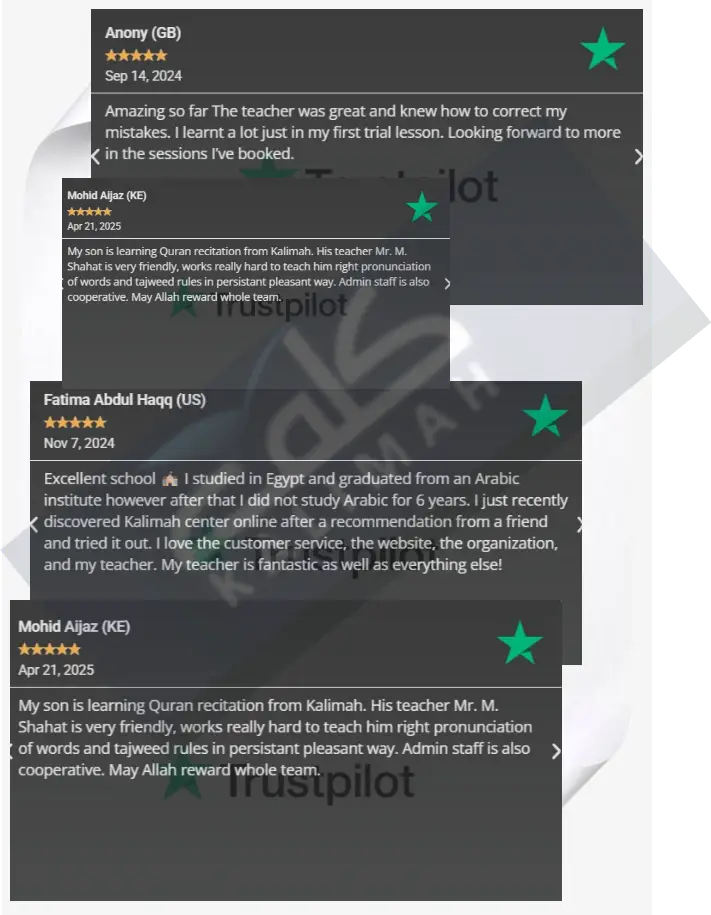
- Vetted, rated instructors — every tutor is assessed for both linguistic depth and teaching method. Before you book, you read real reviews from students who were at your exact level. No guesswork.
- Course books that travel with you — each level is backed by structured written materials at accessible prices, so what your tutor explains in session is reinforced on the page between sessions.
Watch the Teaching Before You Commit
Kalimah’s YouTube channel gives you a genuine preview of how the instruction works — not a promotional clip, but real lessons. Two worth watching if you are working through verb moods right now:
Three Courses, One Coherent Path
From foundational grammar to Quranic recitation to children’s learning — Kalimah offers three structured paths:
- Arabic Course for adults.
- Quran with Tajweed Course for those targeting Quranic comprehension.
- Arabic Course for Kids — all delivered one-on-one, at your pace.
| Course | Levels | Ideal For |
| Online Arabic Course | 16 levels / 400+ hours | Adults building MSA from any starting point |
| Online Quran with Tajweed | 13 levels | Learners targeting Quranic comprehension and recitation |
| Online Arabic for Kids | 24 levels | Children at primary, intermediate, or secondary stage |
Every course runs one-on-one, with interactive tools and tutors matched to your level and learning pace.
Book your free trial at Kalimah Center
Master Arabic with Kalimah Center
Join our expert-led online classes and start your journey toward Arabic fluency today.
Book Your Free TrialConclusion
Learning Arabic in 60 days is a genuine, specific goal — not a marketing promise and not a fantasy. It requires a structured four-block daily routine, a phase-by-phase plan that shifts focus as your level grows, the right tools used consistently, and live speaking practice from Day 1. What it does not require is perfection, native-level fluency, or any prior language-learning experience.
The learners who succeed in 60-day Arabic challenges share one trait above everything else: they treat speaking as a daily non-negotiable, not as something to add “once they know enough.” You will never know enough to feel ready — so start the conversation on Day 1, and let 60 days do the rest.
Read also: Subjunctive and Jussive in Arabic – A Complete Grammar Guide
Frequently Asked Questions About Learning Arabic in 60 Days
Can a complete beginner learn Arabic in 60 days?
A complete beginner can reach elementary conversational ability in Egyptian Arabic in 60 days with four hours of structured daily practice.
This means handling everyday situations, reading the Arabic script, and sustaining simple exchanges. Full fluency takes considerably longer — but the 60-day goal is a meaningful, real milestone that beginners can reach.
How many hours a day do I need to study Arabic to progress in 60 days?
Four hours a day — split across vocabulary, structured study, live speaking, and listening — is the minimum for meaningful progress in 60 days. Two hours a day is viable but extends the same results to 90–120 days.
The split between the four blocks matters as much as total hours; skipping the speaking block consistently will stall your progress regardless of how long you study.
Which Arabic dialect should I learn first?
Egyptian Arabic is the most practical first dialect for most learners. It is the most widely understood across the Arab world due to Egypt’s extensive media output, and more teaching resources exist for it than for any other spoken dialect.
If your goal is specifically Quranic understanding, focus on Modern Standard Arabic pronunciation from the start, then add conversational Egyptian later.
Do I need a tutor, or can I learn Arabic in 60 days with apps alone?
Apps alone will not get you to conversational ability in 60 days. They handle vocabulary drilling and habit formation well, but they cannot provide real-time pronunciation correction, personalized feedback, or actual speaking practice.
A live tutor for at least one session per day — even 30 minutes — is what makes the difference between recognizing Arabic and actually speaking it.
What is the biggest mistake people make when trying to learn Arabic fast?
The most damaging mistake is treating speaking as a reward for when you “know enough” — and spending the early weeks only reading and reviewing vocabulary.
Speaking from Day 1, even in broken sentences, accelerates every other skill: vocabulary sticks faster, listening comprehension improves, and pronunciation errors get caught before they become habits. Start speaking before you feel ready.
Is Egyptian Arabic very different from Modern Standard Arabic?
Egyptian Arabic and Modern Standard Arabic share the same alphabet, the same root system, and a large portion of vocabulary — but differ significantly in pronunciation, everyday expressions, and grammar simplifications.
MSA is understood by educated Arabic speakers everywhere but is not spoken naturally in daily life. Egyptian Arabic is what people actually use in conversation, and what you will need for real-world interaction.