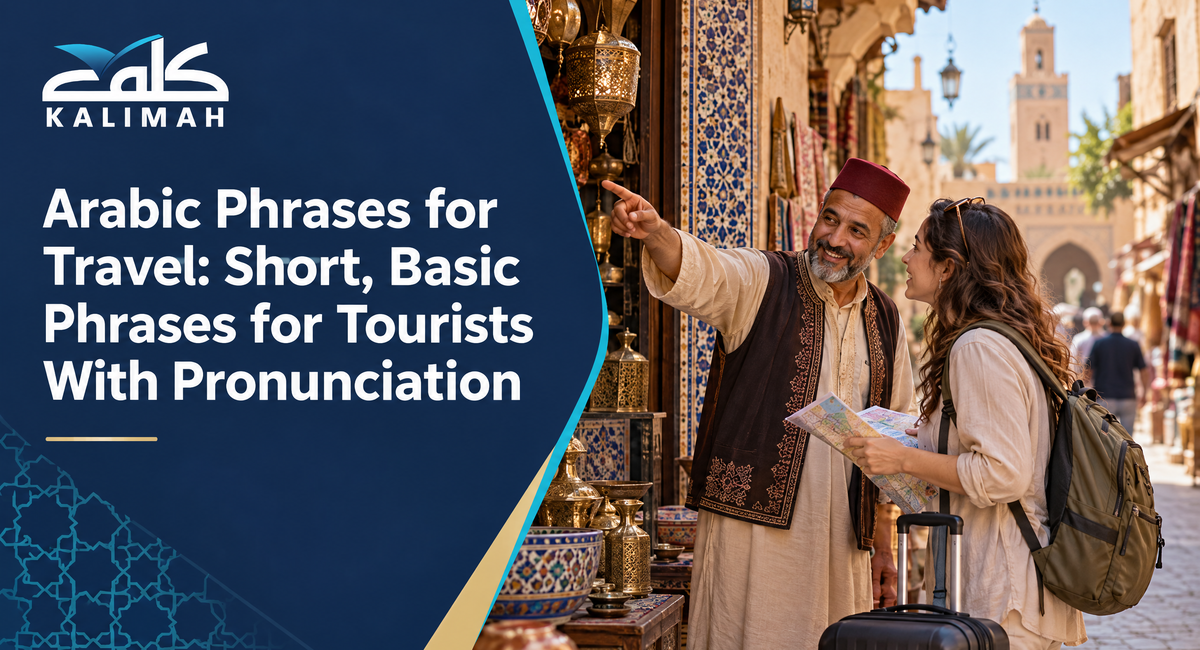
You step out of the airport in Cairo, Amman, or Marrakech. A driver waves. A shop owner smiles at you. What do you say? A few Arabic phrases for travel can make that first minute easy.
Arabic is an official language in the 22 member states of the Arab League. You don’t need to be fluent to visit them. You just need a few short phrases, and the sense to know when to use them.
Below, you’ll find those phrases sorted by place and moment. Each one has the Arabic script, how to say it, what it means, and when to use it.
What you’ll learn in this article
- The 10 Arabic phrases to learn before anything else.
- Basic Arabic phrases for greetings, taxis, shops, food, and hotels.
- What to say if you get sick, lost, or robbed.
- How everyday words change in Egypt, the Gulf, the Levant, and Morocco.
- Small habits that make locals warm up to you.
The 10 Most Important Arabic Phrases for Travel
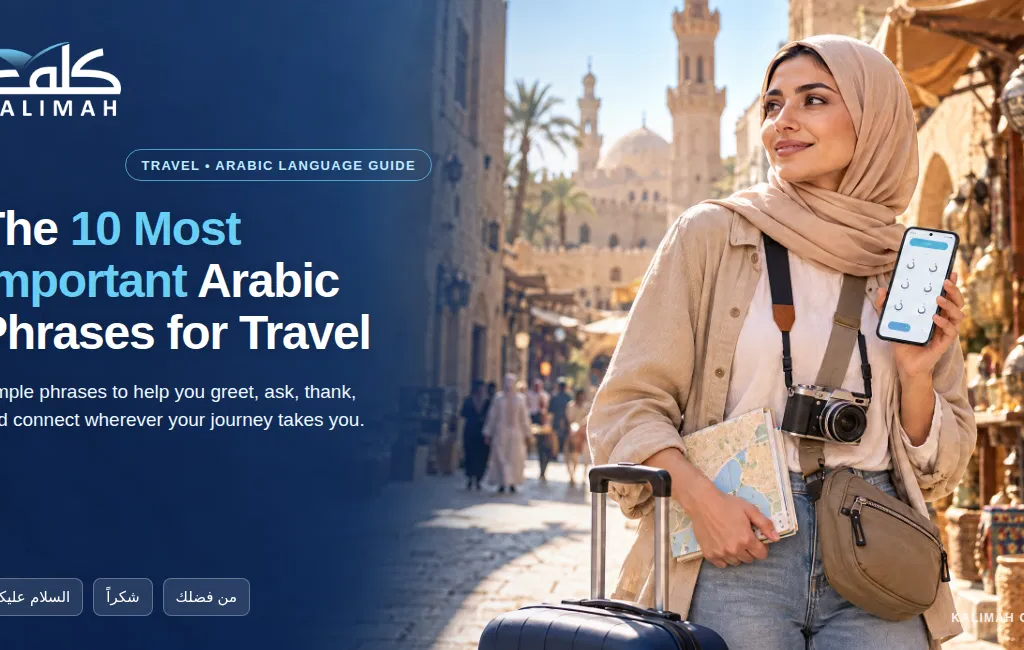
Short on time? Start here. These ten phrases will carry you through most of a short trip. Everything after this section builds on them, one situation at a time. Learn the following table. With them, you can greet people, ask for things, and say thanks.
| Arabic | Pronunciation | Meaning | When to use it |
| السلام عليكم | as-salamu alaykum | Peace be upon you | A safe hello for any place |
| شكراً | shukran | Thank you | After any help or purchase |
| من فضلك | min fadlak | Please | With any request |
| لو سمحت | law samaht | Excuse me | To get someone’s attention |
| نعم / لا | na’am / la | Yes / No | For simple answers |
| أين…؟ | ayna…? | Where is…? | Put any place after it |
| بكم هذا؟ | bikam hadha? | How much is this? | In shops and markets |
| لا أفهم | la afham | I don’t understand | When people talk too fast |
| مساعدة! | musa’ada! | Help! | In an emergency |
| مع السلامة | ma’a as-salama | Goodbye | When you leave |
These work like building blocks. Put two together, and you get a full sentence. “Law samaht, ayna al-hammam?” means “Excuse me, where is the restroom?“
You’ll use shukran more than any other word. Say it to drivers, waiters, guards, and anyone who holds a door. Save this table as a photo on your phone. That way, you can check it even with no signal.
How to Say These Phrases Even If You Don’t Speak Arabic
You don’t need to read Arabic to use this guide. Every phrase is written in English letters. Just read it out loud the way it looks. Most letters sound the same as in English. Only these few need a quick tip:
| You see | How to say it | Try it |
| kh | Like a strong “h” with a little scratch | khayr (good) |
| gh | Like a soft “g” from the back of your mouth | ghali (expensive) |
| q | Just say “k” | qarib (near) |
| ‘ | Take a tiny pause | na’am (yes) |
| Double letters | Say the letter a little longer | jiddan (very) |
Can’t get a sound right? That’s fine. Say the closest English sound, and people will still understand you. Each word is spelled the same way in every table, so you won’t get confused.
All the phrases are in standard Arabic, which people understand in every Arab country. If a country says a word differently, the “Tip” column will tell you.
Basic Arabic Phrases For Tourists: Greetings And Manners
In Arab countries, people say hello before they ask anything. Skipping the greeting can feel cold, even in a quick chat at a shop. This part covers hello, goodbye, and the small polite words you’ll use every hour.
Arabic Greetings And The Replies People Expect
Most Arabic greetings come with a set reply. Once you know it, you won’t freeze when someone greets you first.
| You hear or say | Pronunciation | Meaning | The usual reply |
| السلام عليكم | as-salamu alaykum | Peace be upon you | wa alaykum as-salam (and peace upon you) |
| مرحباً | marhaban | Hello | marhaban (hello) |
| أهلاً وسهلاً | ahlan wa sahlan | Welcome | ahlan bik (welcome to you) |
| صباح الخير | sabah al-khayr | Good morning | sabah an-nur (morning of light) |
| مساء الخير | masa’ al-khayr | Good evening | masa’ an-nur (evening of light) |
| تصبح على خير | tusbih ‘ala khayr | Good night | wa anta min ahlih (you too) |
| مع السلامة | ma’a as-salama | Goodbye | allah yusallimak (God keep you safe) |
As-salamu alaykum fits shops, offices, homes, and mosques. Marhaban and ahlan feel more relaxed. They’re great for cafés and hotels. Use sabah al-khayr until about noon. After that, switch to masa’ al-khayr. Keep tusbih ‘ala khayr for when you leave for the night.
The replies are where you can surprise people. Answer sabah al-khayr with sabah an-nur, and you’ll often get a big smile back. For more ways to say hello, see Kalimah Center’s guide on how to say hi in Arabic. It covers greetings by region.
Polite Arabic Words And The Gender Rule
Polite words soften every request. Many of them change a little, based on who’s talking and who’s listening.
| Arabic | Pronunciation | Meaning | When to use it |
| من فضلك | min fadlak (to a man) / min fadlik (to a woman) | Please | With any request |
| لو سمحت | law samaht / law samahti | Excuse me | To call a waiter or get past someone |
| شكراً جزيلاً | shukran jazilan | Thank you very much | For a big favor |
| عفواً | ‘afwan | You’re welcome | The reply to shukran |
| آسف / آسفة | asif (said by a man) / asifa (said by a woman) | I’m sorry | When you make a mistake |
| تفضّل / تفضّلي | tafaddal / tafaddali | Here you go | When you offer a seat or hand something over |
| لا مشكلة | la mushkila | No problem | In Egypt you’ll hear mafish mushkila |
Arabic has two gender rules here, and they work in opposite ways. With min fadlak and law samaht, the ending matches the person you’re talking to.
With asif (sorry), the ending matches you. So a woman always says asifa, no matter who she’s talking to. Mix them up, and people will still get it. Get them right, and you sound far more natural.
These little endings are much easier with someone listening. The native teachers at Kalimah Center catch them for you in class. You can pick one of their male Arabic teachers or female Arabic teachers.
Arabic Phrases For Getting Around
Finding your way is often the hardest part of a trip. These phrases help you ask, and they help you follow the answer.
Asking For Directions And Understanding The Answer
Asking is easy once you know ayna. The trick is catching a few key words in the reply.
| Arabic | Pronunciation | Meaning | Tip |
| أين الحمام؟ | ayna al-hammam? | Where is the restroom? | Egypt: fayn; Gulf and Levant: wayn |
| أين أقرب محطة مترو؟ | ayna aqrab mahattat metro? | Where is the nearest metro station? | Swap “metro” for any place |
| هل هو بعيد؟ | hal huwa ba’id? | Is it far? | Ask before you start walking |
| يمين | yamin | Right | The same in most countries |
| يسار | yasar | Left | Egypt and Levant often say shimal |
| على طول | ‘ala tul | Straight ahead | You’ll hear it a lot |
| قريب | qarib | Near | Often qarib jiddan (very near) |
Watch out for one word. In formal Arabic, shimal means “north“. On the street in Cairo or Beirut, it means “left“. Follow the person’s hand.
Hands often say more than words here. Look at where someone points, not just at their face. Long answer? Take it one step at a time. Say wa ba’dayn? (and then?) after each part.
Taxi, Bus, And Train Phrases
Taxis are how most tourists get around. A few phrases save you from arguments about the price.
| Arabic | Pronunciation | Meaning | When to use it |
| إلى… من فضلك | ila… min fadlak | To…, please | Tell the driver where you’re going |
| كم الأجرة؟ | kam al-ujra? | How much is the fare? | Before you get in |
| شغّل العداد من فضلك | shaghghil al-‘addad, min fadlak | Please turn on the meter | Before the car moves |
| هنا من فضلك | huna, min fadlak | Here, please | When you want to stop |
| هل تذهب هذه الحافلة إلى…؟ | hal tadhhab hadhihi al-hafila ila…? | Does this bus go to…? | At the bus stop |
| أين أشتري تذكرة؟ | ayna ashtari tadhkara? | Where can I buy a ticket? | At stations |
Settle the fare before the ride starts. If the car has a meter, ask for it. If not, agree on a price first. Drop a pin on your map app before you get in. Show the driver the map along with “ila…, min fadlak”.
Two place words are worth learning before you land: al-matar (the airport) and mahattat al-qitar (the train station).
Inside Kalimah Center: Moments from Our Courses
Get a glimpse into the vibrant learning experience at Kalimah Center. These snapshots capture real moments from our live classes—where students engage deeply, connect with passionate instructors, and grow in a welcoming, supportive environment.
Master Arabic with Kalimah Center
Join our expert-led online classes and start your journey toward Arabic fluency today.
Book Your Free TrialArabic Phrases For Shopping And Money
Markets in the Arab world are loud, busy, and fun. A little Arabic there can even get you a fairer price.
Asking Prices And Bargaining In The Market
In old markets, sellers expect you to bargain. Keep it light, and keep smiling.
| Arabic | Pronunciation | Meaning | Tip |
| بكم هذا؟ | bikam hadha? | How much is this? | Egypt: bikam da? |
| غالي جداً | ghali jiddan | Too expensive | Say it gently to start |
| هل يمكن تخفيض؟ | hal yumkin takhfid? | Can you lower the price? | A polite way to ask |
| ما آخر سعر؟ | ma akhir si’r? | What is your last price? | Near the end of the deal |
| هل لديكم مقاس أكبر؟ | hal ladaykum maqas akbar? | Do you have a bigger size? | Say asghar for smaller |
| سآخذه | sa-akhudhuhu | I’ll take it | To close the deal |
| ربما في المرة القادمة | rubbama fi al-marra al-qadima | Maybe next time | To walk away kindly |
Never name a price you wouldn’t pay. Once you say a number, the seller expects you to buy. Walking away slowly is part of the game. Sometimes the seller calls you back with a better offer.
Malls and big stores have fixed prices, though. Save your bargaining for street markets and small shops.
Reading Arabic Numbers On Price Tags
Price tags, bus signs, and bills often use Arabic numbers. If you can read them, you can check prices yourself.
| Number | Arabic numeral | Pronunciation |
| 0 | ٠ | sifr |
| 1 | ١ | wahid |
| 2 | ٢ | ithnan |
| 3 | ٣ | thalatha |
| 4 | ٤ | arba’a |
| 5 | ٥ | khamsa |
| 6 | ٦ | sitta |
| 7 | ٧ | sab’a |
| 8 | ٨ | thamaniya |
| 9 | ٩ | tis’a |
| 10 | ١٠ | ‘ashara |
Here’s something odd. Arabic words run right to left, but numbers run left to right, just like English. So ١٥٠ means 150. Be careful with zero and five. Zero (٠) is just a dot. Five (٥) is a small circle, so many people read it as zero.
Practice on bus numbers and car plates as you walk around. After a day or two, prices get easy.
Arabic Phrases For Food And Hotels
Food is one of the best parts of any trip, and your hotel is where you rest. Both go better with a few clear phrases.
Ordering Food And Paying The Bill
Waiters tend to love it when guests try Arabic. These phrases help you get what you want and skip what you can’t eat.
| Arabic | Pronunciation | Meaning | Tip |
| القائمة من فضلك | al-qa’ima, min fadlak | The menu, please | Most places know the word “menu” too |
| أريد… | urid… | I would like… | Then point or name the dish |
| ما هذا؟ | ma hadha? | What is this? | Point at a dish you don’t know |
| بدون… | bidun… | Without… | bidun sukkar means no sugar |
| أنا نباتي / نباتية | ana nabati / nabatiya | I’m vegetarian | Man / woman |
| عندي حساسية من… | ‘indi hasasiya min… | I’m allergic to… | Add the food after it |
| لذيذ | ladhidh | Delicious | A kind word for the cook |
| الحساب من فضلك | al-hisab, min fadlak | The bill, please | When you’re ready to pay |
Bidun might be the handiest food word of all. Try bidun lahm (no meat) or bidun filfil (no pepper). Got a serious allergy? Have it written in Arabic on a small card. Hand it to the waiter before you order.
In many places, the bill won’t come until you ask for it. Asking for al-hisab isn’t rude. It’s normal.
Hotel Check-In And Room Problems
Big hotels usually have staff who speak English. Small guesthouses and night staff may not.
| Arabic | Pronunciation | Meaning | Tip |
| عندي حجز | ‘indi hajz | I have a booking | At check-in |
| هل يوجد واي فاي؟ | hal yujad wai-fai? | Is there Wi-Fi? | Egypt and Levant: fi wai-fai? |
| ما كلمة السر؟ | ma kalimat as-sirr? | What is the password? | For the Wi-Fi |
| المفتاح | al-miftah | The key | To ask for your room key |
| التكييف لا يعمل | at-takyif la ya’mal | The AC is not working | Tell the front desk |
| متى وقت الخروج؟ | mata waqt al-khuruj? | What time is check-out? | Ask on your first day |
The words la ya’mal mean “is not working”. Put any item in front of them, and you can report almost any problem. Ad-dush la ya’mal means the shower isn’t working. An-nur la ya’mal means the light is out.
Check the check-out time early. Some hotels want you out before noon.
Arabic Phrases For Emergencies And Health
You’ll probably never need these. Learn them anyway. Stress makes new words very hard to find.
Asking For Help, Police, And Lost Items
These phrases help if you’re lost, robbed, or in danger. Travel phrase guides like this one from the University of Wisconsin list them as must-knows.
| Arabic | Pronunciation | Meaning | When to use it |
| مساعدة! | musa’ada! | Help! | Shout it to get attention fast |
| ساعدني من فضلك | sa’idni, min fadlak | Please help me | Ask one person directly |
| اتصل بالشرطة | ittasil bish-shurta | Call the police | For theft or danger |
| أنا تائه / تائهة | ana ta’ih / ta’iha | I’m lost | Man / woman |
| فقدت جواز سفري | faqadtu jawaz safari | I lost my passport | At the police or hotel |
| سُرق هاتفي | suriqa hatifi | My phone was stolen | When you report a theft |
If you need help right now, shout musa’ada! Then look at one person and say sa’idni. That way, they know you mean them. Keep a photo of your passport on your phone and in your email. A lost passport is much less scary with a copy.
Save your embassy’s number before you fly. Police or hotel staff can help you call it.
Health Phrases For Doctors And Pharmacies
These phrases help you get care, for a headache or for something worse.
| Arabic | Pronunciation | Meaning | When to use it |
| أحتاج طبيب | ahtaj tabib | I need a doctor | Any health problem |
| أحتاج إسعاف | ahtaj is’af | I need an ambulance | A serious emergency |
| أين المستشفى؟ | ayna al-mustashfa? | Where is the hospital? | To find care fast |
| أين الصيدلية؟ | ayna as-saydaliya? | Where is the pharmacy? | For small problems |
| أنا مريض / مريضة | ana marid / marida | I’m sick | Man / woman |
| يؤلمني هنا | yu’limuni huna | It hurts here | Point to the spot |
Pharmacies are easy to find in most Arab cities, and many stay open late. For small problems, the pharmacist is often the quickest help. Point to the spot that hurts as you say yu’limuni huna. Your hand does half the work.
Take medicine every day? Carry the box with you. Showing the name is easier than saying it.
Arabic Small Talk Phrases For Travelers
Small talk turns strangers into friends. Drivers, guides, and shop owners will often ask where you’re from.
Introducing Yourself And Making Friends
These phrases help you have short, friendly chats. Some of your best trip stories may start this way.
| Arabic | Pronunciation | Meaning | Tip |
| كيف حالك؟ | kayfa haluk? | How are you? | To a woman: kayfa haluki? |
| بخير، الحمد لله | bikhayr, al-hamdu lillah | Fine, thank God | The usual reply |
| ما اسمك؟ | ma ismuk? | What’s your name? | To a woman: ma ismuki? |
| اسمي… | ismi… | My name is… | Then say your name |
| تشرفنا | tasharrafna | Nice to meet you | After you share names |
| من أين أنت؟ | min ayna anta? | Where are you from? | To a woman: min ayna anti? |
| أنا من… | ana min… | I’m from… | Then name your country |
| هذه أول مرة لي هنا | hadhihi awwal marra li huna | This is my first time here | People may share tips |
Almost everyone answers “How are you?” with bikhayr, al-hamdu lillah. It’s friendly and normal, so go ahead and use it. Tell people it’s your first visit, and they’ll often help. You might hear about a great café or a quiet place to see.
Want to say more about yourself? Read Kalimah Center’s guide on how to introduce yourself in Arabic. It covers your name, your age, and where you live.
What To Say When You Don’t Understand
Everyone gets lost in a fast reply. These phrases slow things down without any stress.
| Arabic | Pronunciation | Meaning | Tip |
| أعد من فضلك | a’id, min fadlak | Please say it again | When you miss a word |
| ببطء من فضلك | bibut’, min fadlak | Slowly, please | When people talk fast |
| أتكلم العربية قليلاً | atakallam al-‘arabiya qalilan | I speak a little Arabic | Egypt: ‘arabi shwayya bas |
| كيف تقول… بالعربية؟ | kayfa taqul… bil-‘arabiya? | How do you say… in Arabic? | Learn new words on the spot |
| هل تتكلم الإنجليزية؟ | hal tatakallam al-injliziya? | Do you speak English? | Your backup plan |
Say “I speak a little Arabic” early in the chat. Most people will slow down and pick easier words for you. Point at things and ask kayfa taqul… bil-‘arabiya? It’s a fun way to pick up words from real people.
One trap to avoid: don’t nod if you didn’t understand. People will think you got it and keep going. A simple la afham is better.
Ready to go from single phrases to real chats? The Online Arabic Course at Kalimah Center builds your speaking step by step. You talk with a real teacher in each class.
How Arabic Changes From Country To Country
The Arabic people speak on the street isn’t always the Arabic in books. Each region has its own way of talking, called a dialect.
Arabic Dialect Cheat Sheet For Travelers
These are the everyday words that change the most from place to place. MSA works everywhere, but this table helps you follow replies.
| Meaning | MSA | Egypt | Levant | Gulf | Morocco |
| Where? | ayna | fayn | wayn | wayn | fin |
| How much? | bikam | bikam | addaysh | bikam | bshhal |
| I want | urid | ‘ayiz / ‘ayza | baddi | abi | bghit |
| What? | madha | eh | shu | shu | shnu |
| Now | al-an | dilwa’ti | halla’ | al-hin | daba |
| Good | jayyid | kwayyis | mnih | zayn | mzyan |
| Yes | na’am | aywa | ee | ee | iyyeh |
| There isn’t | la yujad | mafish | ma fi | ma fi | makaynsh |
Before you fly, learn just the column for your country. Keep speaking MSA, and use these words to catch the answers. Moroccan Arabic is often the hardest for visitors to follow, because it mixes in many French and Amazigh (Berber) words.
In big Gulf cities like Dubai and Doha, you’ll also hear a lot of English, since many people there come from other countries. If you’re not sure which local word to use, stick with standard Arabic, and people will still understand you.
Read also: Common Arabic Names For Boys and Girls
Arabic Culture And Manners Every Traveler Should Know
Words are only part of it. A few habits and common sayings help you fit in and skip awkward moments.
Common Sayings You’ll Hear Every Day
Some Arabic words mean more than a dictionary shows. You’ll hear these many times a day. Inshallah (إن شاء الله) means “if God wills”. People say it about anything in the future. Think of it as “I hope so”, not a firm promise.
- Mashallah (ما شاء الله) means “what God has willed”. People say it to praise something good, like a child, a meal, or happy news.
- Yalla (يلا) means “let’s go” or “come on”. Your guide will say it when it’s time to move.
- Habibi (حبيبي) means “my dear” to a man, and habibti (حبيبتي) to a woman. Friends use it all the time. With strangers of the other gender, it’s best to leave it out.
- Visiting in Ramadan? Say Ramadan karim (رمضان كريم), and you’ll hear allahu akram back. During Eid, say ‘Eid mubarak (عيد مبارك).
Give and take money, food, and gifts with your right hand. When meeting someone of the other gender, wait to see if they offer a handshake. A hand on your heart is a kind choice too.
Mistakes Tourists Make And How To Avoid Them
Everyone makes a few slips when they start. None of these will ruin your trip, and each one is easy to fix.
- Mixing standard Arabic with local slang: Many online lists blend standard Arabic with street words from one country, and they don’t tell you which is which. So you might learn a Cairo word and then use it in Dubai. Start with standard Arabic. Then add local words only for the country you’re visiting.
- Learning from lists that are wrong: Not every phrase list online is correct. Some say the word for water is ma’an, but it’s actually ma’ in standard Arabic and mayya in Egypt. If a word looks odd, check it in a second source before you learn it.
- Switching between spellings: You might see the same word written as shukran, shokran, or shookran. Jumping between them makes words harder to remember. Choose one spelling, like the ones in this guide, and stick with it.
- Rushing through similar sounds: A few Arabic words sound almost the same to English ears. Qalb means heart, and kalb means dog. Most of the time, people will get your meaning from the situation, but if someone looks puzzled, slow down and say the word again.
How To Get Ready To Speak Arabic On Your Trip
Reading a list is a good start. Saying the words in the moment takes a bit of practice.
A Simple Plan To Practice Before You Fly
You don’t need hours a day. A short, clear plan works better than long, random study.
- First, learn the top 10 phrases from the start of this guide. They cover the moments you’ll face most often.
- Next, learn the local words for your country from the dialect table. That’s only eight words, and they help you follow what people say back.
- Then act out real scenes. Use a simple pattern: say hello, ask, then say thanks. For example: “As-salamu alaykum. Ayna al-hammam, min fadlak? Shukran.”
Try ordering tea, taking a taxi, and buying a scarf. Say each scene out loud, not just in your head. Your mouth has to learn the sounds, too.
A native speaker who talks back is the best partner. They can play the driver, the waiter, and the shop owner. For more ideas, see Kalimah Center’s guide to basic Arabic conversation for beginners.
Experience Kalimah Center Classes
Watch real excerpts from our live sessions at Kalimah Center and see how we bring learning to life. These clips highlight our interactive, student-centered teaching approach across all our courses—designed to keep learners engaged, motivated, and actively involved every step of the way.
Master Arabic with Kalimah Center
Join our expert-led online classes and start your journey toward Arabic fluency today.
Book Your Free TrialBook Your Free Arabic Lesson With Kalimah Center Today
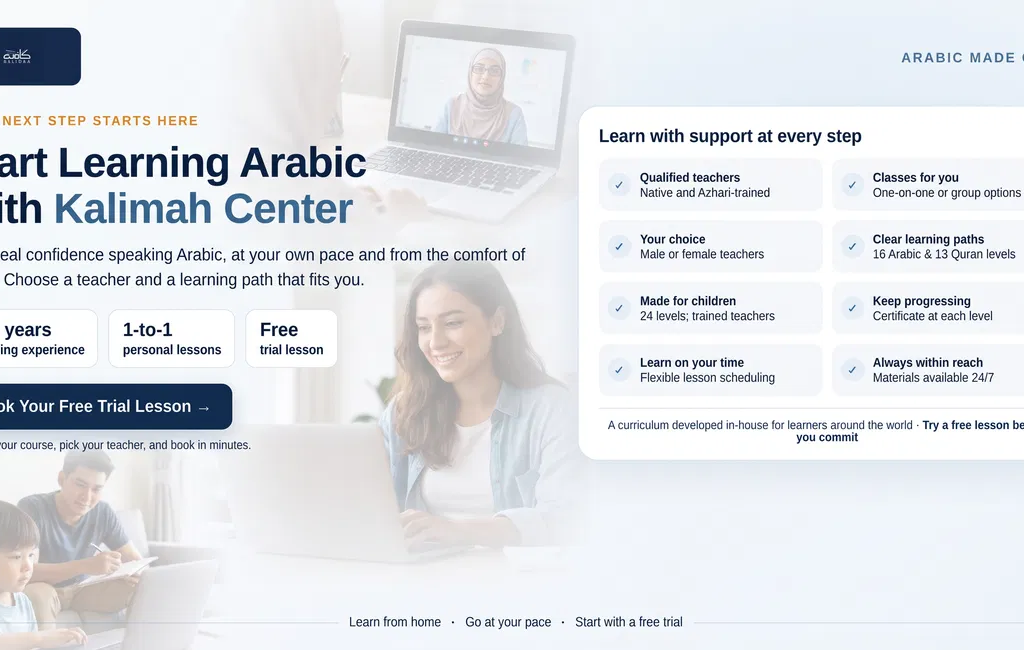
A phrase list gets you started. A real teacher gets you talking. Kalimah Center has taught Arabic for more than 14 years, and here’s what you get when you join:
- Native Arabic teachers who are trained to teach people who don’t speak Arabic.
- One-on-one or group classes, whichever suits you.
- Male and female teachers, so you can learn with someone you feel at ease with.
- Class times you choose, to fit around work and travel.
- Kalimah’s own lessons and books, built from years of teaching students worldwide.
- 16 levels for adults, with a certificate each time you pass a level.
- Mistakes fixed during class, so bad habits don’t come on the trip with you.
- Fun exercises in class, plus your lesson materials open day and night.
- A free trial lesson, so you can try it before you pay.
Tell your teacher where you’re going. Then practice the exact moments you’ll face, from the taxi to the market to the hotel desk.
Explore Our Courses:
Start your learning journey today, browse our courses and click Free Trial.
- Online Arabic Course: Tailored to your level, our comprehensive Arabic program includes 16 teaching levels and 400+ hours of personalized sessions.
- Online Quran With Tajweed Course: Perfect for non-Arabic speakers, our course spans 13 levels and equips you with Tajweed mastery from beginner to advanced.
- Online Arabic Course For Kids: Nurture your child’s love for Arabic with our engaging and structured program, available in 24 levels for primary, intermediate, and secondary stages.
Conclusion
You don’t need perfect Arabic for a great trip. You need a handful of clear phrases and the nerve to use them. Start with the top 10 Arabic phrases for travel. A greeting, min fadlak, shukran, ayna, and bikam will get you through most days.
After that, pick the lists that match your plans. If you’ll eat out a lot, learn the food phrases. If you’ll ride taxis, learn the fare and meter phrases. You don’t have to learn everything.
Don’t skip the emergency and health phrases. They take five minutes to learn, and they give you real peace of mind. The local words for your country come next. MSA helps people understand you. Local words help you understand them.
Then there’s the human side. Use your right hand, give the right reply to a greeting, and smile when you speak. People forget a wrong word quickly. They remember that you tried.
Your Arabic won’t be perfect on day one, and that’s fine. It just has to start. Every shukran makes the next one easier to say.
FAQs
Most travelers have the same few questions before their first trip to an Arab country. Here are short, clear answers to the most common ones.
Can I Travel In Arab Countries With Only English?
Yes, you can get by with English in big cities and tourist areas. Outside those places, English is less common, so basic Arabic phrases make taxis, shops, and small towns much easier.
Is Arabic Hard To Learn For A Short Trip?
No, Arabic for a short trip isn’t hard if you stick to key phrases. You can skip the grammar and focus on greetings, prices, directions, and asking for help.
Should I Learn The Arabic Alphabet Before I Travel?
You don’t need the whole Arabic alphabet for a short trip. It does help to know a few common signs, like مخرج (exit), دخول (entrance), مفتوح (open), and مغلق (closed).
What Arabic Phrases Help During Umrah Or Hajj?
During Umrah or Hajj, two useful phrases are ayna al-haram? (where is the Grand Mosque?) and taqabbal allahu minna wa minkum (may God accept from us and you). Pilgrims also repeat the Talbiyah, labbayka allahumma labbayk.
Is It Rude To Speak English First In An Arab Country?
No, it isn’t rude, but starting with a short Arabic greeting feels warmer. Say as-salamu alaykum first, then switch to English if you need to.
What Does Baksheesh Mean In Egypt?
Baksheesh means a tip in Egypt. People give it to waiters, drivers, guides, and helpers for small services, so keep some small bills handy.
What Is The Best Way To Learn Arabic Phrases For Travel Online?
The best way to learn Arabic phrases for travel online is with a live native teacher. At Kalimah Center, one-on-one classes let you practice real travel scenes, and you can start with a free trial lesson.