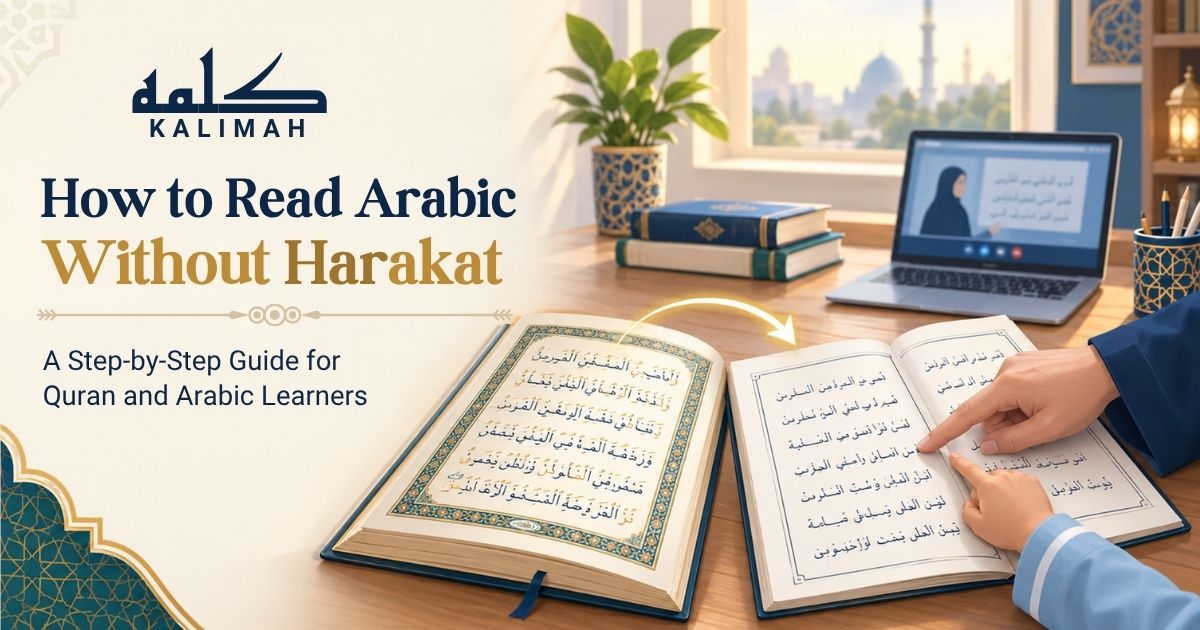
Have you ever read a vowelized Quran page smoothly, then opened an Arabic book or a news headline and felt completely stuck? Almost every learner reaches this point, because everyday Arabic is written without the short vowel marks they learned.
Learning how to read Arabic without harakat is not about guessing. It is a skill built on vocabulary, word patterns, grammar, and meaning, and both children and adults can develop it with the right steps.
In this guide, the teachers at Kalimah Center share the method they use to teach how to read Arabic without harakat: what harakat are, how fluent readers fill them in, a staged practice plan, free resources, and the mistakes that slow learners down.
1. Read Fully Vowelized Texts
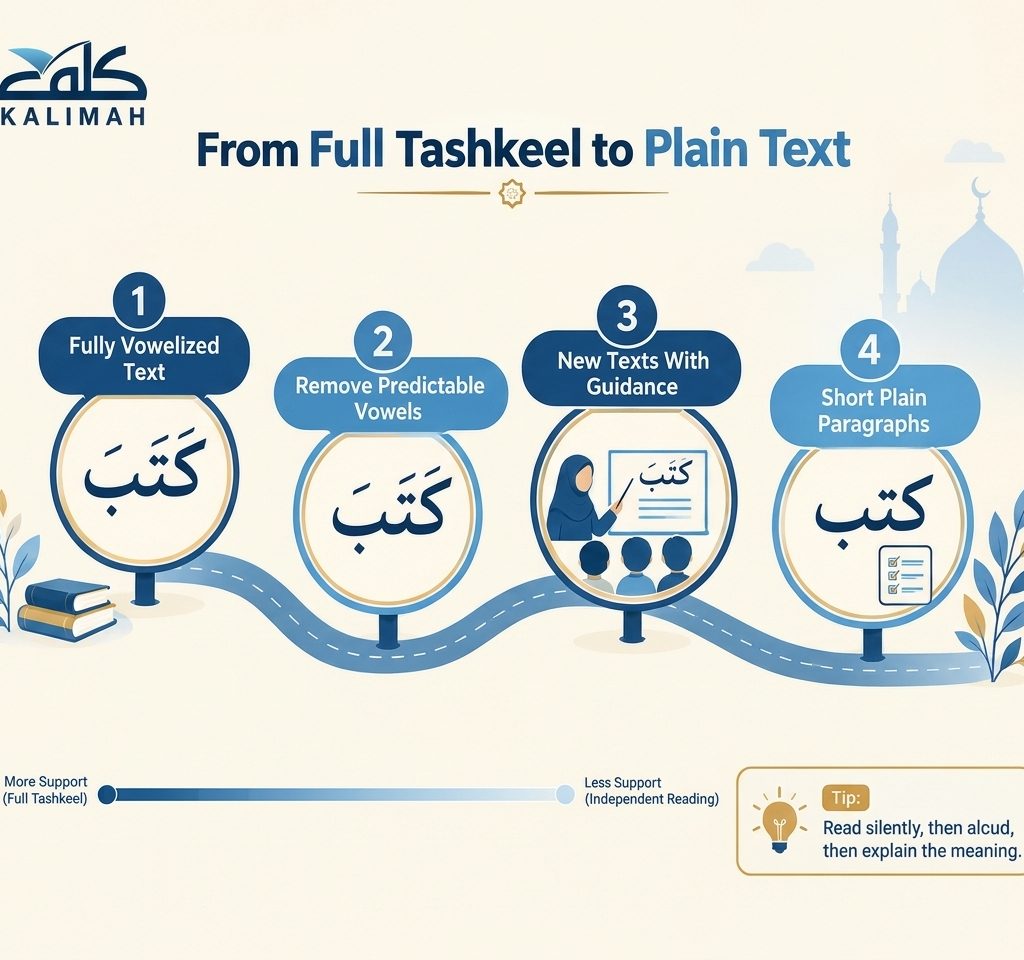
The first step in learning how to read Arabic without harakat is, surprisingly, reading with them. Start with fully vowelized material such as the Mushaf, children’s stories, or graded textbooks.
For children, short vowelized stories and the last juz of the Quran work well because the surahs are brief and repeated often. Adults can use the same material, adding a graded textbook to connect each new word with its meaning.
Point to each word as you read it aloud, then listen to a reliable recitation of the same passage. Comparing your reading with the audio quickly shows which vowels you still confuse, skip, or pronounce too quickly.
Pay special attention to shadda and sukun, since many later errors start with them. A word like مُعَلِّم (teacher) becomes مُعْلِم (informer) if the shadda is dropped, so train your eye to notice these marks every time.
2. Remove Predictable Vowels
This is where you begin to practice how to read Arabic without harakat: use texts where familiar words lose their marks while new or ambiguous words keep them. You can also cover the vowels on a page you already know well and test yourself.
Begin with words you meet constantly, such as في, من, على, and الله, since they rarely need marks. Then remove vowels from words you have read many times, keeping marks only on the words that still slow you down.
A simple exercise is to copy a short vowelized passage by hand without its harakat. The next day, read your copy aloud and check each word against the original to see how much you retained.
Expect to hesitate at first, and treat each pause as useful information. Mark the words that stopped you, review them in new sentences, and return to the same page a few days later to test your progress.
3. Read New, Lightly Vowelized Texts With Guidance
Move to unfamiliar passages that carry marks only where confusion is likely. A teacher or answer key lets you check each reading immediately, so mistakes do not settle in.
Choose texts slightly above your comfort level, such as short stories, simple tafsir summaries, or children’s Islamic books. The few marks that remain usually sit on words with more than one possible reading, so notice why each one was kept.
In Kalimah Center’s one-on-one classes, a native Arabic teacher listens to every word you read, corrects mistakes on the spot, and shows you how to read Arabic without harakat using texts that match your exact level.
Experience Kalimah Center Classes
Watch real excerpts from our live sessions at Kalimah Center and see how we bring learning to life. These clips highlight our interactive, student-centered teaching approach across all our courses—designed to keep learners engaged, motivated, and actively involved every step of the way.
Master Arabic with Kalimah Center
Join our expert-led online classes and start your journey toward Arabic fluency today.
Book Your Free Trial4. Read Short Unvowelized Paragraphs
Finally, read short plain paragraphs and answer comprehension questions about them. This stage is the real test of how to read Arabic without harakat, so read silently first for meaning, then aloud, then explain the main idea in your own words.
Start with two or three sentences on a familiar topic, such as a well-known story of a Prophet or a simple daily routine. Familiar content lets you focus on decoding the words instead of struggling with new ideas at the same time.
Keep a small notebook for words you misread, writing each one with its correct harakat and an example sentence. Reviewing this list every week turns your weak points into words you recognize instantly.
Increase the length gradually, from a short paragraph to a full page, only when your accuracy stays high. If mistakes become frequent, return briefly to lightly vowelized texts before moving forward again.
| With Tashkeel | Without Tashkeel | English |
| ذَهَبَ الطَّالِبُ إِلَى المَسْجِدِ | ذهب الطالب إلى المسجد | The student went to the mosque |
| قَرَأَ الوَلَدُ سُورَةَ الفَاتِحَةِ | قرأ الولد سورة الفاتحة | The boy read Surat Al-Fatiha |
| يَتَعَلَّمُ الأَطْفَالُ التَّجْوِيدَ | يتعلم الأطفال التجويد | The children learn Tajweed |
How to Read Arabic Without Harakat
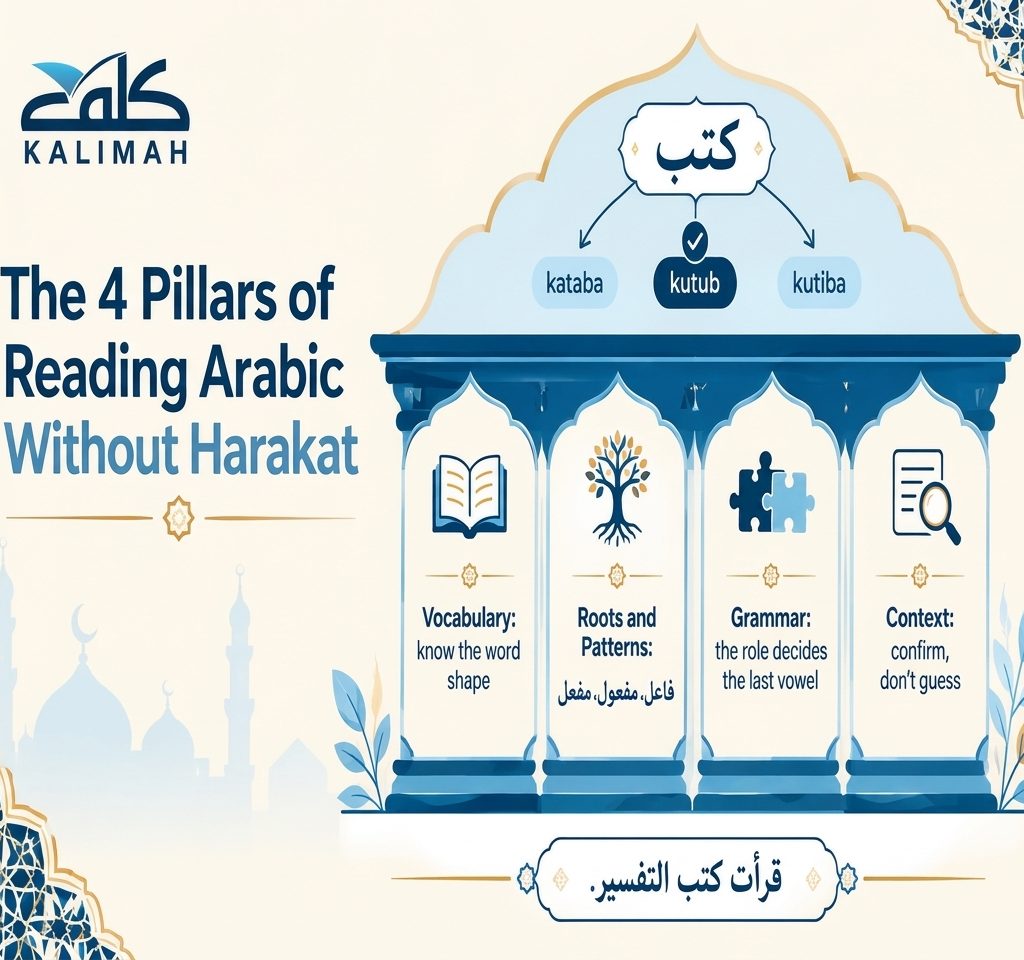
Reading unvowelized Arabic depends on four supports working together: familiar vocabulary, knowledge of roots and patterns, basic grammar, and the meaning of the sentence.
Each one narrows the possible readings until only one remains. The sections below explain how to read Arabic without harakat using each of these supports.
What Are Harakat and Why Are They Usually Missing?
Harakat, also called tashkeel, are the small marks for short vowels: fatha (a), damma (u), and kasra (i), along with sukun and shadda. Arabic script is an abjad, meaning its letters mainly record consonants.
Early Arabic writing had no vowel marks at all. Abu al-Aswad al-Du’ali introduced vowel dots to protect correct Quran recitation, and al-Khalil ibn Ahmad al-Farahidi later developed the marks used today.
Full tashkeel now appears mainly in the Mushaf, children’s books, poetry, and textbooks. Books, newspapers, signs, and messages leave it out because fluent readers do not need it.
How Do Native Readers Supply the Missing Vowels?
They recognize words as whole shapes rather than decoding letter by letter. Take كتب: it can be kataba (he wrote), kutub (books), or kutiba (it was written).
In the sentence قرأت كتب التفسير (I read books of tafsir), only kutub fits. The reader does not stop to calculate; the sentence settles the reading automatically.
Build a Vocabulary of Familiar Word Shapes
A word you have seen and heard hundreds of times becomes instantly readable, with or without marks. This is why vocabulary size is the strongest predictor of success.
Repeat common words in different sentences instead of memorizing random lists. For Quran students, high-frequency words such as قال, الذين, ربك, and يوم make an excellent starting set.
Use Roots and Word Patterns (Awzaan)
Most Arabic words grow from a three-letter root, and fixed patterns decide their internal vowels. Learn a pattern once, and you can read hundreds of words built on it.
| Pattern | Meaning | Examples |
| فَاعِل (fā’il) | The doer | كاتب (writer), عالم (scholar) |
| مَفْعُول (maf’ūl) | The thing acted upon | مكتوب (written), معلوم (known) |
| مَفْعَل (maf’al) | Place of the action | مكتب (office), مسجد (mosque) |
| تَفْعِيل (taf’īl) | Verbal noun of Form II | تعليم (teaching), تجويد (Tajweed) |
So when you meet مدرس, the root د ر س points to studying, and the pattern مُفَعِّل tells you the word is mudarris, a teacher.
Let Grammar Decide the Last Vowel
The ending of a word changes with its role in the sentence. You do not need to finish all of Arabic grammar before learning how to read Arabic without harakat; learn the structures that appear in the texts you read.
Compare جاء الطالبُ (the student came: subject, damma), رأيت الطالبَ (I saw the student: object, fatha), and سلّمت على الطالبِ (I greeted the student: after a preposition, kasra). Beginners can also pause with sukun at the end of a phrase, which reduces pressure on word endings.
Use Context to Confirm, Not to Invent
Context is powerful, but it must agree with the letters on the page. Before settling on a reading, ask: what evidence in the word or the structure supports it?
If a word still feels unclear, finish the whole sentence first, then return to it. Most doubts disappear once the full idea is in front of you.
How to Read Arabic Without Tashkeel Step by Step
Removing all vowel marks at once usually backfires: learners start guessing and build pronunciation errors that are hard to undo. A gradual path lets the support fade as recognition grows, and this staged plan is the safest way to learn how to read Arabic without harakat.
Do Quran Learners Need to Read Without Tashkeel?
Yes, though not for the Mushaf itself, which is always printed with full tashkeel to preserve correct recitation. The skill matters for everything around it: tafsir books, hadith collections, adhkar booklets, and Arabic lessons.
Children should first master vowelized reading and correct recitation, as explained in our guide to Tajweed for kids online. Adults starting from zero can follow the same order with Tajweed for beginners online.
Reading tafsir and hadith without harakat also deepens your connection with the Quran, because you begin to notice the same roots and patterns inside the verses. Many students find their recitation becomes more meaningful once they understand the words they recite.
Inside Kalimah Center: Moments from Our Courses
Get a glimpse into the vibrant learning experience at Kalimah Center. These snapshots capture real moments from our live classes—where students engage deeply, connect with passionate instructors, and grow in a welcoming, supportive environment.
Master Arabic with Kalimah Center
Join our expert-led online classes and start your journey toward Arabic fluency today.
Book Your Free TrialHow to Read Arabic Without Harakat Free: Resources and a Daily Routine
You do not need expensive tools to practice. Learning how to read Arabic without harakat free of charge is realistic with resources available online and a short, consistent daily habit.
1. Free Resources Worth Using
Quran.com lets you read vowelized verses alongside translation and tafsir, which builds a strong base of Quranic vocabulary. Short news headlines and free Arabic children’s stories make good material for Stages 3 and 4. If you are comparing platforms, our review of the best websites to learn Arabic online can help you choose.
Consistency matters more than session length when learning how to read Arabic without harakat. Twenty focused minutes every day builds recognition far faster than two long sessions a week, so link your reading to a fixed time, such as after Fajr or before bed.
2. A 20-Minute Daily Routine
Spend 5 minutes reviewing vocabulary inside sentences, 10 minutes reading a short text at your level, and 5 minutes reading aloud a passage you already understand.
If you look up more than five words on one page, the text is too hard for now. Drop a level; reading speed comes from plenty of easy reading, not from struggling through difficult pages.
Consistency matters more than the length of each session. Twenty focused minutes every day builds recognition far faster than two long sessions a week, so link your reading to a fixed time, such as after Fajr or before bed.
Common Mistakes That Slow Your Progress
When students ask us how to read Arabic without harakat faster, the first mistake we point out is dropping vowels too early, which locks in wrong pronunciation.
Many learners also choose a reading that fits the idea but not the letters, or read silently and never test their pronunciation. Regular feedback from a qualified teacher, such as in our Online Arabic Course, catches these habits early.
Skipping grammar entirely is another frequent mistake, because it leaves word endings random. Learning a few core rules, such as the endings of the subject, the object, and words after prepositions, fixes a large share of these errors.
Start Reading Arabic With Confidence at Kalimah Center
Learning how to read Arabic without harakat becomes much faster when a teacher corrects you in real time. At Kalimah Center, native Arabic tutors with over 14 years of experience guide you from vowelized reading to plain Arabic texts, one stage at a time.
Choose our Online Quran With Tajweed Course taught by Ijazah-certified teachers across 13 levels, our Online Arabic Course with 16 levels, or the Arabic Course for Kids with 24 child-friendly levels.
Explore Our Courses:
- Online Arabic Course: Tailored to your level, our comprehensive Arabic program includes 16 teaching levels and 400+ hours of personalized sessions.
- Online Quran With Tajweed Course: Perfect for non-Arabic speakers, our course spans 13 levels and equips you with Tajweed mastery from beginner to advanced.
- Online Arabic Course for Kids: Nurture your child’s love for Arabic with our engaging and structured program, available in 24 levels for primary, intermediate, and secondary stages.
Male and female teachers are available, and classes fit your schedule. Book a free trial lesson today, and your teacher will assess your level and build a reading plan around your goals.
Master Arabic with Kalimah Center
Join our expert-led online classes and start your journey toward Arabic fluency today.
Book Your Free TrialConclusion
Reading Arabic without vowel marks is a skill every serious learner can build. Fluent readers rely on familiar vocabulary, roots and patterns, basic grammar, and sentence meaning, and each of these can be learned step by step.
The safest path moves from fully vowelized texts to partially vowelized ones, to short plain paragraphs. Quran students should keep reciting from the vowelized Mushaf while using this skill for tafsir, hadith, and Arabic study.
Whether you are a parent guiding a child or an adult returning to Arabic, the same principle applies: build strong vowelized reading first, then remove support gradually. With steady practice, plain Arabic texts will soon start to feel familiar.
The key message is simple: learning how to read Arabic without harakat takes patience, daily reading, and correction, not guesswork. Start with easy texts, read every day, and let a qualified teacher guide you through each stage.
FAQs
Here are answers to the most common questions learners ask about reading Arabic without vowel marks.
Is it hard to read Arabic without harakat?
No. It feels hard at first, but it becomes natural with vocabulary and practice. Once you know common roots, patterns, and basic grammar, most words have only one reading that fits the sentence.
How long does it take to read Arabic without tashkeel?
It depends on your level and daily practice. Many learners who read for 20 to 30 minutes a day move to simple unvowelized texts within several months, and to books and articles within about a year.
Can I read the Quran without harakat?
No. The Mushaf is printed with full harakat so that every word is recited exactly as transmitted. Always recite from a vowelized Mushaf and learn recitation from a qualified teacher.
Should children learn to read Arabic without harakat?
Only after they read vowelized text accurately and fluently, removing vowels too early leads children to guess, so build their foundation in correct reading and Tajweed first.
Do I need to learn all of Arabic grammar first?
No. Learn the grammar that appears in your current texts, such as subject, object, and preposition endings, then expand gradually as your reading grows.
Can I learn how to read Arabic without harakat for free?
Yes. Free resources like Quran.com, Al Jazeera Learning Arabic, and Arabic children’s stories are enough to practice daily. A teacher simply speeds up progress by correcting mistakes early.