Have you ever opened a Mushaf, found the small number inside an ayah marker, and paused because ١٢٥ looked nothing like 125? Many new Quran students, children and adults alike, hit this exact moment in their first week.
The good news: learning how to read Arabic Indic numbers takes far less time than learning the alphabet. There are only ten symbols, and they follow the same place-value system you already use every day.
This guide covers every digit with its Arabic name, the reading-direction rule, the 1 to 100 pattern, and real examples from the Mushaf.
1. Know The 10 Arabic-Indic Digits and Their Names
Mastering how to read Arabic Indic numbers rests on two skills: recognizing ten shapes and knowing which way to read them. Once both are in place, any number on a page, sign, or screen becomes readable.
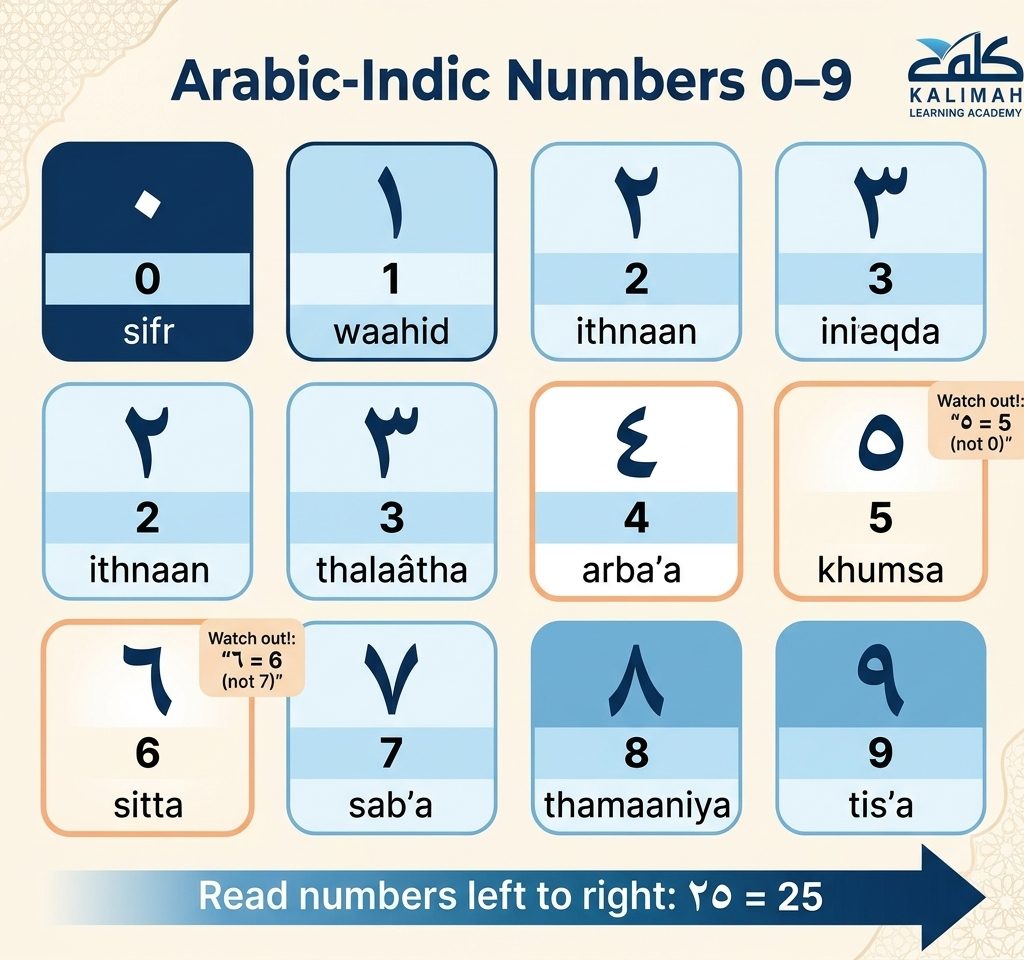
These digits, also called Eastern Arabic numerals, are used in Egypt, the Gulf, the Levant, and Iraq, and in nearly every printed Mushaf. Here is the core chart for how to read Arabic-Indic numbers. Read each row aloud, cover the Arabic column, and test yourself.
| Western | Arabic-Indic | Arabic Word | Transliteration | Memory Tip |
| 0 | ٠ | صِفْر | sifr | A small dot, not a circle |
| 1 | ١ | واحِد | waahid | One straight stroke |
| 2 | ٢ | اِثْنان | ithnaan | One hook on top |
| 3 | ٣ | ثَلاثة | thalaatha | Two hooks on top |
| 4 | ٤ | أَرْبَعة | arba’a | Like a backward 3 |
| 5 | ٥ | خَمْسة | khamsa | A small circle (not zero) |
| 6 | ٦ | سِتّة | sitta | Looks like a 7, but it is 6 |
| 7 | ٧ | سَبْعة | sab’a | A “V” shape |
| 8 | ٨ | ثَمانِية | thamaaniya | An upside-down “V” |
| 9 | ٩ | تِسْعة | tis’a | Close to the Western 9 |
2. Read Multi-Digit Numbers from Left to Right
Arabic words run right to left, but numbers do not. A multi-digit number keeps the same place-value order as English: the largest place sits on the left, and the units sit on the right.
So ٢٥ is 25, never 52, and ٢٠٢٦ is 2026. This single rule is the heart of how to read Arabic-Indic numbers correctly, and it clears up most beginner confusion right away.
Think about how you read a price tag in English. You start with the largest value on the left and move right toward the units. Arabic-Indic digits work the same way, so ١٠٠ is one hundred and ٣٠٧ is three hundred and seven.
Mixed pages are where many learners slip, because the eye wants to keep following the Arabic sentence leftward. When a number appears inside an Arabic line, jump to its leftmost digit, read the number as one unit, then continue with the sentence.
3. Read Ayah, Surah, and Page Numbers in the Mushaf
This is where knowing how to read Arabic Indic numbers pays off most. Each ayah ends with a decorated marker holding its number, and page numbers sit at the top or bottom of each page.
When your teacher says “start from ayah ٢٥٥” in Surah Al-Baqarah, you will find Ayat al-Kursi at once instead of counting markers. Surah Yasin has ٨٣ verses, and Juz’ ‘Amma opens with Surah An-Naba’, number ٧٨.
Surah numbers follow the same logic. The index (fihris) at the start or end of most Mushafs lists all ١١٤ surahs with their numbers and starting pages. A quick glance takes you straight to Surah Al-Kahf, number ١٨, or Surah Al-Mulk, number ٦٧.
At Kalimah Center, Ijazah-certified teachers use ayah and page numbers from the very first lesson, so students build this skill naturally while they recite. Our Tajweed for Beginners Online guide shows how this fits into early recitation.
Experience Kalimah Center Classes
Watch real excerpts from our live sessions at Kalimah Center and see how we bring learning to life. These clips highlight our interactive, student-centered teaching approach across all our courses—designed to keep learners engaged, motivated, and actively involved every step of the way.
Master Arabic with Kalimah Center
Join our expert-led online classes and start your journey toward Arabic fluency today.
Book Your Free Trial4. Read Time, Prices, and Phone Numbers
The same rule works outside the Mushaf. A clock showing ٣:٤٥ reads 3:45 (ص means AM, م means PM), phone numbers are read digit by digit, and prices like ٥٠ are read as whole numbers.
Prayer timetables at your local masjid are a good place to practice. You might see Fajr at ٤:٥٠ and Maghrib at ٦:١٥, which simply means 4:50 and 6:15. The hour is always on the left of the colon and the minutes on the right.
Prices follow the same left-to-right rule, and the decimal point is often written as a small comma-like mark (٫). So ١٢٫٥٠ on a shop label means 12.50, and knowing how to read Arabic Indic numbers helps you avoid paying the wrong amount.
Phone numbers are spoken one digit at a time, just as in English. A number starting with ٠١٠ is read “sifr, waahid, sifr.” Saying your own phone number in Arabic every day is a quick, practical drill that locks the digits into memory.
How to Read Arabic Indic Numbers 1 to 100
Learning how to read Arabic Indic numbers 1 to 100 is about patterns, not memorization. Learn the first ten words, the teens, and the tens, and you can build every remaining number yourself. This range matters for Quran students, since most surahs you recite daily have fewer than 100 verses.
Numbers 1 to 10
The chart below gives you ١ to ٩. Add ١٠ (‘ashara), which is simply ١ followed by ٠, exactly how 10 is written in English. Say all ten aloud while pointing to each digit.
| Western | Arabic-Indic |
| 0 | ٠ |
| 1 | ١ |
| 2 | ٢ |
| 3 | ٣ |
| 4 | ٤ |
| 5 | ٥ |
| 6 | ٦ |
| 7 | ٧ |
| 8 | ٨ |
| 9 | ٩ |
Numbers 11 to 19
The teens join a unit with a form of “ten” (‘ashar). Only 11 and 12 are slightly irregular.
| Number | Arabic-Indic | Arabic Word | Transliteration |
| 11 | ١١ | أَحَدَ عَشَر | ahada ‘ashar |
| 12 | ١٢ | اِثْنا عَشَر | ithnaa ‘ashar |
| 15 | ١٥ | خَمْسةَ عَشَر | khamsata ‘ashar |
| 19 | ١٩ | تِسْعةَ عَشَر | tis’ata ‘ashar |
The Tens: 20 to 100
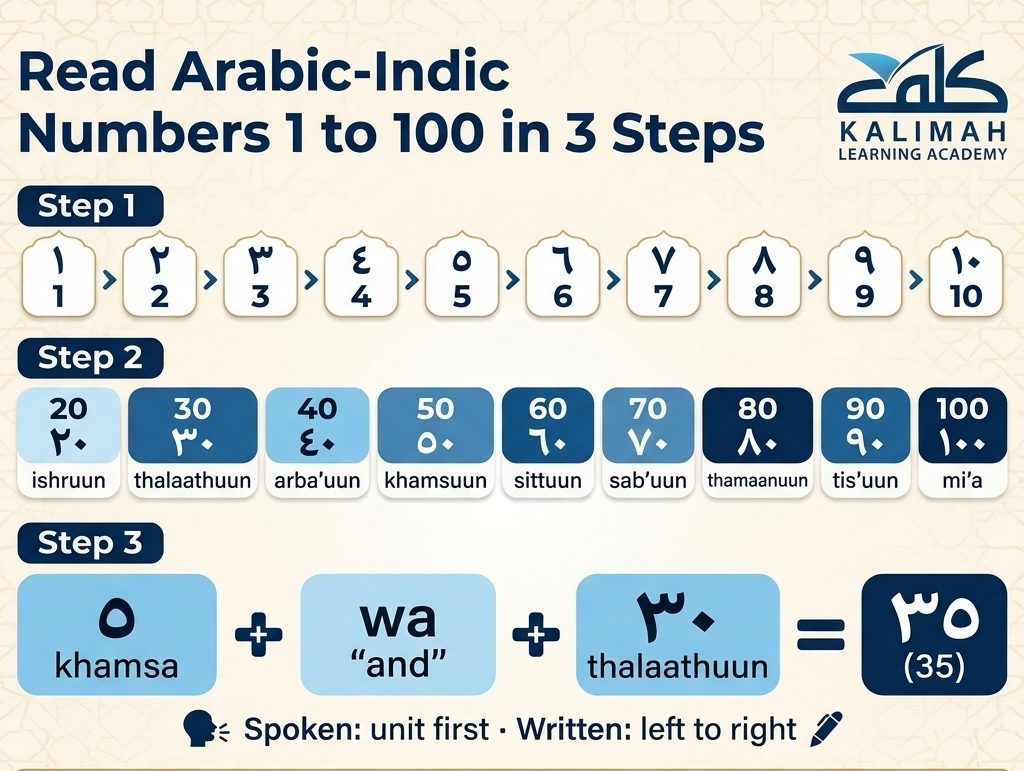
The tens are the next step in how to read Arabic Indic numbers 1 to 100. Most add the ending -uun to a unit you know: thirty echoes three, forty echoes four.
| Arabic-Indic | Western | Transliteration |
| ٢٠ | 20 | ‘ishruun |
| ٣٠ | 30 | thalaathuun |
| ٤٠ | 40 | arba’uun |
| ٥٠ | 50 | khamsuun |
| ٦٠ | 60 | sittuun |
| ٧٠ | 70 | sab’uun |
| ٨٠ | 80 | thamaanuun |
| ٩٠ | 90 | tis’uun |
| ١٠٠ | 100 | mi’a |
The “One and Twenty” Pattern for 21 to 99
Spoken Arabic says the unit first, then wa (“and”), then the tens word. This differs from English, so practice it slowly.
- ٢١ = waahid wa-‘ishruun (one and twenty)
- ٣٥ = khamsa wa-thalaathuun (five and thirty)
- ٩٩ = tis’a wa-tis’uun (nine and ninety)
The written digits still run left to right (٣٥ = 35); only the spoken order puts the unit first. Keeping these two ideas apart is the key to how to read Arabic Indic numbers 1 to 100 fluently. Want a printable chart that goes all the way to 1,000? See our full guide to Arabic Numbers 1 to 1000.
Inside Kalimah Center: Moments from Our Courses
Get a glimpse into the vibrant learning experience at Kalimah Center. These snapshots capture real moments from our live classes—where students engage deeply, connect with passionate instructors, and grow in a welcoming, supportive environment.
Master Arabic with Kalimah Center
Join our expert-led online classes and start your journey toward Arabic fluency today.
Book Your Free TrialHow to Read Arabic Indic Numbers in English
Many learners search for how to read Arabic Indic numbers in English, meaning how to turn what they see into a familiar number. The method is a one-to-one swap: replace each digit with its Western twin. Nothing gets reversed. Think of how to read Arabic-Indic numbers in English as reading a different font for the same values.
A Three-Step Conversion Method
You can learn to convert in a few minutes, because each Arabic-Indic symbol has exactly one Western partner. No math is involved. You only swap shapes and keep every digit in its original position.
- Identify each digit using the chart above.
- Write its Western equivalent in the same position.
- Read the result as a normal English number.
For example, ١٤٤٧ becomes 1447, and ٢٨٦ becomes 286, the number of verses in Surah Al-Baqarah. Practice the swap on numbers you see every day, such as the ayah where your last lesson stopped or the page of your favorite surah. Within about a week, converting becomes automatic, and you stop pausing to think.
Three Digits Beginners Often Mix Up
Most reading errors don’t come from forgetting a digit. They happen when the brain matches an Arabic shape to a familiar Western one. Spotting these look-alikes early is a big part of how to read Arabic Indic numbers with confidence.
When learning how to read Arabic Indic numbers, most mistakes come from shapes that resemble Western digits:
- ٥ looks like zero, but it is 5. The Arabic-Indic zero is the small dot ٠.
- ٦ looks like a 7, but it is 6.
- ٢ and ٣ differ by one extra hook, so read small print slowly.
A simple fix is to make flashcards for only these look-alike digits and review them for one minute before each lesson. Children enjoy sorting the cards into “Arabic” and “Western” piles, which turns correction into a quick game. A South Asian Mushaf may use Persian forms of 4, 5, and 6 (۴ ۵ ۶), but their values stay the same.
A Five-Minute Daily Routine for Kids and Adults
When you learn numbers, steady practice matters more than long sessions. A few focused minutes each day, tied to your regular Quran reading, keeps the digits fresh and builds recognition without feeling like extra homework. Short, regular practice beats long sessions when learning how to read Arabic Indic numbers. Try this plan:
- Days 1 to 3: Read ٠ to ٩ aloud until each shape triggers its name instantly.
- Days 4 to 7: Find five ayah numbers in your Mushaf and say them in Arabic and English.
- Week 2: Read the page number of every page you recite, then check yourself.
Adults can fit this routine into their daily wird by saying each ayah number aloud before reciting it. Over time, you will know how to read Arabic Indic numbers as naturally as you read the Arabic letters themselves.
Parents can make it a game: call out a number and let the child find it on a Mushaf page. Our Tajweed for Kids Online article shares more ways to keep young learners engaged.
Unlock Your Potential in Arabic and Quran with Kalimah Center
Ready to deepen your connection with the Quran and enhance your understanding of Arabic? Join Kalimah Center today and embark on a transformative journey of learning and growth! Our professional, handpicked Online Arabic and Quran Tutors are dedicated to helping you master these essential skills with ease and expertise.
Knowing how to read Arabic Indic numbers is your first step; reciting correctly with Tajweed is the real goal. At Kalimah Center, Ijazah-certified teachers guide you through Quran recitation, Tajweed rules, and Arabic reading.
Explore Our Courses:
- Online Arabic Course: Tailored to your level, our comprehensive Arabic program includes 16 teaching levels and 400+ hours of personalized sessions.
- Online Quran With Tajweed Course: Perfect for non-Arabic speakers, our course spans 13 levels and equips you with Tajweed mastery from beginner to advanced.
- Online Arabic Course For Kids: Nurture your child’s love for Arabic with our engaging and structured program, available in 24 levels for primary, intermediate, and secondary stages.
Male and female tutors are available, and a free placement test shows exactly where to begin. Don’t miss out on this life-changing opportunity to deepen your faith and knowledge. Book your free trial lesson today and turn every number in your Mushaf into a doorway to recitation.
Master Arabic with Kalimah Center
Join our expert-led online classes and start your journey toward Arabic fluency today.
Book Your Free TrialConclusion
Learning how to read Arabic Indic numbers starts with ten simple shapes that follow the same left-to-right place-value order as Western digits. Once you know that ٥ is five, ٦ is six, and ٠ is zero, most confusion disappears.
For how to read Arabic Indic numbers 1 to 100, learn the first ten words, the teens, and the tens, then apply the “unit and ten” pattern. To read them in English, swap each digit for its Western twin and keep the order.
The takeaway is simple: knowing how to read Arabic Indic numbers turns every ayah marker, page number, and clock into something you can read with ease. Practice a few minutes daily, and let a qualified teacher help you move from numbers to fluent, correct recitation.
FAQs
Here are quick answers to the most common questions learners ask about Arabic-Indic numbers.
Are Arabic-Indic numbers read from left to right or right to left?
They are read from left to right. Arabic text runs right to left, but the first rule of how to read Arabic-Indic numbers is that digits keep English place-value order, so ٤٢ means 42.
What is the difference between Arabic numerals and Arabic-Indic numerals?
Both represent the same values with different shapes. “Arabic numerals” usually means the Western digits 0 to 9, while Arabic-Indic (Eastern Arabic) numerals are ٠ to ٩, common in the Arab East and in most printed Mushafs.
Why does zero look like a dot in Arabic-Indic numbers?
The dot ٠ is the standard Arabic-Indic zero, while the small circle ٥ is the digit five. Remembering this pair fixes most errors when learning how to read Arabic-Indic numbers.
How do you say 25 in Arabic?
Twenty-five is written ٢٥ and spoken “khamsa wa-‘ishruun,” literally “five and twenty.” The digits stay in left-to-right order; only the spoken words put the unit first.
How long does it take to learn how to read Arabic Indic numbers?
Most learners recognize all ten digits within a few days of short daily practice. Reading numbers 1 to 100 comfortably usually takes one to two weeks, especially when you practice with your Mushaf.
Does the Quran use Arabic-Indic numbers?
Yes. Most printed Mushafs, including the widely used Madinah edition, number ayahs and pages with Arabic-Indic digits, so knowing how to read Arabic-Indic numbers helps every Quran student.