Every Arabic word you read carries close to two thousand years of change. It was carved into desert rock, inked on parchment and refined by scholars. The history of the Arabic alphabet follows the traders and scribes who turned a borrowed script into a writing system used around the world.
Most learners memorize the 28 letters without asking why ب, ت and ث share one shape, or why short vowels sit above and below the line. These quirks are clues, and each one points back to a specific moment in the script’s long journey.
At Kalimah Centre, we believe that knowing where the letters come from makes them easier to remember and pronounce. This guide takes you from ancient Arabian inscriptions to the dotted, vowelled script you see in every modern book and Mushaf today.
Along the way, you will meet Nabataean merchants, early Islamic grammarians and master calligraphers who each shaped the letters. By the end, the alphabet on your page will feel less like a code and more like a living record of history.
What you will learn in this article:
- Where the Arabic alphabet came from and how it grew out of Nabataean writing.
- Which old Arabian scripts existed before the classical Arabic script.
- Who shaped the letters, and when dots and vowel marks were added.
- How the script spread to other languages and how you can learn it today.
The Early History Of The Arabic Alphabet And Its Roots
The early history of the Arabic alphabet begins long before Islam, on caravan routes that linked Yemen, the Levant and Mesopotamia. Any Arabic language history alphabet timeline has to start with the Semitic scripts those traders carried, because Arabic letters did not appear out of nowhere.
Where Did The Arabic Alphabet Come From?
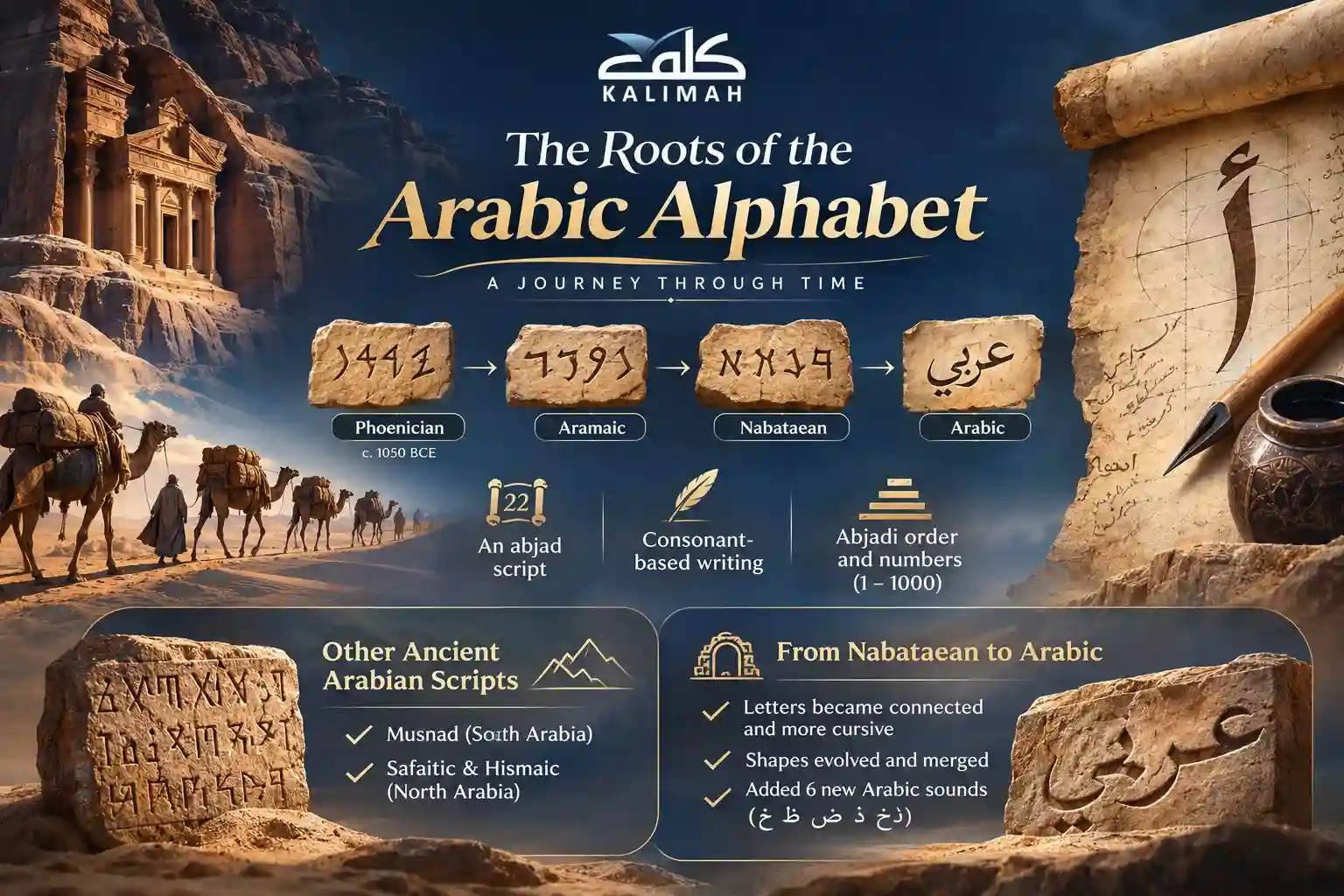
The Arabic alphabet came from the Nabataean script, a regional form of Aramaic writing used by the Nabataean Arabs of Petra and northern Arabia. Aramaic itself descended from the Phoenician alphabet. Phoenician appeared on the eastern Mediterranean coast around 1050 BCE and had only 22 consonant letters.
This chain of descent explains why Arabic is an abjad, a script that writes consonants and usually leaves short vowels unmarked. Phoenician, Aramaic and Nabataean all worked the same way. Arabic therefore inherited a system designed for Semitic languages, where word roots are built mainly from consonants.
The old order of the letters still preserves this ancestry. The abjadi sequence (أبجد هوز حطي كلمن سعفص قرشت) follows the Phoenician order, and each letter carries a number, from alif as 1 to ghayn as 1000. To hear this lineage explained by a leading epigraphist, watch this free afikra talk with Ahmad Al-Jallad on YouTube.
The Old Arabic Alphabet Systems Of Ancient Arabia
Before the Nabataean-based script took over, Arabians used several entirely different alphabets. The best-known ancient Arabic alphabet is the Musnad, or Ancient South Arabian script. The kingdoms of Saba, Ma’in, Qataban and Himyar used it from the early first millennium BCE, and it had 29 bold, geometric consonant letters.
In the north, nomads carved tens of thousands of short texts in the Safaitic and Hismaic scripts. These cover the basalt deserts of southern Syria, Jordan and northern Saudi Arabia. Many Safaitic inscriptions record an early form of the Arabic language, even though their letters look nothing like modern Arabic.
This old Arabic alphabet family belongs to a separate South Semitic branch, which makes it a cousin of today’s script rather than its parent. You can browse thousands of these carvings for free in Ohio State University’s OCIANA corpus, a searchable database of ancient North Arabian inscriptions.
How The Nabataean Script Turned Into Arabic
The Nabataeans spoke Arabic in daily life but wrote official texts in Aramaic, using their own rounded version of the Aramaic letters. Rome annexed their kingdom in 106 CE, but their scribes kept writing. Over time their script became faster, more connected and increasingly cursive.
These changes are the real origin of Arabic alphabet shapes. Letters began to join along a baseline, final forms grew tails, and several Aramaic letters merged into identical outlines. Arabic had 28 consonants but the script had only 22 letters, so one shape often stood for two or three sounds.
A tomb inscription from Hegra dated 267 CE already records the Arabic language in a late Nabataean hand. Over the next three centuries, that hand gradually lost its Aramaic look. The six extra Arabic sounds, ث خ ذ ض ظ غ, were eventually placed at the end of the abjad sequence.
Read Also: Arabic Language: Complete Guide to History, Script & Dialects
Who Invented The Arabic Alphabet And When?
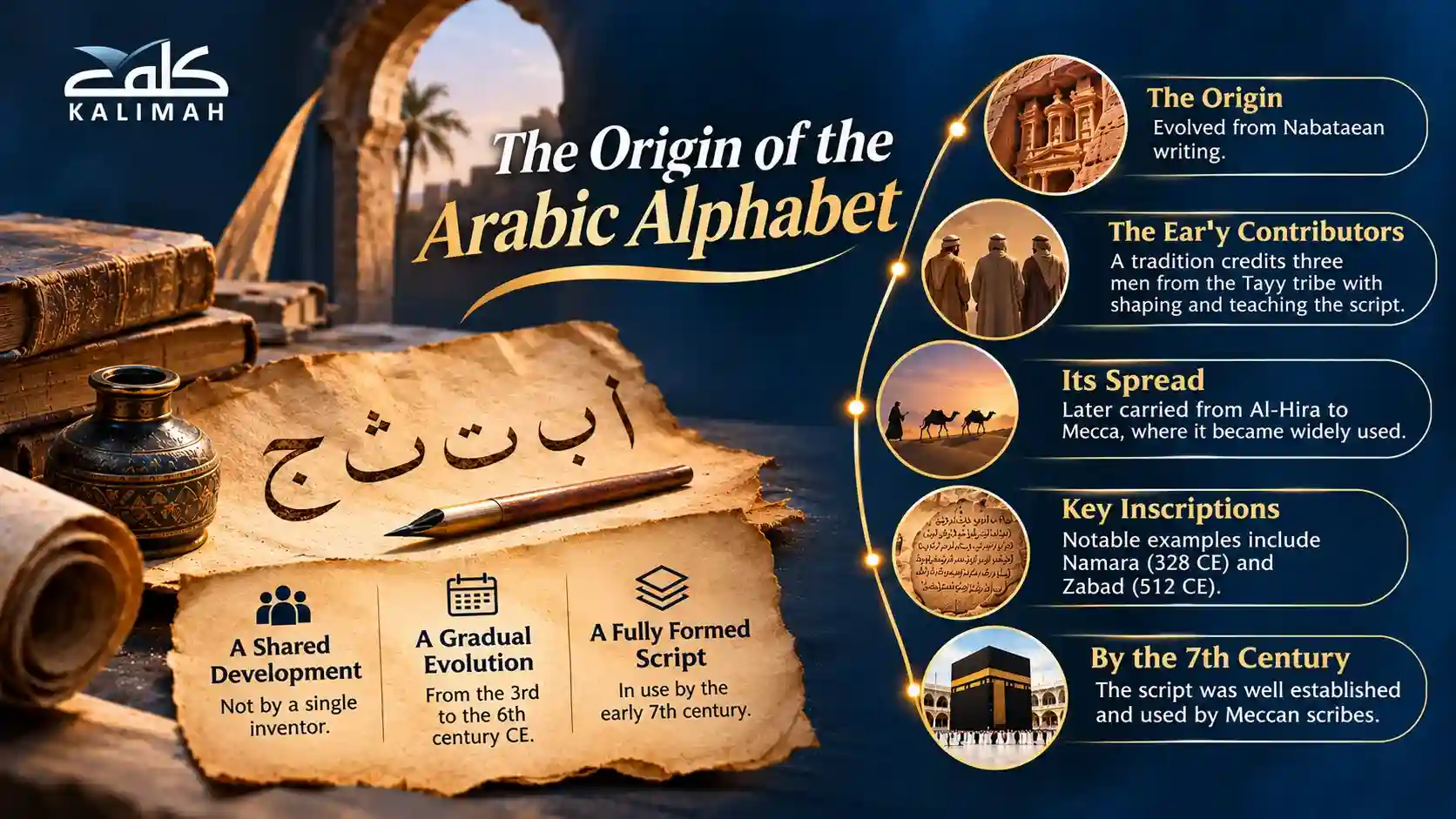
No single person invented the Arabic alphabet. It developed gradually from Nabataean writing between roughly the 3rd and 6th centuries CE. Classical historians preserved stories about the script’s first teachers, and surviving inscriptions let us test those stories at each key stage in the history of the Arabic alphabet.
Who Invented The Arabic Alphabet?
Nobody invented the Arabic alphabet the way an inventor creates a machine. The script was the shared work of generations of scribes who adapted Nabataean letters to fit the sounds of Arabic. Because the process was gradual and collective, no single name can claim it.
Medieval historians such as al-Baladhuri recorded a well-known tradition about three men from the tribe of Tayy: Muramir ibn Murra, Aslam ibn Sidra and Amir ibn Jadra. According to this tradition, they shaped Arabic writing at al-Anbar in Iraq and taught it to the people of al-Hira.
The same reports say that a man named Bishr ibn Abd al-Malik carried writing from al-Hira to Mecca, where he taught members of Quraysh. Historians read these accounts as memories of how the script travelled, not as proof that one person created it from scratch.
When Was The Arabic Alphabet Invented?
The Arabic alphabet was not invented on a single date; it took shape between the 3rd and 6th centuries CE. By the early 500s, inscriptions show a script that is clearly Arabic. Earlier texts still sit somewhere between Nabataean and Arabic.
Scholars call this in-between stage “transitional script.” Its letters connect the way Arabic letters do, yet some forms still resemble their Nabataean models, which makes it hard to date the switch. That is why specialists describe a slow evolution rather than a single birthday for the alphabet.
By the time of the Prophet Muhammad (peace be upon him) in the early 7th century, writing was well established among Meccan merchants. Several companions, including Zayd ibn Thabit, served as scribes who recorded revelation, letters and treaties. This shows the script was already practical and widely understood.
The Earliest Inscriptions In Arabic Script
The most famous milestone is the Namara inscription, carved in 328 CE for Imru’ al-Qays, “king of all the Arabs.” Its language is Arabic, but its letters are still Nabataean. You can view the original basalt lintel in the Louvre’s online collection record.
The first known text in true Arabic script is the Zabad inscription of 512 CE, a trilingual Greek, Syriac and Arabic dedication found near Aleppo. The Jabal Usays inscription of 528 CE and the Harran inscription of 568 CE, both in southern Syria, followed soon after.
Taken together, these stones form a timeline that broadly supports the traditional reports. They show the script moving through Syria and Iraq, the same region linked to al-Hira and al-Anbar. From there it became the everyday writing system of the Hijaz.
Recommended reading: Which Ayah in the Quran Contains All Arabic Letters?
Experience Kalimah Center Classes
Watch real excerpts from our live sessions at Kalimah Center and see how we bring learning to life. These clips highlight our interactive, student-centered teaching approach across all our courses—designed to keep learners engaged, motivated, and actively involved every step of the way.
Master Arabic with Kalimah Center
Join our expert-led online classes and start your journey toward Arabic fluency today.
Book Your Free TrialThe Evolution Of Arabic Alphabet Letters In The Islamic Era
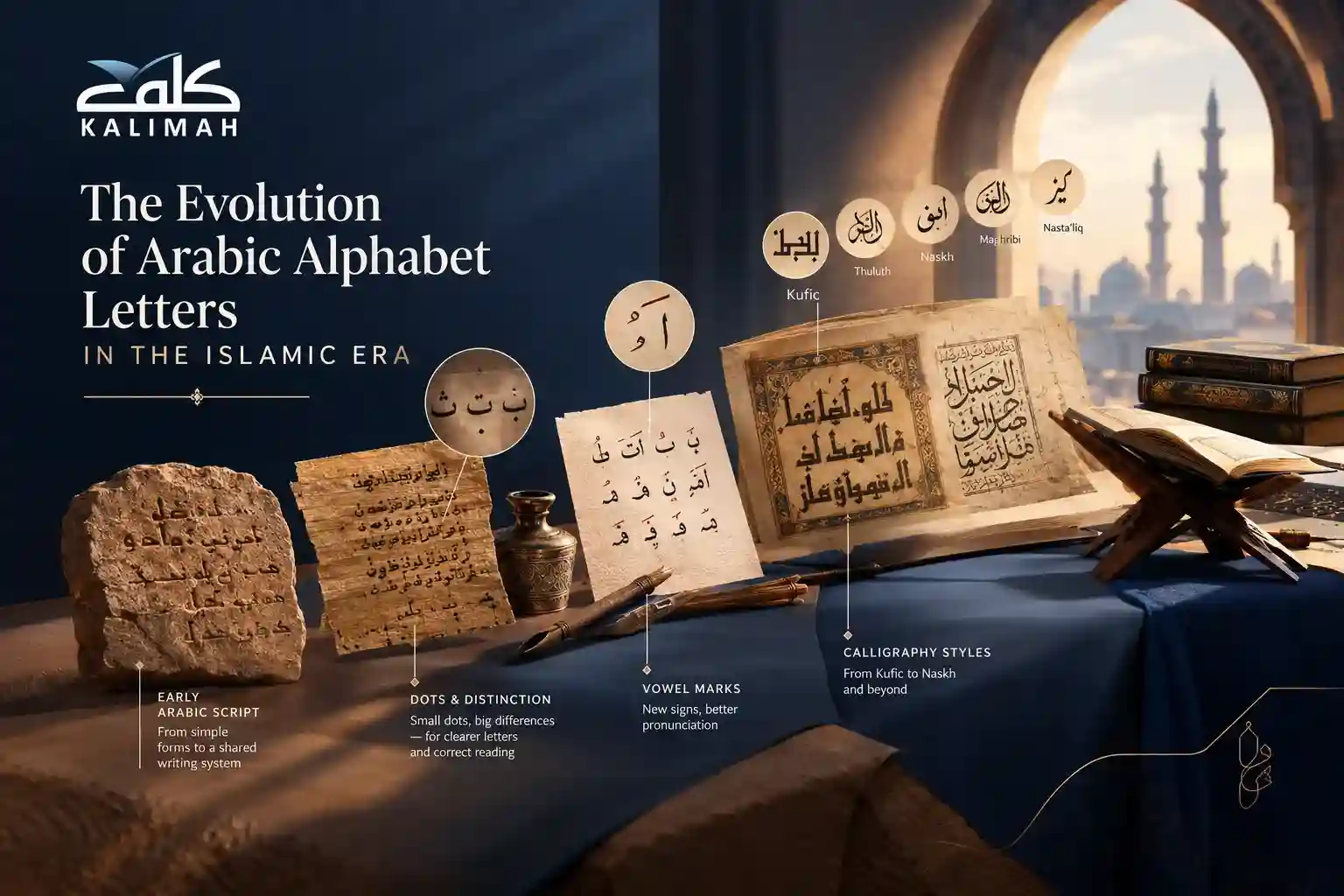
The evolution of Arabic alphabet writing sped up sharply after the rise of Islam, because the Quran had to be recorded and read without error. In this chapter of the history of the Arabic alphabet, dots, vowel signs and calligraphy turned a merchant’s script into a precise scholarly tool.
Allah (Glorious and Exalted is He) says:
“ٱقْرَأْ وَرَبُّكَ ٱلْأَكْرَمُ ٱلَّذِى عَلَّمَ بِٱلْقَلَمِ”
“Read! And your Lord is the Most Generous, Who taught by the pen” — Surah Al-‘Alaq 96:3-4
These lines are among the very first verses revealed, and they honour the pen as a means of knowledge granted by Allah. Early Muslims took the message seriously. Their drive to preserve revelation in writing pushed scholars to refine the script in ways that still shape every Arabic letter.
How Dots Were Added To Arabic Letters
In early Arabic writing, one shape served for several letters, so the same tooth-like stroke could be ب, ت, ث, ن or ي. Dots that tell these letters apart, called i’jam, appear very early, including in a Greek-Arabic papyrus dated 643 CE. Scribes, however, used them inconsistently.
As Islam spread among non-Arab populations, misreadings became a real concern. Under the Umayyad governor al-Hajjaj ibn Yusuf, the scholars Nasr ibn Asim and Yahya ibn Ya’mur are credited with standardizing the dots. They are also credited with the hija’i order (ا ب ت ث), which groups look-alike letters together.
These dots are why careful pronunciation matters so much in Quran recitation: one dot can change a word entirely. Kalimah Centre’s Online Quran Course builds on exactly this precision. It guides you through 13 structured levels with Ijazah-certified tutors who correct every letter.

Here Are The Reviews On Our Courses:
Our students frequently commend the excellence of our courses and the commitment shown by our instructors. You can read their complete reviews on Trustpilot.
Read more reviews on Trustpilot

How Vowel Marks Entered The Arabic Script
Dots solved the problem of telling consonants apart, but short vowels were still invisible on the page. The grammarian Abu al-Aswad al-Du’ali (d. 688 CE) tackled this first. He had a scribe place a red dot above a letter for “a,” below it for “i,” and beside it for “u.”
Two systems of dots on the same page proved confusing, so al-Khalil ibn Ahmad al-Farahidi (d. c. 786 CE) designed new signs. He based the fatha on a small alif and the damma on a small waw, placed the kasra below the letter, and added marks such as shadda, sukun and hamza.
Together these signs are called tashkil, and they are the first thing beginners meet when they start reading. At Kalimah Centre, the Noorani Qaida Course introduces them step by step across 17 lessons. Each vowel mark becomes a sound you can produce with confidence.
Arabic Calligraphy Styles From Kufic To Naskh
The earliest Quran manuscripts were written in the Hijazi script, a slanted, slightly irregular hand. Parchment leaves held at the University of Birmingham have been radiocarbon-dated to between 568 and 645 CE. Soon after, the bold, angular Kufic style, named after the city of Kufa, became the standard for copying the Quran.
In the 10th century, the Abbasid vizier Ibn Muqla created a system of proportions based on the rhombic dot and the height of the alif. Later masters, including Ibn al-Bawwab and Yaqut al-Musta’simi, perfected the “six pens.” These include Naskh and Thuluth, which still guide Arabic typography today.
Regional styles followed, including Maghribi in North Africa and Nasta’liq in Persia. In 2021, Arabic calligraphy was added to the UNESCO Representative List of the Intangible Cultural Heritage of Humanity after a joint nomination by 16 Arab countries.
Further reading: The Complete Arabic Alphabet Guide: Letters, Forms, Sounds & Practice
The Arabic Alphabet Today – Structure, Reach, And Learning
Fourteen centuries later, the script refined by early Muslim scholars is read by hundreds of millions of people. Arabic is one of the six official UN languages and is celebrated every year on UN Arabic Language Day. Its alphabet brings Arabic language history and alphabet knowledge into classrooms worldwide.
How The 28 Arabic Letters Work Today
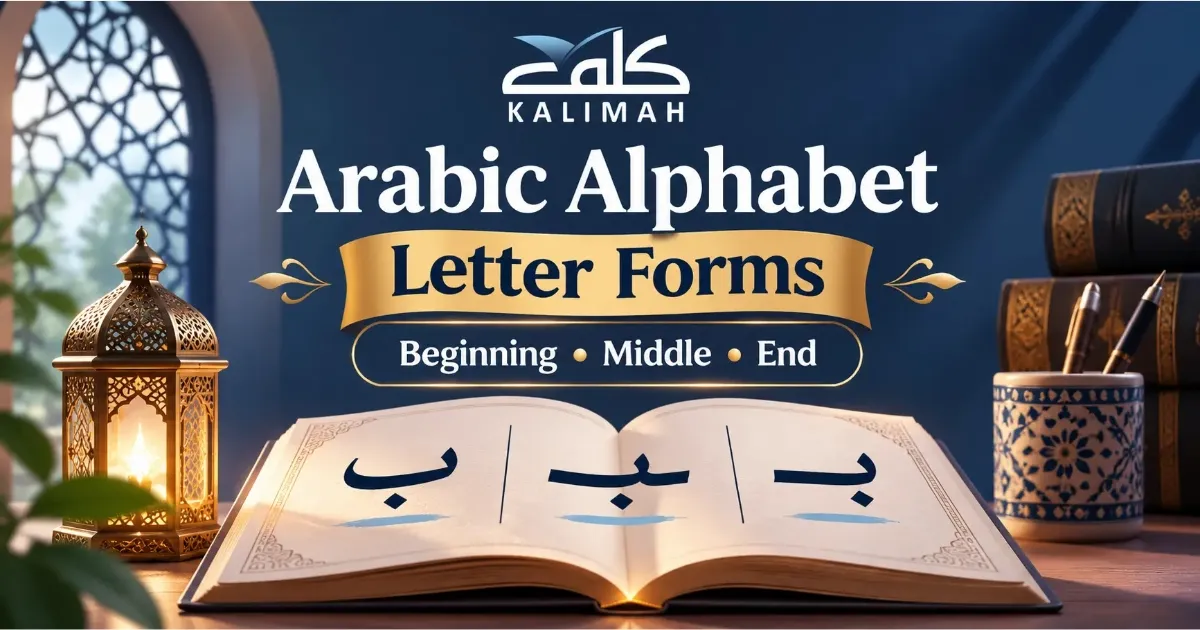
Modern Arabic uses 28 letters written from right to left, and it remains an abjad in which short vowels are usually left out. Most letters change shape depending on their position in a word, with isolated, initial, medial and final forms. This is a direct legacy of the cursive Nabataean hand.
Six letters, ا د ذ ر ز و, never connect to the letter that follows them, which creates the small gaps you see inside words. Learners also meet two letter orders: the hija’i order used in dictionaries, and the older abjadi order still used for numbering. Omniglot’s Arabic script page has a clear chart of each letter’s forms by position.
Knowing the history of the Arabic alphabet makes these rules feel logical rather than random. If you want a guided path, Kalimah Centre’s Arabic Reading Course starts with the letters and builds steadily toward fluent reading. Native teachers give you personal feedback on your pronunciation.
Languages That Use The Arabic Script
The Arabic script is widely described as the second most used alphabetic script in the world, after Latin. Beyond Arabic, it is used to write Persian, Urdu, Pashto, Sorani Kurdish, Sindhi and Uyghur. For centuries it was also used for Ottoman Turkish, Malay (Jawi) and Hausa (Ajami).
Each language adapted the alphabet to its own sounds by adding dots or strokes. Persian, for example, created پ (p), چ (ch), ژ (zh) and گ (g), and Urdu added letters for its retroflex sounds. These additions show how flexible the original design proved to be.
Today, all these letters live together in a single digital standard. The official Unicode Arabic code chart (PDF) lists every base letter, vowel mark and regional addition. It is a handy reference if you want to see how far the alphabet has travelled from its Nabataean beginnings.
Practical Ways To Learn The Arabic Alphabet
Start by learning the letters in shape families, such as ب ت ث, since they differ only in their dots. Then practise writing each letter in all four positions and read short vowelled words aloud. Typing also helps, and the free Google Input Tools let you type Arabic right in your browser.
Children learn faster when letters come with stories, colours and games. Kalimah Centre’s Arabic Classes For Kids follow a 26-level programme with native tutors who also speak English. Young learners link each letter to its sound and meaning without feeling lost.
Adults who want the full picture, from letters to conversation, do best with a structured programme and clear milestones. Kalimah Centre’s Online Arabic Course begins with a free placement test and a dedicated alphabet stage. It then moves through grammar and everyday dialogue, with a certificate at every level.
Don’t miss: Arabic Alphabet in English: All 28 Letters from A to Z, Sounds & Transliteration
Choose Kalimah Centre To Master Arabic Letters
Understanding the history of the Arabic alphabet is a great warm-up, but real progress comes when someone shows you how each letter moves and sounds. Kalimah Centre is built around that idea. It pairs learners with native, Azhari and Ijazah-certified tutors who can explain why each letter looks the way it does.
Our team developed its own curriculum and publications, so the alphabet stage is a full stage, not a rushed preview. Beginners spend dedicated time on letter families, dots and vowel marks before moving on to words, sentences and conversation. These are the same features shaped by Nabataean scribes and early grammarians.
You also choose how you learn: one-on-one sessions or group classes, a male or female tutor, and a schedule that fits your week. Interactive exercises, 24/7 access to course materials and a certificate for every level you pass keep you motivated from the first letter to fluent reading.

Inside Kalimah Center: Moments from Our Courses
Get a glimpse into the vibrant learning experience at Kalimah Center. These snapshots capture real moments from our live classes—where students engage deeply, connect with passionate instructors, and grow in a welcoming, supportive environment.
Master Arabic with Kalimah Center
Join our expert-led online classes and start your journey toward Arabic fluency today.
Book Your Free TrialBook Your Free Arabic Trial Lesson Today!
You now know where every Arabic letter came from, and the next step is learning to read and write them yourself. Book your free trial lesson with Kalimah Centre today. A native tutor will assess your level and plan your first steps with you.
There is no pressure and nothing complicated to set up. Choose a time, join from your laptop or phone, and use your first session to turn the history of the Arabic alphabet into practical skills. You will practise recognising letter shapes, joining them and pronouncing each sound correctly.
???? Explore Our Courses:
Online Arabic Course: Tailored to your level, our comprehensive Arabic program includes 16 teaching levels and 400+ hours of personalized sessions.
Online Quran With Tajweed Course: Perfect for non-Arabic speakers, our course spans 13 levels and equips you with Tajweed mastery from beginner to advanced.
Online Arabic Course For Kids: Nurture your child’s love for Arabic with our engaging and structured program, available in 24 levels for primary, intermediate, and secondary stages.
When you are ready to continue, compare Kalimah Centre’s study plans and pick the schedule that suits you. Centuries of script development produced this alphabet, and your own fluent reading can start with a single booking this week.

Master Arabic with Kalimah Center
Join our expert-led online classes and start your journey toward Arabic fluency today.
Book Your Free TrialConclusion
Arabic writing began with the Phoenician alphabet, passed through Aramaic, and took its rounded, joined shape among the Nabataean Arabs of Petra and Hegra. Alongside it, the Musnad and Safaitic scripts recorded Arabian life. Inscriptions from Namara to Harran trace the slow emergence of a recognisably Arabic script.
No single inventor created the alphabet, but named scholars refined it. Abu al-Aswad al-Du’ali, Nasr ibn Asim, Yahya ibn Ya’mur and al-Khalil ibn Ahmad gave it dots and vowel signs. Calligraphers such as Ibn Muqla gave it proportion and beauty, an art that UNESCO now recognises as shared human heritage.
The key takeaway is simple: every dot, curve and vowel mark exists for a reason, and knowing that reason makes learning faster. The history of the Arabic alphabet is more than a story to admire. It is a practical map that helps you read, write and remember each letter with confidence.
Frequently Asked Questions
What Did Arabs Speak Before Arabic?
They spoke earlier forms of Arabic, now called Old Arabic, recorded in Safaitic and Hismaic inscriptions. In Yemen people spoke South Arabian languages such as Sabaic, and the Nabataeans used Aramaic for official writing.
Which Alphabet Is Older, Arabic Or Persian?
The modern Persian alphabet is Arabic script with four added letters, so Arabic came first. However, older Persian scripts like Old Persian cuneiform came before the Arabic script, and Kalimah Centre students find Persian letters easy to read later.
Where Did The 26 Letter Alphabet Come From?
The English alphabet comes from Latin, which came through Greek and Etruscan from the Phoenician alphabet, the same ancestor as Arabic. Kalimah Centre’s tutors often use this shared origin to help English speakers learn Arabic letters faster.
Who Is Older, Arabic Or Hebrew?
Hebrew was written first: Hebrew inscriptions date to around the 10th–9th century BCE, while the Arabic script developed between the 3rd and 6th centuries CE. Both are Semitic languages with a shared Aramaic link in their scripts.
Did Arabs Exist Before Islam?
Yes. An Assyrian inscription from 853 BCE mentions “Gindibu the Arab,” and pre-Islamic Arabs included the Nabataeans, the Lakhmids and the Ghassanids. Their poets also left behind a large body of classical Arabic poetry.