Among the letters of the Arabic alphabet, “و” (Waw) stands out as a graceful and versatile character. It’s not only a letter but also plays a significant role as a vowel and conjunction in Arabic grammar and vocabulary. Let’s explore its forms, pronunciation, and how it appears in different contexts.
The Letter Waw “و” In Arabic
The letter waw “و” is the 27th letter of the Arabic alphabet and is distinguished by its wavy, looped form. “و” is a hook letter written in a single smooth motion. “و” is unusual in that it has two different uses: as a consonant (like English “w”) and as a vowel that pronounces the long “oo” sound, such as in “moon”.

Besides, “و” is often used as the Arabic equivalent of “and” connecting words and phrases.
How to pronounce the letter “و”?
The letter waw “و” sounds like “w” in water when used as a consonant, and like “oo” in moon when used as a vowel.
1. Consonant Sound:
As a consonant, it sounds like the English “w” in “water*” or “wonder”.
Example: ورد (ward) — flowers
2. Vowel Sound:
Used as a vowel, it elongates the sound of “u” in a word, such as the English “oo” in “school”.
Example: نور (nūr) — light

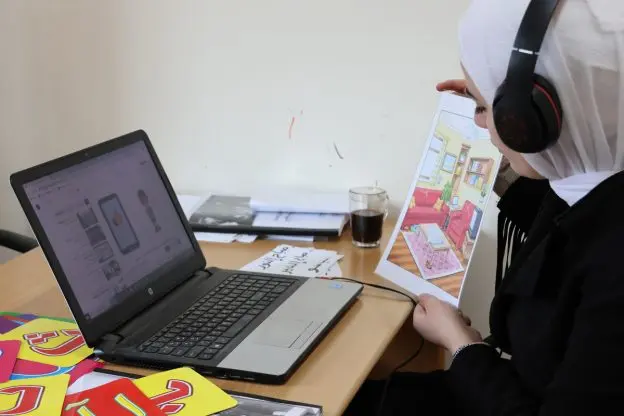
Experience Kalimah Center Classes
Watch real excerpts from our live sessions at Kalimah Center and see how we bring learning to life. These clips highlight our interactive, student-centered teaching approach across all our courses—designed to keep learners engaged, motivated, and actively involved every step of the way.
Writing the letter “و” In Arabic And Its Forms
In contrast with the majority of Arabic letters, “و” doesn’t connect with the following letter, so it maintains the same shape in almost every position. This makes it one of the simplest letters to identify and write.

| Isolated و ولد (boy)
| Initial و وقت (time)
| Medial ـو نور (light)
| Final ـو ضوء (light)
Common Words And Sentences Using the Letter “و”
The letter waw “و” appears in many common Arabic words and sentences, either at the beginning, middle, or end, showing its versatility in daily language.

Beginning of Word:
- ورق (waraq) – paper
- وطن (watan) – homeland
- وجه (wajh) – face
Middle of Word:
- صورة (sorah) – picture
- طاولة (tawelah) – table
- نور (noor) – light
End of Word:
- جرو (garw) – puppy
- عدو (adew) – enemy
- مانجو (mango) – mango
Example sentence:
- اشترى وليد وسادة من الحرير – ( Walid bought a silk pillow )
- وحيد القرن من الحيوانات الضخمة – ( The rhinoceros is a huge animal )
- وددت ان احتفظ بالوردة الحمراء – ( I wish I could keep the red rose )
Read more about: The Arabic Letter “ي” (Ya) With Its Forms, Examples And Pronunciation
Mistakes To Be Avoided With The letter waw “و”
The letter waw “و” is easy to write, but learners often make common mistakes with its sound, connection, and look. Being aware of these pitfalls helps avoid confusion and builds confidence.

- Forgetting its vowel function: Fresh learners may be confused with its pronunciation, thinking it is always a “w.” Nevertheless, in most cases, it is a long vowel “oo.”
- Mislink the letter: “و” never occurs in combination with the letter coming after it, which leads to confusion during writing for new learners.
- Visual confusion: It may be confused with other similar-looking letters like “ف” or “ق” at first glance due to its curved nature. Be careful with dot position and size to avoid confusion.
Practice Tips For Mastering The letter waw “و”
To master the letter “و,” consistent practice is key. These simple tips will help improve your recognition, pronunciation, and writing accuracy.

1. Listen and Repeat:
Listen to audio recordings or songs where the letter is clearly visible. Repeat words like “وردة,” “نور,” and “وقت” out loud.
2. Write in Context:
Copy full sentences with “و” in different positions to exercise your hand and eye coordination.
3. Flashcards and Comparisons:
Compare visually “و” with letters like “ف”, “ق”, and “ر” to avoid confusion.
4. Vowel Practice:
Exercise identifying when “و” is a consonant and when it acts as a vowel by looking at words like: ولد (consonant) – نور (vowel)

Inside Kalimah Center: Moments from Our Courses
Get a glimpse into the vibrant learning experience at Kalimah Center. These snapshots capture real moments from our live classes—where students engage deeply, connect with passionate instructors, and grow in a welcoming, supportive environment.
Here Are The Reviews On Our Courses:
Our students frequently commend the excellence of our courses and the commitment shown by our instructors. You can read their complete reviews on Trustpilot.

Unlock Your Potential in Arabic and Quran with Kalimah Center!
Ready to deepen your connection with the Quran and enhance your understanding of Arabic? Join Kalimah Center today and embark on a transformative journey of learning and growth! Our professional, handpicked Online Arabic and Quran Tutors are dedicated to helping you master these essential skills with ease and expertise.
📚 Explore Our Courses:
Online Arabic Course: Tailored to your level, our comprehensive Arabic program includes 16 teaching levels and 400+ hours of personalized sessions.
Online Quran With Tajweed Course: Perfect for non-Arabic speakers, our course spans 13 levels and equips you with Tajweed mastery from beginner to advanced.
Online Arabic Course For Kids: Nurture your child’s love for Arabic with our engaging and structured program, available in 24 levels for primary, intermediate, and secondary stages.
🚀 Start Your Free Trial Today! 🚀
Don’t miss out on this life-changing opportunity to deepen your faith and knowledge. Sign up now for your free trial and take the first step towards becoming a better practicing Muslim with Kalimah Center!
Conclusion:
The Arabic letter “و” is not just a letter—it’s a thought bridge, a sound vessel, and a unit of countless common words. As a consonant like “w” or a long vowel like “oo” Its impacts are experienced in spoken and written Arabic. Its uniqueness in not being connected to the following letter renders it distinct in form, but its grammatical purpose as the word “and” gives it constant utility in speech and writing.
By understanding and applying the different roles and forms of “و”, students are able to significantly improve their proficiency and knowledge in Arabic.