Have you ever put an Urdu newspaper next to an Arabic book and asked yourself, is Arabic similar to Urdu? The main difference between Arabic and Urdu is that Arabic is a Semitic language, while Urdu is an Indo-Aryan language that took Arabic’s script and much of its vocabulary.
That one fact explains why the two languages look like siblings on paper but sound like strangers in conversation. An Urdu speaker can often pick out familiar words in Arabic, but full sentences quickly show a different grammar, rhythm, and set of sounds.
At Kalimah Centre, we meet many Urdu-speaking students who begin Arabic with a head start they didn’t know they had. Knowing exactly where that advantage starts, and where it stops, can save you months of confusion.
In this guide, we compare the scripts, letters, grammar, pronunciation, and shared words, along with free tools that make the comparison hands-on. By the end, you’ll know how to make your Urdu work for you while you learn Arabic.
What you will learn in this article:
- Why Arabic and Urdu look alike but come from different language families.
- The real differences in the Arabic alphabet vs Urdu alphabet.
- How grammar and pronunciation set the two languages apart.
- Which shared words help you and which ones can mislead you.
- How Urdu speakers can turn their background into faster Arabic progress.
Is Arabic Similar To Urdu?
Arabic is similar to Urdu in script and vocabulary, but not in grammar or language family. So when people ask, is Arabic similar to Urdu, the honest answer is “partly.” The resemblance on the surface is real, but underneath, each language follows a very different linguistic tradition.
The table below gives you a side-by-side view first. After that, we look at each point in detail, starting with where both languages come from and what they actually share.
| Feature | Arabic | Urdu |
| Language family | Semitic (Afro-Asiatic) | Indo-Aryan (Indo-European) |
| Where it’s spoken | Middle East and North Africa | Pakistan, India, and diaspora communities |
| Alphabet size | 28 letters | Usually counted as 38–39 letters |
| Common script style | Naskh | Nastaliq |
| Writing direction | Right to left | Right to left |
| Basic word order | Verb–Subject–Object or Subject–Verb–Object | Subject–Object–Verb |
| Word building | Root-and-pattern system | Stems with suffixes and postpositions |
| Dual number | Yes | No |
| Throat sounds (ع، ح، ق) | Fully pronounced | Often softened or merged |
| Vocabulary | Native Semitic roots | Indo-Aryan base with Persian and Arabic loanwords |
Arabic And Urdu Belong To Different Language Families
Arabic is a Semitic language, related to Hebrew and Aramaic. Urdu belongs to the Indo-Aryan branch of the Indo-European family, alongside Hindi and Punjabi. This leads to a surprising fact: by family tree, Urdu is actually closer to English than it is to Arabic.
As this detailed overview from Encyclopaedia Britannica’s entry on the Urdu language explains, Urdu is Pakistan’s official language and has around 70 million native speakers. It borrows heavily from Arabic and Persian, but its grammar stays Indo-Aryan. The Quran describes this kind of language diversity as one of Allah’s signs.
Allah (Glorified and Exalted be He) says:
“وَمِنْ آيَاتِهِ خَلْقُ السَّمَاوَاتِ وَالْأَرْضِ وَاخْتِلَافُ أَلْسِنَتِكُمْ وَأَلْوَانِكُمْ ۚ إِنَّ فِي ذَٰلِكَ لَآيَاتٍ لِّلْعَالِمِينَ”
“And one of His signs is the creation of the heavens and the earth, and the diversity of your languages and colours. Surely in this are signs for those of ˹sound˺ knowledge.” Surah Ar-Rum, 30:22
The verse reminds us that differences between languages are part of a meaningful design, not random accidents. Arabic and Urdu show this well: two separate language families brought together over centuries by faith, trade, scholarship, and cultural exchange across South Asia.
Where Arabic And Urdu Overlap
Most of the overlap came through Persian, not straight from Arabic. Urdu grew up in North India while Persian was the language of royal courts and administration. Persian had already absorbed thousands of Arabic words, and it passed them on to Urdu along with its own vocabulary.
Because of this, the overlap is strongest in formal, religious, legal, and academic language. Words for knowledge, justice, time, and government, such as ʿilm, ʿadl, waqt, and ḥukūmat, are Arabic in origin. Formal Urdu speeches and literature usually contain far more Arabic words than casual street conversation does.
The overlap has some surprising gaps, though. For prayer and fasting, everyday Urdu uses the Persian words namāz and roza, not the Arabic ṣalāh and ṣawm. So even in religious vocabulary, Urdu speakers can’t assume every familiar word comes from Arabic, which is a useful thing to remember when you study.
Can Urdu Speakers Understand Arabic?
No. Urdu speakers can’t understand spoken or written Arabic without studying it, even though they’ll recognize many individual words. Recognizing words isn’t the same as understanding meaning, because grammar, verbs, and small function words hold a sentence together, and those are entirely different.
Take the Arabic sentence “ذهب الطالب إلى المدرسة” (the student went to school). An Urdu speaker will spot ṭālib (student) and madrasa (school) right away. But the verb ذهب (went) and the preposition إلى (to) mean nothing in Urdu, so the sentence as a whole stays out of reach.
That’s why structured guidance makes such a difference for Urdu speakers. Kalimah Centre’s Learn Arabic With Online Course begins with a free placement test. Native, certified tutors then build your grammar and listening skills on top of the vocabulary you already know from Urdu.
Read Also: Arabic Language: Complete Guide to History, Script & Dialects
Here Are The Reviews On Our Courses:
Our students frequently commend the excellence of our courses and the commitment shown by our instructors. You can read their complete reviews on Trustpilot.
Read more reviews on Trustpilot

Arabic Alphabet Vs Urdu Alphabet
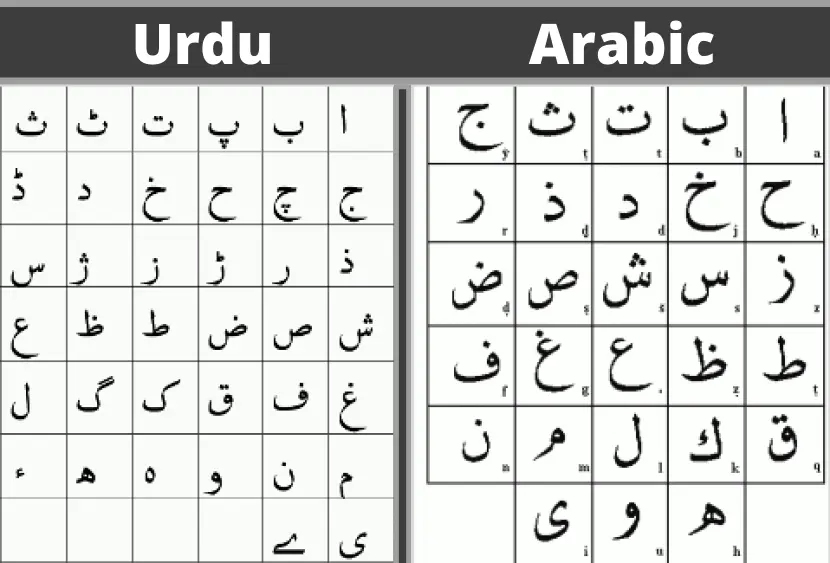
The Arabic alphabet vs Urdu alphabet comparison is where Urdu speakers feel most at home. Both are written right to left and share the same core letters. Still, Urdu added letters and uses a different calligraphic style, so the two scripts are related but not identical.
Is Urdu Written In Arabic Script?
Yes. Urdu is written in a modified Arabic script, usually called the Perso-Arabic script, because it came to South Asia through Persian. The letters are Arabic at their core, but Persian and later Urdu writers adapted them for sounds that Arabic doesn’t have.
To see every letter in a clear visual chart, check out Omniglot’s guide to the Urdu writing system. It notes that Urdu has used the Perso-Arabic script since the 12th century and is normally written in the Nastaliq style, which explains much of how it looks on the page.
For anyone wondering whether that’s a real advantage: is Urdu written in Arabic script closely enough to help with reading? Yes. All 28 Arabic letters exist in Urdu, so an Urdu reader can sound out Arabic words from the first day. Your main job is learning Arabic vowel marks and the correct Arabic pronunciation.
Letters Urdu Added To The Arabic Alphabet
The first additions came from Persian: پ (p), چ (ch), ژ (zh), and گ (g). Arabic has no letters for these sounds, so Persian writers built new letters by adding dots or strokes to existing ones. Urdu inherited all four and uses them every day.
Urdu then added letters of its own for South Asian sounds. These include the retroflex ٹ (ṭ), ڈ (ḍ), and ڑ (ṛ), nūn ghunna ں for nasal endings, and ھ for aspirated sounds like بھ and پھ. You can see how these sit next to the original Arabic letters in the official Unicode Arabic code chart.
So for Urdu speakers, learning to read Arabic is mostly about removing, not adding: drop the extra letters and sharpen the 28 core ones. Kalimah Centre’s Arabic Reading Course covers letter shapes, vowels, and connections, so you read Arabic with Arabic pronunciation instead of Urdu habits.
Naskh Vs Nastaliq – How The Two Scripts Look Different
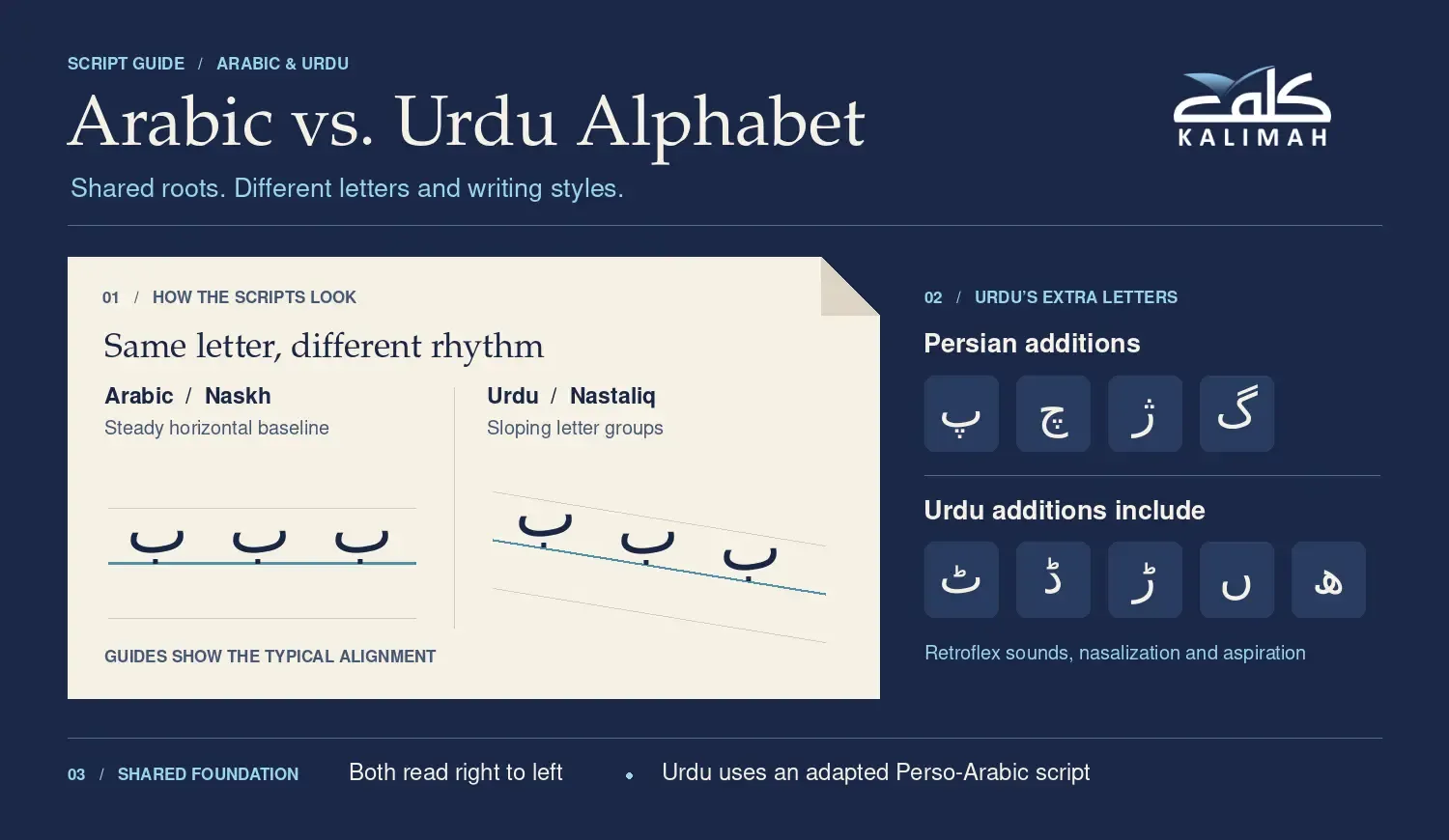
Naskh, the standard style for Arabic, sits on a straight horizontal line and is very clear, which is why most Arabic books and Quran copies use it. Nastaliq, Urdu’s usual style, slants diagonally, so each word flows downward from right to left in a graceful hanging line.
To see the contrast yourself, type a few words into the free Noto Nastaliq Urdu font preview on Google Fonts. Then type the same words in a Naskh font. Seeing them side by side makes it obvious why Arabic print can feel cleaner and more spacious to Urdu readers.
Watch for small differences between letter forms too. Urdu writes ہ where Arabic usually writes ه, uses ک where Arabic uses ك, and writes final ی without dots, while Arabic ي keeps two dots underneath. Noticing these early will stop you from misreading common Arabic words.
Related read: The Complete Arabic Alphabet Guide: Letters, Forms, Sounds & Practice
Inside Kalimah Center: Moments from Our Courses
Get a glimpse into the vibrant learning experience at Kalimah Center. These snapshots capture real moments from our live classes—where students engage deeply, connect with passionate instructors, and grow in a welcoming, supportive environment.
Master Arabic with Kalimah Center
Join our expert-led online classes and start your journey toward Arabic fluency today.
Book Your Free TrialDifference Between Arabic And Urdu In Grammar And Pronunciation
The biggest difference between Arabic and Urdu shows up once you move from single words to full sentences and real conversation. Grammar and sound systems are where the two languages separate completely, and where Urdu speakers need the most focused, patient practice.
1. Word Order And Sentence Structure
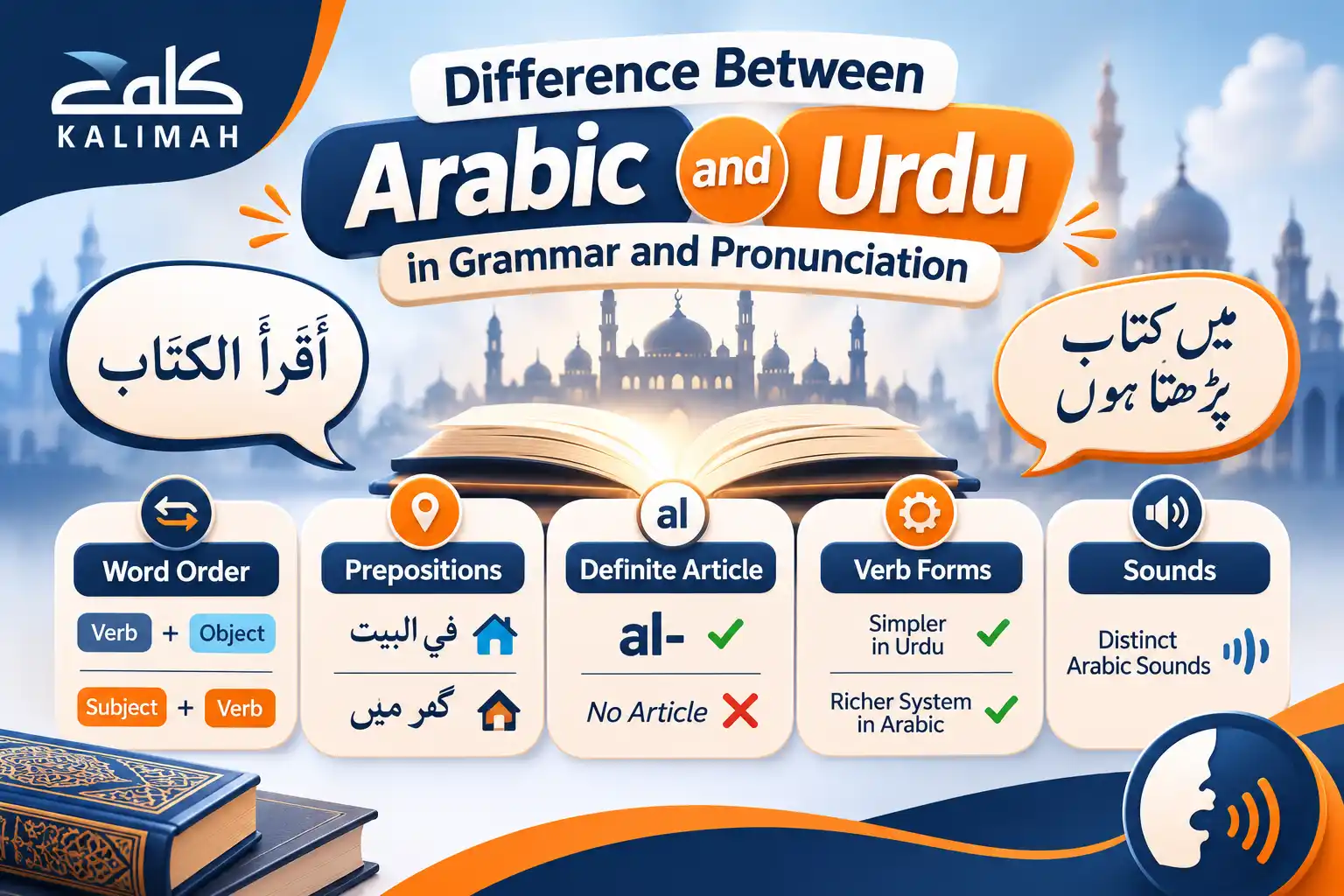
Urdu puts the verb at the end of the sentence: “میں کتاب پڑھتا ہوں” (main kitāb paṛhtā hūñ), literally “I book read.” Arabic usually puts the verb first: “أقرأ الكتاب” (aqraʾu al-kitāb), meaning “I read the book.” Changing this basic sentence order is one of the first habits to retrain.
Arabic uses prepositions, which come before the noun. Urdu uses postpositions, which come after it. “In the house” is “في البيت” (fī al-bayt) in Arabic but “گھر میں” (ghar meñ) in Urdu, literally “house in.” This small reversal appears in almost every sentence you’ll build.
Arabic also has a definite article, al- (the), which Urdu lacks entirely. And in the present tense, Arabic often drops the verb “to be”: “الكتاب جديد” means “the book is new” with no word for “is.” Urdu needs hai at the end: “کتاب نئی ہے.”
2. Verbs, Gender, And The Arabic Root System
Arabic builds words from three-letter roots. The root k-t-b gives kataba (he wrote), kātib (writer), kitāb (book), maktab (office), and maktaba (library). Urdu borrowed several of these as fixed words, but it can’t create new words from roots the way Arabic does.
Both languages have two grammatical genders, and Urdu verbs already change for gender: paṛhtā for a male reader, paṛhtī for a female one. That helps, but Arabic goes further. It separates “you” for a man and a woman, and it has a dual form, so kitābān means exactly two books.
Plurals are another challenge, since Arabic uses “broken plurals” like kitāb becoming kutub. Kalimah Centre’s Online Arabic Grammar Course teaches nahw step by step, from verb patterns to case endings, so the root system turns into a tool instead of a puzzle.
3. Arabic Sounds That Urdu Speakers Find Challenging
Urdu merges several Arabic letters into one sound. ث, س, and ص all become “s.” ذ, ز, ض, and ظ all become “z,” and ت and ط both become “t.” In Arabic these sounds are distinct and change meaning: سيف (sword) and صيف (summer) are different words.
The letters ع and ق need extra attention, because Urdu speakers often drop ʿayn or say qāf as “k.” That’s a problem, since قلب (heart) and كلب (dog) differ only in that one sound. The free Library of Congress Arabic romanization table gives every Arabic consonant its own symbol.
There’s good news too: Urdu already has خ and غ from Persian, so those throat sounds come easily. Practice minimal pairs every day, record yourself reading them, and compare your recordings with native audio. A few focused minutes daily work better than one long, tiring session each week.
Further reading: Farsi vs Arabic: Key Differences, Which Is Harder, and Which to Learn
Shared Vocabulary Between Arabic And Urdu
Vocabulary is the bridge that makes Arabic feel familiar, and it’s the main reason so many learners ask, is Arabic similar to Urdu, in the first place. Used well, shared words speed up your learning. Used carelessly, a few of them lead to funny and sometimes awkward mistakes.
Common Arabic Loanwords In Everyday Urdu
Many everyday Urdu words come straight from Arabic: kitāb (book), qalam (pen), waqt (time), dunyā (world), insān (human), ʿilm (knowledge), ṣabr (patience), khabar (news), sawāl (question), and jawāb (answer). Each one is ready-made vocabulary waiting for you in Arabic.
A practical way to find more is the free Rekhta Dictionary, an online trilingual Urdu dictionary that shows where each word comes from. Look up words you use every day and you’ll quickly see which came from Arabic, which from Persian, and which are native Indo-Aryan.
Keep in mind that borrowed words often changed in pronunciation. Urdu says sabar with a plain “s,” while Arabic says ṣabr with a heavy ṣād. Urdu also built new forms with Persian endings, so Arabic shukran (thanks) became the familiar Urdu shukriya.

False Friends That Change Meaning Between The Two Languages
Gharīb is the classic trap. In Urdu it means “poor,” but in Arabic it means “strange” or “stranger.” The Arabic word for a poor person is faqīr. Calling someone gharīb in Arabic when you mean they’re short of money will lead to some confused looks.
Mazāq is another one. In Urdu it means “a joke,” but Arabic madhāq means “taste” or “flavor.” If you want to talk about joking in Arabic, the word is mizāḥ. One letter and a shift in meaning can turn a light moment into an odd conversation.
Fikr means “worry” in Urdu, as in fikr na karo (don’t worry). In Arabic it means “thought” or “thinking,” and worry is qalaq. Keep a small notebook of false friends like these and review it every week until the Arabic meanings feel natural.
How Urdu Speakers Can Use The Overlap To Learn Arabic Faster
Start with what you already know. Write down Arabic words you use in Urdu, then look up the root of each one. Every root opens a whole family of related words, so one familiar Urdu word can turn into five or six new Arabic words.
The free Quranic Arabic Corpus is excellent for this. Click any word in the Quran to see its root, grammar, and translation. As you explore, you’ll notice how many Quranic roots already live in your Urdu vocabulary, which makes reading the Quran much more rewarding.
If you’re raising Urdu-speaking children, this overlap gives them a real advantage, and a child who asks “is Arabic similar to Urdu?” can learn the answer through play. Kalimah Centre’s Learn Arabic For Children Course uses interactive, age-appropriate lessons to grow that early familiarity.
Don’t miss: Learn Quranic Arabic: Complete Guide to Courses, Curriculum & Timeline
Urdu Speakers Progress Faster With Kalimah Centre
Every learner starts from a different place, and Urdu speakers start from an unusual one. They read the script and recognize hundreds of words, yet they struggle with grammar and sounds. Kalimah Centre‘s free placement test spots that profile, so you skip what you already know and focus on what you don’t.
Kalimah Centre has taught Arabic since 2011 and has spent 13 years refining its curriculum into sixteen structured levels with more than 400 study hours. That roadmap keeps your progress clear: every level has defined goals, and scoring at least 60% on the final oral exam earns you a certificate for that level.
Lessons are taught by native, certified tutors who specialize in teaching non-native speakers, and both male and female teachers are available. For Urdu speakers, that native ear matters a lot. Your tutor catches merged sounds like س and ص right away and corrects them before they become permanent habits.
If you’d rather learn with others, Kalimah Centre’s Group Classes offer the same expert teaching at a lower price, with a fixed schedule that keeps you accountable. Whichever format you pick, the question “is Arabic similar to Urdu?” stops being theory and becomes your personal advantage.
Experience Kalimah Center Classes
Watch real excerpts from our live sessions at Kalimah Center and see how we bring learning to life. These clips highlight our interactive, student-centered teaching approach across all our courses—designed to keep learners engaged, motivated, and actively involved every step of the way.
Master Arabic with Kalimah Center
Join our expert-led online classes and start your journey toward Arabic fluency today.
Book Your Free TrialBook Your Free Arabic Trial Class Today!
You now know where your Urdu helps and where Arabic asks for something new, so the next step is to put that into practice with a real teacher. Book your free trial class at Kalimah Centre today and try a lesson designed around your Urdu background.
Claim your free Arabic trial class here, take the placement test, and get matched with a native tutor who fits your goals. Whether you want Quranic Arabic, Modern Standard Arabic, or confident everyday conversation, your learning plan is built around you from the first session.
Explore Our Courses:
Online Arabic Course: Tailored to your level, our comprehensive Arabic program includes 16 teaching levels and 400+ hours of personalized sessions.
Online Quran With Tajweed Course: Perfect for non-Arabic speakers, our course spans 13 levels and equips you with Tajweed mastery from beginner to advanced.
Online Arabic Course For Kids: Nurture your child’s love for Arabic with our engaging and structured program, available in 24 levels for primary, intermediate, and secondary stages.
Don’t let the question of whether Arabic is similar to Urdu keep you guessing for another year. Your head start is real, your path is clear, and your first lesson is free. Reserve your spot now and start turning familiar words into fluent Arabic.

Master Arabic with Kalimah Center
Join our expert-led online classes and start your journey toward Arabic fluency today.
Book Your Free TrialSummary
So, is Arabic similar to Urdu? On the surface, yes: both use the same core script, read right to left, and share a large stock of vocabulary. Underneath, they come from different families. Arabic is Semitic and Urdu is Indo-Aryan, which shapes everything from word order to how words are built.
The main difference between Arabic and Urdu is structure. Word order, prepositions, the root system, the dual form, and distinct throat sounds all need fresh learning. Meanwhile, the Arabic alphabet vs Urdu alphabet comparison shows Urdu speakers already know the 28 core letters, so reading Arabic comes surprisingly quickly.
The key takeaway: treat your Urdu as a launchpad, not a shortcut. Trust shared words but watch for false friends, retrain your ear for Arabic sounds, and learn grammar on its own terms. If you want structure and correction, guided lessons with native tutors will turn that head start into real fluency.
Frequently Asked Questions
Is Urdu Closer To Hindi Or Arabic?
Urdu is much closer to Hindi. The two share the same grammar and everyday speech, so they’re mutually intelligible, while Arabic mainly contributed vocabulary and, through Persian, the script.
Is The Quran Arabic Or Urdu?
The Quran was revealed in Arabic, and Muslims recite it in Arabic everywhere, while Urdu versions are translations of its meaning. Kalimah Centre helps Urdu speakers understand the original Arabic text directly.
Do Pakistanis Speak Urdu Or Arabic?
Pakistanis speak Urdu, the national language, alongside regional languages such as Punjabi, Sindhi, and Pashto. Arabic is mostly learned for Quran recitation and prayer, not used in daily conversation.
What Language Came First, Arabic Or Urdu?
Arabic came first by many centuries, with written records from before Islam. Urdu developed in North India from around the 12th century, partly through contact with Persian and Arabic.
Can Arabic Speakers Understand Urdu?
No. Arabic speakers may recognize Arabic-origin words like kitāb or waqt in Urdu, but its Indo-Aryan grammar and sounds make whole sentences hard to follow without study.
Do Muslims Speak Urdu Or Arabic?
Muslims speak many languages, and most of them aren’t native Arabic speakers, but all use Arabic in prayer and Quran recitation. Kalimah Centre teaches Muslims worldwide to understand the Arabic they pray in.