Your best friend just posted wedding photos in the family group chat. Everyone is replying in Arabic, and you’re staring at your phone, not sure how to say congratulations in Arabic without getting it wrong.
Here’s the good news: the most common word is easy. It’s mabrook (مبروك), and it works almost anywhere. The tricky part is that Arabic doesn’t stop at one word. A wedding, a new job, and a new baby each have their own phrases.
The words also change when you write a formal card, or when you’re talking to a woman instead of a man.
That’s what this guide is for. You’ll learn each phrase, how to say it, and when to use it. You’ll also get ready-made messages you can copy, a few phrases from different Arab countries, and what to say back when someone congratulates you.
The Most Common Ways to Say Congratulations in Arabic
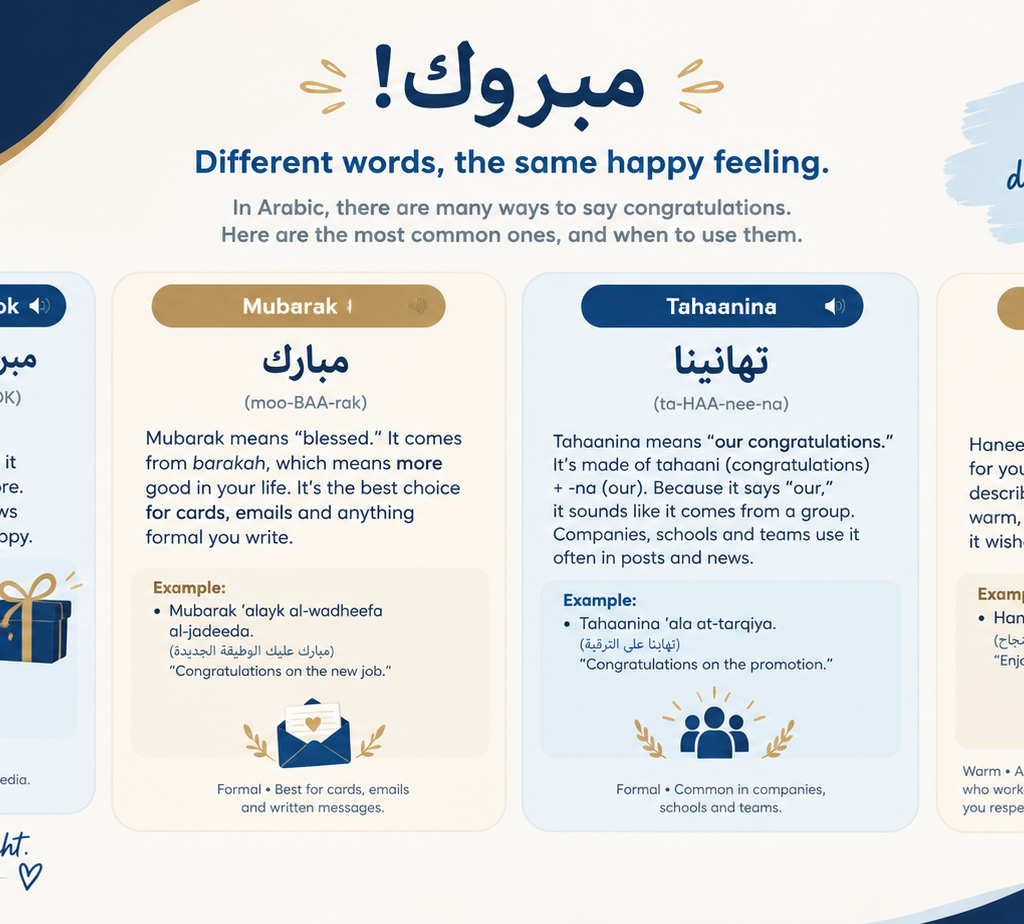
Congratulations in Arabic is mabrook (مبروك) when you speak, and mubarak (مبارك) or tahaanina (تهانينا) when you write something formal. All three share one goal: to show you are happy for someone.
Mabrook And Alf Mabrook: The Words You Will Hear Most
Mabrook (مبروك) is the word Arabs use every day to say congratulations. You will hear it in Cairo, Beirut, Riyadh, and Casablanca. It works for almost any good news, big or small.
To say what the news is, add ‘ala (على), which means “on.” For example, mabrook ‘ala an-najaah (مبروك على النجاح) means “congratulations on passing.”
Alf mabrook (ألف مبروك) means “a thousand congratulations.” People say it when the news is big and they feel very happy. It fits a wedding, a new home, a new baby, or great exam results.
Here is one more example: alf mabrook ‘ala al-bayt al-jadeed (ألف مبروك على البيت الجديد). It means “congratulations on the new house.”
Both words are casual. Use them when you talk to friends, family, and coworkers you know well. You can also use them in texts and in comments on social media.
Sound: mab-ROOK and ALF mab-ROOK
Mubarak And Tahaanina: The Polite Words For Writing
Mubarak (مبارك) means “blessed.” It comes from the word barakah, which means a blessing or more good in your life. You already know it if you have heard ‘Eid mubarak, which means “have a blessed Eid.”
Mubarak is the best choice for cards, emails, and anything formal you write. For example, mubarak ‘alayk al-wadheefa al-jadeeda (مبارك عليك الوظيفة الجديدة) means “congratulations on the new job.”
Tahaanina (تهانينا) is made of two parts. Tahaani means “congratulations” and -na means “our.” So the word means “our congratulations.”
Because it says “our,” tahaanina sounds like it comes from a group. That is why companies, schools, and teams use it in posts and news. For example, tahaanina ‘ala at-tarqiya (تهانينا على الترقية) means “congratulations on the promotion.”
Sound: moo-BAA-rak and ta-HAA-nee-na
Hanee’an Lak: Wishing Someone Joy In What They Got
Hanee’an lak (هنيئاً لك) means “may it be good for you.” It has a sweet story behind it. The root of this word first described food that is tasty and easy to eat.
That is why Arabs still say hanee’an maree’an (هنيئاً مريئاً) to someone who is eating. It is like saying “enjoy your meal.”
When you use it to congratulate, you are saying more than “well done.” You are hoping the person truly enjoys what they won or earned. For example, hanee’an lak an-najaah (هنيئاً لك النجاح) means “enjoy your success.”
This phrase is warm and a little formal. It fits a friend who worked hard for a big goal. It also fits a card for someone you respect. If you want more everyday words like this one, see our list of useful Arabic phrases and sentences.
Sound: ha-NEE-an lak
Formal Vs. Casual Congratulations In Arabic
Many phrase lists mix casual and formal words without telling you which is which. That is how learners end up writing alf mabrook in a work email. Arabic congratulations fall into three groups: casual, formal, and religious. Pick the group first, then pick the phrase.
Casual Phrases For Friends And Family
Casual phrases are short and friendly. You say them out loud, in a text, or in a chat. Use them with people you know well.
These four cover most casual moments:
- Mabrook (مبروك, mab-ROOK): Congratulations.
- Alf mabrook (ألف مبروك, ALF mab-ROOK): A thousand congratulations.
- Tistaahil kull khair (تستاهل كل خير, tis-TAA-hil kull KHAIR): You deserve all good things.
- Ya salaam! (يا سلام, ya sa-LAAM): Wow! People say it when they hear great news.
You can mix them. A friend might say, “Alf mabrook! Tistaahil kull khair.” That means “A thousand congratulations! You deserve all good things.”
These phrases come from spoken Arabic. That is why they sound natural in talk but look too relaxed in a letter to your boss.
Formal Phrases For Work, Cards, And Letters
Formal phrases are longer and more polite. You use them in work emails, printed cards, and official letters. They come from Modern Standard Arabic, the form of Arabic used in news and books.
You will use these four the most:
- Mubarak (مبارك, moo-BAA-rak): Congratulations.
- Tahaanina al-qalbiyya (تهانينا القلبية, ta-HAA-nee-na al-qal-BIY-ya): Our warm congratulations from the heart.
- Atyab at-tahaani (أطيب التهاني, AT-yab at-ta-HAA-nee): Our best wishes.
- Atqaddamu ilaykum bi-asmaa aayaat at-tahni’a (أتقدم إليكم بأسمى آيات التهنئة): I send you my highest congratulations.
The last one is very formal. You will see it at the start of letters from companies and government offices.
One common mistake is mixing the two styles in one message. Starting with atyab at-tahaani and ending with alf mabrook feels odd. Pick one style and keep it.
Religious Phrases That Ask God To Bless
Religious phrases add a short prayer to your congratulations. Muslims use them everywhere, both Arabs and non-Arabs.
Start with these four:
- Baarak Allahu feek (بارك الله فيك, BAA-rak AL-laa-hu FEEK): May God bless you. It fits any good news.
- Baarak Allahu lakumaa (بارك الله لكما, BAA-rak AL-laa-hu la-KU-maa): May God bless you both. It is for a married couple.
- Zawaaj mubarak (زواج مبارك, za-WAAJ moo-BAA-rak): A blessed marriage.
- Maa shaa’ Allah (ما شاء الله): This is what God willed. People say it when they admire good news.
You may have heard Nikah mubarak. Muslims from South Asia use it a lot. Arabs understand it, but they rarely say it. At a wedding in an Arab country, alf mabrook or zawaaj mubarak is more common.
Which Word Fits Which Moment
Still not sure which word to use? The table below puts the main phrases side by side so you can choose in seconds.
| Arabic | English letters | Meaning | Style | Best for |
| مبروك | mabrook | congratulations | Casual | Friends, family, texts |
| ألف مبروك | alf mabrook | a thousand congratulations | Casual and excited | Big news |
| مبارك | mubarak | blessed | Formal | Cards, Eid, emails |
| تهانينا القلبية | tahaanina al-qalbiyya | our warm congratulations | Formal | Work and school news |
| هنيئاً لك | hanee’an lak | may it be good for you | Warm | Hard-earned success |
| بارك الله لكما | baarak Allahu lakumaa | may God bless you both | Religious | Weddings |
A quick rule helps here. If you are speaking, mabrook is almost never wrong. If you are writing to someone you do not know well, start with mubarak or tahaanina.
Read also: Condolences in Arabic
Is Mabrook Wrong? Mabrook Vs. Mubarak
Both words are used every day, but they do not have the same rank in formal Arabic. This matters if you are writing an essay, an exam answer, or an official letter.
What The Arabic Language Academy In Makkah Decided
On 5 February 2020, the Arabic Language Academy in Makkah looked at the word mabrook. It asked one question: is mabrook correct in formal Arabic when you use it to congratulate?
Most members said no. They explained that in old Arabic, mabrook is linked to the word bark, which means the chest. The verb baraka al-ba’eer (برك البعير) describes a camel kneeling down and resting its chest on the ground.
So in classical Arabic, mabrook is about kneeling, not blessing. The academy said that mubarak is the correct word for formal writing. It comes from barakah, which means blessing, and it has a long history in good Arabic.
The Saudi newspaper Okaz reported the decision in March 2020 and shared both sides of the debate.
When Mabrook Is Still the Right Word
Not every member of the academy agreed. Some said mabrook and mubarak come from the same root letters, so they can share a meaning.
They also pointed out that almost every Arab says mabrook today. Words change their meaning over time, and language experts accept that this is normal.
So what should you do? Use a simple rule. When you talk, say mabrook. Nobody at a wedding will correct you, and mubarak might even sound stiff.
When you write something formal, use mubarak or tahaanina. An Arabic teacher may mark mabrook as an error in an essay. A careful reader may notice it in a formal letter. This one small choice tells people a lot about your Arabic. It shows you know the difference between spoken Arabic and written Arabic.
Changing the Phrase for A Man, A Woman, or a Group
Arabic changes the end of a word based on who you are talking to. This is the detail learners forget most, and Arabs notice it right away. When you add “to you” or “on you,” the ending changes. Here is how mabrook ‘aleik (congratulations to you) and hanee’an lak (enjoy it) change:
- One man: mabrook ‘aleik (مبروك عليك) and hanee’an lak (هنيئاً لك)
- One woman: mabrook ‘aleiki (مبروك عليكِ) and hanee’an laki (هنيئاً لكِ)
- Two people, like a couple: mabrook ‘alaykumaa (مبروك عليكما) and hanee’an lakumaa (هنيئاً لكما)
- A group of three or more: mabrook ‘aleikum (مبروك عليكم) and hanee’an lakum (هنيئاً لكم)
Notice the pattern. For a woman, add an “i” sound at the end. For a group, add “um.” For two people, add “umaa.” In spoken Arabic, most people use the group form for two people too. In formal writing, the “two people” form is the correct choice for a married couple.
A Simple Three-Question Check Before You Congratulate
Most mistakes in Arabic congratulations come from skipping one small step. So before you speak or write, ask yourself three quick questions. We call this the Event, Style, Person check.
- What is the event? Is it a wedding, a new job, a baby, or Eid? Each one has its own phrases, which you will find below.
- What style do I need? Are you chatting, texting a friend, or writing a formal card? Chatting and texting call for casual words. Cards and emails call for formal ones.
- Who is the person? Are you talking to a man, a woman, a couple, or a group? Change the ending to match.
This check takes five seconds. It saves you from the two most common slips: the wrong ending, and a casual word in a formal message.
If you want a teacher to check these small details with you, the Kalimah Center online Arabic course trains you to use the right ending and the right style in real talks with native tutors.
Master Arabic with Kalimah Center
Join our expert-led online classes and start your journey toward Arabic fluency today.
Book Your Free TrialCongratulations In Arabic For Success
Success can mean passing an exam, graduating, getting a job, or getting a promotion. Arabic has special phrases for each one.
Phrases for Exams and Graduation
When a student passes an exam, people say mabrook an-najaah (مبروك النجاح, mab-ROOK an-na-JAAH). It means “congratulations on passing.”
For graduation, say alf mabrook at-takharruj (ألف مبروك التخرج, ALF mab-ROOK at-ta-KHAR-ruj). It means “a thousand congratulations on graduating.”
If the student did very well, praise the result. Say mubarak ‘alayk at-tafawwuq (مبارك عليك التفوق, moo-BAA-rak ‘a-LAYK at-ta-FAW-wuq). It means “congratulations on your top grades.”
Parents and teachers often add a prayer for the future. A common one is ‘u’baal ad-doktoraah (عقبال الدكتوراه). It means “next, may you get your PhD!” People say it with a smile after a bachelor’s or master’s degree.
You can also praise the hard work behind the result. Try ta’abak ma raah ‘al-faadi (تعبك ما راح عالفاضي). It means “your hard work did not go to waste.”
Phrases For A New Job Or A Promotion
For a new job, the best phrase joins congratulations with a wish for success. Say mabrook al-wadheefa, Allah ywaffa’ak (مبروك الوظيفة، الله يوفقك).
The sound is mab-ROOK al-wa-DHEE-fa, AL-lah y-WAF-fa-‘ak. It means “congratulations on the job, may God help you do well.”
For a promotion, say mabrook at-tarqiya (مبروك الترقية, mab-ROOK at-tar-QEE-ya). It means “congratulations on the promotion.” Add tistaahilha (تستاهلها) if you want to say “you deserve it.”
At work, the style matters more. If you are writing to a manager, use atyab at-tahaani bimunaasabat at-tarqiya (أطيب التهاني بمناسبة الترقية). It means “best wishes on your promotion.”
Coworkers in the Arab world often add a second wish about the future. Ilaa al-amaam daa’iman (إلى الأمام دائماً) means “always forward.” It is short, kind, and fits any work success.
Congratulations In Arabic For A Wedding And Marriage
Wedding phrases in Arabic are special because one of them comes straight from the teaching of the Prophet Muhammad. Many Muslims say it at every wedding they go to.
The Blessing The Prophet Taught For Marriage
The most famous wedding phrase is this one:
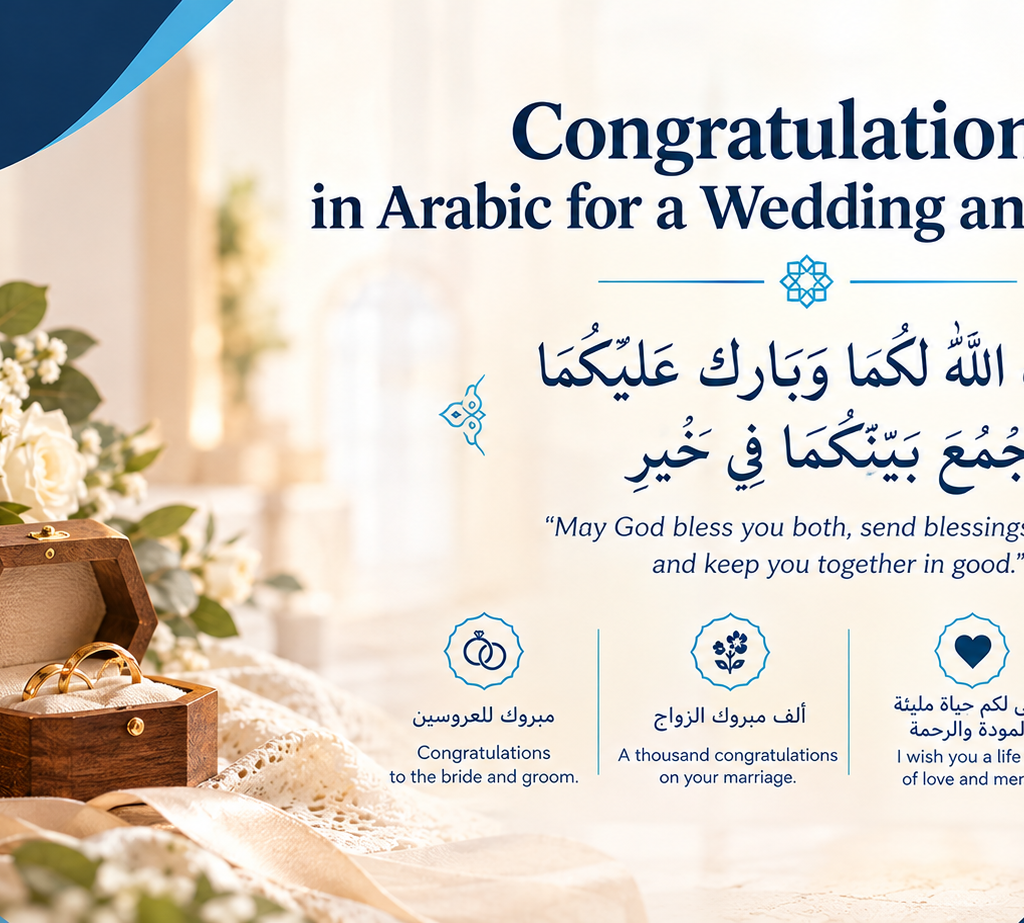
Baarak Allahu lakumaa wa baaraka ‘alaykumaa wa jama’a baynakumaa fee khayr (بارك الله لكما وبارك عليكما وجمع بينكما في خير).
“May God bless you both, send blessings on you, and keep you together in good.”
Sunan Abi Dawud, hadith 2130, and Jami’ at-Tirmidhi, hadith 1091.
In these reports, the Prophet said it to a man who had just married.
In the hadith, the words speak to the groom alone: laka and ‘alayka, which mean “for you” and “on you.” Today, most people change them to lakumaa and ‘alaykumaa to speak to both the bride and the groom.
You can say the full blessing at the wedding, or write it in a card. It is never too formal and never too casual. That is why it works for almost anyone.
Experience Kalimah Center Classes
Watch real excerpts from our live sessions at Kalimah Center and see how we bring learning to life. These clips highlight our interactive, student-centered teaching approach across all our courses—designed to keep learners engaged, motivated, and actively involved every step of the way.
The Old Wedding Wish To Avoid
Before Islam, Arabs had their own wedding wish. They said bir-rifaa’ wal-baneen (بالرفاء والبنين). It means “may you live in peace and have many sons.”
A hadith in Sunan Ibn Majah, hadith 1906 tells a story about it. When ‘Aqil ibn Abi Talib got married, people greeted him with this old wish. He told them not to say it.
Instead, he told them to use the words the Prophet taught: Allahumma baarik lahum wa baarik ‘alayhim. It means “O God, bless them and send blessings on them.”
Why does this matter today? Some people still use the old phrase without knowing its history. In a religious family, it may feel out of place. The baarak Allahu blessing is the safe and kind choice.
Phrases For The Wedding Day And The Engagement
At the wedding party itself, people use short and happy phrases. You will hear these three again and again:
- Mabrook lil-‘arooseen (مبروك للعروسين, mab-ROOK lil-‘a-roo-SEEN): Congratulations to the bride and groom.
- Alf mabrook az-zawaaj (ألف مبروك الزواج, ALF mab-ROOK az-za-WAAJ): A thousand congratulations on your marriage.
- Atmanna lakum hayaatan mal’a bil-mawadda war-rahma (أتمنى لكم حياة مليئة بالمودة والرحمة): I wish you a life full of love and mercy.
The last phrase uses the words mawadda (love) and rahma (mercy). These are the same words the Quran uses to describe marriage in Surat ar-Rum, verse 21.
For an engagement, Egyptians often say rabbina yitammim bi-khair (ربنا يتمم بخير). It means “may God complete it well.” It is a wish that the engagement leads to a happy wedding.
Want to hear how real learners use phrases like these after a few months of study? You can read what students say in the Kalimah Center reviews on Trustpilot.
Congratulations In Arabic For A New Baby
A new baby brings some of the warmest phrases in Arabic. Most of them mix congratulations with a prayer for the child.
What People Say For A Newborn
The simple way is mabrook al-mawlood (مبروك المولود, mab-ROOK al-maw-LOOD). It means “congratulations on the baby.” If the baby is a girl, say mabrook al-mawlooda (مبروك المولودة), with an “a” sound at the end.
In Egypt and the Levant, people often add yitrabba fi ‘izzak (يتربى في عزك, yit-RAB-ba fi ‘IZ-zak). It means “may he grow up under your care.” For a girl, it becomes titrabba fi ‘izzak (تتربى في عزك).
In the Gulf, you will hear mabrook ma jaak (مبروك ما جاك, mab-ROOK ma JAAK). It means “congratulations on what came to you.”
Another common wish is Allah yikhalleeh lak (الله يخليه لك). It means “may God keep him for you.” All of these are casual and kind. They work well in person, in a voice note, or in a text to the new parents.
A Classic Baby Blessing For Cards
For a formal card or a religious family, there is an old blessing. It is linked to al-Hasan al-Basri, a famous scholar from the early days of Islam:
(بارك الله لك في الموهوب لك، وشكرت الواهب، وبلغ أشده، ورزقت بره)
Baarak Allahu laka fil-mawhoobi lak, wa shakarta al-waahib, wa balagha ashuddah, wa ruziqta birrah
“May God bless you in the child He gave you. May you thank the Giver, May the child grow up strong, and may he be good to you.”
This blessing is long, so most people write it instead of saying it. It fits well in a card or a formal message.
The common reply to it is baarak Allahu lak wa baaraka ‘alayk (بارك الله لك وبارك عليك). It means “may God bless you too.”
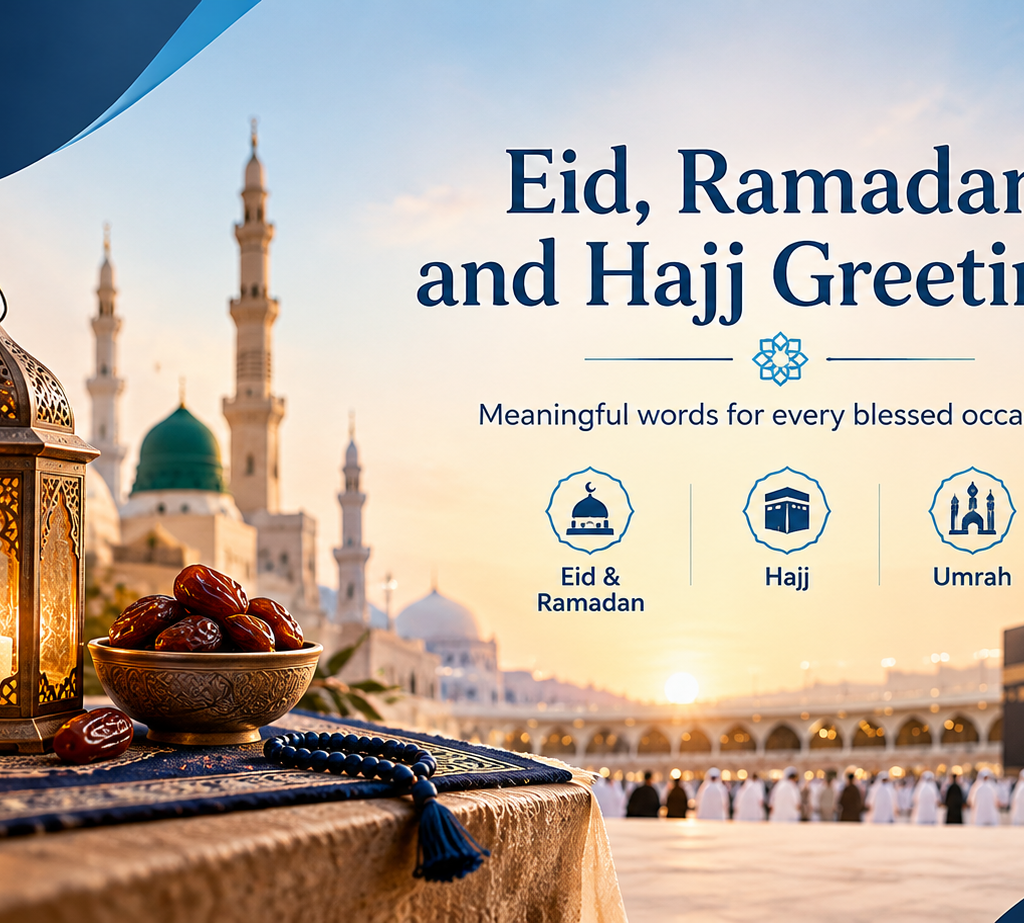
Greetings for Eid, Ramadan, and Hajj
Religious holidays have their own fixed greetings. These are not about something a person did. They are about a special time of year, so mabrook alone sounds strange here.
What To Say For Eid And Ramadan
The best-known holiday greeting is ‘Eid mubarak (عيد مبارك, ‘EED moo-BAA-rak). It means “blessed Eid.” You can use it for both Eid al-Fitr and Eid al-Adha.
Another very common one is kull ‘aam wa antum bikhair (كل عام وأنتم بخير, KULL ‘AAM wa AN-tum bi-KHAIR). It means “may you be well every year.” People use it for Eid, birthdays, and the new year.
After the Eid prayer, many Muslims say taqabbal Allahu minna wa minkum (تقبل الله منا ومنكم). It means “may God accept our worship and yours.”
For Ramadan, say Ramadan kareem (رمضان كريم) or Ramadan mubarak (رمضان مبارك). The first means “generous Ramadan.” The second means “blessed Ramadan.”
You can send any of these in a text or say them face to face. They work with everyone, from close friends to your boss.
What To Say To Someone Back From Hajj Or Umrah
When someone comes home from Hajj, the big pilgrimage to Makkah, people greet them with a special prayer. They say Hajj mabroor wa dhanb maghfoor (حج مبرور وذنب مغفور). The sound is HAJJ mab-ROOR wa DHANB magh-FOOR.
It means “may your Hajj be accepted and your sins forgiven.” Notice the word mabroor here. It looks like mabrook, but it comes from a different root and means “accepted” or “done well.”
For Umrah, the smaller pilgrimage, people say ‘umra maqboola (عمرة مقبولة, ‘UM-ra maq-BOO-la). It means “may your Umrah be accepted.”
The pilgrim often answers with jazaak Allahu khairan (جزاك الله خيراً). It means “may God reward you with good.”
Families often visit the pilgrim at home and bring sweets or gifts. Saying the right phrase at the door is a small act that people remember.
Full Congratulation Messages You Can Copy
Knowing single words is a great start. But sometimes you need a full message. Here are ready messages, from a quick text to a formal card.
Short Messages For Friends And Family
A quick text can make someone’s big day feel even better, and it doesn’t take long to write. Copy any of these messages, or change a word or two to make it your own.
a. Wedding text to a friend
ألف مبروك يا صديقي! بارك الله لكما وجمع بينكما في خير.
Alf mabrook ya sadeeqi! Baarak Allahu lakumaa wa jama’a baynakumaa fee khayr.
“A thousand congratulations, my friend! May God bless you both and keep you together in good.”
b. Success text to a student
مبروك النجاح! تستاهل كل خير، والله يوفقك في الخطوة الجاية.
Mabrook an-najaah! Tistaahil kull khair, w-Allah ywaffa’ak fil-khatwa al-jaaya.
“Congratulations on passing! You deserve all good things. May God help you in your next step.”
To send this to a girl, change tistaahil to tistaahili and ywaffa’ak to ywaffa’ik.
c. New baby text
ألف مبروك المولود! الله يخليه لكم ويتربى في عزكم.
Alf mabrook al-mawlood! Allah yikhalleeh lakum wa yitrabba fi ‘izzakum.
“A thousand congratulations on the baby! May God keep him for you, and may he grow up in your care.”
Formal Messages For Cards And Emails
A formal message needs a little more care than a quick text, because the words have to match the setting. Use these examples for work emails, printed cards, or anyone you want to show extra respect to.
a. Promotion email to a coworker
أتقدم إليكم بأطيب التهاني بمناسبة الترقية، متمنياً لكم دوام التوفيق والنجاح.
Atqaddamu ilaykum bi-atyab at-tahaani bimunaasabat at-tarqiya, mutamanniyan lakum dawaam at-tawfeeq wan-najaah.
“I send you my best wishes on your promotion. I wish you lasting success.”
b. Wedding card
تهانينا القلبية بمناسبة زواجكما، أتمنى لكما حياة مليئة بالمودة والرحمة.
Tahaanina al-qalbiyya bimunaasabat zawaajikumaa, atamanna lakumaa hayaatan malee’a bil-mawadda war-rahma.
“Warm congratulations on your marriage. I wish you a life full of love and mercy.”
c. Graduation card
مبارك عليك التخرج، وهنيئاً لك ثمرة تعبك.
Mubarak ‘alayk at-takharruj, wa hanee’an lak thamarat ta’abak.
“Congratulations on graduating. Enjoy the fruit of your hard work.”
Notice that each formal message uses only formal words. None of them ends with a casual alf mabrook.
Congratulations In Different Arabic Dialects
Mabrook works in every Arab country, so you cannot go wrong with it. But each region also has its own phrases and its own way of saying some words.
Why Some Words Sound Different From Country To Country
The biggest reason is one letter: qaf (ق). In each region, people say it in a different way. In Cairo and Damascus, the qaf often turns into a short stop in the throat. In Saudi Arabia and the Gulf, it often turns into a hard “g,” like in “go.”
That is why one phrase can sound so different. The wish “may God help you do well” is Allah ywaffa’ak in Egypt and the Levant. In the Gulf, the same wish sounds like Allah ywaffgak.
The same thing happens with other words. Qalb (heart) can sound like ‘alb in Cairo and galb in Riyadh.
Once you know this rule, many dialect words start to make sense. You can see more of these regional changes in our guide on how to say hi in Arabic, which compares greetings across the Arab world.
Common phrases in Egypt, the Levant, the Gulf, and Morocco
Each region adds its own touch to congratulations. The table below shows the everyday word and one extra wish you will often hear in four big regions.
| Region | Everyday word | Extra wish you will hear | Meaning |
| Egypt | alf mabrook | rabbina yis’idkum (ربنا يسعدكم) | May God make you happy |
| Levant (Syria, Lebanon, Jordan, Palestine) | mabrook | Allah yhanneekum (الله يهنيكم) | May God bring you joy |
| Gulf and Saudi Arabia | mabrook ‘alaik | ‘asaah mubaarak (عساه مبارك) | May it be blessed |
| Morocco | mabrouk | llah ykammel b-khir (الله يكمل بالخير) | May God complete it well |
Morocco also has a phrase you will hear all day: tbarkallah ‘lik (تبارك الله عليك). It is the Moroccan way to say “well done” or “great job.” People say it for good grades, a new car, or even a nice meal.
If you learn Arabic for one country, focus on that region’s phrases. But keep mabrook ready, because it works everywhere.
Replying When Someone Congratulates You In Arabic
Knowing how to reply is just as important as knowing how to congratulate. Arabic has set replies, and a simple “thanks” can feel a bit short to an Arab speaker.
The Most Common Replies
The top reply is Allah yibaarik feek (الله يبارك فيك, AL-lah yi-BAA-rik FEEK). It means “may God bless you.” You can use it in every Arab country. Change the end to match the person. Say feek to a man, feeki (فيكِ) to a woman, and feekum (فيكم) to a group.
Shukran (شكراً, SHUK-ran) means “thank you.” It is fine alone, but it sounds warmer when you join it with a blessing. Try shukran, Allah yibaarik feek.
To sound extra kind, say shukran min al-qalb (شكراً من القلب). It means “thank you from the heart.”
If someone says baarak Allahu feek to you, a lovely reply is wa feek baarak Allah (وفيك بارك الله). It means “and may God bless you too.”
Once the happy talk is over, you will also need a kind way to end it. Our guide on how to say goodbye in Arabic shows you the right words.
Replying To Eid And Religious Greetings
Religious greetings have their own replies. Using the right one shows that you know the culture well. When someone says ‘Eid mubarak or kull ‘aam wa antum bikhair, reply with wa antum bikhair (وأنتم بخير). It means “and may you be well too.”
You can also answer ‘Eid mubarak with ‘alayna wa ‘alaykum (علينا وعليكم). It means “on us and on you.” This is a way of saying “may the blessing be for all of us.”
When someone says taqabbal Allahu minna wa minkum, you can say the same words back. Or you can say minna wa minkum (منا ومنكم), which means “from us and from you.”
When someone says Ramadan kareem, the usual reply is Allahu akram (الله أكرم). It means “God is more generous.” It is a gentle way to say that all good comes from God.
When To Be Careful With ‘U’baal ‘Andak
Some people reply to congratulations with ‘u’baal ‘andak (عقبال عندك). It means “may the same happen to you.” It is sweet, but it has one risk. It wishes that the other person gets the same good news, and that only works if they want it and can have it.
Think about a wedding. If you say ‘u’baal ‘andak to someone who just got divorced, it may hurt. Think about a baby. If you say it to someone who has trouble having children, it may bring pain.
Many Arabs say it without thinking, and most people take it well. But as a learner, you do not know everyone’s story.
So here is a safe rule. When you are not sure about the person’s life, skip ‘u’baal ‘andak. Use Allah yibaarik feek instead. It is warm, kind, and never wrong.
How To Read The Sounds In This Guide
Every phrase in this article comes with three things: the Arabic script, the word in English letters, and a simple sound guide. Follow these five steps, and you’ll be able to read any phrase out loud.
- Find the loud part. Look for the capital letters in the sound guide. That’s the part you say louder. In mab-ROOK, you push on “ROOK.”
- Stretch the double vowels. When you see two vowels together, hold the sound a little longer. Aa sounds like the “a” in “father,” ee sounds like “see,” and oo sounds like “food.”
- Spot the ‘ mark. This mark usually stands for the letter ‘ayn (ع), as in ‘ala. There’s no English sound like it. Make it deep in your throat, a bit like a tight “ah.” In a few words, like hanee’an, the mark means a quick stop instead, like the break in “uh-oh.”
- Say kh like a soft cough. It’s close to the “ch” in the Scottish word “loch.” You’ll hear it in words like khair (good).
- Say it, even if it’s not perfect. You don’t need a perfect accent. Arabic speakers will understand you, and most will be happy that you tried.
Inside Kalimah Center: Moments from Our Courses
Get a glimpse into the vibrant learning experience at Kalimah Center. These snapshots capture real moments from our live classes—where students engage deeply, connect with passionate instructors, and grow in a welcoming, supportive environment.
Master Arabic with Kalimah Center
Join our expert-led online classes and start your journey toward Arabic fluency today.
Book Your Free TrialLearn to speak Arabic with confidence at Kalimah Center
Reading phrases is a great first step. But saying mabrook ‘aleiki in the moment, with no pause, comes only from practice with a real teacher.
Kalimah Center has taught Arabic since 2011. It started in Cairo and moved online in 2018. When you learn with us, you get:
- Native, certified tutors: Every teacher is a native Arabic speaker with teaching training. Both male and female tutors are available.
- Live one-to-one classes: It is just you and your tutor, with no recorded lectures. Your tutor fixes your sounds as you speak.
- A free placement test: You start at the level that fits you, not too easy and not too hard.
- A clear path: The program has 16 levels, and you get a certificate when you finish each one.
- A course built in-house: Kalimah Center wrote its own books, made for people learning Arabic as a new language.
- Flexible times: You choose class times that fit your work, school, and family life.
Over 8,000 students around the world have learned with Kalimah Center. Your first class is free, so you can try it before you pay anything.
Book your free class today, and say your next congratulations in Arabic like a native speaker.
Explore Our Courses:
- Online Arabic Course: Tailored to your level, our comprehensive Arabic program includes 16 teaching levels and 400+ hours of personalized sessions.
- Online Quran With Tajweed Course: Perfect for non-Arabic speakers, our course spans 13 levels and equips you with Tajweed mastery from beginner to advanced.
- Online Arabic Course For Kids: Nurture your child’s love for Arabic with our engaging and structured program, available in 24 levels for primary, intermediate, and secondary stages.
Conclusion
Saying congratulations in Arabic is easy once you know the basic words. Mabrook and alf mabrook are your everyday choices. They work with friends, family, and coworkers, in person or in a text.
When you write something formal, switch to mubarak or tahaanina. The Arabic Language Academy in Makkah backs mubarak for formal writing, and a careful reader will notice the difference. When you want to wish someone true joy in what they earned, use hanee’an lak.
Each happy event also has its own special phrases. For a wedding, the blessing the Prophet taught, baarak Allahu lakumaa, is the most loved choice.
For success, add Allah ywaffa’ak to wish the person more good ahead. For a baby, yitrabba fi ‘izzak shows warmth, and for Eid, ‘Eid mubarak and kull ‘aam wa antum bikhair are what everyone expects.
Do not forget the small details. Change the ending for a man, a woman, a couple, or a group. Learn the right reply, which is almost always Allah yibaarik feek. And if you live in or plan to visit one country, learn that region’s phrases too.
Before you speak or write, run the Event, Style, Person check. It takes five seconds and keeps you away from the most common mistakes. With these steps, your congratulations in Arabic will sound kind, correct, and natural, and people will feel that you truly share their joy.
FAQs
Learners often have the same few questions about congratulations in Arabic. Here are short, clear answers to the ones we hear most.
What Is the Most Common Way to Say Congratulations in Arabic?
The most common way to say congratulations in Arabic is mabrook (مبروك), said mab-ROOK. People use it in every Arab country for almost any good news.
Is It Mabrook or Mubarak?
Both are correct in daily talk, but mubarak is better in formal writing. The Arabic Language Academy in Makkah said in 2020 that mabrook is not the classical word for congratulations.
How Do You Say Congratulations in Arabic for a Wedding?
To say congratulations in Arabic for a wedding, use baarak Allahu lakumaa wa jama’a baynakumaa fee khayr. For a short and casual option, say alf mabrook.
How Do You Say Congratulations on Your Success in Arabic?
Say mabrook an-najaah (مبروك النجاح) to congratulate someone on their success in Arabic. You can add Allah ywaffa’ak, which means “may God help you do well.”
What Do You Say Back When Someone Says Mabrook?
Reply with Allah yibaarik feek, which means “may God bless you.” Say feeki to a woman and feekum to a group.
How Do You Say Congratulations to a Woman in Arabic?
To congratulate a woman in Arabic, say mabrook ‘aleiki (مبروك عليكِ). The “i” sound at the end shows you are speaking to a woman.
What Does Alf Mabrook Mean?
Alf mabrook means “a thousand congratulations.” People say it when the news is big, like a wedding, a new baby, or a new home.
Is Nikah Mubarak Used in Arabic?
Nikah mubarak is understood in Arabic, but Arabs rarely say it. It is more common among Muslims from South Asia, while Arabs usually say alf mabrook or zawaaj mubarak.