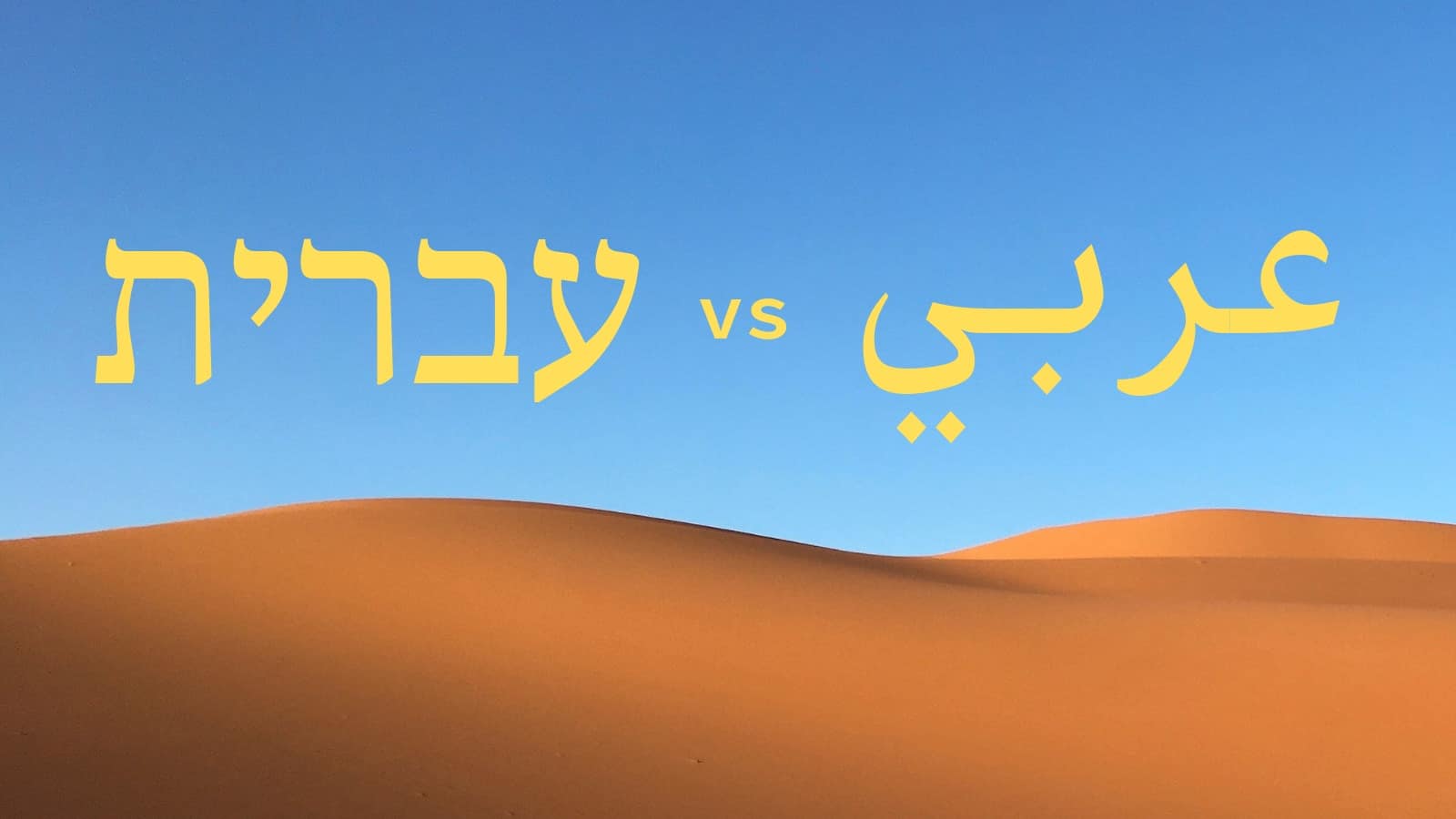
Many learners ask: What is the difference between Arabic and Hebrew?
At first, the two languages may look completely different. Arabic has a flowing connected script, while Hebrew letters usually appear separate. Arabic also sounds deeper to many learners because it has several throat and emphatic sounds But when you look deeper, Arabic and Hebrew are actually related.
Both languages belong to the Semitic language family. They share ancient roots, similar word-building patterns, and some related vocabulary. For example, Arabic salām and Hebrew shalom are both connected to the idea of peace.
Still, Arabic and Hebrew are not the same language. A speaker of Arabic cannot automatically understand Hebrew, and a Hebrew speaker cannot automatically understand Arabic without study.
This guide explains the similarities, differences, alphabets, pronunciation, grammar, and learning challenges of both languages in a simple way.
Are Arabic and Hebrew Related?
Yes, Arabic and Hebrew are related Both are Semitic languages. This means they come from the same broad language family and share some deep linguistic features.
They are similar in:
- Writing direction
- Root-based word formation
- Some vocabulary
- Masculine and feminine nouns
- Consonant-based writing systems
But they are different in:
- Alphabet shape
- Pronunciation
- Grammar details
- Dialects
- Modern usage
- Number of speakers
Is Arabic Similar to Hebrew?
Yes, Arabic is similar to Hebrew in some important ways Both languages are written from right to left. Both use writing systems that focus mainly on consonants. Both also build many words from roots, usually made of three consonants.
For example, the idea of peace appears in both languages:
Arabic: salām
Hebrew: shalom
The words are not identical, but they are clearly related However, similarity does not mean mutual understanding. Arabic and Hebrew have developed separately for thousands of years. Their pronunciation, grammar, and vocabulary are now different enough that speakers cannot understand each other without learning the other language.
Arabic and Hebrew at a Glance
Arabic and Hebrew are two Semitic languages that share similarities in origin, writing direction, and alphabet structure, but they differ in usage and development.
| Point | Arabic | Hebrew |
| Language family | Semitic | Semitic |
| Writing direction | Right to left | Right to left |
| Alphabet type | Abjad | Abjad |
| Basic letters | 28 | 22 |
| Script style | Connected / cursive | Mostly separate letters |
| Dialects | Many strong dialects | More standardized |
| Main modern use | Arab world | Mainly Israel |
| Sacred role | Language of the Qur’an | Language of the Hebrew Bible |
The Linguistic Connection Between Arabic and Hebrew
Arabic and Hebrew both belong to the Semitic branch of the Afro-Asiatic language family This common origin explains why they share some important features. One of the most important is the root system.
In both languages, many words are built from a group of consonants. These consonants carry a general meaning, and different word patterns create related words.
For example, in Arabic, the root K-T-B is connected to writing:
- kataba — he wrote
- kitāb — book
- kātib — writer
Hebrew also uses a similar root-based system. This is one of the clearest signs that Arabic and Hebrew are related.
Learn Arabic Step by Step with Experts With Online Arabic Course at Kalimah Center
If you are exploring the differences between Arabic and Hebrew, the best way to truly understand Arabic is through structured learning. The Online Arabic Course at Kalimah Center is designed to help learners build strong foundations in reading, writing, pronunciation, and comprehension through a clear, level-based system that makes learning Arabic simple and effective.
The course focuses on real progress through guided lessons, interactive practice, and experienced tutors who support you at every stage. Whether you are a complete beginner or looking to improve your fluency, the program helps you move from basic understanding to confident communication while also deepening your connection with the Arabic language and its rich linguistic structure.
Start your journey today with a structured learning path that turns your interest in Arabic into real skills and long-term fluency.
Similar Words in Arabic and Hebrew
Arabic and Hebrew share some words because of their common Semitic background.
Here are a few examples:
Peace
Arabic: salām
Hebrew: shalom
House
Arabic: bayt
Hebrew: bayit
Son
Arabic: ibn
Hebrew: ben
These examples help learners see the connection between the two languages But be careful. Not every word is similar. Many words changed over time, and both languages developed their own vocabulary.
Arabic Alphabet vs Hebrew Alphabet
Although Arabic and Hebrew are both written from right to left and share a Semitic origin, their writing systems look quite different in practice. Each language has its own unique alphabet, structure, and visual style that distinguishes it clearly from the other.
Arabic uses 28 letters that are mostly connected within words, giving the script a flowing and cursive appearance. In contrast, Hebrew has 22 letters that are generally written separately in printed text, which makes its script appear more segmented and less connected compared to Arabic.
The Flowing Nature of Arabic Script
Arabic script is cursive and highly connected, meaning that most letters change their shape depending on their position within a word—whether at the beginning, middle, end, or when written alone. This creates multiple visual forms for the same letter, which learners need to recognize and memorize.
Because of this connected structure, Arabic writing can feel more complex for beginners at first. However, understanding these positional changes is essential, as it helps learners read fluently and become familiar with how real Arabic text naturally appears.
The Clear Structure of Hebrew Script
Hebrew script is also written from right to left, but its letters are generally written separately and do not connect within words in printed form. This gives the script a more spaced and visually distinct appearance compared to Arabic.
Although Hebrew has a few special final letter forms that appear at the end of words, the overall writing system remains simpler in structure. For many beginners, this separation can make Hebrew letters easier to identify at the early stages of learning.
Pronunciation Differences Between Arabic and Hebrew
Arabic and Hebrew sound different, even though they are related Arabic has many sounds that are difficult for learners, especially:
- ع
- ح
- خ
- غ
- ق
- ص
- ض
- ط
- ظ
These include throat sounds and heavy emphatic sounds.
Modern Hebrew has some guttural sounds too, but many of them are pronounced more softly by modern speakers. Some ancient distinctions are not as strong in everyday modern Hebrew Because of this, Arabic may sound deeper or more guttural, while Hebrew may sound lighter or sharper to some learners.
Experience Kalimah Center Classes
Watch real excerpts from our live sessions at Kalimah Center and see how we bring learning to life. These clips highlight our interactive, student-centered teaching approach across all our courses—designed to keep learners engaged, motivated, and actively involved every step of the way.
Master Arabic with Kalimah Center
Join our expert-led online classes and start your journey toward Arabic fluency today.
Book Your Free TrialHow Arabic and Hebrew Differ?
Arabic and Hebrew both have Semitic grammar, but Arabic is often considered more complex for learners.
Arabic has:
- Formal case endings
- Dual forms
- Many broken plurals
- Complex verb forms
- Strong dialect variation
- Rich agreement patterns
Hebrew also has:
- Masculine and feminine nouns
- Verb patterns
- Plural forms
- Root-based word formation
But modern Hebrew is generally more simplified than Classical Arabic or Modern Standard Arabic For example, formal Arabic has case endings, while modern Hebrew does not use a full case system in the same way.
Read also: Which Is Older Arabic Or Hebrew?
Master Qur’anic Recitation with Proper Tajweed Online at Kalimah Center
If you are comparing Arabic and Hebrew and want to take a deeper step into Arabic through the Qur’an, the Online Quran With Tajweed Course at Kalimah Center is the perfect choice. This course is designed to help learners read the Qur’an accurately, improve pronunciation, and apply Tajweed rules in a simple and structured way that suits all levels.
The program focuses on building a strong connection with the Qur’an through guided recitation, correction, and step-by-step practice with qualified teachers. Whether you are a beginner or looking to refine your recitation, the course helps you develop confidence, fluency, and a correct understanding of Arabic pronunciation as used in the Qur’an.
Start your journey with structured learning that brings you closer to accurate recitation and a deeper spiritual connection with the Qur’an.
Dialects and Language Variation in Arabic and Hebrew
One of the most important differences between Arabic and Hebrew is the level of variation in everyday language use. Arabic has many major dialects spoken across different regions, such as Egyptian, Levantine, Gulf, Iraqi, Moroccan, Sudanese, and Yemeni Arabic. These dialects can differ greatly in pronunciation, vocabulary, and even grammar.
In addition to these dialects, Modern Standard Arabic is used in writing, education, news, and formal speech, while daily communication usually happens in local spoken varieties. Hebrew, on the other hand, is much more standardized today and is used consistently in speech, writing, media, and education in Israel, which makes it more unified and easier to approach for learners compared to the wide variation found in Arabic.
Vocabulary Development in Arabic and Hebrew
Although Arabic and Hebrew share ancient Semitic roots, their modern vocabularies have developed in different directions. Each language has been shaped by its own historical, cultural, and social influences over time.
Arabic vocabulary has been influenced by Classical Arabic, the Qur’an, Islamic civilization, regional dialects, and contact with languages such as Persian, Turkish, French, and English. Hebrew vocabulary, on the other hand, has been shaped by Biblical Hebrew, Rabbinic Hebrew, the modern revival of the language, and later influences from European languages and modern Israeli usage.
Are Arabic and Hebrew Mutually Understandable?
Arabic and Hebrew are not mutually intelligible languages. A native speaker of Arabic cannot automatically understand Hebrew, and the same applies in reverse for Hebrew speakers.
Although both languages share Semitic roots, learners may only notice a few similar patterns or related word roots. However, these similarities are not enough to enable real communication without study. While knowing one language can make it slightly easier to learn the other, both Arabic and Hebrew still require dedicated learning and practice to achieve fluency.
Arabic and Hebrew Greetings
One of the most famous similarities appears in greetings.
Arabic:
as-salāmu ʿalaykum
Peace be upon you
Hebrew:
shalom aleichem
Peace be upon you
Both greetings are built around the idea of peace The similarity between salām and shalom is one of the clearest examples of the connection between Arabic and Hebrew.
Main Differences Between Arabic and Hebrew
Here is the difference in a simple way:
| Area | Main Difference |
| Alphabet | Arabic has 28 letters; Hebrew has 22 |
| Script | Arabic connects letters; Hebrew usually does not |
| Pronunciation | Arabic has more throat and emphatic sounds |
| Grammar | Arabic is often more complex, especially formal Arabic |
| Dialects | Arabic has many major dialects; Hebrew is more standardized |
| Speakers | Arabic has far more speakers worldwide |
| Usage | Arabic is used across many countries; Hebrew mainly in Israel |
Inside Kalimah Center: Moments from Our Courses
Get a glimpse into the vibrant learning experience at Kalimah Center. These snapshots capture real moments from our live classes—where students engage deeply, connect with passionate instructors, and grow in a welcoming, supportive environment.
Here Are The Reviews On Our Courses:
Our students frequently commend the excellence of our courses and the commitment shown by our instructors. You can read their complete reviews on Trustpilot.
Read more reviews on Trustpilot

Read also: Herbs And Spices In Arabic
Learn Arabic Smarter with Kalimah Center
If you are exploring the differences between Arabic and languages like Hebrew, Kalimah Center gives you the perfect starting point to go beyond comparison and actually master the Arabic language. With a clear, structured approach, learners build real skills in reading, writing, pronunciation, and understanding Arabic step by step in a simple and effective way.
What makes Kalimah Center special is that it doesn’t just teach language—it builds understanding. You learn how Arabic is formed, how meanings connect, and how to use the language confidently in real life. Whether your goal is religious understanding, communication, or academic growth, the learning path is designed to support you from beginner to confident speaker.
Join Kalimah Center today and turn your interest in Arabic into real fluency with expert guidance.
📚 Explore Our Courses:
Online Arabic Course: Tailored to your level, our comprehensive Arabic program includes 16 teaching levels and 400+ hours of personalized sessions.
Online Quran With Tajweed Course: Perfect for non-Arabic speakers, our course spans 13 levels and equips you with Tajweed mastery from beginner to advanced.
Online Arabic Course For Kids: Nurture your child’s love for Arabic with our engaging and structured program, available in 24 levels for primary, intermediate, and secondary stages.
🚀 Start Your Free Trial Today! 🚀
Don’t miss out on this life-changing opportunity to deepen your faith and knowledge. Sign up now for your free trial and take the first step towards becoming a better practicing Muslim with Kalimah Center!
Master Arabic with Kalimah Center
Join our expert-led online classes and start your journey toward Arabic fluency today.
Book Your Free TrialConclusion
The difference between Arabic and Hebrew is clear: they are related, but they are not the same Both languages share Semitic roots, right-to-left writing, root-based word formation, and some similar vocabulary. This is why many learners ask, is Arabic similar to Hebrew? At the same time, they differ in alphabet shape, pronunciation, grammar, vocabulary, dialects, and modern use.
Arabic has 28 basic letters and many dialects. Hebrew has 22 basic letters and a more standardized modern spoken form So, are Arabic and Hebrew related? Yes But can speakers understand each other automatically? No.
For learners, the best approach is to appreciate their shared roots while studying each language as its own complete system.
FAQ About the Difference Between Arabic and Hebrew
What is the difference between Arabic and Hebrew?
The main difference between Arabic and Hebrew is that they are two separate Semitic languages with different alphabets, pronunciation systems, grammar details, vocabulary, and modern usage.
Is Arabic similar to Hebrew?
Yes, Arabic is similar to Hebrew because both are Semitic languages. They share root-based word formation, right-to-left writing, gendered nouns, and some related vocabulary.
Are Arabic and Hebrew related?
Yes. Arabic and Hebrew are related because both belong to the Semitic branch of the Afro-Asiatic language family.
Can Arabic speakers understand Hebrew?
Not usually. Arabic speakers cannot understand Hebrew without studying it.
Can Hebrew speakers understand Arabic?
Not usually. Hebrew speakers need to study Arabic to understand it properly.
What is the difference between Arabic alphabet and Hebrew alphabet?
The Arabic alphabet has 28 basic letters and connected script. The Hebrew alphabet has 22 basic letters, and its letters are usually written separately.