Have you ever read a verse about your parents and wished you could understand the Prophet’s ﷺ words in their original language? You are not alone. Many Quran learners search for a hadith about parents in Arabic so they can memorize it, teach it to their children, and feel its meaning directly.
This guide gathers authentic narrations from Sahih al-Bukhari, Sahih Muslim, and the Sunan collections. Each hadith about parents in Arabic comes with a clear English meaning, its source, and a short lesson you can apply today.
You will also learn the Quranic root of birr al-walidayn (honoring parents), why a popular hadith about parents in Arabic is weak, and how to honor parents in life and after death.
1. Honoring Parents Is Among the Most Beloved Deeds to Allah
Abdullah ibn Mas’ud was one of the most learned Companions, and he often asked the Prophet ﷺ about the deeds that bring a believer closest to Allah. His question produced a hadith about parents in Arabic that every Muslim family should know by heart.
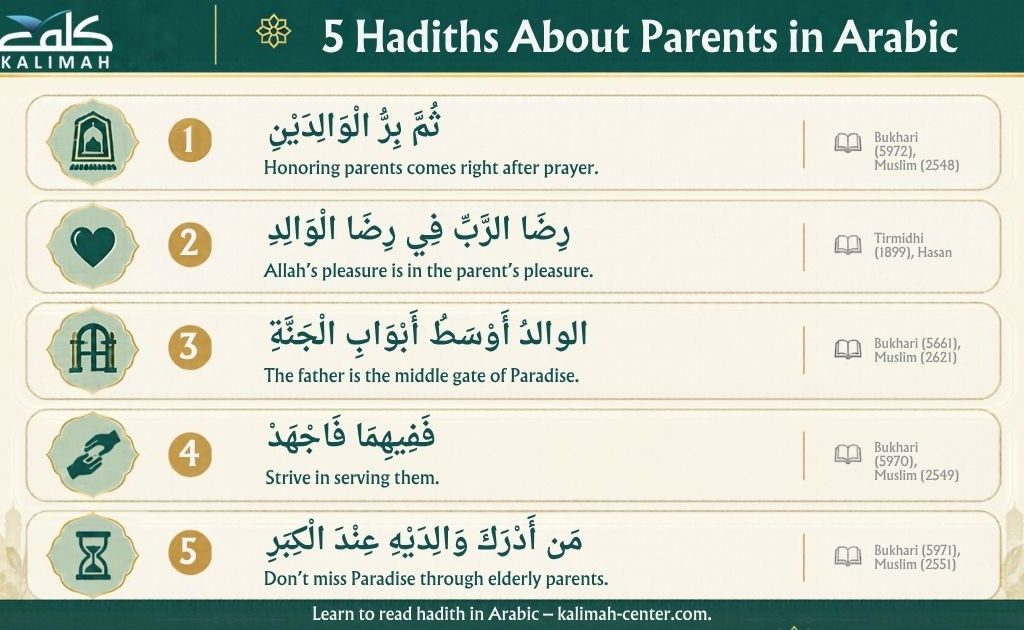
عَنْ عَبْدِ اللَّهِ بْنِ مَسْعُودٍ قَالَ: سَأَلْتُ النَّبِيَّ ﷺ: أَيُّ الْعَمَلِ أَحَبُّ إِلَى اللَّهِ؟ قَالَ: «الصَّلَاةُ عَلَى وَقْتِهَا»، قُلْتُ: ثُمَّ أَيٌّ؟ قَالَ: «ثُمَّ بِرُّ الْوَالِدَيْنِ»، قُلْتُ: ثُمَّ أَيٌّ؟ قَالَ: «الْجِهَادُ فِي سَبِيلِ اللَّهِ»
Ibn Mas’ud asked which deed is most beloved to Allah. The Prophet ﷺ said: prayer on time, then honoring parents, then striving in Allah’s cause. (Al-Bukhari 527)
Notice the order: prayer, which is Allah’s right, comes first, and the right of parents follows right after it, even before jihad. Ibn Hajar explained that such answers varied with each questioner, yet placing parents this high shows how central they are to faith.
2. Allah’s Pleasure Lies in the Pleasure of Parents
Many people seek Allah’s pleasure through long acts of worship and forget the doors already open at home. This narration from Abdullah ibn Amr ties the pleasure of the Lord directly to the pleasure of one’s parents.
«رِضَا الرَّبِّ فِي رِضَا الْوَالِدِ، وَسَخَطُ الرَّبِّ فِي سَخَطِ الْوَالِدِ»
“The Lord’s pleasure is in the parent’s pleasure, and the Lord’s anger is in the parent’s anger.” (At-Tirmidhi 1899, graded authentic by al-Albani)
So a kind word, a quick response, or a small favor for your parents can earn the pleasure of Allah Himself. The mother is included even more, as another narration in at-Tabarani reads «رِضَا الرَّبِّ فِي رِضَا الْوَالِدَيْنِ».
This short hadith about parents in Arabic is easy for children to memorize and ties home manners to Allah’s pleasure.
3. The Father Is the Middle Gate of Paradise
Abu ad-Darda narrated this hadith about parents in Arabic, which describes the father as a gate leading into Paradise. The image is powerful: the gate stays open as long as the parent lives, and the child decides whether to walk through it.
«الْوَالِدُ أَوْسَطُ أَبْوَابِ الْجَنَّةِ، فَإِنْ شِئْتَ فَأَضِعْ ذَلِكَ الْبَابَ أَوِ احْفَظْهُ»
“The father is the middle gate of Paradise, so guard that gate or lose it.” (At-Tirmidhi 1900) Al-Baydawi explained that “middle” means the best gate, making this hadith about parents in Arabic a daily reminder.
You guard this gate by obeying your father in what is good, consulting him, and protecting his dignity as he ages. You lose it through harshness, neglect, or cutting him off, which turns a gate of mercy into a missed chance.
4. Serving Your Parents Is Your Jihad
In the Prophet’s ﷺ time, many young men rushed to join the army, seeing jihad as the highest path to reward. Yet when one of them came asking for permission, the Prophet ﷺ first asked about his parents.
جَاءَ رَجُلٌ إِلَى النَّبِيِّ ﷺ فَاسْتَأْذَنَهُ فِي الْجِهَادِ، فَقَالَ: «أَحَيٌّ وَالِدَاكَ؟» قَالَ: نَعَمْ، قَالَ: «فَفِيهِمَا فَجَاهِدْ»
A man asked permission to join jihad. The Prophet ﷺ asked if his parents were alive, then said: “Then strive in serving them.” (Al-Bukhari 3004)
The Prophet ﷺ turned this man’s zeal toward his parents and called serving them a form of jihad in itself. In a narration in Abu Dawud, a man who left his parents in tears was told: “Go back and make them laugh as you made them cry.”
Ibn Hajar noted that this hadith about parents in Arabic shows that serving them is an individual duty that comes before voluntary jihad.
Experience Kalimah Center Classes
Watch real excerpts from our live sessions at Kalimah Center and see how we bring learning to life. These clips highlight our interactive, student-centered teaching approach across all our courses—designed to keep learners engaged, motivated, and actively involved every step of the way.
Master Arabic with Kalimah Center
Join our expert-led online classes and start your journey toward Arabic fluency today.
Book Your Free Trial5. A Warning for Those Who Neglect Elderly Parents
Old age often brings weakness, illness, and dependence, and this is exactly when parents need their children most. In this narration from Abu Hurayrah, the Prophet ﷺ repeated a strong warning three times to show how serious it is.
«رَغِمَ أَنْفُهُ، ثُمَّ رَغِمَ أَنْفُهُ، ثُمَّ رَغِمَ أَنْفُهُ» قِيلَ: مَنْ يَا رَسُولَ اللَّهِ؟ قَالَ: «مَنْ أَدْرَكَ وَالِدَيْهِ عِنْدَ الْكِبَرِ، أَحَدَهُمَا أَوْ كِلَيْهِمَا، ثُمَّ لَمْ يَدْخُلِ الْجَنَّةَ»
“May he be humiliated” (said three times): this is the one who lives to see one or both parents in old age, yet does not earn Paradise by serving them. (Muslim 2551)
The phrase «رَغِمَ أَنْفُهُ» literally means “his nose is rubbed in dust,” an Arabic expression of humiliation and loss. Qadi Iyad explained that serving elderly parents is a direct path to Paradise, so whoever misses it has lost great good.
Reading this hadith about parents in Arabic with correct pronunciation moves the heart more than a translation. Our Learn Quran Online Course trains you to read sacred texts fluently.
6. Your Mother, Then Your Mother, Then Your Mother
Islam gives the mother a special rank for all she endures. Every hadith about the mother in Arabic below shows how the Prophet ﷺ placed her first. A man once came to the Prophet ﷺ and asked an important question: Who deserves my best treatment more than anyone else? The answer, narrated by Abu Hurayrah, repeats one word three times.
جَاءَ رَجُلٌ إِلَى رَسُولِ اللَّهِ ﷺ فَقَالَ: مَنْ أَحَقُّ النَّاسِ بِحُسْنِ صَحَابَتِي؟ قَالَ: «أُمُّكَ»، قَالَ: ثُمَّ مَنْ؟ قَالَ: «ثُمَّ أُمُّكَ»، قَالَ: ثُمَّ مَنْ؟ قَالَ: «ثُمَّ أُمُّكَ»، قَالَ: ثُمَّ مَنْ؟ قَالَ: «ثُمَّ أَبُوكَ»
A man asked who most deserves his good companionship. The Prophet ﷺ said, “Your mother” three times, then “your father.” (Al-Bukhari 5971)
Repeating «أُمُّكَ» three times gives the mother three shares of kindness and the father one. This does not lower the father’s rank. It honors the burden mothers carry, as Allah says: “His mother carried him in weakness upon weakness” (Luqman 31:14). Imam an-Nawawi explained that the mother comes first because of her hardship in pregnancy, childbirth, and nursing.
7. Paradise Is at Her Feet
Jahimah as-Sulami came to the Prophet ﷺ wanting to join a military expedition and asked for his advice. Instead of encouraging him to go, the Prophet ﷺ asked one question that changed his plan completely.
عَنْ مُعَاوِيَةَ بْنِ جَاهِمَةَ أَنَّ جَاهِمَةَ جَاءَ إِلَى النَّبِيِّ ﷺ فَقَالَ: يَا رَسُولَ اللَّهِ، أَرَدْتُ أَنْ أَغْزُوَ وَقَدْ جِئْتُ أَسْتَشِيرُكَ، فَقَالَ: «هَلْ لَكَ مِنْ أُمٍّ؟» قَالَ: نَعَمْ، قَالَ: «فَالْزَمْهَا فَإِنَّ الْجَنَّةَ عِنْدَ رِجْلَيْهَا»
Jahimah wanted to join a battle. The Prophet ﷺ asked about his mother, then said: “Stay with her, for Paradise is at her feet.” (An-Nasa’i 3104, authenticated by al-Albani)
Al-Ajluni explained that humility toward mothers, serving them, and obeying them in what is lawful is a cause of entering Paradise. For this Companion, the shortest road to Jannah ran through his mother’s home, which makes this a beloved hadith about mothers in Arabic.
Note: Al-Albani grades the popular wording “Paradise lies under the feet of mothers” (الجنة تحت أقدام الأمهات) weak. The authentic narration above carries the same meaning, so quote that one instead.
8. Keep Ties With Your Mother Even If She Is Not Muslim
Asma bint Abi Bakr faced a situation many new Muslims face today: a beloved parent who does not share their faith. Before welcoming her visiting mother with kindness, she asked the Prophet ﷺ for a ruling.
عَنْ أَسْمَاءَ بِنْتِ أَبِي بَكْرٍ قَالَتْ: قَدِمَتْ عَلَيَّ أُمِّي وَهِيَ مُشْرِكَةٌ، فَاسْتَفْتَيْتُ رَسُولَ اللَّهِ ﷺ، قُلْتُ: وَهِيَ رَاغِبَةٌ، أَفَأَصِلُ أُمِّي؟ قَالَ: «نَعَمْ، صِلِي أُمَّكِ»
Asma asked whether she should be kind to her visiting mother, who was not Muslim. The Prophet ﷺ replied: “Yes, keep ties with your mother.” (Al-Bukhari 2620) This hadith about parents in Arabic matches Luqman 31:15: “Accompany them in this world with kindness.”
The answer was clear: a difference in belief does not cancel a mother’s right to kindness, gifts, and good company. Ibn Uthaymin noted that Muslims keep ties with relatives who are not Muslim, because kinship carries its own right.
9. Disrespecting Parents Is One of the Greatest Sins
Abu Bakrah narrated that the Prophet ﷺ asked his question three times to hold the Companions’ full attention. What followed was a list of the gravest sins, and disrespect to parents appeared right beside shirk.
«أَلَا أُنَبِّئُكُمْ بِأَكْبَرِ الْكَبَائِرِ؟» قُلْنَا: بَلَى يَا رَسُولَ اللَّهِ، قَالَ: «الْإِشْرَاكُ بِاللَّهِ، وَعُقُوقُ الْوَالِدَيْنِ»
“Shall I tell you the greatest of the major sins?” He ﷺ said: “Associating partners with Allah and disobeying parents.” (Al-Bukhari 2654) No hadith about parents in Arabic carries a sterner warning.
Placing ‘uquq al-walidayn next to shirk shows how grave ingratitude toward parents is in Islam. The full narration adds that the Prophet ﷺ sat up from reclining to warn against false speech, which shows how strongly he felt about these sins.
10. Insulting Parents Indirectly Is Also Forbidden
The Companions were shocked to hear that a person could insult his own parents. The Prophet ﷺ explained how it happens indirectly, through a chain of words that starts with disrespecting someone else’s father or mother.
«مِنَ الْكَبَائِرِ شَتْمُ الرَّجُلِ وَالِدَيْهِ» قَالُوا: يَا رَسُولَ اللَّهِ، وَهَلْ يَشْتِمُ الرَّجُلُ وَالِدَيْهِ؟ قَالَ: «نَعَمْ، يَسُبُّ أَبَا الرَّجُلِ فَيَسُبُّ أَبَاهُ، وَيَسُبُّ أُمَّهُ فَيَسُبُّ أُمَّهُ»
Cursing one’s parents is a major sin. That includes insulting someone else’s parents so that he insults yours in return. (Muslim 90)
This hadith about parents in Arabic teaches that we answer not only for our own words but also for the replies they provoke. Name-calling and “your mom” jokes, common among young people, can bring insults back onto your own parents. This is an important lesson for teenagers about the words they use with friends and online.
11. Honoring Parents After They Pass Away
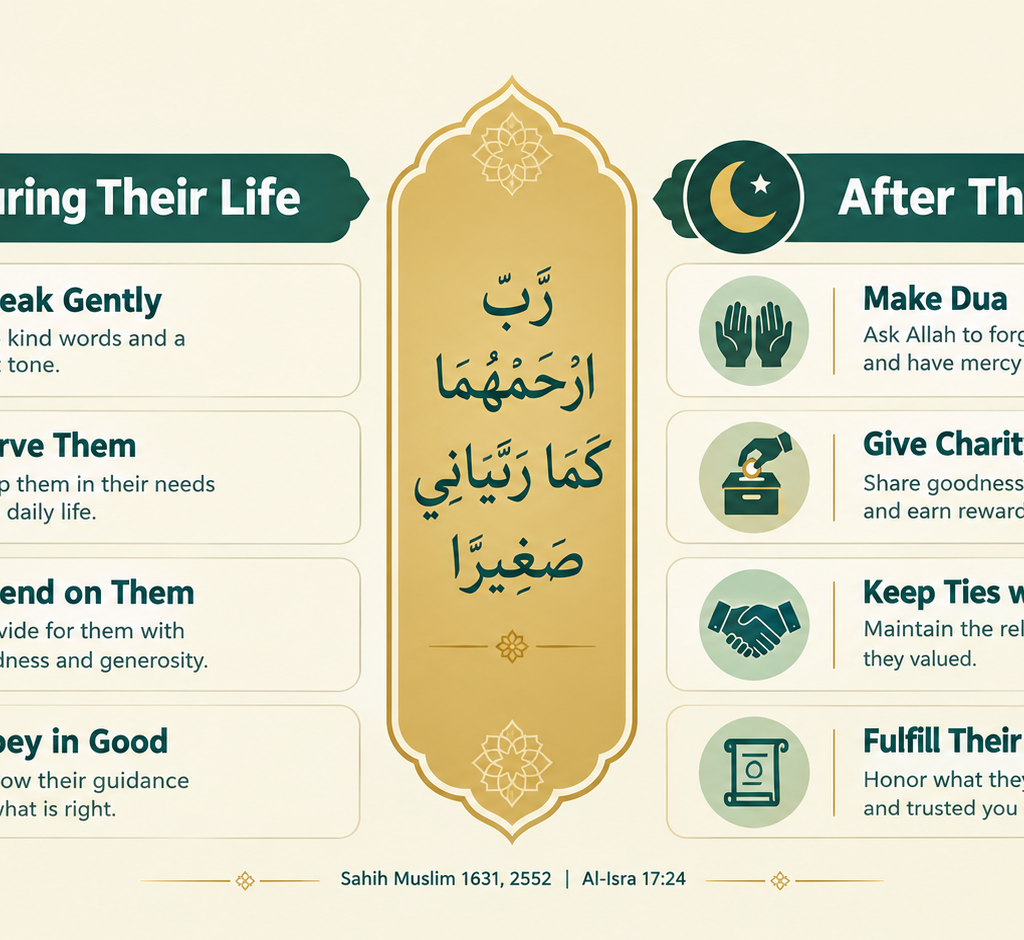
Many grieving children wonder whether they can still do anything for parents who have passed away. The Prophet ﷺ answered with hope in two narrations: the bond of kindness does not end at the grave.
«إِذَا مَاتَ الْإِنْسَانُ انْقَطَعَ عَنْهُ عَمَلُهُ إِلَّا مِنْ ثَلَاثَةٍ: إِلَّا مِنْ صَدَقَةٍ جَارِيَةٍ، أَوْ عِلْمٍ يُنْتَفَعُ بِهِ، أَوْ وَلَدٍ صَالِحٍ يَدْعُو لَهُ»
“When a person dies, his deeds end except three: ongoing charity, beneficial knowledge, or a righteous child who prays for him.” (Muslim 1631)
Making dua with the Quranic words «رَّبِّ ارْحَمْهُمَا كَمَا رَبَّيَانِي صَغِيرًا» (Al-Isra 17:24) is a gift you can give your parents every day. Correct recitation matters here, which is why many families start with our Tajweed for Beginners Online guide.
A righteous child’s dua is a deed that keeps reaching parents after death. Ibn Umar lived the second hadith by honoring a Bedouin on the road to Makkah, simply because the man’s father had been a friend of Umar ibn al-Khattab.
Inside Kalimah Center: Moments from Our Courses
Get a glimpse into the vibrant learning experience at Kalimah Center. These snapshots capture real moments from our live classes—where students engage deeply, connect with passionate instructors, and grow in a welcoming, supportive environment.
Master Arabic with Kalimah Center
Join our expert-led online classes and start your journey toward Arabic fluency today.
Book Your Free TrialHow Can You Teach These Hadiths to Your Children?
Start with the shortest hadith about parents in Arabic, such as «رِضَا الرَّبِّ فِي رِضَا الْوَالِدِ», and repeat it daily for a week. Then link it to an action at home, like helping mom set the table.
Next, let children hear each hadith about parents in Arabic recited by a qualified teacher. Kids who understand Arabic sounds memorize faster, which is the focus of our Learn Arabic For Children Course and the tips in Tajweed For Kids Online.
Stories make these lessons stick, so share the story of the man in the cave who waited all night with milk for his sleeping parents. Then hold a short weekly family circle where each child recites one hadith and names one kind deed they did for their parents.
Adults benefit too. Once you know basic Arabic, words like birr, ‘uquq, and ihsan reveal meanings that translations miss.
Start Today and Read the Prophet’s ﷺ Words in Their Original Arabic
Imagine reading every hadith about parents in Arabic without needing a translation. At Kalimah Center, certified native teachers guide kids and adults step by step through Quran recitation, Tajweed, and Arabic.
Choose one-on-one lessons or our Group Classes, with flexible schedules that fit school, work, and family life. Our Learn Arabic With Online Course builds the vocabulary you need for the Quran and Sunnah.
Explore Our Courses:
- Online Arabic Course: Tailored to your level, our comprehensive Arabic program includes 16 teaching levels and 400+ hours of personalized sessions.
- Online Quran With Tajweed Course: Perfect for non-Arabic speakers, our course spans 13 levels and equips you with Tajweed mastery from beginner to advanced.
- Online Arabic Course For Kids: Nurture your child’s love for Arabic with our engaging and structured program, available in 24 levels for primary, intermediate, and secondary stages.
Book your free trial lesson now and start memorizing every hadith about parents in Arabic with your whole family. A teacher will guide you and correct every letter.
Master Arabic with Kalimah Center
Join our expert-led online classes and start your journey toward Arabic fluency today.
Book Your Free TrialConclusion
The Prophet ﷺ placed honoring parents right after prayer, warned that disrespect is among the gravest sins, and taught that Allah’s pleasure is tied to theirs. Each hadith about parents in Arabic in this guide makes birr al-walidayn a daily act of worship.
The mother holds a special rank: she is named three times before the father, and Paradise is at her feet. Even a non-Muslim parent deserves kindness, and our duty continues after death through dua, charity, and keeping ties with their friends.
Start small this week: memorize one hadith, say one kind word, and make one dua for your parents. With a qualified teacher at Kalimah Center, you and your children can read these narrations in Arabic with confidence.
Take Away Message: Learning a hadith about parents in Arabic is the start, not the finish. Memorize it, understand it, and act on it today, because your parents are a gate to Paradise you can still keep open.
FAQs
Here are quick answers to common questions about the hadiths on parents in this guide.
What is the most famous hadith about parents in Arabic?
The best-known hadith about parents in Arabic is from Ibn Mas’ud: «الصَّلَاةُ عَلَى وَقْتِهَا… ثُمَّ بِرُّ الْوَالِدَيْنِ». It shows that honoring parents is among the deeds most beloved to Allah, right after praying on time. (Al-Bukhari, Muslim)
Is “Paradise lies under the feet of mothers” an authentic hadith?
That exact wording is weak. The authentic narration is «فَالْزَمْهَا فَإِنَّ الْجَنَّةَ عِنْدَ رِجْلَيْهَا» (“Stay with her, for Paradise is at her feet”), reported by an-Nasa’i and authenticated by al-Albani.
Why is the mother mentioned three times before the father?
Scholars explain that the mother goes through unique hardship in pregnancy, childbirth, nursing, and raising the child. That is why she has three shares of good companionship and the father has one.
Do I have to obey my parents if they ask me to sin?
No. You obey parents only in what is good. Allah says: “If they strive to make you associate with Me… do not obey them, but accompany them in this world with kindness” (Luqman 31:15).
How can I honor my parents after they die?
Make dua for them, give charity on their behalf, and keep ties with their friends. Two hadith about parents in Arabic in Sahih Muslim (1631 and 2552) teach this.