Have you ever opened an Arabic book, recognized most of the letters, and still felt lost by the end of the first line? Almost every learner hits that wall, and there’s a clear way past it.
Learning how to read Arabic books depends less on talent and more on doing things in the right order. You need the right steps, texts that match your level, and a little practice every day.
Arabic is read from right to left; its 28 letters change shape inside words, and most adult books leave out the short vowel marks. Each of these is easy to handle once you meet it at the right stage.
This guide covers the full path: the script, the harakat, beginner books, free online libraries, and reading habits that work for both kids and adults.
1. Start From the Right Side of the Book
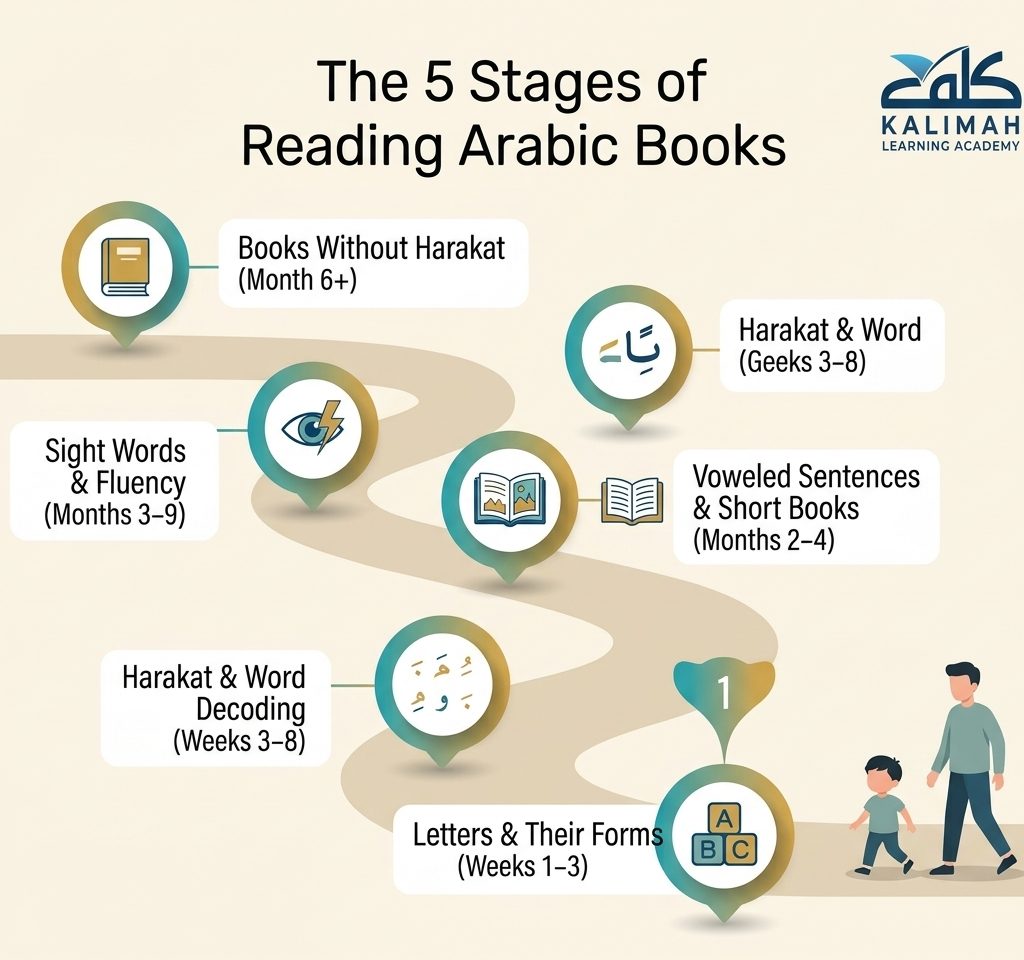
To read Arabic books well, you learn the script and which way it runs, master the vowel marks, and read fully voweled texts aloud. Then you build vocabulary and basic grammar until you can handle pages without marks.
Arabic pages and lines run from right to left, so the front cover sits where an English book’s back cover would be. You finish a full line before moving down to the next one.
Kids usually adapt fastest when they trace each line with a finger. Many Arabic books also put the table of contents (al-fihris) at the end of the book rather than the beginning. Before you start reading, flip to the last pages to see how the chapters are organized.
Numbers are a useful exception to remember. Arabic text flows right to left, but numbers with more than one digit, like ١٢٣, are read left to right, just as in English. Knowing this early prevents confusion with dates, page numbers, and verse numbers.
2. Learn How Each Letter Changes Shape
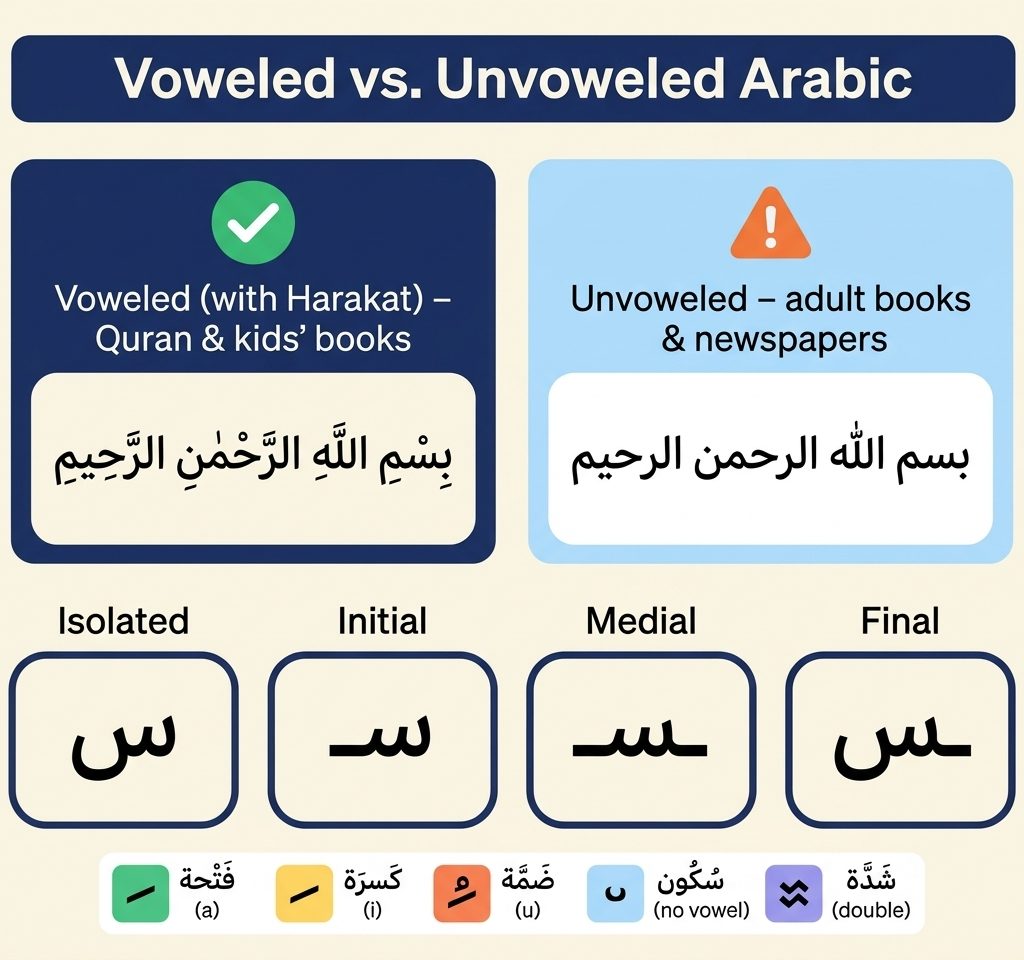
Arabic is cursive, so most letters have four forms: isolated, initial, medial, and final. For example, س becomes سـ at the start of a word and ـس at the end.
Six letters (ا د ذ ر ز و) connect only to the letter before them, which leaves small gaps inside words. Our complete Arabic alphabet guide shows every letter in all its positions.
Many letters share the same basic shape and differ only in their dots. ب, ت, and ث look the same apart from one, two, or three dots, so train your eyes to check the dots before you read the letter.
A simple drill is to circle one letter wherever it appears on a page, in every position. This turns letter forms from a memory test into quick visual recognition, a key early step in learning how to read Arabic books smoothly.
3. Master the Vowel Marks (Harakat)
Short vowels appear as small marks: fatḥah (a), kasrah (i), and ḍammah (u). There are also sukūn (no vowel) and shaddah (a doubled letter). Together they tell you exactly how a word sounds.
The Quran and children’s books are fully marked, but most adult books and newspapers are not. Review our Arabic harakat and tashkeel guide before you open your first book.
Tanwīn is a doubled vowel mark at the end of a word (ـً ـٍ ـٌ). It adds an “n” sound and usually marks an indefinite noun. For example, كِتَابٌ is read kitābun, meaning “a book.”
A single vowel mark can change a word’s meaning completely. عَلِمَ means “he knew,” while عُلِّمَ means “he was taught.” That’s why close attention to the harakat matters so much when you’re learning how to read Arabic books and the Quran.
Experience Kalimah Center Classes
Watch real excerpts from our live sessions at Kalimah Center and see how we bring learning to life. These clips highlight our interactive, student-centered teaching approach across all our courses—designed to keep learners engaged, motivated, and actively involved every step of the way.
Master Arabic with Kalimah Center
Join our expert-led online classes and start your journey toward Arabic fluency today.
Book Your Free Trial4. Read Actively: Before, During, and After
Before you begin, set a goal and skim the cover, the table of contents, and the introduction. While reading, underline new words and jot short notes in the margins. For dense books, read quickly once for the big picture, then slowly a second time for detail.
After each chapter, summarize it in your own words. Any part you can’t explain simply is the part to go back to. Keep a small notebook for each book with three columns: new word, root, and meaning. Look over it before every reading session to reconnect with the text and keep the vocabulary fresh in your mind.
When you finish the book, talk about it with a teacher, a friend, or a study circle. Explaining a story or an idea out loud shows you how much you understood and fixes it in your long-term memory.
5. Read Aloud and Re-Read the Same Page
Read out loud from day one. It trains your tongue, links sounds to letter shapes, and stops you from skipping a vowel you’re unsure about. Reading one page three times often teaches more than reading three new pages once. Each pass gets faster, and common words become words you recognize on sight.
Record yourself reading a short passage once a week and compare it with a native reader. Hearing your own voice makes mispronounced letters easy to spot, especially similar pairs like ح and ه or ق and ك.
For Quran learners, reading aloud is also an act of worship, and correct recitation depends on precise sounds. A qualified tajweed teacher can guide this practice so good habits form from the very first lesson.
How to Read Arabic Books for Beginners
If you’re wondering how to read Arabic books for the very first time, move through clear stages instead of jumping straight into adult titles. This is the order our teachers follow with new students.
Which Arabic Books Should Beginners Read First?
Start with fully voweled material: children’s picture books, graded readers, Qasas al-Anbiya (Stories of the Prophets), and the short surahs of Juz’ Amma. With complete tashkeel, you can focus on sounding words out without guessing.
Teachers of classical Arabic, such as those working with the Library of Arabic Literature, recommend fully vocalized texts with a short glossary for new readers.
Choose topics the learner already enjoys, such as animals, adventures, or the stories of the prophets. Interest keeps beginners reading longer, and a familiar topic helps them work out new words from pictures and context.
Build Vocabulary Through Word Roots
Most Arabic words grow from three-letter roots. كَتَبَ (he wrote), كِتَاب (book), and مَكْتَبَة (library) all share the root k-t-b. Write new words by hand with their root and meaning, then review them with flashcards in an app like Anki.
Word patterns help too. Words that start with مَـ often name a place: مَسْجِد (mosque) comes from s-j-d, “to prostrate,” and مَدْرَسَة (school) comes from d-r-s, “to study.” Spotting these patterns helps you guess meanings faster.
Learn Just Enough Grammar to Predict Vowels
Basic grammar (naḥw) explains why word endings change. A ḍammah often marks the subject, while a kasrah usually follows a preposition. You don’t need advanced grammar to start. Still, every rule you learn helps you fill in missing vowels on unmarked pages.
Start with the difference between nominal sentences, which begin with a noun, and verbal sentences, which begin with a verb. Knowing which type you’re reading helps you predict word order and endings, a core skill in how to read Arabic books without harakat.
When Should You Move to Books Without Harakat?
Move on once you can read voweled texts at a steady pace with few pronunciation mistakes. That usually takes several months of regular practice. Simple short stories, such as those by Zakaria Tamer, make a good first step.
An easy way to bridge the gap is to cover the harakat on a surah you know by heart and read from the bare letters, checking yourself as you go.
How to Read Arabic Books Online
Learning how to read Arabic books online removes a lot of the friction beginners face, from looking up words to hearing the correct pronunciation.
1. Use Word-by-Word Reading Platforms
Some websites show an English translation under each Arabic word, so you can read a real text without stopping every few seconds. E-readers like Kindle and Google Play Books also include built-in dictionaries.
Use these tools as a support, not a crutch. Try to guess each word from context first, then reveal the translation to check yourself. This small habit builds real understanding instead of passive reading.
2. Listen While You Read
Following a native narrator or reciter while your eyes track the text connects sound and script faster than silent reading. Use audiobooks for stories and word-highlighted recitation for the Quran.
Try shadowing: play a sentence, pause, and repeat it with the same rhythm and pronunciation. Over time, your reading aloud sounds more natural, and you start to hear where words connect and where to pause.
3. Learn With a Live Teacher Online
Apps can’t hear your mistakes. A qualified teacher corrects your pronunciation in real time, explains why a vowel changes, and picks texts that match your level.
At Kalimah Center, our Arabic Reading Course takes learners from the alphabet to full texts and Quranic verses with native Arabic teachers, in one-on-one or small group classes.
A teacher also tracks your progress through each stage and knows when to move you from voweled to unvoweled texts. This prevents two common problems: staying too long on easy material, or jumping ahead before you’re ready.
Inside Kalimah Center: Moments from Our Courses
Get a glimpse into the vibrant learning experience at Kalimah Center. These snapshots capture real moments from our live classes—where students engage deeply, connect with passionate instructors, and grow in a welcoming, supportive environment.
Master Arabic with Kalimah Center
Join our expert-led online classes and start your journey toward Arabic fluency today.
Book Your Free TrialHow to Read Arabic Books Online Free
Learning how to read Arabic books online for free is realistic. Several reputable platforms offer good reading material at no cost.
1. Free Arabic Story Libraries for Kids
3asafeer sorts hundreds of Arabic stories into graded reading levels, from learn-to-read books up to teen novels. Many titles include narration, which helps young readers hear the correct pronunciation.
Save every new word to your list as you read, then review it with the platform’s quizzes. Re-reading a chapter after reviewing its words shows you clear progress and makes the next chapter easier to follow.
2. Free Classical and Islamic Texts
Arabook offers Arabic books with word-by-word translations, optional tashkeel, and a personal word list. Its library ranges from beginner stories of the prophets to classical scholarly works.
Save every new word to your list as you read, then review it with the platform’s quizzes. Re-reading a chapter after reviewing its words shows you clear progress and makes the next chapter easier to follow.
3. Free Quran Reading Tools
Quran.com highlights each word as the reciter reads it and shows word-by-word meanings. The Quranic Arabic Corpus adds a grammatical breakdown of every word for intermediate learners.
Pick one short surah, listen to it on Quran.com, then read it aloud on your own and compare. This listen, read, and check cycle is a free, effective routine for learning how to read Arabic books and the Quran accurately.
Tips for Kids and Quran Learners
The same steps for how to read Arabic books apply to children and Quran students, just with shorter sessions and more repetition. Showing up every day matters far more than how long each session lasts.
| Minutes | Activity | Goal |
| 0–5 | Read a short vowel-sound passage aloud | Accurate decoding |
| 5–8 | Flash 20 high-frequency words | Recognize words on sight |
| 8–12 | Re-read the same passage for meaning | Comprehension |
| 12–15 | Listen to a native reader and follow along | Linking sound to script |
Make the Quran Part of Daily Reading
The Quran is always fully voweled, and its vocabulary repeats across surahs. When your child reads surahs they’ve already memorized, sounds they know become words they can see.
Tajweed adds precise letter articulation, which makes reading any Arabic text clearer. Our online Quran course combines recitation, tajweed rules, and guided reading practice.
Keep Sessions Short and Fun for Children
Ten to fifteen minutes a day works better than one long weekend session. Picture books, letter games, and reading a story together keep kids motivated.
For ready-made passages, see our guide to Arabic reading practice for kids, or enroll your child in our online Arabic course for kids.
The biggest mistake is jumping to unvoweled books too early and deciding “I can’t read Arabic.” Others include reading silently, ignoring the harakat, and sounding out words without understanding what they mean.
Book Your Free Trial and Start Reading Arabic Books With Confidence
You can learn to read Arabic on your own, but a teacher gets you there faster. At Kalimah Center, native tutors who specialize in tajweed assess your level and show you how to read Arabic books step by step.
Lessons follow your goal: Quran reading with Quranic examples from day one, or Modern Standard Arabic for books. Kids get patient, playful teachers, and adults get flexible schedules.
Explore Our Courses:
- Online Arabic Course: Tailored to your level, our comprehensive Arabic program includes 16 teaching levels and 400+ hours of personalized sessions.
- Online Quran With Tajweed Course: Perfect for non-Arabic speakers, our course spans 13 levels and equips you with Tajweed mastery from beginner to advanced.
- Online Arabic Course for Kids: Nurture your child’s love for Arabic with our engaging and structured program, available in 24 levels for primary, intermediate, and secondary stages.
Choose private classes or affordable small groups, all from home with just a laptop and an internet connection. Your first lesson is free, so you can try it with no commitment.
Master Arabic with Kalimah Center
Join our expert-led online classes and start your journey toward Arabic fluency today.
Book Your Free TrialConclusion
Learning how to read Arabic books follows a clear order. Get used to reading right to left, master the letter forms and the harakat, then read fully voweled texts aloud before moving to unmarked pages.
Building vocabulary from roots, learning basic grammar, and reading actively with notes and summaries is what turns sounding words out into real understanding. Free tools like 3asafeer, Arabook, and Quran.com make daily practice easy.
The main lesson: read a little every day, re-read often, and move up one stage at a time. With patience and the right guidance, kids and adults alike can open any Arabic book, including the Quran, with confidence.
FAQs
Here are quick answers to the questions learners ask most about reading Arabic books.
Which way do you read an Arabic book?
You read Arabic books from right to left. The book opens from what English readers think of as the back cover, and each line runs from the right edge of the page to the left.
How long does it take to learn how to read Arabic books?
Most beginners can read simple voweled texts within a few weeks of daily practice after learning the alphabet. Unvoweled adult books typically take six months to two years, depending on vocabulary, grammar, and practice time.
Why do most Arabic books have no vowel marks?
Native readers work out the short vowels from context, vocabulary, and grammar, so publishers usually leave them out. Children’s books, learner materials, and the Quran keep full tashkeel to make sure words are pronounced correctly.
Can I read Arabic books without learning grammar?
Yes. You can read voweled texts with very little grammar. To read unmarked books accurately, you’ll need basic grammar to predict word endings and choose the correct vowels.
Where can I read Arabic books online for free?
3asafeer offers leveled children’s stories, Arabook provides classical and Islamic texts with word-by-word translation, and Quran.com has the full Quran with audio and word meanings. All three are free.
Does reading the Quran help me read other Arabic books?
Yes. The Quran’s full vowel marks and repeated vocabulary build accurate reading and quick word recognition. Those skills carry straight over to Modern Standard Arabic books.