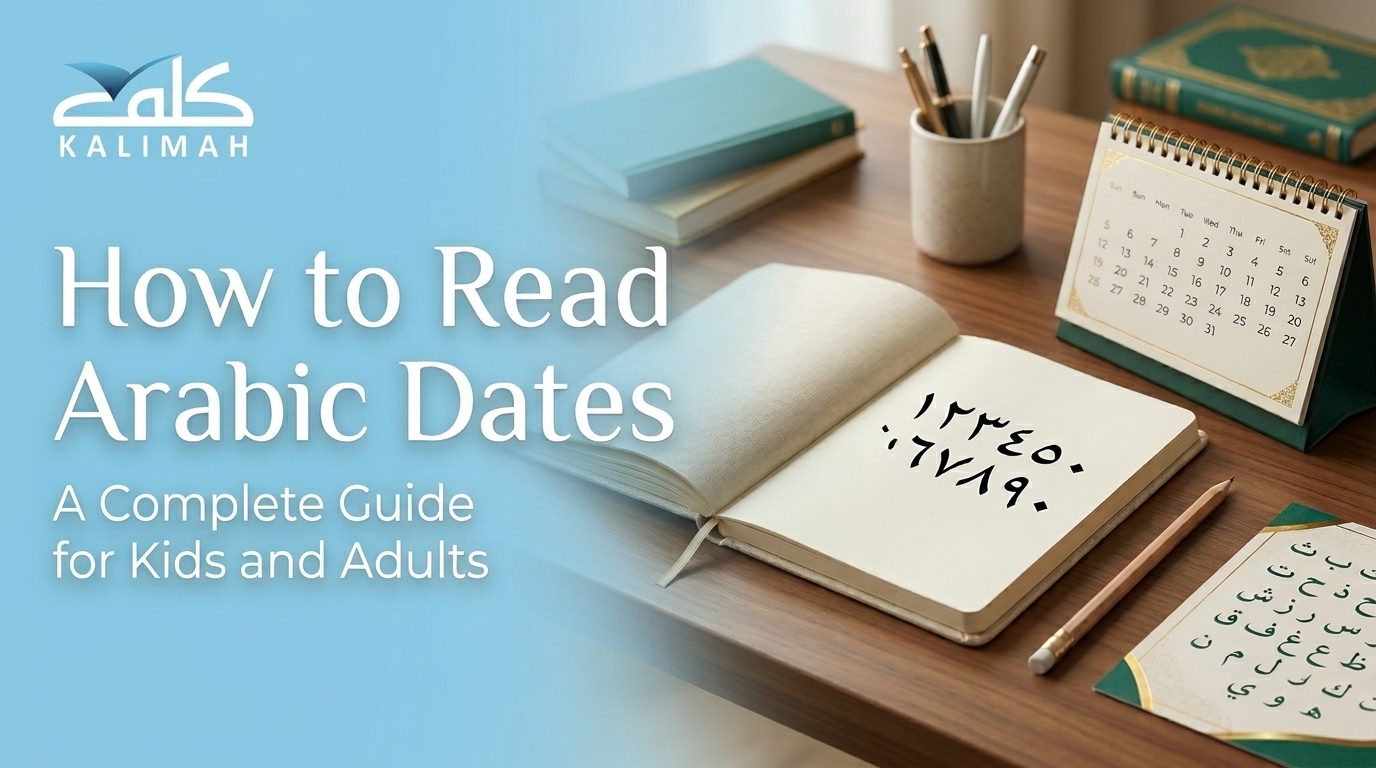
Have you ever looked at a date written in Arabic and wondered which number represents the day, month, or year? Learning how to read arabic dates can make everyday tasks easier, from understanding a birthday invitation to reading a calendar or an Islamic date.
Arabic dates become much easier when you understand the number symbols, the order of date components, Arabic month names, and the difference between Gregorian and Hijri years. You do not need advanced Arabic grammar to begin.
In this guide, you will learn how to read Arabic dates step by step, pronounce years, recognize common formats, and practise with examples suitable for children and adults.
1. Recognize the Arabic Numbers
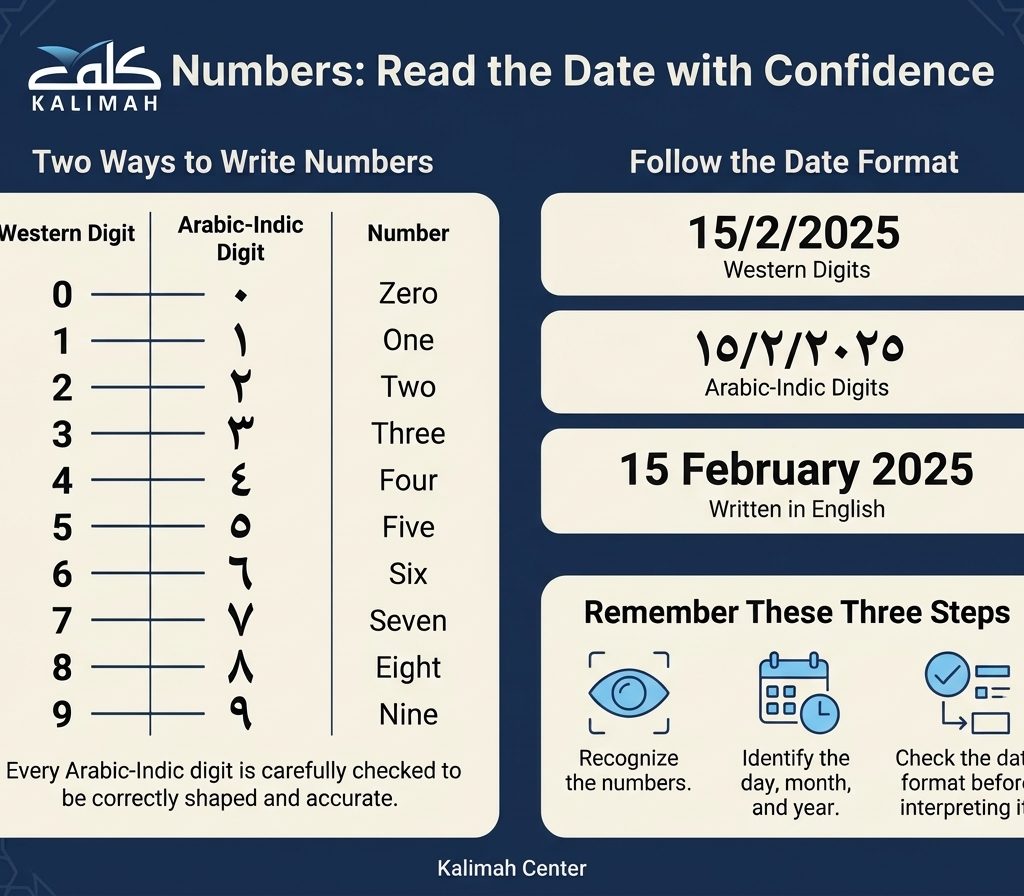
The first step in learning how to read arabic dates is recognizing the numerals used to write them. Arabic-language materials may use Western digits (0–9), Arabic-Indic digits (٠–٩), or a mixture depending on the region and publication.
Although these symbols are often called Arabic-Indic numerals, learners may also encounter the Western digits commonly used in English. Recognizing both systems will help you read dates across Arabic books, calendars, websites, and everyday documents without confusing the numbers.
| Western digits | Arabic-Indic digits | Number |
| 1 | ١ | One |
| 2 | ٢ | Two |
| 3 | ٣ | Three |
| 4 | ٤ | Four |
| 5 | ٥ | Five |
| 6 | ٦ | Six |
| 7 | ٧ | Seven |
| 8 | ٨ | Eight |
| 9 | ٩ | Nine |
| 0 | ٠ | Zero |
Understanding how to read Arabic dates starts with recognizing the numerals themselves. Once you can match each Arabic-Indic digit to its Western equivalent, identifying dates becomes more manageable. For example, ٢٠٢٦ represents 2026. The number is still read as a complete year, even when the digits appear within right-to-left Arabic text.
Children can practise by matching numeral cards with spoken numbers. Adults can build confidence by reading dates from calendars, books, and everyday documents.
2. Understand the Order of an Arabic Date
To read Arabic dates correctly, identify the day, month, and year, then interpret the numbers and month names in context. A common written format is day/month/year, although the precise layout can vary by country, document, and digital system.
For example, the date 15/2/2025 can represent 15 February 2025 in a day/month/year format. Written with Arabic-Indic digits, it may appear as ١٥/٢/٢٠٢٥.
Arabic script runs from right to left, but multi-digit numbers generally retain their internal left-to-right order. This distinction is important when reading a date on a screen or in an Arabic paragraph. In many Arabic-language contexts, dates follow the day/month/year order. However, the layout should always be checked, especially when a numeric date could be interpreted differently in an international document.
When writing the date in words, you can use the day, month name, and year. For instance, 5 March 2026 is an unambiguous English rendering of the first example.
3. Learn the Arabic Names of the Gregorian Months
Knowing the months makes reading a complete date much easier. Arabic month names vary by region, so learners may encounter more than one valid set of names. Learning the month names alongside their English equivalents makes it easier to understand written dates without translating every word separately.
Start by memorizing a few familiar months, then practise identifying them in calendars and simple Arabic sentences until you can recognize them quickly.
| English month | Common Arabic name |
| January | يناير |
| February | فبراير |
| March | مارس |
| April | أبريل |
| May | مايو |
| June | يونيو |
| July | يوليو |
| August | أغسطس |
| September | سبتمبر |
| October | أكتوبر |
| November | نوفمبر |
| December | ديسمبر |
These names are commonly used in Egypt and several other Arab countries. In the Levant and Iraq, you may encounter alternatives such as كانون الثاني for January and شباط for February.
When learning how to read Arabic dates, focus first on the month names used in your learning materials or the country whose documents you are reading. If you want to progress beyond recognizing dates, you can explore the Online Arabic Course and find a learning path suited to your current level.
How to Read Arabic Dates in English
To read Arabic dates in English, convert the Arabic numerals into their Western equivalents, identify the month and year, and express the date using a familiar English format. Keep the original date’s intended meaning rather than assuming that every numeric date follows the same convention.
1. Convert Arabic-Indic Digits Into Western Digits
Converting the numerals is a useful first step when you encounter an Arabic date in a book, message, or online form. Once you recognize each digit, you can identify the day, month, and year more confidently while preserving the original meaning of the date. Consider this example:
- Arabic-Indic date: ١٥/٢/٢٠٢٥
- Western digits: 15/2/2025
- English date: 15 February 2025
The numerals change, but the date remains the same. Remember that Arabic letters are written from right to left, while the digits within a multi-digit number generally follow their usual left-to-right sequence.
To strengthen your understanding, compare Arabic dates with the dates shown on an English calendar and practise converting the numerals one by one. You can also use Kalimah Center’s Arabic numbers guide to review number symbols and build the numerical skills needed to read dates more comfortably.
2. Read the Date Aloud
When learning how to read arabic dates in english, practise saying the date naturally in English and then reading the Arabic month name.
For example:
- ١٠ يناير ٢٠٢٦ — 10 January 2026.
- ٢٥ مارس ٢٠٢٦ — 25 March 2026.
- ٣٠ سبتمبر ٢٠٢٦ — 30 September 2026.
These examples help you connect the written numeral, spoken number, and month name. If you are learning Arabic as a language, you can also practise saying each date aloud in Arabic with a teacher or reliable audio resource.
3. Avoid Confusing the Day With the Month
Some numeric dates are ambiguous. For example, 04/05/2026 could mean 4 May or April 5, depending on the convention being used.
The safest approach is to check the source’s date format or write the month as a word. This is particularly useful when reading school records, travel documents, international forms, and online appointments.
This small check can prevent mistakes when arranging appointments, completing applications, or recording important events. Whenever the date format is unclear, look for a month name or a note explaining the format instead of guessing which number represents the day.
Kalimah Center offers online Arabic courses for adults and children, with structured learning levels, interactive exercises, and guidance from qualified native Arabic tutors.
Experience Kalimah Center Classes
Watch real excerpts from our live sessions at Kalimah Center and see how we bring learning to life. These clips highlight our interactive, student-centered teaching approach across all our courses—designed to keep learners engaged, motivated, and actively involved every step of the way.
Master Arabic with Kalimah Center
Join our expert-led online classes and start your journey toward Arabic fluency today.
Book Your Free TrialHow to Read Arabic Years Correctly
Reading a year aloud is slightly different from simply identifying its digits. You need to recognize the number as a whole and choose a natural spoken form for the language in which you are reading it.
Arabic years are pronounced using Arabic number words, and the exact form may depend on the grammatical context. Rather than memorizing one pronunciation for every year, practise reading complete dates and short phrases with a qualified Arabic teacher or a reliable audio resource.
1. Read the Year as a Complete Number
For English readers, the following examples demonstrate common ways to say years:
| Year | Common English reading |
| 1981 | Nineteen eighty-one |
| 2000 | Two thousand |
| 2025 | Two thousand twenty-five |
| 2026 | Two thousand twenty-six |
When learning Arabic, the corresponding year should be practised as a complete Arabic number. Its exact pronunciation depends on the number’s grammatical form and the sentence in which it appears.
For example, the way you say a year after the Arabic word for “in the year” may differ from how you pronounce the same number in isolation. Learners should therefore practise complete phrases, not only memorize a year-number list.
2. Understand the Difference Between Written and Spoken Dates
A date can be written numerically but read aloud in words. These are two different skills.
For instance, a calendar may display ٢٠٢٦, while a learner says the Arabic words for “two thousand and twenty-six.” The written digits provide a visual representation; pronunciation requires knowledge of Arabic number words.
If your goal is to improve Arabic reading, start with dates that include clear month names and gradually practise numerical formats. This allows you to focus on pronunciation without having to solve several unfamiliar elements at once.
3. Practise With Short, Corrective Exercises
Choose three dates each day and practise identifying their components. Say the day, name the month, read the year, and then explain the complete date in English.
For children, use a wall calendar and ask questions such as, “What month is this?” or “Which number shows the year?” Adults can use birthdays, appointments, and historical dates as practical exercises.
If you are also learning to read Quranic Arabic, building familiarity with Arabic symbols and pronunciation can support your wider language-learning routine.
Inside Kalimah Center: Moments from Our Courses
Get a glimpse into the vibrant learning experience at Kalimah Center. These snapshots capture real moments from our live classes—where students engage deeply, connect with passionate instructors, and grow in a welcoming, supportive environment.
Master Arabic with Kalimah Center
Join our expert-led online classes and start your journey toward Arabic fluency today.
Book Your Free TrialHow to Read Hijri Dates in Arabic
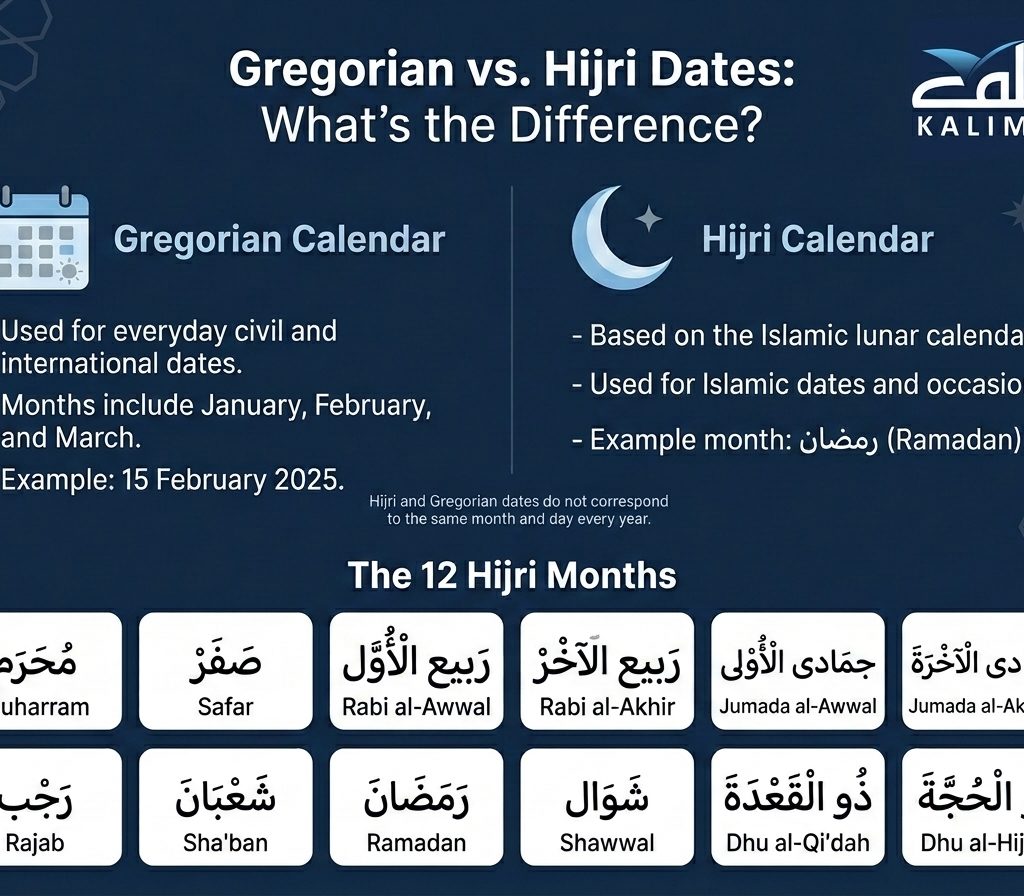
Hijri dates use the Islamic lunar calendar, while Gregorian dates use the calendar commonly used for civil and international purposes. A Hijri date typically includes a day, a month from the Islamic calendar, and a Hijri year.
For example, a date may include رمضان (Ramadan) followed by a year number and the marker هـ, which indicates the Hijri era. Gregorian dates may use م to indicate the ميلادي (Gregorian) era.
1. Learn the Hijri Month Names
The Hijri calendar is important for understanding Islamic occasions, including Ramadan, Eid al-Fitr, and Hajj. Learning the names of its months in order will help you recognize Islamic dates on calendars, in religious announcements, and in everyday conversations with Arabic speakers. The twelve Hijri months are:
- محرم — Muharram
- صفر — Safar
- ربيع الأول — Rabi al-Awwal
- ربيع الآخر — Rabi al-Akhir
- جمادى الأولى — Jumada al-Awwal
- جمادى الآخرة — Jumada al-Akhirah
- رجب — Rajab
- شعبان — Sha’ban
- رمضان — Ramadan
- شوال — Shawwal
- ذو القعدة — Dhu al-Qi’dah
- ذو الحجة — Dhu al-Hijjah
Learning these names is particularly useful for Muslim families reading Ramadan timetables, Islamic calendars, Eid announcements, and religious study materials.
2. Identify the Calendar Before Reading the Year
A number alone does not tell you whether a date is Hijri or Gregorian. Look for the month name, the year marker, or the context of the document.
Pay attention to clues such as the month name, the letters هـ or م, and the subject of the document. These details can help you determine which calendar is being used before interpreting the year, particularly when a date appears without a full month name.
For a reliable introduction to the Hijri calendar and its months, you can explore Kalimah Center’s Arabic numbers guide to practise numeral recognition and learn how Arabic numbers work. Remember that Hijri and Gregorian dates do not correspond to the same month and day every year because their calendars are based on different systems.
Build Your Arabic Reading Skills With Kalimah Center
Build confidence in reading Arabic by combining short daily exercises with structured lessons. Practise recognizing numbers, reading month names, and saying complete dates aloud until the process becomes familiar.
Explore Our Courses:
- Online Arabic Course: Tailored to your level, our comprehensive Arabic program includes 16 teaching levels and 400+ hours of personalized sessions.
- Online Quran with Tajweed Course: Perfect for non-Arabic speakers, our course spans 13 levels and builds Tajweed mastery from beginner to advanced.
- Online Arabic Course for Kids: Nurture your child’s love for Arabic with our engaging, structured program, available in 24 levels for primary, intermediate, and secondary stages.
Whether you are helping a child how to read Arabic dates or returning to the language as an adult, a structured learning plan can make practice more manageable. Kalimah Center offers online Arabic courses designed for learners to develop their reading skills and build confidence.
Don’t miss out on this opportunity to deepen your knowledge. Sign up now for your free trial and take the first step towards becoming a better practicing Muslim with Kalimah Center!
Conclusion
Learning how to read arabic dates begins with three essential skills: recognizing the numerals, identifying the date format, and understanding the month and year. Once these elements become familiar, reading dates on calendars and everyday documents becomes easier.
Remember that Arabic script generally runs from right to left, while numbers within the text retain their usual digit order. Also, distinguish Gregorian dates from Hijri dates and check the formatting convention whenever a numerical date is ambiguous.
Regular practice will help you recognize Arabic numerals more quickly and understand the dates you encounter in daily life. By combining number recognition, month names, and simple reading exercises, you can gradually develop a stronger foundation in Arabic and feel more comfortable working with both Gregorian and Hijri dates.
The main takeaway is to practise with real examples, say dates aloud, and learn in small steps. With regular practice and appropriate Arabic instruction, children and adults can build greater confidence in recognizing dates and continue developing their wider Arabic reading skills.
FAQs
Here are answers to common questions learners may ask when learning how to read Arabic dates.
How do you read dates in Arabic?
Arabic dates commonly use the day/month/year order, although formats vary. Identify the day, month, and year, and check the document’s convention before interpreting a fully numerical date.
How do you write a date in Arabic numbers?
You can use Arabic-Indic numerals such as ١٥/٢/٢٠٢٥ or Western digits such as 15/2/2025. The choice depends on the publication, region, or digital system.
How do you read Arabic dates in English?
Convert the numerals if necessary, identify the month and year, and express the date in a clear English format. For example, ١٥ فبراير ٢٠٢٥ means 15 February 2025.
Do Arabic dates go from right to left?
Arabic writing runs from right to left, but multi-digit numbers generally retain their left-to-right digit order. Date components should be interpreted according to the formatting convention used.
What is the difference between Hijri and Gregorian dates?
The Hijri calendar is lunar and is used to determine Islamic dates, while the Gregorian calendar is the standard civil calendar in many countries. Their dates do not align permanently because their calendar systems differ.
How can children practise reading Arabic dates?
Use a calendar, numeral flashcards, and short spoken exercises. Ask children to identify the day, name the month, and recognize the year, keeping each activity simple and encouraging.