Learning Arabic by yourself is possible — but it requires a structured approach that compensates for the absence of a teacher. The key elements are: a clear goal (Quranic Arabic, MSA, or a specific dialect), a daily study schedule, quality free resources, an early start on speaking practice (do not wait until you feel “ready”), and an honest understanding of the timeline — 1–2 years to basic conversational ability, 2–3 years to intermediate, with consistent daily study. The 8-step self-study method below addresses each of these elements.
As a native Arabic speaker and teacher, I’ve seen many learners struggle with mastering Arabic on their own. The letters look different, the grammar can be tricky, and there are so many ways to speak it. But I can tell you from this early point in our article, learning Arabic independently is achievable.
In this guide, we’ll tackle common questions like “Is it even possible to learn Arabic alone?”, “What’s the best way to approach self-study?”, and “How long will it realistically take?” We’ll provide a clear roadmap and resources to guide you on learning Arabic on your own.
Is It Possible to Learn Arabic by Yourself?
Yes, it is possible to learn Arabic by yourself. I remember one of my students, Sarah, who was passionate about Arabic culture and Islamic studies. Living in a small town with limited access to Arabic classes, Sarah decided to take the plunge and learn Arabic on her own. She started with online resources, books, and mobile apps, dedicating a few hours each day to her studies.
Sarah had a strong will, and she really did learn a lot on her own, MashaAllah! But Arabic has some tricky parts, like how we pronounce things and little grammar rules. She found it difficult to understand these things without a teacher. This is where someone like me comes in – a native Arabic speaker who can help explain those tricky parts.
Sarah still did a great job by herself, and you can too! Even before finding her way to my classroom, she could already greet you with a warm “مرحبا” (pronounced “mar-ha-ban”), meaning “Hello.” Just imagine what you could achieve!
So, if you want to learn Arabic on your own, you absolutely can! It takes patience and effort, but you will be so proud of yourself when you can say “hello” and much more. Remember, We at Kalimah Center are always here to help you with those tricky parts and make learning Arabic fun and easy for you.
What Makes Self-Study Arabic Different From Classroom Learning?
Understanding what you are giving up and what you are gaining in self-study allows you to compensate for the gaps systematically.
| Feature | Classroom Learning | Self-Study |
|---|---|---|
| Structure | ✅ Teacher provides it | ❌ You must create it |
| Pronunciation correction | ✅ Immediate | ❌ Delayed — requires active sourcing |
| Accountability | ✅ Class schedule + teacher | ❌ Entirely self-driven |
| Pace flexibility | ❌ Fixed by class | ✅ Learn at your speed |
| Cost | ❌ Higher | ✅ Can be free |
| Grammar explanation | ✅ On demand | ❌ Must find resources |
| Speaking practice | ✅ Built into class | ❌ Must actively seek |
| Cultural context | ✅ Teacher provides | ❌ Self-sourced |
The most critical gaps to compensate for in self-study:
1. Pronunciation errors become habits
Without a teacher to correct you, mispronunciations can become fossilised — permanently incorrect habits that are difficult to undo. Solution: Schedule at least one session per month with a native Arabic speaker on HelloTalk or italki, specifically asking them to correct your pronunciation.
2. Grammar misconceptions go unnoticed
You will develop wrong understandings of grammar rules without knowing they are wrong. Solution: Use Language Transfer (which teaches through questioning rather than assertion) and regularly test your grammar understanding against a native speaker.
3. Speaking anxiety grows without practice
Self-study learners who do not speak regularly often develop significant anxiety about actual Arabic conversation. Solution: Begin HelloTalk or a speaking exchange from week two — not when you feel ready.
How Can I Learn Arabic by Myself?
Learning Arabic by yourself requires discipline, a good plan, and the right resources. But before we start this journey, let’s take a moment to think about our destination.
Step 1: Define Your Arabic Goal — This Decision Determines Everything
Before starting, make one concrete decision: which Arabic and for what purpose?
| Goal | Arabic Type to Study | First Resource |
|---|---|---|
| Read and understand the Quran | Quranic/Classical Arabic | Madinah Arabic curriculum |
| Communicate with Arabic speakers generally | Modern Standard Arabic (MSA) | Language Transfer + Duolingo |
| Speak with Egyptians specifically | Egyptian Arabic | Egyptian Arabic YouTube channels |
| Live or work in Gulf countries | Gulf Arabic | Gulf dialect resources |
| Read Arabic news and literature | MSA | LingQ + ArabicPod101 |
Why this matters for self-study: Unlike a classroom where the teacher sets the direction, self-study requires you to make this choice explicitly — otherwise you will switch between resources serving different Arabic varieties and make slower progress than if you had committed to one.
Write your answer in one sentence: “I am learning [Arabic type] so that I can [specific outcome] within [realistic timeframe].”
This sentence becomes your compass for every resource decision that follows.
Step 2: Create a Self-Study Plan
Start with a clear and realistic plan. Dedicate specific times each day to study Arabic. For example, you could spend 30 minutes each morning learning new vocabulary and another 30 minutes in the evening practicing grammar.
Example:
- Goal: Learn to read basic Arabic
- Plan: Study for 60 minutes daily. And In the next 4 months, I will learn the Arabic alphabet and the basic grammar and be able to write my background information.
Step 3: Create a Dedicated Self-Study Space
Find a quiet, comfortable place where you can focus. Your study space should be free from distractions and equipped with all the materials you need.
Example:
- A desk with a notebook, Arabic textbooks, and a computer for online resources
Step 4: Use Quality Self-Study Resources — Evaluated and Ranked
The quality of your resources determines the quality of your self-study. Here are the most effective free resources for Arabic self-learners, evaluated honestly:
For Structured Grammar Foundation:
- Language Transfer — Introduction to Arabic (free, Spotify/website): The best free audio Arabic grammar course available — 40 episodes teaching how Arabic works, not just vocabulary. Non-negotiable for serious self-learners.
- Madinah Arabic (free app + website): Academically rigorous curriculum used to teach Arabic to non-native speakers worldwide. Free PDF textbooks available.
For Vocabulary Retention:
- Anki (free on Android/web, $24.99 iOS): Spaced repetition software with free pre-made Arabic frequency decks. 15 minutes daily outperforms hours of traditional review.
- Duolingo (free): Best for building a daily habit and alphabet recognition. Supplement — not replace — with grammar study.
For Listening and Pronunciation:
- ArabicPod101 on YouTube (free): Thousands of structured video lessons from beginner to advanced. The largest free Arabic video library available.
- Kalimah4Arabic on YouTube (free): Curriculum-aligned Arabic lessons — particularly strong for alphabet and foundational grammar.
- Coffee Break Arabic (free podcast): Structured audio lessons for beginners and intermediate learners.
For Speaking Practice:
- HelloTalk (free): Language exchange with native Arabic speakers — the most important free speaking tool for self-learners who do not have Arabic-speaking contacts.
- italki (paid per session): If you can invest in one paid resource for self-study, weekly or bi-weekly sessions with a native Arabic tutor on italki will accelerate your progress more than any other single investment.
Here are some YouTube channels that can help you learn arabic by yourself:
- https://www.youtube.com/user/KalimahCenter
- Learn Arabic with ArabicPod101.com
- Learn Arabic Online Free | Nassra Arabic Method
- Learn Modern Standard Arabic
- Learn Arabic Language
- Learn Arabic and Quran Online
These channels offer a variety of lessons on topics such as the alphabet, grammar, vocabulary, and conversation. They also have a variety of teaching styles, so you can find one that suits your learning preferences.
Master Arabic with Kalimah Center
Join our expert-led online classes and start your journey toward Arabic fluency today.
Book Your Free TrialStep 5: Learn the Arabic Alphabet — Your Non-Negotiable First Priority
Every Arabic self-study expert agrees on one thing: do not skip the alphabet to get to phrases faster. Learning phrases in transliteration (Roman letters) before knowing the Arabic script creates a dependency that dramatically slows reading development.
The Arabic alphabet has 28 letters. Each letter has up to 4 positional forms (isolated, initial, medial, final). Six letters do not connect to the following letter. This sounds complex — but most dedicated learners recognise all 28 isolated letters within 2 weeks of daily 20-minute practice.
Self-study alphabet sequence:
| Week | Focus | Resource |
|---|---|---|
| Week 1 | Letters 1–14 recognition | ArabicPod101 alphabet series (YouTube) |
| Week 2 | Letters 15–28 recognition | Learn Arabic with Maha (YouTube) |
| Week 3 | All 4 positional forms | Arabic alphabet worksheets (free PDF) |
| Week 4 | Reading simple vowelled words | Madinah Arabic Reader (free app) |
Critical self-study mistake to avoid: Moving to vocabulary and phrases before the alphabet is secure. Test yourself: can you read a simple vowelled Arabic word without knowing what it means? If not, stay on the alphabet until you can.
Full alphabet guide: How to Learn the Arabic Alphabet
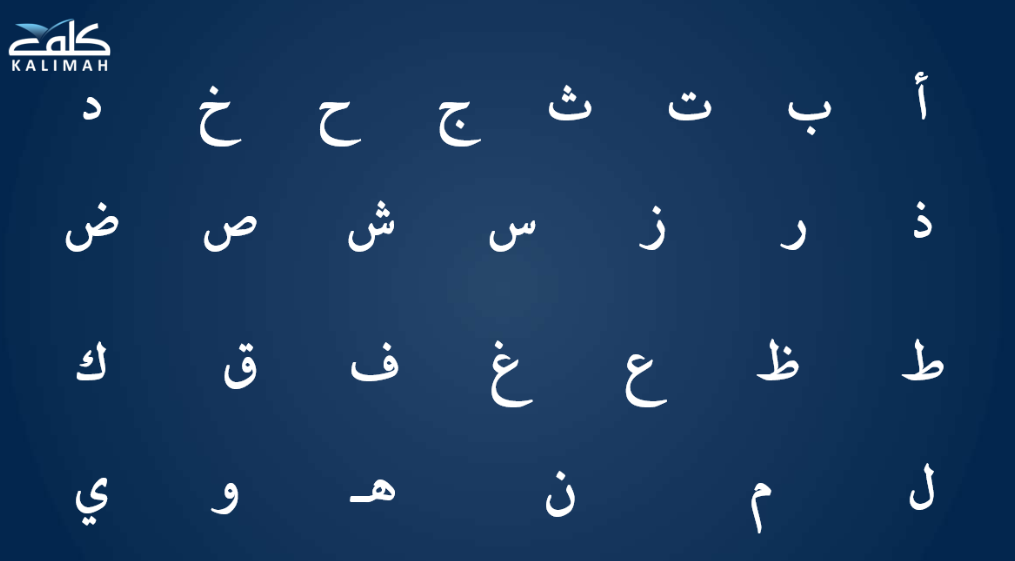
Also, you may consider exploring Alphabets levels Kalimah Center’s Arabic course. This comprehensive online program guides you through the entire Arabic alphabet, accompanied by helpful illustrations.

Designed for both beginners and those seeking a structured refresher, this course empowers you to read and write confidently in Arabic, laying a strong foundation for your language journey. Typically completed within 3-4 months, it offers a flexible and engaging learning experience.
If you’re curious to learn more, why not check out the course details and discover how it could be your first step towards fluency in Arabic with FREE TRIAL?
Meet Hasan from the USA! He found more than just Arabic lessons at Kalimah Center – he found a supportive community and instructors who became like family. Discover the Kalimah difference for yourself!
Step 6: Enrich your Arabic Lexicon Through Self-Study
To truly learn Arabic on your own, you gotta start building your vocabulary arsenal! Start with the simple words you’d use every day, like the ones you hear in the market or on the street.
Flashcards, those little cards with words on them, are your friends here. Write the Arabic word on one side and the English on the other. Look at them over and over until they stick in your mind. Or, use one of those apps on your phone to learn new words and test yourself. The key is to practice every day, even if it’s just for a few minutes.
Here are some more easy Arabic words, along with their pronunciation and meaning to start with in your learning by yourself:
- كتاب (kitaab) – Book
- طاولة (taawilah) – Table
- كرسي (kursi) – Chair
- باب (baab) – Door
- شباك (shubbaak) – Window
- ماء (maa) – Water
- شمس (shams) – Sun
- قمر (qamar) – Moon
- نجم (najm) – Star
- سيارة (sayyaarah) – Car
As you learn more words, you’ll be able to understand more of what you hear and read, and you’ll be able to say more of what you want to say. It’s like adding bricks to a building – one word at a time, you’ll build your Arabic language house.
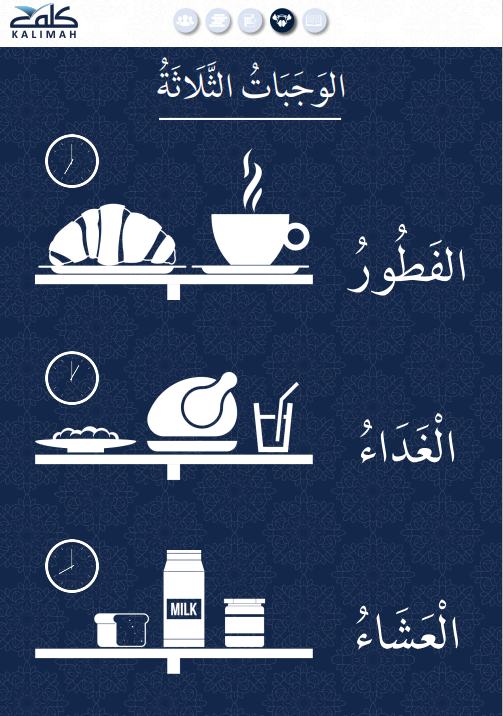
The following image is an example of how Kalimah Center uses illustrations to build vocabulary in its Arabic courses for adults and Arabic courses for kids. It showcases three distinct meal times:
- الفطور (al-Futur): Breakfast is illustrated with a croissant and a cup of coffee.
- الغداء (al-Ghada): Lunch is represented by a roasted chicken and a glass of water.
- العشاء (al-Asha): Dinner is depicted with milk, bread, and a jar, likely containing jam or honey.
These simple yet effective illustrations visually associate everyday objects with their Arabic names, making it easier for learners to memorize and understand vocabulary related to meals and food. This approach aligns with Kalimah Center’s focus on interactive and engaging learning methods.
Step 7: Practice Arabic Listening on Your Own Using Available Materials
First, fill your ears with Arabic. Don’t worry if you don’t understand everything at first. Put on some Arabic podcasts while you’re cooking or driving.
Watch news with subtitles on YouTube, maybe even try some old films like “Al-Resala”. Don’t worry about understanding every word at first, just listen to how they say it.
Try repeating what you hear, even if it sounds difficult at first.
Step 8: Develop your Arabic Speaking Skills with Easily Accessible Resources
You can’t learn to swim without getting in the water, right? Same with Arabic. Find a language exchange partner online, or even better, find a native Arabic speaker in your community. Practice speaking, even if you make mistakes. That’s how you learn!
There are even apps and websites where you can find people to chat with. No one is perfect when they start, so don’t be afraid to speak.
If you want to practice speaking with natives and connect with fellow Arabic learners, consider joining Kalimah Intensive Group Classes for a structured and supportive learning environment.
Our experienced teachers, engaging materials, and small class sizes (maximum 6 students) will help you build confidence and achieve your Arabic language goals faster. With flexible online classes, you can learn from anywhere in the world.
The Best Free Resources for Learning Arabic by Yourself
| Resource | Type | Level | Truly Free? | Best For |
|---|---|---|---|---|
| Language Transfer Arabic | Audio course | Beginner | ✅ 100% free | Grammar foundations |
| ArabicPod101 (YouTube) | Video lessons | All levels | ✅ YouTube free | Structured video study |
| Kalimah4Arabic (YouTube) | Video lessons | Beginner-Int | ✅ YouTube free | Curriculum-aligned content |
| Learn Arabic with Maha | Video lessons | Beginner-Int | ✅ YouTube free | Pronunciation clarity |
| Madinah Arabic (app + website) | Structured curriculum | Beginner-Int | ✅ 100% free | Comprehensive self-study |
| Anki + Arabic frequency deck | Vocabulary | All levels | ✅ Free (Android/web) | Long-term retention |
| Duolingo | Gamified app | Beginner | ✅ Free tier genuine | Daily habit formation |
| HelloTalk | Speaking exchange | Intermediate | ✅ Basic free | Speaking practice |
| Coffee Break Arabic | Podcast | Beginner-Int | ✅ Basic episodes | Audio learning |
| Digital Dialects | Browser games | Beginner | ✅ 100% free | Letter recognition |
Full resource guide with honest evaluations: Best Free Resources to Learn Arabic
Common Mistakes Self-Taught Arabic Learners Make
As someone who has taught Arabic to many learners who previously tried self-study, I see the same mistakes repeatedly:
Mistake 1: Starting with phrases instead of the alphabet
Learning “As-salamu alaykum” in transliteration before knowing the Arabic letters creates a false sense of progress. When you encounter Arabic script, you cannot read it — because you learned sounds, not letters. Fix: Alphabet first, always.
Mistake 2: Using too many resources simultaneously
Three apps, two YouTube channels, a textbook, and a podcast — and nothing is progressing because no single resource is followed consistently. Fix: One primary resource (Language Transfer or Madinah Arabic) + one vocabulary tool (Anki) + one speaking tool (HelloTalk). That is enough for the first three months.
Mistake 3: Avoiding speaking until “ready”
No self-study learner ever feels ready to speak. Waiting for readiness means speaking practice never starts. Fix: Start HelloTalk in week two. Your first conversations will be painful. They are supposed to be.
Mistake 4: Not distinguishing between Arabic varieties
Mixing MSA resources, Egyptian Arabic videos, and Quranic Arabic lessons creates a confused foundation. Fix: Commit to one variety for the first six months. Branch out once the foundation is secure.
Mistake 5: Studying intensively for weeks, then stopping
Two hours every Saturday produces far less retention than 20 minutes every day. Fix: Set the smallest sustainable daily minimum — even 15 minutes. Consistency is the only variable that consistently predicts Arabic learning success.
How Long Does It Take to Learn Arabic on Your Own?
On average, reaching a conversational level can take 1 year to a few years of consistent study on your own. Mastery of the language, including reading and writing fluently, can take several years.
Learning Arabic independently is a rewarding but challenging journey. While the time it takes can vary greatly depending on individual factors such as dedication, learning style, and desired proficiency level, it generally takes significantly longer than learning in a structured course with a teacher.
In a traditional classroom setting, learners receive approximately 400+ hours of instruction to reach a good level. This involves structured lessons, guided practice, and regular feedback from a qualified teacher.
Independent learners need to compensate for the lack of these elements by developing their own learning plan, finding resources, and seeking out opportunities for practice.
Here’s a general estimate of the time commitment required for independent learning:
- Basic proficiency (reading and understanding simple texts): 1-2 years
- Intermediate proficiency (holding conversations and understanding everyday speech): 2-3 years
- Advanced proficiency (understanding complex texts and speaking fluently): 5+ years
These timelines are just estimates and can vary depending on individual circumstances. However, it’s important to understand that independent learning often requires a greater time investment and more self-discipline than learning in a structured course.
If your goal is to learn Arabic efficiently and effectively, consider supplementing your independent studies with resources like language exchange partners, online tutors, or Arabic online classes. These can provide the structure, guidance, and feedback necessary to accelerate your learning journey.
The Benefits of Learning with a Teacher
While it’s commendable to learn on your own, having a teacher offers numerous advantages:
- Structured Learning Path: A teacher provides a clear roadmap tailored to your learning style and goals.
- Correct Pronunciation: Learning pronunciation from native speakers ensures you’re understood correctly.
- Cultural Insights: Teachers offer valuable cultural context that enriches your learning experience.
- Motivation and Support: Regular classes keep you motivated and accountable.
Inside Kalimah Center: Moments from Our Courses
Get a glimpse into the vibrant learning experience at Kalimah Center. These snapshots capture real moments from our live classes—where students engage deeply, connect with passionate instructors, and grow in a welcoming, supportive environment.
Here Are The Reviews On Our Courses:
Our students frequently commend the excellence of our courses and the commitment shown by our instructors. You can read their complete reviews on Trustpilot.
Read more reviews on Trustpilot

Learn Arabic on your own terms, but not Alone. Kalimah is Here to Help
Kalimah Center empowers your self-guided journey with expert guidance, structured courses, and a community of fellow learners. Discover how to master Arabic reading, writing, listening, and speaking at your own pace.
- Reading: Master the art of reading Arabic texts, from short articles to long stories.
- Writing: Develop the skills to write clear, cohesive texts, emails, and detailed descriptions.
- Listening: Enhance your ability to understand spoken Arabic in various contexts.
- Speaking: Achieve fluency and confidence in face-to-face conversations and presentations.
Take the First Step Today with the Best Arabic Online Courses!
Why Choose Kalimah Center:
- Years of Experience: Benefit from well-prepared and continuously developed courses.
- Proven Methodology: Our approach ensures effective and enjoyable learning for all ages.
- Flexible Online Format: Study from anywhere in the world at your convenience.
- Free Trial Lessons: Experience our courses firsthand before making a commitment.
Master Arabic with Kalimah Center
Join our expert-led online classes and start your journey toward Arabic fluency today.
Book Your Free TrialConclusion
Learning Arabic by yourself is not the fastest path to fluency — but for many learners, it is the only available path, and it is entirely workable with the right approach.
The 8 steps in this guide — defining your goal, creating a study plan, learning the alphabet, building vocabulary, practicing listening, developing speaking, using quality resources, and understanding realistic timelines — cover everything you need to structure effective Arabic self-study.
The common mistakes section tells you what to avoid. The resources section tells you what to use. The time estimates tell you what to expect.
What happens next depends entirely on the one thing no guide can provide: the daily decision to study. Make it consistently for six months. At that point, you will have enough Arabic that the language itself motivates you to continue.
That is how Arabic self-study works.
FAQs about How Can I Learn Arabic by Myself?
Q1: Can I really learn Arabic by myself without a teacher?
Yes — thousands of people have learned Arabic to varying levels of proficiency through self-study. The key requirements are: a clear goal, a consistent daily practice routine, quality resources (Language Transfer, ArabicPod101, Anki), and active speaking practice with native speakers through HelloTalk or italki. The most honest assessment: self-study Arabic is possible but takes significantly longer than structured instruction and requires the learner to compensate for the absence of pronunciation correction, grammar feedback, and accountability.
Q2: What should I learn first when studying Arabic alone?
The non-negotiable starting point is the Arabic alphabet. Without it, you cannot read, write, or correctly pronounce anything you learn. Most self-study learners who skip the alphabet to get to phrases faster end up returning to it within a few months — with the additional challenge of having developed incorrect pronunciation habits. After the alphabet, add vocabulary through Anki (spaced repetition) and begin grammar foundations through Language Transfer. Start speaking practice from week two — do not wait until you feel ready.
Q3: How long does it take to learn Arabic by yourself?
Significantly longer than with structured instruction. Realistic estimates for consistent daily self-study (30–60 minutes): 1–2 years to basic conversational ability, 2–3 years to intermediate proficiency, 5+ years to advanced fluency. These timelines can be compressed by 30–40% by adding even one weekly session with a native Arabic tutor. The FSI estimates 2,200 hours to Arabic professional proficiency — self-study learners who do not have structured feedback often need more hours to reach the same level.
Q4: What is the biggest challenge of learning Arabic alone?
Pronunciation errors becoming permanent habits is the most damaging challenge of Arabic self-study. Without a native speaker to correct you in real time, mispronunciations that feel correct to you develop into deeply ingrained habits. This is particularly problematic for Arabic’s unique sounds (ع، ح، غ، ق، خ) that do not exist in English. Solution: Use HelloTalk or italki from week two — even one 30-minute session monthly with a native speaker specifically focused on pronunciation correction can prevent this problem.
Q5: Is it better to learn Arabic alone or with a teacher?
With a teacher — for most learners. The research on language acquisition consistently shows that structured instruction with expert feedback produces faster and more accurate results than equivalent hours of self-study. However, a teacher is not always accessible or affordable. The practical answer for many learners is blended learning: self-study for daily vocabulary and grammar, combined with regular (weekly or bi-weekly) sessions with an online tutor for pronunciation feedback and speaking practice. Kalimah Center’s free trial is a natural starting point for this approach.