The best Arabic learning podcasts in 2026 depend on your level and target dialect. For beginners, ArabicPod101 (MSA) and The Arabic We Speak (multiple dialects) offer structured introductions. For intermediate learners, Bilmasri (Egyptian) and Real Arabic (Syrian) provide authentic conversational exposure.
For advanced learners, Coffee Break Arabic and Deewan Arabic Podcast deliver cultural depth and complex language use. The most effective podcast strategy for Arabic learners combines one structured teaching podcast with one authentic conversation podcast at or slightly above their level.
Master Comparison Table:
| # | Podcast | Level | Dialect | Active in 2026? | Free? | Best For |
|---|---|---|---|---|---|---|
| 1 | ArabicPod101 | Beginner | MSA + Egyptian | ✅ Yes | Free + Paid | Structured lessons |
| 2 | ArabicPod | Beginner–Int | MSA | ✅ Yes | Partial | Grammar + vocabulary |
| 3 | Language Transfer | Beginner | MSA | ✅ Yes | Free | Language structure |
| 4 | The Arabic We Speak | Beginner–Int | Multiple | ✅ Yes | Free | Dialect awareness |
| 5 | Simple & Easy Arabic | Beginner–Int | Levantine | ✅ Yes | Free | Story-based listening |
| 6 | Bilmasri | Intermediate | Egyptian | ✅ Yes | Free | Egyptian culture |
| 7 | Learn Levantine With Livi | Intermediate | Levantine | ✅ Yes | Free | Levantine dialect |
| 8 | El Bulbul | Intermediate | Egyptian | ✅ Yes | Free | Cultural discussions |
| 9 | Qasid Arabic Podcast | Intermediate | MSA | ✅ Yes | Free | Academic Arabic |
| 10 | Real Arabic | Intermediate | Syrian | ✅ Yes | Free | Slow authentic speech |
| 11 | Deewan Arabic Podcast | Advanced | MSA | ✅ Yes | Free | Cultural heritage |
| 12 | Salis — Egyptian Arabic | Advanced | Egyptian | ✅ Yes | Free | Egyptian fluency |
| 13 | Lahthah Brief Moment | Advanced | MSA | ✅ Yes | Free | Reflective storytelling |
| 14 | Arabic in 60 Steps | Int–Advanced | MSA | ✅ Yes | Free | Structured progression |
| 15 | Coffee Break Arabic | All levels | MSA | ✅ Yes | Free + Paid | Comprehensive lessons |
| 16 | Sowt (سوت) | Advanced | MSA + dialects | ✅ Yes | Free | Investigative journalism |
| 17 | Kerning Cultures | Int–Advanced | English + Arabic | ✅ Yes | Free | Middle East stories |
| 18 | Mstdfr | Int–Advanced | Gulf Arabic | ✅ Yes | Free | Gulf dialect exposure |
| 19 | The Nassra Arabic Method | Beginner–Int | MSA | ✅ Yes | Free | Pronunciation focus |
| 20 | ArabicWithSam | Beginner–Int | Levantine | ✅ Yes | Free | Conversational Levantine |
How to Choose the Right Arabic Podcast for Your Level and Dialect
Arabic podcasts range from structured language lessons to unscripted native-speaker conversations — and choosing the wrong type for your level is the most common mistake learners make.
By Level:
| Your Level | What to Look For | Recommended Type |
|---|---|---|
| Beginner (A1–A2) | Slow speech, English explanations, structured lessons | Teaching podcasts (ArabicPod101, Language Transfer) |
| Intermediate (B1–B2) | Moderately paced, some English support, topic-based | Bilingual podcasts (Real Arabic, Learn Levantine With Livi) |
| Advanced (C1–C2) | Native speed, no English, complex topics | Authentic Arabic podcasts (Sowt, Deewan, Mstdfr) |
By Dialect:
| Dialect Goal | Best Podcasts |
|---|---|
| Modern Standard Arabic (MSA) | ArabicPod101, Language Transfer, Coffee Break Arabic, Arabic in 60 Steps |
| Egyptian Arabic | Bilmasri, El Bulbul, Salis |
| Levantine Arabic (Syrian/Lebanese/Palestinian) | Simple & Easy Arabic, Learn Levantine With Livi, Real Arabic, ArabicWithSam |
| Gulf Arabic | Mstdfr |
| Multiple/Mixed Dialects | The Arabic We Speak, Sowt |
The most important principle: Effective podcast learning requires listening to content at or slightly above your current level — where you understand approximately 70–80% and must actively work to comprehend the remaining 20–30%. If you understand everything, the podcast is too easy. If you understand less than 50%, it is too hard.
Podcasts To Learn Arabic For Beginners
Podcasts are highly beneficial for beginners learning Arabic because they provide exposure to authentic language use and diverse accents. They offer a flexible learning option, allowing learners to practice listening skills in a variety of contexts while on the go. With content ranging from general topics to specific interests, podcasts help improve vocabulary and listening comprehension.
They also offer cultural insights, making the learning experience more engaging and relevant. Additionally, podcasts can complement other learning methods and help maintain motivation by integrating language practice into daily routines.
Let me show you some good podcasts for learning Arabic for beginners:
1. ArabicPod101
Beginner–Intermediate | MSA + Egyptian + Moroccan | Free (basic) / Paid subscription | Active
ArabicPod101 is one of the largest and longest-running Arabic podcast libraries available — with thousands of audio and video lessons spanning absolute beginner through intermediate levels. Lessons follow a structured format: vocabulary introduction, dialogue, grammatical explanation, and cultural notes — delivered by native Arabic speakers with English-language instruction woven throughout. Each lesson includes a transcript and vocabulary list, making it easy to review and retain what you hear.
The library’s size is both its strength and its potential weakness. There is enough content to study from for years — but the sheer volume can overwhelm new learners who do not know where to start. The recommended approach is to follow the “Pathway” system, which sequences lessons into a structured course rather than browsing randomly.
The dialect coverage is primarily MSA with Egyptian and some Moroccan content — not comprehensive across all Arabic dialects, but sufficient for learners whose goal is formal Arabic or Egyptian conversational Arabic.
✅ Best for: Absolute beginners and early learners who want structured, lesson-based podcast content with English explanation — the most comprehensive free starting point for Arabic podcast learning.
⚠️ Limitation: The free tier provides access to the most recent lessons only — the full library and learning tools (flashcards, transcripts, grammar notes) require a paid subscription. Advanced learners will find the content too basic. The dialect mix can be confusing for learners who have not yet decided whether to focus on MSA, Egyptian, or another dialect.
🔗 Where to listen: ArabicPod101.com, Spotify, Apple Podcasts, YouTube

2. ArabicPod
Beginner–Intermediate | MSA (primarily) | Free (beginner) / Paid (intermediate+) | Active
ArabicPod offers structured Arabic lessons through conversation-based episodes — each episode centres on a natural dialogue in Arabic, followed by a detailed breakdown of vocabulary, grammar, and cultural context. The beginner episodes are entirely free, providing a genuine no-cost entry point for new learners. The teaching approach is clear and methodical: dialogues are repeated at natural and slow speeds, vocabulary is extracted and explained, and grammar points are illustrated through the dialogue itself rather than presented abstractly.
The show’s progression from beginner through intermediate is well-structured — early episodes assume zero Arabic knowledge and build systematically. The intermediate and advanced episodes, however, require a paid subscription.
✅ Best for: Beginners who prefer structured, dialogue-driven lessons in MSA — and who want to start for free before deciding whether to commit to a paid subscription for more advanced content.
⚠️ Limitation: The free content is limited to beginner-level episodes. Intermediate and advanced content requires a paid membership. The podcast is primarily MSA-focused — learners targeting a specific dialect (Egyptian, Levantine, Gulf) will need to supplement with dialect-specific podcasts.
🔗 Where to listen: ArabicPod.net, Apple Podcasts
3. Language Transfer — Arabic
Beginner | MSA | Completely Free | Active
Language Transfer takes a radically different approach from other Arabic podcasts — it is not a conversation show or a vocabulary builder. It is a structured audio course that teaches you how Arabic works as a system — the grammar, the root-based morphology, the verb patterns — through a Socratic method where the instructor (Mihalis) guides a real beginner student through increasingly complex Arabic concepts, prompting them to derive answers rather than simply memorise them.
The method’s power is in its demand for active participation: as you listen, you are expected to pause, think through the prompt, and attempt an answer before the student responds. This forced retrieval practice builds genuine understanding of Arabic structure rather than surface-level recognition. By the end of the course (approximately 40 episodes), learners have a working understanding of Arabic grammar that many months of traditional study struggle to achieve.
The entire course is free — permanently, with no paywall, no premium tier, and no advertisements. It is one of the most generous educational resources in Arabic learning.
✅ Best for: Analytical learners who want to understand how Arabic works as a grammatical system — particularly adults who learn best through logic and pattern recognition rather than memorisation and repetition.
⚠️ Limitation: Language Transfer provides minimal immersion in authentic Arabic speech — you will learn about Arabic more than you will absorb Arabic. Pronunciation practice is limited. After completing the course, you will understand Arabic grammar well but will need immersion-based podcasts (Real Arabic, Bilmasri) to develop listening comprehension and fluency. It is a foundation builder, not a fluency builder.
🔗 Where to listen: LanguageTransfer.org, Spotify, Apple Podcasts, YouTube
4. The Arabic We Speak
Beginner–Intermediate | Multiple dialects | Free | Active
Hosted by Dalal and Amani, The Arabic We Speak occupies a unique position in the Arabic podcast landscape: it explicitly bridges the gap between formal Arabic (MSA) and the spoken dialects — a gap that frustrates learners who study textbook Arabic and then discover they cannot understand anything spoken in the real world. Each episode explores how the same concept, phrase, or word differs across MSA and various regional dialects, with hosts who bring different dialect backgrounds to the conversation.
The educational value is genuinely distinctive. Rather than teaching one dialect well, this podcast teaches dialect awareness — the ability to recognise and navigate between different forms of Arabic, which is one of the most practically useful skills for any Arabic learner who will interact with speakers from different regions.
Cultural context is woven throughout — episodes cover not just language differences but the cultural and historical reasons behind them, giving learners a richer understanding of why Arabic varies the way it does.
✅ Best for: Learners who are confused by the gap between textbook Arabic and real-world Arabic — and those who want to develop the ability to understand multiple Arabic dialects rather than mastering a single one.
⚠️ Limitation: The multi-dialect approach, while valuable for awareness, means you will not develop deep fluency in any single dialect through this podcast alone. Learners who have decided on a specific dialect (Egyptian, Levantine, Gulf) should supplement with a dialect-specific podcast. Some episodes assume basic Arabic knowledge — absolute zero beginners may need to start with ArabicPod101 or Language Transfer first.
🔗 Where to listen: Spotify, Apple Podcasts

5. Simple & Easy Arabic Podcast
Beginner–Intermediate | Levantine | Free | Active
Simple & Easy Arabic teaches Levantine Arabic through clearly articulated stories — narratives spoken in slow, careful Arabic that are designed to be followed by intermediate beginners. Each episode opens with new vocabulary for the upcoming story, presents the story itself at a learner-appropriate pace, and concludes with comprehension questions that verify understanding.
The story-based approach is this podcast’s defining strength. Rather than isolated vocabulary drills or grammar explanations, learners absorb Arabic in the context of meaningful narratives — which research in language acquisition consistently identifies as more effective for long-term retention than decontextualised learning.
✅ Best for: Beginners and early intermediate learners targeting Levantine Arabic who learn best through narrative and storytelling rather than structured grammar lessons.
⚠️ Limitation: Focuses exclusively on Levantine Arabic — not suitable for learners targeting MSA, Egyptian, or Gulf dialects. The slow speech pace, while excellent for beginners, may become too easy for intermediate learners relatively quickly. Transition to Real Arabic or Learn Levantine With Livi when you consistently understand 90%+ of each episode.
🔗 Where to listen: Spotify, Apple Podcasts
6. The Nassra Arabic Method
Beginner–Intermediate | MSA + Levantine | Free + Paid resources | Active
The Nassra Arabic Method focuses specifically on Arabic pronunciation — the skill that most Arabic podcasts treat as secondary but that determines whether native speakers can understand you. Host Ehab Nassra breaks down the sounds of Arabic systematically, addressing the specific pronunciation challenges that English speakers face (emphatic consonants, ع, غ, ح, خ) with clear, repeated modelling and explanation.
Beyond pronunciation, the podcast covers vocabulary and grammar through practical dialogues, but the phonetic focus remains central throughout — making it genuinely unique in the Arabic podcast landscape.
✅ Best for: Learners who know they need to improve their Arabic pronunciation specifically — and those who want to build accurate sound production from the beginning rather than correcting fossilised pronunciation errors later.
⚠️ Limitation: The pronunciation focus, while valuable, means the podcast covers vocabulary and grammar more slowly than content-focused alternatives. Learners who are confident in their pronunciation should use ArabicPod101 or Language Transfer for faster grammar and vocabulary progression.
🔗 Where to listen: Spotify, Apple Podcasts, NassraArabicMethod.com
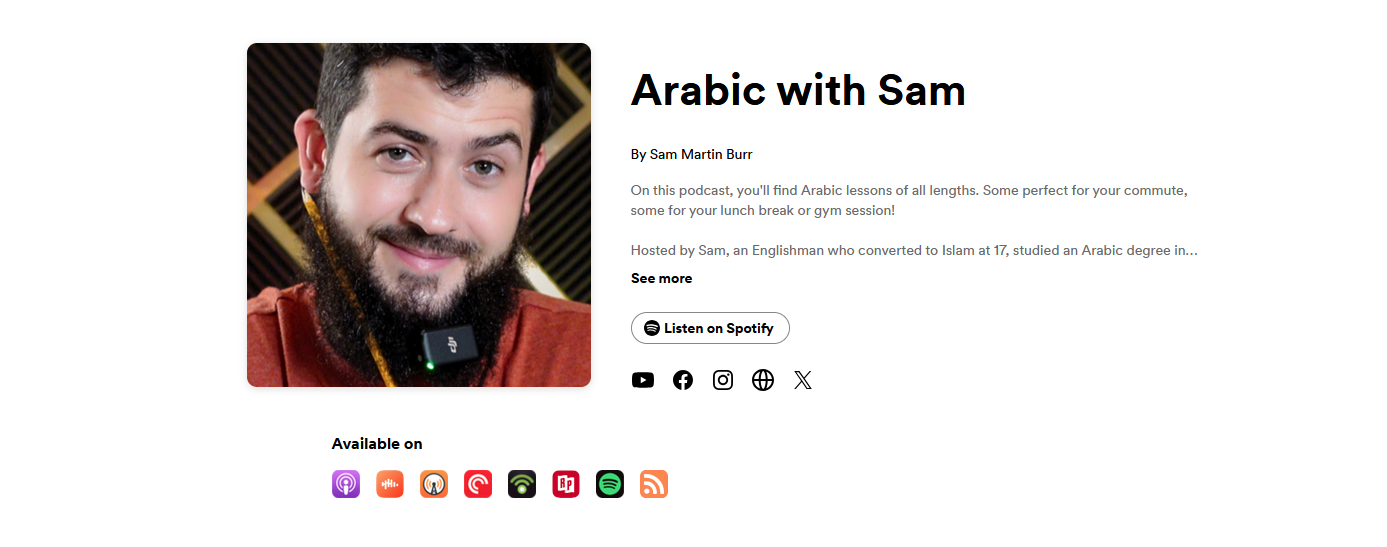
7. ArabicWithSam
Beginner–Intermediate | Levantine | Free | Active
ArabicWithSam is a podcast teaching conversational Levantine Arabic through short, practical episodes that mirror real-life situations — ordering food, taking a taxi, visiting a doctor, having a phone conversation. Host Sam delivers content at a deliberate pace with clear pronunciation, then breaks down each phrase into its components, explaining grammar and vocabulary naturally within the conversational context.
The show’s practical, situation-based approach means learners are building usable Arabic from the first episode — not abstract language knowledge, but the actual phrases and structures needed to function in a Levantine Arabic-speaking environment.
✅ Best for: Beginners targeting Levantine Arabic who want immediately usable conversational phrases and situational language — particularly travellers or those with Levantine-speaking family members.
⚠️ Limitation: Covers Levantine dialect only. Episodes are short and situation-specific — learners who want broader vocabulary coverage and grammar depth will need to supplement with a more comprehensive resource.
🔗 Where to listen: Spotify, Apple Podcasts, YouTube
Podcasts For Learning Arabic At Intermediate Level
Podcasts are a valuable resource for intermediate Arabic learners because they offer exposure to natural language use, including idiomatic expressions and varied accents. They help improve listening skills by presenting conversations and discussions at different speeds and pronunciations. Through diverse topics, learners can acquire relevant vocabulary and understand Arabic in various contexts.
Additionally, podcasts provide cultural insights and references that enrich learners’ knowledge of Arabic-speaking cultures. The flexibility of podcasts allows learners to practice Arabic conveniently and engage with native speakers, enhancing their overall language proficiency.
1. Bilmasri
Intermediate | Egyptian | Free | Active
Bilmasri — meaning “in the Egyptian way” — is a podcast entirely in Egyptian Arabic covering topics relevant to Egyptian and Arab culture: social trends, contemporary issues, personal stories, and cultural observations. The show features interviews with guests from diverse backgrounds, offering authentic exposure to natural Egyptian conversational Arabic at moderate speed.
For intermediate learners specifically targeting Egyptian Arabic, Bilmasri fills a critical gap: it provides the kind of authentic, unscripted conversational exposure that teaching podcasts cannot replicate. When you listen to Bilmasri, you hear how Egyptians actually speak — with natural pacing, colloquial expressions, and the cultural references that make comprehension feel authentic rather than academic.
✅ Best for: Intermediate learners targeting Egyptian Arabic who are ready to move beyond structured lessons and into authentic native-speed content — the transition from learning about Arabic to learning in Arabic.
⚠️ Limitation: Entirely in Egyptian Arabic with no English support — beginners will find it inaccessible. The conversational pace is natural, not slowed for learners, which is intentionally challenging but can be overwhelming for early intermediate students. If you understand less than 50% of an episode, you are not ready for Bilmasri yet — return to ArabicPod101 or ArabicPod first.
🔗 Where to listen: Spotify, Apple Podcasts

2. Learn Levantine With Livi
Intermediate | Levantine | Free | Active
Hosted by Livi, this podcast is specifically designed to help learners master the Levantine dialect through practical, everyday conversation topics. Episodes cover situations ranging from daily routines and shopping to travel and social interactions — always through the lens of how Levantine Arabic speakers actually talk, not how textbooks represent the dialect.
What distinguishes this podcast from other Levantine resources is Livi’s structured approach to dialect teaching: each episode targets specific vocabulary sets and grammatical patterns, presented through natural dialogue rather than isolated drills. Cultural context — why certain expressions exist, when they are appropriate, how tone changes meaning — is woven throughout.
✅ Best for: Intermediate learners specifically targeting Levantine Arabic who want structured dialect instruction combined with practical conversational content.
⚠️ Limitation: Exclusively Levantine — learners targeting Egyptian, Gulf, or MSA will need different resources. Some foundational Arabic knowledge is assumed — complete beginners should build basic vocabulary through ArabicWithSam or Simple & Easy Arabic before starting this podcast.
🔗 Where to listen: Spotify, Apple Podcasts
3. El Bulbul
Intermediate | Egyptian | Free | Active
El Bulbul explores Egyptian culture and society through extended conversations and interviews with diverse guests — covering contemporary social issues, personal stories, cultural phenomena, and reflections on Egyptian life. The podcast’s conversational style is natural and unscripted, providing intermediate learners with exposure to authentic Egyptian Arabic at the level of complexity they need to develop real comprehension.
The interview format is particularly valuable for intermediate learners because it exposes them to multiple speakers with different speaking styles — fast and slow, formal and colloquial, male and female — building the adaptive listening skills that single-narrator podcasts cannot develop.
✅ Best for: Intermediate learners of Egyptian Arabic who want cultural immersion through genuine conversations — developing the ability to follow extended Arabic discussions on substantive topics.
⚠️ Limitation: Content is culturally specific to Egypt — learners who are not interested in Egyptian culture or society may find the topics less engaging. No English support or vocabulary assistance — learners should be comfortable with Egyptian Arabic basics before listening.
🔗 Where to listen: Spotify, Apple Podcasts
4. Qasid Arabic Podcast
Intermediate | MSA | Free | Active
The Qasid Arabic Podcast is produced by the Qasid Institute in Amman, Jordan — one of the most respected Arabic language schools in the world. The podcast combines structured grammar and vocabulary lessons with discussions on Arabic culture and current events, delivered primarily in MSA with clear pronunciation and moderate pacing.
The academic credibility behind this podcast is significant: Qasid Institute has been teaching Arabic to international students for decades, and their podcast reflects the pedagogical rigor of their classroom programs. Grammar points are explained with precision and illustrated through authentic examples, vocabulary is contextualised within cultural discussions, and pronunciation is modelled by professional educators.
✅ Best for: Intermediate learners who want academically rigorous MSA instruction combined with cultural content — particularly those who intend to pursue formal Arabic studies or use Arabic in academic or professional contexts.
⚠️ Limitation: The academic tone may feel dry to learners who prefer conversational or entertainment-based content. MSA focus means the language you learn will sound formal — not conversational. For spoken fluency in any specific dialect, supplement with dialect-specific podcasts.
🔗 Where to listen: Spotify, Apple Podcasts, Qasid.com

5. Real Arabic
Intermediate | Syrian Arabic (with English support) | Free | Active
Real Arabic was born from a genuine frustration: the lack of colloquial Arabic listening resources for intermediate learners. Co-hosted by Amer (Syrian) and Keire (Irish), the podcast features Amer speaking in slow, clearly articulated Syrian Arabic about culture, society, and personal stories from the Arab world, while Keire periodically provides brief English context to ensure learners can follow along.
Full transcripts and translations are available on their website — a critical supplementary resource that transforms each episode from passive listening into an active study tool. Learners can listen first without the transcript, then review with it, then listen again — a cycle that research in language acquisition identifies as highly effective for developing comprehension.
The deliberate pacing — slower than natural Syrian speech but faster than beginner resources — is precisely calibrated for intermediate learners who need exposure to authentic Arabic without the full-speed challenge of native-audience podcasts.
✅ Best for: Intermediate learners who want authentic Arabic content delivered at a pace they can actually follow — with the safety net of English support and full transcripts for review.
⚠️ Limitation: Syrian Arabic specifically — some vocabulary and pronunciation will differ from Egyptian, Gulf, or North African dialects. The slow pacing, while perfect for intermediates, means advanced learners will outgrow it. Transition to Sowt or Deewan when you consistently understand 90%+ of Real Arabic episodes.
🔗 Where to listen: Spotify, Apple Podcasts, RealArabicPodcast.com
Experience Kalimah Center Classes
Watch real excerpts from our live sessions at Kalimah Center and see how we bring learning to life. These clips highlight our interactive, student-centered teaching approach across all our courses—designed to keep learners engaged, motivated, and actively involved every step of the way.
Master Arabic with Kalimah Center
Join our expert-led online classes and start your journey toward Arabic fluency today.
Book Your Free TrialPodcasts For Learning Arabic At Advanced Level
Podcasts are particularly valuable for advanced Arabic learners as they provide immersive exposure to complex language use and sophisticated vocabulary. They offer insights into nuanced expressions, idiomatic phrases, and regional variations, which help refine understanding and usage of the language.
Listening to podcasts can also deepen cultural knowledge and offer perspectives on contemporary issues and current events, enhancing overall comprehension.
Additionally, advanced learners benefit from engaging with diverse voices and topics, which helps them stay attuned to subtle language changes and trends, contributing to a more nuanced and fluent command of Arabic.
1. Deewan Arabic Podcast
Advanced | MSA | Free | Active
The Deewan Arabic Podcast explores the rich cultural, literary, and linguistic heritage of the Arab world through in-depth discussions with experts, authors, cultural commentators, and academic figures. Topics span Arabic literature, history, philosophy, contemporary social issues, and linguistic analysis — presented entirely in formal MSA at native speed with no English support.
For advanced learners, Deewan offers something rare: intellectual engagement in Arabic. Rather than learning about the language, you are using the language to engage with ideas. This is the transition from Arabic as a subject to Arabic as a medium — which is the defining characteristic of advanced proficiency.
✅ Best for: Advanced learners (C1+) who want to engage with Arabic cultural and intellectual content at native level — particularly those whose goal is academic, literary, or professional Arabic.
⚠️ Limitation: Entirely in MSA at native speed with no concessions to learners — genuinely challenging even for upper-intermediate listeners. Topics are cultural and intellectual rather than conversational — learners who want colloquial fluency should use dialect-specific podcasts alongside Deewan.
🔗 Where to listen: Spotify, Apple Podcasts

2. Salis- Learn Egyptian Arabic
Advanced | Egyptian | Free | Active
Salis focuses on developing Egyptian Arabic fluency through practical, everyday conversational content. Unlike beginner Egyptian Arabic resources that teach phrases in isolation, Salis presents extended conversations, situational dialogues, and cultural discussions at a level of complexity and speed that challenges advanced learners to develop true conversational competence.
The podcast’s strength is its authenticity: conversations sound like actual Egyptian Arabic as it is spoken in Cairo — with natural speed, colloquial expressions, cultural references, and the informal register that textbook Egyptian Arabic rarely captures.
✅ Best for: Advanced learners who want to develop genuine Egyptian Arabic conversational fluency — understanding and producing the informal, culturally embedded Arabic that native Egyptians actually use.
⚠️ Limitation: Entirely in Egyptian Arabic at natural speed — requires strong intermediate Egyptian Arabic as a prerequisite. Learners who struggle to follow Bilmasri are not yet ready for Salis.
🔗 Where to listen: Spotify, Apple Podcasts
3. The Lahthah ‘brief Moment’ Podcast
Advanced | MSA | Free | Active
Lahthah (“Brief Moment”) offers reflective, narrative storytelling — intimate explorations of personal and societal experiences through thoughtful, carefully crafted Arabic prose. Each episode captures a significant moment in human experience — an observation, a memory, an emotional turning point — and examines it with literary care and cultural depth.
For advanced Arabic learners, Lahthah provides exposure to a register of Arabic that most learning resources never reach: literary, reflective, emotionally complex language that develops vocabulary and comprehension in domains beyond the practical and conversational. This is Arabic as art.
✅ Best for: Advanced learners who want to develop sophisticated Arabic comprehension — particularly those with an interest in Arabic literary expression, storytelling, or creative writing.
⚠️ Limitation: The reflective, literary style is deliberately slow and contemplative — learners who want dynamic conversation or practical language skills will find the pace and tone mismatched to their goals.
🔗 Where to listen: Spotify, Apple Podcasts
4. Arabic in 60 Steps Podcast
Intermediate–Advanced | MSA | Free | Active
Arabic in 60 Steps is a structured, sequenced audio course disguised as a podcast — each episode builds directly on the previous one, covering grammar, vocabulary, and pronunciation in an incremental progression designed to take learners from intermediate through to advanced MSA proficiency. The structured approach is its defining feature: unlike conversation-based podcasts that jump between topics, Arabic in 60 Steps follows a deliberate curriculum.
The practical exercises embedded in each episode — including prompted pauses for learner response — make it more actively engaging than passive listening podcasts. The course design reflects a classroom pedagogy adapted for audio.
✅ Best for: Self-disciplined learners who want a structured, course-like progression through intermediate and advanced MSA — particularly those who prefer systematic study over exploratory listening.
⚠️ Limitation: The structured format means episodes must be listened to in order — you cannot dip in randomly like conversation podcasts. The academic MSA focus means the language learned sounds formal rather than conversational. For speaking fluency, supplement with dialect-specific conversation podcasts.
🔗 Where to listen: Spotify, Apple Podcasts
5. Coffee Break Arabic
All Levels | MSA | Free (basic) / Paid (premium) | Active
Coffee Break Arabic applies the proven Coffee Break language learning format — short, accessible lessons that cover vocabulary, grammar, and conversation within a consistent 15–20 minute episode structure. Each episode targets a specific learning objective: a grammar point, a conversational scenario, a vocabulary theme — delivered with clear English explanations and native Arabic pronunciation.
The strength of the Coffee Break format is its consistency and accessibility: episodes are short enough to fit into a commute or lunch break, structured enough to deliver genuine learning in each session, and progressive enough that regular listeners build competence over time without feeling overwhelmed.
✅ Best for: Learners at any level who want a reliable, structured, short-format podcast that fits into a busy schedule — the most accessible entry point for learners who have never used podcasts for language learning before.
⚠️ Limitation: The MSA focus and lesson-based format means Coffee Break Arabic develops academic Arabic knowledge more than conversational fluency. The basic episodes are free, but the full course (including transcripts, worksheets, and bonus content) requires a paid subscription.
🔗 Where to listen: CoffeeBreakLanguages.com, Spotify, Apple Podcasts
Know more about Learn To Read Arabic In 21 Days
6. Sowt
Advanced | MSA + various dialects | Free | Active
Sowt (meaning “voice” in Arabic) is an independent podcast network producing high-quality Arabic audio journalism and storytelling — covering investigative reports, cultural documentaries, personal narratives, and social commentary. Shows in the Sowt network include Eib, Ritmocast, and others, spanning a range of formats from narrative journalism to cultural analysis.
For advanced Arabic learners, Sowt represents the gold standard of authentic Arabic audio content. This is not content made for learners — it is content made for Arabic speakers, which is exactly what advanced learners need. The production quality rivals international podcast networks, the language is authentic and unfiltered, and the topics are substantive and engaging.
✅ Best for: Advanced learners (C1+) who are ready to consume Arabic content made for native speakers — and who want to stay engaged with Arabic through genuinely interesting journalism and storytelling rather than learning-focused content.
⚠️ Limitation: No English support, no vocabulary assistance, no speed reduction. This is native-speed Arabic for Arabic speakers. If you understand less than 60% on first listen, you need more time with intermediate resources before Sowt will be productive.
🔗 Where to listen: Sowt.com, Spotify, Apple Podcasts
7. Kerning Cultures
Intermediate–Advanced | English + Arabic (bilingual) | Free | Active
Kerning Cultures produces narrative-driven audio documentaries about the Middle East and North Africa — stories about people, places, and cultures across the Arab world told through a combination of English narration and Arabic interviews, conversations, and field recordings. The bilingual format — with Arabic embedded naturally within English-language storytelling — provides intermediate learners with authentic Arabic exposure within a comprehensible framework.
For learners who find fully Arabic podcasts overwhelming but find fully English podcasts useless, Kerning Cultures occupies the perfect middle ground. The Arabic segments are genuine — unscripted, native-speed, culturally embedded — but the English narrative provides context that makes comprehension possible for learners who are not yet ready for fully Arabic content.
✅ Best for: Intermediate learners who want authentic Arabic exposure within a bilingual format — and anyone interested in the cultures, stories, and contemporary issues of the Arab world.
⚠️ Limitation: The bilingual format means less total Arabic listening time per episode compared to fully Arabic podcasts. Advanced learners who need maximum Arabic exposure should transition to Sowt or Deewan.
🔗 Where to listen: KerningCultures.com, Spotify, Apple Podcasts
8. Mstdfr
Intermediate–Advanced | Gulf Arabic | Free | Active
Mstdfr (a stylised abbreviation of the Arabic for “studio”) is one of the most prominent Gulf Arabic podcast platforms — producing content about entrepreneurship, technology, culture, and contemporary life in the Gulf region. Episodes feature interviews with business leaders, cultural commentators, and public figures from Saudi Arabia, UAE, Kuwait, and other Gulf states.
For Arabic learners, Mstdfr fills a critical gap: Gulf Arabic exposure. The vast majority of Arabic learning podcasts focus on MSA, Egyptian, or Levantine dialects. Gulf Arabic — spoken across one of the wealthiest and most geopolitically significant regions in the Arab world — is dramatically underrepresented in learning resources. Mstdfr provides natural, authentic Gulf Arabic listening that no structured learning podcast can replicate.
✅ Best for: Intermediate to advanced learners who want or need exposure to Gulf Arabic — particularly those working with, travelling to, or living in Gulf states.
⚠️ Limitation: Entirely in Gulf Arabic at native speed — learners without prior Gulf Arabic exposure will initially find comprehension challenging even at intermediate levels, as Gulf Arabic differs significantly from Egyptian and Levantine in pronunciation, vocabulary, and expression. Use alongside a general Arabic podcast like Coffee Break Arabic to maintain broader Arabic comprehension.
🔗 Where to listen: Mstdfr.com, Spotify, Apple Podcasts
How to Use Arabic Podcasts Effectively for Language Learning
Downloading a podcast is not the same as learning from it. The learners who progress fastest through podcast-based Arabic study follow a specific listening method:
The Three-Pass Method:
| Pass | What You Do | Why It Works |
|---|---|---|
| First listen | Listen without pausing — try to follow the overall meaning | Builds tolerance for ambiguity and trains contextual comprehension |
| Second listen | Pause after each sentence — write down words you recognise and words you do not | Identifies specific vocabulary gaps for targeted study |
| Third listen | Listen while reading the transcript (if available) — connect sounds to written forms | Reinforces reading and listening simultaneously |
Additional tips:
- Shadow the speaker — repeat what you hear in real time, matching pronunciation and rhythm. This builds spoken fluency even during passive listening time.
- Use Anki alongside podcasts — add unknown words from each episode to a spaced repetition deck. Review daily.
- Listen to the same episode multiple times before moving on. Three passes through one episode produces more learning than one pass through three episodes.
- Match podcast difficulty to your level — you should understand 70–80% on first listen. Less than 50% is too hard. More than 90% is too easy.
Choose Your Best Native Tutor Now That Suits Your Educational Needs.
What Is The Importance Of Listening When Learning Arabic?
Listening is vital for mastering Arabic as it immerses learners in the language’s natural sounds and rhythms. It helps in grasping the nuances of pronunciation and accent, which are crucial for effective communication. By regularly listening to Arabic, learners become more adept at understanding different dialects and contextual meanings, which enhances their overall comprehension.
This auditory exposure also builds vocabulary and reinforces language patterns, making it easier to apply these elements in speaking and writing. In essence, listening provides a foundation for fluent and nuanced language use.
Master Arabic with Kalimah Center
Join our expert-led online classes and start your journey toward Arabic fluency today.
Book Your Free TrialInside Kalimah Center: Moments from Our Courses
Get a glimpse into the vibrant learning experience at Kalimah Center. These snapshots capture real moments from our live classes—where students engage deeply, connect with passionate instructors, and grow in a welcoming, supportive environment.
Here Are The Reviews On Our Courses:
Our students frequently commend the excellence of our courses and the commitment shown by our instructors. You can read their complete reviews on Trustpilot.

Kalimah Intensive Group Classes
Discover the transformative power of language with Kalimah Center’s group Arabic classes. Whether you’re starting from scratch or looking to refine your skills, our dynamic group sessions offer interactive and immersive learning experiences. Join a community of learners and benefit from expert instruction tailored to your level.

Enhance your proficiency, practice conversational skills, and gain cultural insights in a supportive environment. Don’t miss this opportunity to advance your Arabic in a collaborative and engaging setting.
Visit Kalimah Center today to learn more and enroll!
📚 Explore Our Courses:
Online Arabic Course: Tailored to your level, our comprehensive Arabic program includes 16 teaching levels and 400+ hours of personalized sessions.
Online Quran With Tajweed Course: Perfect for non-Arabic speakers, our course spans 13 levels and equips you with Tajweed mastery from beginner to advanced.
Online Arabic Course For Kids: Nurture your child’s love for Arabic with our engaging and structured program, available in 24 levels for primary, intermediate, and secondary stages.
🚀 Start Your Free Trial Today! 🚀
Don’t miss out on this life-changing opportunity to deepen your faith and knowledge. Sign up now for your free trial and take the first step towards becoming a better practicing Muslim with Kalimah Center!
Conclusion: Build Your Arabic Podcast Playlist by Level
The 20 podcasts in this guide cover every level, every major dialect, and every learning style — from structured grammar courses for absolute beginners to native-speed investigative journalism for advanced learners.
Your starting playlist by level:
| Level | Teaching Podcast | Authentic Podcast |
|---|---|---|
| Beginner | Language Transfer + ArabicPod101 | The Arabic We Speak |
| Intermediate | Coffee Break Arabic | Real Arabic + Bilmasri |
| Advanced | Arabic in 60 Steps | Sowt + Deewan |
Use the teaching podcast for structured learning. Use the authentic podcast for immersion. Listen daily — even 15 minutes produces measurable improvement over time. And remember: the goal is not to understand every word. The goal is to understand slightly more this week than you did last week.
That is how Arabic fluency is built — one episode at a time.
Join now for the best and cheapest group classes
FAQs about Best Podcasts for Learning Arabic
Q1: What is the best Arabic podcast for beginners in 2026?
ArabicPod101 is the most comprehensive beginner option — its structured lessons, vocabulary lists, and cultural notes create a complete learning experience. For learners who prefer understanding Arabic grammar systematically, Language Transfer is the best alternative. For Levantine dialect specifically, Simple & Easy Arabic Podcast and ArabicWithSam are the strongest beginner options. The best free starting combination is Language Transfer (grammar foundations) + ArabicPod101 (vocabulary and listening).
Q2: Can I learn Arabic just by listening to podcasts?
Podcasts develop listening comprehension and vocabulary effectively — but they cannot develop speaking fluency, writing, or reading on their own. The most effective approach is to treat podcasts as your listening and vocabulary input and supplement with speaking practice (through a language exchange partner or tutor), reading practice (through LingQ or Madinah Arabic Reader), and spaced repetition (through Anki) for vocabulary retention. Podcasts alone will take you from 0% comprehension to significant understanding — but not to well-rounded Arabic fluency.
Q3: How many hours of Arabic podcast listening do I need per week?
Research on language acquisition suggests that 30–60 minutes of daily listening (3.5–7 hours per week) produces measurable comprehension improvement within 8–12 weeks. The key is consistency — 30 minutes daily is significantly more effective than a single 3.5-hour session once per week. For maximum benefit, split listening time between a structured teaching podcast (ArabicPod101, Coffee Break Arabic) and an authentic content podcast at your level (Bilmasri, Real Arabic, Sowt).
Q4: Which Arabic podcast teaches Egyptian Arabic specifically?
Three podcasts focus specifically on Egyptian Arabic: Bilmasri (intermediate — cultural discussions), El Bulbul (intermediate — interviews and conversations), and Salis (advanced — conversational fluency). For beginners wanting Egyptian Arabic exposure, ArabicPod101 includes Egyptian dialect content alongside its MSA lessons. The recommended progression: ArabicPod101 (beginner Egyptian content) → Bilmasri (intermediate) → Salis (advanced).
Q5: Are there any Arabic podcasts for Gulf Arabic?
Mstdfr is the strongest Gulf Arabic podcast for language learners — covering entrepreneurship, technology, and culture from Saudi Arabia, UAE, Kuwait, and other Gulf states. It is entirely in Gulf Arabic at native speed, making it appropriate for intermediate to advanced learners. Gulf Arabic is underrepresented in learning podcasts — learners specifically targeting Gulf Arabic should supplement Mstdfr with Gulf-focused vocabulary resources and, ideally, conversation practice with Gulf Arabic speakers.