In a nutshell: The dual form (Al-Muthanna) is a unique aspect of Arabic grammar that modifies nouns and adjectives to express “two,” with endings like “-ان” (-ān) or “-ين” (-ayn), depending on the case and gender. This feature enhances fluency, ensuring precise and natural expression in both formal and casual Arabic.
I always find it interesting to teach the foreign learners the dual form, because it’s one of the unique aspects of Arabic grammar that sets it apart from many other languages.
Unlike English, where you only have singular and plural forms, in Arabic we have something special: a form that specifically refers to two of something.
Let me take you step by step through how we use the dual form in Arabic in detail and explore its usage with examples, explanations, and practical insights.
What is Al-Muthanna (The Dual Form) in Arabic?
Al-Muthanna (المثنى) refers to nouns that indicate two of something: two people, two objects, or two abstract concepts.
The dual form in Arabic is distinct and is expressed through specific endings added to the noun (We will learn about these endings in detail soon).
It’s important to understand that Arabic doesn’t just leave the noun as it is and add “two”; instead, we change the word itself. This is different from the way English handles duality, where you simply add “two” or make a noun plural.
For example:
- رجل (rajul) meaning “man” becomes رجلان (rajulan) when referring to “two men.”
- فتاة (fatāh) meaning “girl” becomes فتاتان (fatatan) for “two girls.”
Knowing this is important to making your Arabic sound more natural.
Dual Nouns in Arabic
Now, let us focus on dual nouns in Arabic in more detail. In Arabic, we often use the dual form not only in everyday language but also in formal speech and writing. This is why it is important to understand dual nouns, how to form them, and how to use them correctly in sentences. It will help you speak more accurately and sound natural.
So, Arabic nouns can be singular (مفرد mufrad), dual (مثنى muthannā), or plural (جمع jam’).
A dual noun in Arabic is a noun that refers to exactly two things. For example:
- Singular: طالب (Talib) – a student
- Dual: طالبان (Taliban) – two students
- Plural: طلاب (Tulab) – students
As you can see, Arabic distinguishes clearly between one, two, and many.
When you learn dual nouns, you must remember that these nouns change their endings depending on the grammatical case:
- Nominative case: Ends with “-ان” (-ān).
- Accusative and genitive cases: End with “-ين” (-ayn).
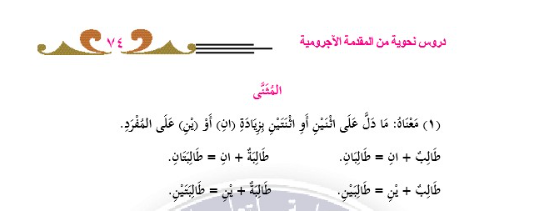
* Excerpted from Kalimah’s Online Arabic Course Curriculum.
This is a rule, but how do we apply it? Let me show you with examples.

Experience Kalimah Center Classes
Watch real excerpts from our live sessions at Kalimah Center and see how we bring learning to life. These clips highlight our interactive, student-centered teaching approach across all our courses—designed to keep learners engaged, motivated, and actively involved every step of the way.
Differences Between Masculine and Feminine Dual Nouns in Arabic
In Arabic, the dual form changes depending on whether the noun is masculine or feminine. These changes are important because Arabic is a gendered language, which means every noun is either masculine (مذكر mudhakkar) or feminine (مؤنث mu’annath).
1. Masculine Dual Nouns in Arabic
For masculine nouns, you usually add “-ان” (-aan) in the nominative case and “-ين” (-ayn) in the accusative or genitive case, as we will talk about in the following section. This rule is pretty simple and applies to most masculine nouns. Let me give you some examples:
Singular: طالب (talib) – student
Dual (Nominative): طالِبان (taliban) – two students
Dual (Accusative/Genitive): طالبَين (talibayn) – two students (as objects or after a preposition)

Another example:
Singular: رجل (rajul) – man
Dual (Nominative): رجلان (rajulān) – two men
Dual (Accusative/Genitive): رجلين (rajulayn) – two men
So, remember, if the noun is masculine, you always follow these patterns. The ending “-ان” or “-ين” changes based on the noun’s role in the sentence.
2. Feminine Dual Nouns in Arabic
Now, for feminine nouns, the endings are a little different. We first convert the (ة) to (ت) then add “-ان”.
Or… in other words to make it simpler for you:
Instead of “-ان” (-aan) for the nominative, we use “-تان” (-taan). And for accusative or genitive cases, we use “-تين” (-tayn). Let’s look at an example:
Singular: طالبة (ṭāliba) – student (female)
Dual (Nominative): طالبتان (ṭālibaṭān) – two students (female)
Dual (Accusative/Genitive): طالبتين (ṭālibaṭayn) – two students (female) (as objects or after a preposition)

Another example:
Singular: امرأة (imra’a) – woman
Dual (Nominative): امرأتان (imra’atān) – two women
Dual (Accusative/Genitive): امرأتين (imra’atayn) – two women
Read Also: Gender In Arabic
Dual Nouns in Different Cases: Nominative, Accusative, and Genitive
Arabic nouns change their endings based on their role in the sentence, a system called i‘rab. For al-muthanna, the ending also changes depending on whether the noun is in the nominative, accusative, or genitive case.
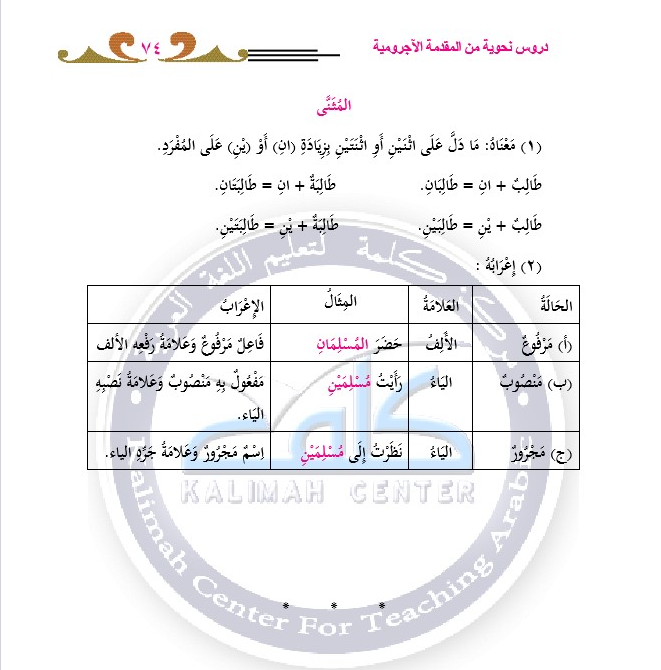
* Excerpted from Kalimah’s Online Arabic Course Curriculum.
1. ِArabic Dual Nouns in Nominative Case (الرفع):
We use the nominative case when the dual noun is the subject of the sentence, meaning it is the one doing the action. For example:
- حضر المسلمان (Haḍara al-muslimān) The two Muslims arrived.
- القطتان تلعبان في الحديقة (Al-qiṭṭatān tal‘abān fī al-ḥadīqa.) The two cats are playing in the garden.
Here, both nouns “المسلمان” (al-muslimān) and “القطتان” (al-qiṭṭatān) are the subjects of the verbs, so they take the “-ان” (-ān) ending.

2. Arabic Dual Nouns in Accusative Case (النصب):
We use the accusative case when the dual noun is the object of the verb, meaning the action is happening to them.
- رأيت مُسلمَيْن في السوق (Ra’aytu muslimayn fī as-sūq.) I saw the two Muslims in the market.
- اشتريت التفاحتين من المتجر (Ishtaraytu at-tuffāḥatayn min al-matjar.) I bought the two apples from the store.
In these examples, “رأيت” (ra’aytu) and “اشتريت” (ishtaraytu) are verbs, and the dual nouns “مُسلمَيْن” (muslimayn) and “التفاحتين” (at-tuffāḥatayn) are the objects, so they take the “-ين” (-ayn) ending.

3. Arabic Dual Nouns in Genitive Case (الجر):
We use the genitive case when the dual noun follows a preposition.
- نظرت إلى مُسلمَيْن (Nazartu ila muslimayn) – I looked at two Muslims.
- الكتابان على الطاولتين (Al-kitābān ‘ala aṭ-ṭāwilatayn.) The two books are on the two tables.
Notice how the nouns “مسلمين” (muslimayn) and “الطاولتين” (aṭ-ṭāwilatayn) change depending on their role in the sentence. The “-ين” (-ayn) ending shows that these nouns are in the genitive case, as they follow a preposition.

How to Convert Arabic Singular Noun to Arabic Dual Noun?
Changing an Arabic singular noun (اسم مفرد) into a dual noun (اسم مثنى) is one of the important skills that learners should learn early.
It’s actually not hard, but you must follow a few specific steps to do it correctly.
The dual form is used to indicate two people, objects, or things, and it can change depending on the grammatical case of the sentence (nominative, accusative, or genitive) as we explained.
Here’s a step-by-step guide to forming dual nouns:
1. Start with the Singular Form Of the Arabic Noun
First, you take the singular noun in its basic form. For example:
- رجل (rajul) – meaning “man”
- كتاب (kitāb) – meaning “book”
2. Add the Correct Arabic Dual Form Ending
To form the dual, you need to add specific endings based on the case. This is where the magic happens!
In the nominative case (حالة الرفع):
You add “ان” (ān) at the end of the noun.
For example:
- رجل → رجلان (rajulān) – meaning “two men”
- كتاب → كتابان (kitābān) – meaning “two books”
In the accusative and genitive cases (حالة النصب والجر):
You add “ين” (ayn) at the end of the noun.
For example:
- رأيتُ رجلين (ra’aytu rajulayn) – “I saw two men”
- مررتُ بطالبين (marartu b-talibayn) – “I passed by two students”
3. Watch Out for the Noun Gender
As with everything in Arabic, the gender of the noun is important. If you are dealing with feminine nouns, the process is the same, but the singular noun usually ends with “ة” (tā marbūṭa). You convert this “ة” to “ت” before adding the dual ending.
Example in nominative:
- معلمة (muʿallima) → معلمتان (muʿallimatān) – “two female teachers”
- طالبة (ṭāliba) → طالبتان (ṭālibatān) – “two female students”
Example in accusative or genitive:
- رأيتُ طالبتين (ra’aytu ṭālibatayn) – “I saw two female students”
- مررتُ بمعلمتين (marartu bi-muʿallimatayn) – “I passed by two female teachers”
At Kalimah Center, we’ve developed a clear and structured approach to teaching al-muthanna, ensuring students master it through exercises, examples, and personalized feedback. Our online Arabic courses emphasize understanding the dual form early in the learning process to build a strong foundation.
join us for a FREE trial class.

Dual Adjectives in Arabic
Now that you understand how dual nouns work, we will move to dual adjectives. This is very important because adjectives in Arabic must always match the nouns they describe in gender, number, and case. For dual nouns, this rule is the same—adjectives must be in the dual form too.
How to Form Dual Adjectives in Arabic?
To form the dual adjective in Arabic, we follow the same pattern as we did with the nouns. This means:
- For the nominative case, we add “-ان” (-ān) to the singular masculine or feminine adjective.
- For the accusative and genitive cases, we add “-ين” (-ayn).
Let me show you some examples so you can see how this works:
Masculine Dual Adjectives in Arabic
When the adjective is used with a dual masculine noun as the subject of the sentence, we use the “-ان” (-ān) ending.
- الولدان الطويلان في الحديقة (Al-waladān aṭ-ṭawīlān fī al-ḥadīqa.) The two tall boys are in the garden.
- الكتابان الجديدان على الطاولة (Al-kitābān al-jadīdān ‘ala aṭ-ṭāwila.) The two new books are on the table.
In both sentences, the adjectives “الطويلان” (aṭ-ṭawīlān) and “الجديدان” (al-jadīdān) agree with the dual masculine nouns “الولدان” (al-waladān) and “الكتابان” (al-kitābān) in number (dual), gender (masculine), and case (nominative).
When the adjective is used with a dual masculine noun in the accusative or genitive cases, we use the “-ين” (-ayn) ending.
- رأيت الولدين الطويلين في المدرسة (Ra’aytu al-waladayn aṭ-ṭawīlayn fī al-madrasa.)
I saw the two tall boys at school. - جلست مع الصديقين القديمين. (Jalastu ma‘a aṣ-ṣadīqayn al-qadīmayn.) I sat with the two old friends.
Notice here that “الطويلين” (aṭ-ṭawīlayn) and “القديمين” (al-qadīmayn) have changed their endings to match the accusative and genitive case of the dual nouns “الولدين” (al-waladayn) and “الصديقين” (aṣ-ṣadīqayn).
Feminine Dual Adjectives in Arabic
Now, what happens when we deal with feminine nouns? The rules are similar, but the feminine adjectives must match the feminine dual nouns.
For feminine dual nouns, we still use the “-ان” (-ān) ending for the nominative case, but the singular feminine adjective itself ends with “ـة”, so we convert it to “ت” before adding the dual ending.
- الفتاتان الجميلتان في المنزل (Al-fatātān al-jamīlatān fī al-manzil.) The two beautiful girls are in the house.
In this sentence, “الجميلتان” (al-jamīlatān) is adjective that matches the dual feminine noun “الفتاتان” (al-fatātān) in gender and number.
As with the masculine nouns, the adjectives take the “-ين” (-ayn) ending for the accusative and genitive cases.
- رأيت الفتاتين الجميلتين في الحديقة (Ra’aytu al-fatātayn al-jamīlatayn fī al-ḥadīqa.) I saw the two beautiful girls in the garden.
- تحدثت مع المدرستين المتفوقتين (Tahaadath-tu ma‘a al-mudarrisatayn al-mutafawwiqatayn.) I spoke with the two outstanding teachers.
Here, “الجميلتين” (al-jamīlatayn) and “المتفوقتين” (al-mutafawwiqatayn) follow the same pattern to match the nouns “الفتاتين” (al-fatātayn) and “المدرستين” (al-mudarrisatayn).
Arabic Dual Form Exercises: Test your knowledge
The following is a sample exercise from Kalimah’s Online Arabic Course Curriculum designed to assess comprehension of the dual form in Arabic. Can you find all the examples of the dual form in the following paragraph?

“Maryam and Zainab are friends and colleagues at the same university. These two friends love two types of food: meat and chicken, and hate two types of drinks: tea and coffee. The two colleagues who are diligent in their studies are successful, and they go to university by bus every morning.”
And Here are some more exercises to solidify your understanding:
Transform these singular nouns into their dual forms:
- كتاب (book) ➡️ _______ (two books)
- قلم (pen) ➡️ _______ (two pens)
- بنت (girl) ➡️ _______ (two girls)
- عين (eye) ➡️ _______ (two eyes)
- باب (door) ➡️ _______ (two doors)
Now try these with an adjective:
- ولد صغير (a small boy) ➡️ _______ (two small boys)
- سيارة جديدة (a new car) ➡️ _______ (two new cars)
Complete the sentences with the correct dual form of the noun in parentheses:
- رأيتُ _______ في الحديقة. (قطة) (I saw two cats in the garden.)
- ال_______ يلعبان بالكرة. (ولد) (The two boys are playing with the ball.)
- ذهبتُ إلى السوق واشتريتُ _______ . (تفاحة) (I went to the market and bought two apples.)
Identify and correct the errors in the following sentences:
- الكتابين على الطاولة. (The two books are on the table.)
- البنتان جميل. (The two girls are beautiful.)
- رأيتُ رجلان في الشارع. (I saw two men in the street.)
Translate these sentences into Arabic using dual nouns:
- The two teachers are writing on the board.
- I bought two new shirts from the store.

Inside Kalimah Center: Moments from Our Courses
Get a glimpse into the vibrant learning experience at Kalimah Center. These snapshots capture real moments from our live classes—where students engage deeply, connect with passionate instructors, and grow in a welcoming, supportive environment.
Here Are The Reviews On Our Courses:
Our students frequently commend the excellence of our courses and the commitment shown by our instructors. You can read their complete reviews on Trustpilot.

Want to Really Master the Dual Nouns in Arabic?
To truly understand and use the dual nouns correctly, you need more than just information. You need practice and guidance from experienced teachers.
That’s where Kalimah Center can help.
Our online Arabic courses will help you:
- You’ll learn the rules of Al-Muthanna and how to apply them in different situations.
- You’ll practice using Al-Muthanna in various contexts, from simple sentences to complex texts.
- You’ll use Al-Muthanna in conversations with your teacher and classmates.
Join us for a FREE trial class and see if Kalimah is the right fit for you.

And consider to join Kalimah Intensive Group Classes!
- Small class sizes for more speaking practice.
- Native Arabic teachers for authentic learning.
- Affordable prices – 4x cheaper than private lessons!
- Flexible online schedule to fit your life.
📚 Explore Our Courses:
Online Arabic Course: Tailored to your level, our comprehensive Arabic program includes 16 teaching levels and 400+ hours of personalized sessions.
Online Quran With Tajweed Course: Perfect for non-Arabic speakers, our course spans 13 levels and equips you with Tajweed mastery from beginner to advanced.
Online Arabic Course For Kids: Nurture your child’s love for Arabic with our engaging and structured program, available in 24 levels for primary, intermediate, and secondary stages.
🚀 Start Your Free Trial Today! 🚀
Don’t miss out on this life-changing opportunity to deepen your faith and knowledge. Sign up now for your free trial and take the first step towards becoming a better practicing Muslim with Kalimah Center!

Conclusion:
The dual form (Al-Muthanna) is a unique feature of Arabic grammar, distinguishing it from many other languages. It refers to nouns that specifically indicate two of something, whether people, objects, or concepts, by adding specific endings.
Unlike English, where “two” is simply added to a singular noun, Arabic transforms the noun itself with endings like “-ان” (-ān) for nominative and “-ين” (-ayn) for accusative and genitive cases. For instance, “رجل” (rajul) becomes “رجلان” (rajulān) for “two men,” and feminine nouns like “طالبة” (ṭāliba) become “طالبتان” (ṭālibatān) when pluralized.
These rules extend to adjectives, which must match the nouns in number, gender, and grammatical case.