Arabic root letters explain something that confuses almost every new learner: why does kitab (book), kataba (he wrote), and maktaba (library) all feel related? The answer is the root system — a structure unique to Semitic languages where a small set of consonants carries the core meaning, and everything else is built around it.
Arabic root letters are the original consonants of a word — typically three, sometimes four or five — that carry its core meaning and stay fixed across every derived form. Remove or change one of these letters, and the meaning breaks.
This single mechanism is why Arabic dictionaries are organized by root rather than alphabetically by the full word, and why understanding roots is the fastest way to expand vocabulary rather than memorizing words one at a time.
What You’ll Learn in This Article
- What Arabic root letters are and why most roots have exactly three letters.
- How the root system differs from ordinary word families in English.
- The step-by-step method (tajrid) used to strip a word down to its root.
- The difference between sound roots, weak roots, and doubled roots.
- How dictionaries use roots to organize entries.
- Why this system matters for reading the Quran and classical texts.
What Are Arabic Root Letters?
form the fixed consonantal skeleton of a word — the consonants that recur across every derived form, regardless of tense, number, or grammatical role.
The root encodes the core meaning; prefixes, suffixes, and vowel patterns layer additional grammatical or semantic information without replacing that core.
Common root patterns:
- Most Arabic roots are triliteral (three consonants). Classical grammarians observed that three‑consonant roots dominate the language and appear frequently in the Quran.
- Roots with two, four, or five consonants do occur but are relatively uncommon.
The 10th‑century grammarian Ibn Jinni associated the prevalence of triliteral roots with phonetic balance: three consonants place a middle consonant between two others, creating a more stable spoken structure than a two‑consonant root.
How Many Letters Can an Arabic Root Have?
Arabic roots range from two to five consonants, though three‑letter roots predominate by a large margin.
Four‑letter roots form a smaller secondary category (for example: د‑ح‑ر‑ج — the root behind the verb “to roll”).
Five‑letter roots are rare; the 8th‑century lexicographer al‑Khalil ibn Ahmad treated five consonants as the practical upper limit for roots, arguing that any extra consonants in a word are likely augmentations rather than part of the root.
A note on common explanations
- Many English‑language introductions simplify the system to “roots are three letters,” skipping these documented exceptions. This simplification presents the triliteral pattern as an absolute rule rather than a dominant tendency with occasional deviations.
If distinguishing these exceptions feels like the moment you need a teacher rather than a webpage, that is exactly the gap a structured course is designed to fill.
Why Three Letters Specifically?
The three-consonant structure gives Arabic a stable template — fa-ʿ-l (ف-ع-ل) — onto which every vowel pattern, prefix, and suffix attaches predictably.
Linguists who studied this question arrived at different explanations:
- Some argued the two-letter root is historically older and the third consonant was added later for clarity.
- While others, including Ibn Jinni, maintained the trilateral form was original to the language and earned its dominance through sheer frequency of use rather than evolution from something simpler.
Modern Arabic lexicography settled on the trilateral root as the organizing default precisely because it covers the largest share of the vocabulary.
How the Arabic Root System Actually Works
Understanding the relationship between roots and patterns is the key to seeing how thousands of Arabic words are formed from a relatively small number of root letters.
- The Arabic root system is built by combining a fixed set of consonants with a specific pattern of vowels, prefixes, and suffixes known as a wazn (وزن) or morphological scale.
- The root provides the core meaning of the word.
- The wazn determines the grammatical function and structure of that word.
- The same three root letters can produce different types of words depending on the pattern used.
- A single root may become:
- A verb
- A noun
- An adjective
- The name of a tool or instrument.
In other words, the meaning comes from the root, while the grammatical role comes from the pattern into which the root is placed.
Take the root ك-ت-ب (k-t-b), connected to writing. Slotting it into different molds produces:
| Word | Transliteration | Meaning | Mold/Pattern |
| كَتَبَ | kataba | he wrote | فَعَلَ (base verb) |
| كِتَاب | kitab | book | فِعَال |
| كَاتِب | katib | writer | فَاعِل (active participle) |
| مَكْتُوب | maktub | written / letter | مَفْعُول (passive participle) |
| مَكْتَبَة | maktaba | library | مَفْعَلَة (place noun) |
| مُكَاتَبَة | mukataba | correspondence | مُفَاعَلَة |
This single root-and-mold mechanism is what makes Arabic vocabulary acquisition compound rather than linear — learning one root effectively hands you access to its entire family.
What Is the Difference Between a Root and a Mold (Wazn)?
The root is the consonantal content — the meaning-carrying skeleton — while the mold (wazn) is the structural template of vowels and affixes that turns that root into a specific grammatical form.
The root ض-ر-ب (related to striking/hitting) stays identical whether it appears as ضَرَبَ (he struck), ضَارِب (striker), or مَضْرَب (a place or instrument of striking) — what changes each time is the mold layered around it, never the three original consonants.
This distinction is also why Arabic dictionaries list every derived word under its root entry, not under the full spelled-out form a learner might search for first.
Why Are There Different Theories About How Roots Formed Historically?
There is a real, unresolved debate among Arabic linguists about the origins of the triliteral root. Many introductory accounts treat three‑consonant roots as settled fact, but specialists disagree.
- One view holds that triliteral roots arose from earlier two‑consonant roots by adding a third consonant for emphasis or distinction.
- A competing view, supported by comparative Semitic evidence (Hebrew, Aramaic), argues that triliteral roots are original to the Semitic family and therefore not a later Arabic innovation.
Both positions remain defended in serious scholarship, so advanced treatments of Arabic morphology usually present both perspectives.
Why does this matter?
- Not settled: scholars continue to debate the historical origin of triliteral roots.
- Two main hypotheses: derivation from biliteral roots vs. original triliteral system.
- Comparative evidence matters: sister Semitic languages support the triliteral‑original view.
- Pedagogical note: introductory texts often simplify this as settled fact; for accuracy, acknowledge the debate.
The Three Types of Arabic Roots by Letter Quality
Arabic roots fall into three structural categories based on the nature of their consonants:
- Sound roots
- Weak roots
- Doubled roots.
This classification matters practically because each type behaves differently when conjugated, and recognizing the type before you start conjugating prevents a common beginner error — applying sound-root rules to a weak root and producing a form that doesn’t exist in the language.

- Sound roots (صحيح) contain no weak letters and no repeated consonants — for example, د-خ-ل (d-kh-l, “to enter”). These conjugate the most predictably and are the best starting point for learners.
- Weak roots (معتل) contain at least one of the three weak letters — alif, waw, or ya — in any position. The root ق-و-ل (q-w-l, “to say”) is weak because of the waw in the middle position, which is why the present-tense form يَقُول (yaqul) looks different from what a sound-root pattern would predict.
- Doubled roots (مضاعف) have an identical consonant in the second and third position, such as م-د-د (m-d-d), which produces مَدَّ (madda, “he extended”). The repeated letter often merges visually into a single doubled consonant (shadda) in the spelled form.
How Do You Know If the Alif in a Word Is Part of the Root?
This is one of the most common practical confusions for learners, and it deserves its own explanation rather than being folded into the general weak-root category above.
- The alif in an Arabic word is never an original root letter on its own — it always represents a converted waw or ya that has shifted to an alif sound for phonetic reasons.
- To find the true letter underneath, you trace the word back to its present-tense verb form or its verbal noun (masdar).
- The verb قَالَ (qala, “he said”) has the root ق-و-ل because its present tense, يَقُول (yaqul), reveals the waw. Similarly, بَاعَ (baʿa, “he sold”) traces back to ب-ي-ع because its present tense يَبِيع (yabiʿ) shows the ya.
- Skipping this step and assuming the alif is original is the single most frequent root-identification mistake among intermediate learners — and it’s the kind of mistake a live tutor catches and corrects on the spot, rather than one you discover three lessons later on your own.
5 Steps To Find The Root Of Any Arabic Word
Finding a root requires systematically stripping a word down to its bare consonantal skeleton through a process called tajrid (تجريد), meaning “stripping” or “denuding.”
This isn’t guesswork — it follows a fixed sequence that Arabic morphology students are trained to apply mechanically.
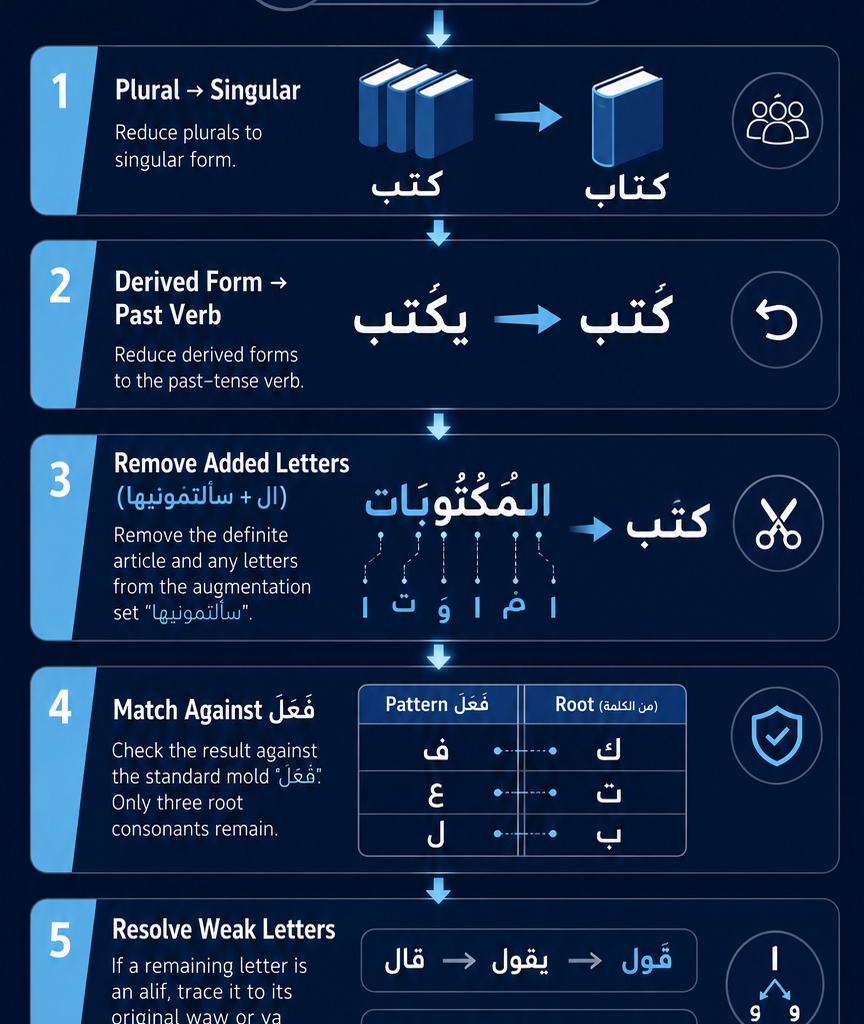
- Reduce plurals to singular form, If the word is plural, return it to its singular before anything else, since plural patterns add their own letters.
- Reduce derived forms to the past-tense verb, Present tense, imperative, verbal nouns, and participles all get traced back to the simple past (الفعل الماضي), where the root becomes visible.
- Remove the definite article and any added letters, Strip ال (the) if present, then remove any letters belonging to the augmentation set مجموعة “سألتمونيها” (a mnemonic word containing every letter that can be an added, non-root letter: س ا ل ت م و ن ي ه ا).
- Check the result against the standard mold فَعَلَ, Match what remains, letter for letter, against the base trilateral pattern to confirm only three root consonants are left.
- Resolve weak letters using the present tense or verbal noun, If a remaining letter is an alif, trace it to its original waw or ya as described above.
Applying this five-step sequence to real examples makes the abstract process concrete — here’s how it plays out on words that look nothing alike on the surface but resolve to clean three-letter roots.
Read also about: 5 steps to learn Arabic
Experience Kalimah Center Classes
Watch real excerpts from our live sessions at Kalimah Center and see how we bring learning to life. These clips highlight our interactive, student-centered teaching approach across all our courses—designed to keep learners engaged, motivated, and actively involved every step of the way.
Master Arabic with Kalimah Center
Join our expert-led online classes and start your journey toward Arabic fluency today.
Book Your Free TrialWorked Examples of Root Extraction
| Word | Meaning | Process | Root |
| اسْتَغْفَرَ | he sought forgiveness | Strip ا-س-ت (augmentation letters from the istafʿala mold) | غ-ف-ر |
| اشْتَرَى | he bought | Strip ا-ت (augmentation), remaining matches فَعَل | ش-ر-ي → ش-ر-ى (resolved via masdar شِراء) |
| اسْتَخْرَجَ | he extracted | Strip ا-س-ت, remaining خ-ر-ج matches فَعَل exactly | خ-ر-ج |
| المُزَارِعُونَ | the farmers | Remove ال and plural ending, singular مُزَارِع, strip م-ا augmentation | ز-ر-ع |
| سُرَّ | he was pleased | Undo the doubling (shadda) to reveal the repeated letter | س-ر-ر |
A common mistake at this stage: learners stop after removing the obvious prefix and assume they’ve found the root, without checking the result against the فَعَلَ mold.
A word like اسْتَخْرَجَ initially looks like it might reduce to a four-letter root if you only strip the alif — the mold check is what confirms خ-ر-ج is correct and that the س and ت belong to the istafʿala pattern, not to the root itself.
Read also: The Imperative In Arabic – A Complete Guide With To Forms and Usages Examples
What Is the “سألتمونيها” Method for Spotting Added Letters?
The method uses the mnemonic word سَأَلْتُمُونِيهَا (literally “you asked me it”), which includes every consonant that Arabic morphology allows as an added, non‑root letter: س، ا، ل، ت، م، و، ن، ي، ه، ا.
How to use it
- If a letter in a word matches one of the letters in سَأَلْتُمُونِيهَا and that letter is not needed to complete the basic pattern فَعَلَ, then it is likely an augmentation (a non‑root letter).
- Treat the mnemonic as a filtering tool: it greatly narrows down which letters may be augmentations, but it does not replace full analysis.
Limitations and practice advice
This mnemonic is a memorization aid, not a foolproof rule; you must still check the word’s pattern and context to confirm the root.
Many learners get stuck on extraction exercises during self‑study. Working with a tutor who corrects your attempts in real time prevents repeated errors and can save weeks of practice.
Why Arabic Dictionaries Are Organized by Root
Classical and modern Arabic dictionaries (e.g., Lisan al‑Arab, Al‑Mu’jam al‑Wasit) index words by their three‑consonant root rather than by the written word form.
To look up a derived form like المُسْتَقْبَل (the future), you first reduce it to its root ق‑ب‑ل, then find that root’s entry. The entry lists many related derivatives that may look grammatically unrelated but share the core sense of “coming before” or “facing.”
Why this matters for learners
- This system differs from English dictionaries and commonly surprises beginners: the first visible letter of a word is often an added prefix, not the root consonant.
- Therefore, searching by the word’s first letter usually fails; you must extract the root before consulting the dictionary.
- Root extraction is not optional background knowledge — it’s the essential skill required to use an Arabic dictionary effectively.
Why Arabic Root Letters Matter for Reading the Quran
Recognising roots helps a reader identify unfamiliar words quickly by linking them to known roots, instead of memorising each surface form separately.
One root can appear many times across the Quran in varied grammatical shapes — verbs, nouns, participles, plurals — and a reader who has internalised the root immediately recognises the whole family.
Connections with related Quranic disciplines
- Tajweed: root awareness supports correct pronunciation and informed recitation choices.
- Tafsir: exegetes often clarify a verse by tracing key words back to their root meanings.
- Morphology (sarf): it explains how molds attach to roots to generate different word forms.
A focused Quran and Tajweed course pairs root analysis with recitation practice, because analysing roots and practising tajweed strengthen each other rather than developing separately.
Inside Kalimah Center: Moments from Our Courses
Get a glimpse into the vibrant learning experience at Kalimah Center. These snapshots capture real moments from our live classes—where students engage deeply, connect with passionate instructors, and grow in a welcoming, supportive environment.
Here Are The Reviews On Our Courses:
Our students frequently commend the excellence of our courses and the commitment shown by our instructors. You can read their complete reviews on Trustpilot.
Read more reviews on Trustpilot

Master Arabic Root Letters with Expert Guidance at Kalimah Center
Learning Arabic root letters is one of the most powerful steps toward understanding how the Arabic language works. Once you recognize roots and patterns, thousands of Arabic words become easier to understand, remember, and connect together.
However, many learners struggle to identify roots correctly because they study vocabulary in isolation without a structured learning path.
That is why guided instruction can make a significant difference in how quickly and accurately you develop your Arabic skills.
At Kalimah Center, we help students move beyond memorization and build a deeper understanding of Arabic through personalized online courses taught by experienced instructors.
Read also: Arabic Morphology For Beginners – A Complete Guide To Sarf
Online Arabic Courses
If you want to understand Arabic root letters, sentence structures, grammar patterns, and authentic Arabic texts, the Arabic courses provides a clear step-by-step roadmap.
What makes this course different?
- 16 progressive levels designed for all learning stages.
- More than 400 hours of one-to-one instruction.
- Personalized lessons based on your individual level.
- Interactive learning tools that increase engagement.
- Experienced teachers who provide direct feedback and support.
- Strong focus on reading, comprehension, grammar, and practical language use.

As your understanding of Arabic roots grows, you will be able to recognize connections between words and improve your overall language proficiency much faster.
Online Quran With Tajweed Course
Many Quran learners encounter Arabic root letters repeatedly while reading Quranic verses. Understanding these roots helps learners connect related words and gain a deeper appreciation of Quranic meanings.
Through this course, students can:
- Learn correct Quran recitation step by step.
- Study Tajweed from beginner to advanced levels.
- Improve pronunciation with qualified instructors.
- Build a stronger connection with the Quran.
- Learn with Ijazah-certified teachers.
- Progress through a structured 13-level curriculum.
Combining Quran study with an understanding of Arabic word roots can make Quran reading more meaningful and rewarding.
Online Arabic Course for Kids
Children learn languages best when lessons are engaging, interactive, and age appropriate. Arabic course for Kids introduces Arabic in a way that helps young learners gradually understand vocabulary, sounds, and word patterns without feeling overwhelmed.
By learning Arabic from an early age, children build a stronger foundation that supports future Quran and Arabic studies.

Why Learners Choose Kalimah Center
Students from different countries choose Kalimah Center because they want more than isolated lessons. They want a clear learning journey that helps them achieve measurable progress.
Some of the advantages include:
- One-to-one live online classes.
- Flexible scheduling options.
- Highly qualified instructors.
- Structured learning pathways.
- Interactive learning experience.
- Continuous assessment and feedback.
- Programs suitable for adults and children.
What Our Students Say
Many students join Kalimah Center with limited Arabic knowledge and quickly discover that understanding grammar, vocabulary, and Arabic root letters becomes much easier with professional guidance.
You can explore real student reviews and success stories to see how learners have improved their Arabic skills, Quran recitation, and confidence through our programs.

📚 Explore Our Courses:
Online Arabic Course: Tailored to your level, our comprehensive Arabic program includes 16 teaching levels and 400+ hours of personalized sessions.
Online Quran With Tajweed Course: Perfect for non-Arabic speakers, our course spans 13 levels and equips you with Tajweed mastery from beginner to advanced.
Online Arabic Course For Kids: Nurture your child’s love for Arabic with our engaging and structured program, available in 24 levels for primary, intermediate, and secondary stages.
🚀 Start Your Free Trial Today! 🚀
Don’t miss out on this life-changing opportunity to deepen your faith and knowledge. Sign up now for your free trial and take the first step towards becoming a better practicing Muslim with Kalimah Center!
Master Arabic with Kalimah Center
Join our expert-led online classes and start your journey toward Arabic fluency today.
Book Your Free TrialConclusion
Arabic root letters are the consonantal core that every derived word in the language is built from — almost always three letters, occasionally four or five, and never reducible any further without losing the original meaning.
Once you can apply the stripping process (tajrid) reliably — removing plurals, returning to the past tense, stripping augmentation letters, and checking against the فَعَلَ mold — unfamiliar words stop being isolated obstacles and start being recognizable members of a family you already know.
This is the actual mechanism behind Arabic’s reputation for “logical” vocabulary, and it’s why dictionary literacy, Quranic reading fluency, and grammar study all converge on the same starting point: learn the root, and the rest of the word family becomes predictable rather than memorized.
Frequently Asked Questions
What are Arabic root letters?
Arabic root letters are the original consonants of a word — usually three — that carry its core meaning and remain present in every word derived from that root.
They form the basis for organizing Arabic dictionaries and for understanding how vocabulary expands through prefixes, suffixes, and vowel patterns.
How many root letters does most Arabic words have?
Most Arabic words are built on a three-letter (trilateral) root, which is the dominant pattern in the language.
A smaller number of words use four-letter or five-letter roots, and two-letter roots exist but are rare and debated among linguists.
How do I find the root of an Arabic word?
You find the root by reducing the word to its past-tense verb form, removing the definite article and any letters from the augmentation set “سألتمونيها,” and checking the remaining letters against the base فَعَلَ mold.
Weak letters like alif are resolved by tracing the word back to its present tense or verbal noun.
Is the alif always part of the root in Arabic words?
No, the alif is never an original root letter — it’s always a converted waw or ya.
You uncover the true letter by checking the word’s present-tense form; for example, قَالَ traces to ق-و-ل because its present tense يَقُول reveals the waw.
Why are Arabic dictionaries organized by root instead of alphabetically?
Arabic dictionaries group every derived word under its three-letter root entry because the first letters visible in a word are often added prefixes rather than the root’s starting consonant.
This means you must extract the root before you can locate a word, which is why root literacy is a prerequisite for dictionary use, not an optional skill.
Can an Arabic root have only two letters?
Yes, though two-letter roots are rare and their status is debated among linguists — some argue they represent an older, more basic layer of the language that the dominant three-letter roots later developed from, while others maintain the trilateral root was original.
Either way, two-letter roots make up a small minority of the language compared to trilateral roots.