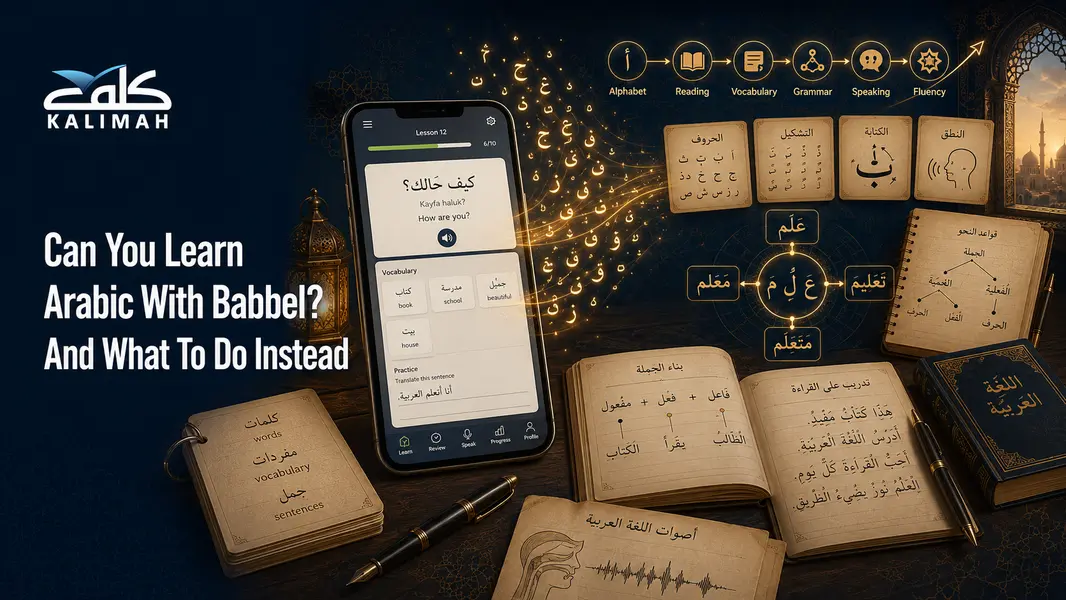
If you’ve been searching for a way to learn Arabic with Babbel, you’ve already hit the same wall thousands of learners hit before you: Babbel doesn’t offer an Arabic course. And if you’re still asking “can I learn Arabic with Babbel?” — the short answer is no, but the longer answer is far more useful.
This article explains exactly why Babbel skipped Arabic, what that means for your learning plan, and — more importantly — what actually works for learning Arabic as a native English speaker. One of those options is Kalimah Center, a specialized Arabic academy that teaches what general-purpose apps simply cannot.
What You’ll Learn in This Article
- Why Babbel does not offer an Arabic course and whether that’s likely to change
- How Arabic differs from the European languages apps like Babbel are designed for
- The honest strengths and limitations of general language-learning apps for Arabic
- What a specialized Arabic academy like Kalimah Center offers that apps don’t
- The smartest path forward if your goal is to actually speak, read, or understand Arabic
Why Babbel Doesn’t Offer an Arabic Course?
Babbel is one of the most popular language-learning platforms in the world, with over 10 million active subscribers and courses in 14 languages — all of them European. French, German, Italian, Spanish, Polish, Swedish, Turkish, and several others are available. Arabic is not.
This isn’t an oversight. It’s a deliberate product decision rooted in how hard Arabic genuinely is to teach at scale.
1. Arabic Is Structurally Different from Every Language Babbel Teaches
Every language currently on Babbel shares a common ancestor with English or is at least written in a Latin-adjacent or phonetically familiar script. Arabic is different in nearly every dimension that matters for a language app:
Script: Arabic reads right to left. Letters change shape depending on their position in a word.
There are no capital letters, and written Arabic often omits short vowels entirely — meaning a learner must infer pronunciation from context and pattern recognition, not from what’s on the page.
Grammar: Arabic uses a root-and-pattern system that has no equivalent in English. A single three-letter root like k-t-b generates dozens of words: kitab (book), kataba (he wrote), maktaba (library), maktub (written). Building vocabulary means learning root logic, not memorizing isolated words.
Pronunciation: Arabic has sounds — the ayn (ع), the ghayn (غ), the emphatic consonants — that don’t exist in English and cannot be approximated by the audio repetition methods apps typically use. Correct pronunciation requires real-time feedback from a qualified instructor.
Dialects: Egyptian Arabic, Levantine Arabic, Gulf Arabic, and Moroccan Arabic are not merely accents — they differ significantly in vocabulary and grammar.
A learner who completes an Egyptian Arabic course may struggle to follow Moroccan speech. This fragmentation makes a single Arabic product commercially complicated for a platform that sells one course per language.
The U.S. Foreign Service Institute rates Arabic as a Category IV language — the hardest category — estimating 2,200 classroom hours for an English speaker to reach professional proficiency.
For context, Spanish and French are Category I, requiring roughly 600–750 hours. Babbel’s methods were built for Category I and II languages. Arabic sits in a different universe.
Every learner who tries to learn Arabic with Babbel eventually reaches the same conclusion: the platform wasn’t built for this language — and no workaround changes that.
2. Many Arabic Apps Treat Arabic Like a Slightly Harder Spanish
This is the core problem with applying a generic app framework to Arabic. Some existing Arabic apps are essentially Spanish apps in Arabic dress — vocabulary flashcards, audio repetition, multiple choice.
These methods work when the target language is structurally similar to English. They break down when the script is different, the grammar system is different, and the sounds are different.
If you’ve tried Duolingo’s Arabic or a basic flashcard app and felt like you weren’t really learning — this is why. The method didn’t match the language.
Read Also: Is the Drops App Good for Learning Arabic?
What General Language Apps Are Good At?
Before dismissing apps entirely, it’s worth being honest about what they actually do well — because the right tool depends on your goal.
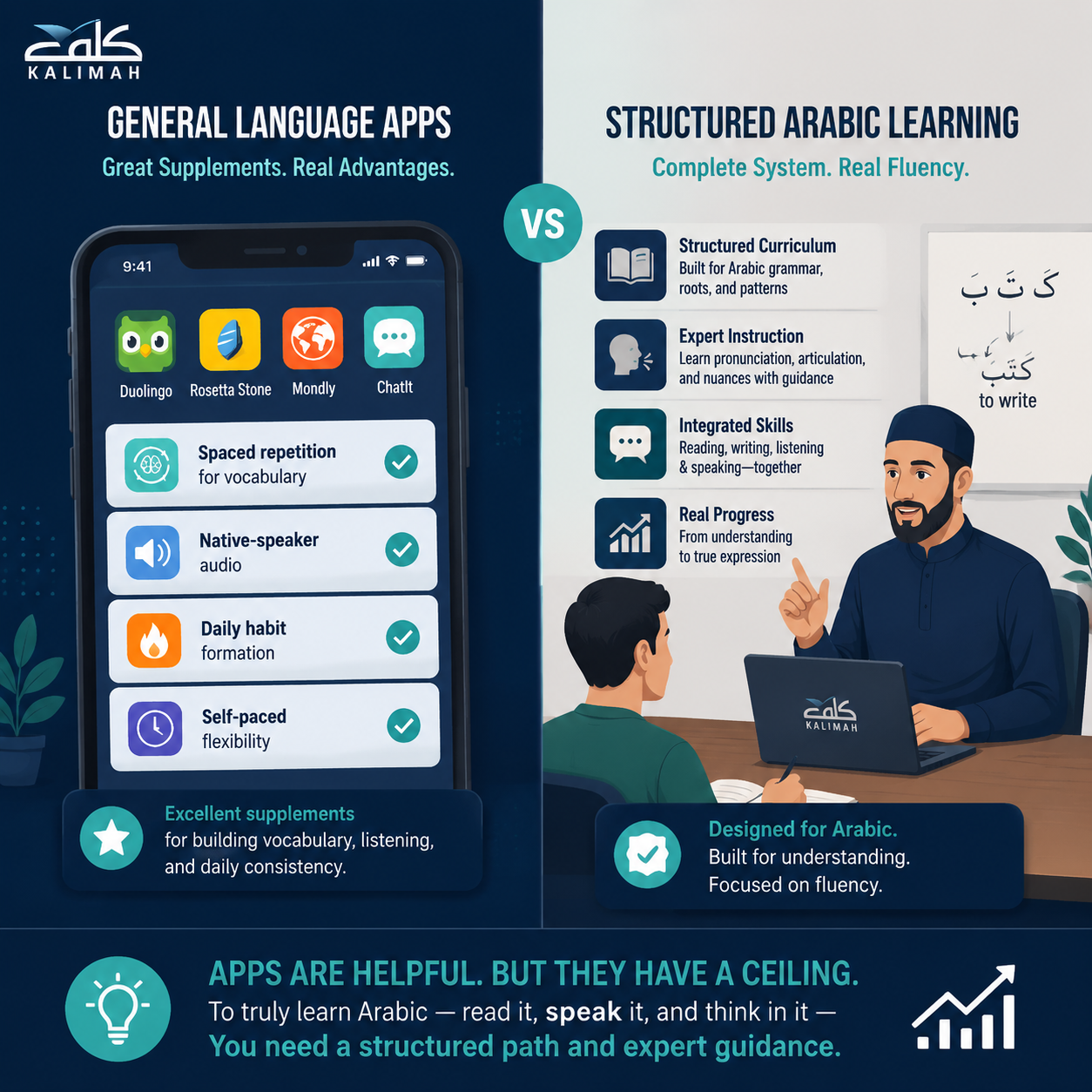
Apps like Duolingo, Rosetta Stone, Mondly, and the ChatIt platform (reviewed in detail above) are well-designed for European languages. Their shared strengths include:
- Spaced repetition for vocabulary: presenting words at increasing intervals to lock them into long-term memory
- Native-speaker audio: building familiarity with natural pronunciation
- Daily habit formation: short lessons designed to maintain consistency
- Self-paced flexibility: learn on your commute, in breaks, anywhere
These are real advantages. But every one of them has a ceiling when applied to Arabic:
Spaced repetition works for isolated vocabulary — but Arabic vocabulary is not isolated. Words are generated from root patterns, and learning without understanding the root is like memorizing a phone book without a number system. You accumulate words but can’t generate new ones.
Native-speaker audio is useful, but Arabic has sounds that require a teacher to physically demonstrate articulation — the position of the tongue and throat for letters like qaaf (ق) or khaa (خ) cannot be learned by imitation alone without correction.
Self-paced flexibility is excellent for consistent learners with clear goals — but without a structured curriculum matched to Arabic’s specific grammar sequence, self-paced study in Arabic often stalls at the intermediate level. Learners can read slowly but can’t construct sentences, or can converse but can’t read.
The honest summary: apps are excellent supplements. They are not sufficient as a primary learning method for Arabic — and for the Arabic script alone, most require a qualified instructor to supplement them from the start.
If you want to learn Arabic online at a level that actually moves the needle, you need more than an app. You need a structured curriculum taught by a specialist.
Read Also: Arabic Numbers History
Experience Kalimah Center Classes
Watch real excerpts from our live sessions at Kalimah Center and see how we bring learning to life. These clips highlight our interactive, student-centered teaching approach across all our courses—designed to keep learners engaged, motivated, and actively involved every step of the way.
Master Arabic with Kalimah Center
Join our expert-led online classes and start your journey toward Arabic fluency today.
Book Your Free TrialWhat Kalimah Center Offers That Babbel Never Could
Kalimah Center is not a language app. It is a specialized Arabic academy — and that distinction matters more for Arabic than for almost any other language.
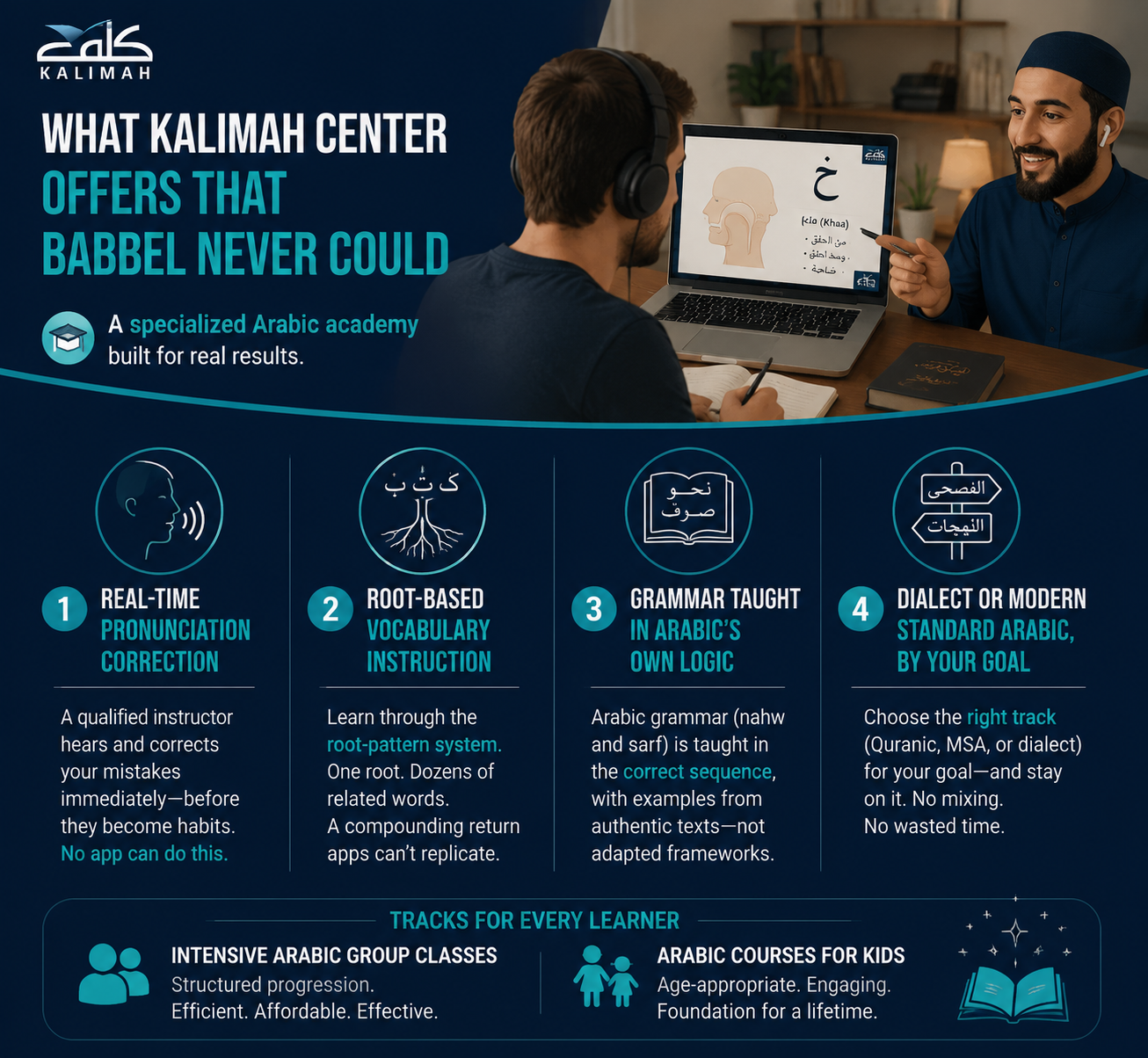
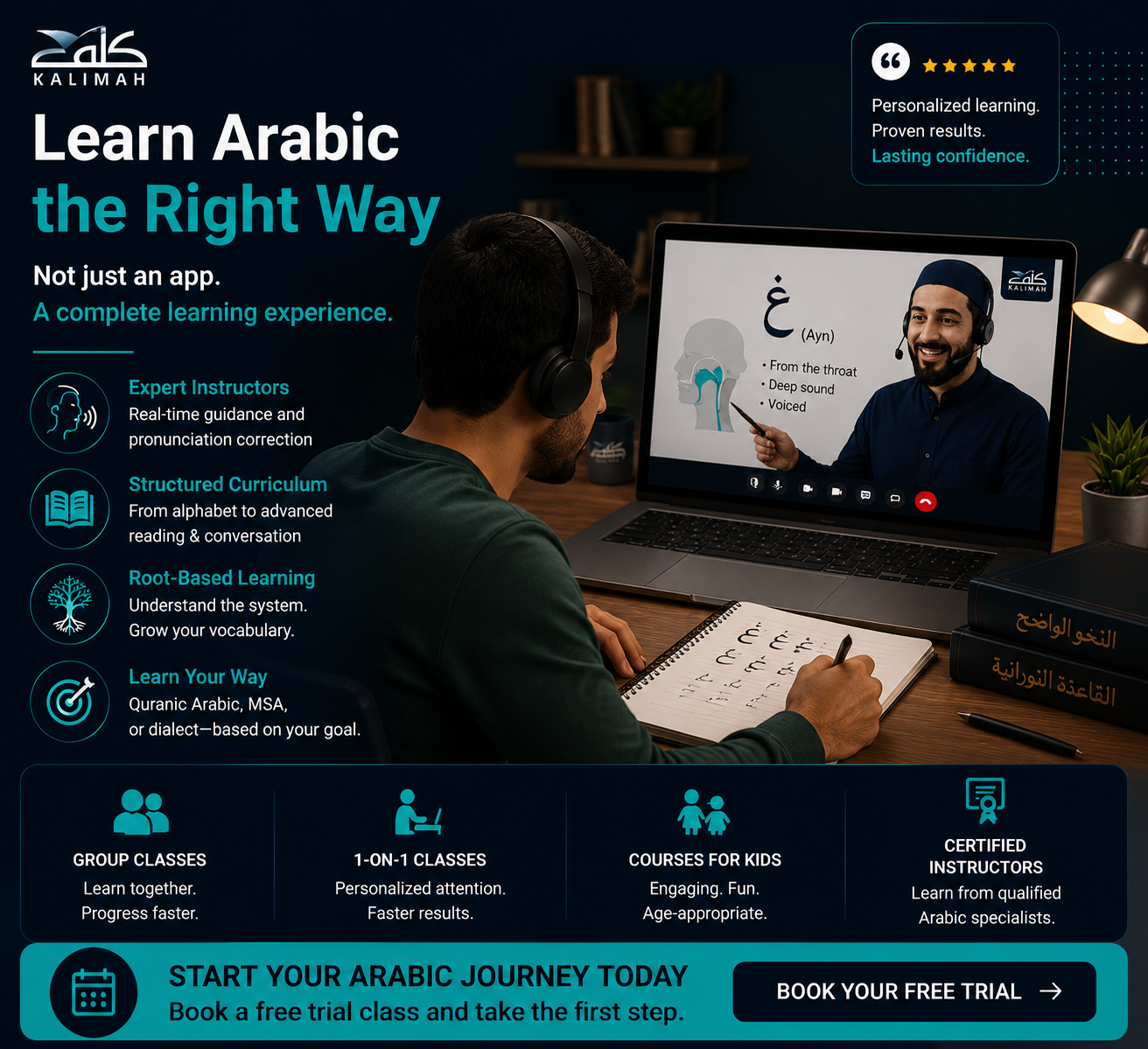
Where apps offer one-size-fits-all content built for the broadest possible audience, Kalimah Center’s curriculum is designed specifically for non-native Arabic learners — with a clear sequence from alphabet to advanced reading and conversation.
Here is where a dedicated academy like Kalimah Center separates from any app on the market:
1. Real-time pronunciation correction
A qualified instructor hears you mispronounce a letter and corrects it immediately — at the point of error, before the mistake becomes a habit. No app can do this.
2. Root-based vocabulary instruction
Rather than presenting Arabic words as isolated flashcard items, structured academy instruction builds vocabulary through the root-pattern system.
This means that once you learn one root, you can infer dozens of related words — a compounding return that apps cannot replicate.
3. Grammar taught in Arabic’s own logic
Arabic grammar (nahw and sarf) follows an internal logic completely different from English. It must be taught in the correct sequence, with examples drawn from authentic Arabic texts.
Kalimah Center’s instructors teach this sequence — not an adapted Spanish grammar framework.
4. Dialect or Modern Standard Arabic, by your goal
If your goal is to understand the Quran, you need Classical/Quranic Arabic. If your goal is to speak with people in Egypt or the Gulf, you need the appropriate dialect. A specialist academy helps you choose the right track and stay on it — rather than mixing approaches that slow progress.
Kalimah Center offers dedicated tracks for adults and children alike, including intensive Arabic group classes for learners who want structured progression at an efficient price point, and Arabic courses for kids that introduce the language in an age-appropriate, engaging format.
Read Also: Learn Arabic in 1 Hour a Day
Start Learning Arabic The Right Way With Kalimah Center
If you came looking to learn Arabic with Babbel, you already know the first answer: it doesn’t exist. But now you know something more important — why the app-only approach doesn’t work for Arabic even where apps do exist.
Arabic rewards the learner who takes the time to learn it correctly from the start. A few months of structured instruction with a qualified teacher at Kalimah Center will advance your Arabic further than years of sporadic app use — because the method matches the language.
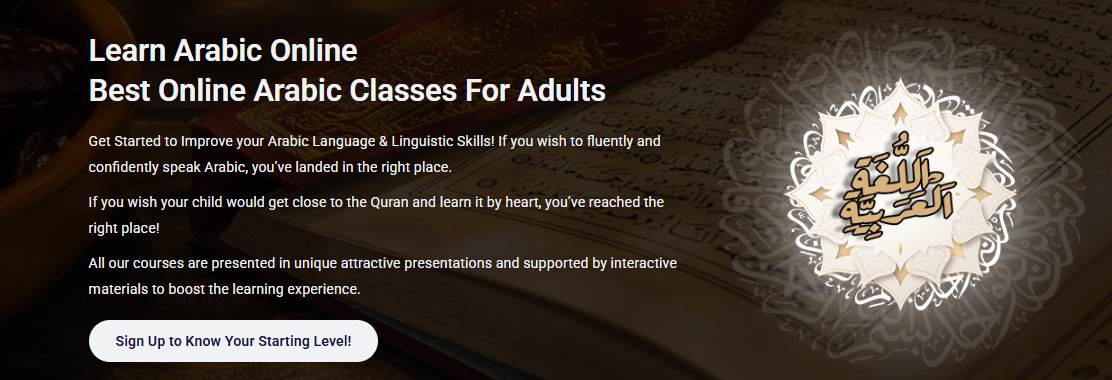
Kalimah Center is where serious Arabic learners begin. Don’t waste months on a workaround when the real thing is available.
Explore Our Courses:
- Best Online Arabic Classes for Adults: for adults who want intensive, structured progress.
- Intensive Arabic Group Classes: for learners who want affordable group learning.
- Learn Arabic Online for Kids: for children beginning their Arabic journey.
Inside Kalimah Center: Moments from Our Courses
Get a glimpse into the vibrant learning experience at Kalimah Center. These snapshots capture real moments from our live classes—where students engage deeply, connect with passionate instructors, and grow in a welcoming, supportive environment.
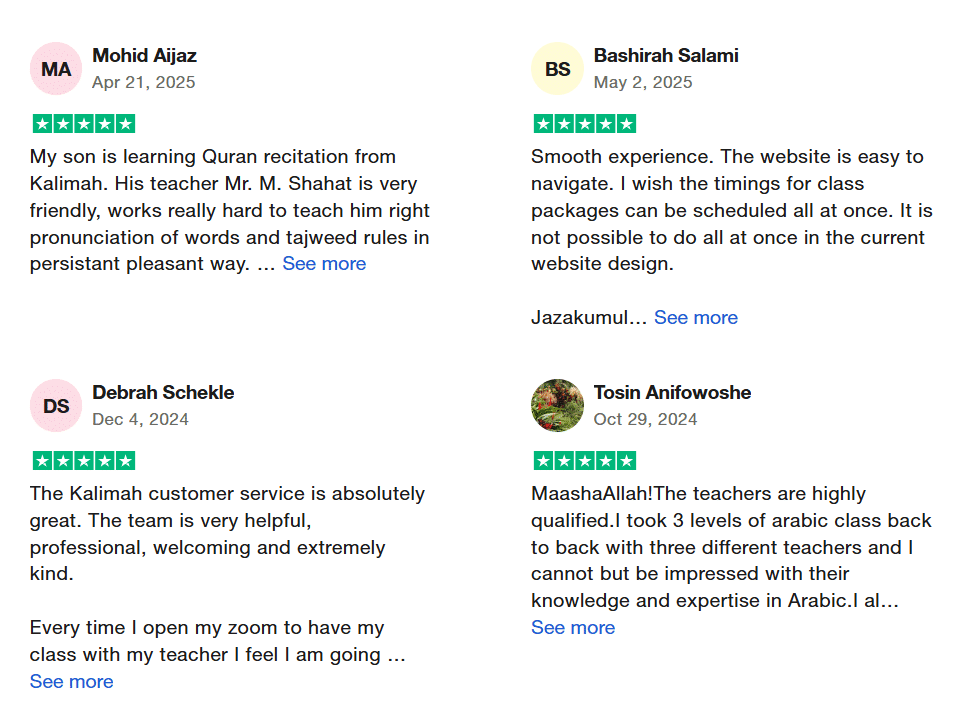
Here Are The Reviews On Our Courses:
Our students frequently commend the excellence of our courses and the commitment shown by our instructors. You can read their complete reviews on Trustpilot.
Read more reviews on Trustpilot
🚀 Start Your Free Trial Today! 🚀
Don’t miss out on this life-changing opportunity to deepen your faith and knowledge. Sign up now for your free trial and take the first step towards becoming a better practicing Muslim with Kalimah Center!
Master Arabic with Kalimah Center
Join our expert-led online classes and start your journey toward Arabic fluency today.
Book Your Free TrialConclusion
Anyone who set out to learn Arabic with Babbel quickly discovers that the option simply doesn’t exist — and that is unlikely to change, because Arabic’s structural complexity sits outside what app-based language learning was designed to handle. For European languages, apps like Babbel are genuinely effective.
For Arabic, they are at best a partial supplement and at worst a path to years of slow, plateaued progress.
The learners who advance in Arabic fastest are those who learn it in a structured, specialist environment from the start — with real-time correction, a curriculum built around Arabic’s own grammar logic, and an instructor who has actually taught non-native speakers through the full arc from alphabet to fluency.
Kalimah Center exists for exactly this purpose. Whether you’re a complete beginner, a parent looking for Arabic classes for your child, or an adult who’s tried apps and stalled — Kalimah Center offers the structure and expertise that turns Arabic learning from a frustrating experiment into measurable, lasting progress.
Frequently Asked Questions About Learning Arabic with Babbel
Here are the most common questions learners ask when they discover Babbel doesn’t offer Arabic — along with honest, practical answers.
1. Does Babbel offer an Arabic course?
No. As of now, Babbel does not offer an Arabic course. Babbel’s catalog covers 14 languages, all of them European or European-adjacent. Arabic’s unique script, grammar system, and dialect complexity place it outside the product model Babbel currently uses.
2. Will Babbel add Arabic in the future?
There is no confirmed timeline for Babbel to add Arabic. Given that Arabic requires a fundamentally different pedagogical approach from the languages Babbel currently offers, a credible Arabic course would require significant curriculum investment — not simply an extension of existing methods.
3. What is the best alternative to Babbel for learning Arabic?
The most effective alternative for serious learners is a specialized Arabic academy like Kalimah Center, which offers structured curricula taught by qualified instructors who specialize in teaching non-native speakers. For supplementary self-study, platforms like Madinah Arabic and ArabicPod101 provide additional practice, but should be used alongside live instruction, not as replacements.
4. Can I learn Arabic with Duolingo instead of Babbel?
Duolingo offers a basic Arabic course that teaches the script and some vocabulary. It is a useful starting point for alphabet recognition and building a daily learning habit. However, it does not provide the grammatical depth, pronunciation correction, or structured progression needed for genuine Arabic fluency. Use it as a warm-up tool, not a primary course.
5. How long does it take to learn Arabic?
The U.S. Foreign Service Institute estimates approximately 2,200 classroom hours for an English speaker to reach professional-level Arabic proficiency. With consistent structured study — daily sessions with a qualified instructor — most learners achieve basic reading and conversational ability within 12 to 24 months. The pace depends heavily on instruction quality and daily practice consistency.
6. Is Arabic too hard to learn as an English speaker?
Arabic is difficult relative to European languages, but it is learnable by any motivated adult with the right instruction. The difficulty is largely methodological — learners who use methods designed for other languages on Arabic will struggle. Learners who use a curriculum built specifically for Arabic, with a qualified instructor, progress steadily and consistently. Kalimah Center is designed precisely for this: teaching Arabic the way Arabic needs to be taught.