What was the very first word Allah revealed to Prophet Muhammad ﷺ? It was not “pray” or “fast.” It was “Read!” (Iqra’), a clear sign of how central learning is in Islam.
If you are looking for Quran verses about knowledge in Arabic, you likely want more than a list. You want the original Arabic, an accurate translation, and a simple explanation to share with your children.
This guide collects the most quoted Quran verses about knowledge in Arabic, explains key words like ‘ilm, and shows how kids and adults can turn them into a daily habit.
Below are the ayat teachers quote most when they speak about learning. Reading these Quran verses about knowledge in Arabic, not only in translation, helps you notice root words that English hides.
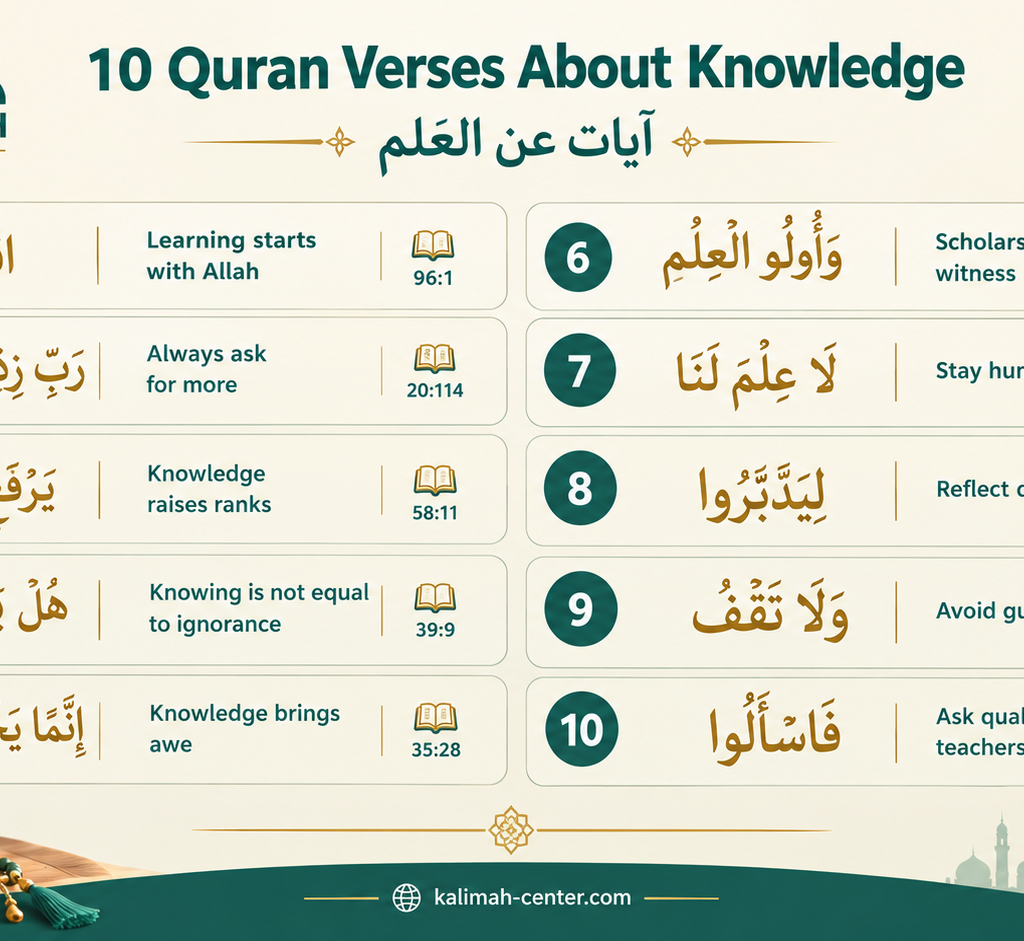
1. Read! The First Revelation (Surah Al-Alaq 96:1–5)
These five verses were the first ever revealed, in the Cave of Hira, when Angel Jibreel came to the Prophet ﷺ. He could not read or write, yet the very first command he received from his Lord was to read.
اقْرَأْ بِاسْمِ رَبِّكَ الَّذِي خَلَقَ خَلَقَ الْإِنسَانَ مِنْ عَلَقٍ اقْرَأْ وَرَبُّكَ الْأَكْرَمُ الَّذِي عَلَّمَ بِالْقَلَمِ عَلَّمَ الْإِنسَانَ مَا لَمْ يَعْلَمْ
Iqra’ bismi Rabbika alladhee khalaq. Khalaqal-insaana min ‘alaq. Iqra’ wa Rabbukal-Akram. Alladhee ‘allama bil-qalam. ‘Allamal-insaana maa lam ya’lam.
“Read in the name of your Lord who created. Created man from a clinging substance. Read, and your Lord is the Most Generous, who taught by the pen, taught man that which he knew not.” (Quran 96:1–5)
Allah links reading to His name, His creation, and His generosity. He mentions the pen as the tool that preserves knowledge, then reminds us that everything humans know is a gift He taught us after we knew nothing.
The command iqra’ comes twice, and the root ع-ل-م appears three times in two verses. Learning starts with Allah’s name and leads back to Him.
2. “My Lord, Increase Me in Knowledge” (Surah Ta-Ha 20:114)
The Prophet ﷺ used to hurry to repeat the revelation before Jibreel finished reciting it. Allah told him not to rush, and instead taught him a short du’a that every learner can carry for life.
وَقُل رَّبِّ زِدْنِي عِلْمًا
Wa qur-Rabbi zidnee ‘ilmaa. “And say: My Lord, increase me in knowledge.” (Quran 20:114)
Scholars note that knowledge is the only thing the Prophet ﷺ was commanded to ask for more of. The word zidnee (increase me) shows that learning never reaches an end; there is always another level to reach.
The Prophet ﷺ was told to ask for more knowledge, not more wealth. This three-word du’a is ideal for children to say before lessons.
3. Allah Raises People of Knowledge (Surah Al-Mujadila 58:11)
This verse comes after Allah teaches the believers good manners in gatherings, such as making room for others. He then reveals the reward for those who combine sincere faith with beneficial knowledge.
يَرْفَعِ اللَّهُ الَّذِينَ آمَنُوا مِنكُمْ وَالَّذِينَ أُوتُوا الْعِلْمَ دَرَجَاتٍ
Yarfa’il-laahul-ladheena aamanoo minkum walladheena ootul-‘ilma darajaat.
“Allah will raise those who have believed among you and those who were given knowledge, by degrees.” (Quran 58:11)
Rank with Allah is not earned through wealth or lineage, but through faith joined with knowledge. The verse ends by reminding us that Allah is fully aware of what we do, so intention and action both count.
Faith and knowledge are paired here. The plural darajat points to many levels of honor, in this life and the Hereafter.
4. Those Who Know and Those Who Do Not (Surah Az-Zumar 39:9)
The verse opens by describing a believer who stands in prayer at night, prostrating, fearing the Hereafter and hoping for Allah’s mercy. It then asks a question that has only one honest answer.
قُلْ هَلْ يَسْتَوِي الَّذِينَ يَعْلَمُونَ وَالَّذِينَ لَا يَعْلَمُونَ ۗ إِنَّمَا يَتَذَكَّرُ أُولُو الْأَلْبَابِ
Qul hal yastawil-ladheena ya’lamoona walladheena laa ya’lamoon; innamaa yatadhakkaru ulul-albaab.
“Say: Are those who know equal to those who do not know? Only people of understanding will remember.” (Quran 39:9)
Because the question follows a description of worship, the “knowing” person here is the one whose knowledge leads to devotion. Knowledge that leaves the heart unchanged does not earn this praise.
The answer is obvious, and that is the point. Yet only ulul-albab, people of real understanding, take the reminder to heart.
5. Knowledge Leads to Awe of Allah (Surah Fatir 35:28)
Just before this verse, Allah describes fruits of different colors, mountains with white and red streaks, and people and animals of many shades. He then names who truly benefits from these signs.
إِنَّمَا يَخْشَى اللَّهَ مِنْ عِبَادِهِ الْعُلَمَاءُ
Innamaa yakhshal-laaha min ‘ibaadihil-‘ulamaa’. “Only those of His servants who have knowledge fear Allah.” (Quran 35:28)
The word innamaa (only) limits true reverence to people of knowledge. The context shows that studying creation, not only books, can fill the heart with awe of the Creator’s power and wisdom.
The more we learn about Allah and His creation, the deeper our khashyah, a reverent awe. True knowledge softens the heart instead of feeding the ego.
6. People of Knowledge Bear Witness (Surah Al Imran 3:18)
This ayah records the greatest testimony in existence: that there is no god but Allah. What is remarkable is who Allah chose to mention alongside Himself in giving this testimony.
شَهِدَ اللَّهُ أَنَّهُ لَا إِلَٰهَ إِلَّا هُوَ وَالْمَلَائِكَةُ وَأُولُو الْعِلْمِ
Shahidal-laahu annahu laa ilaaha illaa huwa wal-malaa’ikatu wa ulul-‘ilm.
“Allah witnesses that there is no deity except Him, and so do the angels and those of knowledge.” (Quran 3:18)
Scholars such as Ibn al-Qayyim used this verse as proof of the honor of knowledge. Allah begins with Himself, then the angels, then people of knowledge, and accepts their witness to His Oneness.
People of knowledge are mentioned right after the angels in the greatest testimony of all, a rare honor for learning.
7. “We Have No Knowledge Except What You Taught Us” (Surah Al-Baqarah 2:32)
When Allah told the angels He would place a successor on earth, He taught Adam the names of all things. He then asked the angels to name them, and this was their humble reply.
قَالُوا سُبْحَانَكَ لَا عِلْمَ لَنَا إِلَّا مَا عَلَّمْتَنَا ۖ إِنَّكَ أَنتَ الْعَلِيمُ الْحَكِيمُ
Qaaloo subhaanaka laa ‘ilma lanaa illaa maa ‘allamtanaa; innaka antal-‘Aleemul-Hakeem.
“They said: Exalted are You; we have no knowledge except what You have taught us. You are the Knowing, the Wise.” (Quran 2:32)
Even the angels admitted that all their knowledge came from Allah. Adam’s honor over them was shown through knowledge, which tells us how highly Allah values learning in human life. After Allah taught Adam “the names of all things” (2:31), the angels answered with humility, a model for every student.
8. The Quran Was Revealed for Reflection (Surah Sad 38:29)
Why did Allah send down the Quran? This verse answers directly. It describes the Quran as a blessed Book and explains the two goals behind its revelation: reflection and remembrance.
كِتَابٌ أَنزَلْنَاهُ إِلَيْكَ مُبَارَكٌ لِّيَدَّبَّرُوا آيَاتِهِ
Kitaabun anzalnaahu ilayka mubaarakul-liyaddabbaroo aayaatih. “A blessed Book We revealed to you, that they might reflect upon its verses.” (Quran 38:29)
The word mubarak means full of lasting blessing. Its verses are meant to be pondered, not only recited, which is why learning their Arabic meaning opens a door that translation alone cannot.
Tadabbur means deep reflection. Recitation is blessed, but understanding the words is what lets the message change us.
9. Do Not Follow What You Do Not Know (Surah Al-Isra 17:36)
Among the Quran verses about knowledge in Arabic, this one sets a clear rule for thinking and speaking. It comes in a list of commands that shape a believer’s character and daily conduct.
وَلَا تَقْفُ مَا لَيْسَ لَكَ بِهِ عِلْمٌ
Wa laa taqfu maa laysa laka bihee ‘ilm. “And do not pursue that of which you have no knowledge.” (Quran 17:36)
The verb taqfu covers following, saying, or judging anything without proof. Every claim we repeat should rest on real knowledge, because the faculties Allah gave us will testify about how we used them.
The verse continues that hearing, sight, and heart will all be questioned. It is a timeless lesson for kids growing up with social media rumors.
10. Ask the People of Knowledge (Surah An-Nahl 16:43)
Some people in Makkah objected that a messenger should not be a human being. Allah answered that all earlier messengers were men, and told them to ask those who knew the previous scriptures.
فَاسْأَلُوا أَهْلَ الذِّكْرِ إِن كُنتُمْ لَا تَعْلَمُونَ
Fas’aloo ahladh-dhikri in kuntum laa ta’lamoon. “So ask the people of the message if you do not know.” (Quran 16:43)
Scholars took a general principle from this verse: whoever does not know should ask someone who does. Asking is not a weakness; it is the Quranic method of learning, and it protects us from mistakes.
Knowledge passes through qualified teachers. If you want a tutor to correct your recitation of these Quran verses about knowledge in Arabic, Kalimah’s Tajweed tutors online teach one-on-one.
Experience Kalimah Center Classes
Watch real excerpts from our live sessions at Kalimah Center and see how we bring learning to life. These clips highlight our interactive, student-centered teaching approach across all our courses—designed to keep learners engaged, motivated, and actively involved every step of the way.
Master Arabic with Kalimah Center
Join our expert-led online classes and start your journey toward Arabic fluency today.
Book Your Free TrialWhat Does ‘Ilm Mean in the Quran?
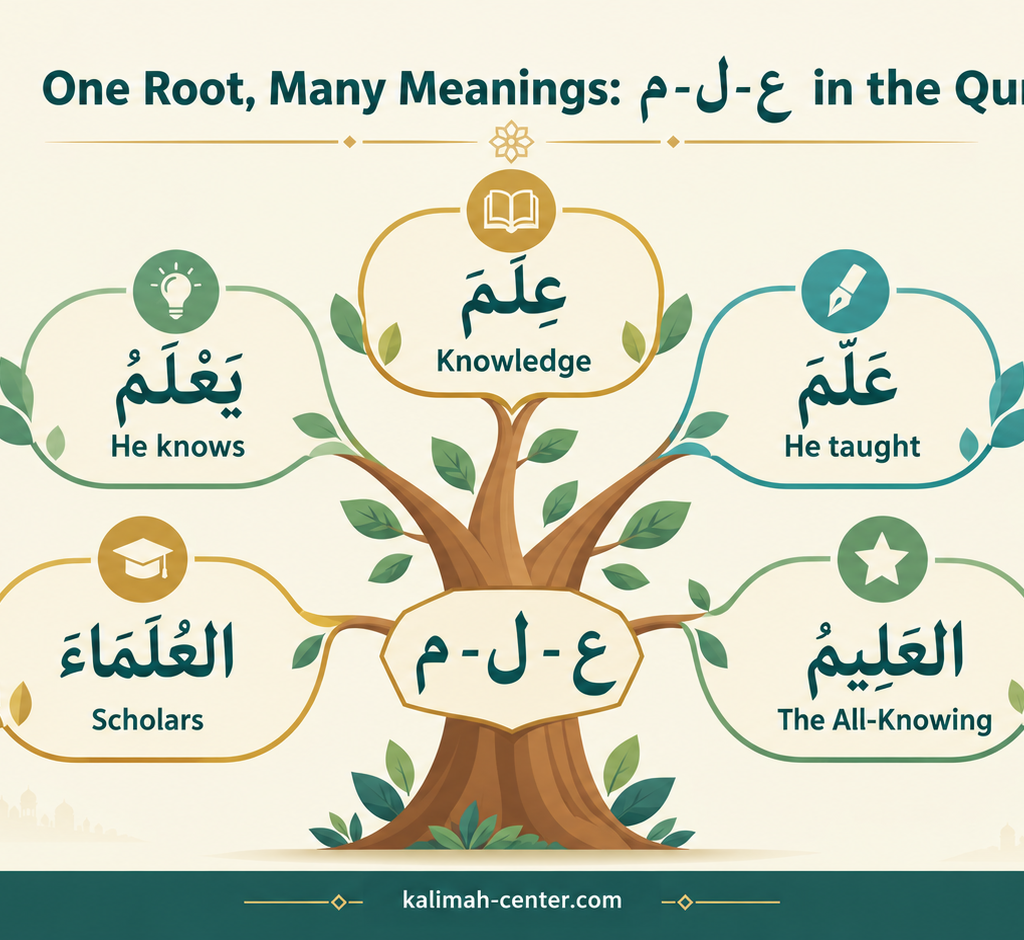
‘Ilm (عِلْم) means certain, well-grounded knowledge, the opposite of zann (guesswork). Its root ع-ل-م appears hundreds of times in the Quran, more than 750 by most counts.
Once you recognize this root, the Quran’s Arabic verses about knowledge start to stand out on the page:
| Arabic | Transliteration | Meaning |
| عَلِمَ / يَعْلَمُ | ‘alima / ya’lamu | he knew / he knows |
| عَلَّمَ | ‘allama | he taught |
| عِلْم | ‘ilm | knowledge |
| العُلَمَاء | al-‘ulamaa’ | scholars |
| العَلِيم | al-‘Aleem | The All-Knowing |
Spotting patterns like these is the first step toward understanding Quran verses about knowledge in Arabic directly. Kalimah’s online Arabic course builds this skill gradually, even for complete beginners.
Why Knowledge in Islam Must Lead to Action
In Islam, knowledge is a trust, not a decoration. Scholars always tied ‘ilm (knowledge) to ‘amal (action), and the Quran warns strongly against people who know what is right but do not live by it. The Quran does not praise knowledge that stays on paper. Allah asks:
لِمَ تَقُولُونَ مَا لَا تَفْعَلُونَ
“Why do you say what you do not do?” (Quran 61:2).
The next verse adds that it is most hateful to Allah to say what you do not do. Knowledge is meant to shape behavior, and the true test of what we learn is how it shows in our daily actions.
The Prophet ﷺ said that whoever travels a path seeking knowledge, Allah makes easy for him a path to Paradise (Sahih Muslim 2699).
Beneficial knowledge even keeps rewarding you after death. “Knowledge that is benefited from” is one of three deeds that never stop (Sahih Muslim 1631).
Inside Kalimah Center: Moments from Our Courses
Get a glimpse into the vibrant learning experience at Kalimah Center. These snapshots capture real moments from our live classes—where students engage deeply, connect with passionate instructors, and grow in a welcoming, supportive environment.
Master Arabic with Kalimah Center
Join our expert-led online classes and start your journey toward Arabic fluency today.
Book Your Free TrialHow to Teach Quran Verses About Knowledge in Arabic to Kids
Children connect best through short verses, single words, and real-life examples. These three steps work at home or in class.
1. Start With One Short Ayah
Begin with رَبِّ زِدْنِي عِلْمًا. It is three words, easy to memorize, and perfect before every study session.
Repeat it together every day for a week until your child says it alone. Once it is mastered, move to the next short verse, so each success builds confidence and turns memorization into an enjoyable routine.
2. Explain One Arabic Word at a Time
Teach that ‘ilm means knowledge and iqra’ means read. Kids remember single Arabic words of the Quran far longer than long explanations about knowledge.
Use flashcards, colors, or simple drawings for each word. When children later hear the same word in salah or recitation, they recognize it instantly, and the Quran starts to feel familiar instead of foreign.
3. Connect the Verse to Daily Life
When your child checks a fact before sharing it, link it to 17:36. When they ask a teacher for help, link it to 16:43.
Praise them when they act on a verse, and share small stories that show it in action. Children remember lessons they live far longer than lessons they only hear, so let every verse become a habit.
For structured support, Kalimah offers an Arabic course for children and Tajweed for kids online, with patient female teachers for sisters and kids. Parents can also read how to learn Quran online for kids.
Learn to Recite and Understand These Ayat With Kalimah Center
Reading Quran verses about knowledge in Arabic is beautiful; reciting them correctly and understanding every word is even better. Kalimah Center helps kids and adults do both.
Our online Quran with Tajweed course pairs you with native Arabic tutors in live one-on-one classes. Beginners can start with Tajweed for beginners, and families can join group classes.
Explore Our Courses:
- Online Arabic Course: Tailored to your level, our comprehensive Arabic program includes 16 teaching levels and 400+ hours of personalized sessions.
- Online Quran With Tajweed Course: Perfect for non-Arabic speakers, our course spans 13 levels and equips you with Tajweed mastery from beginner to advanced.
- Online Arabic Course For Kids: Nurture your child’s love for Arabic with our engaging and structured program, available in 24 levels for primary, intermediate, and secondary stages.
Choose a male teacher or a female teacher and compare plans and pricing. Book your free trial lesson today and take your first step toward “Rabbi zidnee ‘ilmaa.”
Master Arabic with Kalimah Center
Join our expert-led online classes and start your journey toward Arabic fluency today.
Book Your Free TrialConclusion
The Quran opens with “Read!”, commands us to seek more knowledge, and promises to raise people in knowledge by ranks. These ten Quran verses about knowledge in Arabic show that learning is worship, not a side activity.
Real knowledge leads to humility, awe of Allah, careful speech, and good action. Knowing the root ع-ل-م makes these Arabic verses of the Quran about knowledge easier to recognize and remember.
Whether you are a parent teaching your child or an adult starting from the alphabet, the right teacher makes the path easier and keeps your recitation accurate from day one.
The take-away message is simple: start small, learn the Arabic, and act on what you learn. One ayah a week, read with a teacher and understand word by word, can shape a lifetime of seeking ‘ilm.
FAQs
Here are quick answers to the questions people ask most about knowledge in the Quran.
What is the most famous Quran verse about knowledge?
The most famous is وَقُل رَّبِّ زِدْنِي عِلْمًا “My Lord, increase me in knowledge” (20:114). The first revelation, “Read in the name of your Lord” (96:1–5), is equally well known.
What does the Quran say about seeking knowledge?
It presents knowledge as a path to faith, honor, and awe of Allah. It raises people of knowledge by ranks (58:11) and says those who know are not equal to those who do not (39:9).
Is seeking knowledge obligatory in Islam?
Yes. The Prophet ﷺ said: “Seeking knowledge is an obligation upon every Muslim” (Sunan Ibn Majah 224). This covers the basics of faith and worship every Muslim needs.
What is the dua for knowledge in the Quran?
It is رَبِّ زِدْنِي عِلْمًا (Rabbi zidnee ‘ilmaa), “My Lord, increase me in knowledge.” Young children can memorize it in one sitting.
How many times is knowledge mentioned in the Quran?
The root ع-ل-م and its derivatives appear hundreds of times, more than 750 by most counts, making knowledge one of the Quran’s most frequent themes.
How can kids memorize Quran verses about knowledge in Arabic?
Start with one short ayah, repeat it daily with its meaning, and link it to real situations. A teacher who corrects pronunciation early makes memorization faster and more accurate.