Have you ever given a little charity and wondered whether it really counts? Reading Quran verses about charity in Arabic answers that question in Allah’s own words.
Across Quran verses about charity in Arabic, Sadaqah (صدقة), Zakat (زكاة), and Infaq (إنفاق) appear as acts that purify the heart, protect wealth, and build caring communities.
In this guide, you’ll find the most important Quran verses about charity in Arabic with clear English translations and the key Arabic words explained. You’ll also get simple ways to teach them to kids and adults.
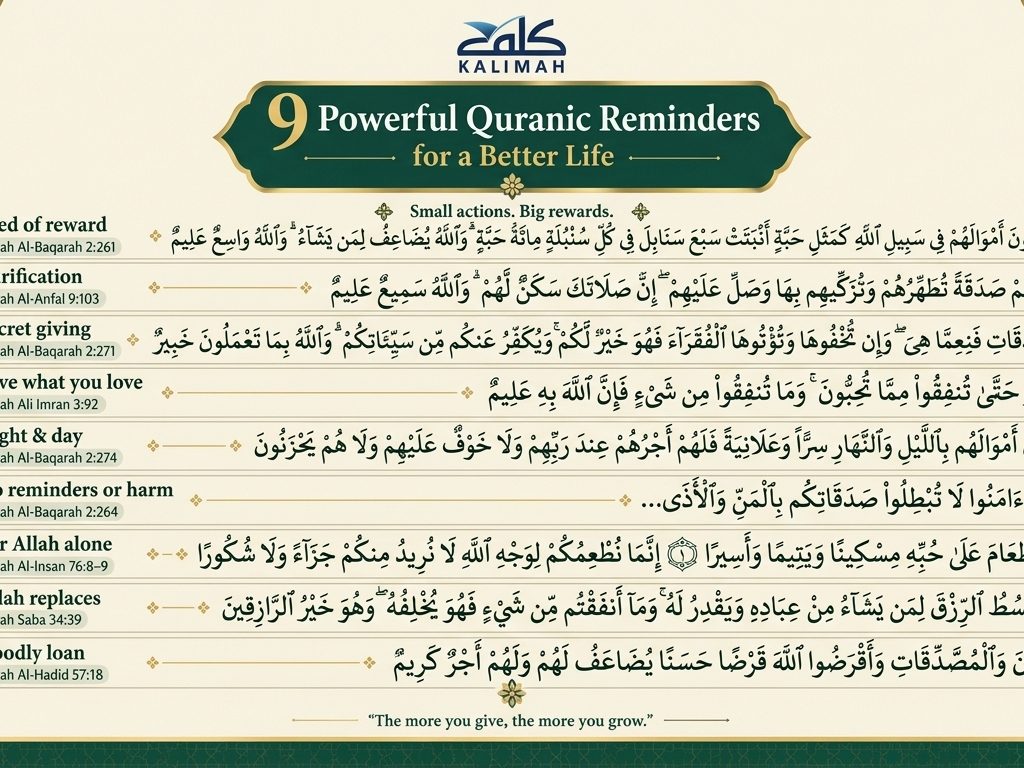
1. Charity Grows Like a Seed (Al-Baqarah 2:261)
The first verse on our list is one of the most quoted Quran verses about charity in Arabic. In Surah Al-Baqarah, Allah uses a simple picture from farming, a single seed, to show how a small act of giving can grow into a huge reward.
مَّثَلُ الَّذِينَ يُنفِقُونَ أَمْوَالَهُمْ فِي سَبِيلِ اللَّهِ كَمَثَلِ حَبَّةٍ أَنبَتَتْ سَبْعَ سَنَابِلَ فِي كُلِّ سُنبُلَةٍ مِّائَةُ حَبَّةٍ ۗ وَاللَّهُ يُضَاعِفُ لِمَن يَشَاءُ ۗ وَاللَّهُ وَاسِعٌ عَلِيمٌ
“The example of those who spend their wealth in the way of Allah is like a seed which grows seven spikes; in each spike is a hundred grains. And Allah multiplies [His reward] for whom He wills. And Allah is All-Encompassing and Knowing.” (Quran 2:261)
Allah compares money spent for His sake to a seed planted in good soil. One grain produces seven ears, and each ear carries a hundred grains. The lesson is clear: no sincere gift is small in Allah’s sight, because He grows it far beyond what we gave.
Key word: يُضَاعِفُ (yuḍāʿifu) means to multiply many times over, not just to double. One sincere seed of giving can become 700 rewards, and Allah gives even more to whom He wills.
2. Zakat Purifies the Giver (At-Tawbah 9:103)
In this verse, Allah speaks directly to the Prophet ﷺ and tells him to take charity from the believers’ wealth. It shows that Zakat is not only a duty toward the poor but also a gift to the giver, because it cleanses the soul and blesses one’s money.
خُذْ مِنْ أَمْوَالِهِمْ صَدَقَةً تُطَهِّرُهُمْ وَتُزَكِّيهِم بِهَا وَصَلِّ عَلَيْهِمْ ۖ إِنَّ صَلَاتَكَ سَكَنٌ لَّهُمْ ۗ وَاللَّهُ سَمِيعٌ عَلِيمٌ
“Take from their wealth a charity by which you purify them and cause them increase, and invoke [Allah’s blessings] upon them. Indeed, your invocations are reassurance for them. And Allah is Hearing and Knowing.” (Quran 9:103)
The verse names two benefits for the giver: purification from sins and stinginess, and growth in goodness and wealth. It also mentions the Prophet’s ﷺ prayer for those who gave, which brought their hearts peace. Charity heals the giver as much as it helps the receiver.
Key word: تُزَكِّيهِم (tuzakkīhim) comes from the same root as Zakat (ز ك و), which means purity and growth. Giving cleanses the heart of greed and makes blessings grow.
3. Secret Charity Erases Sins (Al-Baqarah 2:271)
Should you give openly or quietly? Many Muslims ask this, and Surah Al-Baqarah gives a balanced answer. Among the Quran verses about charity in Arabic, this ayah praises both ways but shows which one is better for the heart.
إِن تُبْدُوا الصَّدَقَاتِ فَنِعِمَّا هِيَ ۖ وَإِن تُخْفُوهَا وَتُؤْتُوهَا الْفُقَرَاءَ فَهُوَ خَيْرٌ لَّكُمْ ۚ وَيُكَفِّرُ عَنكُم مِّن سَيِّئَاتِكُمْ ۗ وَاللَّهُ بِمَا تَعْمَلُونَ خَبِيرٌ
“If you disclose your charitable expenditures, they are good; but if you conceal them and give them to the poor, it is better for you, and He will remove from you some of your misdeeds. And Allah is fully Acquainted with what you do.” (Quran 2:271)
Allah says public charity is good, since it can encourage others to give. Yet giving secretly to the poor is better, because it keeps the intention pure and protects the receiver’s dignity. On top of that, Allah promises to wipe away some of the giver’s sins.
Giving openly can inspire others, but giving in secret protects sincerity. The Prophet ﷺ named, among the seven people Allah will shade, one who gives so secretly that his left hand does not know what his right hand gave (Sahih al-Bukhari 1423).
Experience Kalimah Center, Classes
Watch real excerpts from our live sessions at Kalimah Center and see how we bring learning to life. These clips highlight our interactive, student-centered teaching approach across all our courses—designed to keep learners engaged, motivated, and actively involved every step of the way.
Master Arabic with Kalimah Center
Join our expert-led online classes and start your journey toward Arabic fluency today.
Book Your Free Trial4. Give From What You Love (Aal-Imran 3:92)
Some verses set a higher standard than simply giving what we don’t need. This ayah from Surah Aal-Imran is one of the most challenging Quran verses about charity in Arabic, because it links true righteousness to real sacrifice.
لَن تَنَالُوا الْبِرَّ حَتَّىٰ تُنفِقُوا مِمَّا تُحِبُّونَ ۚ وَمَا تُنفِقُوا مِن شَيْءٍ فَإِنَّ اللَّهَ بِهِ عَلِيمٌ
“Never will you attain righteousness until you spend from that which you love. And whatever you spend, indeed Allah is Knowing of it.” (Quran 3:92)
When this verse was revealed, the Companion Abu Talhah gave away his most beloved garden, Bayruha, for Allah’s sake (Sahih al-Bukhari 1461). The verse teaches that real goodness comes when we share what our hearts are attached to.
Key word: الْبِرَّ (al-birr) means complete goodness and righteousness. This verse asks us to give what we value, whether that is money, time, or, for children, a favorite toy.
Understanding Quran verses about charity in Arabic directly, with no translation in between, changes how you feel them. Our Online Arabic Course helps learners do exactly that, step by step.
5. Giving by Night and Day (Al-Baqarah 2:274)
This verse closes the long passage of Quran verses about charity in Arabic in Surah Al-Baqarah. It describes believers for whom giving is a daily habit, not a one-time event, and it ends with one of the most comforting promises in the Quran.
الَّذِينَ يُنفِقُونَ أَمْوَالَهُم بِاللَّيْلِ وَالنَّهَارِ سِرًّا وَعَلَانِيَةً فَلَهُمْ أَجْرُهُمْ عِندَ رَبِّهِمْ وَلَا خَوْفٌ عَلَيْهِمْ وَلَا هُمْ يَحْزَنُونَ
“Those who spend their wealth by night and by day, secretly and publicly – they will have their reward with their Lord. And no fear will there be concerning them, nor will they grieve.” (Quran 2:274)
The ayah covers every time and every way of giving: night and day, secret and open. Whoever keeps giving like this has a reward stored safely with Allah. They are also freed from fear of the future and grief over the past.
Among the Quran verses about charity in Arabic, this one praises consistency. Small, regular giving earns a reward of peace: no fear and no grief.
6. Do Not Cancel Your Charity (Al-Baqarah 2:264)
Giving charity is only half the task; protecting its reward is the other half. Among the Quran verses about charity in Arabic, this one warns believers about two habits that can destroy a good deed after it is done.
يَا أَيُّهَا الَّذِينَ آمَنُوا لَا تُبْطِلُوا صَدَقَاتِكُم بِالْمَنِّ وَالْأَذَىٰ…
“O you who have believed, do not invalidate your charities with reminders [of it] or injury…” (Quran 2:264)
The full verse compares charity spoiled by reminders, harm, or showing off to dust on a smooth rock. When heavy rain falls, the dust washes away, and nothing is left. In the same way, boasting or hurting the receiver can erase the reward.
Key words: الْمَنّ (al-mann) means reminding people of the favor you did them, and الْأَذَى (al-adhā) means hurting them. Either one can wipe out the reward, so give with kindness and keep it to yourself.
7. Feeding Others for Allah Alone (Al-Insan 76:8–9)
Surah Al-Insan describes the people of Paradise and their noble character. Among its Quran verses about charity in Arabic, these two ayahs paint a moving picture of believers who feed others even when they need the food themselves.
وَيُطْعِمُونَ الطَّعَامَ عَلَىٰ حُبِّهِ مِسْكِينًا وَيَتِيمًا وَأَسِيرًا إِنَّمَا نُطْعِمُكُمْ لِوَجْهِ اللَّهِ لَا نُرِيدُ مِنكُمْ جَزَاءً وَلَا شُكُورًا
“And they give food, despite love for it, to the needy, the orphan, and the captive, [saying], ‘We feed you only for the countenance of Allah. We wish not from you reward or gratitude.’” (Quran 76:8–9)
The believers here feed three groups: the poor, orphans, and captives. They give the food despite loving it, and they say they seek only Allah’s pleasure. They want no payment and not even a word of thanks, which is the purest kind of giving.
This is the highest level of ikhlas (sincerity). The giver expects nothing back, not even thanks, because the reward is with Allah.
8. Allah Replaces What You Give (Saba 34:39)
A common worry stops many people from giving: “What if I run short later?” Surah Saba answers this fear directly. This verse is one of the Quran verses about charity in Arabic that speak to anyone afraid of poverty.
قُلْ إِنَّ رَبِّي يَبْسُطُ الرِّزْقَ لِمَن يَشَاءُ مِنْ عِبَادِهِ وَيَقْدِرُ لَهُ ۚ وَمَا أَنفَقْتُم مِّن شَيْءٍ فَهُوَ يُخْلِفُهُ ۖ وَهُوَ خَيْرُ الرَّازِقِينَ
“Say, ‘Indeed, my Lord extends provision for whom He wills of His servants and restricts it. But whatever you spend of anything, He will compensate it; and He is the best of providers.’” (Quran 34:39)
Allah reminds us that provision is in His hands; He widens it for some and limits it for others. Then He promises that anything spent for His sake will be replaced. The replacement may come as money, blessing, health, or reward in the Hereafter.
Many people fear that giving will reduce their wealth. This verse, together with the hadith “Charity does not decrease wealth” (Sahih Muslim 2588), removes that fear.
9. A Goodly Loan to Allah (Al-Hadid 57:18)
Our final entry among these Quran verses about charity in Arabic comes from Surah Al-Hadid and uses a striking image: lending to Allah. It speaks to men and women equally, reminding every believer that charity is an investment with the Most Generous.
إِنَّ الْمُصَّدِّقِينَ وَالْمُصَّدِّقَاتِ وَأَقْرَضُوا اللَّهَ قَرْضًا حَسَنًا يُضَاعَفُ لَهُمْ وَلَهُمْ أَجْرٌ كَرِيمٌ
“Indeed, the men who practice charity and the women who practice charity and [they who] have loaned Allah a goodly loan – it will be multiplied for them, and they will have a noble reward.” (Quran 57:18)
Allah praises men and women who give charity and calls their giving a “goodly loan.” A loan is always paid back, and Allah promises to return it multiplied. He adds a “noble reward” (ajrun karīm), an honorable reward beyond anything we imagine.
Key words: قَرْضًا حَسَنًا (qarḍan ḥasanan) means a goodly loan. Allah owns everything, yet He calls our charity a loan to Him that He will repay many times over.
If these Quran verses about charity in Arabic touched your heart, explore Quran Verses About Kindness in Arabic and Quran Verses About Forgiveness in Arabic.
What Is the Difference Between Zakat, Sadaqah, and Infaq?
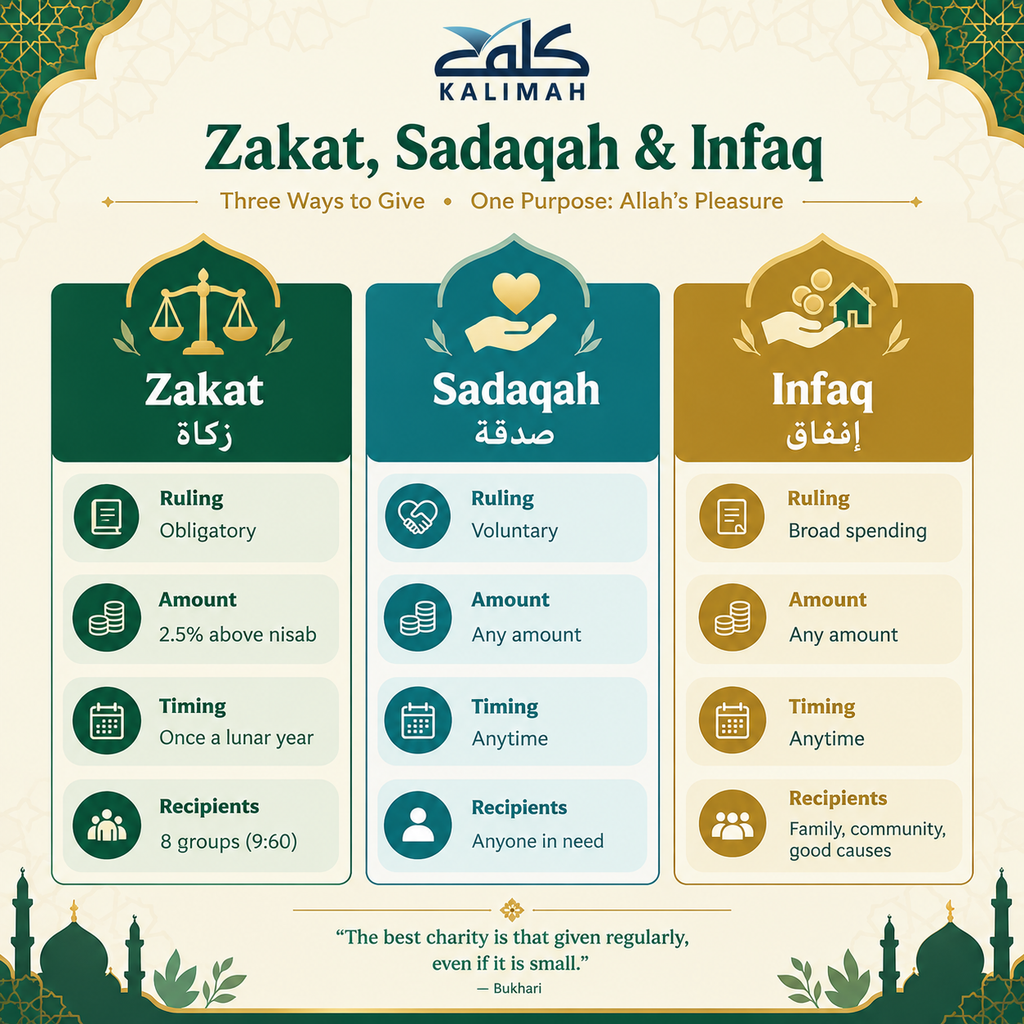
Zakat is the obligatory yearly charity, Sadaqah is voluntary charity, and Infaq is the wider act of spending anything for Allah’s sake. All three appear across Quran verses about charity in Arabic, often side by side.
Zakat (الزكاة)
Zakat is the third pillar of Islam. It is a fixed share, usually 2.5% of savings above the nisab that have been held for a full lunar year. It goes to the eight groups named in At-Tawbah 9:60.
Zakat is often mentioned right next to prayer in the Quran, which shows its high rank in Islam. Its rules cover gold, silver, cash, trade goods, crops, and livestock, so asking a trusted scholar helps you work out the exact amount you owe.
Sadaqah (الصدقة)
Sadaqah has no fixed amount or time. The Prophet ﷺ taught that even a smile, a kind word, or removing something harmful from the road counts as Sadaqah.
Sadaqah also includes sadaqah jariyah, or ongoing charity, such as digging a well, planting a tree, or teaching someone the Quran. Its reward keeps flowing even after a person dies, as the Prophet ﷺ taught (Sahih Muslim 1631).
Infaq (الإنفاق)
Infaq is the broadest of the three terms. It covers spending on your family, your community, and good causes, as long as the intention is for Allah.
Many Quran verses about charity in Arabic use the verb يُنفِقُونَ (yunfiqūn, “they spend”), which comes from the same root as Infaq. This shows that Allah values every kind of spending for His sake, even what a parent spends feeding their own children.
How Can Kids and Adults Memorize These Verses?
Start with short verses like 3:92 and 57:18, then move on to longer ones. Memorizing Quran verses about charity in Arabic is easier when you link each verse to a real act of giving.
Tips for Children
Teach one of the Quran verses about charity in Arabic each week and pair it with a family charity jar. Our Arabic Course for Kids and Tajweed for Kids Online make this journey fun and structured.
Make learning playful by using flashcards with an Arabic word on one side and its meaning on the other. Reward each new verse with a small charity mission, because children remember Quran verses about charity in Arabic best when they see giving in action at home.
Tips for Adults
Listen to a trusted reciter, repeat each verse five times, and then recite it in Salah. If your pronunciation needs work, our guide to Tajweed for Beginners Online is a good first step.
Write the verse on a card and read its meaning before you give charity each week. Linking the ayah to a real action helps it stick in your memory and turns Quran verses about charity in Arabic into a lived habit, not just words you memorized.
Inside Kalimah Center: Moments from Our Courses
Get a glimpse into the vibrant learning experience at Kalimah Center. These snapshots capture real moments from our live classes—where students engage deeply, connect with passionate instructors, and grow in a welcoming, supportive environment.
Master Arabic with Kalimah Center
Join our expert-led online classes and start your journey toward Arabic fluency today.
Book Your Free TrialWhy Learn Quran Verses About Charity in Arabic With Tajweed?
Translations of Quran verses about charity in Arabic give you the meaning, but the Arabic itself gives you the depth. Words like يُضَاعِفُ and تُزَكِّيهِم carry layers of meaning that no single English word can hold.
Reciting with correct Tajweed also protects the meaning. A wrong vowel or a missed letter can change a word, which is why learners benefit from a qualified teacher who listens and corrects them in real time.
That is the heart of our Online Quran With Tajweed Course. There, students recite Quran verses about charity in Arabic with a teacher and build real confidence.
Start Reciting and Understanding the Quran With Kalimah Today
At Kalimah Center, we help kids and adults read the Quran correctly and understand its Arabic. Our teachers guide you from the first letters all the way to fluent, beautiful recitation.
Choose one-on-one Tajweed lessons or join our interactive Group Classes. You can also learn Arabic so you understand Quran verses about charity in Arabic and every other verse you recite.
Explore Our Courses:
- Online Arabic Course: Tailored to your level, our comprehensive Arabic program includes 16 teaching levels and 400+ hours of personalized sessions.
- Online Quran With Tajweed Course: Perfect for non-Arabic speakers, our course spans 13 levels and equips you with Tajweed mastery from beginner to advanced.
- Online Arabic Course For Kids: Nurture your child’s love for Arabic with our engaging and structured program, available in 24 levels for primary, intermediate, and secondary stages.
Lessons are live, flexible, and built around your level. Book your first class today and turn every verse you read into a verse you understand.
Master Arabic with Kalimah Center
Join our expert-led online classes and start your journey toward Arabic fluency today.
Book Your Free TrialConclusion
We explored 9 powerful Quran verses about charity in Arabic, from the seed that grows 700 grains (2:261) to the goodly loan that Allah multiplies (57:18). Together they show that giving is worship, not loss, and that Allah repays every sincere gift.
These Quran verses about charity in Arabic also teach the manners of giving: give from what you love, give sincerely, often in secret, and never with reminders or harm. We also clarified how Zakat, Sadaqah, and Infaq differ.
Whether you are a parent teaching your child or an adult starting your own Quran journey, these Quran verses about charity in Arabic are a great place to begin. With a qualified teacher, you can recite them correctly and understand every word you say.
Your takeaway: charity purifies your heart and grows your blessings. Learn Quran verses about charity in Arabic, recite them with Tajweed, understand their words, and let them shape how you give every day.
FAQs
Here are quick answers to the questions people ask most about charity in the Quran.
What does the Quran say about charity?
The Quran verses about charity in Arabic describe giving as purification, a cause of multiplied reward, and a loan to Allah. They encourage giving both secretly and openly, from what we love, and without harming the person who receives it.
Which Surah talks most about charity?
Surah Al-Baqarah holds the longest passage of Quran verses about charity in Arabic, especially verses 261 to 274. In verse 60, Surah At-Tawbah explains Zakat and who may receive it.
What is the most famous Quran verse about charity?
Al-Baqarah 2:261 is the best-known. It is the parable of the seed that grows seven spikes with a hundred grains in each, and it is often the first charity verse taught to children.
Is a smile considered charity in Islam?
Yes. The Prophet ﷺ said, “Your smile in the face of your brother is charity” (Jami’ at-Tirmidhi 1956). Kind words and helping others also count as Sadaqah.
How can kids learn Quran verses about charity in Arabic?
Start with short verses, repeat them daily, and connect each one to a simple act like sharing food. A qualified Tajweed teacher helps children pronounce every letter correctly from the start.