Have you ever memorized a short surah and wondered what reward Allah writes for every minute you spend learning? The Prophet ﷺ answered that question many times, and every hadith about knowledge in Arabic is still recited in mosques and Quran circles today.
This guide collects the most authentic hadith about knowledge in Arabic. Each one comes with its original text, a clear English meaning, and its source in Sahih al-Bukhari, Sahih Muslim, or the Sunan collections.
Whether you are a parent, an adult starting Tajweed, or a teacher, each narration comes with a practical lesson you can apply this week.
1. The Path to Paradise Is Made Easy
Our first hadith about knowledge in Arabic is one of the most quoted narrations in Islamic education. It comes within a longer hadith in Sahih Muslim about helping others, covering their faults, and gathering in mosques to study the Book of Allah.
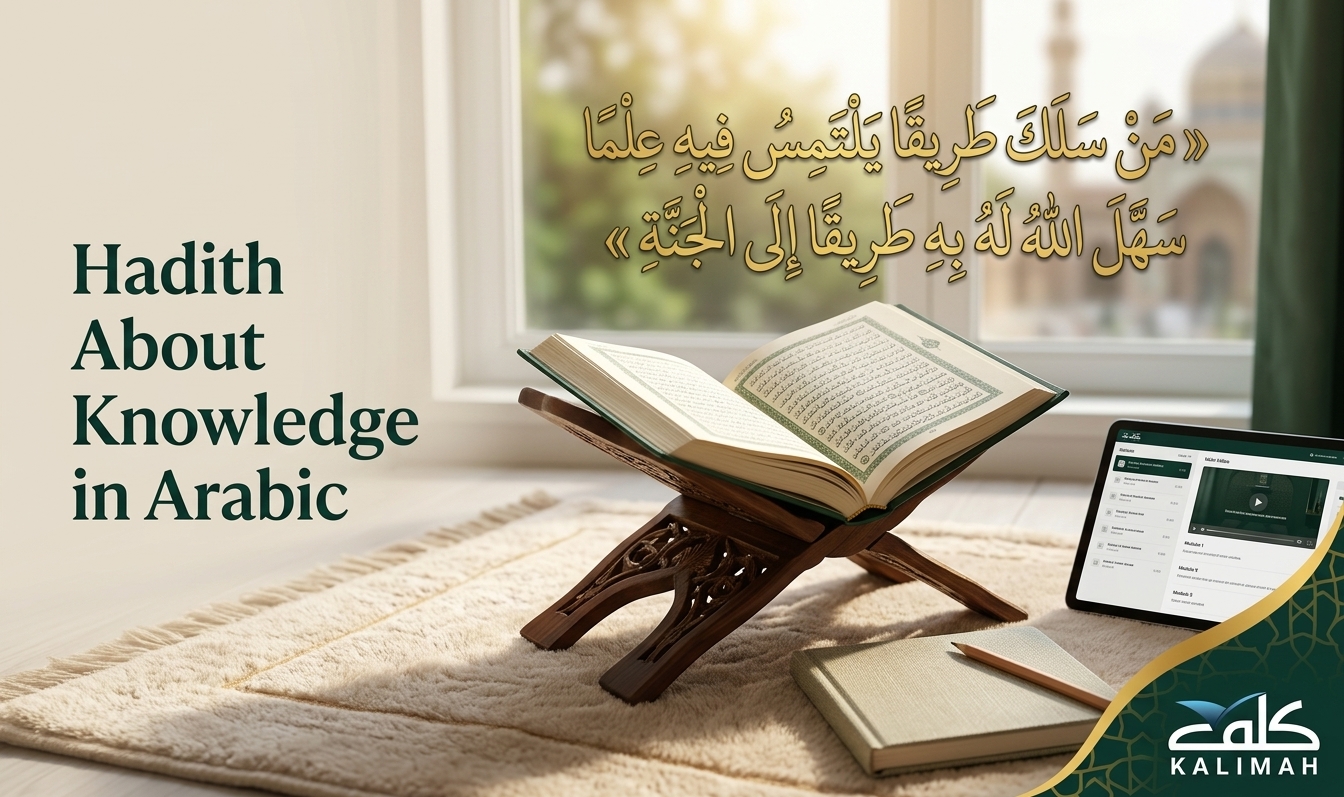
«مَنْ سَلَكَ طَرِيقًا يَلْتَمِسُ فِيهِ عِلْمًا، سَهَّلَ اللَّهُ لَهُ بِهِ طَرِيقًا إِلَى الْجَنَّةِ»
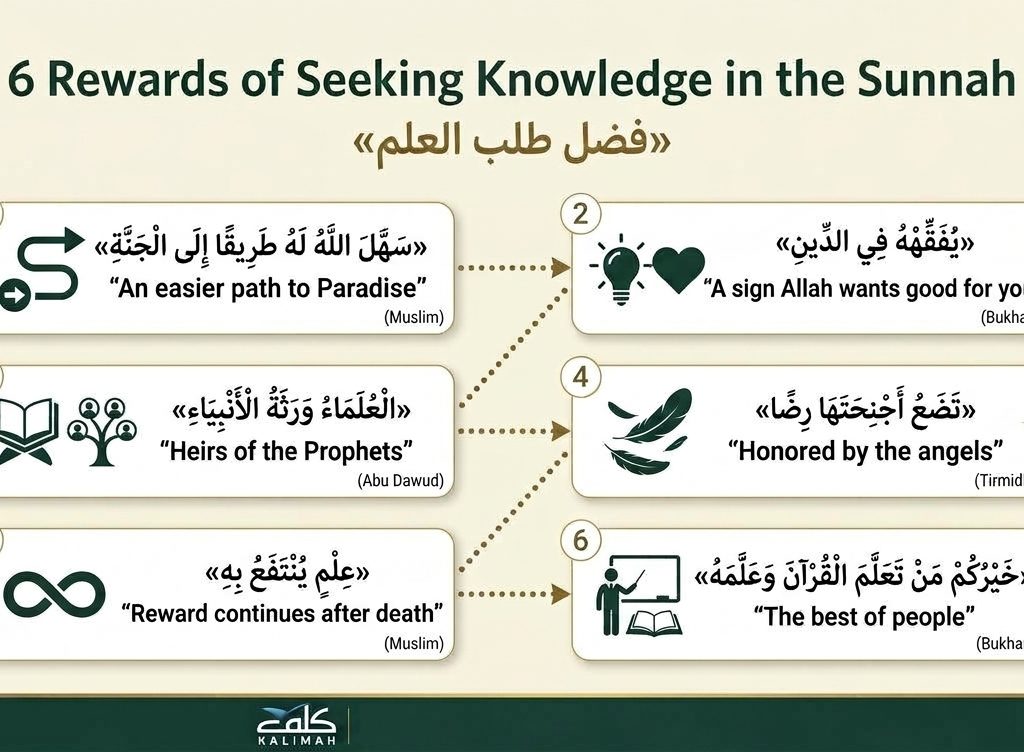
“Whoever travels a path seeking knowledge, Allah makes easy for him a path to Paradise.” Narrated by Abu Hurairah (Sahih Muslim 2699).
The reward matches the action: the learner makes an effort on a path in this world, and Allah eases a path for him in the Hereafter. The word “path” comes in an indefinite form, so it covers every road that leads to beneficial knowledge.
This hadith about knowledge in Arabic shows that “travelling a path” means more than walking to a mosque. Opening a mushaf, joining an online class, or revising at night all count.
2. Understanding the Religion Is a Sign of Allah’s Goodness
Many people measure Allah’s favor by wealth, health, or status, but this narration offers a different measure. Imam al-Bukhari placed it in his Book of Knowledge, and Muawiyah reported it while delivering a sermon to the people.
«مَنْ يُرِدِ اللَّهُ بِهِ خَيْرًا يُفَقِّهْهُ فِي الدِّينِ»
“When Allah wants good for someone, He gives him understanding of the religion.” Narrated by Muawiyah (Sahih al-Bukhari 71).
Fiqh in this hadith means more than memorizing legal rulings. It is a deep understanding of the Quran and Sunnah that shapes how a believer prays, deals with people, and thinks about this life and the next.
This hadith about knowledge in Arabic is a gentle test for every learner. If you feel drawn to understand the Quran, that desire itself is a sign of good Allah has willed for you.
3. Scholars Are the Heirs of the Prophets
Every family passes something down to the next generation, whether a home, savings, or a business. This hadith about knowledge in Arabic tells us what the Prophets chose to pass down, and who has the right to receive that inheritance after them.
«إِنَّ الْعُلَمَاءَ وَرَثَةُ الْأَنْبِيَاءِ، وَإِنَّ الْأَنْبِيَاءَ لَمْ يُوَرِّثُوا دِينَارًا وَلَا دِرْهَمًا، وَإِنَّمَا وَرَّثُوا الْعِلْمَ، فَمَنْ أَخَذَهُ أَخَذَ بِحَظٍّ وَافِرٍ»
“The scholars are the heirs of the Prophets. The Prophets did not leave behind dinars or dirhams; they left knowledge, and whoever takes it has taken an abundant share.” Narrated by Abu al-Darda (Sunan Abi Dawud 3641).
Money is divided among a few heirs and eventually runs out, while knowledge grows the more it is shared. Any student who learns the Quran and Sunnah, even one verse at a time, takes a real portion of that prophetic inheritance.
This hadith about knowledge in Arabic teaches that the real inheritance of the Prophets is learning, not wealth.
4. Angels Lower Their Wings for the Student
The narration of Abu al-Darda continues with a scene that inspires every learner. It describes how creation responds when someone sets out to learn, from the angels in the heavens down to the smallest creatures of the land and sea.
The same narration adds: «وَإِنَّ الْمَلَائِكَةَ لَتَضَعُ أَجْنِحَتَهَا رِضًا لِطَالِبِ الْعِلْمِ», meaning “The angels lower their wings out of pleasure for the seeker of knowledge” (Jami at-Tirmidhi 2682).
Even the fish in the water ask forgiveness for the scholar. Imam al-Khattabi said lowering the wings may mean humility and honor toward the student.
Angels only honor what Allah loves, so their pleasure shows that seeking knowledge is among the deeds most beloved to Him. The student does not need to be a scholar yet; the honor begins with the sincere intention to learn.
This is a powerful hadith about knowledge in Arabic to share with children. When a child sits for a Tajweed for kids lesson, the angels are honoring that small effort.
Experience Kalimah Center Classes
Watch real excerpts from our live sessions at Kalimah Center and see how we bring learning to life. These clips highlight our interactive, student-centered teaching approach across all our courses—designed to keep learners engaged, motivated, and actively involved every step of the way.
Master Arabic with Kalimah Center
Join our expert-led online classes and start your journey toward Arabic fluency today.
Book Your Free Trial5. Seeking Knowledge Is an Obligation
Some acts of worship are encouraged, while others are required of every believer. This hadith about knowledge in Arabic places learning in the second category, which is why scholars treat it as the foundation for every other duty a Muslim performs.
«طَلَبُ الْعِلْمِ فَرِيضَةٌ عَلَى كُلِّ مُسْلِمٍ»
“Seeking knowledge is an obligation upon every Muslim.” Narrated by Anas ibn Malik (Sunan Ibn Majah 224), graded authentic by al-Albani.
Scholars explain that “every Muslim” here includes Muslim women as well. The required level is what each person needs for their own life: correct belief, valid prayer and fasting, and the rulings of the work they do.
This hadith about knowledge in Arabic applies to men, women, and children. Ibn Abd al-Barr recorded scholarly consensus that some knowledge, like how to pray and recite al-Fatiha, is required of everyone.
6. You Will Be Asked What You Did With Your Knowledge
Knowledge is a blessing, but it is also a trust that carries responsibility. This narration lists the questions every servant will face before taking a single step on the Day of Judgment, and knowledge is one of them.
«لَا تَزُولُ قَدَمَا عَبْدٍ يَوْمَ الْقِيَامَةِ حَتَّى يُسْأَلَ عَنْ عُمُرِهِ فِيمَا أَفْنَاهُ، وَعَنْ عِلْمِهِ فِيمَ فَعَلَ…»
“A servant’s feet will not move on the Day of Judgment until he is asked about his life and how he spent it, and about his knowledge and what he did with it…” (Jami at-Tirmidhi 2417).
The question is not how much you learned, but what you did with it. A little knowledge practiced sincerely is better than a library of information that never changes how a person prays, speaks, or treats others.
This hadith about knowledge in Arabic reminds us that learning must lead to action. The Quran criticizes those who say what they do not do (Quran 61:2-3).
7. The Best of You Learn the Quran and Teach It
If you could choose one title to describe yourself, the Prophet ﷺ offered the best one in a single short sentence. This hadith about knowledge in Arabic, narrated by Uthman ibn Affan, is a favorite in Quran schools around the world.
«خَيْرُكُمْ مَنْ تَعَلَّمَ الْقُرْآنَ وَعَلَّمَهُ»
“The best of you are those who learn the Quran and teach it.” Narrated by Uthman ibn Affan (Sahih al-Bukhari 5027).
The narrator Abu Abd al-Rahman al-Sulami taught the Quran from the time of Uthman until the days of al-Hajjaj, and he said this hadith is what kept him in his teaching seat all those years.
This hadith about knowledge in Arabic puts learning first, then teaching. That is why we encourage students to master Tajweed for beginners before passing recitation on to their families.
8. Knowledge That Keeps Rewarding After Death
Most deeds stop the moment a person dies, but Allah has left three doors open. This hadith about knowledge in Arabic names those doors, and beneficial knowledge sits between charity and righteous children as a source of lasting reward.
«إِذَا مَاتَ الْإِنْسَانُ انْقَطَعَ عَنْهُ عَمَلُهُ إِلَّا مِنْ ثَلَاثَةٍ: إِلَّا مِنْ صَدَقَةٍ جَارِيَةٍ، أَوْ عِلْمٍ يُنْتَفَعُ بِهِ، أَوْ وَلَدٍ صَالِحٍ يَدْعُو لَهُ»
“When a person dies, his deeds end except for three: ongoing charity, beneficial knowledge, or a righteous child who prays for him” (Sahih Muslim 1631).
Beneficial knowledge includes a lesson you taught, a book you shared, or a student you helped recite correctly. As long as people benefit from it, the reward keeps reaching you long after your own deeds have ended.
This hadith about knowledge in Arabic links learning to your legacy. Teaching your child Surah al-Fatiha correctly combines two of these three, and every recitation sends reward to the parent and the teacher.
Inside Kalimah Center: Moments from Our Courses
Get a glimpse into the vibrant learning experience at Kalimah Center. These snapshots capture real moments from our live classes—where students engage deeply, connect with passionate instructors, and grow in a welcoming, supportive environment.
Master Arabic with Kalimah Center
Join our expert-led online classes and start your journey toward Arabic fluency today.
Book Your Free TrialHow to Live by These Narrations as a Quran Student
Knowing each hadith about knowledge in Arabic is the first step. Living by it is what turns information into reward, and the scholars summarized that in a few clear habits.
Every hadith about education in Arabic we covered connects learning with action, sincerity, and service to others. The habits below turn these texts from words we memorize into a daily routine that shapes how we study, worship, and teach.
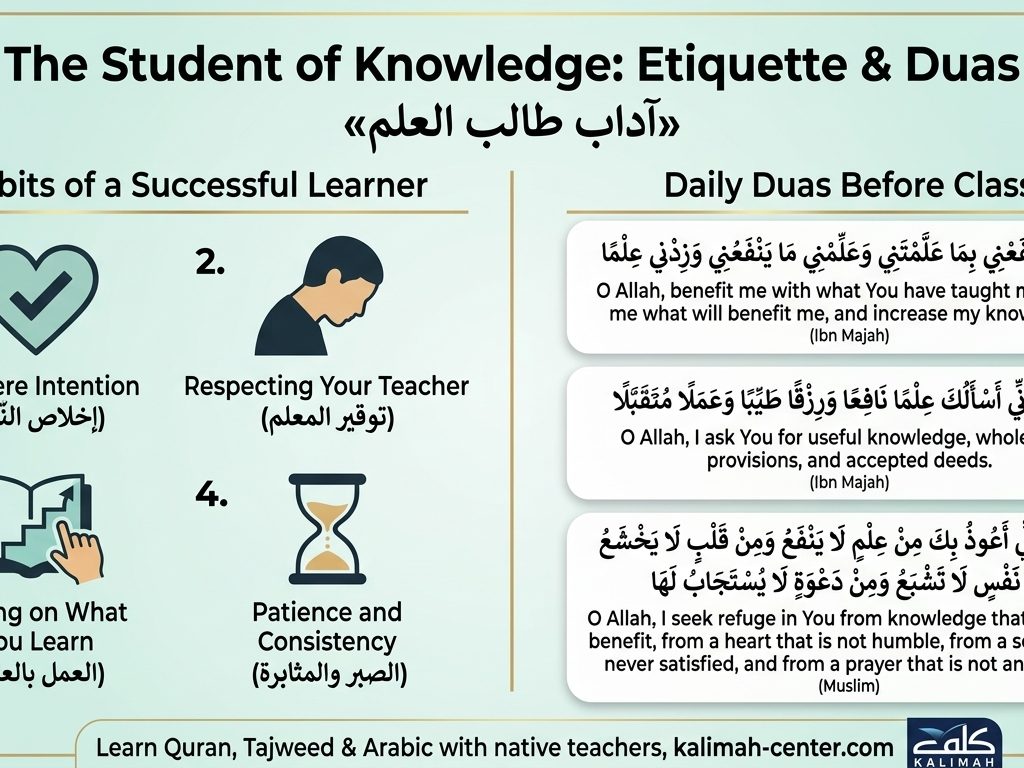
The Etiquette of a Student of Knowledge
Sheikh Ibn Baz advised students to keep a sincere intention, respect their teachers, organize their time, and stay patient, because no learner progresses without patience.
He gave the Quran priority: memorizing it, reflecting on it, and reciting it often. A structured online Quran course with Tajweed makes this priority easy to keep each week.
He also urged students to review their lessons together without envy and to be good examples for others. Every student and teacher, he said, should set aside time to teach their own household what they have learned.
Duas for Beneficial Knowledge
The Prophet ﷺ asked Allah for beneficial knowledge and sought refuge from knowledge that does not benefit. Say these duas before every lesson:
- «اللَّهُمَّ انْفَعْنِي بِمَا عَلَّمْتَنِي، وَعَلِّمْنِي مَا يَنْفَعُنِي، وَزِدْنِي عِلْمًا» (Ibn Majah 251)
- «اللَّهُمَّ إِنِّي أَسْأَلُكَ عِلْمًا نَافِعًا، وَرِزْقًا طَيِّبًا، وَعَمَلًا مُتَقَبَّلًا» (Ibn Majah 925)
- «اللَّهُمَّ إِنِّي أَعُوذُ بِكَ مِنْ عِلْمٍ لَا يَنْفَعُ» (Sahih Muslim 2722)
Teach these duas to your children as part of their class routine, and recite them yourself before opening the mushaf. Asking Allah for beneficial knowledge reminds the heart that understanding is a gift from Him, not only the result of effort.
Why Learning Arabic Deepens Every Hadith
Reading a hadith about knowledge in Arabic in its original wording lets you feel words like «يَلْتَمِسُ», “searching carefully,” which no translation fully captures. An online Arabic course opens that door for adults, while the Arabic course for kids builds it early.
The Quran was revealed in Arabic and the Prophet ﷺ spoke Arabic, so every translation is only an approximation of the original meaning. Even a basic grasp of Arabic vocabulary helps you notice the depth behind each hadith about knowledge in Arabic.
Take the word «يُفَقِّهْهُ», which comes from fiqh and means deep understanding, not just information. Learners who study Arabic alongside Tajweed often find their prayer becomes more focused because they understand the words they recite.
Start Your Path of Knowledge With Kalimah Center Today
Every hadith about knowledge in Arabic above points to one action: begin. At Kalimah Center, certified native Arabic teachers guide kids and adults through Quran recitation, Tajweed, and Arabic in live one-on-one or group classes.
Sisters and children can choose from our female teachers, and every learner gets a personal plan. Our flexible plans fit families of every size.
Explore Our Courses:
- Online Arabic Course: Tailored to your level, our comprehensive Arabic program includes 16 teaching levels and 400+ hours of personalized sessions.
- Online Quran With Tajweed Course: Perfect for non-Arabic speakers, our course spans 13 levels and equips you with Tajweed mastery from beginner to advanced.
- Online Arabic Course For Kids: Nurture your child’s love for Arabic with our engaging and structured program, available in 24 levels for primary, intermediate, and secondary stages.
Take the first step on the path the Prophet ﷺ described. Book your free trial lesson today and see how easy steady learning can be.
Master Arabic with Kalimah Center
Join our expert-led online classes and start your journey toward Arabic fluency today.
Book Your Free TrialConclusion
The Sunnah places knowledge at the heart of faith. As every hadith about knowledge in Arabic in this guide shows, seeking it opens a path to Paradise, the angels honor the student, and the scholars inherit the legacy of the Prophets.
Teaching is just as rewarded in every hadith about knowledge in Arabic we covered. The best people learn the Quran and teach it; beneficial knowledge keeps earning reward after death, and whoever guides others to good shares the reward of everyone who follows.
Whether you are a child learning your first surah or an adult returning to the Quran, every step counts. Start small, stay consistent, and let each hadith about seeking knowledge in Arabic remind you why the effort is worth it.
The key takeaway is simple: knowledge must lead to action. Learn each hadith about knowledge in Arabic, act on it, teach it at home, and ask Allah daily for beneficial knowledge.
FAQs
Here are quick answers to the questions learners ask most about the hadith about knowledge in Arabic.
What is the most famous hadith about knowledge in Arabic?
The most famous is the hadith of the path to Paradise in Sahih Muslim (2699). It promises an easy path to Paradise for anyone who sincerely seeks knowledge.
Is “seek knowledge even if you have to go to China” an authentic hadith?
No. Hadith scholars, including al-Albani, graded it as fabricated. The authentic hadith about seeking knowledge in Arabic is «طَلَبُ الْعِلْمِ فَرِيضَةٌ عَلَى كُلِّ مُسْلِمٍ», recorded by Ibn Majah.
Does the reward of knowledge include worldly sciences?
Islamic knowledge comes first, because it teaches you how to worship Allah. Sheikh Ibn Uthaymeen explained that any beneficial knowledge, such as medicine or engineering, can be rewarded when the intention is sincere.
Which short hadith about knowledge in Arabic is best for kids?
«خَيْرُكُمْ مَنْ تَعَلَّمَ الْقُرْآنَ وَعَلَّمَهُ» is short, easy to memorize, and links learning directly to the Quran. Children can repeat it before every class.
How can adults start seeking knowledge with a busy schedule?
Start with 20 to 30 minutes a day with a qualified teacher. Small, consistent lessons follow the hadith about knowledge in Arabic that calls two verses better than two camels.