Have you ever stopped on a page of the Quran and wondered how every letter looks so balanced, clear, and calm? That even, quiet look comes from Naskh Arabic calligraphy, the script that has carried sacred and everyday texts for more than a thousand years.
Naskh is still the style you see in most printed mushafs, books, and newspapers across the Arab world. Its simple look hides a precise system of dots, proportions, and pen angles, and any patient learner can master that system one step at a time.
At Kalimah Centre, many of our students fall in love with Arabic through its letters before they can speak a single sentence. We wrote this guide for them and for you, whether you’re just curious or ready to pick up a reed pen today.
You’ll learn where Naskh came from, what makes it unique, which tools you actually need, and how to build a practice routine that works. We’ve also added free fonts, videos, and printable sheets to support you along the way.
Key highlights of this article:
- What Naskh is and how it differs from other Arabic scripts.
- The masters and milestones that shaped Naskh from Baghdad to today.
- The essential tools, plus free fonts, sheets, and videos for practice.
- A clear, step-by-step method for your first weeks of practice.
- How learning Arabic makes your calligraphy faster and more accurate.
What Is Naskh Arabic Calligraphy?
Naskh Arabic calligraphy is a rounded, highly readable cursive style of Arabic writing that follows fixed proportions, and it’s best known as the main script of the printed Quran. It’s one of the classical “six scripts” (al-aqlam al-sitta), and the wider art now appears in UNESCO’s Intangible Cultural Heritage listing for Arabic calligraphy.
The Meaning Of The Word Naskh
The word naskh comes from the Arabic verb nasakha, which means “to copy” or “to transcribe.” The name tells you exactly what the script was made for: copying long texts quickly and clearly, whether religious books, scholarly works, or official records.
Before Naskh matured, scribes often used angular Kufic forms for the Quran and looser, unregulated hands for daily business. Naskh bridged these two worlds. It kept the speed of everyday handwriting and added the discipline and beauty of a measured art.
That’s why Naskh is described as both a “copyist’s script” and a “master’s script.” Beginners love it because they can read it from day one, while advanced calligraphers keep refining its subtle curves, joins, and spacing for decades.
The Main Visual Features Of The Naskh Script
Naskh letters are small to medium in size, with short vertical strokes and generous, rounded bowls. Most letters sit firmly on an invisible baseline. A few, such as the final forms of nun, ra, waw, and ya, dip below it in controlled curves.
Another hallmark is the contrast between thick and thin strokes. The pen nib is cut at an angle, so some strokes come out bold and others light. That gives each word a natural rhythm that guides the reader’s eye from right to left.
Naskh is also clean and uncluttered. Letters rarely stack on top of each other, and dots and short vowel marks (harakat) sit in clearly spaced positions. That’s exactly why the style is still the preferred choice for fully vocalized texts like the Quran.
How Naskh Differs From Thuluth, Kufic, And Ruq’ah
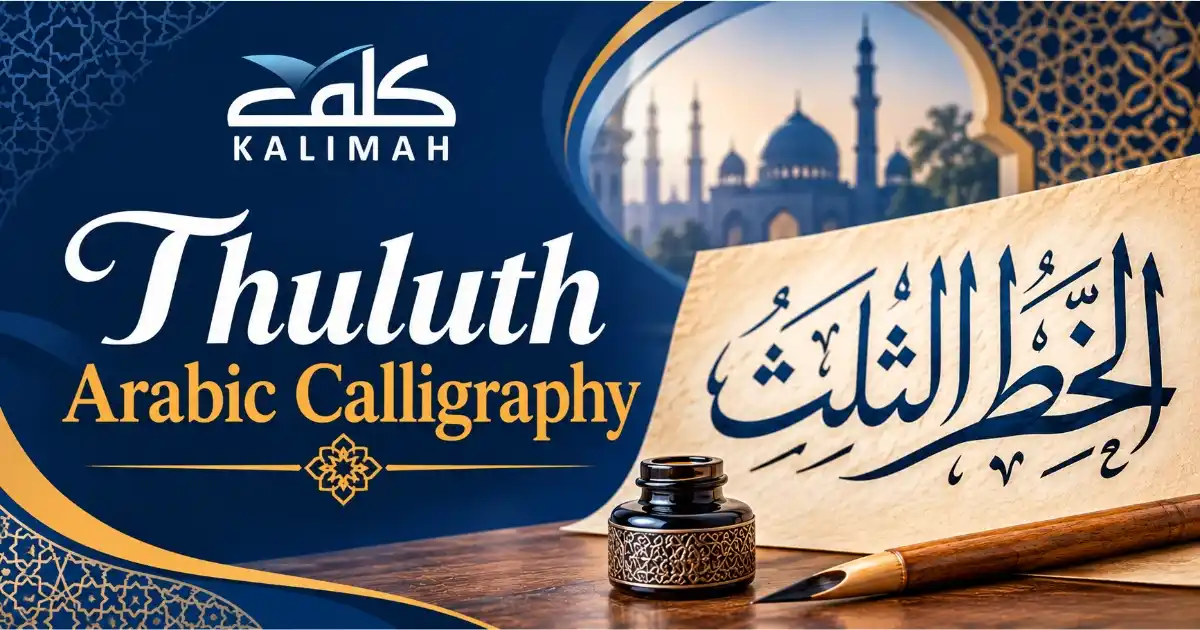
Thuluth is Naskh’s grander sibling. It uses larger letters, taller vertical strokes, and dramatic overlapping compositions. You’ll usually find it on mosque walls, book titles, and monuments rather than in long blocks of reading text.
Kufic, by contrast, is angular and geometric, with straight lines and sharp corners that suited stone carving and early Quran manuscripts. Ruq’ah sits at the other end: a fast, compact everyday hand with very few flourishes, ideal for notes and quick writing.
Naskh sits comfortably in the middle. It’s more formal than Ruq’ah, easier to read than Thuluth, and softer than Kufic. That makes Naskh Arabic calligraphy the best first choice for most learners and a strong base before moving on to decorative styles.
Want to read the words you write, not just copy their shapes? Kalimah Centre’s Online Arabic Course takes you from the alphabet to confident reading and writing with native tutors, so every Naskh letter you draw carries real meaning.
The History Of The Naskh Script From Baghdad To The Modern Mushaf
Naskh’s history is the story of brilliant scribes turning practical handwriting into a precise art. Knowing these names and milestones helps you see why the script looks the way it does, and why teachers still ask beginners to measure every letter they write.
Ibn Muqla And The Proportional Writing System
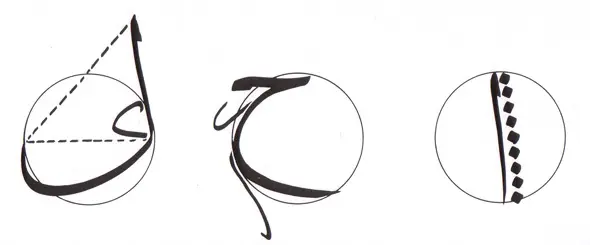
In 10th-century Baghdad, the Abbasid vizier and calligrapher Ibn Muqla (died 940) introduced a system known as al-khatt al-mansub, or “proportioned writing.” He measured letters using the rhombic dot made by the pen, the height of the alif, and an imagined circle.
This was a turning point. For the first time, a scribe could check every letter against fixed ratios instead of personal taste, so writing became teachable, repeatable, and consistent. Naskh grew directly out of this rule-based approach to the Arabic alphabet.
Encyclopaedia Britannica’s entry on the naskhi script credits Ibn Muqla, along with his successor Ibn al-Bawwab, with shaping the style. It describes Naskh as a legible, stately script built on the horizontal line and careful proportion between letters.
How Ibn Al-Bawwab And Later Masters Refined Naskh
Ibn al-Bawwab took Ibn Muqla’s rules and gave them elegance and fluidity. His only surviving Quran, copied in Baghdad in 391 AH (around 1000 CE), is kept at the Chester Beatty Library in Dublin. It’s still treated as a model of early Naskh.
According to ICESCO’s report on the replica of his famous manuscript, he wrote 64 copies of the Quran and set the proportions for each part of the letter. Later, Yaqut al-Musta’simi (died 1298) refined the pen cut for a sharper finish.
Ottoman masters carried the work further. Şeyh Hamdullah (died 1520) and later Hafız Osman (died 1698) polished Naskh into the balanced form most teachers still use. Their models are copied in calligraphy classes from Istanbul to Cairo to this day.
Why Naskh Became The Standard Script For Copying The Quran
Naskh became the standard Quranic script because it combines clarity with beauty: its open letters leave room for every dot and vowel mark, which lowers the risk of misreading. From the 11th century onward, it gradually replaced Kufic in most mushafs.
Allah (Glorified and Exalted be He) says:
“ٱقْرَأْ وَرَبُّكَ ٱلْأَكْرَمُ ﴿٣﴾ ٱلَّذِى عَلَّمَ بِٱلْقَلَمِ ﴿٤﴾”
“Read! And your Lord is the Most Generous, Who taught by the pen.” (Surah Al-‘Alaq 96:3–4)
These lines, from the first revelation, link reading directly with the pen and present writing as one of Allah’s generous gifts of knowledge. For generations of scribes, copying the Quran in clear Naskh was a way to honor that gift with care and precision.
Today, the widely printed Madinah Mushaf, written by the Syrian calligrapher Uthman Taha, is in Naskh. So when you practice Naskh Arabic calligraphy, you’re training your hand and eye on the same letterforms millions of people read in their daily recitation.
Love the beauty of Quranic letters? Learn to recite them just as beautifully. Kalimah Centre’s Online Quran Course pairs you with certified tutors who guide your Tajweed level by level, so your recitation matches the precision of the mushaf in front of you.
Recommended Reading: The Complete Arabic Alphabet Guide: Letters, Forms, Sounds & Practice
Experience Kalimah Center Classes
Watch real excerpts from our live sessions at Kalimah Center and see how we bring learning to life. These clips highlight our interactive, student-centered teaching approach across all our courses—designed to keep learners engaged, motivated, and actively involved every step of the way.
Master Arabic with Kalimah Center
Join our expert-led online classes and start your journey toward Arabic fluency today.
Book Your Free TrialEssential Tools For Practicing Naskh Calligraphy
You don’t need an expensive studio to start Naskh Arabic calligraphy. A few well-chosen tools and some free digital resources are enough to build correct habits from your first stroke. Here’s what to gather before your first session.
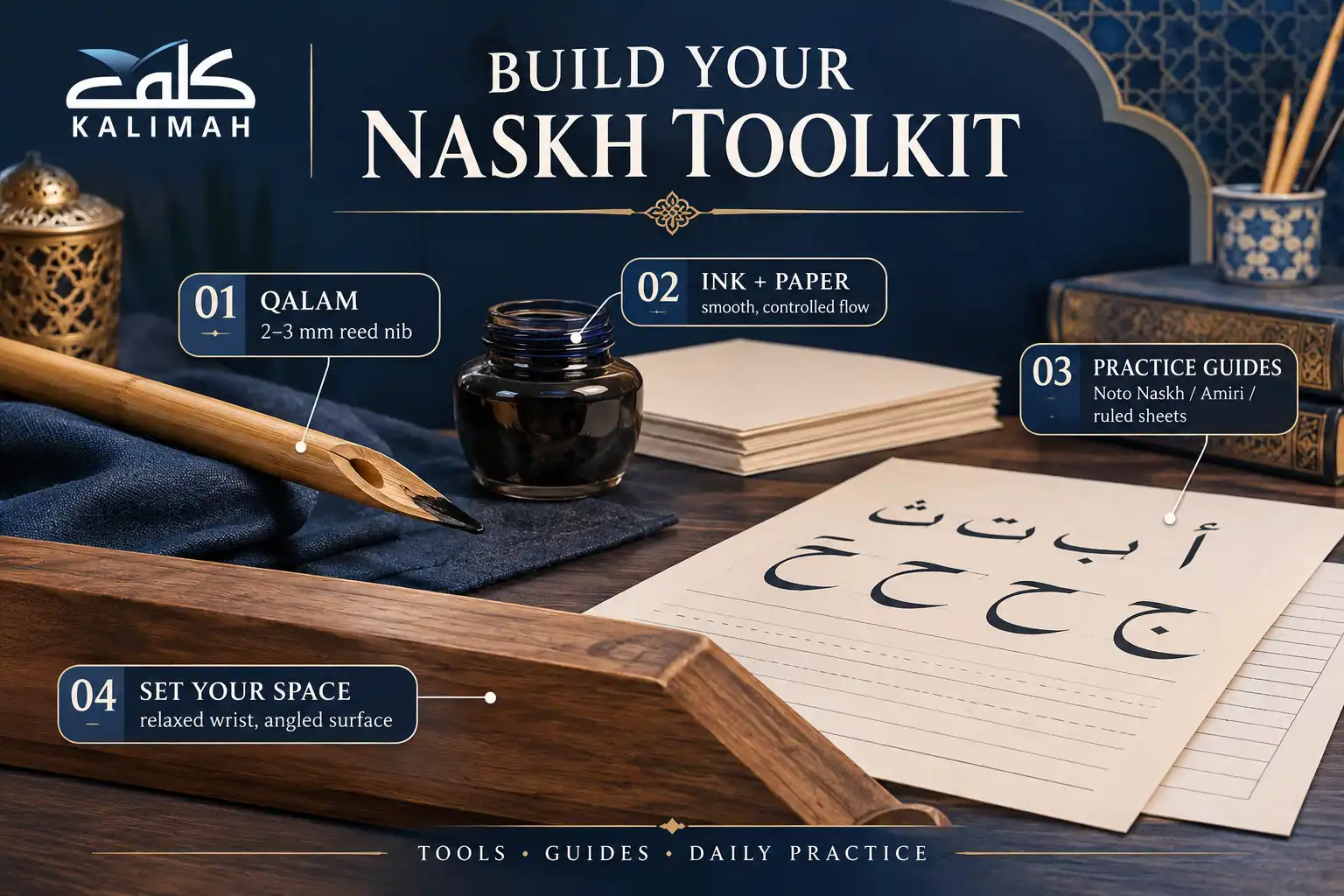
1. Choosing And Cutting A Qalam For Naskh
The traditional pen is the qalam, cut from dried reed or bamboo. UNESCO notes that reeds and bamboo stems are still the classic materials for the calligrapher’s pen. They’re prized because they hold ink well and respond gently to the writer’s pressure.
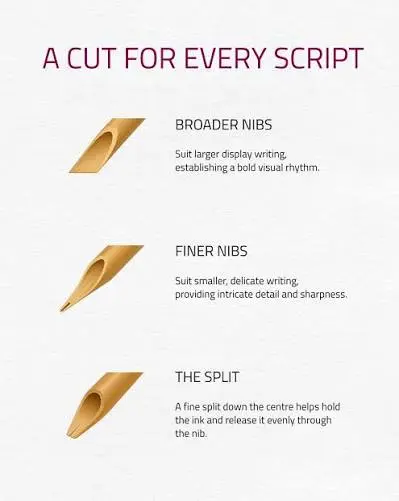
The nib is cut with a sharp knife on a hard cutting plate, then slit down the middle and trimmed at an angle. For Naskh, beginners usually work with a nib about 2 to 3 millimeters wide, which keeps letters large enough to study their proportions closely.
If cutting reeds feels intimidating at first, start with a ready-made bamboo pen or a flat-tipped calligraphy marker of similar width. Move to a hand-cut qalam once you understand how the angle of the nib shapes your thick and thin strokes.
2. Ink, Paper, And Writing Surfaces For Beginners
Traditional calligraphers made soot-based ink and placed silk fibers, called liqa, inside the inkwell to control how much ink the pen picks up. You can copy this trick easily: put a small piece of silk or cotton thread in your ink pot.
Classical paper, known as ahar, was coated with starch, egg white, and alum, then polished so the pen could glide smoothly. For daily practice, smooth coated paper or marker paper works well, because the nib slides across it without catching or bleeding.
Your writing surface matters too. Many calligraphers write on a board resting on the knee or on a slightly slanted desk, which keeps the wrist relaxed. Sit upright, keep good light coming from the side, and put a soft sheet under your paper for a gentler feel.
3. Free Digital Fonts And Printable Practice Sheets
Studying well-designed Naskh fonts helps you see letter shapes clearly before you copy them. You can download Google’s free Noto Naskh Arabic typeface, type any word you want to study, and zoom in on its joins and curves.
Another excellent option is the open-source Amiri font project, a Naskh typeface modeled on the classic Bulaq (Amiri) Press of Cairo. It’s free under the SIL Open Font License, so you can print large reference sheets for your personal practice.
For guidelines, Incompetech’s free calligraphy guideline paper generator lets you print ruled practice sheets as PDFs at no cost. Set the line spacing to match your nib width, then use those lines as your baseline and letter-height guides in every session.
Your pen is ready, so add the right books to your desk. Browse Kalimah Centre’s online bookshop for structured Arabic learning books that help you recognize, read, and write every letter correctly as your calligraphy practice grows.
Further Reading: Arabic Handwriting Practice: Free Printable Tracing Worksheets PDF
How To Learn Naskh Arabic Calligraphy Step By Step
Learning Naskh Arabic calligraphy depends less on talent than on method. The three steps below follow the same order traditional teachers use, so each new skill builds naturally on the one before it and your progress stays steady.
1. Learn The Rhombic Dot And Letter Proportions
Start by drawing rows of rhombic dots. Press the full width of your nib onto the paper at its natural angle, then pull a short diagonal stroke. This little diamond is your ruler, and every Naskh letter is measured in these dots.
Next, write the alif. In many traditional Naskh models, it stands about five dots tall. Stack dots vertically beside your alif to check its height, and keep repeating until it stays straight, even, and the same size every time you write it.
Once your alif is steady, use it to measure other letters. The width of the ba, the depth of the nun, and the curve of the ha all relate back to these units. To see proportions in motion, watch the British Museum’s short video on Arabic scripts, where calligrapher Mustafa Ja’far writes the alphabet in Naskh.
2. Practice Isolated Letters Before Connected Words
Work through the alphabet in letter families rather than dictionary order. Letters that share a body, such as ba, ta, and tha, or jim, ha, and kha, use the same base stroke. Once you master one shape, you can write the whole group.
Copy each letter slowly, compare it with your model, and circle the parts that look different. Traditional teachers call these exercise sheets mashq. Slow, careful repetition builds muscle memory far better than filling pages quickly without any correction.
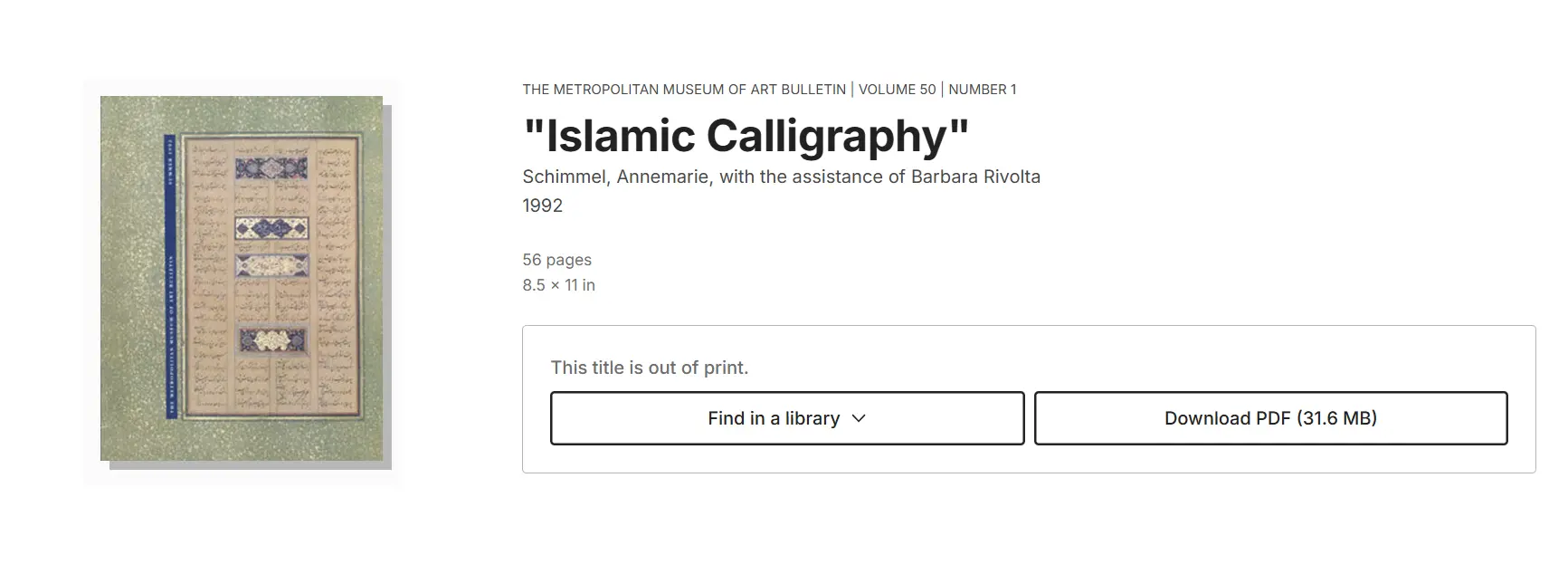
When your isolated letters look consistent, move on to two- and three-letter connections, then short words. For excellent historical models, download Annemarie Schimmel’s free Met Museum bulletin on Islamic calligraphy, a free PDF full of high-quality examples to study.
3. Build A Daily Practice Routine And Track Your Progress
Short, regular sessions beat long, irregular ones. Aim for 20 to 30 minutes a day: five minutes of dots and alifs to warm up, then focused work on one letter family, and a final few minutes copying a full word or short phrase.
Date every practice sheet and keep it in a folder. Comparing pages from week one and week six shows exactly where your curves, spacing, and proportions have improved. It also reveals stubborn habits, such as a tilted alif, that need extra attention.
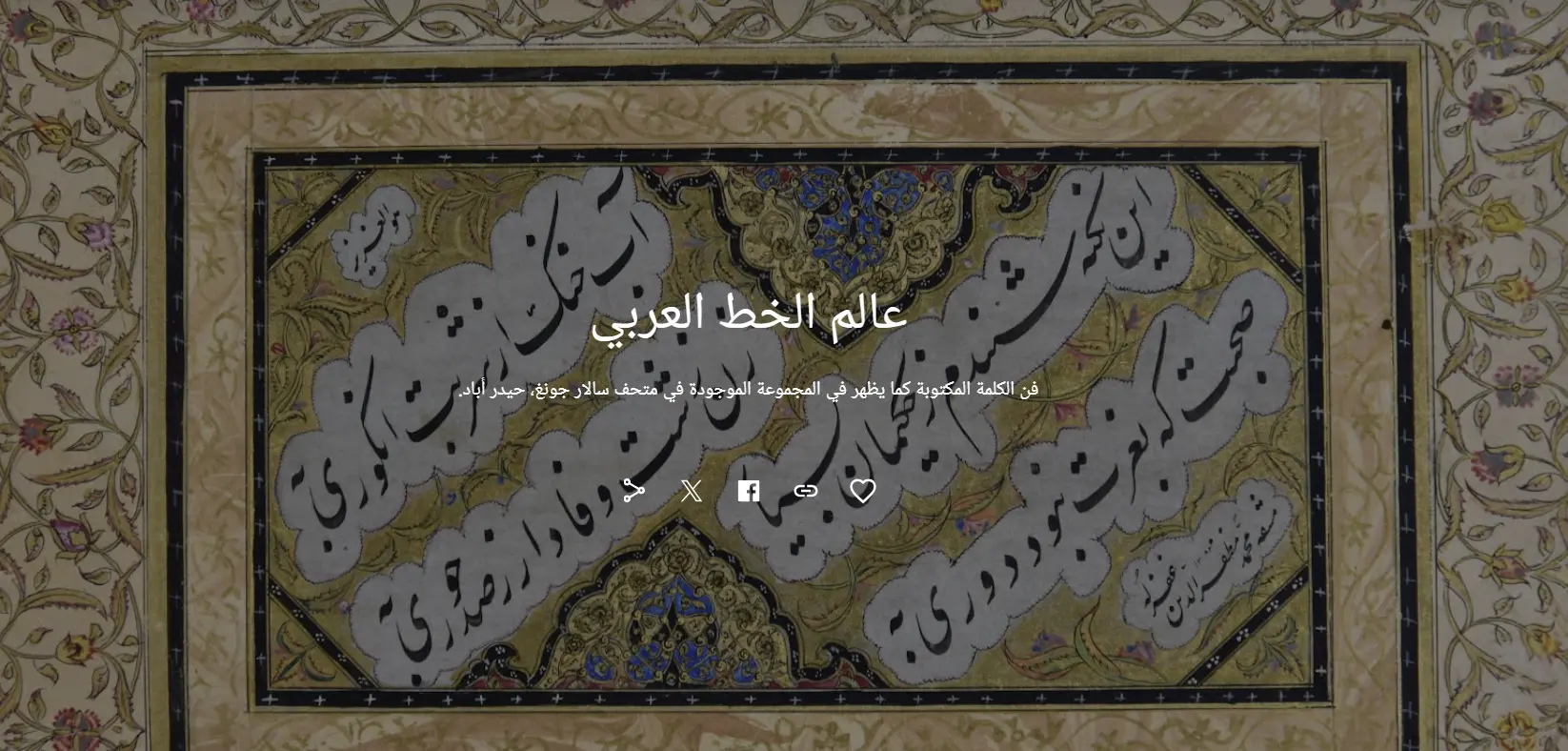
Train your eye, too. Browse the Salar Jung Museum’s calligraphy story on Google Arts & Culture, free on the web and in the Google Arts & Culture app, to see centuries-old Naskh manuscripts. The more fine examples you study, the faster your own taste develops.
Want your children to grow up loving Arabic letters as much as you do? Kalimah Centre’s Arabic Classes For Kids build reading and writing skills through fun, interactive lessons, giving young learners the foundation every future calligrapher needs.
Don’t Miss: Arabic Alphabet Cursive And Learn Arabic Cursive Writing With Examples And Worksheets
Learn The Arabic Behind Your Calligraphy With Kalimah Centre
Calligraphy is far more rewarding when you understand what you’re writing. Many self-taught learners of Naskh Arabic calligraphy copy beautiful shapes but misplace a dot, skip a vowel mark, or join letters that should never connect, simply because nobody taught them how Arabic spelling and letter connections work.
At Kalimah Centre, that gap closes quickly. A free placement test shows exactly where you should start, and the first alphabet levels focus on letter forms, sounds, and connections. Native Arabic tutors, including Azhari teachers, correct your reading and writing as you go in private one-on-one sessions.
You choose your tutor, male or female, and set lesson times that fit your week, so learning never clashes with work or family. You’ll receive a certificate for each level you complete, so your progress stays visible, and your Naskh practice gains accuracy, meaning, and confidence.

Inside Kalimah Center: Moments from Our Courses
Get a glimpse into the vibrant learning experience at Kalimah Center. These snapshots capture real moments from our live classes—where students engage deeply, connect with passionate instructors, and grow in a welcoming, supportive environment.
Master Arabic with Kalimah Center
Join our expert-led online classes and start your journey toward Arabic fluency today.
Book Your Free TrialBook Your Free Trial Class At Kalimah Centre Today!
You now know what Naskh is, where it came from, and how to practice it with the right tools. The next step is to back up your pen with real Arabic knowledge, so every letter you shape is correct, readable, and meaningful to you.
Book your free trial lesson with Kalimah Centre today. You’ll meet a native tutor, take your placement test, and get a personal plan that matches your goals, whether you want to read the Quran, write Arabic fluently, or both.
???? Explore Our Courses:
Online Arabic Course: Tailored to your level, our comprehensive Arabic program includes 16 teaching levels and 400+ hours of personalized sessions.
Online Quran With Tajweed Course: Perfect for non-Arabic speakers, our course spans 13 levels and equips you with Tajweed mastery from beginner to advanced.
Online Arabic Course For Kids: Nurture your child’s love for Arabic with our engaging and structured program, available in 24 levels for primary, intermediate, and secondary stages.
Don’t wait for the “perfect” moment, because steady progress starts with one lesson. Explore our flexible learning plans, pick a schedule that suits your routine, and start reading and writing Arabic with expert guidance this week.

Master Arabic with Kalimah Center
Join our expert-led online classes and start your journey toward Arabic fluency today.
Book Your Free TrialConclusion
Naskh began as a copyist’s hand in Abbasid Baghdad. Ibn Muqla measured it into fixed proportions, Ibn al-Bawwab and the Ottoman masters refined it, and it became the script of the modern mushaf. Its rounded letters, clear spacing, and steady baseline make it the ideal first script for almost any learner of Arabic writing.
To practice it well, you only need a reed or bamboo pen, smooth paper, good ink, and a patient routine built on rhombic dots, the alif, and letter families. Free fonts, printable guideline sheets, museum videos, and digitized manuscripts can support every practice session, at no cost.
The key takeaway: Naskh Arabic calligraphy rewards method, not magic. Measure every letter, practice a little each day, and learn the Arabic language behind the shapes. Understanding what you write is what turns careful copying into a real skill, and that skill keeps growing with you for years to come.
Frequently Asked Questions
Is Naskh A Good Script For Complete Beginners?
Yes, Naskh is the most recommended first script because its letters are clear, rounded, and carefully measured. Kalimah Centre’s tutors help beginners master the alphabet first, which makes calligraphy practice much easier.
How Long Does It Take To Learn Naskh Calligraphy?
Most learners write neat basic letters after a few months of daily practice, while true mastery takes years. Learning to read and write Arabic with Kalimah Centre noticeably shortens that early learning curve.
Do I Need To Speak Arabic To Learn Naskh Calligraphy?
No, you can start copying Naskh letters without speaking Arabic, but knowing the language prevents spelling and joining mistakes. Kalimah Centre’s native tutors teach you to read and understand what you write.
Can Children Learn Naskh Calligraphy?
Yes, children can start with simple Naskh letters once they recognize the Arabic alphabet and can hold a pen comfortably. Kalimah Centre’s interactive kids’ lessons build that writing foundation in a fun, structured way.
What Is The Difference Between Naskh And Uthmani Script?
Naskh is a calligraphic style that describes how letters look, while “Uthmani” refers to the Quran’s traditional spelling (rasm), which is often written in Naskh. Kalimah Centre’s Quran tutors explain these details clearly.