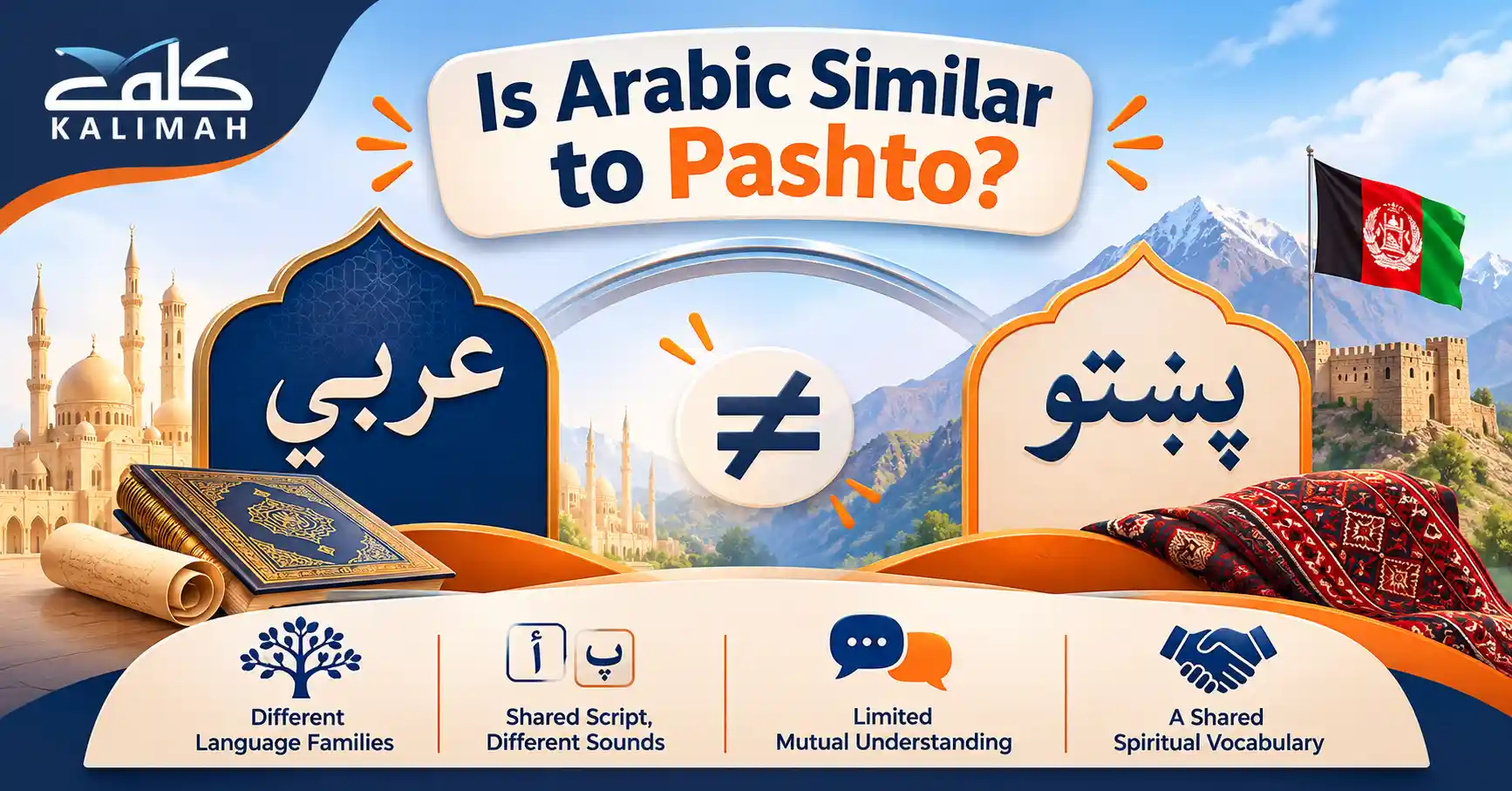
The main difference between Arabic and Pashto is that Arabic is a Semitic language built on consonant roots, while Pashto is an Eastern Iranian language that borrowed the Arabic script and many Arabic words.
Picture an Arabic speaker reading a shop sign in Peshawar. The letters look familiar, and a word like “kitab” jumps out, but the rest of the sign makes no sense. That moment explains why so many learners ask: is Arabic similar to Pashto, or does it only look that way?
At Kalimah Centre, we teach Arabic to learners from Afghanistan, Pakistan, and Pashto-speaking families around the world, so this question comes up a lot in our classes. The answer affects how fast you progress and what you should study first.
In this guide, we’ll go through the script, the shared vocabulary, the grammar, and the sounds of both languages. By the end, you’ll know what carries over from one to the other and what you need to learn from scratch.
Here’s what you’ll walk away with:
- Why Arabic and Pashto share a script but come from different language families
- Which Pashto letters and sounds don’t exist in Arabic, and the reverse
- Real examples of Arabic words used in Pashto
- The grammar differences that matter most for learners
- Free tools and practical steps to start learning Arabic with confidence
Is Arabic Similar To Pashto?
Arabic is similar to Pashto only on the surface. Both use the same core alphabet and share hundreds of words, but their grammar, sound systems, and origins are very different. The table below gives you the full picture at a glance before we look at each area in detail.
| Feature | Arabic | Pashto |
| Language family | Afro-Asiatic (Semitic) | Indo-European (Eastern Iranian) |
| Script | Arabic script, right to left | Modified Arabic script, right to left |
| Number of letters | 28 | About 44–45 |
| Main regions | Middle East and North Africa | Afghanistan and Pakistan |
| Word building | Three-letter roots and patterns | Stems with prefixes and suffixes |
| Typical word order | Verb–Subject–Object or Subject–Verb–Object | Subject–Object–Verb |
| Distinctive sounds | Throat sounds (ع، ح) and emphatics (ص، ط) | Retroflex sounds (ټ، ډ، ړ، ڼ) |
| Definite article | Yes (al-) | No |
| Dual form | Yes | No |
| Shared vocabulary | Source of many loanwords | Hundreds of Arabic loanwords, often via Dari |
With that overview in mind, the next question is why two unrelated languages have so much in common on paper. To answer “is Arabic similar to Pashto” properly, we need to look at their family trees, their shared history, and how well their speakers understand each other in real life.
Arabic And Pashto Belong To Different Language Families
Arabic is a Semitic language in the Afro-Asiatic family, which makes it a close relative of Hebrew and Aramaic. According to the Encyclopaedia Britannica entry on the Arabic language, most of its words are built from consonant roots, and that system shapes the whole language.
Pashto is an Indo-European language in the Eastern Iranian branch, so its distant relatives include Persian, Kurdish, and even English. If you ask whether Arabic is similar to Pashto by origin, the answer is no. They grew from separate roots and only met much later in history.
Allah (Glorified and Exalted be He) says:
“وَمِنْ آيَاتِهِ خَلْقُ السَّمَاوَاتِ وَالْأَرْضِ وَاخْتِلَافُ أَلْسِنَتِكُمْ وَأَلْوَانِكُمْ ۚ إِنَّ فِي ذَٰلِكَ لَآيَاتٍ لِّلْعَالِمِينَ”
“And one of His signs is the creation of the heavens and the earth, and the diversity of your languages and colours. Surely in this are signs for those of ˹sound˺ knowledge.” Surah Ar-Rum, 30:22
This verse treats the variety of human languages as a sign to reflect on, not as a barrier. Arabic and Pashto show this well: they come from different families, yet they meet in faith, in writing, and in daily life across Afghanistan and Pakistan.
Where The Shared Script And Vocabulary Come From
The connection began when Islam spread into the region and Arabic became the language of the Quran, prayer, and scholarship. Pashto speakers adopted the Arabic alphabet and borrowed words for religion, law, science, and administration that their language didn’t have yet.
Many of these words didn’t come straight from Arabic. As the Indiana University language portal for Pashto explains, many Arabic loanwords reached Pashto through Dari. That’s why some of them arrive with a Persian accent or a slightly different meaning.
The script has its own history. The Pashto alphabet developed in the 16th century, when scholars took the 28 Arabic letters and added new ones for native Pashto sounds. Later spelling reforms in Afghanistan and Pakistan produced small regional differences that are still visible today.
Can Arabic And Pashto Speakers Understand Each Other?
No. An Arabic speaker can’t follow a Pashto conversation, and a Pashto speaker can’t follow spoken Arabic without studying it. The shared words are usually formal or religious terms, while everyday speech, verbs, and sentence patterns are completely different in each language.
Reading is a little different. An Arabic reader can sound out most Pashto text because the letters are familiar, yet still not understand what the sentence means. A Pashto reader opening an Arabic book runs into the same gap in reverse, recognizing letters but not meaning.
The biggest advantage shows up in religious life. Many Pashto speakers recite the Quran and use phrases like “As-salamu alaykum” and “Insha’Allah” every day. So when people ask “is Arabic similar to Pashto,” this shared spiritual vocabulary is often the first thing they notice.
Read Also: Difference Between Arabic And Hebrew
How The Arabic And Pashto Alphabets Compare
The alphabet is where the two languages look most alike, and also where the first surprises appear. If you’re asking “is Arabic similar to Pashto” in writing, the answer is mostly yes, with a few important differences every learner should know before starting.
1. The Shared Right-To-Left Script
Both languages are written from right to left, and the letters inside a word join together and change shape depending on where they sit. Pashto uses the clear Naskh style, the same style you see in most printed Arabic books, newspapers, and copies of the Quran.
Pashto keeps all 28 letters of the Arabic alphabet, so an Arabic reader recognizes every one of them right away. Both languages often leave short vowels unwritten, which means readers rely on context and familiarity to pronounce words correctly, especially in fast everyday reading.
To see the full Pashto letter set with sounds and exercises, the University of Cambridge Language Centre offers an open-access Pashto alphabet self-study guide. Comparing it with the Arabic alphabet letter by letter is an easy way to see how much the two scripts overlap.
2. Extra Letters Pashto Adds To The Arabic Alphabet
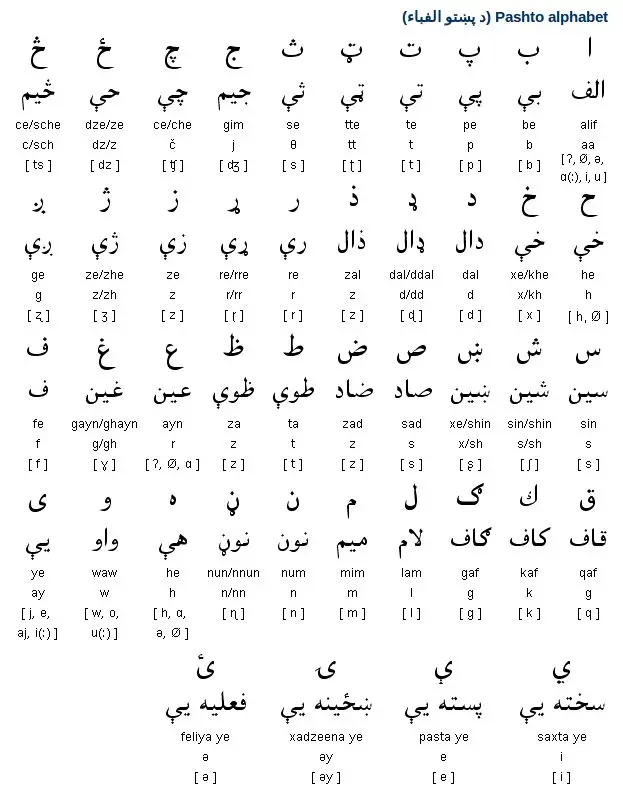
Pashto expands the Arabic set to about 44 or 45 letters, depending on which standard you follow. The extra letters stand for sounds Arabic doesn’t have, such as retroflex consonants made by curling the tongue back: ټ (ṭ), ډ (ḍ), ړ (ṛ), and ڼ (ṇ).
Other additions include څ (ts), ځ (dz), ښ, and ږ, along with Persian-style letters such as پ (p), چ (ch), ژ (zh), and ګ (g). The Pashto alphabet chart on Wikipedia lists each letter with its sound, which makes it a handy visual reference while you study.
The letters ښ and ږ are pronounced differently depending on the region: “sh” and “zh” in the south, but “kh” and “g” in the north. That’s why you’ll hear both “Pashto” and “Pakhto,” and why Pashto learners usually choose one dialect early on.
3. Arabic Letters Pashto Keeps Mainly For Borrowed Words
Letters such as ث، ح، ذ، ص، ض، ط، ظ، and ع appear in Pashto almost only inside Arabic loanwords. Pashto speakers usually pronounce them with simpler native sounds, so ص becomes a plain “s,” ط a plain “t,” and ح a soft “h.”
This is the biggest pronunciation hurdle for Pashto speakers learning Arabic. In Arabic, these letters have their own sounds, and those sounds change meaning: “سيف” (sword) and “صيف” (summer) differ by a single letter, so mixing them up can confuse listeners.
Kalimah Centre’s Learn Quran Online Course trains learners to pronounce every Arabic letter from its correct point of articulation, following Tajweed rules. For Pashto speakers who already recite, it turns familiar sounds into precise, confident pronunciation they can use in prayer and reading.
Recommended reading: Is The Arabic Alphabet The Same For All Dialects?
Here Are The Reviews On Our Courses:
Our students frequently commend the excellence of our courses and the commitment shown by our instructors. You can read their complete reviews on Trustpilot.
Read more reviews on Trustpilot
The Difference Between Pashto And Arabic In Vocabulary And Grammar
The difference between Pashto and Arabic becomes much clearer once you move past the alphabet. Vocabulary overlaps in meaningful ways, but grammar is where the two languages separate completely. Understanding both sides helps you set realistic goals and avoid frustration early in your studies.
1. Arabic Loanwords You Will Recognize In Pashto
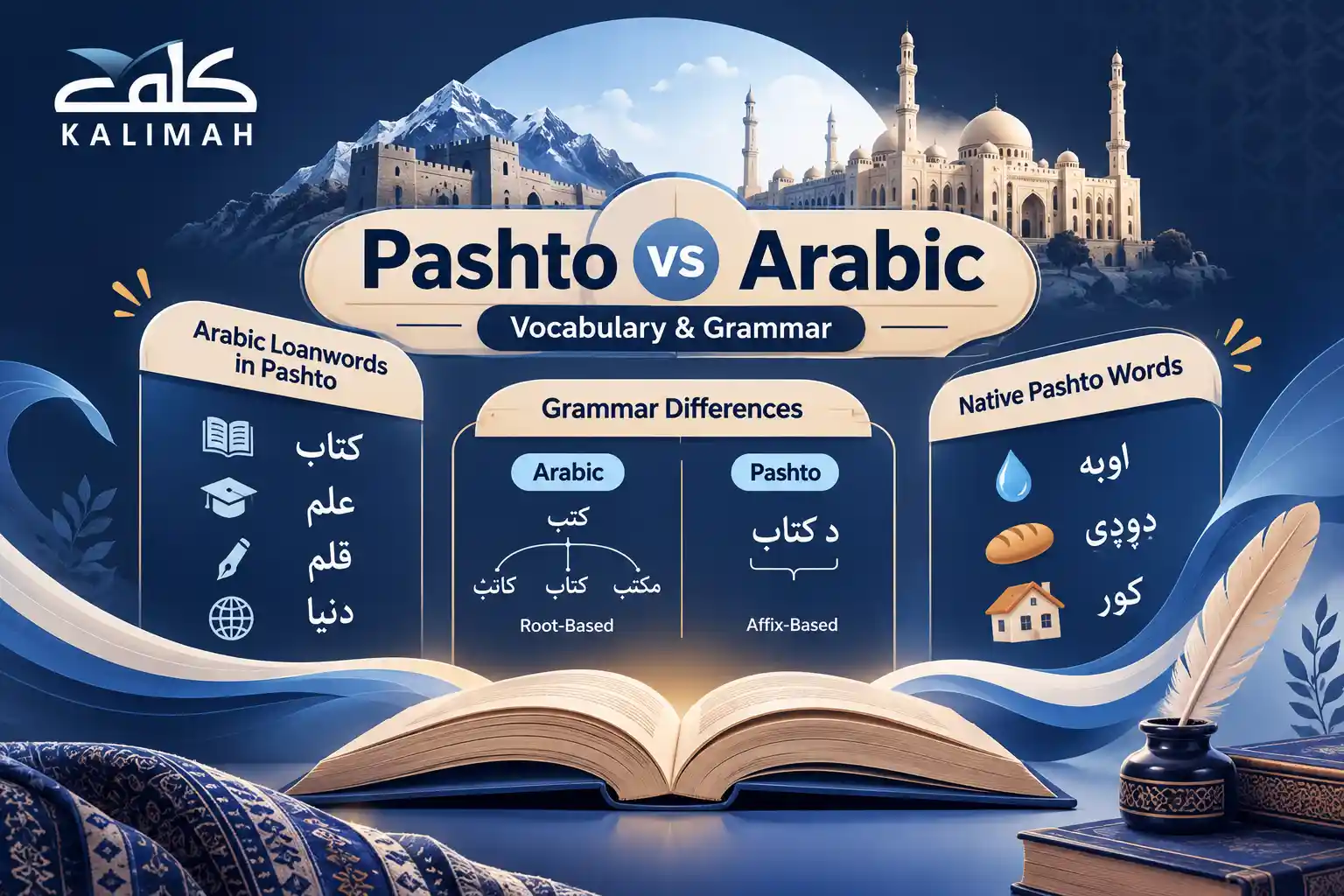
Pashto uses many Arabic words in education, religion, and public life. Examples include کتاب (kitab, book), علم (ilm, knowledge), قلم (qalam, pen), خبر (khabar, news), دنیا (dunya, world), and حکومت (hukumat, government). An Arabic speaker spots these immediately in Pashto text.
Some loanwords changed along the way. Arabic وقت (waqt, time) became وخت (wakht) in Pashto, and several words shifted in meaning after passing through Persian. A familiar word is a useful clue, but it isn’t always a perfect match for the original Arabic.
If you want to check the original Arabic meaning of a borrowed word, the free Arabic Lexicon dictionary search searches dozens of classical Arabic dictionaries at once. It’s an easy way to trace a Pashto loanword back to its Arabic root and see its full range of meanings.
2. Everyday Pashto Words With No Arabic Connection
The words people use most at home are native Pashto, not Arabic. Water is اوبه (oba) instead of ماء, bread is ډوډۍ (doday) instead of خبز, and house is کور (kor) instead of بيت. These everyday words have no link to Arabic at all.
Many of them connect to other Indo-European languages instead. Pashto مور (mor, mother) sounds like the English “mother,” while دوه (dwa, two) and درې (dre, three) resemble “two” and “three.” The free Glottolog language catalogue shows where Pashto sits in this family.
To hear these words spoken naturally, the U.S. Defense Language Institute’s free eLearning resources portal includes Pashto language and culture materials. Listening to native audio shows how different Pashto’s rhythm and intonation are from Arabic, even when a few shared words come up.
3. Grammar Structures That Set Arabic And Pashto Apart
Arabic builds words from three-letter roots. From ك-ت-ب, for example, you get كتاب (book), كاتب (writer), and مكتب (office). Pashto doesn’t work this way. Its native words are built from stems with prefixes and suffixes, so Arabic’s root logic is new for Pashto learners.
Word order differs as well. Arabic often puts the verb first or in the middle of the sentence, while Pashto puts it at the end. As the Britannica overview of Pashto notes, the possessor comes first in Pashto, as in د زلمي کتاب (Zalmay’s book), the reverse of Arabic.
Pashto also has features Arabic lacks, such as split ergativity: in the past tense, the verb agrees with the object rather than the subject. Arabic, meanwhile, has a dual form and case endings (i’rab), which Pashto speakers have to learn from the beginning.
Further reading: How Long Does It Take to Learn Arabic? Timeline, FSI Data & Difficulty Guide
Experience Kalimah Center Classes
Watch real excerpts from our live sessions at Kalimah Center and see how we bring learning to life. These clips highlight our interactive, student-centered teaching approach across all our courses—designed to keep learners engaged, motivated, and actively involved every step of the way.
Master Arabic with Kalimah Center
Join our expert-led online classes and start your journey toward Arabic fluency today.
Book Your Free TrialWhat These Similarities Mean For Arabic Learners
Knowing the answer to “is Arabic similar to Pashto” is only useful if it changes how you study. Here’s how the overlap and the gaps turn into real advantages, common challenges, and free tools you can start using today to make faster, steadier progress.
Advantages Pashto Speakers Have When Learning Arabic
Pashto speakers skip the hardest first step for most beginners: learning a brand-new script. They already read right to left, recognize the letters, and join them naturally. That can save weeks of alphabet practice at the start of any Arabic program.
They also bring hundreds of familiar words related to faith, education, and society. Terms like علم، کتاب، and محبت need no memorizing, so learners can spend their energy on grammar, listening, and speaking instead of building vocabulary from zero.
Families who want their children to grow up with both languages can start early. Kalimah Centre’s Learn Arabic For Children Course uses engaging, level-based lessons designed for young learners, helping Pashto-speaking kids build Arabic skills alongside their home language.
Challenges Pashto Speakers Face In Arabic
The first challenge is pronunciation. Arabic letters such as ع، ح، and ق are made deep in the throat, where Pashto has no matching sounds, so they need deliberate practice with feedback. Without correction, learners tend to carry Pashto pronunciation habits into their Arabic.
The second challenge is grammar. Root patterns, verb forms, the dual, and case endings are all unfamiliar, and loanwords that changed meaning can mislead you. Steady, structured practice works much better than guessing based on what a word means in Pashto.
Kalimah Centre’s Learn Arabic With Online Course tackles both challenges through one-on-one sessions with certified native tutors. A placement test sets your starting level, so Pashto speakers skip the basics they already know and focus on the skills that still need work.
Free Tools To Practice Arabic And Compare It With Pashto
Typing practice helps you learn the letters that differ between the two scripts. The free Lexilogos online Pashto keyboard lets you type Pashto characters on screen and compare them with their Arabic counterparts, which makes the extra letters easy to spot.
For Arabic roots and grammar, the free Quranic Arabic Corpus analyzes every word of the Quran by root, form, and grammatical role. It’s especially useful for Pashto speakers who recite regularly and want to understand the structure behind verses they already know by heart.
When you’re ready for live practice with other motivated learners, Kalimah Centre’s Kalimah Intensive Group Classes offer structured lessons in a supportive group setting. Learning with peers keeps you accountable and gives you more speaking practice than studying alone.
Don’t miss: Arabic Language: Complete Guide to History, Script & Dialects
Kalimah Centre Is The Smart Choice For Pashto Speakers Learning Arabic
Learning Arabic as a Pashto speaker works best with a teacher who knows exactly where your head start ends and where the real work begins. Kalimah Centre has taught Arabic and Quran online since 2011, and our native tutors are certified to teach non-Arabic speakers, including learners who already read the script.
Our own curriculum covers 16 levels and more than 400 hours of one-on-one study, moving from the alphabet through everyday topics to full grammar (Nahw). Because you take a placement test first, you never spend time on letters you already know from Pashto, and every lesson targets the skills you’re still missing.
You can see your progress clearly. At the end of each level, you take an oral exam, and when you pass, you can request a certificate for that level. Whether you came here asking “is Arabic similar to Pashto” or you simply want to understand the Quran you recite, each level gives you a clear milestone to aim for.
Inside Kalimah Center: Moments from Our Courses
Get a glimpse into the vibrant learning experience at Kalimah Center. These snapshots capture real moments from our live classes—where students engage deeply, connect with passionate instructors, and grow in a welcoming, supportive environment.
Master Arabic with Kalimah Center
Join our expert-led online classes and start your journey toward Arabic fluency today.
Book Your Free TrialBook Your Free Arabic Trial Class Today!
You already have a head start: the script, the sounds of recitation, and dozens of shared words. Now it’s time to build on it with a tutor who can guide your pronunciation, explain the grammar step by step, and build your confidence from the very first lesson.
Book your free trial class with Kalimah Centre today and meet a certified native tutor live. You’ll get a quick level check, a personalized learning plan, and a clear sense of how our one-on-one sessions turn your Pashto background into real Arabic progress.
Explore Our Courses:
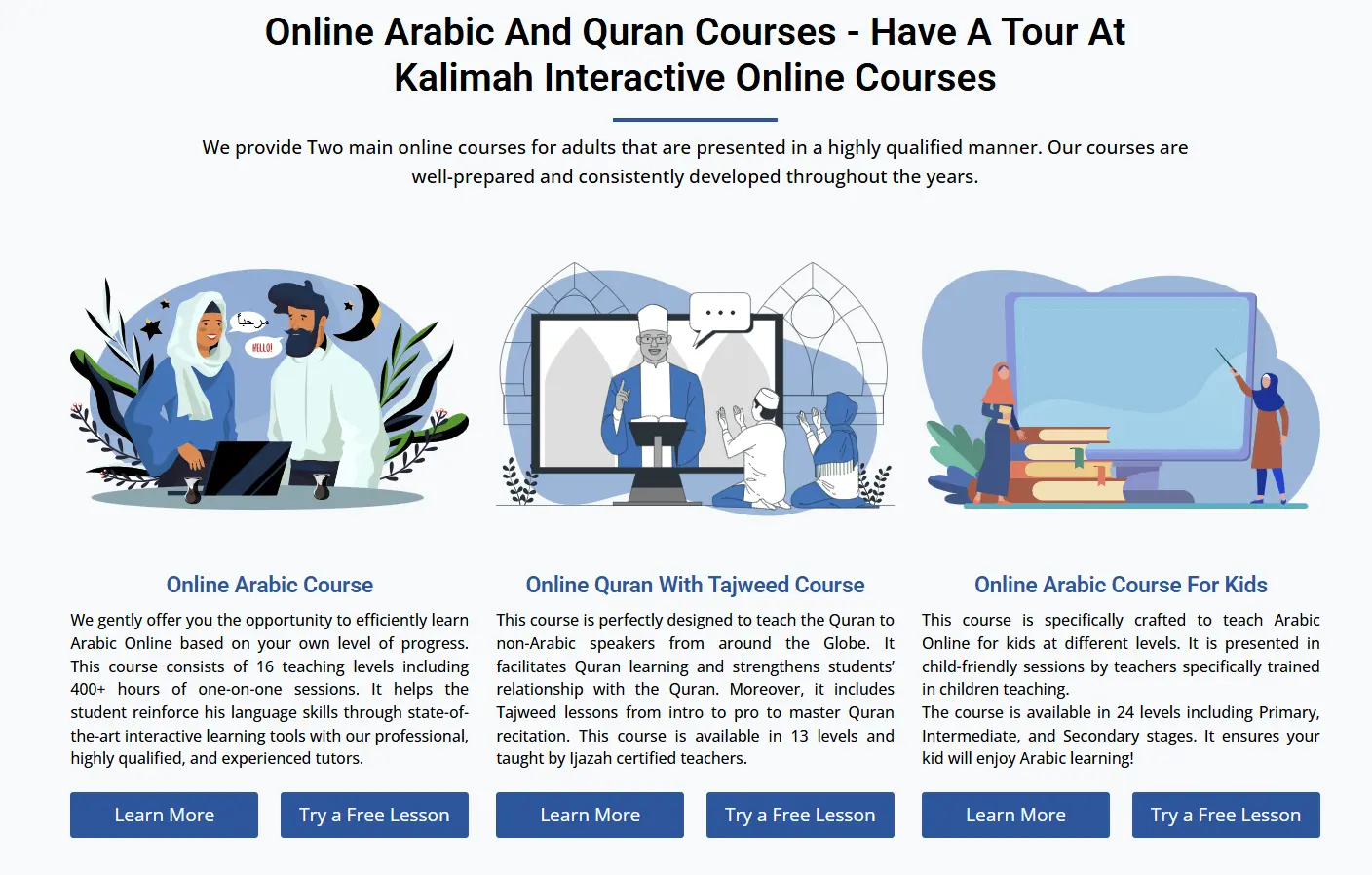
Online Arabic Course: Tailored to your level, our comprehensive Arabic program includes 16 teaching levels and 400+ hours of personalized sessions.
Online Quran With Tajweed Course: Perfect for non-Arabic speakers, our course spans 13 levels and equips you with Tajweed mastery from beginner to advanced.
Online Arabic Course For Kids: Nurture your child’s love for Arabic with our engaging and structured program, available in 24 levels for primary, intermediate, and secondary stages.
Don’t let another month go by wondering how far you could get. Reserve your free session now, pick a time that fits your schedule, and take your first step toward reading, understanding, and speaking Arabic with ease and confidence.
Master Arabic with Kalimah Center
Join our expert-led online classes and start your journey toward Arabic fluency today.
Book Your Free TrialFinal Takeaways
Arabic and Pashto share a script, a body of religious vocabulary, and centuries of history, yet they belong to completely different language families. Arabic is Semitic and built on roots and patterns. Pashto is Eastern Iranian, with retroflex sounds, verb-final sentences, and split ergativity, features Arabic doesn’t have.
So, is Arabic similar to Pashto? In writing and in religious vocabulary, yes. In grammar and everyday speech, not really. For Pashto speakers, that means a faster start with reading and vocabulary, but Arabic pronunciation, root patterns, and case endings still need focused, guided practice.
If your main goal is reading the Quran correctly, Tajweed-focused study will give you the quickest results. If you want conversation and full comprehension, a structured, level-based Arabic program works best. Either way, your familiarity with the script is a real advantage, and a good teacher will help you get the most out of it.
Frequently Asked Questions
What Language Is Closest To Pashto?
Pashto’s closest relatives are small Eastern Iranian languages such as Munji and Yidgha, spoken in the Pamir region. Among widely spoken languages, Persian (Dari) is the nearest, since both belong to the Iranian branch.
Is Pashto Closer To Persian Or Arabic?
Pashto is much closer to Persian, which shares its Iranian roots, grammar patterns, and many everyday words. Arabic is linked to it only through the script and borrowed terms, so Kalimah Centre teaches Arabic grammar to Pashto speakers from the ground up.
Is Pashto A Difficult Language To Learn?
Yes, for English speakers Pashto is considered challenging, mainly because of its retroflex sounds, split ergativity, and regional dialect differences. Learners who already read Arabic or Urdu script start ahead, since the alphabet takes far less time to learn.
How Do You Say Hello In Pashto?
The most common greeting is the Arabic “As-salamu alaykum,” along with the native Pashto “ستړې مه شې” (staṛe ma she), meaning “may you not be tired.” Kalimah Centre helps Pashto speakers turn greetings like this into full Arabic conversations.
Do Muslims Speak Pashto?
Yes. Most Pashto speakers are Muslims, mainly in Afghanistan and Pakistan, and they use Arabic for prayer and Quran recitation. That’s why many of them join Kalimah Centre to understand the Arabic they recite every day.