Kalimah Center offers live, one-on-one Arabic lessons in Philadelphia for adults, children, and families across Pennsylvania. Sessions cover Modern Standard Arabic, spoken dialects, Quranic Arabic, and Arabic script — taught by native, certified tutors online.
Finding a qualified Arabic teacher in Philadelphia who fits your schedule is a real challenge. Kalimah Center connects you with certified native tutors available in the evenings, on weekends, and around Pennsylvania school hours — no commute, no group class pace.
Arabic Classes in Philadelphia Taught by Native Certified Tutors
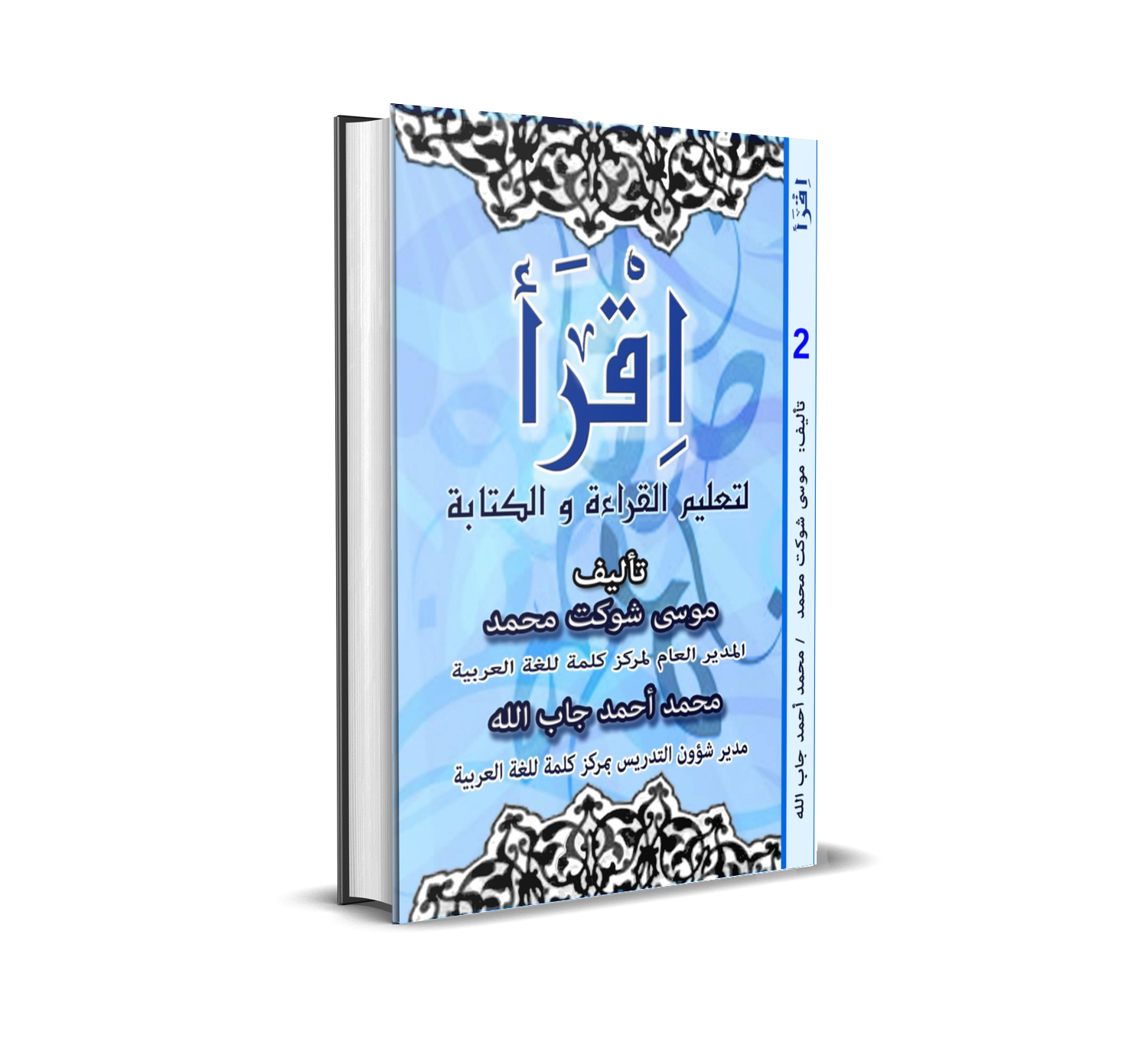
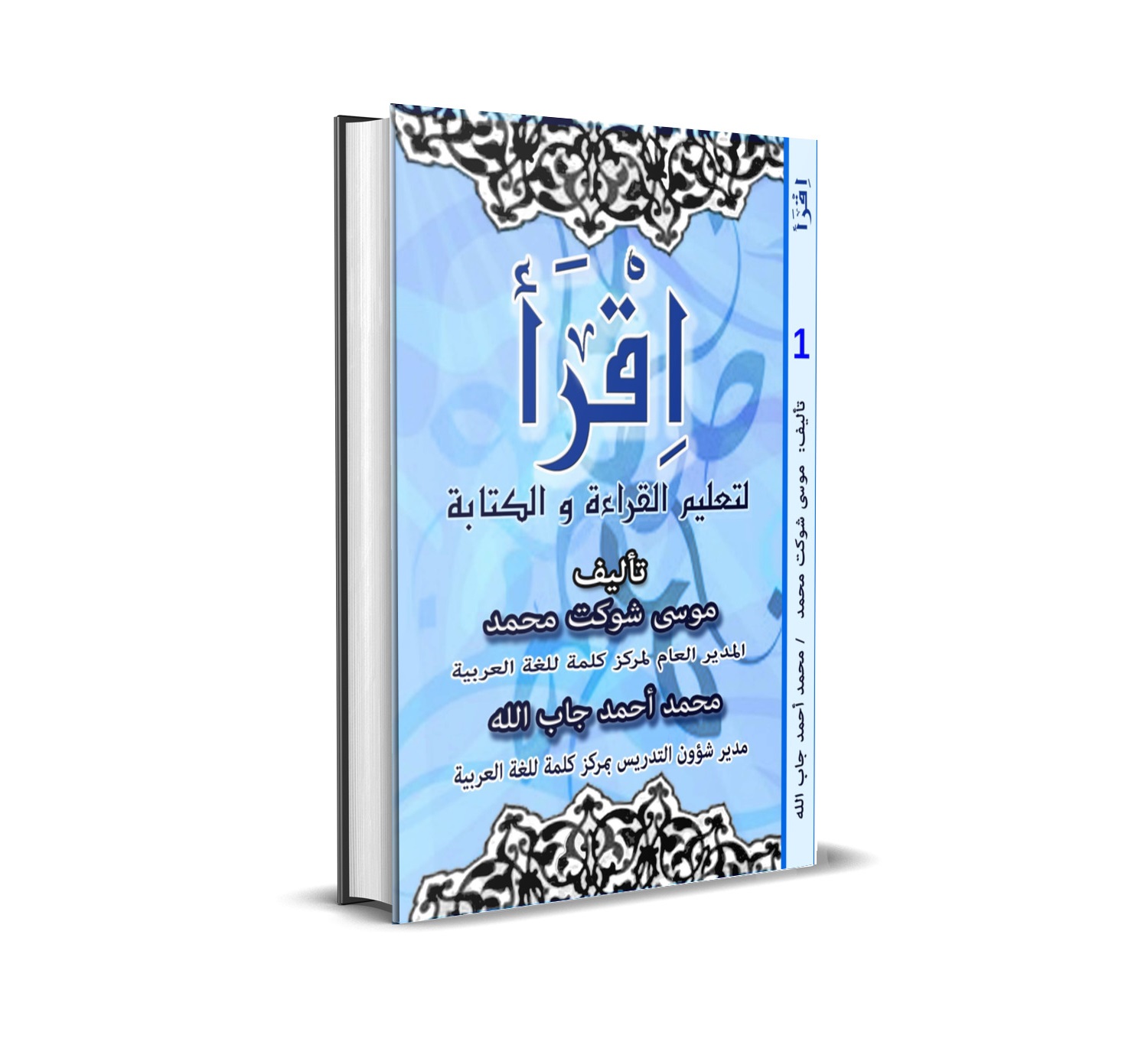
Arabic lessons in Philadelphia through Kalimah Center cover Modern Standard Arabic (MSA), Arabic script and alphabet foundations, spoken dialects including Egyptian and Levantine, Quranic Arabic, and grammar from beginner through advanced. Tutors hold professional certifications and teach through a structured, level-appropriate curriculum.
All instruction is delivered in English-medium online sessions — accessible from anywhere in Philadelphia, including South Philly, West Philadelphia, and surrounding areas. Beginners start from the Arabic alphabet itself. Advanced learners work on reading authentic texts, academic Arabic, or Quranic recitation at the appropriate level.
How Online Arabic Classes in Philadelphia Work
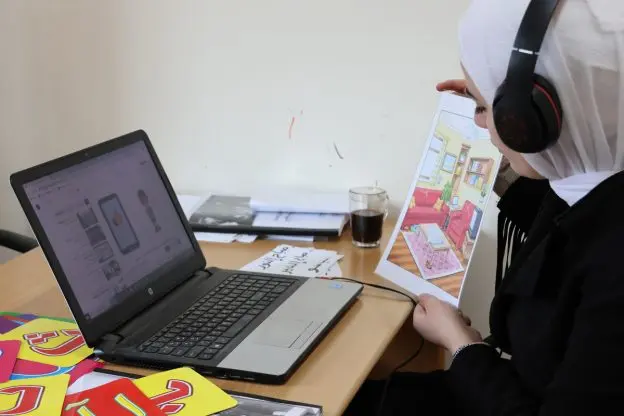
Kalimah Center’s Arabic classes in Philadelphia run entirely online through live video sessions. Each lesson is one-on-one, structured around the student’s specific level and goals — not a fixed group pace.
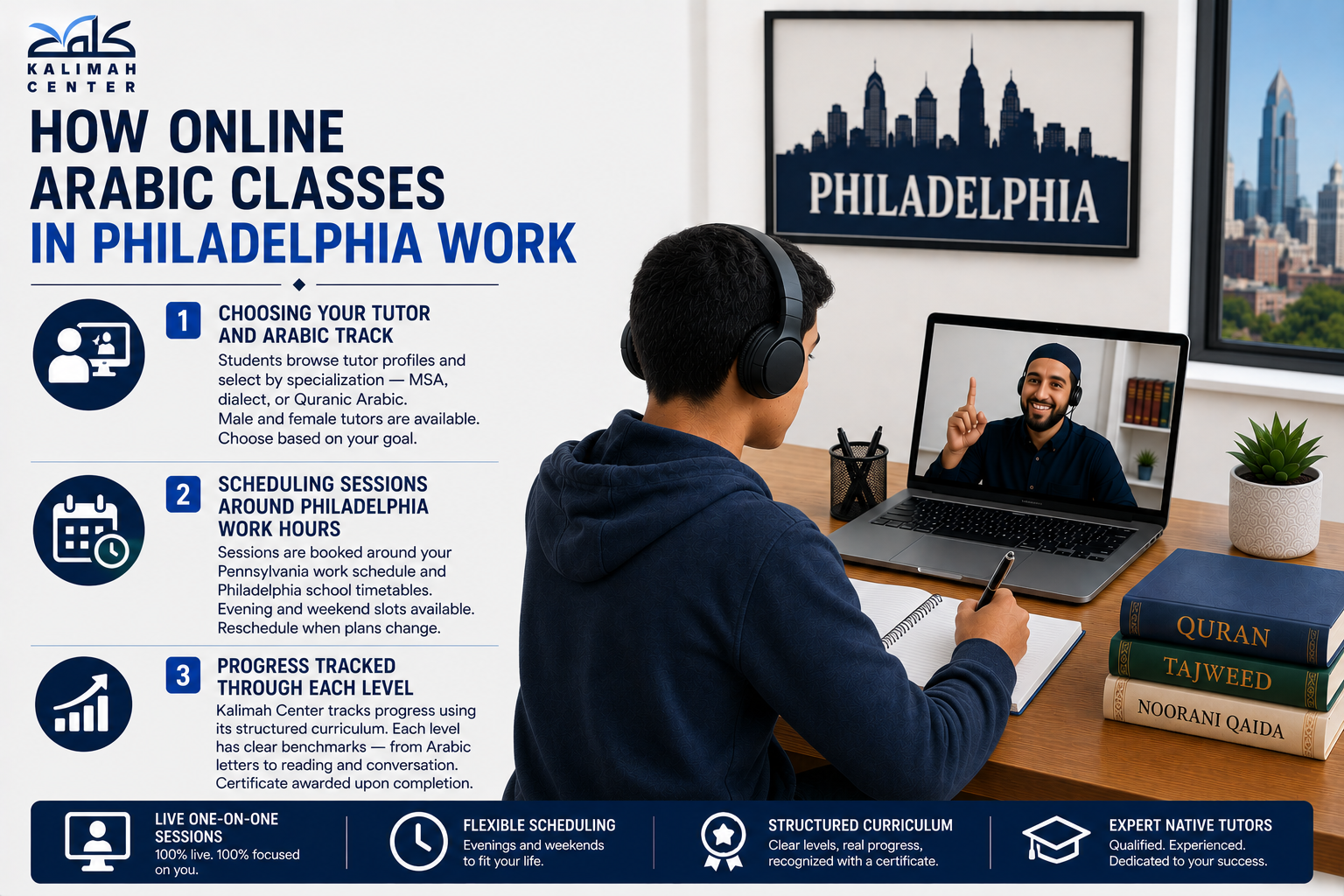
1. Choosing Your Tutor and Arabic Track
Students browse Kalimah Center’s teacher profiles and select a tutor by specialization — MSA, dialect, or Quranic Arabic. Male and female tutors are available. Learners choose based on their goal, whether that is conversational Arabic, heritage reconnection, or Quran reading.
2. Scheduling Sessions Around Philadelphia Work Hours
Sessions are booked directly around Pennsylvania work schedules and Philadelphia school timetables. Evening and weekend slots are available. Students reschedule when plans change, keeping learning consistent without the rigidity of a fixed class format.
3. Progress Tracked Through Each Level
Kalimah Center tracks student progress across levels using its own structured curriculum. Each level has defined benchmarks — from Arabic letter recognition through to reading continuous text and holding spoken conversation. A certificate is awarded upon completing each level.
What Philadelphia Students Learn in Arabic Lessons
Kalimah Center’s Arabic lessons in Philadelphia follow a structured sequence — from alphabet and pronunciation through grammar, reading, and spoken communication. Every subject area below is taught through personalized live sessions.
1. Arabic Script and Alphabet from the Start
Complete beginners in Philadelphia start with the Arabic alphabet, letter forms, and how letters connect in written words. Tutors teach correct letter shapes, directionality, and vowel marks (harakat) before moving on to vocabulary and reading. No prior knowledge is needed to begin.
2. Teaching Modern Standard Arabic for Reading and Writing
Modern Standard Arabic (MSA) is the formal written form used across the Arab world — in media, literature, academic texts, and official communication. Kalimah Center’s MSA track builds reading, writing, vocabulary, and grammar through structured levels aligned with ACTFL proficiency expectations.
3. Spoken Dialects Including Egyptian and Levantine
Learners in Philadelphia who want to speak Arabic in everyday situations choose a dialect track. Egyptian Arabic is widely understood across the Arab world. Levantine Arabic connects learners to Syrian, Lebanese, Palestinian, and Jordanian communities. Tutors are native speakers of the selected dialect.
4. Quranic Arabic Reading with Proper Pronunciation
Quranic Arabic has a distinct vocabulary, grammar structure, and recitation style. Kalimah Center’s Quranic Arabic track covers Tajweed rules, Makharij (letter articulation points), and reading directly from the Quran. Tutors certified in Hafs narration guide students through proper recitation at each stage.
5. Arabic Grammar Built Across Structured Levels
Grammar is taught progressively — beginning with sentence structure and verb conjugation, advancing through noun-adjective agreement, dual and plural forms, and verb patterns. Each grammar concept is practiced in context through reading passages and spoken exercises, not through isolated memorization.
6. Building Active Vocabulary for Real Situations
Vocabulary instruction at Kalimah Center focuses on three-root Arabic word patterns, which allow learners to recognize related words across texts. Students build active vocabulary through reading exercises, conversation practice, and tutor-guided oral drills — not passive word lists or apps.
Book a free placement session with Kalimah Center today.
Read also: Arabic Lessons In Washington DC
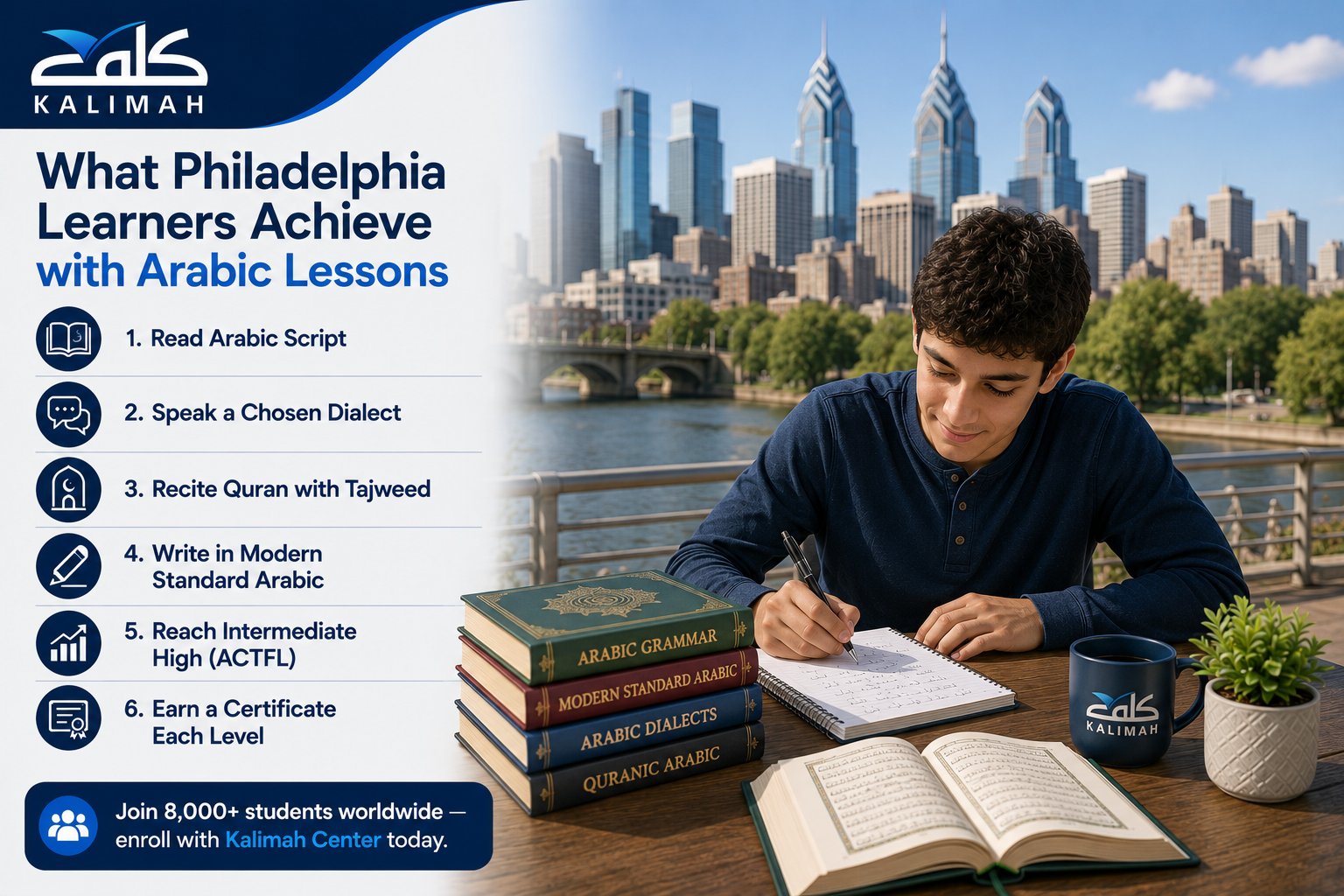
What Philadelphia Learners Achieve with Arabic Lessons
Kalimah Center’s Arabic lessons in Philadelphia produce specific, measurable results — from reading the Arabic script independently to holding conversations in a chosen dialect. These are the outcomes students work toward across the program.
1. Reading Arabic Script Without Transliteration
Students reach a point where they read Arabic letters, connected text, and short passages directly — without needing romanized transliterations as a crutch. This is the foundation every other Arabic skill is built on, and Kalimah Center’s tutors work on it from the first session.
2. Conversational Confidence in a Chosen Dialect
Learners who focus on Egyptian or Levantine Arabic develop the ability to hold everyday conversations — greetings, directions, family discussions, and practical interactions — at a natural pace. Tutors use real conversational scenarios, not scripted dialogues, to build spoken fluency progressively.
3. Accurate Quran Recitation with Tajweed Rules
Students on the Quranic track recite with correct Makharij and observe Tajweed rules — elongations, stops, and letter merging — as applied in the Hafs narration. Kalimah Center’s certified tutors correct pronunciation errors in real time during every live session.
4. Writing and Composing Short Passages in MSA
Intermediate and advanced students produce written Arabic — short paragraphs, structured responses, and essay-level text in Modern Standard Arabic. Grammar accuracy, vocabulary range, and sentence structure are assessed and corrected by the tutor throughout each level.
5. Reaching Intermediate High on the ACTFL Scale
For learners pursuing academic or professional Arabic, Kalimah Center’s MSA curriculum is structured to take students from beginner through Intermediate High proficiency — the level at which a learner can communicate across a wide range of everyday and professional topics in Arabic.
6. Earning a Certificate at Each Completed Level
Kalimah Center awards a certificate upon completing each program level — providing documented evidence of progress. Students who complete the full Quran recitation track with their tutor are eligible to receive an Ijazah, the traditional certification of qualified Quranic recitation.
Enroll with Kalimah Center today.
About Kalimah Center for Learners in Philadelphia
Kalimah Center is an established online Arabic and Quran teaching platform serving students in Philadelphia, across Pennsylvania, and throughout the United States. Learners from Philadelphia, Camden, Cherry Hill, Wilmington, and Trenton access the same certified tutors through live online sessions — no local classroom needed.
With more than 8,000 students enrolled worldwide and over 40 teachers and program administrators, Kalimah Center operates a full professional curriculum developed in-house. Tutors are screened, trained, and assigned based on subject expertise — not availability alone. Students have access to a consistent, structured experience from their first free session.
Book a free trial class and get matched with the right tutor for your level.
Philadelphia Arabic Teachers at Kalimah Center
Kalimah Center’s Arabic tutors are native speakers, professionally certified, and experienced teaching learners at all levels — from complete beginners through advanced. Male and female tutors are available, with specializations covering MSA, Arabic dialects, and Quranic Arabic with Tajweed.
Browse all Arabic teachers and pick the one that fits your learning goals in Philadelphia.
Read also: Arabic Lessons in New York for All Levels
Experience Kalimah Center Classes
Watch real excerpts from our live sessions at Kalimah Center and see how we bring learning to life. These clips highlight our interactive, student-centered teaching approach across all our courses—designed to keep learners engaged, motivated, and actively involved every step of the way.
Master Arabic with Kalimah Center
Join our expert-led online classes and start your journey toward Arabic fluency today.
Book Your Free TrialWhy Philadelphia Students Choose Kalimah Center for Arabic
Arabic classes in Philadelphia through Kalimah Center combine native tutor quality with scheduling flexibility that local group classes or apps cannot match — every session is live, one-on-one, and built around your specific level and goal.
1. Native Tutors with Professional Certification
Every Kalimah Center Arabic tutor is a native Arabic speaker who holds a professional teaching certification. Many hold Al-Azhar qualifications or Ijazah in Quranic recitation. Credentials are verified — not self-reported — before tutors join the platform.
2. Live One-on-One Sessions Every Lesson
Every Arabic lesson is a live, direct session between one student and one tutor. No recorded videos, no group classes to keep pace with. The tutor corrects pronunciation, adjusts explanations, and moves at the student’s actual speed — not a fixed syllabus clock.
3. Both Male and Female Tutors Available
Kalimah Center provides male and female Arabic tutors. Sisters and girls who prefer a female teacher, and families seeking a male tutor for their sons, can select accordingly from the teacher profiles. Preference is accommodated from the first booking.
4. Scheduling Built Around Pennsylvania Routines
Sessions are available in the mornings, evenings, and on weekends — fitting around Philadelphia work hours, Pennsylvania school calendars, and family schedules. Students reschedule when needed. Consistency is built in, not forced by a fixed timetable.
5. Kalimah Center’s Own Proprietary Curriculum
Kalimah Center develops and owns its Arabic teaching materials — not borrowed from third-party textbooks or apps. The curriculum sequences skills logically from letter recognition through advanced reading and writing, with built-in benchmarks at each level so progress is measurable and clear.
6. Certificate Per Level and Ijazah Upon Completion
Students receive a formal certificate from Kalimah Center at the end of each completed level. For learners who complete the full Quranic recitation program, an Ijazah is awarded — the traditional chain-of-transmission certification recognizing mastery of proper recitation.
7. Dialect Choice Matched to Each Learner’s Purpose
Philadelphia learners choose their Arabic track from the start — MSA for reading and writing, Egyptian Arabic for broad spoken comprehension, Levantine for community connection, or Quranic Arabic for religious study. Kalimah Center matches each student with a tutor who is a native speaker of their chosen variety.
8. Heritage Arabic Reconnection for Diaspora Learners
Many Arabic learners in Philadelphia grew up in Arabic-speaking households but never studied the language formally. Kalimah Center’s tutors identify exactly what a heritage learner already knows and builds from there — reinforcing reading, grammar, and dialect skills efficiently without repeating basics unnecessarily.
Read also: Arabic Lessons in Miami for All Levels
Here are the reviews on our Arabic Courses:
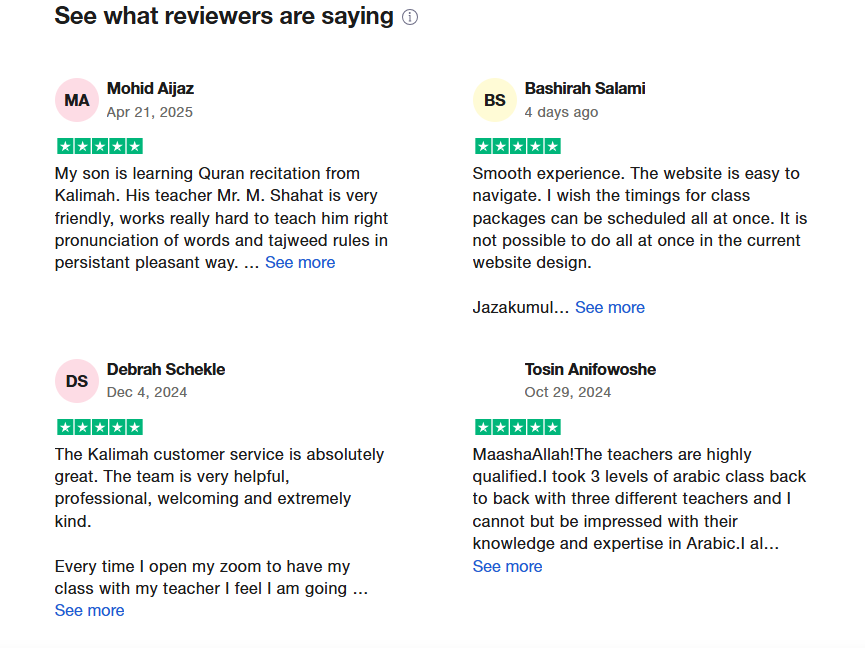
https://www.trustpilot.com/review/kalimah-center.com
Prices:
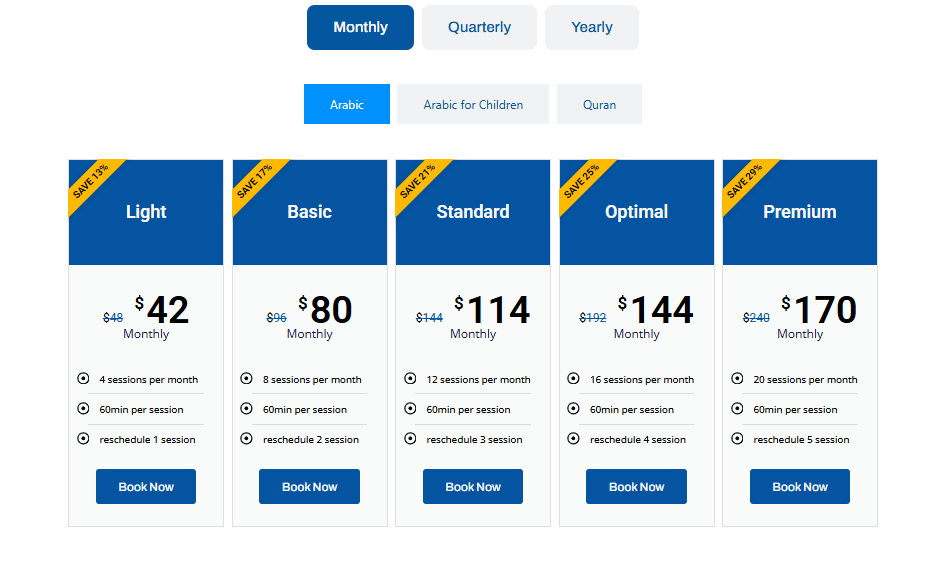
Start with a free Arabic class first.
Inside Kalimah Center: Moments from Our Courses
Get a glimpse into the vibrant learning experience at Kalimah Center. These snapshots capture real moments from our live classes—where students engage deeply, connect with passionate instructors, and grow in a welcoming, supportive environment.
Start Arabic Lessons in Philadelphia with Kalimah Center
Philadelphia has a growing Arabic-speaking community — and many families in the area are looking for qualified instruction that goes beyond what a local masjid class or language app can provide. Kalimah Center gives learners in Philadelphia direct access to native-certified tutors without leaving home, with sessions available around Pennsylvania work and school hours.
Kalimah Center offers a free first class with no payment required upfront. Adults, children, and families across Philadelphia, Camden, and Cherry Hill can book a trial session, get assessed at the right level, and begin structured Arabic classes in Philadelphia the same week.
📚 Explore Our Courses:
Online Arabic Course: Tailored to your level, our comprehensive Arabic program includes 16 teaching levels and 400+ hours of personalized sessions.
Online Quran With Tajweed Course: Perfect for non-Arabic speakers, our course spans 13 levels and equips you with Tajweed mastery from beginner to advanced.
Online Arabic Course For Kids: Nurture your child’s love for Arabic with our engaging and structured program, available in 24 levels for primary, intermediate, and secondary stages.
🚀 Start Your Free Trial Today! 🚀
Don’t miss out on this life-changing opportunity to deepen your faith and knowledge. Sign up now for your free trial and take the first step towards becoming a better practicing Muslim with Kalimah Center!
Master Arabic with Kalimah Center
Join our expert-led online classes and start your journey toward Arabic fluency today.
Book Your Free TrialConclusion
Arabic lessons in Philadelphia at Kalimah Center cover Arabic alphabet, Modern Standard Arabic, Egyptian and Levantine dialects, Quranic Arabic with Tajweed, and advanced reading from beginner to advanced levels. Live one-on-one classes are taught by native certified tutors with flexible scheduling and level certificates. A free trial session is available.
Frequently Asked Questions
Are Arabic Lessons in Philadelphia Suitable for Complete Beginners?
Yes. Kalimah Center’s Arabic classes in Philadelphia start with the Arabic alphabet, letter shapes, and pronunciation. No prior knowledge is required, and tutors assess each student’s starting level before developing an appropriate learning plan.
Can Children in Philadelphia Join Arabic Classes at Kalimah Center?
Yes. Kalimah Center provides Arabic lessons for children of all ages using age-appropriate materials and pacing. Philadelphia parents can book a trial lesson to find the right tutor before choosing a regular schedule.
Are Female Arabic Tutors Available for Sisters and Girls?
Yes. Kalimah Center has certified male and female Arabic tutors. Sisters and families who prefer a female teacher for their daughters can select one directly from the available teacher profiles when booking lessons.
What Session Times Are Available for Philadelphia Students?
Sessions are available in the mornings, evenings, and on weekends to fit Philadelphia work hours and Pennsylvania school schedules. Students can reschedule when plans change while maintaining consistent learning without a rigid timetable.
How Does Kalimah Center Track Student Progress in Arabic?
Kalimah Center tracks progress through a structured curriculum with defined benchmarks for each level. Tutors assess reading, grammar, vocabulary, and speaking skills throughout the program, with a certificate issued after completing each level.
Is There a Free Trial Class Before Enrolling in Arabic Lessons?
Yes. Kalimah Center offers a free first Arabic class with no upfront payment. Philadelphia learners can meet their tutor, receive a level assessment, and determine whether the teaching approach matches their goals and learning style.
Do Students Receive a Certificate After Completing Arabic Levels?
Yes. Kalimah Center awards a formal certificate after completing each Arabic program level. Students who complete the full Quranic recitation track may also receive an Ijazah with a verified chain of transmission.