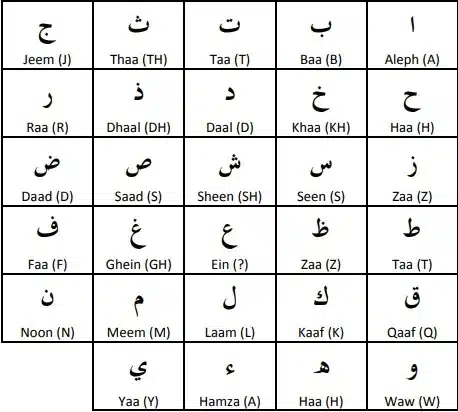
Arabic pronunciation can feel unusual for English speakers because some Arabic sounds simply do not exist in English Many beginners try to match every Arabic letter with an English sound. This works for some letters, such as ب which is close to “b,” or م which is close to “m.” But it does not work for every letter.
Some Arabic letters are produced from the throat. Others are deeper, heavier, or more emphatic than their English equivalents. That is why learners often struggle with letters like ح, خ, ع, غ, ق, ص, ض, ط, and ظ.
This guide explains the most important Arabic letters with no English equivalent, how they sound, why they are difficult, and how to practice them without overcomplicating pronunciation.
Which Arabic Letters Have No English Equivalent?
The Arabic letters that English speakers usually find hardest are:
ح، خ، ع، غ، ق، ص، ض، ط، ظ
These letters do not have exact English equivalents.
Some of them are throat sounds, such as ح and ع.
Some are guttural sounds, such as خ and غ.
Some are deeper or heavier versions of familiar sounds, such as ص, ض, ط, and ظ.
And ق is a deep sound from the back of the mouth, different from the English “k.”
Arabic Letters with No English Equivalent
Arabic has several sounds that do not exist in English, which makes pronunciation difficult for beginners. Learning these letters early helps build correct pronunciation and improves reading fluency in Arabic.
| Arabic Letter | Name | Common Transliteration | Closest English Idea | Main Difficulty |
| ح | ḥā’ | ḥ | deep h | Throat sound |
| خ | khā’ | kh | “ch” in loch | Rough back-mouth sound |
| ع | ʿayn | ʿ | no real equivalent | Deep voiced throat sound |
| غ | ghayn | gh | French r / gargle | Guttural voiced sound |
| ق | qāf | q | deep k/q | Back-of-mouth sound |
| ص | ṣād | ṣ | heavy s | Emphatic sound |
| ض | ḍād | ḍ | heavy d | Emphatic sound |
| ط | ṭā’ | ṭ | heavy t | Emphatic sound |
| ظ | ẓā’ | ẓ | heavy th/z | Emphatic sound |
Why Some Arabic Sounds Do Not Exist in English?
Arabic and English use the mouth differently.
English sounds are mostly produced with the lips, teeth, tongue, and front or middle part of the mouth. Arabic uses those areas too, but it also uses the throat and deeper parts of the mouth more clearly.
That is why some Arabic sounds feel strange at first.
For example, English has an “h” sound, but it does not have the deep throat sound ح. English has “s,” “d,” and “t,” but it does not have the heavier Arabic versions ص, ض, and ط.
So, when we say there are Arabic letters with no English equivalent, we do not mean they are impossible. We mean they need new mouth and throat habits.
ح — The Deep H Sound
The Arabic letter ح is one of the most important sounds English speakers need to practice.
It is usually transliterated as ḥ.
It is not the same as the English “h” in “hello.” The English “h” is light. Arabic ح is deeper and comes from the throat.
Examples:
حب — ḥubb — love
حلال — ḥalāl — permissible
صباح — ṣabāḥ — morning
To pronounce ح, open your mouth slightly and release air from the throat. It should sound breathy and deep, but not painful.
A common mistake is pronouncing ح like a normal English “h.” This makes the word sound too weak.
خ — The Rough Kh Sound
The Arabic letter خ is usually written as kh in English transliteration.
This sound is close to the “ch” in the Scottish word “loch” or the German word “Bach.” It does not exist in standard English, so many learners replace it with “k.”
Examples:
خبز — khubz — bread
خمسة — khamsa — five
أخ — akh — brother
To pronounce خ, make a gentle rough sound from the back of the mouth. It is a little like lightly clearing your throat, but softer and more controlled.
Do not make it too harsh. Arabic pronunciation should not hurt your throat.
ع — The Arabic Sound English Does Not Have
The letter ع is called ʿayn.
For many English speakers, this is the hardest Arabic letter because it has no direct English equivalent.
It is a voiced sound from deep in the throat. “Voiced” means your vocal cords vibrate when you say it.
Examples:
عربي — ʿarabī — Arabic
عين — ʿayn — eye / spring
مع — maʿa — with
Many learners remove ع completely or replace it with a simple vowel. For example, they may pronounce عربي as if it starts with a normal “a.” But in Arabic, the word begins with the deep sound ع.
To practice it, start with a soft “ah” sound, then gently tighten the throat while keeping the sound voiced.
Do not force it. This letter often takes time.
غ — The Ghayn Sound
The Arabic letter غ is called ghayn and is usually written as gh.
It sounds a little like a French “r” or a soft gargling sound.
Examples:
غرفة — ghurfah — room
غالي — ghālī — expensive
لغة — lughah — language
The sound comes from the back of the mouth and throat area. Unlike خ, the letter غ is voiced. This means your vocal cords should vibrate.
A common mistake is pronouncing غ like the English “g” in “go.” But غ is not a normal “g” sound.
ق — The Deep Q Sound
The Arabic letter ق is called qāf.
It is usually written as q in transliteration. It is deeper than the English “k.”
Examples:
قلم — qalam — pen
قلب — qalb — heart
قهوة — qahwah — coffee
Many English speakers pronounce ق like ك, because English has a “k” sound but not a true qāf sound.
To practice ق, say “k,” then move the sound farther back in your mouth. It should feel deeper and firmer.
Some Arabic dialects pronounce ق differently, but in Modern Standard Arabic, learners should practice the deep qāf sound.
Learn Arabic Step by Step from Anywhere with Kalimah Center’s Online Arabic Course
If you want a structured and professional way to learn Arabic online, the Online Arabic Course at Kalimah Center Online Arabic Course is designed to take you from beginner to advanced level through a clear, guided learning path. The course focuses on building all essential skills—reading, speaking, listening, and understanding—through interactive one-on-one sessions with qualified tutors.
Instead of random lessons or unstructured learning, you follow a complete curriculum that helps you progress gradually with real practice and continuous feedback. This makes it ideal for learners who want real fluency and confidence in using Arabic in daily life or for Islamic studies.
Start your journey today with Kalimah Center and learn Arabic online in a structured, effective, and flexible way.
ص — The Heavy S Sound
The Arabic letter ص is called ṣād.
It is a heavy or emphatic version of the normal “s” sound.
Arabic has:
س — a light s
ص — a heavy s
Examples:
صباح — ṣabāḥ — morning
صديق — ṣadīq — friend
صحيح — ṣaḥīḥ — correct
English speakers often pronounce ص exactly like “s.” But Arabic ص is deeper and darker.
To practice it, say “s,” then lower the middle of your tongue slightly and make the sound heavier. Do not make it louder. Heavy does not mean loud.
ض — The Famous Heavy D Sound
The letter ض is called ḍād.
Arabic is sometimes called “the language of ض” because this sound is strongly associated with Arabic.
It is not the same as the English “d.” It is heavier and deeper.
Examples:
ضوء — ḍaw’ — light
أرض — arḍ — land / earth
ضرب — ḍaraba — he hit
English speakers often replace ض with a normal “d.” This may make pronunciation easier, but it loses the Arabic sound.
To practice ض, start with “d,” then make it deeper and heavier. Keep your tongue relaxed but firm.
Experience Kalimah Center Classes
Watch real excerpts from our live sessions at Kalimah Center and see how we bring learning to life. These clips highlight our interactive, student-centered teaching approach across all our courses—designed to keep learners engaged, motivated, and actively involved every step of the way.
Master Arabic with Kalimah Center
Join our expert-led online classes and start your journey toward Arabic fluency today.
Book Your Free Trialط — The Heavy T Sound
The Arabic letter ط is called ṭā’.
It is a heavy version of ت, the normal “t” sound.
Examples:
طالب — ṭālib — student
طريق — ṭarīq — road
طيب — ṭayyib — good / okay
English “t” often has a small puff of air. Arabic ط is firmer and deeper.
To pronounce it, say “t,” but make it heavier and more controlled. The sound should feel stronger in the mouth.
Read also: Is The Arabic Alphabet The Same For All Dialects?
ظ — The Heavy Th or Z Sound
The Arabic letter ظ is called ẓā’.
It is one of the more difficult Arabic letters because it is both heavy and unfamiliar.
It is often described as a heavy version of the “th” sound in “this.” In some dialects, it may sound closer to “z,” but in standard Arabic it has an emphatic quality.
Examples:
ظلم — ẓulm — injustice
ظاهر — ẓāhir — apparent / clear
نظر — naẓar — sight / view
A common mistake is pronouncing ظ like a normal “z” or a normal “th.” The correct sound is deeper and heavier.
Light and Heavy Arabic Sounds
Some Arabic letters are difficult because they come in light and heavy pairs.
For English speakers, these pairs can sound almost the same at first.
Examples:
س and ص
د and ض
ت and ط
ذ and ظ
The heavy letters are called emphatic letters. They make the sound deeper and often affect the vowel around them.
This is one reason why Arabic letters with no English equivalent take time to master. You are not only learning a new letter. You are training your ear to hear a difference that English does not usually make.
Arabic Sounds vs English Sounds
It is also useful to understand the opposite situation.
Just as some Arabic sounds do not exist in English, some English sounds do not exist in Standard Arabic.
For example, Standard Arabic does not have the English p sound. Arabic speakers often use ب as the closest sound.
Standard Arabic also does not have the English v sound. The closest Arabic sound is often ف.
The English hard g sound, as in “great,” does not exist in Standard Arabic as a separate standard letter, although some Arabic dialects use similar sounds. For example, Egyptian Arabic often pronounces ج like “g,” and some Gulf dialects may pronounce ق like “g.”
This shows that pronunciation challenges go both ways. English speakers struggle with sounds like ع and ح, while Arabic speakers may struggle with sounds like p and v.
How to Practice Arabic Letters with No English Equivalent?
The best way to practice is not to memorize explanations only. You need to listen, repeat, and compare.
Start with one letter at a time.
Choose a difficult letter, such as ع or ح.
Listen to three words that contain that letter.
Repeat the words slowly.
Record yourself.
Compare your pronunciation with a native speaker.
Do this for a few minutes each day.
Short daily practice is much better than one long session once a week.
Practice Words for Beginners
Here are useful practice words for difficult Arabic letters:
ح: حب، صباح
خ: خبز، خمسة، أخ
ع: عربي، عين، مع
غ: غرفة، غالي، لغة
ق: قلم، قلب، قهوة
ص: صباح، صديق، صحيح
ض: ضوء، أرض، ضرب
ط: طالب، طريق، طيب
ظ: ظلم، ظاهر، نظر
Read each group slowly. Focus on one sound at a time.
Do not try to master all of them in one day.
Read also: Difficult Arabic Letters For English Speakers And How To Learn Them
Common Mistakes Learners Make
One common mistake is replacing every difficult Arabic sound with an English sound.
For example:
Replacing ق with “k”
Replacing خ with “k”
Dropping ع completely
Pronouncing ح like a light English “h”
Pronouncing ص like normal “s”
Pronouncing ض like normal “d”
Another mistake is forcing the throat.
Letters like ح, خ, ع, and غ should be practiced gently. If your throat hurts, you are pushing too hard.
A third mistake is practicing letters only in isolation. It is better to practice them inside real words, because this is how Arabic is actually spoken.
Inside Kalimah Center: Moments from Our Courses
Get a glimpse into the vibrant learning experience at Kalimah Center. These snapshots capture real moments from our live classes—where students engage deeply, connect with passionate instructors, and grow in a welcoming, supportive environment.
Here Are The Reviews On Our Courses:
Our students frequently commend the excellence of our courses and the commitment shown by our instructors. You can read their complete reviews on Trustpilot.
Read more reviews on Trustpilot

Master Arabic Pronunciation with Kalimah Center
If you struggle with Arabic letters that don’t exist in English—such as ح, خ, ع, غ, ق, ص, ض, ط, and ظ—then the Arabic Pronunciation Course at Kalimah Center is designed to help you overcome exactly that challenge. You’ll learn how each sound is produced correctly from the throat and mouth, with simple step-by-step guidance that removes confusion and builds strong pronunciation from the very beginning.
Through guided listening, repetition, and practical speaking exercises, you will train your tongue and ears to recognize and produce Arabic sounds naturally. Instead of memorizing rules, you’ll develop real pronunciation skills that improve your fluency, confidence, and reading accuracy.
Start your journey today and transform the way you speak Arabic with Kalimah Center.
📚 Explore Our Courses:
Online Arabic Course: Tailored to your level, our comprehensive Arabic program includes 16 teaching levels and 400+ hours of personalized sessions.
Online Quran With Tajweed Course: Perfect for non-Arabic speakers, our course spans 13 levels and equips you with Tajweed mastery from beginner to advanced.
Online Arabic Course For Kids: Nurture your child’s love for Arabic with our engaging and structured program, available in 24 levels for primary, intermediate, and secondary stages.
🚀 Start Your Free Trial Today! 🚀
Don’t miss out on this life-changing opportunity to deepen your faith and knowledge. Sign up now for your free trial and take the first step towards becoming a better practicing Muslim with Kalimah Center!
Master Arabic with Kalimah Center
Join our expert-led online classes and start your journey toward Arabic fluency today.
Book Your Free TrialConclusion
Arabic has several sounds that do not exist in English. The most important Arabic letters with no English equivalent include ح، خ، ع، غ، ق، ص، ض، ط، and ظ.
These letters may feel difficult because they use the throat, the back of the mouth, or a heavier tongue position. But they are not impossible.
Start slowly. Listen carefully. Practice real words. Record yourself. Most importantly, do not force your throat With regular practice, these sounds will become more familiar, and your Arabic pronunciation will become clearer, stronger, and more natural.
FAQ About Arabic Letters with No English Equivalent
What are the Arabic letters with no English equivalent?
The main Arabic letters with no English equivalent are ح، خ، ع، غ، ق، ص، ض، ط، ظ. Some are throat sounds, some are guttural sounds, and some are emphatic sounds.
What is the hardest Arabic letter for English speakers?
Many learners find ع the hardest because it has no direct English equivalent and comes from deep in the throat.
Does Arabic have the English p sound?
No. Standard Arabic does not have the English p sound. The closest Arabic letter is usually ب.
Does Arabic have the English v sound?
No. Standard Arabic does not have the English v sound. The closest Arabic letter is usually ف.
Is ق the same as k?
No. ق is deeper than ك. English speakers often pronounce it like “k,” but in Modern Standard Arabic it should be produced farther back in the mouth.
Are Arabic throat sounds supposed to hurt?
No. Arabic throat sounds should not hurt. If your throat hurts, you are forcing the sound too much.