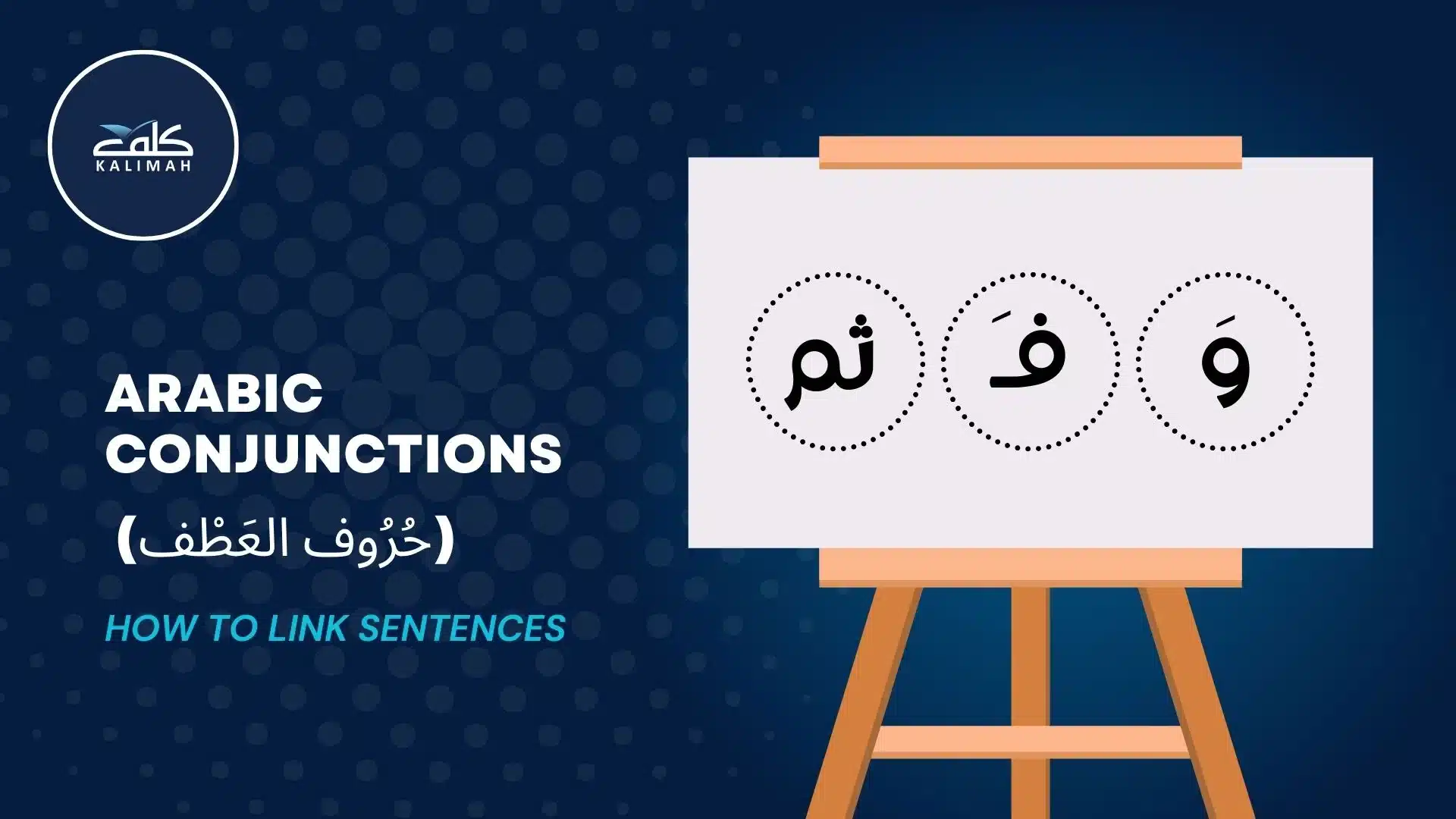
In a nutshell, Arabic conjunctions (حروف العطف) are particles that link words, phrases, or clauses to create coherence in sentences. They are categorized into coordinating conjunctions, like “و” (wa) for “and,” and subordinating conjunctions, such as “إِن” (in) for “if.” These particles must maintain grammatical consistency between the connected elements, ensuring proper alignment in case, mood, and meaning.
In a previous article, we explored the concept of particles in Arabic, highlighting their unique characteristics and diverse types, including ِArabic conjunctions. Today, let’s take a closer look at the essence of Arabic conjunctions. We will examine their core function and how they operate within the structure of Arabic sentences with examples of using conjunctions in Arabic grammar sentences.
Remember, in Arabic, we call conjuncations حروف العطف (ḥurūf al-ʻaṭf), which literally translates to “letters of connection.” Why “letters”? This is because they are considered a type of حرف (ḥarf) – a particle – in Arabic grammar.
What Do Conjunctions in Arabic Do?
Conjunctions in Arabic, like in any language, serve as links between words, phrases, and clauses. They provide coherence and flow to sentences by expressing relationships between different parts of the sentence.
What are Conjunctions in Arabic Grammar?
In essence, an Arabic conjunction (حرف العطف – harf al-ʻatf) is an invariable particle that connects words, phrases, or clauses. Unlike verbs or nouns, they don’t change their form. They are the constant connectors that bring different parts of speech together, it also know as connecting words in Arabic.
In the context of Arabic grammar, the concept of العطف (al-ʻatf) refers to the act of linking a word or phrase (المعطوف, al-matoof) to another word or phrase (المعطوف عليه, al-matoof ʿalayh) using a conjunction (حرف العطف, harf al-ʻatf).
These are crucial concepts in understanding Arabic conjunctions. Let’s recap the 3 essential elements:
1. حرف العطف (harf el atf) in Arabic Grammar
harf el atf is an invariable particle that connects words, phrases, or clauses.
2. المعطوف عليه (al-matoof ʿalayh) in Arabic Grammar
Al-matoof ʿalayh is the word or phrase that comes before the conjunction. It’s the main element, the one we are “leaning towards.”
3. المعطوف (al-matoof) in Arabic Grammar
Al-maṭoof is the word or phrase that comes after the conjunction. It is linked to and dependent on the matoof ʿalayh.
The Rule for Conjunctions in Arabic
The most important rule for Arabic conjunctions is: The maṭoof المعطوف (the word or phrase after the conjunction) must always match the maṭoof ʿalayh المعطوف عليه (the word or phrase before the conjunction) in its grammatical function and case.
This means if the maṭoof ʿalayh is in the nominative case (مرفوع), the maṭoof must also be in the nominative case. If the maṭoof ʿalayh is in the accusative case (منصوب), the maṭoof must also be in the accusative case, and so on.
Let me illustrate this with some examples:
جاءَ الولدُ والبنتُ
The boy and the girl came.
Here, “the boy” (الولدُ) is the maṭoof ʿalayh, and it is a noun in the nominative case (مرفوع) because it is the subject of the verb “came” (جاءَ). The conjunction و (wa) connects it to “the girl” (البنتُ), which is the maṭoof.
Notice how “the girl” is also a noun in the nominative case, matching the grammatical function and case of the maṭoof ʿalayh.
قرأَ الطالبُ الكتابَ والدفترَ
The student read the book and the notebook.
In this example, “the book” (الكتابَ) is the maṭoof ʿalayh, and it is a noun in the accusative case (منصوب) because it is the object of the verb “read” (قرأَ). The conjunction و (wa) links it to “the notebook” (الدفترَ), which is the maṭoof. Again, “the notebook” is also a noun in the accusative case, maintaining grammatical consistency.
Master Arabic with Kalimah Center
Join our expert-led online classes and start your journey toward Arabic fluency today.
Book Your Free TrialArabic Conjunctions List
Here’s a list of Arabic conjunctions with their English translations:
- و (wa): and
- ف (fa): so, then
- حتى (hatta): until, even
- ثم (thumma): then, afterwards
- أم (am): or (used in interrogative sentences)
- أو (aw): or
- بل (bal): rather, but rather, on the contrary
- لا (la): no, not (used for negation)
- لكن (lakin): but
Types of Conjunctions in Arabic
We can categorize Arabic conjunctions into two main types: coordinating conjunctions and subordinating conjunctions. We’ll explore each in detail below.
But for the sake of scientific accuracy…
It’s worth noting that traditional Arabic grammar further distinguishes between Atf Nasq عطف نسق (And that’s what this article is all about) and Atf Bayan عطف بيان. However, Atf Bayan is an advanced concept and doesn’t quite align with the typical understanding of conjunctions for non-native speakers.
For now, we’ll focus on the two primary types mentioned earlier.
Coordinating Conjunctions in Arabic
Coordinating conjunctions in Arabic are important particles that connect words, phrases, or sentences, making them flow smoothly in a meaningful way.
Here are the 9 coordinating conjunctions in Arabic with examples of using conjunctions in arabic grammar sentences.
1. The Conjunction “و” (wa) – And in Arabic
The conjunction و (wa) is the simplest and most widely used conjunction in Arabic. It is used to indicate pure addition or combination between two elements without implying sequence or causation. Both parts share the same grammatical rule, whether it is case, mood, or meaning.
Example of the Conjunction “و” (wa) From the Qur’an:
“وَالْعَصْرِ . إِنَّ الْإِنْسَانَ لَفِي خُسْرٍ . إِلَّا الَّذِينَ آمَنُوا وَعَمِلُوا الصَّالِحَاتِ وَتَوَاصَوْا بِالْحَقِّ وَتَوَاصَوْا بِالصَّبْرِ”
“By time, indeed, mankind is in loss, except for those who have believed and done righteous deeds and advised each other to truth and advised each other to patience.” (Surah al-Asr 103:1-3)
Notice how “wa – و” connects the qualities of the believers, starting with faith and progressing to good deeds, advising truth, and finally, advising patience. This creates a sense of ascending virtues.
Everyday Example of the Conjunction “و” (wa):
اشتريت تفاحا وبرتقالا
“I bought apples and oranges.”
2. The Conjunction “ف” (fa) – Then/So in Arabic
The conjunction ف (fa) expresses immediate sequence or cause and effect between two events. It suggests that the second action occurs directly after the first or as a result of it.
قرأتُ ففهمتُ
“I read, so I understood.”
Here, ف (fa) shows that understanding happened as a direct result of reading.
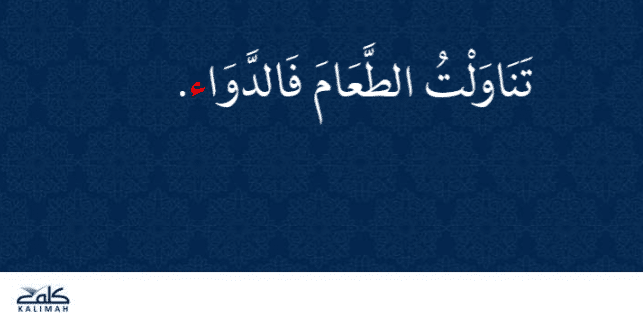
تناولت الطعام فالدواء
I ate the food, then the medicine.
3. The Conjunction “ثُمّ” (thumma) – Then (with Delay)
ثُمّ (thumma) indicates sequence with delay. Unlike ف, it shows that there is a time gap between the two actions.
تناولتُ الطَّعامَ ثم القهوة
“I had food, then coffee”
This example reflects the natural progression of events in a delayed manner.

When narrating events or giving instructions, “thumma” helps establish a clear sequence. Imagine a recipe in an old Arabic cookbook:
خُذْ الْلَّحْمَ، ثُمَّ قَطِّعْهُ، ثُمَّ اطْبُخْهُ
Take the meat, then cut it, then cook it.
“Thumma” guides the reader through the steps in a precise order.
4. The Conjunction “أو” (aw) – Or in Arabic
أو (aw) is used to express choice, doubt, or substitution. It can also be used to indicate categories or divisions.
Example of Choice:
أريد أن أدرس مع الأستاذ محمد أو خالد
“I want to study with Mr. Mohamed or Mr. Khalid”

Example of Doubt:
هذا خالد أو أحمد
“This is Khalid or Ahmed”
Example of Division:
الكلمة اسمٌ أو فعلٌ أو حرفٌ
“A word is either a noun, a verb, or a particle.”
5. The Conjunction أم (am) in Arabic
The conjunction أم (am) is similar to أو (aw) but is primarily used in interrogative sentences to ask which of two options is true.
أتحب الدجاج أم اللحم؟
Do you like chicken or meat?
6. The Conjunction “بل” (bal) – Rather in Arabic
بل (bal) is used for correction or contrast. It negates the first part and replaces it with the second.
ليس هذا صحيحاً بل هو خطأ
(This is not right, but rather it is wrong.)
7. The Conjunction “لكن” (lakin) – But in Arabic
لكن (lakin) introduces contrast or exceptions, and it often follows a negation.
الجو بارد اليوم لكن مشمس.
(The weather is cold today but sunny)
8. The Conjunction لا (lā) – The Negator
The conjunction لا (lā) is used for negation, meaning “not” or “no.” It negates the meaning of the word or phrase that follows it.
نريد اللحم لا الأرز
We want meat, not rice.
9. The Conjunction “حتى” (ḥattā) – Even/Until
حتى (ḥattā) is unique because it often signifies inclusion or a point of completion. It requires that the second part is a part of the first or closely related.
السبّاحون حتى الأخير وصلوا إلى نقطة النهاية
“The swimmers, even the last one, reached the finish line.”
Read also: Interrogative particles in Arabic
Arabic Conjunctions Worksheet pdf
We’ve covered a lot in our exploration of Arabic conjunctions. Now, it’s time to put your knowledge to the test!
To help you solidify your understanding and practice what you’ve learned, Kalimah Center is delighted to offer you a free Arabic conjunctions worksheet. This worksheet includes a variety of exercises designed to challenge you and reinforce the concepts we’ve discussed.
Arabic Conjunctions Worksheet.pdf
For further practice and personalized feedback, consider enrolling in our online Arabic courses.
Experience Kalimah Center Classes
Watch real excerpts from our live sessions at Kalimah Center and see how we bring learning to life. These clips highlight our interactive, student-centered teaching approach across all our courses—designed to keep learners engaged, motivated, and actively involved every step of the way.
Master Arabic with Kalimah Center
Join our expert-led online classes and start your journey toward Arabic fluency today.
Book Your Free TrialSubordinating Conjunctions in Arabic
Subordinating conjunctions in Arabic are used to connect a main clause with a dependent clause, showing relationships like cause, time, or condition.
Let’s explore some of the most important subordinating conjunctions in Arabic
1. The Subordinating Conjunction إِنْ (In) – ‘If’ for Conditions
The word إِنْ introduces a conditional sentence. It is used to establish cause-and-effect relationships and always starts the sentence. This conjunction emphasizes possibility, depending on the fulfillment of the condition.
إِنْ تَزُرْ مَكَّة، تَرَ الكَعْبَة
(If you visit Mecca, you will see the Kaaba.)
2. The Subordinating Conjunction عِنْدَمَا (Indama) – ‘When’ for Sequential Actions
عِنْدَمَا signals a temporal connection between two events. Both verbs in the sentence must align in tense, indicating that one action follows or occurs alongside another.
عِنْدَمَا جَاءَ الزُّوَّار، قَدَّمْنَا الشَّاي
(When the guests arrived, we served tea.)
3. The Subordinating Conjunction رغم (raghm)
This means “despite” or “in spite of.” It can introduce a subordinate clause that presents an obstacle or challenge that is overcome.
نجحَ في الامتحانِ رغمَ أنَّهُ لم يدرسْ جيدًا
He succeeded in the exam despite the fact that he didn’t study well.
4. The Subordinating Conjunction لَوْ (Law) – ‘If’ for Unreal Conditions
لَوْ is used for hypothetical or unreal conditions.
لَوْ كُنْتُ طَبِيْبًا، لَسَاعَدْتُ الجَمِيْع
(If I were a doctor, I would help everyone.)
5. The Subordinating Conjunction كُلَّمَا (Kullama) – ‘Whenever’ for Repeated Actions
The word كُلَّمَا expresses repetitive conditions in the past. Both clauses must contain past-tense verbs, and the sentence reflects actions occurring together repeatedly.
كُلَّمَا زَارَ أَصْحَابَهُ، أَحْضَرَ الهَدَايَا
(Whenever he visited his friends, he brought gifts.)
6. The Subordinating Conjunction لِأَنَّ (Li’anna) – ‘Because’ for Reason
لِأَنَّ explains the reason for an action. The main and subordinate clauses should share the same tense.
أَكَلُوا كَثِيْرًا لِأَنَّ الطَّعَامَ شَهِيٌّ
(they ate a lot, because the food was delicious.)
7. The Subordinating Conjunction بَيْنَمَا (Baynama)
بَيْنَمَا bridges clauses to indicate simultaneity.
بَيْنَمَا الطُّفْلُ يَلْعَب، كَانَتِ الأُمُّ تَطْبُخ.
(While the child was playing, the mother was cooking.)
Different Types of و in Arabic
Depending on its position and use, و in Arabic plays different roles, adding richness and precision to Arabic sentences. Here, we will explore the most important types of و:
1. واو العطف (Waw al-ʿAṭf) – The Conjunctive “و” in Arabic
This is our main waw in this article, and it is the most common and familiar usage of “و,” acting as a coordinating conjunction meaning “and.”
ذهبَ محمدٌ وَعليٌّ إلى السوقِ
Muhammad and Ali went to the market.
2. واو المعية (Wāw al-Ma‘iyyah) – The Accompanying “و” in Arabic
Wāw al-Ma‘iyyah carries the meaning of “with” (ma‘a). It indicates accompaniment and often follows a verb. The noun after و المعية is always in the accusative case (mansoob).
سرتُ والنهرَ
“I walked with the river.”
Be careful!
واو المعية can sometimes look like واو العطف (conjunction و), but they are different. For instance:
How to Recognize واو المعية:
The action (verb) doesn’t logically apply to both subjects. For example:
سار خالد والشاطئ
“Khalid walked along the beach.”
Here, it’s clear the beach cannot “walk,” so و must mean “with.”
3. واو القسم (Waw al-Qasam) – The “و” of the Oath in ARabic
Wāw al-Qasam is used for making an oath or swear. It often appears before Allah’s name.
وَاللهِ لأفعلَنَّ ذلكَ
By God, I will definitely do that.
4. واو الحال (Waw al-hal)
Waw al-hal connects a sentence with a descriptive state, answering the question “how?” It’s often translated as “while” or “as.”
جاء الطالبُ وهو متعبٌ
“The student came while he was tired.”
5. واو الاستئناف (Waw al-Istiʾnāf) – The Resumptive “و” in Arabic
Waw al-Istiʾnāf introduces a new sentence or topic that is not directly related to the previous one. It marks a shift in discourse or a new beginning.
قرأتُ الكتابَ. وَالآنَ، سأُشاهدُ فيلمًا
I read the book. And now, I will watch a movie.
Master Arabic with Kalimah Center
Join our expert-led online classes and start your journey toward Arabic fluency today.
Book Your Free TrialInside Kalimah Center: Moments from Our Courses
Get a glimpse into the vibrant learning experience at Kalimah Center. These snapshots capture real moments from our live classes—where students engage deeply, connect with passionate instructors, and grow in a welcoming, supportive environment.
Here Are The Reviews On Our Courses:
Our students frequently commend the excellence of our courses and the commitment shown by our instructors. You can read their complete reviews on Trustpilot.

Want to really feel confident with Arabic conjunctions?
Our online courses will help you master Arabic Conjunctions in a fun and supportive way. We offer:
- Clear explanations from expert native teachers.
- Lots of practice with interactive exercises.
- Focus on speaking and using Conjunctions correctly.
- Courses for all levels, from beginner to advanced.
📚 Explore Our Courses:
Online Arabic Course: Tailored to your level, our comprehensive Arabic program includes 16 teaching levels and 400+ hours of personalized sessions.
Online Quran With Tajweed Course: Perfect for non-Arabic speakers, our course spans 13 levels and equips you with Tajweed mastery from beginner to advanced.
Online Arabic Course For Kids: Nurture your child’s love for Arabic with our engaging and structured program, available in 24 levels for primary, intermediate, and secondary stages.
🚀 Start Your Free Trial Today! 🚀
Don’t miss out on this life-changing opportunity to deepen your faith and knowledge. Sign up now for your free trial and take the first step towards becoming a better practicing Muslim with Kalimah Center!

Conclusion:
Arabic conjunctions (حروف العطف) are essential particles that link words, phrases, or clauses, ensuring coherence within sentences. These particles serve to connect elements in a sentence, allowing for a smooth flow of ideas. In Arabic, conjunctions are divided into two main types: coordinating and subordinating.
Coordinating conjunctions, like “و” (wa) for “and,” “ف” (fa) for “so,” and “أو” (aw) for “or,” link similar elements or show relationships between them. Subordinating conjunctions, such as “إِن” (in) for “if” or “لِأَنَّ” (li’anna) for “because,” connect dependent clauses to main clauses, indicating cause, condition, or time.
In Arabic grammar, conjunctions must follow specific rules, such as ensuring grammatical consistency between the connected elements. For example, if the first element (المعطوف عليه) is in the nominative case, the second element (المعطوف) must also match in case. Additionally, there are special types of “و” (waw), like “واو العطف” (Waw al-‘Aṭf) for conjunction, “واو المعية” (Wāw al-Ma‘iyyah) for accompaniment, and “واو القسم” (Waw al-Qasam) for oaths, each adding nuance to the meaning of the sentence.
FAQs about Conjunctions in Arabic
How do Arabic conjunctions (حروف العطف) function in grammar?
Arabic conjunctions, known as ḥurūf al-ʻaṭf, are invariable particles that connect words, phrases, or clauses to build sentence coherence. They require the word following the conjunction (al-maṭoof) to completely match the grammatical case (nominative, accusative, or genitive) of the word preceding it (al-matoof ʿalayh).
What is the difference between the Arabic conjunctions “و” (wa) and “ف” (fa)?
While both are coordinating conjunctions, “و” (wa) indicates pure addition or combination without any specific order or time delay. In contrast, “ف” (fa) expresses immediate sequence, proximity, or a direct cause-and-effect relationship, signaling that the second action happened immediately after the first.
How does the conjunction “ثُمّ” (thumma) differ from “ف” (fa) in Arabic?
The conjunction “ثُمّ” (thumma) indicates a chronological sequence with a time delay or gap between events, translated as “then” or “afterwards.” Conversely, “ف” (fa) implies an immediate, consecutive action or a direct result with no time delay between the connected elements.
When should you use “أم” (am) instead of “أو” (aw) for “or” in Arabic?
“أو” (aw) is used in declarative sentences to express general choice, doubt, division, or substitution. “أم” (am) is specifically restricted to interrogative sentences (questions) when asking a listener to choose or verify which of two specific options is the true one.
What are the different grammatical roles of the letter “و” (Waw) in Arabic?
The letter “و” serves multiple distinct roles in Arabic grammar, including Waw al-ʿAṭf (the coordinating conjunction “and”), Wāw al-Ma‘iyyah (denoting accompaniment, meaning “with”), Waw al-Qasam (used to swear an oath), Waw al-hal (meaning “while” or “as”), and Waw al-Istiʾnāf (the resumptive “and” used to start a new topic).