The best Arabic learning apps in 2026 serve specific skills rather than all skills equally. For reading and vocabulary, LingQ and Duolingo lead. For handwriting and script, Write It! Arabic is the top-rated dedicated tool. For speaking with native speakers, HelloTalk and Tandem deliver the most authentic practice. For children, Lamsa and IReadArabic are the most comprehensive options. No single app replaces structured instruction — but the right combination of two to three apps, used daily, can dramatically accelerate Arabic learning at any level.
✅ Master Comparison Table:
| # | App | Section | Best For | Level | Price | Platform | Rating |
|---|---|---|---|---|---|---|---|
| 1 | Duolingo | Reading | Reading + vocabulary | Beginner | Free / $6.99 mo | iOS, Android, Web | ⭐⭐⭐⭐ |
| 2 | LingQ | Reading | Authentic text reading | Int–Adv | Free / $12.99 mo | iOS, Android, Web | ⭐⭐⭐⭐⭐ |
| 3 | Beelinguapp | Reading | Bilingual reading | Beg–Int | Free / $2.99 mo | iOS, Android | ⭐⭐⭐⭐ |
| 4 | Drops | Reading | Vocabulary building | Beginner | Free (5 min) / $9.99 mo | iOS, Android | ⭐⭐⭐ |
| 5 | Madinah Arabic Reader | Reading | Quranic Arabic reading | Beg–Int | Free | iOS, Android | ⭐⭐⭐⭐ |
| 6 | Anki | Reading | Vocabulary retention | All | Free (Android/Web) / $24.99 (iOS) | iOS, Android, Web | ⭐⭐⭐⭐⭐ |
| 7 | Mango Languages | Reading | Structured MSA course | Beginner | Free w/library card / $7.99 mo | iOS, Android, Web | ⭐⭐⭐⭐ |
| 8 | Write It! Arabic | Writing | Handwriting + script | Beginner | $3.99 one-time | iOS, Android | ⭐⭐⭐⭐⭐ |
| 9 | Arabic Alphabet App | Writing | Letter formation | Absolute Beg | Free / Paid | iOS, Android | ⭐⭐⭐ |
| 10 | Mondly | Speaking | Speaking + pronunciation | Beg–Int | Free / $9.99 mo | iOS, Android, Web | ⭐⭐⭐⭐ |
| 11 | Rosetta Stone | Speaking | Immersive speaking | Beg–Int | $11.99 mo | iOS, Android, Web | ⭐⭐⭐ |
| 12 | HelloTalk | Speaking | Native speaker exchange | Intermediate | Free / $6.99 mo | iOS, Android | ⭐⭐⭐⭐⭐ |
| 13 | Tandem | Speaking | Video + voice exchange | Intermediate | Free / $9.99 mo | iOS, Android | ⭐⭐⭐⭐ |
| 14 | Nemo Arabic | Speaking | Conversational phrases | Beginner | Free / $4.99 | iOS, Android | ⭐⭐⭐ |
| 15 | Read Along by Google | Kids | Reading aloud fluency | Kids 5–10 | Free | iOS, Android | ⭐⭐⭐⭐ |
| 16 | IReadArabic | Kids | Kids reading | Kids 4–12 | Free / Paid | iOS, Android | ⭐⭐⭐⭐ |
| 17 | 3asafeer School | Kids | Kids alphabet + writing | Kids 3–8 | Free / Paid | iOS, Android | ⭐⭐⭐⭐ |
| 18 | Habar | Kids | Kids early literacy | Kids 3–7 | Paid | iOS, Android | ⭐⭐⭐ |
| 19 | Gus on the Go | Kids | Kids vocabulary | Kids 4–10 | $3.99 | iOS, Android | ⭐⭐⭐ |
| 20 | Lamsa | Kids | Kids culture + language | Kids 2–8 | Free / $4.99 mo | iOS, Android | ⭐⭐⭐⭐⭐ |
With dozens of Arabic learning apps available across iOS, Android, and web platforms, choosing the right one depends on three factors: what skill you are targeting (reading, writing, speaking, or comprehensive learning), your current level (absolute beginner to advanced), and your budget (free, freemium, or paid).
This guide evaluates and ranks 20 Arabic learning apps across four categories — including pricing, platform availability, honest limitations, and specific recommendations based on your learning goal. Use the comparison table above for a quick overview, or read the detailed reviews below to find the apps that fit your situation.
Best Free Arabic Learning Apps in 2026
Cost is one of the most common barriers to starting Arabic study. The good news: several of the most effective Arabic learning tools are completely free — or offer genuinely useful free tiers that are not artificially limited.
Completely Free — No Subscription Required:
| App | What You Get Free | Best For |
|---|---|---|
| Duolingo | Full Arabic course — all levels | Beginners building reading + vocabulary |
| Anki | Unlimited flashcard decks + spaced repetition | Vocabulary retention at any level |
| HelloTalk | Language exchange with native speakers | Speaking practice |
| Madinah Arabic Reader | Full structured reading curriculum | Quranic Arabic foundations |
| Read Along by Google | Full app — all stories and activities | Children learning to read aloud |
| Mango Languages | Full access free with library card | Structured MSA course |
Free Tier Worth Using (Paid Tier Optional):
| App | Free Tier Quality | Paid Upgrade Worth It? |
|---|---|---|
| LingQ | 5 free lessons + limited import | Yes — for serious readers |
| Beelinguapp | Limited story selection | Yes — if you use it daily |
| Drops | 5 minutes per day | Depends — very restrictive free tier |
| Tandem | Basic exchange features | Yes — for video calling |
| Lamsa | Limited content | Yes — for families with young children |
The best completely free Arabic learning stack:
Duolingo (structure + reading)
- Anki with free Arabic frequency deck (vocabulary)
- HelloTalk (speaking with native speakers)
- Madinah Arabic Reader (if Quran is your goal)
This combination costs nothing and covers reading, vocabulary, speaking, and structured grammar — everything a beginner needs to reach basic conversational ability.
Best Arabic Apps for Reading
Reading is the foundation of language learning. If you can read Arabic, you can explore the beauty of the Quran, Arabic literature, and even everyday signs when you visit an Arab country. Here are some of the best apps to help you learn to read Arabic:
1. Beelinguapp
iOS, Android | 💰 Free (limited) / $2.99 per month / $19.99 lifetime | ⭐⭐⭐⭐
Beelinguapp presents Arabic stories, fairy tales, news articles, and cultural texts in a split-screen format — Arabic on one side, your native language on the other — with native speaker audio that highlights each sentence as it is read aloud. This parallel text approach, borrowed from a classical language learning technique, allows learners to absorb Arabic in context without constantly stopping to look up words.
The audio component is what elevates Beelinguapp above a simple bilingual reader. As you follow the Arabic text while hearing it spoken naturally, your brain simultaneously processes the written form, the sound, and the meaning — a multi-channel input that reinforces retention more effectively than reading alone. The app also includes a karaoke-style reading mode where you read aloud and the app tracks your position in the text.
✅ Best for: Beginner to intermediate learners who want to build reading comprehension through meaningful stories while simultaneously training their ear to natural Arabic pronunciation and rhythm.
⚠️ Limitation: The free library is limited to a small selection of texts. Accessing the full Arabic story library requires a paid subscription. More significantly, Beelinguapp does not teach Arabic — it provides reading practice for learners who already have basic Arabic literacy. If you cannot yet read Arabic script, start with Duolingo or Write It! Arabic before coming to Beelinguapp.
2. LingQ
iOS, Android, Web | 💰 Free (limited) / $12.99 per month / $199 lifetime | ⭐⭐⭐⭐⭐
LingQ is built around a single powerful principle: learn a language by reading and listening to content you are genuinely interested in. The platform gives you access to a vast library of authentic Arabic texts — news articles, short stories, podcasts, YouTube transcripts, and more — and turns every unknown word into a “LingQ” (a saved vocabulary item with definition) that is then tracked through a spaced repetition system until it becomes known.
What sets LingQ apart from every other app on this list is that it works with real, unmodified Arabic — not simplified learner content. An intermediate learner can import an Al Jazeera article and work through it word by word, building vocabulary in the exact context where those words are actually used. The built-in audio synchronisation — where text highlights as audio plays — makes it simultaneously a listening and reading tool.
LingQ also allows you to import your own content: a Quranic verse, a favourite Arabic poem, a news article from any source. This makes it the most flexible reading platform available for Arabic learners.
✅ Best for: Intermediate to advanced learners who want to build reading fluency and vocabulary through authentic Arabic content — especially those whose goal is reading Arabic literature, news, or the Quran in context.
⚠️ Limitation: LingQ has a steep learning curve — the interface takes time to understand, and new users often feel overwhelmed before they discover the workflow that makes it powerful. The free tier is genuinely restrictive (20 LingQs maximum before you hit the paywall), which means serious users need the paid subscription to use it effectively. It is also not suitable for absolute beginners: LingQ works best once you know the Arabic alphabet and have a base vocabulary of 200–300 words to build from.
Pro Tip: Once you are comfortable using LingQ, import Arabic news articles directly from Al Jazeera Arabic, BBC Arabic, or Asharq Al-Awsat into LingQ’s reader. This transforms any Arabic news source into a vocabulary-building tool — every unknown word is saved, tracked, and reviewed through spaced repetition. This is the most powerful combination of authentic content and learning technology available to intermediate Arabic readers.
3. Drops
iOS, Android | 💰 Free (5 min/day) / $9.99 per month / $69.99 per year | ⭐⭐⭐
Drops uses fast-paced, visual word-association games to build Arabic vocabulary — stripping away grammar, sentences, and explanations entirely and focusing purely on connecting Arabic words to images. Each session is timed to exactly 5 minutes on the free plan, which creates focused bursts of learning without the cognitive fatigue that longer study sessions can produce. Vocabulary is organised into thematic sets — food, travel, emotions, numbers, body, nature — presented through clean, minimalist illustrations rather than translations.
The speed of each session is what makes Drops distinctive. Words cycle rapidly, forcing instant recognition rather than deliberate analysis. Over time, this builds the kind of automatic word-recognition that is essential for reading fluency — you see the Arabic word and know its meaning without translating through English first.
Drops also teaches Arabic script alongside vocabulary: each word is displayed in Arabic script, transliteration, and with native speaker audio, which means learners absorb letter recognition passively while actively building vocabulary.
✅ Best for: Visual learners who want to build vocabulary quickly and enjoyably in short daily bursts. Works exceptionally well as a daily warm-up before more intensive study sessions — or as a habit-building tool for learners who struggle to commit to longer sessions.
⚠️ Limitation: The free plan’s 5-minute daily cap is genuinely restrictive — just as you build momentum, the session ends and you must wait 10 hours for the next one. More significantly, Drops teaches vocabulary in complete isolation — no grammar, no sentence context, no production practice. Knowing the Arabic word for “bread” does not mean you can say “I want bread” or write it in a sentence. Drops must be supplemented with a grammar-focused tool (Duolingo or Mango Languages) and a speaking tool (HelloTalk) to produce usable Arabic.
4. Duolingo
iOS, Android, Web | 💰 Free / $6.99 per month (Super Duolingo) | ⭐⭐⭐⭐
Duolingo’s Arabic course teaches the script, pronunciation, and foundational vocabulary through short, gamified daily lessons — each taking 5–10 minutes. The app uses spaced repetition to cycle back through previously learned material, and its streak system creates a daily habit more effectively than almost any other language app. For Arabic specifically, Duolingo covers the alphabet recognition and basic MSA vocabulary well enough to give a complete beginner genuine traction in the first 4–6 weeks.
What distinguishes Duolingo from other beginner apps is its zero barrier to entry — no account required to start, no decisions to make, no level test. You open the app and begin. For learners who have been putting off starting Arabic because it feels overwhelming, this frictionless beginning has genuine psychological value.
✅ Best for: Absolute beginners who need a structured, habit-forming entry point into Arabic reading and vocabulary — particularly those with no prior exposure to the Arabic script.
⚠️ Limitation: Duolingo’s Arabic course is significantly shorter and less comprehensive than its Spanish, French, or German courses. Learners who complete the Arabic tree will have a solid beginner foundation — but will hit a ceiling faster than with European languages. The app also teaches recognition more than production: you will recognise Arabic words before you can independently generate them. Supplement with HelloTalk for speaking and Anki for deeper vocabulary retention after the first 4–6 weeks.
5. Madinah Arabic Reader
iOS, Android | 💰 Free | ⭐⭐⭐⭐
This app Developed by the Islamic University of Madinah — the same institution behind the widely used Madinah Arabic Book series that has taught Arabic to millions of learners worldwide — this app brings the university’s structured reading curriculum into a mobile format. Lessons progress from simple vowelled texts to more complex passages, with comprehension questions at each stage to verify understanding before advancing.
The Madinah Arabic Reader’s greatest strength is its pedagogical credibility: it is built on a curriculum that has been refined over decades of teaching Arabic to non-native speakers in a structured, grammar-aware progression. Unlike apps built primarily for engagement and gamification, this app is built for genuine acquisition.
✅ Best for: Learners whose primary goal is Quranic Arabic or classical Arabic reading — particularly those who want a structured, academically grounded curriculum rather than a gamified experience.
⚠️ Limitation: The app is functional rather than visually polished — it lacks the gamification, animations, and engagement mechanics of commercial apps like Duolingo or Drops. Learners who are motivated primarily by entertainment value may find it dry. It is also best suited to learners who already know the Arabic alphabet — it is a reading curriculum, not an alphabet-learning tool.
6. Anki
iOS ($24.99 one-time) / Android + Web (Free) | 💰 Free on most platforms | ⭐⭐⭐⭐⭐
Anki is not an Arabic learning app — it is a spaced repetition flashcard system that happens to be the most powerful vocabulary retention tool available to Arabic learners. Using the scientifically validated forgetting curve algorithm, Anki shows you each vocabulary item at precisely the moment your brain is about to forget it — forcing retrieval at the optimal interval for long-term memory consolidation.
For Arabic learners, Anki’s power lies in the pre-made decks available for free download: the Quranic Arabic frequency deck (the 500 most common words in the Quran, covering approximately 75% of its total word count), the Hans Wehr Arabic dictionary deck, the Madinah Arabic vocabulary deck, and dozens of thematic vocabulary sets. A learner who spends 15–20 minutes per day on Anki consistently will outperform learners doing 60-minute vocabulary study sessions using traditional methods.
✅ Best for: Any Arabic learner at any level who wants to retain vocabulary long-term — particularly those studying Quranic Arabic who need to build the 500-word frequency list efficiently.
⚠️ Limitation: Anki has a notoriously unintuitive interface — the desktop version in particular looks unchanged from 2010 and takes time to configure correctly. New users often create poorly designed cards, which reduces effectiveness. Recommendation: download a pre-made Arabic deck rather than creating your own cards initially. The iOS version ($24.99) is the most significant cost barrier, though the Android and web versions are completely free and functionally identical.
7. Mango Languages
iOS, Android, Web | 💰 Free with library card / $7.99 per month | ⭐⭐⭐⭐
Mango Languages offers a structured Modern Standard Arabic course designed for adult learners — moving from basic phrases through grammar, vocabulary, and cultural context in sequenced lessons. What makes Mango genuinely distinctive is its library partnership: millions of learners have free access through their public library card, making it one of the best completely free Arabic resources available to anyone with a library membership.
The course uses a combination of audio instruction, written Arabic, transliteration, and English explanation — a more balanced approach than Duolingo’s immersion-style or Rosetta Stone’s no-translation method. Grammar explanations are built into the lessons rather than hidden in a separate reference section, which helps adult learners who want to understand why Arabic works the way it does, not just pattern-match through repetition.
✅ Best for: Adult beginners who learn best with explicit grammar explanation and structured lesson progression — particularly those who can access it free through their public library.
⚠️ Limitation: Mango’s Arabic course covers MSA — not any specific dialect or Quranic Arabic. Learners whose goal is conversational Arabic in a specific region will find the MSA focus limiting. The course also plateaus at an upper-beginner to lower-intermediate level — it does not take learners to advanced Arabic on its own. Use it as a foundation builder, then transition to LingQ or a structured course for intermediate progression.
Experience Kalimah Center Classes
Watch real excerpts from our live sessions at Kalimah Center and see how we bring learning to life. These clips highlight our interactive, student-centered teaching approach across all our courses—designed to keep learners engaged, motivated, and actively involved every step of the way.
Master Arabic with Kalimah Center
Join our expert-led online classes and start your journey toward Arabic fluency today.
Book Your Free TrialBest Arabic Apps for Writing and Script Practice
Writing in Arabic requires mastering two distinct skills: handwriting (forming Arabic letters correctly on paper or screen) and digital typing (using an Arabic keyboard on a phone or computer). These are separate motor skills that develop independently.
The apps below focus on handwriting — the foundational skill that most Arabic learners need first. For digital typing, Arabic keyboards are built into every smartphone operating system: activate yours through Settings → Language → Add Arabic Keyboard. Practice by typing Arabic words you already know in messaging apps — real communication pressure builds typing speed faster than isolated drills.
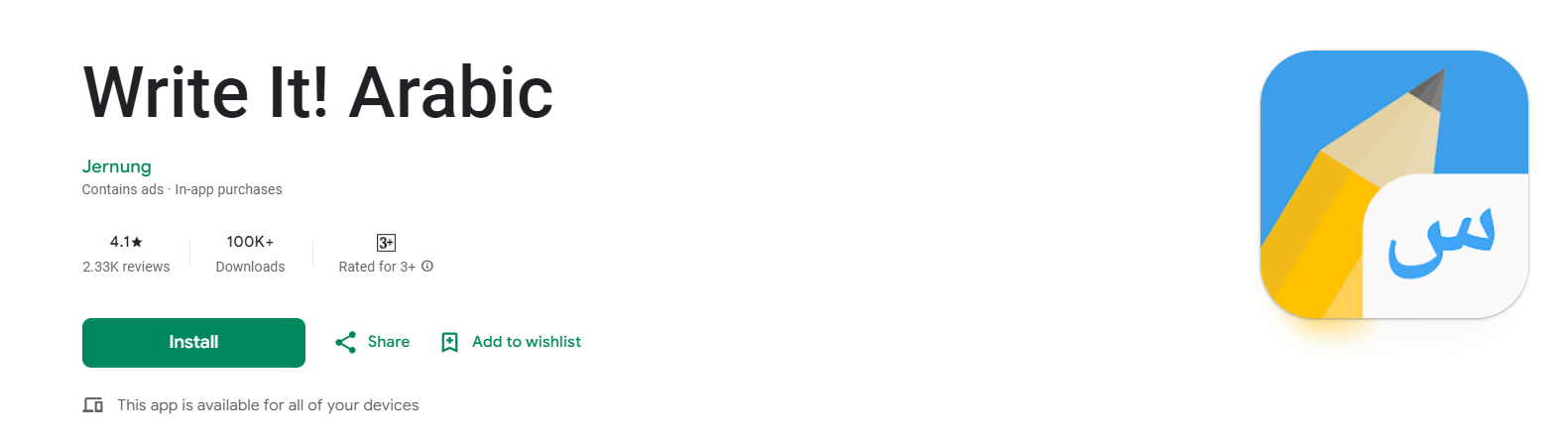
1. Write It! Arabic
iOS + Android | 💰 $3.99 one-time purchase | ⭐⭐⭐⭐⭐
Write It! Arabic is the most dedicated and highly-rated app specifically built for learning to write Arabic script. Unlike general Arabic learning apps that include writing as a feature, Write It! Arabic treats handwriting as its entire purpose — and the depth of that focus shows in the quality of the learning experience.
What it teaches:
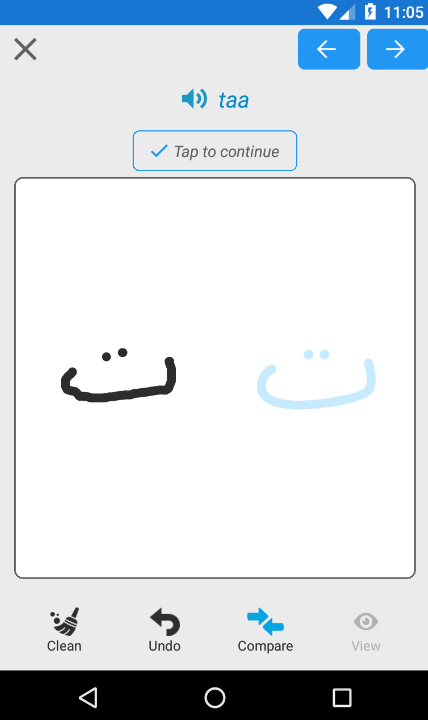
The app covers the Arabic alphabet comprehensively — all 28 letters in all four positional forms (isolated, initial, medial, and final). For each letter, learners see the correct stroke order, trace the letter on screen, and receive instant accuracy feedback based on their tracing path. The app then moves from individual letters to full words, building muscle memory for connected Arabic script.
Key Features:
| Feature | Detail |
|---|---|
| Stroke order guidance | Animated demonstration before each tracing exercise |
| Accuracy feedback | Real-time scoring on tracing precision |
| Positional forms | All four forms of every letter taught separately |
| Word practice | Connected script practice beyond isolated letters |
| Progress tracking | Completion percentage and accuracy scores saved |
| No subscription | One-time $3.99 purchase — no recurring fees |
Who it is best for:
- Absolute beginners who need to learn the Arabic alphabet from scratch
- Learners who already know Arabic letters but write them incorrectly or inconsistently
- Students whose Arabic course requires handwriting but who need additional practice outside class
- Anyone transitioning from printed Arabic (reading) to written Arabic (production)
Honest limitations:
Write It! Arabic teaches script formation — it does not teach vocabulary, grammar, pronunciation, or conversational Arabic. It is a specialist tool for a specific skill. Learners who want to understand what the words they are writing mean need to use it alongside a vocabulary app (Drops or Anki) or a structured course. Additionally, the app focuses on handwriting — not digital typing. If your goal is to type in Arabic rather than write by hand, an Arabic keyboard typing app is a separate tool you will need.
Write It! Arabic vs alternatives:
| App | Script Teaching | Price | Depth |
|---|---|---|---|
| Write It! Arabic | ⭐⭐⭐⭐⭐ | $3.99 once | Dedicated — full stroke order + all forms |
| Duolingo | ⭐⭐ | Free | Superficial — recognition only |
| Arabic Alphabet App | ⭐⭐⭐ | Free/Paid | Good for kids — less rigorous for adults |
| Mondly | ⭐ | $9.99/mo | Minimal writing component |
Verdict: For the specific skill of learning to write Arabic script correctly, Write It! Arabic is the clear category leader. At a one-time cost of $3.99 with no subscription, it is also exceptional value. It should be in every Arabic beginner’s toolkit alongside a vocabulary and speaking tool.
2. Arabic Alphabet App
iOS, Android | 💰 Free (basic) / Paid premium | ⭐⭐⭐
The Arabic Alphabet App takes a straightforward approach to the foundational challenge of Arabic literacy: learning to recognise and write all 28 letters. Each letter is presented with a clear illustration, the letter’s name, its sound, and an example word. Learners trace the letter on screen with their finger, receiving immediate visual feedback on accuracy. Audio pronunciations — recorded by native speakers — play automatically so learners hear the correct sound as they practice writing.
The app’s design is intentionally simple and unintimidating: large letter displays, bright colours, and minimal text make it approachable for learners of all ages who find the Arabic script visually overwhelming at first encounter.
✅ Best for: Absolute beginners — both children and adults — who need to learn the Arabic alphabet from zero, with a focus on letter recognition and basic handwriting. Particularly well-suited to learners who find Write It! Arabic’s more rigorous stroke-order system too detailed for their needs at the start.
⚠️ Limitation: The app teaches letters in isolation — it does not cover the four positional forms of each letter (how a letter changes shape depending on its position in a word), which is essential for reading real Arabic text. Learners who complete this app will recognise letters but may still struggle to read connected Arabic script. Transitioning to Write It! Arabic for positional forms, or to Duolingo for reading practice in context, is the natural next step.
Looking for a more structured approach to your Arabic learning?
Kalimah Group Classes are perfect for you!
Learn with our best teachers, use our amazing books, and meet fellow learners from all over the world.
Why Group Classes?
- More classes, less money!
- Learn better together!
- Everyone gets to practice and ask questions.
- We use the best materials.
- Learn from anywhere with your laptop!
- Make new friends!
Ready to start?
- Choose your class time.
- Fill out the form.
- Take our Arabic test to find your level.
- Pay and start learning!
Choose your class time and start learning!
Don’t wait! Spots are filling up fast!
Best Arabic Apps for Speaking and Listening
Speaking is perhaps the most rewarding part of learning a new language. To be able to communicate in Arabic and express your thoughts and feelings is a big achievement. Here are the top apps that can help you learn to speak Arabic:
1. Mondly
iOS, Android, Web | 💰 Free (limited) / $9.99 per month / $47.99 lifetime | ⭐⭐⭐⭐
Mondly’s defining feature is its speech recognition system — built specifically to evaluate Arabic pronunciation in real time and provide corrective feedback before errors become habits. Unlike apps that accept any vaguely similar sound as correct, Mondly’s Arabic speech evaluation is genuinely demanding: if your pronunciation of ع (ayn) or غ (ghayn) is inaccurate, the app will not accept the response and will model the correct pronunciation again.
The lesson structure is conversation-forward: rather than starting with isolated vocabulary, Mondly drops learners into short dialogues from the first session — ordering food, introducing yourself, asking directions — with vocabulary and grammar introduced in context. The app also includes a Daily Lesson feature that delivers one new conversation topic per day, building a consistent practice habit without requiring learners to plan their own study sessions.
✅ Best for: Beginners who want to start speaking Arabic immediately — particularly those who struggle with pronunciation of Arabic sounds that do not exist in their native language (ع، غ، ح، خ، ق).
⚠️ Limitation: Mondly’s Arabic content does not extend deeply into intermediate or advanced grammar. It is a speaking confidence builder for the beginner stage — not a complete language course. The free tier is limited to a small number of lessons before requiring upgrade. For learners past the beginner stage, HelloTalk or Tandem will deliver more authentic speaking practice than Mondly’s AI-driven conversations.
2. Rosetta Stone
iOS, Android, Web | 💰 $11.99 per month / $179 lifetime | ⭐⭐⭐
Rosetta Stone takes a full-immersion, no-translation approach to Arabic — teaching entirely through image-word-sound associations without ever using English to explain a concept. The theory: by removing the translation crutch, learners build direct associations between Arabic words and their meanings, the way children acquire their first language. The app’s TrueAccent speech recognition evaluates your Arabic pronunciation in real time and refuses to accept inaccurate attempts, forcing repeated practice until the sound is correct.
The Arabic course covers Modern Standard Arabic through a sequenced progression: simple nouns and verbs first, building to basic sentences, then to more complex structures. Each unit follows a consistent pattern — vocabulary introduction, contextual practice, pronunciation drilling, and review.
What Rosetta Stone does better than most competitors is pronunciation discipline. The speech recognition system is strict enough that learners who complete the Arabic course typically produce more accurate pronunciation of difficult Arabic phonemes (ع، ح، خ، غ، ق) than learners using apps with more lenient or absent speech evaluation.
✅ Best for: Learners who prefer immersive, translation-free learning and are willing to invest in a premium tool specifically for pronunciation accuracy. Particularly effective for learners whose native language has few sounds in common with Arabic and who need intensive phonetic training.
⚠️ Limitation: Three significant weaknesses. First, the no-translation approach is slower for adult learners than methods that strategically use the learner’s native language — adults learn differently from children, and pretending otherwise does not change the neuroscience. Second, at $11.99/month, Rosetta Stone is one of the most expensive options on this list — and independent reviews consistently rate its Arabic course as less developed than its European language courses. Third, the app does not facilitate speaking with real humans — all practice is with the AI. For the same monthly cost, a combination of Duolingo (free) + one italki session ($10–15) would deliver broader skill development. Rosetta Stone’s value lies specifically in its pronunciation training — if that is not your primary need, other tools offer better return on investment.
3. HelloTalk
iOS, Android | 💰 Free (basic) / $6.99 per month (VIP) | ⭐⭐⭐⭐⭐
HelloTalk is fundamentally different from every other app on this list. It is not a language course — it is a social network for language exchange, connecting learners with native speakers who want to learn their language in return. You help a native Arabic speaker with their English; they help you with your Arabic. The exchange is direct, human, and free.
What elevates HelloTalk above simple messaging is its built-in language learning tools: you can request corrections from your partner with a single tap, who can then annotate your message directly — showing what you wrote, what the correction is, and why. Voice messages can be slowed down for listening practice. Pronunciation recordings can be compared side by side. Translations are available inline without leaving the conversation.
The result is a practice environment that combines the authenticity of real human conversation with the scaffolding of a language learning tool. Learners who use HelloTalk consistently — having 30-minute voice or text conversations three to four times per week — typically report faster improvement in speaking fluency than any other app-based method.
✅ Best for: Intermediate learners who have a basic Arabic foundation (alphabet + 150–200 words) and are ready for authentic conversation practice with native speakers — the most accelerating speaking tool available for free.
⚠️ Limitation: HelloTalk requires you to bring your own foundation — it is not a teaching tool for absolute beginners who do not yet have vocabulary or grammar to work with. It also depends on finding compatible language partners, which can take some time. The quality of correction and feedback varies significantly between partners. The VIP subscription unlocks unlimited corrections and advanced features — worth the cost for serious learners who use it daily.
4. Tandem
iOS, Android | 💰 Free (basic) / $9.99 per month (Pro) | ⭐⭐⭐⭐
Tandem shares HelloTalk’s core model — connecting language learners with native speakers for mutual exchange — but differentiates itself through its video calling functionality and more structured partner-matching system. Where HelloTalk is primarily text and voice message based, Tandem is built for live video conversation: you can schedule sessions with Arabic-speaking partners, conduct structured conversation practice via video call, and receive real-time feedback on your spoken Arabic.
The video component is significant. Speaking Arabic on a video call — where you can see your conversation partner’s face, read their reactions, and manage the natural rhythm of conversation — is closer to real-world Arabic communication than any other app-based practice. It also introduces the anxiety of real-time performance, which, while uncomfortable, is exactly the pressure that consolidates speaking skills fastest.
Tandem’s partner profiles include language proficiency levels, learning goals, and availability schedules — making it easier to find partners whose Arabic level and schedule match yours than the less structured environment of HelloTalk.
✅ Best for: Intermediate to upper-intermediate learners who are ready for live video conversation practice and want the most realistic simulation of real-world Arabic communication available through an app.
⚠️ Limitation: Video calling with strangers requires a level of speaking confidence that absolute beginners rarely have. Tandem is most valuable after you have built a basic speaking foundation through Mondly or HelloTalk. The free tier limits the number of messages and calls — serious users who want multiple sessions per week will need the Pro subscription.
5. Nemo Arabic
iOS, Android | 💰 Free (limited) / $4.99 one-time | ⭐⭐⭐
Nemo Arabic is an audio-first phrasebook with spaced repetition — covering approximately 250 high-frequency Arabic words and phrases across travel, social, and basic communication categories. Each item is presented with native speaker audio, transliteration, and Arabic script, then cycled back through spaced repetition intervals to build retention. The app can also shuffle phrases randomly for a more dynamic review session.
What Nemo does well is accessibility: it requires no prior Arabic knowledge, no commitment to a structured curriculum, and no daily lesson schedule. You open it, listen to a phrase, repeat it, and move on. For learners whose lifestyle does not easily accommodate structured study sessions, this low-friction format has genuine appeal.
✅ Best for: Travellers preparing for a visit to an Arabic-speaking country who need functional spoken phrases quickly — and learners who want a simple, low-commitment daily audio review tool to keep vocabulary active between more intensive study sessions.
⚠️ Limitation: Nemo is a sophisticated phrasebook — not a language course. It does not teach grammar, Arabic script reading, or the productive language skills needed to construct original sentences. Learners who complete Nemo will have memorised useful phrases but will not be able to generate new Arabic independently. It is best used as a supplementary tool alongside a structured course, not as a primary learning resource.

Best Arabic Learning Apps for Kids (Ages 2–12)
Teaching Arabic to kids can be a different challenge. Children need to have fun while learning, or they will lose interest quickly. Here are some apps that make learning Arabic fun and engaging for kids:
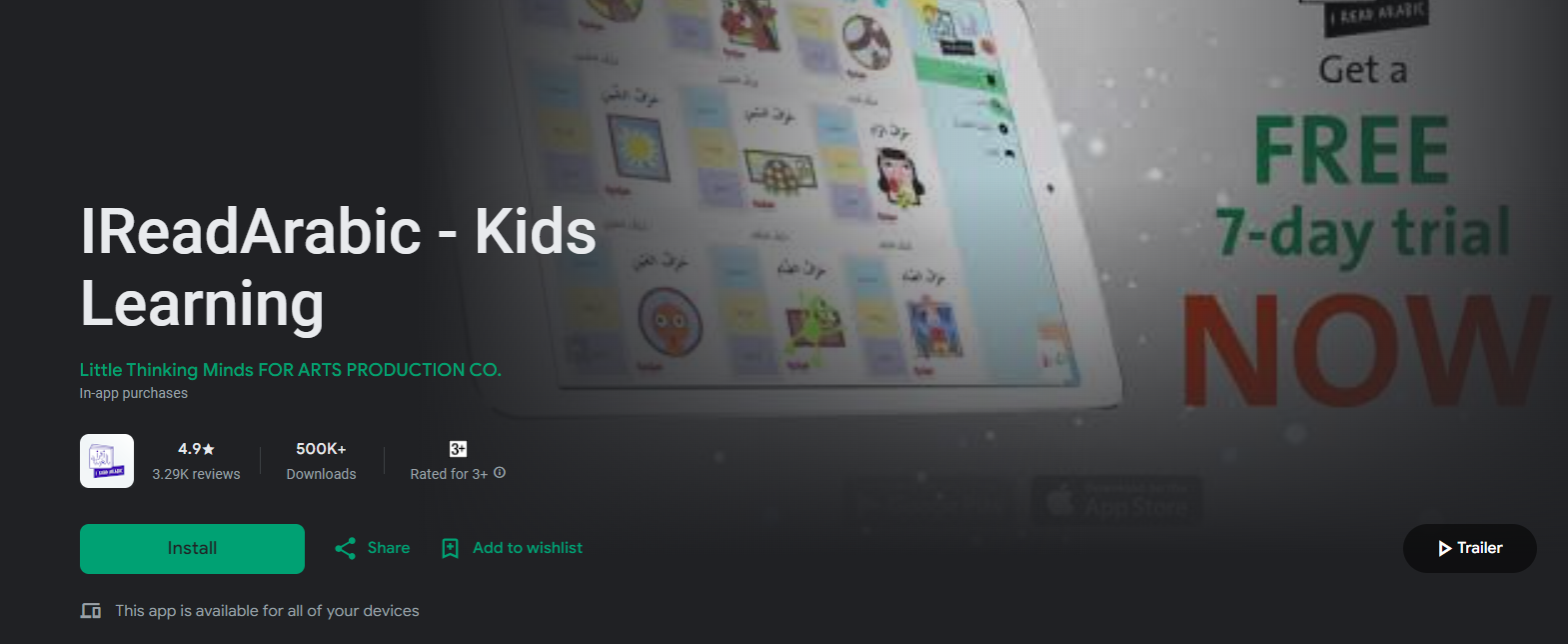
1. IReadArabic – Kids Learning
iOS, Android | 💰 Free / Paid premium content | ⭐⭐⭐⭐
IReadArabic offers one of the largest libraries of Arabic children’s books available in a single app — spanning multiple reading levels from pre-literacy to independent reading. Books are categorised by difficulty, topic, and age group, with comprehension questions and vocabulary activities embedded throughout. The app also includes educational videos and interactive games, making it a complete Arabic literacy platform rather than just a reading app.
✅ Best for: Children aged 6–12 who are building Arabic reading fluency — particularly effective as a school supplement.
⚠️ Limitation: The free tier has limited book access. Full library access requires a paid subscription. The app teaches reading comprehension — it does not teach the alphabet from scratch, so children who do not yet know Arabic letters should start with 3asafeer or Habar first.
2. (3asafeer School)
iOS, Android | 💰 Free / Paid | ⭐⭐⭐⭐
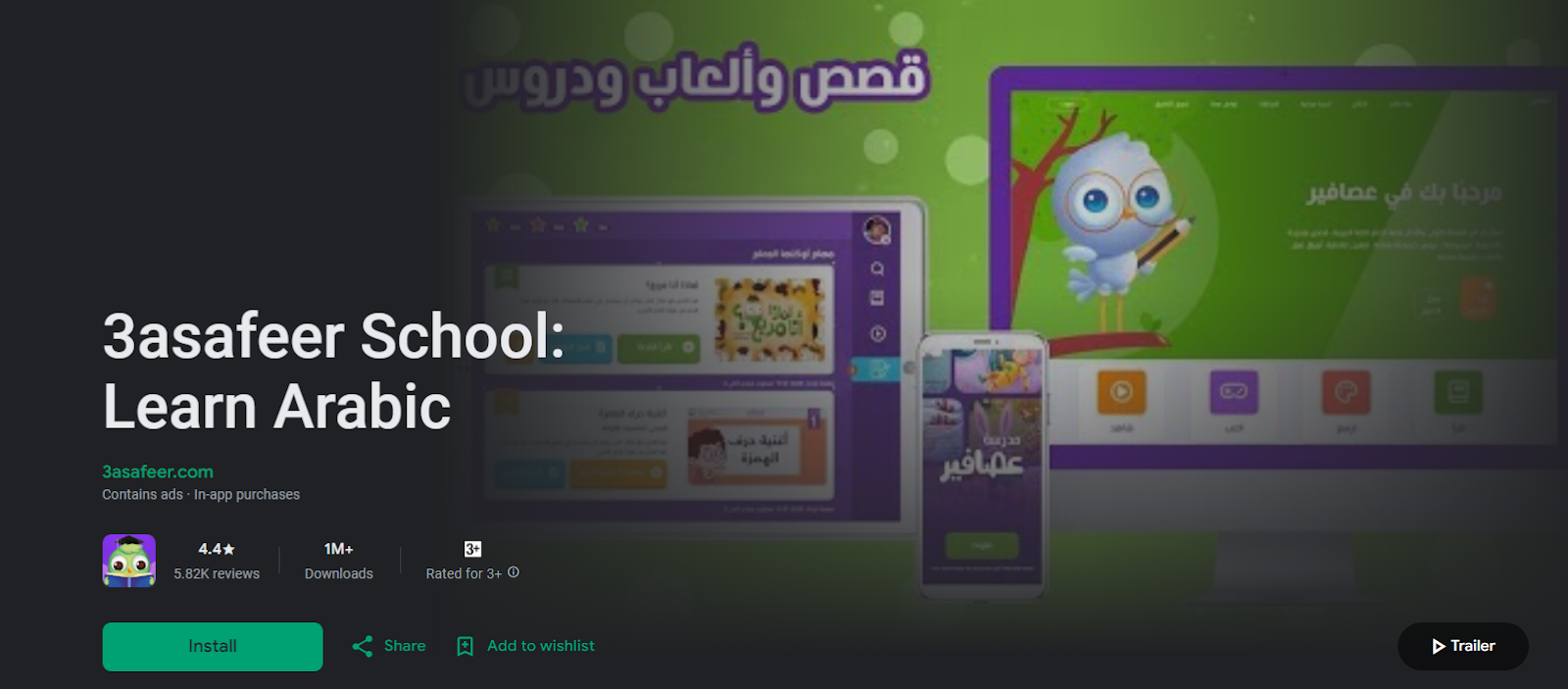
3asafeer School uses game-based learning to teach young children the Arabic alphabet, letter sounds, and early writing. The app’s character-driven approach — with animated animals and interactive scenarios — sustains attention effectively in the 3–8 age range. Children practice letter recognition, tracing, and pronunciation through activities that feel like play rather than study.
✅ Best for: Children aged 3–8 learning the Arabic alphabet for the first time — particularly strong for pre-readers and early readers.
⚠️ Limitation: Covers alphabet and early literacy only — not a full Arabic language curriculum. Children who have mastered the alphabet will outgrow 3asafeer quickly and should transition to IReadArabic for continued reading development.
3. Habar: Learn Arabic for kids
iOS, Android | 💰 Paid (varies by platform) | ⭐⭐⭐
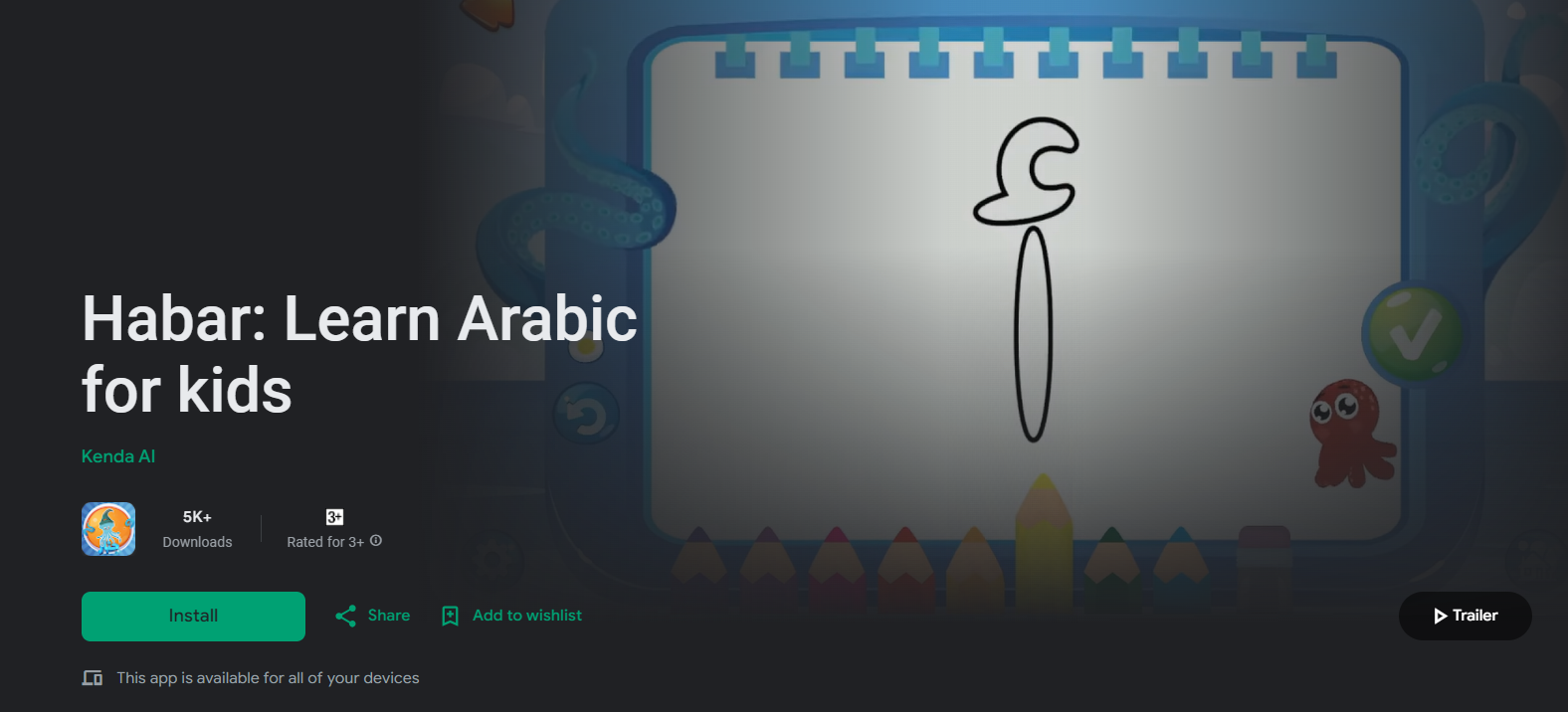
Habar takes an interactive games-first approach to early Arabic literacy — teaching letter recognition, letter sounds, and basic writing through gameplay rather than structured lessons. The app’s activities include letter-matching games, tracing exercises, and word-picture association games where children connect Arabic words with their illustrations. Each activity is short (2–5 minutes), which matches the attention span of the 3–7 age group and makes Habar effective for integration into daily routines without dedicated study time.
The writing component is Habar’s strongest feature: tracing exercises guide children through the correct stroke order and direction for each Arabic letter, with visual feedback that makes the correction feel like part of the game rather than a mistake.
✅ Best for: Children aged 3–7 who are at the very beginning of Arabic literacy — learning to recognise letters, understand their sounds, and practice basic writing in an environment that feels like play rather than study.
⚠️ Limitation: Habar is an early literacy tool — it covers letter recognition and basic writing only. It does not teach vocabulary beyond simple illustrated words, and it does not develop reading fluency or conversational Arabic. Children who complete Habar’s content will have a solid alphabet foundation and should transition to Read Along (for reading fluency) or IReadArabic (for structured reading progression) as their next step. The paid model with no free trial makes it harder to evaluate before purchase — check current app store pricing as it varies by region and platform.
4. Gus on the Go
iOS, Android | 💰 $3.99 one-time purchase | ⭐⭐⭐
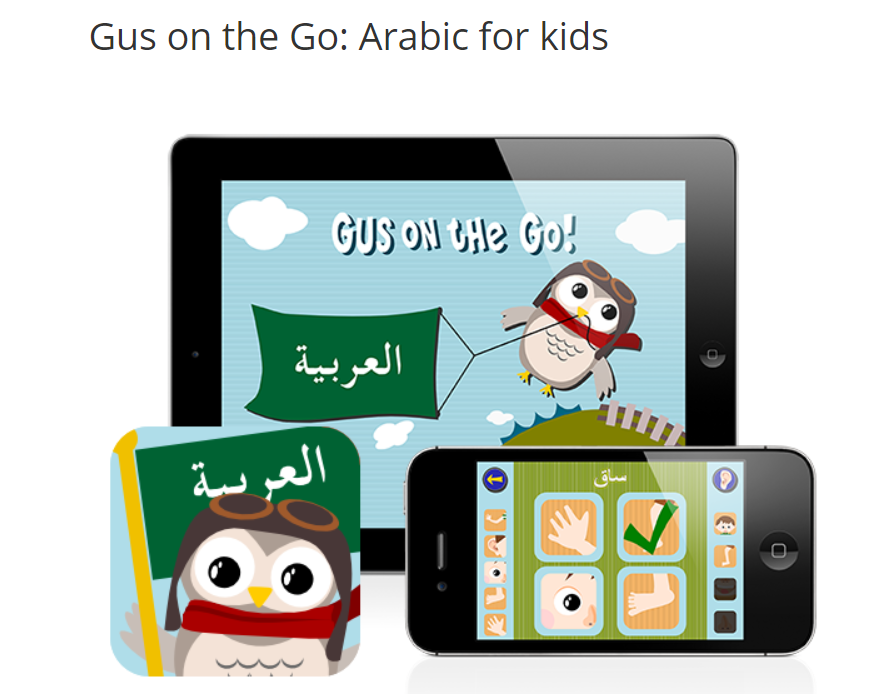
Gus on the Go is a vocabulary-focused Arabic app for children aged 4–10, built around an animated owl character who guides children through themed word sets — animals, colours, numbers, food, family, clothing, and body parts. Each word is presented with a clear native speaker pronunciation, a colourful illustration, and a simple repetition activity where the child taps or drags the word to its matching image.
The app’s structure is deliberately simple: themed categories appear on a map, children tap a destination to explore that category, and each category contains 8–12 words with interactive activities. Sessions are naturally short (5–10 minutes per category), which aligns well with young children’s attention span and makes the app effective for daily practice without parental supervision.
The one-time purchase model ($3.99 with no subscription) makes Gus on the Go appealing for parents who want a quality Arabic vocabulary tool without committing to recurring costs. Unlike subscription apps that lock content behind monthly payments, all of Gus on the Go’s content is available permanently after purchase.
✅ Best for: Children aged 4–8 who need an engaging, character-led introduction to Arabic vocabulary. Particularly effective as a first Arabic app for children who have no prior exposure to the language — the visual approach means children can learn words without needing to read Arabic script first.
⚠️ Limitation: Gus on the Go covers vocabulary only — it does not teach the Arabic alphabet, letter recognition, reading, writing, or any grammatical structure. Children who use Gus on the Go will learn to recognise and say approximately 90 Arabic words — but they will not be able to read, write, or construct sentences. For alphabet and writing foundations, pair it with 3asafeer School or Habar. For reading progression, transition to IReadArabic once the child has learned the letters.
5. Lamsa
iOS, Android | 💰 Free / $4.99 per month | ⭐⭐⭐⭐⭐
Lamsa is the most comprehensive Arabic learning platform for young children — and one of the few apps that integrates language, Islamic culture, values, and storytelling into a single cohesive experience. Used by over 5 million families across the Arab world and diaspora, Lamsa offers hundreds of interactive stories, songs, educational games, and creative activities spanning Arabic literacy, mathematics, and cultural knowledge. The visual design is exceptional — rich, colourful illustrations that children engage with instinctively.
✅ Best for: Children aged 2–8 whose parents want a culturally grounded Arabic learning environment — not just language, but identity and values.
⚠️ Limitation: The free tier is limited. Full access to Lamsa’s library requires a subscription at $4.99/month. For families committed to Arabic learning, this is good value — but parents who want to evaluate before committing should use the free trial period fully.
6. Read Along by Google (Arabic)
iOS, Android | 💰 Free | ⭐⭐⭐⭐
Read Along by Google uses real-time speech recognition to listen to children read Arabic stories aloud — providing instant feedback, encouragement through an animated companion character (Diya the reading buddy), and gentle prompting when a child struggles with a word or loses their place. The app’s Arabic library includes stories at multiple difficulty levels, with the text highlighted word-by-word as children read, helping them track their position in the text.
What makes Read Along particularly valuable is its reading fluency focus: most Arabic apps teach letters or vocabulary — Read Along specifically develops the ability to read connected Arabic text aloud with correct pronunciation and flow. This is a distinct and often neglected skill: children who know the alphabet and basic vocabulary still frequently struggle to read Arabic text fluently, and this app addresses that gap directly.
The app stores reading sessions and tracks progress over time, giving parents and teachers visibility into which words a child struggles with most frequently.
✅ Best for: Children aged 5–10 who already know the Arabic alphabet and basic vocabulary but need to develop reading fluency — the ability to read connected Arabic text aloud smoothly and with correct pronunciation.
⚠️ Limitation: Read Along assumes prior Arabic literacy — it does not teach the alphabet or letter sounds from scratch. Children who do not yet recognise Arabic letters should start with 3asafeer School or Habar before using Read Along. The Arabic story library, while growing, is smaller than the app’s English collection. Some parents also report that the speech recognition occasionally struggles with very young children’s voices or strong accents, though Google continues to improve this.
Master Arabic with Kalimah Center
Join our expert-led online classes and start your journey toward Arabic fluency today.
Book Your Free TrialInside Kalimah Center: Moments from Our Courses
Get a glimpse into the vibrant learning experience at Kalimah Center. These snapshots capture real moments from our live classes—where students engage deeply, connect with passionate instructors, and grow in a welcoming, supportive environment.
Here Are The Reviews On Our Courses:
Our students frequently commend the excellence of our courses and the commitment shown by our instructors. You can read their complete reviews on Trustpilot.

Want to Learn Arabic on the Go? The apps are Great, but Kalimah Center is Better!
You found some good Arabic learning apps, and that’s a good start! But if you truly want to master Arabic – reading, writing, speaking, and understanding – Kalimah Center’s online Arabic courses are the best choice.
Why Kalimah Center? We offer more than just an app:
- Live teachers, not just robots: Our experienced native teachers give you personalized feedback and support.
- Structured Arabic Language curriculum,
- not just random lessons: Our courses are carefully designed to build your skills step-by-step.
- Interactive exercises, not just flashcards: You’ll practice real-life conversations and develop your Arabic fluency.
- Community of learners: Connect with other students and practice your Arabic together.
📚 Explore Our Courses:
Online Arabic Course: Tailored to your level, our comprehensive Arabic program includes 16 teaching levels and 400+ hours of personalized sessions.
Online Quran With Tajweed Course: Perfect for non-Arabic speakers, our course spans 13 levels and equips you with Tajweed mastery from beginner to advanced.
Online Arabic Course For Kids: Nurture your child’s love for Arabic with our engaging and structured program, available in 24 levels for primary, intermediate, and secondary stages.
🚀 Start Your Free Trial Today! 🚀
Don’t miss out on this life-changing opportunity to deepen your faith and knowledge. Sign up now for your free trial and take the first step towards becoming a better practicing Muslim with Kalimah Center!
Join for FREE today and discover how Kalimah Center can help you achieve your language goals. Our online courses are perfect for busy adults who want to learn Arabic at their own pace.
Conclusion:
The 20 apps reviewed in this guide cover every skill Arabic learners need — reading, writing, speaking, listening, and children’s learning. The right choice depends on your goal, your level, and how you learn best.
The honest truth about Arabic learning apps in 2026: they are better than they have ever been, and none of them are sufficient on their own. LingQ is exceptional for reading — but it will not teach you to speak. HelloTalk accelerates speaking dramatically — but it will not teach you grammar. Write It! Arabic develops your script beautifully — but it will not build your vocabulary.
The most effective Arabic learners treat apps as a daily practice environment — consistent, accessible, low-friction — while supplementing with structured instruction and live conversation. Two or three well-chosen apps, used daily, combined with even one weekly session with a native speaker, will take you further than any single premium app used alone.
Our recommended starting stacks:
| Goal | App Combination |
|---|---|
| Learn Arabic from zero (free) | Duolingo + Anki + HelloTalk |
| Learn to read the Quran | Madinah Arabic Reader + Anki (Quranic deck) + Write It! Arabic |
| Conversational Arabic | Mondly → HelloTalk → Tandem |
| Teach a child Arabic (ages 2–8) | Lamsa + 3asafeer School |
| Teach a child Arabic (ages 8–12) | IReadArabic + Read Along by Google |
Choose your starting point. Use it daily. Add a second tool when the first becomes comfortable. And remember: the fastest route to Arabic fluency depends entirely on knowing where you are going.
FAQs about Best Arabic Learning Apps
Q1: What is the best Arabic learning app in 2026?
There is no single best app — the answer depends on your skill focus. For reading and vocabulary: LingQ (intermediate–advanced) or Duolingo (beginner). For writing the Arabic script: Write It! Arabic is the clear category leader. For speaking with native speakers: HelloTalk or Tandem. For children: Lamsa (ages 2–8) or IReadArabic (ages 6–12). The most effective approach combines two apps targeting different skills rather than relying on one app for everything.
Q2: Is Write It! Arabic worth buying?
Yes — for most Arabic learners, Write It! Arabic at $3.99 is one of the best-value purchases in Arabic learning. It is the most dedicated and rigorous app for learning Arabic handwriting and script formation, covering all 28 letters in all four positional forms with stroke-order guidance and accuracy feedback. Its one-time purchase model (no subscription) makes it particularly good value. The only caveat: it teaches script formation only — pair it with a vocabulary app to understand what you are writing.
Q3: What is the best free Arabic learning app?
Duolingo is the most accessible free option for beginners. Anki (with a free pre-made Arabic vocabulary deck) is the most effective free tool for vocabulary retention. HelloTalk offers free language exchange with native Arabic speakers. Madinah Arabic Reader provides a complete free structured curriculum for Quranic Arabic foundations. Mango Languages gives full access free with a library card. The combination of Duolingo + Anki + HelloTalk covers the core learning needs of a beginner at zero cost.
Q4: Which Arabic app is best for learning to read the Quran?
Madinah Arabic Reader (developed by the Islamic University of Madinah) is the most structured free app for Quranic Arabic reading foundations. For script recognition specifically, Write It! Arabic builds the handwriting foundation. For vocabulary, Anki with a Quranic frequency deck (the 500 most common Quranic words are freely available as an Anki deck) is highly effective. Apps alone are generally insufficient for Quranic Arabic mastery — the grammatical complexity and classical vocabulary typically require structured instruction alongside app-based practice.
Q5: Are Arabic learning apps good for kids?
Yes — several Arabic apps are specifically and effectively designed for children. Lamsa (ages 2–8) is the most comprehensive, covering language, Islamic culture, and interactive storytelling. 3asafeer School teaches the alphabet through games for ages 3–8. IReadArabic provides levelled reading books for ages 6–12. Read Along by Google supports reading aloud practice for ages 5–10. For children, the key selection criteria are: age-appropriate content, audio-first learning (before reading), short sessions (5–10 minutes), and game mechanics that maintain engagement.