The letter “د” (Daal) is one of the most important letters in the Arabic language. This article discusses the properties of the letter “د” (Daal), its pronunciation and usage, its function in an Arabic word, and the proper formation of its pronunciation and sound.
Arabic Letter “د” (Daal)
The Arabic letter “د” (Daal) is a simple and essential part of the Arabic alphabet. As the eighth letter, it is characterized by a clean vertical line with a rounded top and lacks additional dots. This makes it easy to identify and distinguish from other similar letters.
Pronounced like the English “D” in words like “dog” or “desk,” “د” is straightforward to articulate, differing from the emphatic “ض” (Dhaad), which has a heavier, more forceful sound. The letter retains the same shape in all positions—whether isolated, at the beginning, middle, or end of a word.
In writing, the letter “د” does not connect to other letters in the middle or final positions, remaining visually consistent throughout. Learners often encounter confusion with similar letters, such as “ذ” (Thaal), which includes a dot, or with the emphatic “ض”.
Introduction To The Arabic Letter “د” (Daal)
The letter “د” is very simple and specially designed so it is easy to recognize. It is one of the first few letters in Arabic and is key to understanding the formation of many words.

- Design: The letter “د” looks like a small vertical line with a slight curve at the top right, resembling an upright stroke with a rounded top. It does not have any dots or additional marks like some other letters.
- Position in alphabet: “د” is the eighth letter in the Arabic alphabet and occurs after the letter “ج” and before the letter “ه”.
- Letter types: The shape of this letter, as in most Arabic letters, takes a different form at the beginning, middle, or end of a word, standing alone or in conjunction with another letter
The Sound Of “د” (Daal)
The pronunciation of the letter “د” is quite simple and close to the English “D” sound.

Pronunciation: The “د” sound is similar to the English letter “D”, as in “dog” or “desk”.
Sound Comparison: Unlike the emphatic “ض” (Dhaad), which has a deep and thick sound, “د” is a clear, standard “D” sound without any emphasis
Master Arabic with Kalimah Center
Join our expert-led online classes and start your journey toward Arabic fluency today.
Book Your Free TrialDifferent Forms Of “د” (Daal)
Like other Arabic letters, the “د” changes form depending on how it is placed in the word. Below are the shapes of the letter “D” in different contexts:

Isolated form: In isolated space, the “د” appears as a simple curve with a single dot: “د”.
Initial Form: The “د” at the beginning of a word is not related to the following letters, so it remains the same as its stand-alone form: “د”.
Middle and Final: Unlike many Arabic letters, “د” does not change form in the middle or end of a word. It stays the same in both places, with no connecting tail: “ـد” and “ـد.”
Examples Of “د” (Daal) In Words And Sentences
To understand the use of “د” in different contexts, here are several examples of words and sentences that feature the letter:

Initial Form:
- دقيقة – “duqiqa” – (minute)
- دب – “doub” – (bear)
- دخان – “dokhan” – (smoking)
Medial Form:
- مدرسة – “madrasa” (school)
- صندوق – “sandouk” (box)
- هدوء – ” hodo’ ” – (quiet)
Final Form:
- قرد – “qerd” – (monkey)
- يد – “yad” – (hand)
- حداد – “haddad” – (Blacksmith)
Example Sentences:
- “محمد يذهب الي المدرسة بالدراجة” (Mohammed goes to school by bike)
- “يد الله مع الجماعة” (God’s hand is with the group)
- “هذه المدينة مليئة بالدخان” (This city is full of smoke)
Read more about: Arabic Letter “ذ” (Thaal) With Its Forms, Pronunciation, And Examples
Tips To Master The Letter “د” (Daal)
Some practical tips for learners who want to master “د” perfect in pronunciation and usage include the following:

- Pronunciation Practice: The best way to do this is by listening to native speakers and repeating exactly what they say. Language learning apps and videos can help in this regard.
- Writing Practice: Pay close attention to writing the isolated and connected forms of “د,” making sure to correctly position the single dot above the curve.
- Calligraphy Practice: Practice writing with Arabic calligraphy tools to develop your writing technique and get a feel for how “د” flows in different word structures.
Common Challenges With “د” (Daal)
While “د” is largely pretty straightforward, a learner might make a couple of common mistakes with this letter:

Dot Confusion: Sometimes beginners use “د” when they mean to use “ذ” because the two letters are similarly curved but “ذ” has a dot.
Mispronunciation: A very important thing not to do is to confuse “د” with the other “D” sounds like the emphatic “ض”, which has a more forceful pronunciation.
Master Arabic with Kalimah Center
Join our expert-led online classes and start your journey toward Arabic fluency today.
Book Your Free TrialInside Kalimah Center: Moments from Our Courses
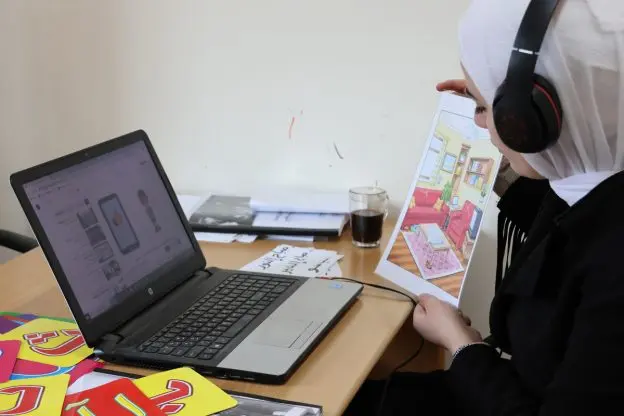
Get a glimpse into the vibrant learning experience at Kalimah Center. These snapshots capture real moments from our live classes—where students engage deeply, connect with passionate instructors, and grow in a welcoming, supportive environment.
Here Are The Reviews On Our Courses:
Our students frequently commend the excellence of our courses and the commitment shown by our instructors. You can read their complete reviews on Trustpilot.

Unlock Your Potential in Arabic and Quran with Kalimah Center!
Ready to deepen your connection with the Quran and enhance your understanding of Arabic? Join Kalimah Center today and embark on a transformative journey of learning and growth! Our professional, handpicked Online Arabic and Quran Tutors are dedicated to helping you master these essential skills with ease and expertise.
📚 Explore Our Courses:
Online Arabic Course: Tailored to your level, our comprehensive Arabic program includes 16 teaching levels and 400+ hours of personalized sessions.
Online Quran With Tajweed Course: Perfect for non-Arabic speakers, our course spans 13 levels and equips you with Tajweed mastery from beginner to advanced.
Online Arabic Course For Kids: Nurture your child’s love for Arabic with our engaging and structured program, available in 24 levels for primary, intermediate, and secondary stages.
🚀 Start Your Free Trial Today! 🚀
Don’t miss out on this life-changing opportunity to deepen your faith and knowledge. Sign up now for your free trial and take the first step towards becoming a better practicing Muslim with Kalimah Center!
Conclusion
The letter “د” is rather simple and one of the most important letters in the Arabic alphabet. Mastering its pronunciation, writing, and usage in various positions adds to the learners’ skills for better understanding. Its simple form and soft pronunciation make it a good starting point for learners.
FAQs about Arabic Letter “د” (Daal)
What is the Arabic letter Daal (د) and its position in the alphabet?
The Arabic letter Daal (د) is the eighth letter of the Arabic alphabet. It is a non-connecting letter (does not attach to following letters) and is written as a simple vertical stroke with a rounded top, completely lacking any dots or additional diacritics.
How do you correctly pronounce the Arabic letter Daal?
The letter Daal (د) is pronounced exactly like the English letter “D” in words such as “dog” or “desk.” It features a light, crisp, and standard dental sound, which distinguishes it from heavier Arabic letters.
What is the difference between the Arabic letters Daal (د) and Dhaad (ض)?
The primary difference is emphasis and phonetic depth. Daal (د) is a light, standard “D” sound similar to English. In contrast, Dhaad (ض) is an emphatic, heavy, and thick non-English sound articulated from the sides of the tongue against the molars.
Does the Arabic letter Daal (د) change its shape in words?
No, the Arabic letter Daal (د) maintains its core visual shape across all positions (isolated, initial, medial, and final). Because it is a “selfish” or non-connecting letter, it never joins the letter following it, only connecting to preceding letters via a small tail (ـد).
What are common examples of the letter Daal (د) in Arabic?
Common examples of Daal (د) include دقيقة (duqiqa – minute) in the initial position, مدرسة (madrasa – school) in the medial position, and يد (yad – hand) or قرد (qerd – monkey) in the final position.