Death is one of the most repeated themes in the Quran, with the root word for death and its derivatives appearing more than 70 times across the text.
Quran verses about death in Arabic cover several distinct angles: the certainty of death for every soul, the timing of death being fixed by Allah, the actual moment of the soul leaving the body, and the wisdom behind why death exists at all.
This guide collects the verses most often searched for, gives you the Arabic text alongside transliteration and translation, and explains what each verse means in its original context.
What you’ll learn in this article:
- The Arabic text, transliteration, and meaning of the most cited Quran verses on death.
- The exact verse behind “every soul will taste death” and where it repeats.
- How these verses group by theme: certainty, timing, the moment of death, and purpose.
- The hadith context connected to remembering death.
The Quran does not address death in a single passage. It returns to the subject across more than twenty Surahs, approaching it from different angles each time — sometimes as a warning, sometimes as a description of mechanism, sometimes as a statement of purpose.
Below are the verses most frequently cited under this theme, grouped by what each one specifically addresses.
The Certainty and Reach of Death
Several verses in the Quran address a single idea directly: physical safety has no bearing on when death arrives. This section looks at the verse most often cited on that point and the historical context behind it.
أَيْنَمَا تَكُونُوا يُدْرِككُّمُ الْمَوْتُ وَلَوْ كُنتُمْ فِي بُرُوجٍ مُّشَيَّدَةٍ
Ainama takoonoo yudrikkumul mawtu walaw kuntum fee buroojim mushayyadah.
“Wherever you are, death will overtake you, even if you are in fortified towers.” Surah An-Nisa 4:78
The verse was revealed addressing people who attributed misfortune to external causes while assuming physical safety meant immunity from death. The image of “fortified towers” — the maximum protection available in that era — makes the point that no structure changes the outcome.
The Timing And Place Of Death Are Fixed In The Quran
Just as death itself is certain, the Quran is equally specific about when and where it happens. Several verses address this directly, closing the door on the idea that timing is flexible or that circumstances can push a death date earlier or later.
1. The Absolute Precision of the Appointed Time
The Quran does not describe the moment of death as approximate. It uses language that rules out any margin of delay or advance, down to the hour.
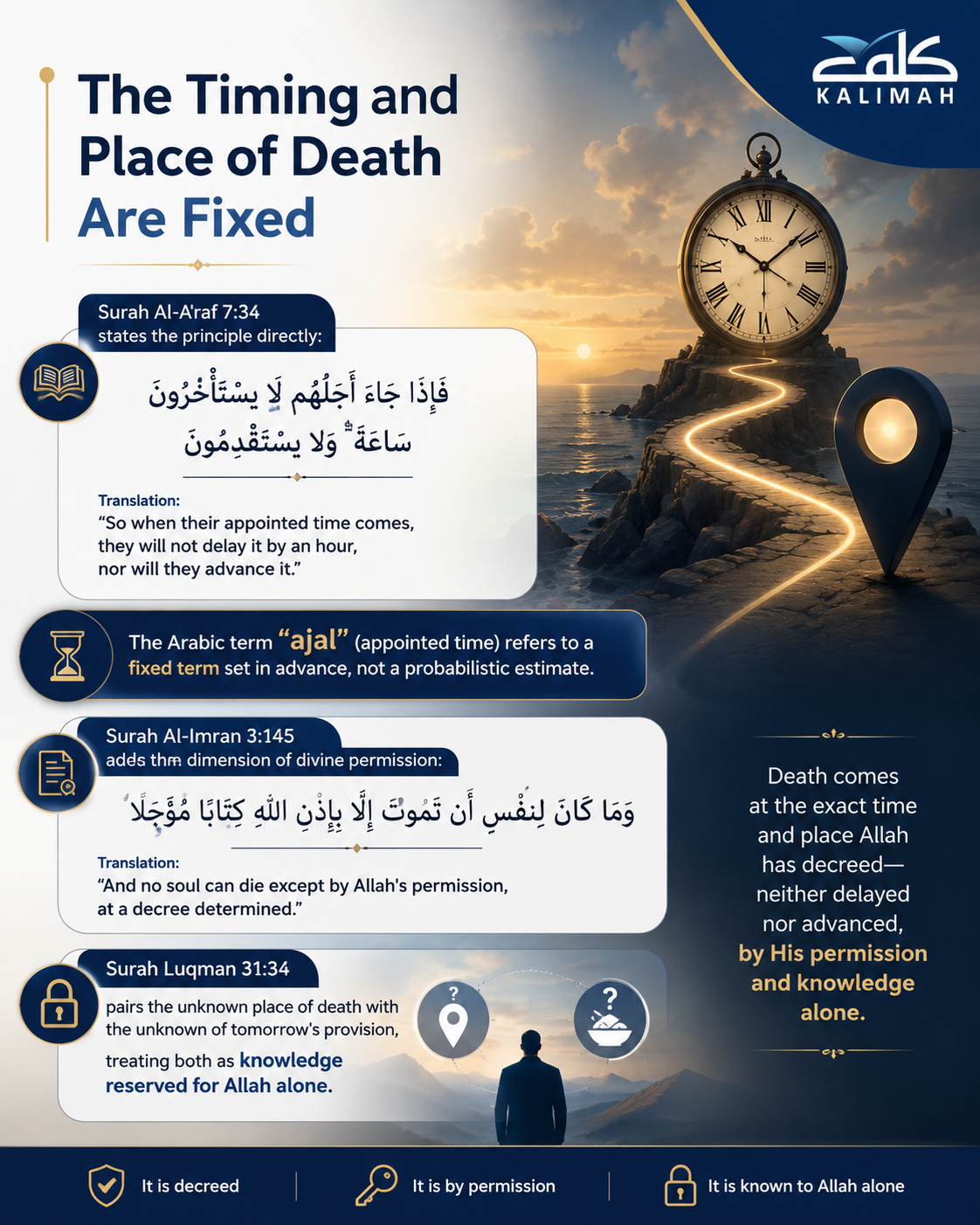
فَإِذَا جَاءَ أَجَلُهُمْ لَا يَسْتَأْخِرُونَ سَاعَةً ۖ وَلَا يَسْتَقْدِمُونَ
“So when their appointed time comes, they will not delay it by an hour, nor will they advance it.” Surah Al-A’raf 7:34
The Arabic term “ajal” (appointed time) refers to a fixed term set in advance, not a probabilistic estimate. The verse states that this moment is locked into place well before it arrives, and that no human action — caution, medicine, or precaution — moves it earlier or later.
2. The Divine Decree and Permission
Death is not presented in the Quran as a mechanical biological event that simply runs its course. It is tied directly to a specific act of divine permission, recorded as a decree before it happens.
وَمَا كَانَ لِنَفْسٍ أَنْ تَمُوتَ إِلَّا بِإِذْنِ اللَّهِ كِتَابًا مُؤَجَّلًا
“And no soul can die except by Allah’s permission, at a decree determined.” (Surah Al-Imran 3:145)
This verse adds a second layer to the first: death does not happen on its own. It occurs only with Allah’s permission, recorded in advance as a fixed decree.
Read together with 7:34, the two verses describe the same event from two angles — one fixes the timing, the other fixes the authority behind it.
3. The Hidden Geography of Death
The Quran extends this fixed quality beyond timing to location. The place where a person dies is treated as settled in advance, even though it remains unknown to the person concerned until it happens.
وَمَا تَدْرِي نَفْسٌ بِأَيِّ أَرْضٍ تَمُوتُ
Translation: “…And no soul knows in what land it will die…” (Surah Luqman 31:34)
This verse pairs the unknown place of death with the unknown of tomorrow’s provision, treating both as knowledge reserved for Allah alone. The location is just as fixed as the timing — it is simply hidden from the person it concerns, which is part of why classical commentators read this verse as a call to live attentively rather than anxiously.
Kalimah Center’s Tafsir sessions go through verses like these line by line, connecting the Arabic wording to the classical commentary so the meaning isn’t lost in translation alone.
Read Also: Quran Verses About Patience in Arabic
The Quran Describes The Moment The Soul Leaves The Body
Most discussions of death stop at the fact that it happens. The Quran goes further, describing who is present and what occurs in the moments around it — naming the angels involved and addressing the people standing in the room. Two verses carry this description directly.
وَهُوَ الْقَاهِرُ فَوْقَ عِبَادِهِ ۖ وَيُرْسِلُ عَلَيْكُمْ حَفَظَةً حَتَّىٰ إِذَا جَاءَ أَحَدَكُمُ الْمَوْتُ تَوَفَّتْهُ رُسُلُنَا وَهُمْ لَا يُفَرِّطُونَ
“And He is the subjugator over His servants, and He sends over you guardian-angels until, when death comes to one of you, Our messengers take him in death, and they do not fail in their duty.” Surah Al-An’am 6:61
The verse names two categories of angels: those watching over a person during life, and “Our messengers” who carry out the act of taking the soul.
While Surah Al-Waqi’ah 56:83-85 shifts to direct address, describing the scene around a dying person: وَنَحْنُ أَقْرَبُ إِلَيْهِ مِنكُمْ وَلَٰكِن لَّا تُبْصِرُونَ — “We are nearer to him than you, but you do not see.”
The verse is addressed to people standing in the room, stating that Allah’s presence at that instant is closer than anyone physically present.
Read Also: 16 Most Beautiful Arabic Words in the Quran
Quran Verses About The Divine Purpose Of Death
The Quran frames the reality of passing away not to induce fear, but to offer profound moral clarity, establishing that both our time on Earth and our departure from it are intentionally designed parts of a grander divine plan. By examining specific verses, we gain a clearer understanding of how this transition serves a specific, divine objective.
1. Death and Life as a Deliberate Test
Surah Al-Mulk establishes the foundational philosophy of our existence, framing both death and life together as a deliberate, purposeful trial through the following verse:
الَّذِي خَلَقَ الْمَوْتَ وَالْحَيَاةَ لِيَبْلُوَكُمْ أَيُّكُمْ أَحْسَنُ عَمَلًا ۚ وَهُوَ الْعَزِيزُ الْغَفُورُ
“He who created death and life to test you as to which of you is best in deeds — and He is the Exalted in Might, the Forgiving.” Surah Al-Mulk 67:2
The verse places death before life in the pairing — a sequence that ties both states to one purpose: testing through deeds.
Experience Kalimah Center Classes
Watch real excerpts from our live sessions at Kalimah Center and see how we bring learning to life. These clips highlight our interactive, student-centered teaching approach across all our courses—designed to keep learners engaged, motivated, and actively involved every step of the way.
Master Arabic with Kalimah Center
Join our expert-led online classes and start your journey toward Arabic fluency today.
Book Your Free Trial2. The Appointed Angel and Divine Decree
Moving from the purpose of death to its execution, the Quran introduces the administrative reality of this transition.
قُلْ يَتَوَفَّاكُم مَّلَكُ الْمَوْتِ الَّذِي وُكِّلَ بِكُمْ
“Say: The angel of death, who has been entrusted with you, will take your souls.”
In Surah As-Sajdah 32:11 names the angel responsible by title, the only verse in the Quran to do so directly:
Kalimah Center’s Tafsir classes cover passages like these with attention to sequence and context, since reading 67:2 and 32:11 together gives a fuller picture of the Quran’s framing of death than either verse read alone.

Every Soul Will Taste Death Quran Verse in Arabic
The phrase “Every Soul Will Taste Death” is one of the most frequently discussed verses on this topic, and for good reason. It appears in three different chapters of the Quran, each time adding a new dimension to the same fundamental truth. The following verses explain its origin and how each repetition builds upon the previous one.
1. The Original Verse
The verse behind this phrase is found in Surah Al Imran, and it is the verse that most readers are looking for:
كُلُّ نَفْسٍ ذَائِقَةُ الْمَوْتِ ۗ وَإِنَّمَا تُوَفَّوْنَ أُجُورَكُمْ يَوْمَ الْقِيَامَةِ
Kullu nafsin dha’iqatul mawt, wa innama tuwaffawna ujurakum yawmal qiyamah.
“Every soul will taste death, and you will only be given your full compensation on the Day of Resurrection.” Surah Al-Imran 3:185
The Arabic word kullu (every) leaves no soul outside its scope — not the wealthy, not the powerful, not the righteous. The verse pairs the certainty of death with the certainty of reward, which is why this exact ayah appears so often in funeral contexts and reminders.
2. The Same Phrase With A Different Pairing
The same phrase appears again, nearly word for word, in Surah Al-Anbiya 21:35.
كُلُّ نَفْسٍ ذَائِقَةُ الْمَوْتِ وَنَبْلُوكُمْ بِالشَّرِّ وَالْخَيْرِ فِتْنَةً وَإِلَيْنَا تُرْجَعُونَ
“Every soul will taste death, and We test you with good and bad as a trial, and to Us you will be returned.” Surah Al-Anbiya 21:35:
Classical commentators point directly to the repetition of this exact opening phrase in two separate Surahs — it signals that this particular truth was meant to be unmissable to a reader moving through the Quran in sequence, not a detail easy to read past once and forget.
It is also mentioned in Surah Al-Jumu’ah with the same wording, but it adds that fleeing from death only leads to the revelation of deeds..
ثُمَّ تُرَدُّونَ إِلَىٰ عَالِمِ الْغَيْبِ وَالشَّهَادَةِ فَيُنَبِّئُكُم بِمَا كُنتُمْ تَعْمَلُونَ
“Then you will be returned… and He will inform you of what you used to do.” Al-Jumu’ah 62:8
Reading 3:185 alongside 62:8 gives a fuller picture than either verse alone: death’s certainty in 3:185 is followed directly by accountability for what was done before it in 62:8 — the two verses form a sequence, not two unrelated statements on the same subject..
Read Also: Quran Verses About Mothers in Arabic
Inside Kalimah Center: Moments from Our Courses
Get a glimpse into the vibrant learning experience at Kalimah Center. These snapshots capture real moments from our live classes—where students engage deeply, connect with passionate instructors, and grow in a welcoming, supportive environment.
Here Are The Reviews On Our Courses:
Our students frequently commend the excellence of our courses and the commitment shown by our instructors. You can read their complete reviews on Trustpilot.
Read more reviews on Trustpilot

Study These Verses With Guided Tajweed and Tafsir at Kalimah Center

Reading these verses on a page gives you the words. Reciting them with correct Tajweed, and understanding the classical commentary behind each one, gives you what they were meant to deliver.
Kalimah Center pairs every verse covered in class with both the recitation rules that govern its pronunciation and the Tafsir context that explains its meaning — so a verse like Al-Waqi’ah 56:83 is never taught as text alone.
Reading these verses about death in translation gives you the meaning — reading them in Arabic gives you the meaning and the weight the Prophet’s companions first felt when they heard them.
Kalimah Center helps you close that gap, whether your goal is reciting with confidence or understanding the Quran word for word.
Explore Our Courses:
- Online Arabic Course — 16 levels and 400+ hours of one-on-one sessions, built around your current level and pace.
- Online Quran With Tajweed Course — 13 levels for non-Arabic speakers, from your first letters to advanced Tajweed.
- Online Arabic Course for Kids — 24 levels covering primary, intermediate, and secondary stages.
Start Your Free Trial Today
Try a live class before you commit to anything. Sign up for your free trial with Kalimah Center and see how a one-on-one session feels.

Master Arabic with Kalimah Center
Join our expert-led online classes and start your journey toward Arabic fluency today.
Book Your Free TrialConclusion
Quran verses about death in Arabic return again and again to four ideas: death is certain for every soul, its timing and location are fixed in advance, the moment itself is described with specific detail rather than left vague, and its stated purpose is to test deeds during life.
The verse behind “every soul will taste death” — Surah Al-Imran 3:185 — remains the most cited line precisely because it compresses all four ideas into a single sentence, and its near-repetition in Surah Al-Anbiya 21:35 reinforces that this is a truth the Quran wants impossible to miss.
Reading these verses in their original Arabic, alongside accurate transliteration and translation, is the starting point; understanding them in sequence and context is what turns reading into reflection.
Frequently Asked Questions
These are the most common questions readers ask about Quran verses on death, covering the most-cited ayat, the concept of the soul’s transition.
1- What is the most famous Quran verse about death in Arabic?
The most cited verse is Surah Al-Imran 3:185: كُلُّ نَفْسٍ ذَائِقَةُ الْمَوْتِ (“Every soul will taste death”). It appears almost identically again in Surah Al-Anbiya 21:35, which is why both verses are frequently searched together.
2- How many times does the Quran mention death?
The root word for death and its derivatives appear more than 70 times across the Quran, covering themes including the certainty of death, its fixed timing, the moment the soul departs, and the wisdom behind why death and life were created.
3- Which verse names the Angel of Death directly?
Surah As-Sajdah 32:11 is the only verse that names “Malak al-Mawt” (the Angel of Death) by title: قُلْ يَتَوَفَّاكُم مَّلَكُ الْمَوْتِ الَّذِي وُكِّلَ بِكُمْ. Other verses describe angels taking the soul without using this specific title.
4- Does the Quran say where or when a person will die?
No. Surah Luqman 31:34 states that no soul knows in what land it will die, and Surah Al-A’raf 7:34 confirms the appointed time cannot be delayed or advanced once it arrives. Both facts are presented as knowledge reserved for Allah alone.
5- Why does the Quran link death with good deeds instead of just describing it as an ending?
Surah Al-Mulk 67:2 states death and life were both created “to test you as to which of you is best in deeds.” This framing treats death as the close of an accountability period, not simply a biological endpoint.