Learning Arabic provides benefits across five domains: religious (direct Quran comprehension, deeper prayer), travel (authentic cultural immersion in 22+ Arabic-speaking countries), career (high-demand skills in the MENA region, translation, and diplomacy), business (access to markets worth $3.6 trillion GDP), and cognitive (improved memory, attention, and cultural empathy). Arabic is the official language of 22 countries, spoken by 400+ million people, and the 5th most spoken language globally. “Benefits” in Arabic is فوائد (fawa’id).
✅ Top Benefits Quick Reference:
| # | Benefit | Category | Who It’s For |
|---|---|---|---|
| 1 | Understand the Quran in its original language | Religious | Muslims |
| 2 | Deepen prayer and spiritual practice | Religious | Muslims |
| 3 | Authentic cultural travel in 22+ countries | Tourism | Travellers |
| 4 | Access to MENA region job market | Career | Professionals |
| 5 | Translation and interpretation career | Career | Language specialists |
| 6 | Business advantage in Arab markets | Business | Entrepreneurs |
| 7 | Competitive edge in diplomacy and international relations | Career | International professionals |
| 8 | Improved memory and cognitive function | Cognitive | All learners |
| 9 | Enhanced critical thinking | Cognitive | Students |
| 10 | Cultural awareness and empathy | Cultural | All learners |
| 11 | Access to 1,400 years of literature and scholarship | Academic | Researchers, students |
| 12 | Connection with global Muslim community | Community | Muslims |
| 13 | Language exchange and networking | Social | All learners |
| 14 | Freelance and remote work opportunities | Career | Independent workers |
| 15 | Understanding of Arabic calligraphy and art | Cultural | Art and culture enthusiasts |
Ready to discover the benefits of learning Arabic that enriches your life in many ways? Learning Arabic can be an investment of time and effort, but the rewards can be immense. تعلُم العربية (Ta’allum Al-Arabiyya), or Learning Arabic opens up a world of opportunities, connecting you with a rich cultural heritage, enhancing your travel experiences, and providing significant professional advantages.
Let me guide you through the many benefits of learning Arabic, each one an invitation to a new adventure and deeper understanding, from enriching your travel experiences and deepening your understanding of Islamic texts to boosting your career prospects and cognitive abilities.
What Are The Benefits of Learning Arabic?
Learning Arabic opens a world of benefits. For travelers, it enhances the cultural experience by enabling authentic interactions, understanding local customs, and discovering hidden gems. For Muslims, it deepens religious connections through a better understanding of the Quran and other religious texts.
Economically, Arabic proficiency unlocks lucrative job opportunities and business advantages in the thriving markets of the Middle East. Additionally, it improves cognitive skills, boosting memory, critical thinking, and cultural awareness.
Whether for travel, faith, career, or personal growth, learning Arabic offers rich and diverse rewards.
Let’s explore the benefits of learning arabic in a detailed way:
First: Tourism Benefits of Learning Arabic
Learning Arabic opens up a world of immersive travel experiences in the Middle East and North Africa. You can engage with locals authentically, navigate bustling souks with ease, and unearth hidden gems off the beaten path.
1. Immersive Travel Experience
Traveling to Arabic-speaking countries becomes a much richer experience when you can speak the language. Imagine exploring the bustling souks of Marrakech or the historic streets of Cairo, where you can engage with locals, ask for directions, and appreciate the stories behind every corner.
Example: In Marrakech, asking a vendor, “بكم هذا؟” (Bikam hatha? – How much is this?) not only helps you negotiate prices but also sparks delightful conversations.
2. Understanding Local Culture
Language is a key to understanding culture. When you speak Arabic, you gain insights into the customs, traditions, and daily lives of people in the region. This understanding transforms your travel experience, allowing you to connect with locals on a deeper level.
Understanding the significance of hospitality in Arab culture, where a simple “أهلًا وسهلًا” (Ahlan wa sahlan – Welcome) can lead to warm invitations and lasting friendships.
3. Access to Hidden Gems
Many travel guides overlook the hidden gems known only to locals. Speaking Arabic gives you access to these secrets, whether it’s a secluded beach, a family-run restaurant, or a historical site off the beaten path.
4. Enhanced Safety and Navigation
Understanding Arabic enhances your ability to navigate cities and rural areas safely. Reading street signs, asking for directions, and understanding public transportation announcements make your travels smoother and more secure.
5. Enriching Cultural Interactions
Language is a bridge to deeper cultural interactions. Participating in local festivals, understanding traditional music and dance, and appreciating art and literature in their original forms enrich your travel experience.
Example: Engaging in a conversation about “الخط العربي” (al-khatt al-Arabi – Arabic calligraphy) with an artist in Fez deepens your appreciation for this intricate art form.
The conversation in the following image, which is a part of the Kalimah curriculum, is an example of how Kalimah’s Arabic courses prepare students for real-life interactions they may encounter when traveling in Arabic-speaking countries. It focuses on a dialogue between a traveler and an airport employee, covering essential travel-related topics such as:
- Flight Confirmation: The traveler inquires about confirming their flight to Jeddah.
- Airline Identification: The employee asks about the airline, and the traveler specifies that they are flying with Indonesian Airlines.
- Ticket and Passport Verification: The employee requests to see the traveler’s tickets and passports, including those of their family members.
- Exit Visa Check: The employee asks for the exit visa, which the traveler provides along with the entry visa.
- Flight Details and Departure Time: The employee informs the traveler about their flight number, departure time (3 am), and advises them to arrive two hours before departure.
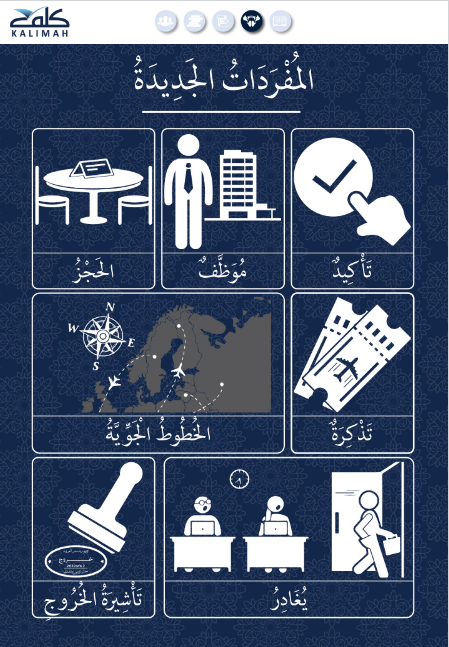
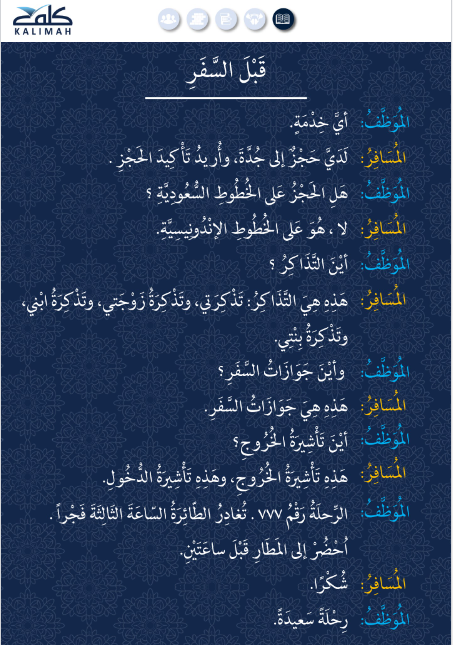
By incorporating dialogues like this, Kalimah equips learners with the necessary vocabulary, phrases, and cultural understanding to navigate common situations they might face during their travels, such as airport check-ins, hotel bookings, asking for directions, or ordering food. This practical approach ensures that students are not only learning the language but also developing the skills to communicate effectively and confidently in real-world scenarios.
Know more about Arabic Language Day
Second: Religious Benefits of Learning Arabic
Learning Arabic, the language of the Quran, allows Muslims to connect deeply with their faith. It unlocks the ability to understand the Holy Quran in its original form, enhancing the spiritual experience of prayer and recitation. Moreover, studying Arabic enables a deeper understanding of Islamic traditions and teachings, fostering a stronger connection to the religion’s rich history and culture.
1. Deepening Connection with Islam
For Muslim learners, understanding Arabic is essential for a deeper connection with their faith. The Quran is written in Classical Arabic, and being able to read and understand it in its original language brings a profound spiritual fulfillment.
Reciting “بِسْمِ اللَّهِ الرَّحْمَٰنِ الرَّحِيمِ” (Bismillah ir-Rahman ir-Rahim – In the name of Allah, the Most Gracious, the Most Merciful) with full comprehension enhances the meaning and impact of daily prayers.
2. Access to Religious Texts
Beyond the Quran, the Hadiths, Tafsirs, and other religious texts are written in Arabic. Learning the language allows you to study these texts directly, gaining a more accurate and nuanced understanding of Islamic teachings.
3. Participation in Religious Practices
Knowing Arabic enriches your participation in religious practices, from understanding sermons during Jumu’ah prayers to participating in discussions at Islamic study groups.
Engaging in a discussion about “تفسير القرآن” (Tafsir al-Quran – Exegesis of the Quran) with fellow worshippers at a local mosque.
4. Strengthening Community Bonds
Arabic is often the language of communication within Muslim communities. Learning Arabic helps you connect more deeply with fellow Muslims, fostering a sense of belonging and shared identity.
For example, Volunteering at a local mosque and communicating effectively with Arabic-speaking members strengthens your community ties.
5. Enriching Religious Education
For educators and parents, teaching Arabic to children or students enhances their religious education, allowing them to understand and appreciate the Quran and other religious texts from an early age.
Teaching children to recite and understand “الحمد لله” (Alhamdulillah – Praise be to Allah) instills gratitude and faith in their daily lives.
Our comprehensive Arabic curriculum not only prepares you for everyday conversations and travel but also lays the groundwork for your Quranic studies.
Once you’ve established a strong foundation in Arabic, delve deeper into the Quran with our specialized Quran and Tajweed courses, designed to enhance your recitation, pronunciation, and comprehension of the divine text.
Start Experiencing the Quranic Benefit Today — Free Trial
Understanding the Quran in Arabic is one of the most profound benefits described above. Kalimah Center’s online Arabic course builds toward that goal from the very first lesson — starting with the alphabet and working through structured levels toward direct Quranic comprehension.
Master Arabic with Kalimah Center
Join our expert-led online classes and start your journey toward Arabic fluency today.
Book Your Free TrialThird: Economic Benefits and Income Benefits of Learning Arabic
Learning Arabic opens doors to diverse and lucrative career opportunities in fields like international business, diplomacy, translation, education, and tourism. With a growing demand for Arabic speakers in the global market, fluency in Arabic can lead to significant salary increases and competitive advantages in the job market.
1. Job Opportunities in the Middle East
The Middle East is home to some of the world’s fastest-growing economies. Proficiency in Arabic opens up job opportunities in diverse fields such as finance, engineering, education, and healthcare in countries like the UAE, Saudi Arabia, and Qatar.
2. Translation and Interpretation Services
With globalization, there is a high demand for Arabic translators and interpreters. This skill is valuable in international business, diplomatic services, and global organizations like the UN.
For example, translating a business proposal for a multinational company looking to expand into the MENA region.
3. Enhancing Business Ventures
For entrepreneurs, speaking Arabic can be a significant advantage when doing business in Arab countries. It helps in building trust, negotiating deals, and understanding the local market better.
4. Competitive Edge in the Job Market
In a globalized job market, bilingualism is a valuable asset. Knowing Arabic gives you a competitive edge, making your resume stand out to employers looking for candidates with diverse language skills.
Adding “Fluent in Arabic” to your resume can open doors to positions in international organizations, NGOs, and government agencies.
5. Freelancing and Remote Work
The rise of remote work has created opportunities for freelancers who can offer their services globally. Arabic language skills allow you to take on translation, content creation, and consulting projects from Arabic-speaking clients.
The following dialogue from Kalimah’s curriculum demonstrates the practical focus of our Arabic courses on workplace communication and essential vocabulary:
- Professional Introductions and Information Exchange: The conversation starts with a common workplace question, “What do you do?” followed by the exchange of professions and workplaces. This exchange highlights the importance of introducing oneself and inquiring about others’ roles in a professional setting.
- Work-Related Vocabulary: The dialogue introduces key terms like “doctor” (طبيب), “engineer” (مهندس), “company” (شركة), and “hospital” (مستشفى). These are essential vocabulary words for anyone working or interacting in a business environment.
- Daily Routine and Work Hours: The conversation delves into daily routines, asking about work hours (كم ساعة تعمل في اليوم؟) and typical workdays. This exchange highlights the importance of understanding work schedules and routines in a professional setting.
- Job Satisfaction: The conversation concludes with inquiries about job satisfaction (هل تحب عملك؟), a common topic of discussion among colleagues and an important aspect of professional life.
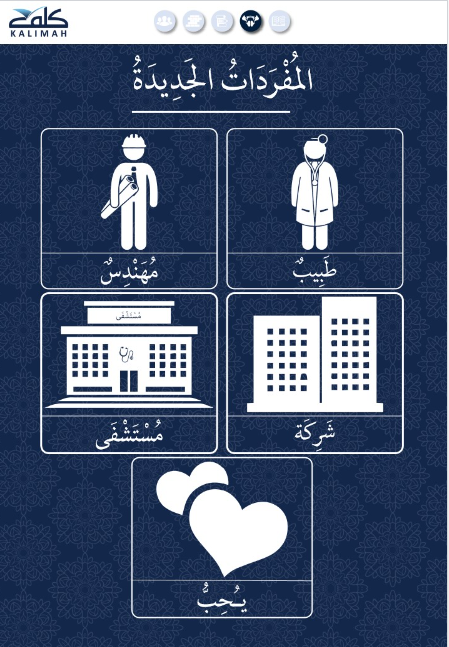
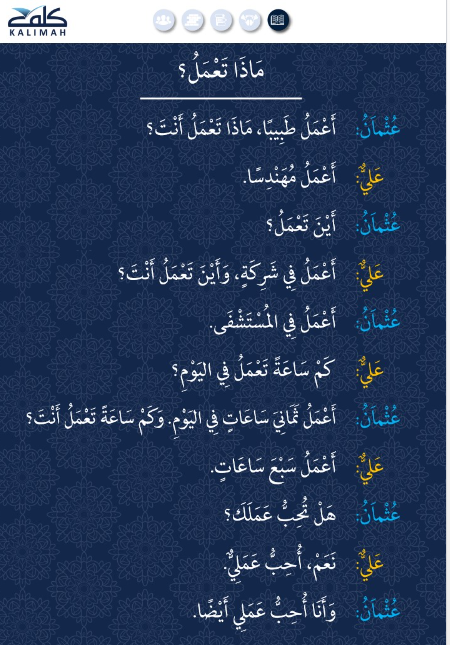
Read Also: Arabic Grammar
Fourth: Business Benefits of Learning Arabic
Learning Arabic opens doors to a vast and thriving market, as it is the official language of 22 countries and the 5th most spoken language globally. With millions of consumers and numerous emerging markets in the Middle East and North Africa, Arabic proficiency can significantly enhance business opportunities, foster stronger relationships with key stakeholders, and give your company a competitive edge in these regions.
1. Expanding Market Reach
For businesses, Arabic proficiency allows you to tap into the vast and lucrative markets of the Arab world. It helps in creating marketing materials, websites, and customer service channels tailored to Arabic-speaking customers.
2. Building Stronger Relationships
In business, relationships are crucial. Speaking Arabic enables you to build stronger, more personal connections with Arab clients and partners, fostering trust and long-term cooperation.
Example: Hosting an Arab delegation and impressing them with your ability to converse in Arabic during business meetings.
3. Understanding Business Etiquette
Arabic-speaking countries have unique business etiquettes. Knowing the language helps you navigate these cultural norms, ensuring successful and respectful interactions.
Example: Understanding the importance of greetings and respectful titles, such as addressing a business partner as “السيد” (al-Sayed – MR.) in formal meetings.
Fifth: Educational and Cognitive Benefits of Learning Arabic
The complex grammar and vocabulary of Arabic challenge learners, enhancing critical thinking, problem-solving skills, and memory retention. Moreover, studying Arabic improves cognitive flexibility, as individuals navigate different dialects and cultural nuances, ultimately boosting overall brain function and adaptability.
1. Cognitive Flexibility
Learning a new language like Arabic enhances cognitive flexibility, improving problem-solving skills, multitasking, and creativity.
2. Enhanced Memory
Studying Arabic, with its rich vocabulary and intricate script, boosts memory and cognitive function, keeping the brain sharp and active.
3. Improved Attention to Detail
Arabic’s unique script and grammar require careful attention to detail, honing your ability to notice and process information accurately.
Example: Differentiating between similar-looking letters like “ث” (tha) and “ت” (ta) improves your visual discrimination skills.
4. Cultural Awareness and Empathy
Learning Arabic fosters cultural awareness and empathy, allowing you to understand and appreciate diverse perspectives and experiences.
Example: Studying Arabic literature and poetry deepens your understanding of Arab culture, history, and values.
Is Arabic Worth Learning?
Yes — and the data supports it:
| Factor | Data Point |
|---|---|
| Native speakers | 400+ million — 5th most spoken language globally |
| Countries | 22 official countries — Middle East and North Africa |
| UN status | One of the 6 official UN languages |
| GDP of Arab world | Approximately $3.6 trillion |
| Job demand | US Bureau of Labor Statistics lists Arabic interpreters and translators among fastest-growing occupations |
| Quran readers | 1.8 billion Muslims worldwide — all have motivation to learn |
| FSI difficulty | Category IV — significant investment required |
| Payoff | Higher salary premium for Arabic speakers vs other language skills |
Who benefits most from learning Arabic:
- Muslims seeking to understand the Quran and Islamic scholarship
- Business professionals targeting the MENA region
- Diplomats, journalists, and NGO workers in the Middle East
- Academics in Islamic studies, Middle Eastern history, or linguistics
- Travellers to the Arab world wanting authentic experiences
The honest trade-off: Arabic requires approximately 2,200 hours to professional proficiency (FSI Category IV). It is one of the more challenging languages for English speakers. But for the specific audiences above, no other language investment produces equivalent returns in religious, cultural, or professional value.
Master Arabic with Kalimah Center
Join our expert-led online classes and start your journey toward Arabic fluency today.
Book Your Free TrialExperience Kalimah Center Classes
Watch real excerpts from our live sessions at Kalimah Center and see how we bring learning to life. These clips highlight our interactive, student-centered teaching approach across all our courses—designed to keep learners engaged, motivated, and actively involved every step of the way.
Here Are The Reviews On Our Courses:
Our students frequently commend the excellence of our courses and the commitment shown by our instructors. You can read their complete reviews on Trustpilot.
Read more reviews on Trustpilot

Live the Benefits of Learning Arabic with Kalimah!
Reading about the power of Arabic to transform your travel, faith, career, and even your mind is exciting… but are you ready to experience it?
Kalimah Center is your gateway to the rich tapestry of the Arabic language. Whether you’re drawn by the call to prayer, the allure of bustling souks, or the prospect of career advancement, our online courses will equip you with the skills you need to thrive.
Why Kalimah? Because we tailor your learning journey to your dreams:
- Tourism: Bargain like a native, find your way around easily, and make friends with the locals.
- Religion: Learn more about the Quran, have thoughtful conversations, and meet fellow Muslims from around the world.
- Job & Money: Discover well-paying jobs, make more money, and grow your network of contacts.
- Business: Make deals with confidence, build strong relationships with Arabic speakers, and find new customers.
- Learning & Thinking: Improve your memory, get better at solving problems, and learn about different cultures.
As the saying goes, “العلم نور” (Al-‘ilm nur), meaning “Knowledge is light.” Let the light of Arabic illuminate your path to a brighter future!
Click Here to explore our comprehensive Arabic courses

Conclusion:
Access to 1,400 years of scholarship. Access to the Quran in its original revelation. Access to careers in one of the world’s most economically significant regions. Access to the cultures, literatures, and people of 22 countries and 400 million speakers.
The 15 benefits in this article are not theoretical — they are experienced daily by Arabic learners who committed to the language and reached the milestones.
Your starting point:
| Your Primary Motivation | First Benefit You’ll Experience | Timeline |
|---|---|---|
| Quran understanding | Recognise common prayer phrases | Weeks |
| Travel | Navigate and communicate in Arab countries | 3–6 months |
| Career | List Arabic as a professional skill | 12–18 months |
| Business | Conduct basic business conversations | 12–24 months |
| Cognitive | Brain benefits begin immediately | From Day 1 |
The benefits are real. The path is structured. The first step is the same regardless of motivation: the Arabic alphabet.
FAQs about Benefits of Learning Arabic
Q1: What are the main benefits of learning Arabic?
Learning Arabic offers benefits across five categories: (1) Religious — direct comprehension of the Quran and Islamic texts in their original language. (2) Tourism — authentic cultural immersion in 22+ Arabic-speaking countries. (3) Career — high-demand translation, diplomatic, and business skills in the MENA region. (4) Business — access to Arab world markets representing approximately $3.6 trillion in GDP. (5) Cognitive — improved memory, critical thinking, and cultural empathy from learning a linguistically complex language.
Q2: How does learning Arabic benefit Muslims specifically?
For Muslims, Arabic is the language in which the Quran was revealed — meaning learning Arabic provides direct, unmediated access to the divine text without depending on translation. Specific religious benefits include: understanding prayer (salah) with full comprehension, engaging directly with Hadith and Tafsir literature, participating meaningfully in religious scholarship, and connecting with Muslims across the global ummah through a shared language. Many Islamic scholars consider learning Arabic an obligation (fard kifayah) for the Muslim community as a whole.
Q3: Is Arabic useful for career advancement?
Yes — Arabic is one of the highest-demand languages in several professional sectors. Arabic translators and interpreters are among the fastest-growing occupations according to the US Bureau of Labor Statistics. Specific career advantages include: positions in international diplomacy and government (Arabic is one of 6 UN official languages), roles in multinational companies operating in the Gulf states, journalism and media covering the Middle East and North Africa, and academic research in Islamic studies, Arabic literature, or regional history. Arabic-speaking professionals consistently command salary premiums over monolingual equivalents.
Q4: What are the cognitive benefits of learning Arabic?
Arabic’s linguistic complexity provides stronger cognitive benefits than simpler languages. Specifically: the right-to-left script develops attention to detail and visual discrimination. The root-based morphological system (one three-letter root → multiple related words) develops pattern recognition and analytical thinking. Managing Arabic’s grammatical case system (nominative, accusative, genitive) strengthens working memory. Research on bilingualism consistently shows delayed onset of cognitive decline in language learners — Arabic’s complexity provides stronger cognitive exercise than many other languages.
Q5: How long does it take to reach the point where Arabic benefits become tangible?
Religious benefits begin almost immediately — understanding the Fatiha (the opening Surah of the Quran) takes weeks, and recognising common prayer phrases develops within months. Travel benefits begin with 3–6 months of study — basic conversational Arabic transforms travel experiences. Career benefits require professional-level Arabic — typically 2–3 years of intensive study. Cognitive benefits are measurable from the beginning of language study — the brain responds to language learning challenges from day one. The timeline for meaningful benefit depends on which category matters most to you.