Teaching Arabic effectively requires matching method to learner: immersive instruction for full beginners, communicative approach for conversational goals, grammar-translation for analytical learners, and task-based learning for practical language use. For children, early introduction through play, songs, and labeling household items produces the strongest results. For online teaching, structured platforms, interactive tools, and consistent live sessions replace physical classroom immersion. Arabic is best taught in skill-specific stages: alphabet → vocabulary → basic grammar → conversation → advanced reading and writing.
Key Takeaway Table:
| Learner Type | Best Method | Primary Focus | Starting Point |
|---|---|---|---|
| Adults (formal goals) | Grammar-Translation + Communicative | MSA reading and writing | Alphabet → grammar rules |
| Adults (conversational goals) | Communicative + Immersive | Speaking and listening | Vocabulary → dialogues |
| Children (ages 4–8) | Play-based + Storytelling | Vocabulary and pronunciation | Songs, rhymes, labeling |
| Children (ages 8–14) | Task-based + Storytelling | Reading and conversation | Structured curriculum |
| Non-native beginners | Immersive + Communicative | All four skills equally | Alphabet → basic phrases |
| Online learners | Communicative + Technology-aided | Speaking and reading | Live sessions + apps |
As I stood before my new class of eager Arabic learners, I felt a wave of excitement. Teaching Arabic is not just about imparting knowledge; it’s about sharing a piece of my culture, my heritage, and my heart. I remember my first day as a student of Arabic, filled with curiosity and a bit of apprehension. Today, I strive to create a welcoming and immersive environment where students can thrive.
In this article, I will guide you through effective methods and techniques for teaching Arabic, sharing stories and insights from my experience as a native Arabic educator. Whether you are a teacher, a parent, or a self-learner, you will find valuable tips and strategies to help you on your journey.
How to Teach Arabic Language?
Teaching Arabic begins with understanding your learners. Whether you are teaching adults, teenagers, or children, it’s important to create a learning environment that is engaging, supportive, and interactive. Here’s how to start:
1. Understand Your Students’ Needs
Before you begin teaching, take the time to understand your students’ goals and backgrounds. Are they learning Arabic for business, travel, religious reasons, or personal interest? Do they have any prior knowledge of the language? This understanding will help you tailor your lessons to meet their specific needs.
2. Create a Comprehensive Curriculum
A well-structured curriculum is key to effective teaching. Here’s a suggested outline:
- Beginner Level:
- Introduction to Arabic Alphabet: Teach the Arabic letters, their sounds, and how to write them.
- Basic Vocabulary and Phrases: Focus on everyday words and simple sentences.
- Simple Grammar Rules: Introduce basic sentence structures and verb conjugations.
- Intermediate Level:
- Expanded Vocabulary: Include words related to different themes such as food, travel, and daily activities.
- Complex Sentences: Teach compound sentences and the use of conjunctions.
- Cultural Insights: Integrate cultural lessons to deepen their understanding.
- Advanced Level:
- Advanced Grammar: Teach complex grammatical structures and nuanced language uses.
- Fluent Conversation: Encourage conversations on various topics to build fluency.
- Literature and Media: Use Arabic literature, news, and media to enhance learning.
Sample Arabic Lesson Plan for Beginners (45 Minutes)
Level: Absolute Beginner (Week 3–4 — after basic alphabet is established)
Topic: Introducing Yourself in Arabic (التعارف)
Skills: Speaking, Listening, basic Reading
Learning Objectives:
By the end of this lesson, students will be able to:
- Introduce themselves in Arabic (name, country, profession)
- Ask and answer “What is your name?” and “Where are you from?”
- Read and recognize the key vocabulary words in Arabic script
| Time | Stage | Teacher Activity | Student Activity | Resources |
|---|---|---|---|---|
| 0–5 min | Warm-up | Greet students in Arabic: “صباح الخير، كيف حالكم؟” | Respond with phrases from previous lesson | — |
| 5–15 min | Presentation | Introduce vocabulary: اسم، بلد، مهنة + model introduction: “أنا [اسم]. أنا من [بلد]. أنا [مهنة].” | Listen, repeat, identify letters they recognize | Whiteboard, flashcards |
| 15–25 min | Controlled Practice | Drill: substitute name, country, profession | Students practice with their own information | Handout with sentence frames |
| 25–35 min | Free Practice | Set up pair dialogue: “ما اسمك؟” / “من أين أنت؟” | Students conduct introductions in pairs | Dialogue prompt card |
| 35–42 min | Reading | Show phrases written in Arabic script | Students identify words, practice reading aloud | Whiteboard |
| 42–45 min | Wrap-up | Error correction + preview of next lesson | Students write their own introduction sentence | Notebooks |
Homework: Record a 30-second Arabic introduction video; write your introduction in Arabic script.
Differentiation:
- For struggling students: Provide sentence frames with blanks to fill
- For advanced students: Add: age, family members, hobbies to introduction
Arabic Language Teaching Methods: Comparison of 5 Proven Approaches
Different methods can be employed to teach Arabic effectively. Here are some of the most successful approaches:
1. Immersive Method
Immerse students in the language by using Arabic as the primary language of instruction. This method helps students think in Arabic rather than translating from their native language.
For example, greet them with “صباح الخير” (Sabah al-khayr) meaning “Good morning,” and encourage them to respond in Arabic.
2. The Communicative Approach (CLT) for Arabic Teaching
The Communicative Language Teaching (CLT) approach shifts the focus from grammar rules to actual communication. The goal: students can express themselves and understand others in Arabic from the very first lesson.
How to implement CLT in an Arabic class:
| Stage | Activity | Duration | Example |
|---|---|---|---|
| Warm-up | Review previous vocabulary in context | 5 min | “من يتذكر كيف نقول ‘أريد’؟” |
| Input | Present new language through dialogue | 10 min | Teacher acts out ordering food in Arabic |
| Controlled practice | Students repeat and substitute | 10 min | “أريد ماء… أريد شاي… أريد قهوة” |
| Free practice | Students create their own dialogue | 15 min | Pair work: order food at a restaurant |
| Feedback | Address errors heard during free practice | 5 min | Teacher notes recurring errors, explains |
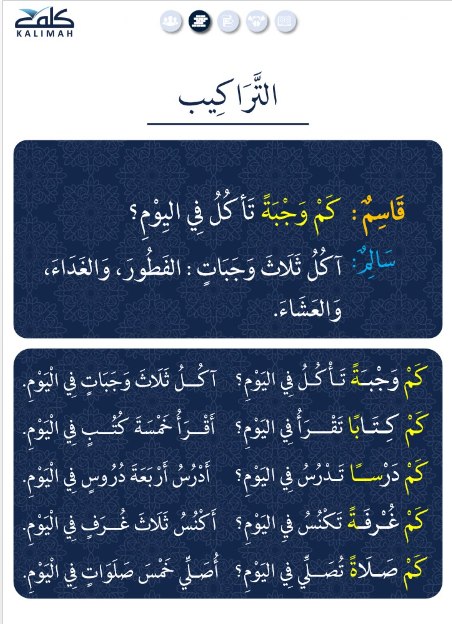
CLT principle for Arabic specifically: Arabic learners often over-rely on translation. CLT breaks this habit by making Arabic the language of the classroom from day one — instructions, questions, and praise all in Arabic. Even at beginner level, using Arabic for classroom management (“خذوا الكتاب” — take out your books, “كرروا” — repeat) accelerates immersion.
3. Grammar-Translation Method
While not as interactive, this traditional method helps students understand the grammatical rules of Arabic by translating sentences between Arabic and their native language. It’s useful for explaining complex grammar points.
4. Task-Based Learning
Create tasks that require the use of Arabic to complete. These tasks can range from writing a short essay on a given topic to participating in a debate. This method encourages active use of the language and helps students apply what they have learned in practical contexts.
No single method works for every Arabic learner. Understanding the strengths and limitations of each approach helps teachers and parents choose the right strategy:
| Method | Core Principle | Best For | Strengths | Limitations |
|---|---|---|---|---|
| Immersive Method | Arabic-only instruction from day one | Young children, intensive programs | Fastest path to natural thinking in Arabic | Can frustrate absolute beginners without support |
| Communicative Approach (CLT) | Focus on real communication over grammar rules | Adults and teens with conversational goals | Builds speaking confidence quickly | May produce grammatically imprecise speakers |
| Grammar-Translation | Explicit grammar rules + translation | Academic learners, Quran study, reading goals | Strong grammatical foundation, good for reading | Slow speaking development, passive learning |
| Task-Based Learning (TBL) | Complete real-world tasks using Arabic | Intermediate learners, practical goals | Motivating, practical language use | Requires more teacher preparation |
| Storytelling/Narrative | Language embedded in meaningful stories | Children of all ages, vocabulary building | Strong retention, cultural connection | Less structured grammar progression |
Which Method Is Best for Arabic Specifically?
Most experienced Arabic teachers use a blended approach — not one method exclusively:
- Start with structured phonics (alphabet and sounds) — Arabic’s unique script requires explicit instruction
- Add communicative elements from week 2 — even basic greetings and classroom phrases build confidence
- Integrate grammar explanation at intermediate level — Arabic’s case system (I’rab) is complex enough to require explicit teaching
- Use storytelling throughout — for vocabulary retention and cultural context at all levels
The Arabic-specific consideration: Unlike languages with Latin scripts, Arabic requires an explicit alphabet phase (typically 4–8 weeks) before any reading-based method can work. This alphabet phase is uniquely important and should not be rushed.
Experience Kalimah Center Classes
Watch real excerpts from our live sessions at Kalimah Center and see how we bring learning to life. These clips highlight our interactive, student-centered teaching approach across all our courses—designed to keep learners engaged, motivated, and actively involved every step of the way.
Master Arabic with Kalimah Center
Join our expert-led online classes and start your journey toward Arabic fluency today.
Book Your Free TrialSpecific Arabic Teaching Techniques: Storytelling, Technology, and Cultural Immersion
Here are some specific techniques that can enhance the teaching and learning experience:
1. Storytelling as an Arabic Teaching Technique
Storytelling is one of the most evidence-backed techniques for language acquisition — it provides vocabulary in meaningful context, exposes learners to natural sentence structures, and creates emotional engagement that strengthens memory.
A practical Arabic storytelling lesson framework:
Step 1 — Pre-story vocabulary (5 minutes)
Introduce 5–8 key vocabulary words from the story with visuals before reading. Example for a food story: teach طعام (food), جائع (hungry), مطبخ (kitchen), أكل (ate).
Step 2 — First reading (with pictures or acting)
Read the story aloud in Arabic while showing pictures or acting out key moments. Students listen for comprehension, not translation.
Step 3 — Comprehension questions in Arabic
Ask simple questions: “من هو البطل؟” (Who is the hero?), “ماذا فعل؟” (What did he do?)
Step 4 — Retelling
Students retell the story in their own words — even with simple vocabulary, this builds productive language use.
Step 5 — Language focus
Highlight one grammar point from the story (e.g., verb conjugation pattern that appeared repeatedly).
Recommended Arabic stories by level:
| Level | Story Type | Example |
|---|---|---|
| Beginner | Simple repetitive structure, familiar vocabulary | الأرنب والسلحفاة (The Tortoise and the Hare in Arabic) |
| Elementary | Short folk tales, 1-2 characters | قصص جحا (Juha stories — Arab folk tales) |
| Intermediate | Graded readers, simple modern stories | Arabic graded reader series |
| Advanced | Classical literature, adapted texts | ألف ليلة وليلة (selected excerpts) |
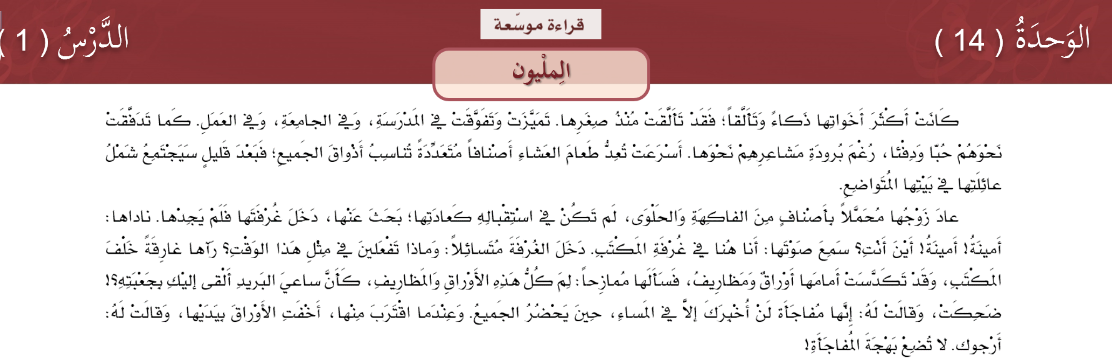
2. Interactive Technology
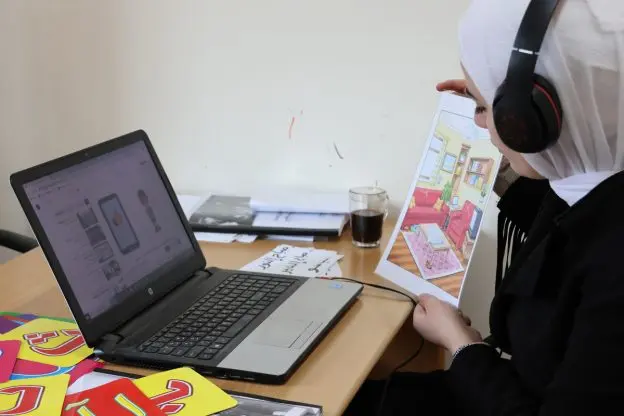
Incorporating technology into lessons can make learning more engaging. Language learning apps, online quizzes, and interactive whiteboards provide dynamic ways to practice and reinforce language skills.
3. Cultural Immersion
Teaching language is inseparable from teaching culture. Introducing students to Arabic arts, cuisine, and customs enriches their learning experience and deepens their understanding of the language’s context.
4. Visual Aids
Visual aids such as flashcards, pictures, and videos can help students understand and remember new vocabulary. For example, show a picture of a “كتاب” (kitab) meaning “book” while saying the word.
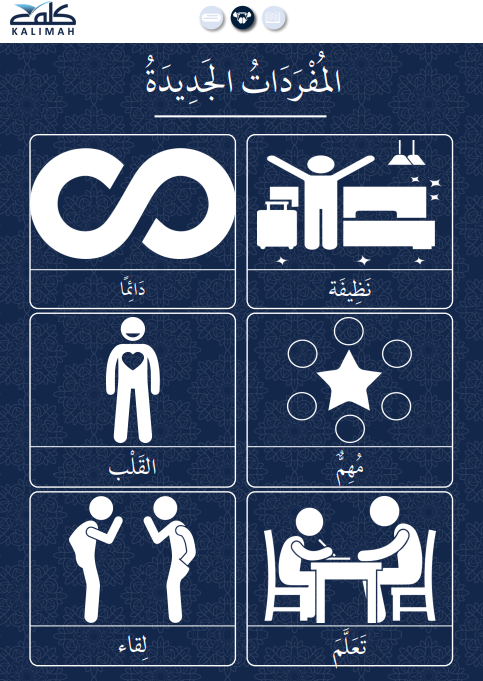
That’s why Kalimah effectively uses visual aids, to enhance language acquisition. The image showcases our approach, incorporating symbols and illustrations to represent new vocabulary:
- Visual Representation of Abstract Concepts: The infinity symbol creatively represents the word “always” (دائمًا).
- Action-Oriented Illustrations: The image for “cleaning” (نظيفة) depicts a person actively tidying a room.
- Symbolic Learning: The heart symbol for “heart” (القلب) and the star for “meeting” (لقاء) provide memorable visual cues.
- Contextual Visuals: The image for “learning” (تعلّم) illustrates two individuals engaged in a learning setting.
This visual approach aligns with Kalimah’s commitment to providing engaging and effective learning experiences, helping students grasp concepts more easily.
How to Teach Arabic Online: Complete Guide for Online Arabic Teachers
Teaching Arabic online presents unique challenges and opportunities compared to in-person instruction. Here is a practical framework for effective online Arabic teaching:
Essential Online Arabic Teaching Setup
| Element | Recommendation | Why It Matters |
|---|---|---|
| Platform | Zoom + Google Jamboard, or dedicated platforms like Preply/iTalki | Screen-sharing whiteboard essential for Arabic script |
| Camera | Positioned to show your face clearly | Pronunciation guidance requires students to see your mouth |
| Lighting | Front-lit, no backlighting | Students must clearly see facial expressions and lip movement |
| Whiteboard | Digital whiteboard or physical behind you | Writing Arabic script live is more effective than slides |
| Microphone | External or dedicated headset | Arabic pronunciation details are lost in poor audio |
The 5 Keys to Effective Online Arabic Instruction
1. Arabic script on screen
Use large, clearly visible Arabic text. Arabic letters at small sizes on screen become illegible. Minimum 24pt font for display text; 36pt+ for letter-by-letter instruction.
2. Speaking practice despite screen barrier
The biggest challenge online is that students speak less. Counter this with: daily 2-minute voice message exercises between sessions, using WhatsApp or a platform message feature. Assign students to record themselves reading one paragraph and send it for feedback.
3. Structured session format
Online attention spans are shorter. A 45-minute online Arabic session should include:
- Minutes 0–5: Review from last session (oral Q&A)
- Minutes 5–20: New content with interactive whiteboard
- Minutes 20–35: Student practice and speaking activities
- Minutes 35–45: Writing practice + preview of next session
4. Digital tools integration
- Wordwall.net — create custom Arabic vocabulary games (matching, word search, fill-in-the-blank)
- Kahoot — vocabulary and grammar quizzes for engagement
- Padlet — students post Arabic sentences for class review
- Flipgrid — students record Arabic speech for teacher and peer feedback
5. Building the immersion environment digitally
Since students can’t be in an Arabic environment at home, assign daily environmental Arabic: change their phone language to Arabic, follow Arabic social media accounts, listen to Arabic music during commute. Report back each session on what they encountered.
How to Start Teaching Arabic Online: A Step-by-Step Guide
- Define your target student — children, adults, Quran focus, conversational, academic?
- Choose your platform — Kalimah Center, Preply, iTalki, Superprof, or independent website
- Prepare a structured curriculum with clearly defined level progression
- Create a sample lesson to demonstrate your teaching style (for marketing purposes)
- Set up your technical environment — quality camera, microphone, lighting, digital whiteboard
- Start with trial sessions — most platforms allow free or discounted first sessions
- Gather and display student feedback — reviews are essential for online teacher credibility
AI Tools and Technology for Teaching Arabic
Artificial intelligence is transforming Arabic language teaching in 2026. Here are the most valuable tools for Arabic teachers and learners:
AI Pronunciation and Speaking Tools
| Tool | What It Does | Best For |
|---|---|---|
| Speechling | Records student Arabic speech, provides native speaker feedback | Pronunciation correction at scale |
| ELSA Speak | AI pronunciation feedback (limited Arabic support) | Supplementary speaking practice |
| ChatGPT (Arabic mode) | Generates practice dialogues, explains grammar, creates exercises | Teacher preparation, student self-study |
Interactive Classroom Technology
| Tool | What It Does | Best For |
|---|---|---|
| Wordwall | Create custom Arabic vocabulary games instantly | Vocabulary reinforcement, student engagement |
| Kahoot | Arabic vocabulary and grammar quizzes | Competitive review sessions |
| Quizlet | Arabic flashcard sets with audio | Vocabulary memorization |
| Jamboard / Miro | Digital collaborative whiteboard | Live Arabic writing practice |
Content and Media Resources
| Resource | Content Type | Level |
|---|---|---|
| Al Jazeera Arabic | Authentic MSA news broadcasts | Intermediate–Advanced |
| Almaany.com | Comprehensive Arabic dictionary | All levels |
| Forvo Arabic | Native speaker pronunciation database | Beginner–Intermediate |
| Madrasa.com | Structured Arabic curriculum | Beginner–Intermediate |
Honest Assessment: What AI Cannot Replace
AI tools are valuable supplements but cannot replace:
- Real-time pronunciation correction from a native speaker who understands your specific errors
- Cultural context that a teacher naturally integrates into every lesson
- Motivational accountability — the human relationship between teacher and student
- Adaptive pacing — a skilled teacher adjusts the lesson mid-session based on student comprehension signals that AI cannot yet reliably read
Use AI tools to scale your teaching impact and give students more practice opportunities — not to replace the fundamental value of live instruction.
How Parents Can Teach Arabic at Home: Practical Strategies by Age Group
As a teacher, I often say that parents are the first and most important teachers a child will ever have. This is especially true when it comes to language. The home is where the seeds of language are planted, nurtured, and begin to bloom. So, how can you cultivate a love for Arabic in your children’s hearts?
1. Start Early
Introduce Arabic to your children at a young age. Children have a natural ability to absorb languages, and starting early can give them a head start.
2. The Power of Play
Children learn best through play. Make learning Arabic fun and engaging:
- Sing Arabic Nursery Rhymes: Melodies like “أنشودة الحروف الأبجدية” (The Alphabet Chant) are not just catchy tunes; they’re rhythmic introductions to vocabulary and sentence structure.
- Tell Stories: Share tales from “الذئب والخراف السبعة” (The Story of the Wolf and the Seven Sheep), or create your own stories with Arabic characters and settings.
- Play Arabic Games: Simple games like (I Spy), but using Arabic colors or objects, can make vocabulary stick.
3. Create a Bilingual Environment
If possible, create an environment where Arabic is spoken regularly. Label household items in Arabic, watch Arabic cartoons for kids, and read Arabic books together. Sprinkle Arabic into your daily routines:
- Labeling: Put Arabic labels on household items. A refrigerator becomes a “ثلاجة” (thallaaja), a chair a “كرسي” (kursi).
- Mealtime Conversations: Ask “هل تريد المزيد؟” (hal tureed al mazid? – Do you want more?), or teach them to say “شكرًا” (shukran – thank you).
- Bedtime Rituals: Read Arabic bedtime stories or recite a simple prayer like “الحمد لله” (alhamdulillah – praise be to God) before sleep.
4. Beyond Words: The Cultural Connection
Language is more than just words; it’s a gateway to a whole culture.
Decorate for Eid, try traditional recipes like “كشري” (Kushari), or watch Arabic cartoons together.
And learn about Arab countries, their history, and their contributions to the world.
If you have Arabic-speaking relatives, encourage your children to converse with them, even if it’s just a few words at a time.
A Note to Non-Arabic Speaking Parents
Don’t worry if you’re not fluent in Arabic yourself. The most important thing is to show your child that you value the language and are willing to learn alongside them. There are many resources available to help you, from online courses for kids to language exchange partners.
Teaching Arabic is a gift you give your child, a connection to their heritage, and a passport to a world of opportunities. It’s a journey filled with joy, laughter, and the thrill of discovery. And remember, as the Arabic proverb says, “الصبر مفتاح الفرج” (Patience is the key to relief).
بالتوفيق! (Bil tawfiq!) – With success!
Master Arabic with Kalimah Center
Join our expert-led online classes and start your journey toward Arabic fluency today.
Book Your Free TrialInside Kalimah Center: Moments from Our Courses
Get a glimpse into the vibrant learning experience at Kalimah Center. These snapshots capture real moments from our live classes—where students engage deeply, connect with passionate instructors, and grow in a welcoming, supportive environment.
Here Are The Reviews On Our Courses:
Our students frequently commend the excellence of our courses and the commitment shown by our instructors. You can read their complete reviews on Trustpilot.

Inspired to Empower the Next Generation of Arabic Speakers? Kalimah Center Has Your Back!
You’ve just explored the art and science of teaching Arabic. Now, let’s turn theory into action! Whether you’re a parent seeking to nurture your child’s linguistic heritage or an educator shaping young minds, Kalimah Center‘s specialized online Arabic courses are designed to amplify your impact.
Why Kalimah? Because we go beyond methods – we ignite passion:
- Kids’ Courses: Our vibrant, interactive courses captivate young learners with illustrations, stories, and age-appropriate activities. We make Arabic fun!
- Adult Courses: From beginners to advanced, our structured curriculum builds confidence and fluency.
- Proven Framework: Our courses seamlessly integrate the latest research in language acquisition with culturally relevant content, ensuring a holistic learning experience.
Don’t let your passion for Arabic fade away!
Take the next step and explore Kalimah Center’s comprehensive online Arabic courses for kids and adults.
Conclusion:
Teaching Arabic is a journey that blends culture, heritage, and language. Start by understanding your students’ backgrounds and tailoring lessons to their needs. Craft a curriculum that progresses from the basics of the Arabic alphabet to advanced grammar and conversation.
Use immersive methods, communicative activities, and task-based learning to engage students. Techniques like storytelling, interactive tech, and cultural immersion make learning vibrant and memorable.
For parents, introduce Arabic early through playful activities and create a bilingual environment at home. Embrace the cultural richness of Arabic to deepen your child’s connection to the language. And remember, teaching Arabic is not just about language—it’s about sharing a piece of your world.
FAQs about How to Teach Arabic Language?
Q1: What is the best method for teaching Arabic to beginners?
The most effective method for teaching Arabic to beginners combines two approaches: (1) Phonics-based alphabet instruction — teaching letter sounds before letter names, then connecting letters into words before building sentences; (2) Communicative introduction — immediately using simple, high-frequency phrases from day one so learners experience the language as communication, not just memorization. For young children, add play-based and song-based elements. For adults, explicit grammar explanation accelerates progress significantly. The key principle for all beginners: correct pronunciation habits must be built from the first lesson — bad pronunciation habits are extremely difficult to correct later.
Q2: How do you teach Arabic online effectively?
Teaching Arabic online effectively requires five elements: (1) Live interaction — pre-recorded videos alone produce poor speaking results; live sessions with a teacher are essential; (2) Interactive platform — tools like Zoom with virtual whiteboard, Google Jamboard, or dedicated language platforms allow real-time writing practice; (3) Daily touchpoints — even 5-minute voice message exercises between sessions dramatically accelerate progress; (4) Speaking from session one — online learners are more shy than in-person students; build an encouraging environment for mistakes early; (5) Visual materials — Arabic script on screen requires larger fonts and careful whiteboard organization for readability.
Q3: How do you teach Arabic to non-native English speakers?
Teaching Arabic to non-native English speakers requires adapting your explanation language first. Key adjustments: (1) Use simple English (or the learner’s native language where possible) to explain grammatical concepts; (2) Connect Arabic sounds to sounds in the learner’s native language — a Spanish speaker can relate ج to their “y” in “yema,” a French speaker can relate غ to their uvular “r”; (3) Be aware of false friends — Arabic sounds that seem similar to the learner’s language but are actually different (ص and “s,” for example); (4) Use visual phoneme charts rather than relying on English phonetic descriptions; (5) Leverage the learner’s existing language learning experience — anyone who successfully learned English as a non-native has transferable study strategies.
Q4: What AI tools are useful for teaching Arabic?
Several AI and technology tools have demonstrated value for Arabic language teachers: Speechling — AI-powered Arabic pronunciation feedback; Kalimah Center’s interactive curriculum — structured digital exercises with native teacher feedback; Anki with Arabic decks — spaced repetition vocabulary learning; Al Jazeera’s Arabic Learning — authentic MSA content with graded difficulty; Duolingo — useful only for supplementary vocabulary practice (not sufficient as a primary resource); ChatGPT — useful for generating practice exercises, example sentences, and grammar explanations (teachers should verify Arabic accuracy); Wordwall — customizable interactive games for vocabulary and grammar practice. None of these replace live native instruction — they function best as supplements.
Q5: How long should an Arabic lesson be for beginners?
Optimal lesson duration varies by age and level: Young children (ages 4–7): 15–25 minutes maximum — attention spans are short; multiple short daily sessions outperform one long weekly session. Older children (ages 8–13): 30–45 minutes with built-in activity changes every 10–15 minutes. Adults (beginners): 45–60 minutes, structured as: 10 min review → 20 min new content → 15 min practice → 5 min preview of next lesson. Online sessions should be 10–15 minutes shorter than equivalent in-person sessions — screen fatigue accelerates for language learners. Frequency matters more than duration: 3 sessions of 30 minutes per week produces better retention than 1 session of 90 minutes.