| Key Takeaways |
| Arabic builds nearly every word from a three-letter root, so learning one root unlocks dozens of related words at once. |
| Classical lexicographers recorded 400 names for the lion and 255 for the camel, each carrying a distinct shade of meaning. |
| The Arabic Quran contains 77,429 words while its English translation runs to 158,962, showing how compactly Arabic carries meaning. |
| Arabic became the sixth official language of the United Nations on 18 December 1973, now marked each year as World Arabic Language Day. |
The beauty of the Arabic language is not a sentimental claim made by its own speakers. It is a structural fact, visible in how Arabic builds words, how it compresses meaning, and how it turns writing into art.
Roughly 400 million people speak Arabic today, and more than a billion Muslims encounter it in prayer. Yet many learners meet the language only as a set of unfamiliar letters, never seeing the architecture underneath those letters.
What follows examines that architecture piece by piece: the root system, the depth of vocabulary, the words that hold opposite meanings, the script, the poetic heritage, and the position Arabic holds in the world right now.
Is Arabic a Beautiful Language?
Yes, Arabic is widely regarded as one of the most beautiful languages in the world, and the judgement comes as often from outsiders as from native speakers. Its phonetic range, visual script, and literary record all contribute.
The German scholar Sigrid Hunke, writing about Arab influence on Europe, asked how anyone could resist a language with such sound logic and charm. Her point was about structure, not decoration.
Beauty in a language is measurable in three places: how it sounds, how it looks, and how much it can say in how little space. Arabic performs unusually well in all three, and the sections below show why.
Nine Features Behind the Beauty of Arabic
Before examining each feature in depth, it helps to see them together. The table below summarises the nine qualities that linguists most often name when they describe what makes Arabic distinctive among world languages.
| Feature | What It Means | Example |
| Root system | Words derive from three-letter roots | k-t-b yields kitab, katib, maktaba |
| Synonym depth | Many words, each with a fine distinction | asad, layth, ghadanfar for lion |
| Precision | Specific words for specific states | maghtoom means hungry on a hot day |
| Opposites | One word carrying two contrary senses | jalal means momentous and trivial |
| Phonetics | Sounds absent from most languages | the letters dad, ayn, and qaf |
| Script | Cursive forms that allow calligraphic art | Bismillah written in Thuluth |
| Compression | Maximum meaning in minimum words | 77,429 Quranic words against 158,962 in English |
| Case endings | Irab marks each word’s grammatical role | kitabu, kitaba, kitabi |
| Adaptability | Absorbs modern terms without breaking | tilfaz for television |
Each row above represents a different kind of beauty. Some are structural, some are acoustic, and some are visual. The rest of this article takes them in turn.
Arabic Root System and How Words Derive
Arabic organises its entire vocabulary around consonantal roots, usually three letters long, each carrying a core idea. Every word built on that root inherits a trace of the original meaning, which makes the language remarkably systematic.
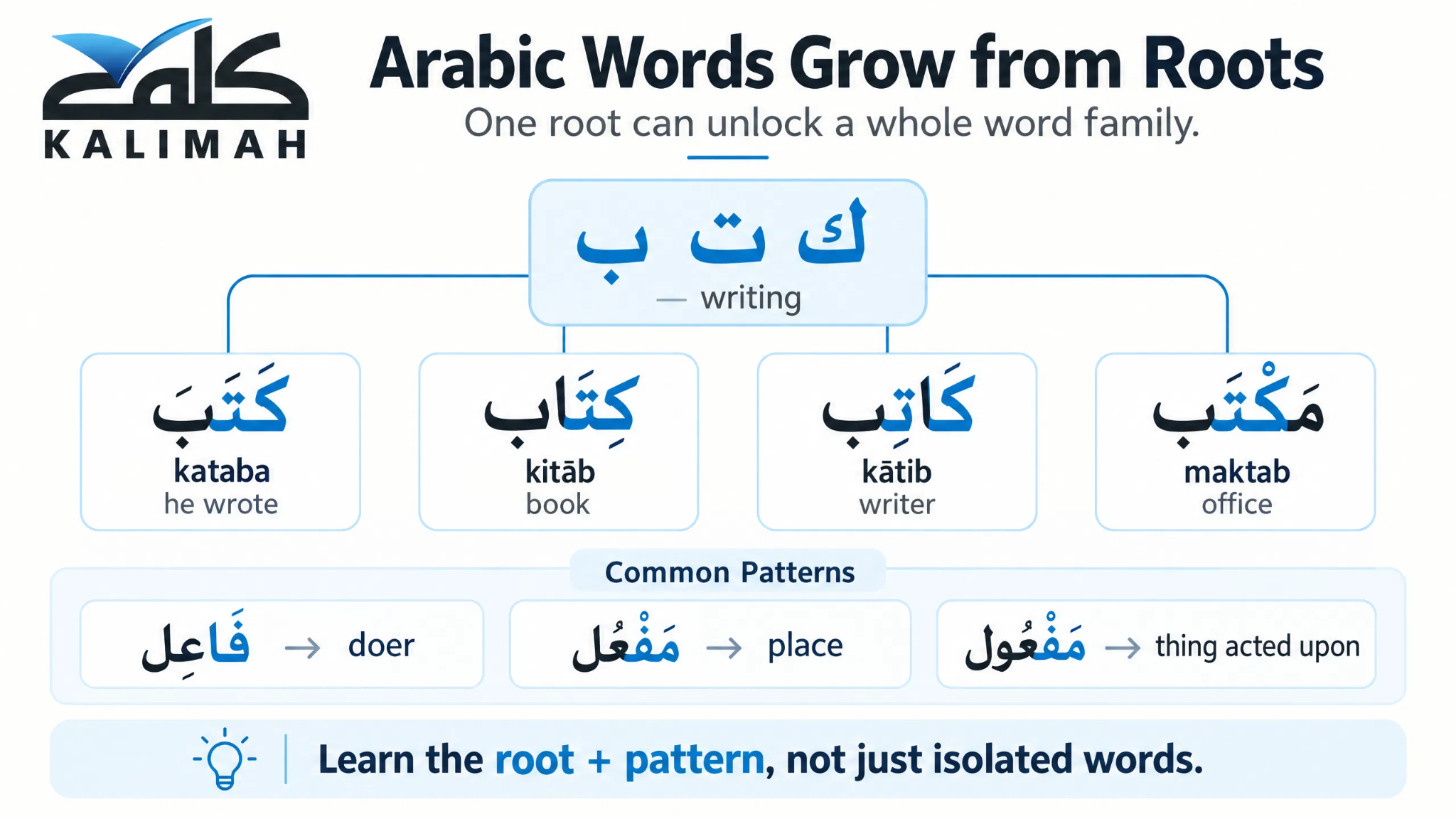
Take the root k-t-b, which carries the sense of writing. From it come kataba meaning he wrote, kitab meaning book, katib meaning writer, maktab meaning office, and maktaba meaning library or bookshop.
Patterns Make New Words Predictable
Roots are combined with fixed patterns, and each pattern carries its own function. Once a learner recognises the pattern, the meaning of an unfamiliar word often becomes obvious without a dictionary.
| Pattern | Function | Examples |
| fa’ala | Past tense verb | kataba, qara’a, dhahaba |
| maf’al | Place where the action happens | maktab, masjid, majlis |
| fa’il | The one who performs the action | katib, qari, hakim |
| maf’ool | The thing acted upon | maktoob, maqrooʼ, mafhoom |
One Root Opens Dozens of Words
This is why Arabic vocabulary grows faster than learners expect. Memorising a single root gives access to a whole family of related terms, rather than one isolated item.
Learners who grasp this early tend to progress far more quickly than those who treat each word as separate. The root system turns vocabulary from memorisation into pattern recognition.
Kalimah Center offers an Online Arabic Course that teaches the root system across sixteen structured levels, with native instructors correcting pronunciation live in one-on-one sessions.
Vast Vocabulary and the Precision of Synonyms
Arabic vocabulary is unusually large, and its synonyms are rarely interchangeable. Each one encodes a condition, a quality, or a circumstance that the others do not, which gives writers extraordinary control over meaning.
Al-Zubaidi, the fourth-century lexicographer, counted the words Arabs used for single concepts. His figures are still cited today because no later survey has matched their scope.
| Concept | Recorded number of names |
| Lion | 400 |
| Sword | 300 |
| Camel | 255 |
| Water | 170 |
| Rain | 70 |
| Snake | 200 (Ibn Khalawayh) |
| Honey | 70 (Al-Firuzabadi) |
Each Synonym Encodes a Condition
The distinctions are not stylistic. They are informational. A speaker choosing one word over another is specifying circumstances that English would need a full clause to express.
A hungry person is jaa’i, but someone hungry during intense heat is maghtoom. A thirsty person is atshan, while someone thirsty specifically for milk is ayman.
Precision Lets Arabic Say More in Fewer Words
That density explains a striking statistic. The Arabic text of the Quran contains 77,429 words, while the Saheeh International English translation of the same text runs to 158,962 words.
English needs roughly twice the material to carry the same content. This compression is one of the clearest arguments for the beauty of the Arabic language as a working instrument, not an ornament.
See Us in Action
Curious about what our online classrooms look like? Watch the short clips below to see how our interactive, one-on-one sessions bring learning to life with real-time feedback and engaging teaching methods.
Master Arabic with Kalimah Center
Join our expert-led online classes and start your journey toward Arabic fluency today.
Book Your Free TrialWords That Carry Two Opposite Meanings
Arabic contains a category of words known as addad, where a single term holds two contrary senses at once. Context alone decides which sense applies, and classical poetry supplies the evidence.
This is not ambiguity or defect. It is a feature that allows a single word to operate on two levels simultaneously, something translators consistently struggle to reproduce.
| Word | One sense | Opposite sense |
| waraa | behind | in front of |
| sareem | night | morning |
| joon | black | white |
| tarab | joy | grief |
| jalal | momentous | trivial |
The Quran Uses Waraa in Both Directions
The clearest illustration appears in Surah Al-Insan, where the word waraa describes the Day of Judgement in relation to those who ignore it.
إِنَّ هَٰؤُلَاءِ يُحِبُّونَ الْعَاجِلَةَ وَيَذَرُونَ وَرَاءَهُمْ يَوْمًا ثَقِيلًا
(Inna haa’ulaa’i yuhibboona al-‘aajilata wa yazaroona waraa’ahum yawman thaqeelan)
(“Indeed, these people love the immediate and leave behind them a grave Day.”)
Context Resolves Every Apparent Contradiction
Most English translations render waraa as behind, yet many classical commentators read it here as ahead, since the Day of Judgement lies in the future, not the past.
The poet Labid used waraa in exactly this forward-facing sense when describing the old age waiting ahead of him. Arabic readers resolve such cases instinctively through surrounding context.
Elegant Script and the Art of Calligraphy
Arabic script is cursive by nature, with letters changing shape depending on whether they sit at the start, middle, or end of a word. That flexibility is what makes calligraphy possible.
No other writing system has produced a comparable body of visual art from letters alone. Arabic calligraphy, al-khatt al-arabi, developed into dozens of recognised styles with their own rules and masters.
Major Calligraphic Styles and Their Uses
| Style | Character | Typical use |
| Kufi | Angular and geometric | Early Quran copies, architecture |
| Naskh | Clear and legible | Printed Quran text, books |
| Thuluth | Large, curved, ornamental | Mosque inscriptions, titles |
| Diwani | Dense and flowing | Ottoman official documents |
| Ruqah | Simple and quick | Everyday handwriting |
Letters Themselves Carry Visual Logic
Learners who study the Arabic alphabet properly notice early that letters are grouped by shared skeletons, distinguished only by the number and position of dots.
Baa, taa, and thaa share one body with one, two, and three dots. That economy of design is exactly what gives calligraphers room to stretch, compress, and layer the forms.
Poetic Heritage and the Language of Revelation
Arabic poetry predates Islam by centuries, and pre-Islamic Arabia treated eloquence as its highest social currency. In a largely oral society, poetry carried news, preserved lineage, and settled reputations.
A single line from a respected poet could elevate a tribe or destroy its standing. That competitive pressure pushed the language toward extreme precision long before it was ever written down systematically.
Eloquence Was Measured by Compression
Arabs judged fluency by how much meaning a speaker packed into how few words. Ahmad Shawqi, known as the Prince of Poets, captured the same idea when he wrote that the One who gave every language its charm chose Arabic to be beauty itself.
The Egyptian writer Abbas Mahmoud al-Aqqad devoted a book, The Poetic Language, to arguing that Arabic is phonetically unique, containing sounds that exist in no other tongue.
Revelation Raised the Standard Further
The Quran arrived among people who were already masters of the language, and it challenged them to produce a single comparable chapter. Surah Al-Kawthar runs to roughly ten words, and the challenge still stands unanswered.
Those who want to trace how the language reached that level can read more about the origin and history of the Arabic language and the stages it passed through before revelation.
Global Standing of Arabic Today
Arabic holds official status in more than twenty countries and functions as a liturgical language for over a billion Muslims worldwide. Its reach is both geographic and devotional.
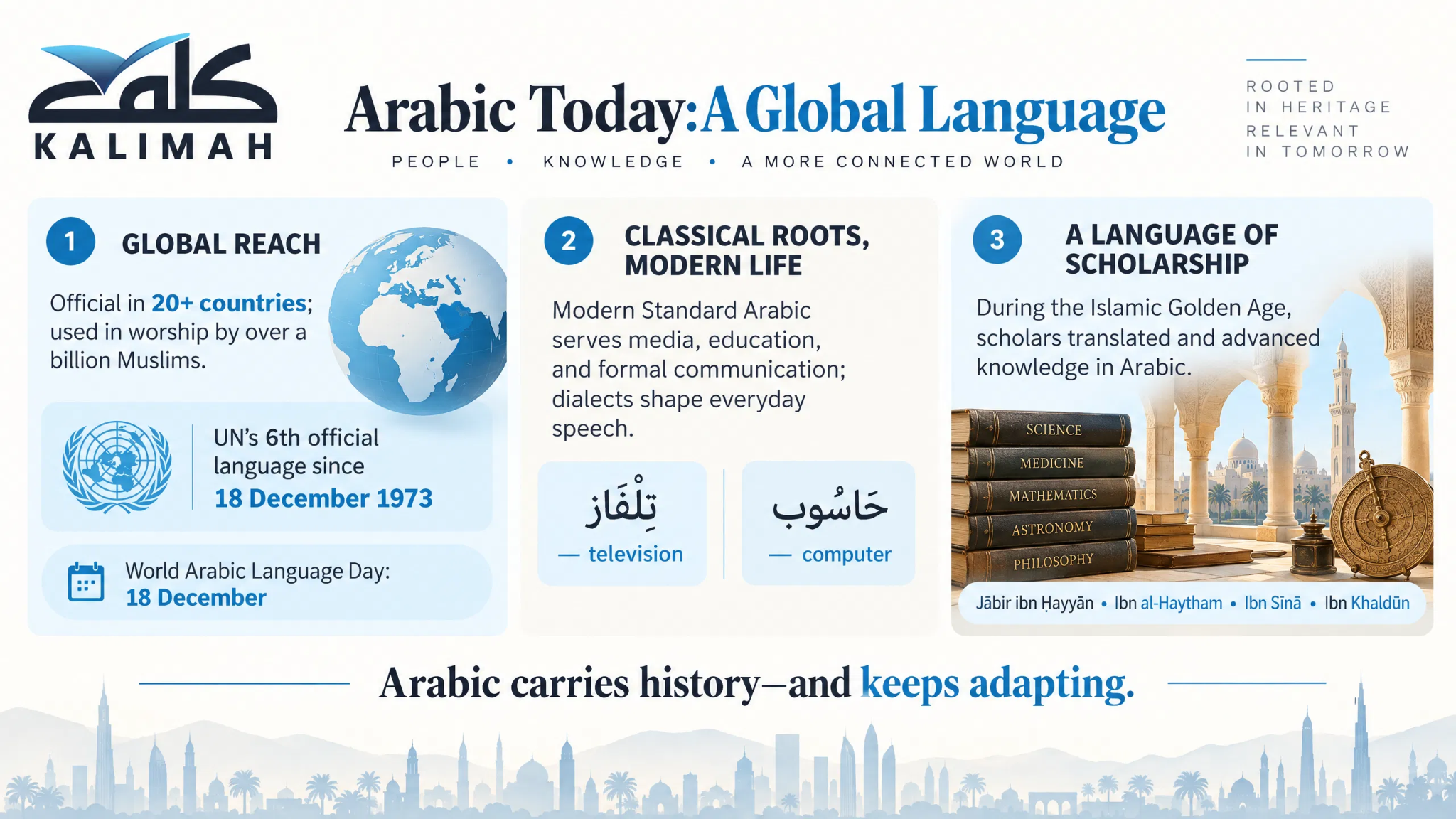
On 18 December 1973, the United Nations General Assembly approved Arabic as its sixth official language. That date is now observed annually as World Arabic Language Day.
Classical Roots With Modern Flexibility
Modern Standard Arabic serves media, education, and formal communication across the Arab world, while regional dialects handle daily speech. The two coexist without the classical form losing ground.
The language also absorbs new terminology without distorting its structure. Tilfaz for television and hasoob for computer were built from existing roots rather than borrowed wholesale.
Knowledge Transfer Shaped World Civilisation
During the Islamic Golden Age, Arabic became the working language of science. Scholars translated Greek, Persian, and Indian works into Arabic, then expanded on them substantially.
Jabir ibn Hayyan in chemistry, Ibn al-Haytham in optics, Ibn Sina in medicine, and Ibn Khaldun in historiography all wrote in Arabic. The Belgian-American historian George Sarton praised the language for a flexibility that let it express subtle ideas with precision.
Inside Our Virtual Classrooms
We believe in full transparency and proven quality. Take a look at these actual snippets from our live classes to experience our modern learning platform, patient instructors, and interactive student participation.
Master Arabic with Kalimah Center
Join our expert-led online classes and start your journey toward Arabic fluency today.
Book Your Free TrialStart Learning Arabic With Kalimah Center Expert Teachers
Reading about Arabic beauty and experiencing it are different things. The root system, the synonyms, and the script only become real once a qualified teacher walks you through them in live practice.
Kalimah Center runs one-on-one and small-group sessions with native Arabic and Quran instructors, flexible scheduling across time zones, and structured levels that take complete beginners through to advanced fluency.
What sets Kalimah Center apart:
- Native instructors who correct articulation in real time during every session.
- Sixteen structured Arabic levels and thirteen Quran levels with clear progression criteria.
- Separate tracks for adults, children, and sisters who prefer female teachers.
Our Arabic and Quran Courses
- Online Arabic Course
- Online Quran Course With Tajweed
- Arabic Classes for Kids
- Arabic Group Classes
- Arabic Classes With Female Teachers
- All Kalimah Center Courses
Conclusion
The beauty of the Arabic language rests on structure rather than sentiment. Its root system, its calibrated synonyms, and its capacity to compress meaning all serve communication before they serve aesthetics.
What scholars from Sigrid Hunke to George Sarton noticed was the same thing learners notice eventually. Arabic is built with an internal logic that rewards study, and the reward compounds the deeper you go.
Nothing here requires talent or an unusual ear. It requires a correct starting point, a consistent routine, and a teacher who can hear what you cannot yet hear yourself.
FAQs
Why Is the Arabic Language So Beautiful?
Arabic is beautiful because of its three-letter root system, its vast calibrated vocabulary, its cursive script that supports calligraphy, and its ability to compress meaning. These are structural features, not decorative ones.
What Are the Top 3 Most Attractive Languages?
Arabic, French, and Italian appear most often at the top of such rankings. Arabic earns its place through phonetic range and calligraphic script, while French and Italian are usually cited for melodic rhythm and vowel-rich flow.
What Is Harder, English or Arabic?
Arabic is harder for English speakers, mainly because of its script, root-and-pattern morphology, and unfamiliar sounds such as ayn and dad. English is harder in spelling consistency and phrasal verbs, but its alphabet is simpler.
How Many Words Does the Arabic Language Contain?
Estimates run to roughly 12 million word forms, far more than English. The figure is high because Arabic generates entire word families from each root, and classical lexicons recorded hundreds of synonyms for single concepts.
Why Was the Quran Revealed in Arabic?
The Quran was revealed in Arabic because its first audience had reached an exceptional level of linguistic mastery. They were challenged to produce one comparable chapter, and the language itself became part of the evidence.