To learn to speak Arabic fluently, beginners should focuses on a specific colloquial dialect (like Egyptian or Levantine) rather than formal MSA. The most effective method is “Shadowing”—mimicking native audio repeatedly to build muscle memory. Combine this with daily voice recording and usage of the 100 most common verbal phrases to achieve conversational proficiency in 6–12 months.
At Kalimah Center, we often see students come into class with mixed emotions. Some are excited about learning a new language; others feel nervous, unsure of where to start or how long it might take to speak Arabic fluently. These feelings are completely normal, but I’m here to tell you, learning to speak Arabic is very possible, and with the right approach, it can even be enjoyable.
Learn How to Speak Arabic
Now, let’s get into the real question: How to learn to speak Arabic? Speaking is different from just learning the language. The best way to learn to speak Arabic is through training your tongue, your ears, and your brain to work together. So, here I will share with you some steps and tips on speaking Arabic for beginners that can help you become better at speaking Arabic.
1. Choose Your Spoken Dialect
Before you speak, you must choose how you want to sound.
- Modern Standard Arabic (MSA): Used in news and formal speeches. If you speak this in a taxi or cafe, you will be understood, but you will sound like a history book.
- Dialects (Ammiya): This is real spoken Arabic.
- Egyptian: The most widely understood (thanks to movies).
- Levantine: Spoken in Jordan, Lebanon, Syria, Palestine.
- Gulf: Spoken in Dubai, Saudi Arabia, Qatar.
Action: Pick one dialect and stick to it for speaking practice to avoid confusion.
2. Listen Before You Speak
Before you start speaking, you need to listen a lot. Learn to speak Arabic online by finding Arabic content like podcasts, YouTube videos, or Arabic TV shows. Even if you don’t understand everything, your ears are getting used to the sounds.
Listen to how native speakers pronounce words and how they form sentences. Focus on conversations and how people greet each other or respond to questions.
For example, when you listen to greetings like “Assalamu alaikum (السلام عليكم)” – Peace be upon you, pay attention to the flow of words and how they connect.
3. Start with Basic Arabic Sounds and Pronunciation
Arabic has some unique sounds that don’t exist in English. For example, the letter “ع” (Ayn) is a deep sound that might feel strange at first. Another letter, “ق” (Qaaf), comes from the throat. Many students struggle with these at the beginning, but trust me, the more you practice, the easier it becomes.
To start, focus on simple words that include these sounds. For example:
- “عربي (ʿarabi)” – Arabic.
- “قرآن (Qurʾān)” – Quran.
Spend a few minutes each day repeating these sounds. You can record yourself speaking and compare it with native speakers online. This helps you train your tongue and mouth muscles to make the right movements for Arabic pronunciation.

4. Don’t Overwhelm Yourself with Grammar
This may sound strange coming from a teacher, but don’t worry too much about grammar at first. When you’re learning to speak, the most important thing is communication. Yes, grammar is important, but focusing on it too early can slow you down. It’s better to speak imperfect Arabic than to not speak at all.
At Kalimah Center, we stress the importance of practicing speaking from day one in all our courses. Whether in group classes or one-on-one sessions, you will have plenty of opportunities to speak and improve your conversational skills. Our structured courses are designed with that in mind—helping students feel comfortable speaking from day one.
Try a FREE class now, and see if Kalimah is the right fit to you

5. Think in Arabic, Not English
A common mistake is translating everything from English to Arabic in your head. This slows down your speaking. Instead, try thinking directly in Arabic. For example, when you see something simple like a car, instead of thinking “car,” think “سيارة (sayyārah).”
The more you train your brain to think in Arabic, the faster your speech will become. You can start with basic objects or daily routines. When you wake up, say “صباح الخير (ṣabāḥ al-khayr)” – Good morning, or when you eat, say “أريد الطعام (urīd aṭ-ṭaʿām)” – I want food.
6. Talk to Yourself in Arabic
This is one of the best ways to practice speaking when no one is around. I know it sounds funny, but trust me, it works! You can practice saying what you’re doing out loud in Arabic. For example, if you’re making breakfast, say “Ana a’kulu khubz (أنا آكل خبز)” – “I am eating bread.”
This may seem strange at first, but it helps to build confidence in speaking Arabic out loud. You’ll get used to forming sentences, and it’s a great way to keep practicing even when you don’t have a partner to talk to.
7. Shadowing Native Arabic Speakers
Shadowing is a technique where you listen to someone speak and then try to imitate them. You repeat exactly what they say, trying to match their pronunciation and rhythm. This method is very powerful for learning to speak Arabic fluently.
For example, you can find an Arabic video or audio, pause after each sentence, and repeat it aloud. Let’s say the speaker says, “Al-yawm jameel wa ash-shams mushriqah (اليوم جميل والشمس مشرقة)” – “Today is beautiful and the sun is shining.” You pause, then repeat it exactly as they say it.
Over time, this will help your speaking sound more natural, and you will start to pick up on the intonation and flow of the language.
8. Record Yourself Speaking Arabic
One of the best ways to improve your speaking is to record yourself. When you listen to your own voice, you can catch your mistakes. You might think you’re saying something correctly, but when you listen back, you’ll notice things you can improve.
Try recording yourself reading a short paragraph in Arabic. Then listen to the recording and compare it with how native speakers pronounce the same words. For example, you can practice saying something like:
- Ana uhibbu ta’alumu allughatu al-‘Arabiyya (أنا أحب تعلم اللغة العربية)” – “I love learning the Arabic language.”
Recording helps you become aware of how you sound, and it’s a very effective way to practice speaking.
9. Find an Arabic Speaking Partner
You need someone to practice with regularly. The more you speak, the better you get. If you don’t live in an Arabic-speaking country, no problem. There are many online platforms where you can find Arabic-speaking partners.
At Kalimah Center, we encourage students to join our group classes, where they can practice speaking with other learners and native speakers. This way, you get used to real conversations, and it helps you stay motivated.
In these group classes, we focus on conversation practice. You’ll be asked to introduce yourself, share your thoughts on a topic, and practice daily conversations. These sessions are a safe space for you to speak without fear of making mistakes.
10. Use Real-Life Scenarios in Arabic
One of the most effective techniques is to practice speaking in real-life situations. Don’t just repeat isolated words or phrases. Instead, imagine yourself in situations like ordering food at a restaurant, asking for directions, or introducing yourself at a meeting.
For example, when you practice ordering food, you can say:
- Ureedu ka’san min al-ma’ (أريد كأسا من الماء)” – “I want a glass of water.
- “Hal yumkinuni al-husul ‘ala daftar? (هل يمكنني الحصول على دفتر؟)” – “Can I get a notebook?”
By putting yourself in real-life situations, you start thinking in Arabic, and it becomes more natural to speak.
To illustrate further, imagine you’re at a furniture store, just like in the dialogue below:
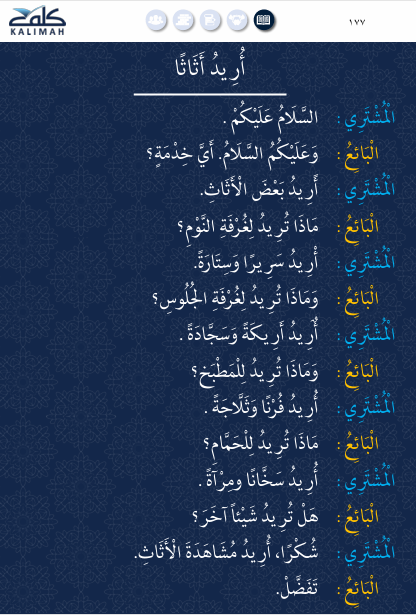
* Excerpted from Kalimah’s Online Arabic Course Curriculum
Here is the text with the transliteration and translation for practice:
- المشتري: السلام عليكم. (Assalamu alaykum) – Peace be upon you.
- البائع: وعليكم السلام. أي خدمة؟ (Wa alaykum assalam. Ayy khidmah?) – And peace be upon you. How can I help you?
- المشتري: أريد بعض الأثاث. (Ureedu ba’d al-athath) – I want some furniture.
- البائع: ماذا تريد لغرفة النوم؟ (Matha tureed lighurfat al-nawm?) – What do you want for the bedroom?
- المشتري: أريد سريرًا ومرآة. (Ureedu sareeran wa mir’ah) – I want a bed and a mirror.
- البائع: وماذا تريد لغرفة الجلوس؟ (Wamatha tureed lighurfat al-juloos?) – And what do you want for the living room?
- المشتري: أريد أريكة وسجادة. (Ureedu arikah wa sajjadah) – I want a sofa and a carpet.
- البائع: وماذا تريد للمطبخ؟ (Wamatha tureed lilmatbakh?) – And what do you want for the kitchen?
- المشتري: أريد فرنًا وثلاجة. (Ureedu furnan wa thallajah) – I want an oven and a refrigerator.
- البائع: وماذا تريد للحمام؟ (Wamatha tureed lilhamam?) – And what do you want for the bathroom?
- المشتري: أريد ستائر ومرآة. (Ureedu sata’ir wa mir’ah) – I want curtains and a mirror.
- البائع: هل تريد شيئًا آخر؟ (Hal tureed shay’an akhar?) – Do you want anything else?
- المشتري: شكرًا. أريد مشاهدة الأثاث. (Shukran. Ureedu mushaahadat al-athath) – Thank you. I’d like to view the furniture.
- البائع: تفضل. (Tafaddal) – Please go ahead.
By practicing dialogues like this, you are using Arabic in real-life contexts, which makes learning both engaging and practical. At Kalimah Center, we immerse you in such everyday scenarios through our courses, helping you not only learn the language but also confidently apply it in daily interactions.
Whether it’s negotiating at a market, chatting in a café, or purchasing household items, our Arabic language curriculum covers all these scenarios and more. Join our Arabic courses today to start thinking and speaking like a native!
Inside Kalimah Center: Moments from Our Courses
Get a glimpse into the vibrant learning experience at Kalimah Center. These snapshots capture real moments from our live classes—where students engage deeply, connect with passionate instructors, and grow in a welcoming, supportive environment.
Master Arabic with Kalimah Center
Join our expert-led online classes and start your journey toward Arabic fluency today.
Book Your Free Trial11. Challenge Yourself with Short Conversations
Another tip is to set small speaking goals. Challenge yourself to have a short conversation in Arabic every day, even if it’s just for a minute. You can talk about your day or describe something you see around you.
For example, try saying:
- “Al-yawm kana mut‘iban (اليوم كان متعبا)” – “Today was tiring.”
- Sanaqtadiru ‘ala ta‘allum al-‘Arabiyya bisura‘a (سأقدر على تعلم العربية بسرعة)” – “I will be able to learn Arabic quickly.”
The idea is to keep talking, even if it’s short. Every bit of practice helps.
Using English Transfer Skills (Without Relying on Translation)
While it’s ideal to eventually rely less on English, it’s okay to use it as a starting point, especially for difficult concepts.
For example, some students find it helpful to compare grammar structures. For example, in English, you say “the house,” but in Arabic we say”البيت” (al-bayt), with “ال” (al-) being the equivalent of “the.”
English and Arabic are different in many ways, but using your English knowledge can make the learning easier. Here’s how:
1. Don’t translate sentences; transfer words
English and Arabic share more history than you think. To start speaking immediately, use ‘Cognates’—words that sound the same in both languages.
Sugar = Sukkar (سكر)
Cotton = Qutn (قطن)
Mirror = Mira’ah (مرآة)
Using these bridge words builds confidence without forcing your brain to do mental gymnastics.
Read also: Arabic words are used in English
2. Use English Sentences as Models
You can think in English, then translate into Arabic. For example, if you want to say, “I am going to the market,” you think in English first, then say it in Arabic:
- “Ana athhab ila as-souq (أنا أذهب إلى السوق).”
Start with simple sentences like this and practice saying them aloud. You will begin to think in Arabic slowly, but at first, using English helps.
3. Understand Similar Sentence Structures
Some English sentence structures are not too different from Arabic. For example, in both languages, you can say, “I love learning.” In Arabic, it’s “Ana uhibb at-ta‘allum (أنا أحب التعلم).” Focus on these similarities to make learning smoother.
Best Free Tools & Apps to Practice Arabic Speaking Online
There are several great resources that you can use to practice speaking without spending money. Let me share some with you:
1. YouTube Videos
There are many YouTube channels where native speakers teach Arabic. For example, channels like ArabicPod101 offer free videos for speaking practice. Look for videos that focus on conversation, and follow along by repeating the sentences.
2. Language Exchange Apps to speak Arabic
Apps like Tandem and HelloTalk allow you to find native Arabic speakers who want to learn English. You can practice speaking Arabic with them in exchange for helping them with English. This way, you get free speaking practice while making new friends.
3. Free Group Classes and Forums
Some websites like Reddit have communities where people organize free online classes or conversation groups for learners. You can join these forums to find people who want to practice speaking together. You can also join free groups on platforms like Meetup to find Arabic conversation partners.
At Kalimah Center, we offer some free speaking resources too, like FREE trial lessons. In these lessons, you’ll get a taste of what it’s like to learn Arabic from an experienced, native-speaking teacher.
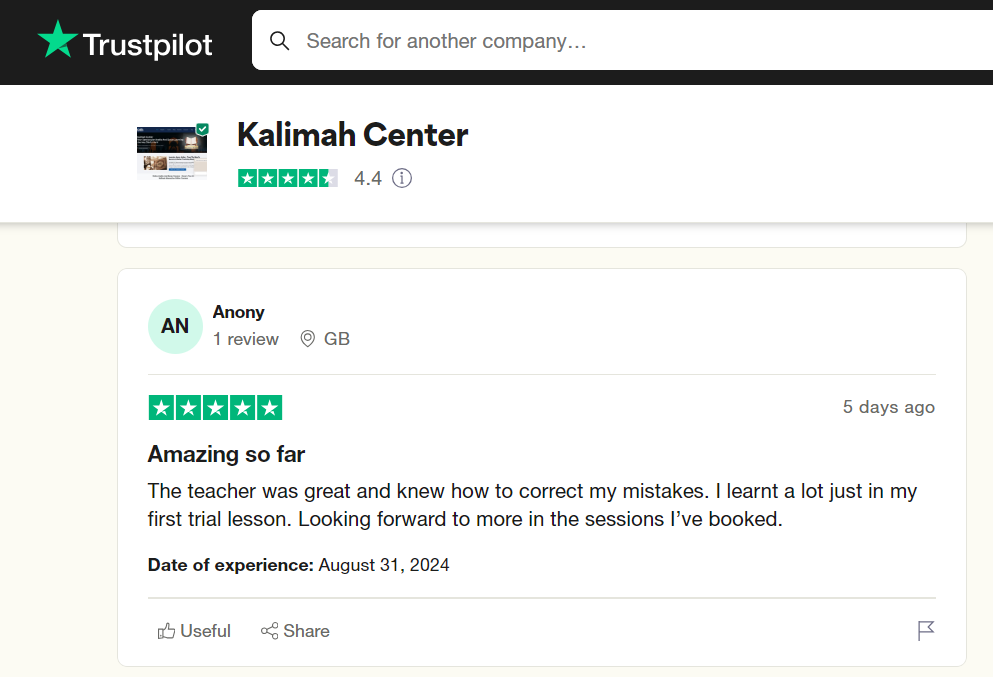
And here is a testimonial review on our page at Trustpilot of a student who learnt a lot just in the first trial lesson.
Is Arabic Hard to Speak?
The short answer is NO, not if you take the right steps. Yes, Arabic has some unique sounds and a different script, but speaking it is not as difficult as many think. Like any language, it’s about practice and immersion. If you can dedicate time each day to speaking Arabic for beginners, you’ll find that the language starts to come together quite naturally.
In my experience, it’s important not to focus too much on perfection at first. Instead, get comfortable with the basics—simple greetings like “marhaban (مرحبا),” which means “hello,” or “shukran (شكرا),” meaning “thank you.” The pronunciation will improve as you keep practicing.
How Long Does It Take to Speak Arabic Fluently?
On average, if you can spend about an hour a day practicing, you can expect to hold conversations within six months to a year.
Fluency, however, takes longer. But don’t let that discourage you! You don’t need to be fluent to communicate effectively. Even knowing basic Arabic will open doors, especially if you’re visiting Arabic-speaking countries or engaging with Arab communities.
Where Can I Learn to Speak Arabic?
If you’re wondering where can I learn to speak Arabic, the answer is—anywhere! Thanks to online platforms, you no longer need to be in an Arabic-speaking country to learn the language. That said, choosing the right place to learn is important.
Kalimah Center offers one of the best-structured programs available online. Our students consistently tell us that our courses gave them the confidence to start speaking Arabic quickly. What sets us apart is our focus on conversation and practical speaking skills. Plus, our group classes offer a sense of community that makes learning much more enjoyable.
Our online Arabic courses offer:
- Step-by-step learning: From alphabet to advanced conversations, we have a course for you.
- Focus on speaking: Practice speaking Arabic with native teachers in every class.
- Interactive and fun lessons: Our engaging materials and exercises make learning enjoyable.
Our courses:
- Learn Arabic Online For adults. Talk Arabic easy!
- Learn Arabic for Kids: Fun way for kids to learn to speak Arabic language.
- Learn Quran & Tajweed Online: Read Quran right. Understand it better!
Join us for a FREE trial class today!
Master Arabic with Kalimah Center
Join our expert-led online classes and start your journey toward Arabic fluency today.
Book Your Free TrialFAQs about How to Speak Arabic
Q: Should I learn MSA or a Dialect to speak Arabic?
A: If your primary goal is speaking with locals, travel, or making friends, you must choose a Dialect (Ammiya). MSA is rarely used in casual daily conversation.
Q: How can I practice speaking Arabic if I have no partner?
A: Use the “Self-Talk” method. Narrate your daily actions (e.g., “I am opening the door”) out loud. Additionally, use the voice typing feature on your phone to see if Google/Siri recognizes your pronunciation.
Q: Is Arabic pronunciation difficult for English speakers?
A: It challenges the throat muscles. Sounds like ‘Ayn (ع) and Haa (ح) do not exist in English. However, with daily shadowing exercises, the tongue adapts within 3–4 weeks.
Q: How many words do I need to be conversational?
A: You do not need a massive vocabulary. Knowing the top 50 verbs and top 100 nouns accounts for roughly 50% of daily conversation.
Q: Can I learn to speak Arabic just by listening?
A: No. Listening is passive; speaking is active. You must physically move your mouth muscles. Listening aids comprehension, but only speaking builds fluency.
Conclusion:
Learning to speak Arabic involves more than memorizing vocabulary; it’s about practicing communication skills in real-life contexts. Key steps include listening to native speakers, mastering basic sounds and pronunciation, and focusing on speaking from day one without getting bogged down by grammar. Engaging in conversations, shadowing native speakers, and thinking directly in Arabic are crucial for fluency.
To enhance your Arabic speaking skills, immerse yourself in the language by using real-life scenarios, practicing with speaking partners, and setting daily conversation goals. Recording your voice can help identify areas for improvement.
Remember, it’s normal to start with simple phrases and build confidence over time. With consistent practice, you can achieve conversational fluency within months, making the learning process enjoyable and rewarding.