If you’ve ever tried to learn Arabic and felt lost the moment words started changing form, you’re not alone. Arabic has a grammatical number system that goes beyond what most languages use — and the singular form is where everything starts.
Learning the singular form in Arabic (المفرد – al-mufrad) provides the foundation for accurate reading, sentence formation, and understanding the grammatical changes that occur when words take different forms.
Whether you’re a complete beginner or brushing up on grammar, this guide gives you the full picture.
What You’ll Learn in This Article
- The precise definition of singular in Arabic, including the classical and grammatical meanings
- The four distinct ways grammarians use the term “singular”
- How the singular form behaves in a sentence (case endings, gender rules)
- The difference between singular, dual, and plural in Arabic
- The most common mistakes learners make when working with Arabic number forms
What Is Singular in Arabic (المفرد)?
Singular in Arabic is called المفرد (al-mufrad), from the root أَفْرَدَ — meaning to make something one, or to isolate it. In standard grammatical usage, a singular noun is any noun that refers to exactly one person, animal, or thing — whether masculine or feminine.
Examples of Arabic singular nouns:
| Arabic | Transliteration | Meaning |
| رَجُل | rajul | man |
| كِتَاب | kitāb | book |
| مَدْرَسَة | madrasa | school |
| طَالِب | ṭālib | student |
| سَيَّارَة | sayyāra | car |
What all these words share: each refers to one thing, and none carries a dual or plural ending. The singular form represents a single person, object, animal, or concept and serves as the starting point from which dual and plural forms are derived.
Classical Arabic grammarians, including Ibn Malik in Sharh al-Tasheel, defined the mufrad more precisely as: a word in which no part of it is intended to indicate a part of its meaning. In other words, the internal letters of the word (ز، ي، د in “Zayd”) are not independently meaningful — they contribute to the whole, not parts of a concept. This distinguishes a single word from a compound phrase.
Read also about: Arabic Plurals
The Four Uses of “Singular” in Arabic Grammar
One important detail that most beginner resources skip entirely: Arabic grammarians use the word mufrad to mean four different things depending on context. Confusing these is one of the most consistent errors among intermediate learners.
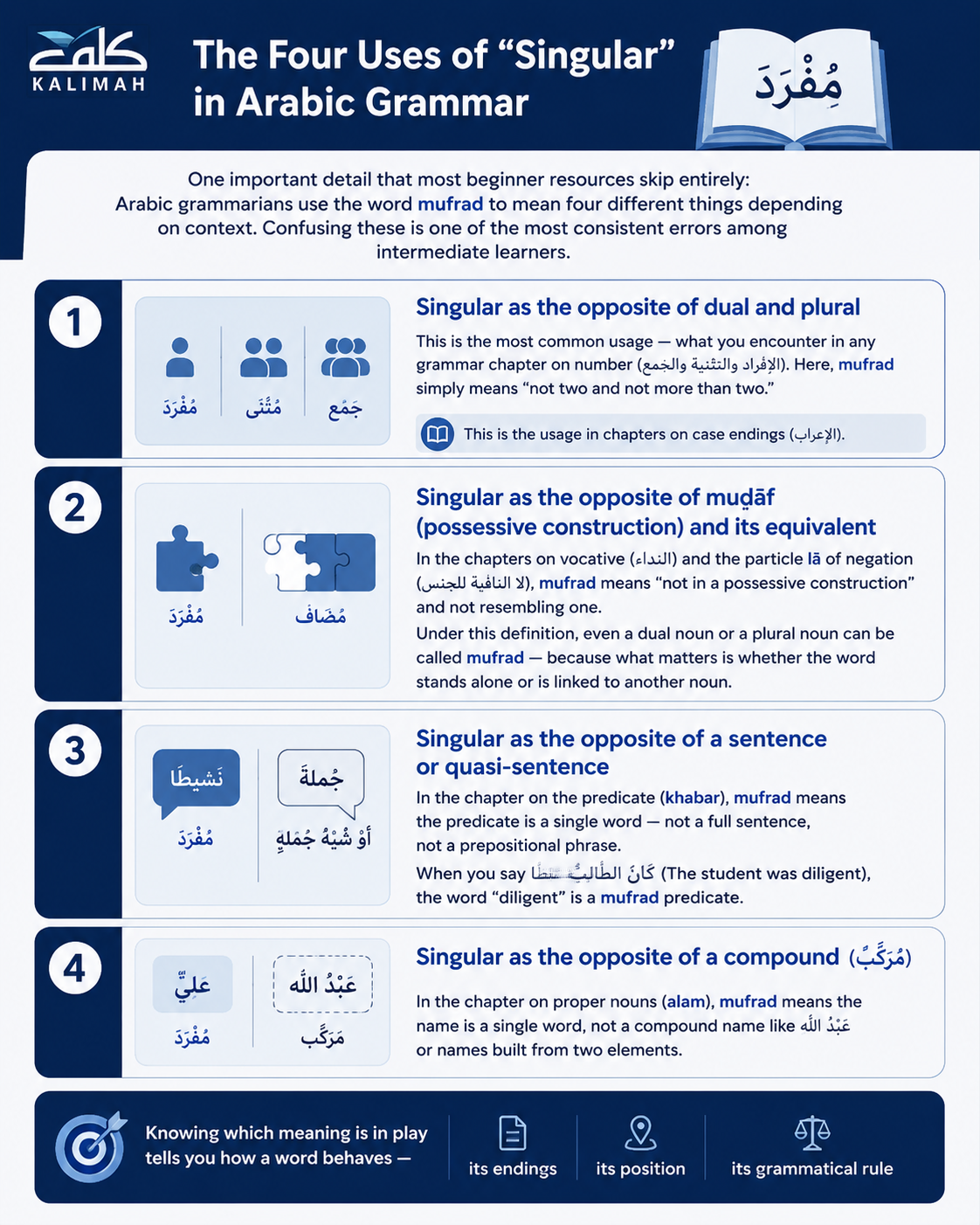
1. Singular as the opposite of dual and plural
This is the most common usage — what you encounter in any grammar chapter on number (الإفراد والتثنية والجمع). Here, mufrad simply means “not two and not more than two.” This is the usage in chapters on case endings (الإعراب).
2. Singular as the opposite of muḍāf (possessive construction) and its equivalent
In the chapters on vocative (النداء) and the particle lā of negation (لا النافية للجنس), mufrad means “not in a possessive construction and not resembling one.” Under this definition, even a dual noun or a plural noun can be called mufrad — because what matters is whether the word stands alone or is linked to another noun.
3. Singular as the opposite of a sentence or quasi-sentence
In the chapter on the predicate (khabar), mufrad means the predicate is a single word — not a full sentence, not a prepositional phrase. When you say كَانَ الطَّالِبُ نَشِيطًا (The student was diligent), the word “diligent” is a mufrad predicate.
4. Singular as the opposite of a compound (مُرَكَّب)
In the chapter on proper nouns (alam), mufrad means the name is a single word, not a compound name like عَبْد الله or names built from two elements.
Knowing which meaning is in play tells you how a word behaves — its endings, its position, and its grammatical rule.

How the Singular Noun Is Declined in Arabic?
A singular noun in Arabic takes case endings (حَرَكَات) that show its grammatical role in the sentence. This is different from the dual and plural — those use letters instead of vowels in some cases.
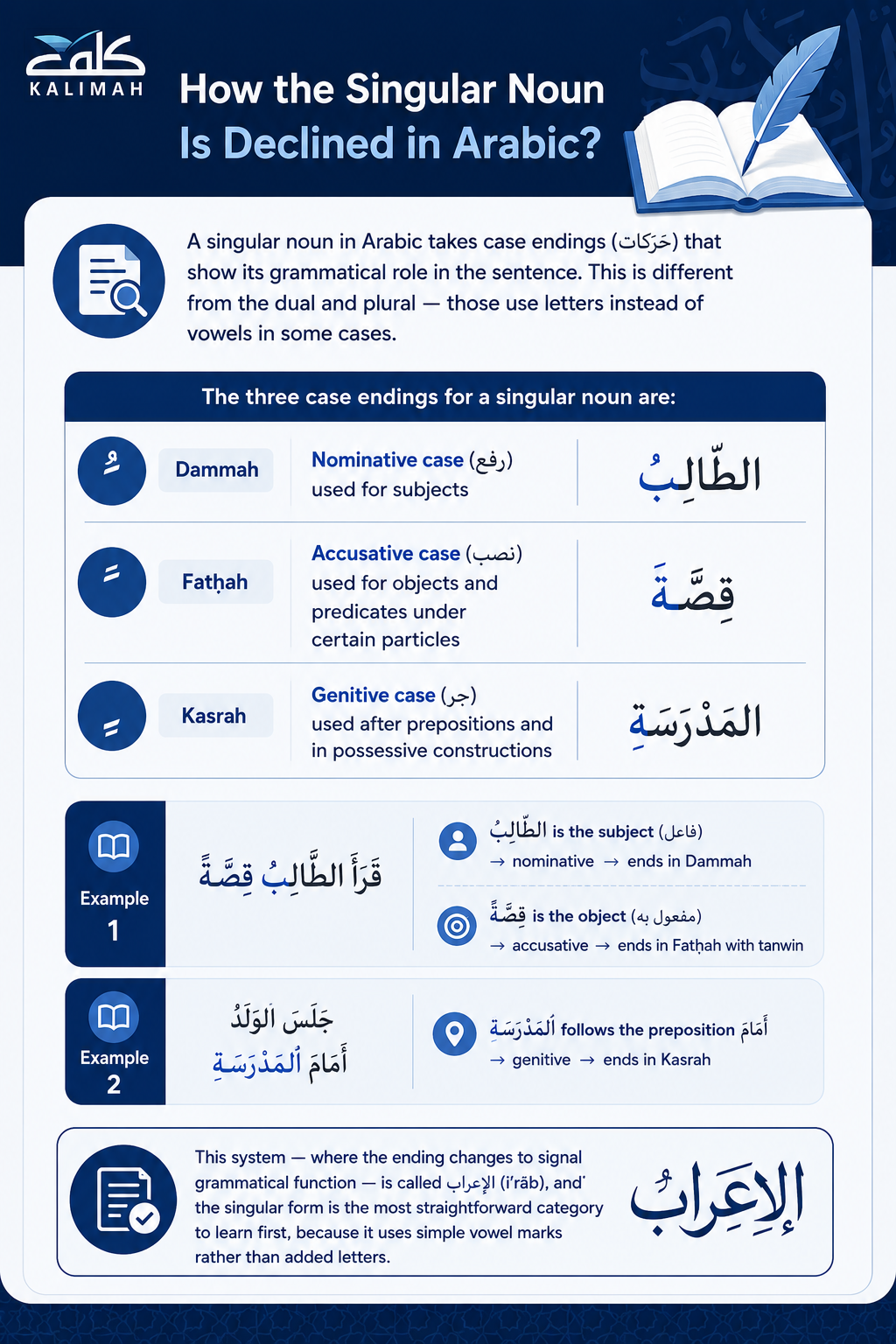
The three case endings for a singular noun are:
- Dammah (ُ ) → Nominative case (رفع) — used for subjects
- Fatḥah (َ ) → Accusative case (نصب) — used for objects and predicates under certain particles
- Kasrah (ِ ) → Genitive case (جر) — used after prepositions and in possessive constructions
Example 1: قَرَأَ الطَّالِبُ قِصَّةً → الطَّالِبُ is the subject (فاعل) → nominative → ends in Dammah → قِصَّةً is the object (مفعول به) → accusative → ends in Fatḥah with tanwin
Example 2: جَلَسَ الوَلَدُ أَمَامَ المَدْرَسَةِ → المَدْرَسَةِ follows the preposition أَمَامَ → genitive → ends in Kasrah
This system — where the ending changes to signal grammatical function — is called الإعراب (i’rab), and the singular form is the most straightforward category to learn first, because it uses simple vowel marks rather than added letters.
Experience Kalimah Center Classes
Watch real excerpts from our live sessions at Kalimah Center and see how we bring learning to life. These clips highlight our interactive, student-centered teaching approach across all our courses—designed to keep learners engaged, motivated, and actively involved every step of the way.
Master Arabic with Kalimah Center
Join our expert-led online classes and start your journey toward Arabic fluency today.
Book Your Free TrialRead also: The Predicate in Arabic: Definition, Types, and Grammar Rules Explained
Singular, Dual, and Plural in Arabic: The Core Difference
Arabic has three number categories, not two. This is one of the first things that distinguishes it from English — and understanding it correctly prevents an enormous number of reading errors.
| Number | Arabic Term | Ending Pattern | Example |
| Singular | المفرد | No suffix added | طَالِب (student) |
| Dual | المثنى | ـَانِ (nominative) / ـَيْنِ (accusative/genitive) | طَالِبَانِ / طَالِبَيْنِ |
| Plural | الجمع | Varies by type (see below) | طُلَّاب / طَالِبُون |
The dual is formed by adding -āni (ـَانِ) to a masculine singular noun in the nominative, or -ayni (ـَيْنِ) in the accusative and genitive. This form disappears from English, French, and most other major languages — which is why Arabic learners consistently underestimate how much the dual changes a sentence.
Unlocking the Secrets of Arabic Grammar: Understanding Singular, Dual, and Plural”
The plural has three types:
1. Sound masculine plural (جمع المذكر السالم): adds -ūna (ـُونَ) in nominative or -īna (ـِينَ) in accusative/genitive. Example: مُعَلِّمُونَ → teachers (male)
2. Sound feminine plural (جمع المؤنث السالم): adds -āt (ـَات). Example: مُعَلِّمَات → teachers (female)
3. Broken plural (جمع التكسير): the internal vowel structure changes entirely, with no predictable suffix. Example: كِتَاب → كُتُب (books), قَلَم → أَقْلَام (pens)
The broken plural is entirely unpredictable from the singular form — each one must be learned with its base noun. This is the most demanding feature of Arabic number grammar, and it is why building vocabulary always means learning the plural alongside the singular.
Kalimah Center’s Arabic courses teach singular, dual, and plural forms in integrated vocabulary sets — so learners never need to relearn a word’s number forms separately.

Singular in Arabic Words: Pronunciation Rules
The singular form of a noun is its base pronunciation — what you find in the dictionary, before any suffixes are added.
Key pronunciation features of the Arabic singular:
- Most singular nouns end in a short vowel or sukūn (no vowel). The ending changes only with grammatical case.
- Feminine singular nouns typically end in tāʾ marbūṭa (ة), which is pronounced as a t in connected speech (idhāfah) and as a soft h when pausing at the end.
- Indefinite singular nouns carry tanwīn — the doubling of the final vowel — which sounds like -un, -an, or -in. So كِتَابٌ is pronounced kitābun (indefinite, nominative), and الكِتَابُ is al-kitābu (definite, nominative).
- When reading Quran or formal Arabic, every short vowel on the final letter must be pronounced correctly — mispronouncing a singular ending can turn a subject into an object.
One specific detail learners often miss: the tāʾ marbūṭa at the end of feminine singular nouns behaves differently in idhāfah (possessive construction). مَدِينَة alone is madīnah, but مَدِينَةُ الرَّسُول becomes madīnatu r-rasūl — the ة is fully pronounced as a t because the word is linked to what follows it.
Inside Kalimah Center: Moments from Our Courses
Get a glimpse into the vibrant learning experience at Kalimah Center. These snapshots capture real moments from our live classes—where students engage deeply, connect with passionate instructors, and grow in a welcoming, supportive environment.
Here Are The Reviews On Our Courses:
Our students frequently commend the excellence of our courses and the commitment shown by our instructors. You can read their complete reviews on Trustpilot.
Read more reviews on Trustpilot

Start Arabic Grammar the Right Way
Many learners hit a wall because they never fully mastered the singular (mufrad); as a result, new word forms feel unfamiliar. At Kalimah Center we reverse that problem by building from the mufrad outward, so you gain a sturdy foundation before tackling duals, broken plurals, and advanced patterns.
Our method teaches Arabic in the order it naturally unfolds, helping you read, speak, and understand with confidence.
What you’ll gain
- Comprehensive Tajweed and memorization: the course covers nearly all Tajweed rules while providing structured pathways for memorizing the Quran.
- Ijazah-certified instructors: lessons are delivered by teachers with Ijazah qualifications, ensuring authentic transmission and high teaching standards.
- A spiritually focused environment: classes are designed to deepen your connection with the Quran, not just teach technical skills.
- Integrated Arabic support: optional Arabic classes run alongside the Quran course to boost comprehension and make memorization easier.

Courses Offered At Kalimah Center
Online Arabic Course (Adults)
A structured 16-level program totaling 400+ hours of one-on-one lessons. Tailored to your current level, it focuses on grammar, reading, and communication using interactive whiteboards and personalised corrections from experienced tutors.
Arabic Conversation for Beginners | 70 Basic Arabic Phrases To Know #learnarabic#ArabicForBeginners
Online Quran with Tajweed
A purpose-built Quran course for non-Arabic speakers that combines Quran reading with tajweed from beginner to advanced (13 levels). Lessons are led by Ijazah-certified teachers who emphasise correct recitation and progressive improvement.
Online Arabic for Kids
A kid-focused program across 24 levels (primary, intermediate, secondary) taught by instructors trained in child pedagogy. Sessions are engaging and age-appropriate while building strong foundations.

Master Arabic with Kalimah Center
Join our expert-led online classes and start your journey toward Arabic fluency today.
Book Your Free TrialConclusion
Singular in Arabic — المفرد — is not just the “basic form” of a noun. It is a precise grammatical concept with four different applications depending on the chapter of grammar you’re reading.
In its most common use, the mufrad is any noun that refers to one thing, takes case endings on its final letter, and serves as the base from which the dual and plural are built.
Mastering the singular means you understand what changes when you add the dual suffix, why broken plurals look nothing like their source word, and how case endings signal grammatical role. Everything in Arabic number grammar extends from here.
Read also: Parts of Speech in Arabic: The Complete Guide with Examples
Frequently Asked Questions
What does “mufrad” mean in Arabic?
Mufrad (المفرد) means singular — a noun that refers to exactly one person, animal, or thing. It is the base form of any Arabic noun, before dual or plural suffixes are added.
What is the singular form of a word in Arabic called?
The singular form is called المفرد (al-mufrad). The term comes from the verb أَفْرَدَ, meaning to isolate or make something one.
How do you form the dual from a singular noun in Arabic?
To form the dual, add ـَانِ (-āni) to the masculine singular noun in the nominative case, or ـَيْنِ (-ayni) in the accusative and genitive. For example: كِتَاب (singular) → كِتَابَانِ (dual nominative).
What is the difference between singular, dual, and plural in Arabic?
Arabic has three number categories. Singular (mufrad) refers to one thing. Dual (muthannā) refers to exactly two and is marked by a suffix. Plural (jam’) refers to three or more and comes in three types: sound masculine plural, sound feminine plural, and broken plural.
How does the singular noun change in a sentence?
The singular noun changes its final vowel to show its grammatical role: Dammah (ُ) for the subject (nominative), Fatḥah (َ) for the object (accusative), and Kasrah (ِ) after prepositions (genitive). These are the three case endings (i’rab) of Arabic.
Why do some plural forms look nothing like their singular in Arabic?
These are broken plurals (جمع التكسير — jam’ al-taksīr). They change the internal vowel structure of the word rather than adding a suffix. There is no single rule that predicts them — each broken plural must be memorized alongside its singular form.