Many of the Quran’s most vivid descriptions are reserved for one subject: Jannah, or Paradise. Reading quran verses about jannah in arabic brings you closer to the original wording the Prophet ﷺ and his companions heard, with imagery of gardens, rivers, and eternal peace that translation alone can soften or flatten.
This guide collects the Quran’s clearest verses on Jannah in their original Arabic, with transliteration and meaning, organized by what each verse reveals about Paradise — its size, its rewards, its inhabitants, and the conditions for entering it.
What You’ll Learn in This Article
- The Arabic text, transliteration, and meaning of the Quran’s key verses on Jannah
- How the Quran describes Jannah’s size, rivers, food, and eternal nature
- Which verses describe entering Paradise and being greeted by its gatekeepers
- What the Quran says is required to deserve Jannah
- How to read these verses in Arabic and benefit from their original wording
The Quran does not describe Jannah in modest terms. One of its most quoted verses on the subject compares its size to the heavens and the earth combined, while another describes its food and shade as permanent in a way nothing on earth is.
1. Jannah’s Size “As Vast as the Heavens and Earth”
This verse is one of the most frequently cited in discussions of Jannah’s scale, because of the comparison it uses.
“وَسَارِعُوا إِلَى مَغْفِرَةٍ مِنْ رَبِّكُمْ وَجَنَّةٍ عَرْضُهَا السَّمَاوَاتُ وَالْأَرْضُ أُعِدَّتْ لِلْمُتَّقِينَ”
Wa sāriʿū ilā maghfiratin min rabbikum wa jannatin ʿarḍuhā as-samāwātu wal-arḍu uʿiddat lil-muttaqīn.
“And hasten to forgiveness from your Lord and a Garden as vast as the heavens and earth, prepared for the righteous.” (Quran 3:133)
This verse defines Jannah’s scale by comparison rather than measurement — its width (عرض) equals the combined span of the heavens and the earth.
Classical exegetes point out that this is a deliberate Quranic technique: when no earthly unit can capture a reality, the Quran reaches for the largest frame of reference humans can imagine, then says Jannah exceeds even that.
2. Food and Shade That Never Run Out
This verse shifts from size to duration, describing what never depletes inside Jannah.
“مَثَلُ الْجَنَّةِ الَّتِي وُعِدَ الْمُتَّقُونَ تَجْرِي مِنْ تَحْتِهَا الْأَنْهَارُ أُكُلُهَا دَائِمٌ وَظِلُّهَا”
Mathalu al-jannati al-latī wuʿida al-muttaqūna tajrī min taḥtihā al-anhāru ukuluhā dāʾimun wa ẓilluhā.
“The example of Paradise promised to the righteous: beneath it rivers flow; its food is everlasting, and so is its shade.” (Quran 13:35)
The Arabic word دائم (permanent, unceasing) is doing precise theological work here — it draws a direct contrast with worldly fruit, which spoils, and worldly shade, which moves with the sun. Jannah’s provisions are described as fixed in their permanence, never depleting and never withdrawn.
A common point of confusion for new students of the Quran is treating verses like this as purely poetic.
They are not. Tafsir scholars classify “rivers flowing beneath it” (تجري من تحتها الأنهار) as one of the most repeated single phrases in the entire Quran — it appears in close to 30 separate verses, almost always paired with the promise of eternal residence (خالدين فيها). The repetition itself is a rhetorical device: a phrase the reader’s memory locks onto by sheer frequency.
Read Also: Quran Quotes In Arabic And English
Verses Describing Jannah’s Rivers and Provisions
Two verses stand out here — one naming four distinct rivers, and another describing fruit without any fixed limit.
1. The Four Rivers of Paradise
This verse is the Quran’s most detailed single description of what flows through Jannah.
“مَثَلُ الْجَنَّةِ الَّتِي وُعِدَ الْمُتَّقُونَ فِيهَا أَنْهَارٌ مِنْ مَاءٍ غَيْرِ آسِنٍ وَأَنْهَارٌ مِنْ لَبَنٍ لَمْ يَتَغَيَّرْ طَعْمُهُ وَأَنْهَارٌ مِنْ خَمْرٍ لَذَّةٍ لِلشَّارِبِينَ وَأَنْهَارٌ مِنْ عَسَلٍ مُصَفًّى”
Mathalu al-jannati al-latī wuʿida al-muttaqūna fīhā anhārun min māʾin ghayri āsinin wa anhārun min labanin lam yataghayyar ṭaʿmuhū wa anhārun min khamrin ladhdhatin lish-shāribīna wa anhārun min ʿasalin muṣaffā.
“In it are rivers of water unaltered, rivers of milk whose taste never changes, rivers of wine delightful to those who drink, and rivers of purified honey.” (Quran 47:15)
This verse names four distinct rivers, each described by what makes them superior to their earthly equivalents.
Water that never stagnates (غير آسن), milk that never sours (لم يتغير طعمه), wine without the harm of intoxication, and honey already purified (مصفى) — every adjective is chosen to negate a specific flaw the reader would associate with that substance in this life.
Note the wine reference specifically: Islamic teaching prohibits intoxicants in this life, and the Quran’s own commentary elsewhere clarifies that Jannah’s wine carries none of the harm, headache, or loss of reason associated with worldly wine — it is a reward, not a repeated test.
2. The believers ate in Paradise
While the first verse establishes the sheer scale of Jannah’s luxury through its flowing rivers, this passage shifts the focus to the personal experience of the believers and the boundless nature of their rewards.
“إِنَّ الْمُتَّقِينَ فِي ظِلَالٍ وَعُيُونٍ * وَفَوَاكِهَ مِمَّا يَشْتَهُونَ * كُلُوا وَاشْرَبُوا هَنِيئًا بِمَا كُنْتُمْ تَعْمَلُونَ”
“Indeed, the righteous will be among shades and springs, and fruits of whatever they desire. [They will be told], ‘Eat and drink in satisfaction for what you used to do.'” (Quran 77:41-43)
The phrase “fruits of whatever they desire” (فواكه مما يشتهون) makes clear the named rivers and fruits described elsewhere are examples, not an exhaustive menu — desire itself becomes the only limit on what’s available.
Verses Describing Entry Into Jannah
The Quran doesn’t only describe Jannah’s features — it stages the moment of arrival with specific dialogue between believers and the angels guarding its gates.
1. Greeted At The Gates By The Keepers Of Jannah
This verse gives one of the Quran’s clearest narrative sequences for the moment of entry itself.
“وَسِيقَ الَّذِينَ اتَّقَوْا رَبَّهُمْ إِلَى الْجَنَّةِ زُمَرًا حَتَّى إِذَا جَاءُوهَا وَفُتِحَتْ أَبْوَابُهَا وَقَالَ لَهُمْ خَزَنَتُهَا سَلَامٌ عَلَيْكُمْ طِبْتُمْ فَادْخُلُوهَا خَالِدِينَ”
Wa sīqa al-ladhīna ttaqaw rabbahum ilā al-jannati zumaran ḥattā idhā jāʾūhā wa futiḥat abwābuhā wa qāla lahum khazanatuhā salāmun ʿalaykum ṭibtum fa-dkhulūhā khālidīn.
“Those who feared their Lord will be led to Paradise in groups. When they reach it, its gates will be opened, and its keepers will say to them, ‘Peace be upon you; you have been pure, so enter it to abide eternally.'” (Quran 39:73)
This is one of the few Jannah verses with a clear narrative sequence: groups arrive (زمرا), gates open specifically for them, and the keepers (خزنة) speak directly. The greeting “you have been pure” (طبتم) ties entry directly to a state of purity earned through belief and conduct — not granted arbitrarily.
2. Entering Without Fear Or Sorrow
This verse pairs two separate Arabic words to address two different forms of anxiety at once.
“إِنَّ الْمُتَّقِينَ فِي جَنَّاتٍ وَعُيُونٍ * ادْخُلُوهَا بِسَلَامٍ آمِنِينَ”
“Indeed, the righteous will be among gardens and springs. [They will be told], ‘Enter it in peace, safe and secure.'” (Quran 15:45-46)
The pairing of سلام (peace) and آمنين (secure) in the same instruction addresses two separate human anxieties at once — peace from conflict, and security from any future loss.
This is a recurring structure across Jannah verses: the Quran often answers an unstated worldly fear (will it end? will there be conflict here?) directly inside the description of reward.
A soft-selling note worth weaving in here: understanding why each word choice matters — āminīn versus simply “peaceful,” for instance — is exactly the kind of detail that gets lost in translation but comes alive once you can read the Arabic directly.
This is the gap between knowing what a verse means and knowing why the Quran chose that specific word, which is the core focus of Kalimah Center‘s Quran with Tajweed course.
Read Also: Quran Verses About Patience
Verses Describing the Inner Peace of Jannah’s People
This verse moves past physical reward and into something more easily overlooked: emotional healing.
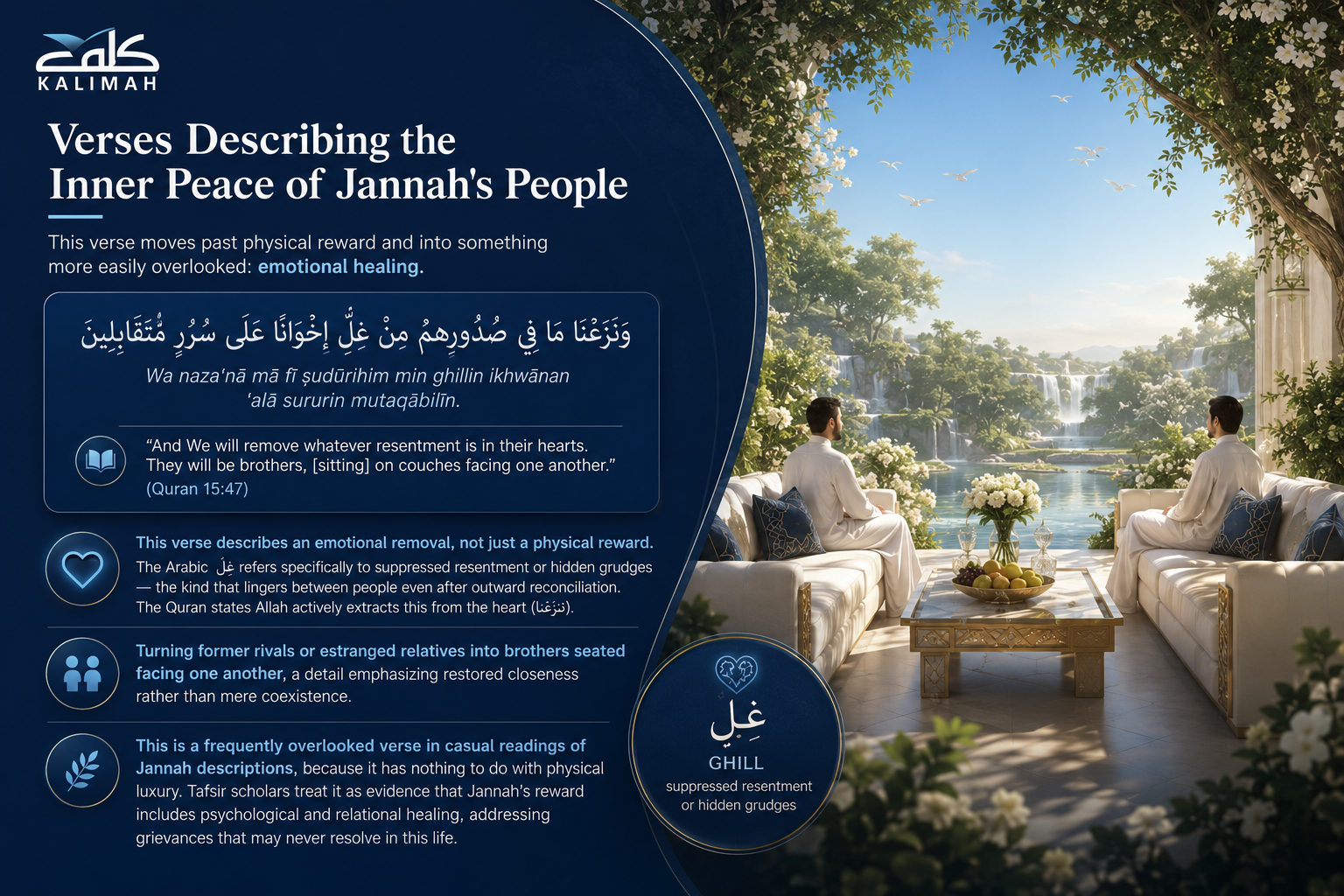
“وَنَزَعْنَا مَا فِي صُدُورِهِمْ مِنْ غِلٍّ إِخْوَانًا عَلَى سُرُرٍ مُتَقَابِلِينَ”
Wa nazaʿnā mā fī ṣudūrihim min ghillin ikhwānan ʿalā sururin mutaqābilīn.
“And We will remove whatever resentment is in their hearts. They will be brothers, [sitting] on couches facing one another.” (Quran 15:47)
This verse describes an emotional removal, not just a physical reward. The Arabic غل refers specifically to suppressed resentment or hidden grudges — the kind that lingers between people even after outward reconciliation. The Quran states Allah actively extracts this from the heart (نزعنا), turning former rivals or estranged relatives into brothers seated facing one another, a detail emphasizing restored closeness rather than mere coexistence.
This is a frequently overlooked verse in casual readings of Jannah descriptions, because it has nothing to do with physical luxury. Tafsir scholars treat it as evidence that Jannah’s reward includes psychological and relational healing, addressing grievances that may never resolve in this life.
Experience Kalimah Center Classes
Watch real excerpts from our live sessions at Kalimah Center and see how we bring learning to life. These clips highlight our interactive, student-centered teaching approach across all our courses—designed to keep learners engaged, motivated, and actively involved every step of the way.
Master Arabic with Kalimah Center
Join our expert-led online classes and start your journey toward Arabic fluency today.
Book Your Free TrialEnter Paradise Quran Verse In Arabic
This verse uses an exact phrase that repeats throughout the Quran, and the repetition itself is significant.
1. What Earns Entry Into Jannah
The Quran’s most repeated formula for earning Paradise pairs two conditions that are never presented separately.
“وَالَّذِينَ آمَنُوا وَعَمِلُوا الصَّالِحَاتِ أُولَئِكَ أَصْحَابُ الْجَنَّةِ هُمْ فِيهَا خَالِدُونَ”
“And those who believe and do righteous deeds — those are the companions of Paradise; they will abide therein eternally.” (Al-Baqarah 2:82)
This exact phrase — belief (آمنوا) paired with righteous deeds (عملوا الصالحات) — repeats with near-identical wording across more than a dozen verses throughout the Quran. The repetition is itself an information point: the Quran does not vary the formula because it isn’t presenting belief and action as separate paths to Jannah, but as a single, inseparable condition.
A common misreading worth correcting directly: belief alone, without corresponding action, does not appear anywhere in the Quran as sufficient for entry into Jannah on its own. Every major verse promising Paradise pairs ايمان (belief) with عمل صالح (righteous action) in the same breath.
2. Entering Paradise
The Quran describes the moment of entry into Jannah through several distinct verses, each revealing a different dimension of what that arrival looks like.
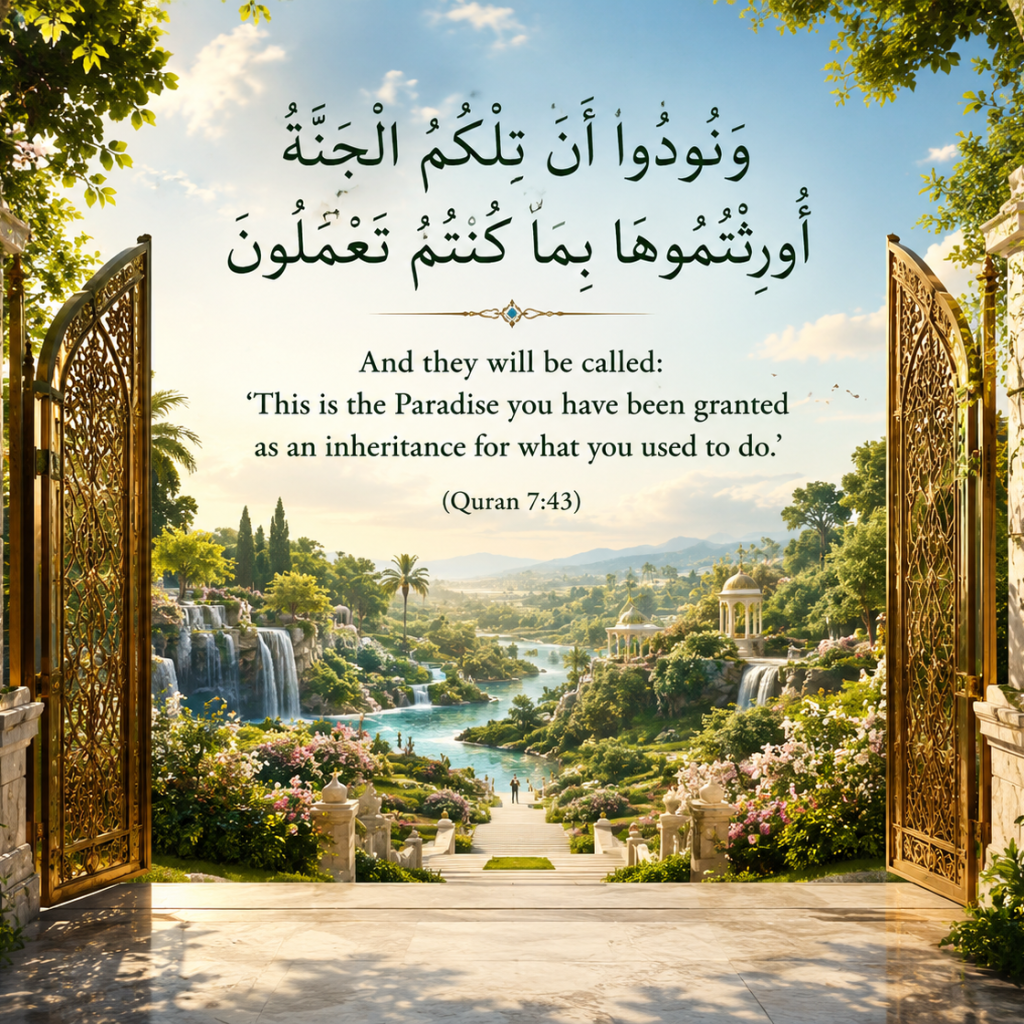
وَنُودُوا أَن تِلْكُمُ الْجَنَّةُ أُورِثْتُمُوهَا بِمَا كُنتُمْ تَعْمَلُونَ
“And they will be called: ‘This is the Paradise you have been granted as an inheritance for what you used to do.'” (Quran 7:43)
The word أورثتموها — you have been given it as an inheritance — is precise. Jannah is framed as something earned through a lifetime of action, then bestowed as a final, permanent gift.
ادْخُلُوا الْجَنَّةَ أَنتُمْ وَأَزْوَاجُكُمْ تُحْبَرُونَ
“Enter Paradise, you and your spouses, delighted.” (Quran 43:70)
The Arabic تحبرون carries a sense of joy expressed outwardly — a gladness visible on the face and body, not just an internal feeling. The believers do not enter alone; they enter with their spouses, together, which addresses one of the deepest human anxieties about what the afterlife holds.
Understanding why each word choice matters — آمنين versus simply “peaceful,” for instance — is exactly the kind of detail that gets lost in translation but comes alive once you can read the Arabic directly. This is the gap that Kalimah Center’s Quran with Tajweed course is built to close.

How to Read These Verses Correctly in Arabic
Reading Jannah verses in Arabic is not the same as reading them aloud phonetically. Words like خالدين (eternally) and مزاجها (its mixture, as in 76:5) carry grammatical case endings and elongation rules (madd) that change meaning or rhythm if mispronounced — a single dropped shaddah on a word like جنّة can shift its sound entirely.
This is precisely where Tajweed matters even for verses you’re not memorizing for prayer. Reading “تَجْرِي مِنْ تَحْتِهَا الْأَنْهَارُ” with correct elongation on the alif in الأنهار preserves both the meaning and the rhythmic structure the Quran was revealed in.
Students working through Kalimah Center’s Quran with Tajweed course typically start applying these rules to exactly this kind of verse within the first few teaching levels, since Jannah verses are short, repetitive in structure, and ideal for early practice.
Inside Kalimah Center: Moments from Our Courses
Get a glimpse into the vibrant learning experience at Kalimah Center. These snapshots capture real moments from our live classes—where students engage deeply, connect with passionate instructors, and grow in a welcoming, supportive environment.
Here Are The Reviews On Our Courses:
Our students frequently commend the excellence of our courses and the commitment shown by our instructors. You can read their complete reviews on Trustpilot.
Read more reviews on Trustpilot
Start Reading the Quran’s Verses on Jannah with Proper Guidance
This is where understanding meets practice — moving from reading about these verses to reading them yourself, correctly.
Reading translated verses about Jannah is a starting point, but the full weight of these descriptions only lands once you can read the Arabic directly, understand its grammar, and recite it with correct Tajweed.
Kalimah Center’s Quran with Tajweed course is built specifically for non-Arabic speakers who want to move past translation and engage with verses like these in their original form, guided by Ijazah-certified tutors in one-on-one sessions.
Explore Our Courses:
- Online Arabic Course: tailored to your level, with 16 teaching levels and 400+ hours of personalized sessions.
- Online Quran With Tajweed Course: built for non-Arabic speakers, spanning 13 levels from beginner to advanced Tajweed mastery.
- Online Arabic Course for Kids: a structured program in 24 levels covering primary, intermediate, and secondary stages.
Master Arabic with Kalimah Center
Join our expert-led online classes and start your journey toward Arabic fluency today.
Book Your Free TrialStart Your Free Trial Today!
Book your free trial session today and start with the verse that matters most to you right now.
Conclusion
The Quran’s verses about Jannah describe far more than a reward waiting at the end of life — they describe rivers that never run dry, food that never spoils, resentment that is removed from the heart, and a welcome at the gates that addresses fear directly.
Reading quran verses about jannah in arabic, rather than relying solely on translation, brings you closer to the precision behind every word choice the Quran makes on this subject.
Whether you’re drawn to the size described in 3:133, the four rivers in 47:15, or the emotional healing in 15:47, each verse rewards a second, closer reading in Arabic.
That closer reading is exactly what structured study — rather than scattered online searching — is designed to deliver.
Frequently Asked Questions
We addressed the most important questions about Paradise, exploring its names, descriptions, and the righteous deeds required to enter it, along with practical guidance on reciting its verses accurately.
1- What is the Arabic word for Paradise in the Quran?
The Quran’s primary word for Paradise is جنة (Jannah), from a root meaning concealment or dense shade, referring to a garden so thick with trees that the ground is hidden. The Quran also uses جنات (plural, gardens) and specific names like جنات عدن (Gardens of Eden) and جنة الفردوس (Gardens of Paradise) to describe its different levels.
2- Which Quran verse describes the size of Jannah?
Quran 3:133 describes Jannah’s size directly: “a Garden as vast as the heavens and earth” (وجنة عرضها السماوات والأرض). This comparison places Jannah’s scale beyond any earthly measurement, using the largest reference point the Quran offers — the combined span of the heavens and the earth.
3- How many rivers does the Quran say are in Jannah?
Quran 47:15 names four specific rivers in Jannah: water that never stagnates, milk whose taste never changes, wine delightful to drink without harm, and purified honey. Other verses add springs (عيون) as a separate, additional feature alongside these named rivers.
4- Does the Quran say Jannah has different levels?
Yes, the Quran references multiple Jannah names and structures, including جنات عدن (Gardens of Eden) in Surah At-Tawbah and جنة الفردوس (Gardens of Paradise) in Surah Al-Kahf, both understood by classical commentators as indicating tiered or varying levels of reward based on deeds.
5- Can I recite these Jannah verses without understanding Arabic grammar?
You can recite them phonetically, but understanding basic Quranic Arabic grammar and Tajweed rules changes how accurately you preserve their meaning and rhythm, since elongation marks and word endings can shift a verse’s sense if mispronounced. Structured lessons with a certified tutor address this gap far faster than self-study from transliteration alone.