Have you ever noticed that Arabic verbs change their endings depending on what comes before them — even when the verb itself hasn’t changed its meaning? That shift is the subjunctive and jussive mood at work, and understanding it is one of the most rewarding breakthroughs a student of Arabic can have.
The subjunctive and jussive in Arabic are two grammatical moods of the present-tense verb (المضارع) that alter the verb’s ending based on the particle or context preceding it.
Mastering these two moods is essential for reading the Quran, understanding Arabic grammar, and producing natural, accurate Arabic sentences.
What You’ll Learn in This Article?
- What the subjunctive and jussive moods are and how they differ from the default indicative.
- Which particles trigger each mood, with Arabic examples.
- How jussive words connect to conditional sentences.
- The relationship between the jussive and the imperative.
- Where Most Arabic Learners Go Wrong — and How to Stay on Track.
Meaning, Particles, and Examples Of Subjunctive Arabic
The subjunctive mood is one of the first places where Arabic grammar moves beyond straightforward word recognition into how sentences are structured around meaning.
Once you understand what triggers it and what it signals, a large portion of Quranic and Modern Standard Arabic opens up immediately.
What Is the Subjunctive Mood in Arabic?
The subjunctive mood (المنصوب) is a form of the present-tense Arabic verb triggered by specific particles that place the verb into a dependent or projected context. It signals that the action is anticipated, desired, or purposeful rather than simply stated as a current fact.
In practical terms, the subjunctive marks the verb with a fatha (َ) at the end — or drops the final ن in plural and dual forms — instead of the default damma (ُ) of the indicative.
The verb يَكْتُبُ (he writes) in the indicative becomes يَكْتُبَ (that he writes) in the subjunctive.
What Triggers the Subjunctive Mood in Arabic?
The subjunctive is triggered by a defined set of particles called حروف النصب. Each one introduces a verb that describes an action tied to intention, outcome, or negated future:
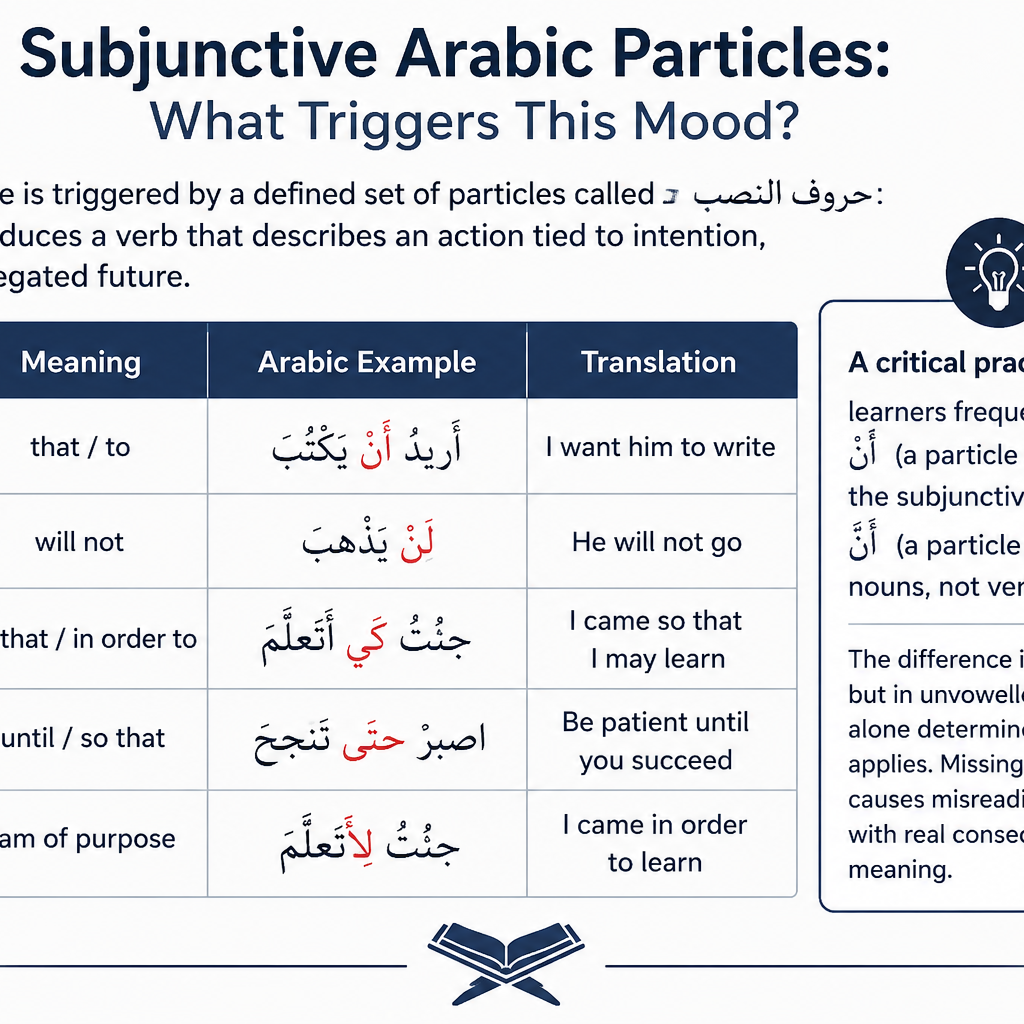
| Particle | Meaning | Arabic Example | Translation |
| أنْ | that / to | أريدُ أنْ يَكْتُبَ | I want him to write |
| لنْ | will not | لنْ يَذْهَبَ | He will not go |
| كيْ / لِكيْ | so that / in order to | جئتُ كيْ أتعلَّمَ | I came so that I may learn |
| حتى | until / so that | اصبرْ حتى تَنجحَ | Be patient until you succeed |
| لام التعليل | lam of purpose | جئتُ لِأتعلَّمَ | I came in order to learn |
A critical practitioner note: learners frequently confuse أنْ (a particle causing the subjunctive) with أنَّ (a particle governing nouns, not verbs).
The difference is the shadda — but in unvowelled text, context alone determines which one applies. Missing this distinction causes misreadings in the Quran with real consequences for meaning.
Subjunctive Arabic Examples in Quranic Context
The subjunctive appears constantly in Quranic Arabic. A clear example:
وَأُمِرْنَا لِنُسْلِمَ لِرَبِّ الْعَالَمِينَ (Al-An’am: 71) “And we are commanded to submit to the Lord of the worlds.”
The verb نُسْلِمَ carries a fatha ending — subjunctive — because it follows لِ (lam of purpose). Without recognizing this, a reader might misread the grammatical relationship and lose the intended meaning entirely.
Arabic Jussive Meaning Particles and Examples
The jussive is the second dependent mood of the Arabic present-tense verb, and in many ways it is the more powerful of the two. It governs commands, past negations, prohibitions, and — most critically — the entire system of Arabic conditional sentences.
What Is the Jussive Mood in Arabic?
The jussive mood (المجزوم) signals a sharper grammatical dependency than the subjunctive. Where the subjunctive deals with anticipated or purposeful actions, the jussive is the mood of conditions, commands relayed through a particle, and negated past actions.
The jussive is marked by a sukun (ْ) at the end of the verb — or by deletion of the final ن in plural and dual forms, or deletion of the weak letter in defective verbs ending in و or ي. The verb يَذْهَبُ (he goes) becomes يَذْهَبْ in the jussive.
Which Particles Trigger the Jussive in Arabic?
Jussive particles divide into two groups: those that govern a single verb, and conditional particles that govern two verbs simultaneously.
Particles governing one verb:
| Particle | Meaning | Example | Translation |
| لمْ | did not | لمْ يَذْهَبْ | He did not go |
| لمَّا | not yet | لمَّا يَحْضُرْ | He has not yet arrived |
| لامُ الأمر | command particle | لِيَقُمْ زيدٌ | Let Zayd stand |
| لا الناهية | prohibition | لا تَكْذِبْ | Do not lie |
Conditional particles governing two verbs (both jussive):
| Particle | Meaning | Example |
| إنْ | if | إنْ تذاكرْ تنجحْ |
| مَنْ | whoever | مَنْ يجتهدْ ينجحْ |
| ما | whatever | ما تفعلْ يُرَ |
| مهما | whatever / however | مهما تُخفِ يظهرْ |
| متى | whenever | متى تقمْ أقمْ |
| أينما | wherever | أينما تكونوا يُدرككمُ الموتُ |
Jussive Arabic Examples in Quranic Context
From the Quran: وَمَن يَتَّقِ اللَّهَ يَجْعَل لَّهُ مَخْرَجًا (Al-Talaq: 2) “And whoever fears Allah — He will make for him a way out.”
Here مَنْ is the conditional particle. يَتَّقِ is the condition verb — jussive, with the weak letter dropped (from يَتَّقِي). يَجْعَلْ is the response verb — jussive, with sukun. Both verbs carry jussive endings because of the conditional particle governing them.
Read Also: Arabic Language Importance
Jussive vs. Imperative in Arabic
The relationship between the jussive and the imperative is one of the most misunderstood areas in Arabic grammar for learners at the intermediate level.
Most textbooks treat them as separate categories — but the grammar tells a different story.
What Is the Difference Between Jussive and Imperative?
The imperative (فعل الأمر) is not an independent verbal category. It is derived directly from the jussive form of the present-tense verb by dropping the prefix letter:
- يَكْتُبُ → jussive: يَكْتُبْ → drop the يـ → add helping hamzah if needed: اُكْتُبْ
This derivation is why the imperative and jussive share the same ending: sukun, or deletion of ن or the weak letter. They are the same mood applied in different positions within Arabic grammar.
Read also: Arabic Vocabulary For Breakfast Foods
How the Jussive and Imperative Differ in Arabic Usage
The practical difference lies in person and context:
| Feature | Jussive | Imperative |
| Person | Third or second person (with particle) | Second person only |
| Form | Present-tense verb under a particle | Derived form, no prefix |
| Example | لِيَقُمْ زيدٌ — Let Zayd stand | قُمْ — Stand up! |
| Context | Inside a governed sentence | Standalone command |
A common learner mistake is treating these as entirely separate grammatical categories and learning their forms independently.
Understanding the derivation relationship means you only need to master one underlying pattern — the jussive ending — and the imperative forms follow automatically, including in the tricky defective and hollow verb classes.
Experience Kalimah Center Classes
Watch real excerpts from our live sessions at Kalimah Center and see how we bring learning to life. These clips highlight our interactive, student-centered teaching approach across all our courses—designed to keep learners engaged, motivated, and actively involved every step of the way.
Master Arabic with Kalimah Center
Join our expert-led online classes and start your journey toward Arabic fluency today.
Book Your Free TrialThe Jussive Mood and Conditional Sentence Structure in Arabic
No grammatical structure in Arabic puts the jussive to work more consistently — or more visibly — than the conditional sentence.
Understanding how it is built — and when the response clause needs a connecting faa — is one of the most practically useful things an Arabic learner can internalize.
How Does the Jussive Work in Conditional Sentences?
A conditional sentence (أسلوب الشرط) consists of two parts: the condition clause (جملة الشرط) and the response clause (جواب الشرط). A conditional particle introduces the structure and places both verbs into the jussive.
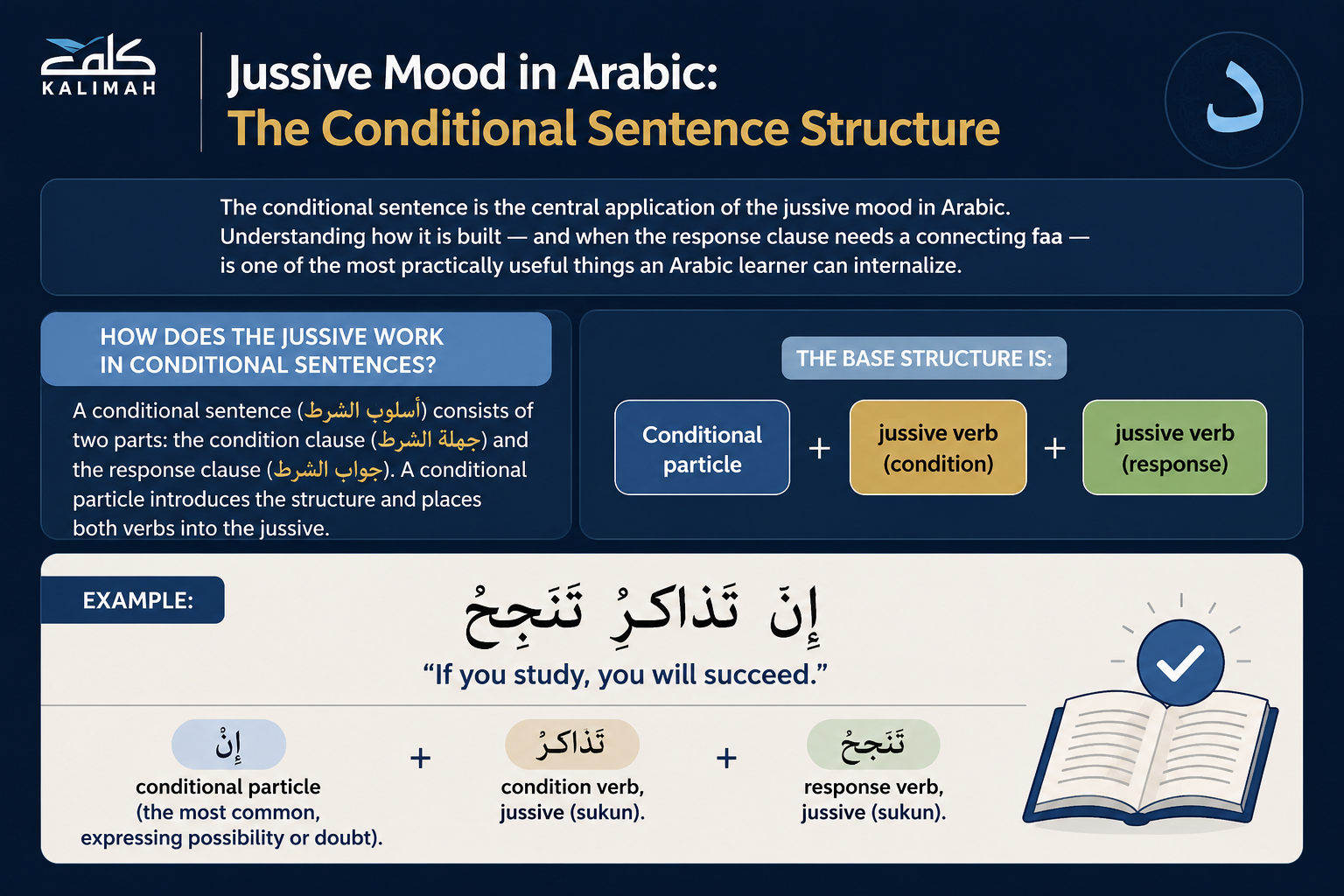
The base structure is:
Conditional particle + jussive verb (condition) + jussive verb (response)
Take this everyday conditional: إنْ تذاكرْ تنجحْ — link consistent effort to its outcome, and the jussive carries both sides of that connection.
- إنْ: conditional particle (the most common, expressing possibility or doubt).
- تذاكرْ: condition verb, jussive (sukoon).
- تنجحْ: response verb, jussive (sukun).
When Does the Response Clause Require a Connecting Faa?
When the response clause cannot stand alone as a bare jussive verb, a faa (فاء الجواب) is added to connect it to the condition. The eight situations that require it:
| Situation | Example | Translation |
| Response is a nominal sentence | مَنْ يجتهدْ فالنجاحُ حليفُه | Whoever strives, success is his companion |
| Response starts with لن | إنْ تستمعْ للنصيحة فلن تندم | If you heed advice, you will not regret |
| Response starts with سـ or سوف | إنْ تصبرْ فستتغلبُ | If you are patient, you will overcome |
| Response starts with قد | مَنْ أطاعَ اللهَ فقدْ نجا | Whoever obeys Allah has indeed succeeded |
| Response is an imperative or request | إنْ ابتُليتَ فاصبرْ | If you are tested, be patient |
| Response starts with a frozen verb | إنْ تضقْ فعسى اللهُ أن يأتيَ بالفرج | If you are distressed, perhaps Allah will bring relief |
| Response starts with ما النافية | فَإِنْ أُحْصِرْتُمْ فَمَا اسْتَيْسَرَ مِنَ الْهَدْيِ | If you are prevented, then whatever is easy of the offering |
| Response starts with لن | وَمَنْ يَبْتَغِ غَيْرَ الإِسْلامِ دِينًا فَلَنْ يُقْبَلَ مِنْهُ | Whoever seeks other than Islam as a religion, it will never be accepted |
The faa is not stylistic — it is grammatically required in these cases. Omitting it in unvowelled text or speech is an error that affects how the sentence is parsed and understood.
Read also: Quran Verses About Marriage In Arabic And English
Inside Kalimah Center: Moments from Our Courses
Get a glimpse into the vibrant learning experience at Kalimah Center. These snapshots capture real moments from our live classes—where students engage deeply, connect with passionate instructors, and grow in a welcoming, supportive environment.
Take Your Arabic Grammar Further with Kalimah Center
Reading about the subjunctive and jussive is one thing — hearing them explained, seeing them corrected in real time, and practicing them with a qualified teacher is what actually makes them stick.
At Kalimah Center, we built our courses around exactly that gap: the distance between understanding a grammar rule on paper and being able to use it confidently in reading, writing, and Quranic comprehension.
What Sets Kalimah Apart1
Three things distinguish a Kalimah course from self-study or generic online platforms:
- Qualified tutors with real teaching records — every instructor is vetted for both Arabic expertise and teaching methodology, not just language fluency.

- Student ratings and reviews you can read before you book — no hidden surprises; you choose your tutor based on real learner feedback from students at your level.

- Supporting course books included — each level comes with structured written materials that reinforce what is covered in your sessions, so you are never relying on notes alone.
See the Grammar in Action Before You Commit
Before booking a single session, you can watch Kalimah’s free video lessons and get a feel for how the teaching works. A strong starting point for anyone working through verb moods is:
- Arabic Conversation for Beginners | 70 Basic Arabic Phrases To Know: builds the practical sentence patterns that subjunctive and jussive structures slot into naturally.
- Learn Arabic Verbs and Vocabulary Slowly | Daily Routine Verbs for Beginners: slows down verb forms so you can see the endings clearly, which is exactly the skill you need to spot jussive and subjunctive markers in real text.
Three Courses — One Clear Path Forward
Kalimah offers a structured route from first contact with Arabic grammar all the way to confident Quranic reading:
- Online Arabic Course: 16 levels and 400+ hours of one-on-one sessions, designed for adults building Modern Standard Arabic from any starting point, at their own pace.
- Online Quran with Tajweed: 13 levels taught by Ijazah-certified teachers, built for learners whose goal is confident Quranic recitation and comprehension, not just fluency.
- Online Arabic for Kids: 24 levels spanning primary, intermediate, and secondary stages, delivered by teachers trained specifically in child-centered Arabic instruction.

Every course includes one-on-one sessions, interactive tools, and tutor-matched placement — so you start at the right level, not the beginning of a generic program.
Book Your Free Trial Session at Kalimah Center
Master Arabic with Kalimah Center
Join our expert-led online classes and start your journey toward Arabic fluency today.
Book Your Free TrialConclusion
The subjunctive and jussive are not isolated grammar rules — they are the operating logic behind Arabic conditions, commands, purposes, and prohibitions.
The subjunctive, triggered by particles like أنْ، لنْ، and كيْ, marks verbs with fatha and signals anticipated or purposeful action. The jussive, triggered by particles like لمْ، إنْ، and مَنْ, marks verbs with sukun and powers the entire conditional sentence system.
The imperative, far from being a separate category, is derived directly from the jussive — which means learning the jussive teaches you two systems at once. And the conditional sentence, built on two jussive verbs, is one of the most frequently occurring structures in the Quran and in everyday Arabic.
Study these two moods together, in context, with real Quranic examples — and your reading comprehension will shift from recognizing words to understanding how Arabic actually constructs meaning.
Frequently Asked Questions About Subjunctive and Jussive in Arabic
What is the difference between the subjunctive and jussive in Arabic?
The subjunctive (المنصوب) is triggered by particles of purpose or anticipation like أنْ and لنْ, marking the verb with a fatha ending.
The jussive (المجزوم) is triggered by conditional or negation particles like إنْ and لمْ, marking the verb with a sukun or deletion of the final ن.
Both are dependent moods of the present-tense verb, but they serve different grammatical functions.
What are the most common jussive words in Arabic?
The most common jussive particles are لمْ (did not), لا الناهية (prohibition), لامُ الأمر (command particle), and the conditional particles إنْ، مَنْ، ما، مهما، متى، and أينما. Each places the verb that follows into the jussive mood.
Is the Arabic imperative the same as the jussive?
They are closely related but not identical. The imperative is derived from the jussive by removing the prefix letter of the present-tense verb.
They share the same ending — sukun or deletion of ن — but the imperative is used as a direct second-person command while the jussive operates under a governing particle inside a sentence.
What does the subjunctive mean in Arabic grammar?
The subjunctive signals that the verb is dependent on a purpose, hope, or anticipated outcome.
Particles like أنْ (that/to), لنْ (will not), and كيْ (so that) introduce a subjunctive verb, marking it with a fatha instead of the default indicative damma.
How do you identify the jussive mood in Arabic text?
Look for a sukun on the final consonant of the present-tense verb, or the absence of a final ن in forms that normally carry it. In defective verbs, the final weak letter is deleted entirely.
These markers appear after jussive particles or in both verbs of a conditional sentence.
Can both verbs in a conditional sentence be in the jussive?
Yes — this is the standard structure. When a conditional particle like إنْ or مَنْ begins a conditional sentence, both the condition verb and the response verb take jussive endings.
If the response clause cannot take a bare jussive verb, a faa (فاء الجواب) is added before it.
External Links
- The Importance of Arabic Grammar and Syntax
- Research on Arabic Grammar and Linguistic Studies
- Academic Study of Arabic Language and Grammar
- Introduction to Arabic Grammar Concepts
- Studies in Arabic Linguistics and Grammar
- Understanding Arabic Syntax and Grammar Rules
- Learning Arabic Grammar and Language Structure