Have you ever opened the Mushaf and wished you could read its flowing script on your own? You are not alone. Arabic is spoken by more than 400 million people, and millions more learn it mainly to read the Quran.
The good news is that learning how to read Arabic for beginners is much simpler than it looks. The script follows clear, logical rules, and once you know them, every page starts to make sense.
In this guide, the Kalimah Center teaching team explains how to read Arabic for beginners step by step: which way the script runs, the 28 letters, the vowel marks, and how to blend sounds into words. It works for children and adults alike.
Step 1: Learn the Letters and Their Sounds
Every plan for how to read Arabic for beginners starts here. Study letters in groups of four or five. Give extra attention to sounds with no English equivalent, such as ع (Ayn), ح (Ha), and ق (Qaf).
Start with letters that sound close to English, such as ب (b), م (m), and ن (n), to build early confidence. Then move on to the harder groups, so each new set feels like a small, manageable win.
A native teacher matters: ح and هـ sound alike to new ears, yet swapping them changes the meaning.
Say each letter’s name aloud while you write it, so sight, sound, and movement work together. This habit is why tracing sheets work so well for kids, and it helps adults memorize the alphabet much faster too.
Step 2: Master the Short Vowels (Harakat)
The mark changes the sound, not the letter itself. The same ب can be read ba, bi, or bu, so train your eyes to check above and below every letter before you pronounce it. Short vowels appear as small marks above or below the letters:
- Fatha (َ) above a letter gives “a”: بَ = ba.
- Kasra (ِ) below a letter gives “i”: بِ = bi.
- Damma (ُ) above a letter gives “u”: بُ = bu.
Drill every letter with all three marks, like قَ قِ قُ. In our experience, no single exercise teaches how to read Arabic for beginners faster than this one.
In the Quran, these marks are never optional. In Surah Al-Fatiha, أَنْعَمْتَ (an’amta, “You favored”) becomes أَنْعَمْتُ (an’amtu, “I favored”) if one vowel changes. That is why every good teacher perfects the Harakat first.
Step 3: Add the Long Vowels (Madd Letters)
Three letters stretch a vowel to twice its length: Alif after Fatha (بَا = baa), Waw after Damma (بُو = boo), and Ya after Kasra (بِي = bee). Think of a long vowel as holding a note in a song.
A short vowel lasts one count, and a Madd letter lasts two. Keeping this rhythm steady is a key part of how to read Arabic for beginners smoothly. Read pairs like بَ and بَا until the difference feels natural.
Length can change meaning completely. Compare كَتَبَ (kataba, “he wrote”) with كَاتَبَ (kaataba, “he corresponded with”). One extra Alif creates a new word, so never rush through a long vowel.
In the Mushaf, you will also see a wavy sign (ـٓ) called Maddah, which marks a longer stretch. That belongs to Tajweed, so master the basic two-count Madd first, and your teacher will add the longer rules later.
Step 4: Understand Sukoon and Shadda
A Sukoon (ْ) is a small circle above a letter. It means the letter has no vowel, so you stop on it, as in مِنْ (min). The Sukoon often appears in the middle of a word too. In قُلْ (qul, “say”) and بَحْرٌ (bahrun, “sea”), the silent letter closes the syllable, so you move straight on without adding any extra vowel.
A Shadda (ّ), shaped like a small “w”, doubles the letter, as in رَبّ (rabb). A Shadda is really two identical letters written as one: the first is silent and the second carries the vowel. So مُحَمَّد is read Mu-ham-mad, with the “m” pressed slightly longer than usual.
A Shadda almost always comes with a vowel mark as well. Reading both marks together, as in رَبِّ (rabbi) and إِنَّ (inna), trains your eye for some of the most frequent words in the Quran.
Step 5: Learn Tanween (Nunation)
Tanween is a doubled vowel mark at a word’s end that adds an “n” sound: بٌ (bun), بً (ban), and بٍ (bin). The “n” you hear in Tanween is never written as a separate letter.
It lives only in the doubled mark, which is why beginners often skip it, so make a habit of checking every word ending carefully. It usually marks an indefinite noun, such as كِتَابٌ (kitaabun, “a book”).
Tanween with Fatha usually has an extra Alif after it, as in كِتَابًا (kitaaban). While reading on, this Alif is not pronounced; when you stop on the word, you read it as a long “aa”: kitaabaa.
Once you recognize Tanween, many everyday nouns become easy to read: بَيْتٌ (baytun, “a house”), وَلَدٌ (waladun, “a boy”), and رَجُلٌ (rajulun, “a man”). Later, it also opens the door to key Tajweed rules.
Step 6: Blend Letters Into Words
Read right to left, one letter and its vowel at a time, then join the sounds: كَ + تَ + بَ = كَتَبَ (kataba, “he wrote”). At first, read each syllable with short pauses, then repeat the word faster until the pauses disappear.
This “slow, then smooth” method is the core of how to read Arabic for beginners, step by step. Continue with short words like قَلَمٌ (qalamun) and نُورٌ (noorun).
Watch for the non-connecting letters as you blend. In دَرَسَ (darasa, “he studied”), the letters do not join on the left, yet the word is still read as one unit, not three separate pieces.
Next, move on to longer words like مَسْجِدٌ (masjidun, “a mosque”) and مَدْرَسَةٌ (madrasatun, “a school”). Every word you decode builds your reading speed and your vocabulary at the same time.
Step 7: Move Into Quranic Reading
Practice short surahs from Juz’ Amma. The Mushaf is fully vowelled, which makes it the ideal text for anyone learning how to read Arabic for beginners. Basic Tajweed rules now help you pronounce each letter correctly. Our guide to Tajweed for beginners online explains where to begin.
If you want a guided path through these seven steps, the Arabic Reading Course teaches how to read Arabic for beginners with a native teacher. It takes you from the alphabet all the way to Quranic verses.
Experience Kalimah Center Classes
Watch real excerpts from our live sessions at Kalimah Center and see how we bring learning to life. These clips highlight our interactive, student-centered teaching approach across all our courses—designed to keep learners engaged, motivated, and actively involved every step of the way.
Master Arabic with Kalimah Center
Join our expert-led online classes and start your journey toward Arabic fluency today.
Book Your Free TrialHow to Read Arabic for Beginners: The Basics First
Learning how to read Arabic for beginners step by step stops you from skipping skills that later cause reading errors. Before memorizing a letter, understand the writing system. These foundations are the heart of how to read Arabic for beginners, and they remove most first-week confusion.
Which Direction Do You Read Arabic?
You read Arabic from right to left. Every line starts on the right side of the page, and books open from what English readers call the back cover. Numbers are the exception: they are read left to right.
How Many Letters Are in the Arabic Alphabet?
The standard Arabic alphabet has 28 letters, from Alif (ا) to Ya (ي). There are no capital or small letters, so you learn one set of shapes, not two.
Many letters share one base shape and differ only in their dots. For example, ب (b), ت (t), and ث (th) are identical except for the number and position of dots.
Letters Change Shape Based on Position
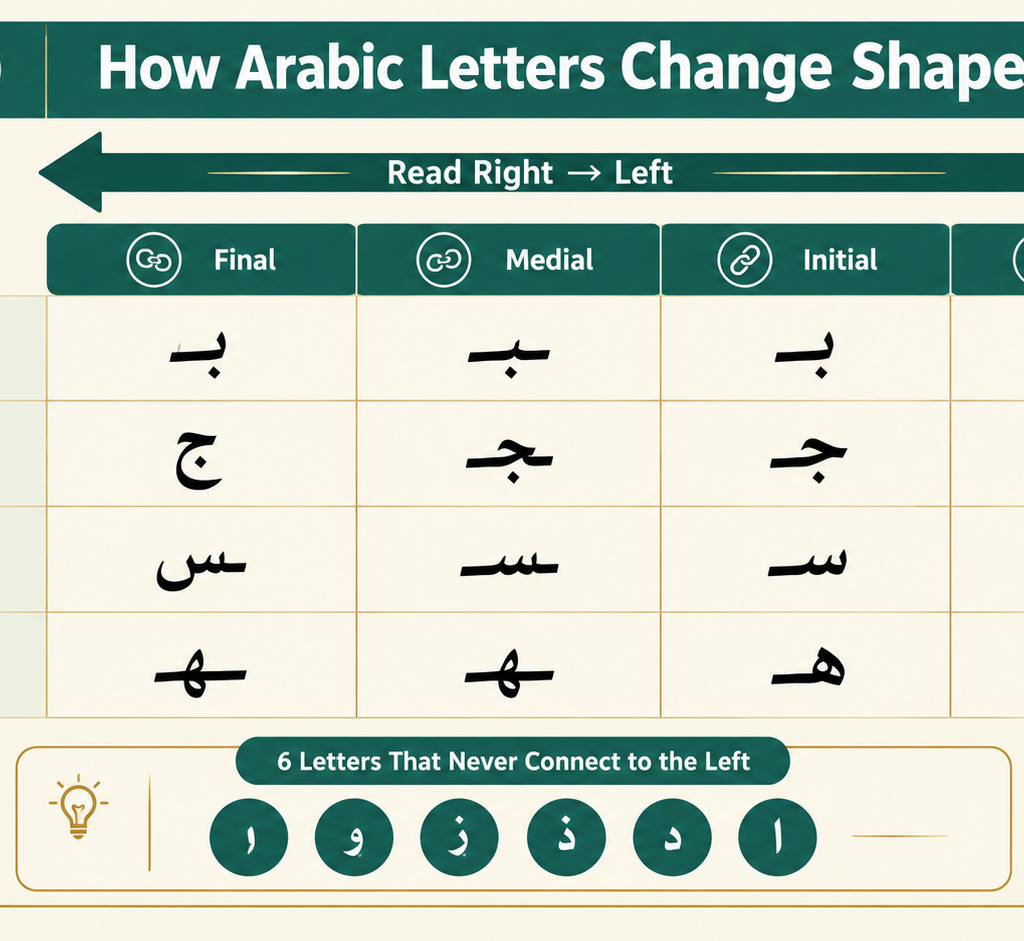
Arabic is cursive, so most letters join their neighbors. Each letter can take four forms: isolated, initial, medial, and final.
Take Ba: ب alone, بـ at the start, ـبـ in the middle, and ـب at the end. The core shape stays recognizable, so the forms are easier than they first appear.
Six Letters Never Connect to the Left
Alif (ا), Dal (د), Dhal (ذ), Ra (ر), Zay (ز), and Waw (و) only join the letter before them. After any of them, the next letter starts again in its initial form.
Learning these six early saves a lot of confusion. When you see gaps inside a word like وَرْدَة (warda, “a rose”), you will know it is still one word and read it without stopping.
How to Read in Arabic for Beginners: Kids vs. Adults
The steps are the same at every age, but the teaching style differs. Mastering how to read in Arabic for beginners means adapting the method to the learner.
Children learn best through repetition, games, and imitation, while adults learn better when they understand the rule first. At any age, the best results come from a patient teacher, short regular lessons, and reading aloud.
How Do You Teach a Child to Read Arabic?
For children, learning how to read Arabic for beginners should feel like play. Keep sessions to 20–30 minutes with flashcards, songs, and tracing sheets.
Make reading part of daily life by pointing out Arabic letters on book covers, prayer mats, or the Mushaf at home. Praise effort more than speed, and let your child read a short surah to you each night.
The Noorani Qaida builds reading from sounds to words in tiny steps, which is why so many families start with it. Read what the Noorani Qaida is to learn more.
For children ready to recite, our article on Tajweed for kids online shows how to build correct recitation from the first lessons.
Can Adults Learn to Read Arabic Quickly?
Yes. When adults ask how to read Arabic for beginners quickly, our answer is consistency: 15 minutes daily beats one long weekly session.
Adults also want the reason behind each rule, such as why ح sits deeper in the throat than the English “h”. A one-on-one tutor answers on the spot.
Many adults also feel shy about making mistakes in front of others. Private one-on-one lessons remove that pressure and let them progress at their own pace, which is why many adult learners choose individual classes.
Whether you are enrolling your child or yourself, the Noorani Qaida Course turns how to read Arabic for beginners into a level-by-level plan with personal feedback.
Inside Kalimah Center: Moments from Our Courses
Get a glimpse into the vibrant learning experience at Kalimah Center. These snapshots capture real moments from our live classes—where students engage deeply, connect with passionate instructors, and grow in a welcoming, supportive environment.
Master Arabic with Kalimah Center
Join our expert-led online classes and start your journey toward Arabic fluency today.
Book Your Free TrialLearning to Read Arabic for Beginners: Mistakes and Tips
Learning to read Arabic for beginners is far easier when you know the traps in advance. These are the errors our teachers correct most often. Almost every beginner faces the same few challenges, whatever their age or background.
Once you know them, learning to read Arabic for beginners becomes a matter of steady correction rather than frustration.
Common Beginner Mistakes
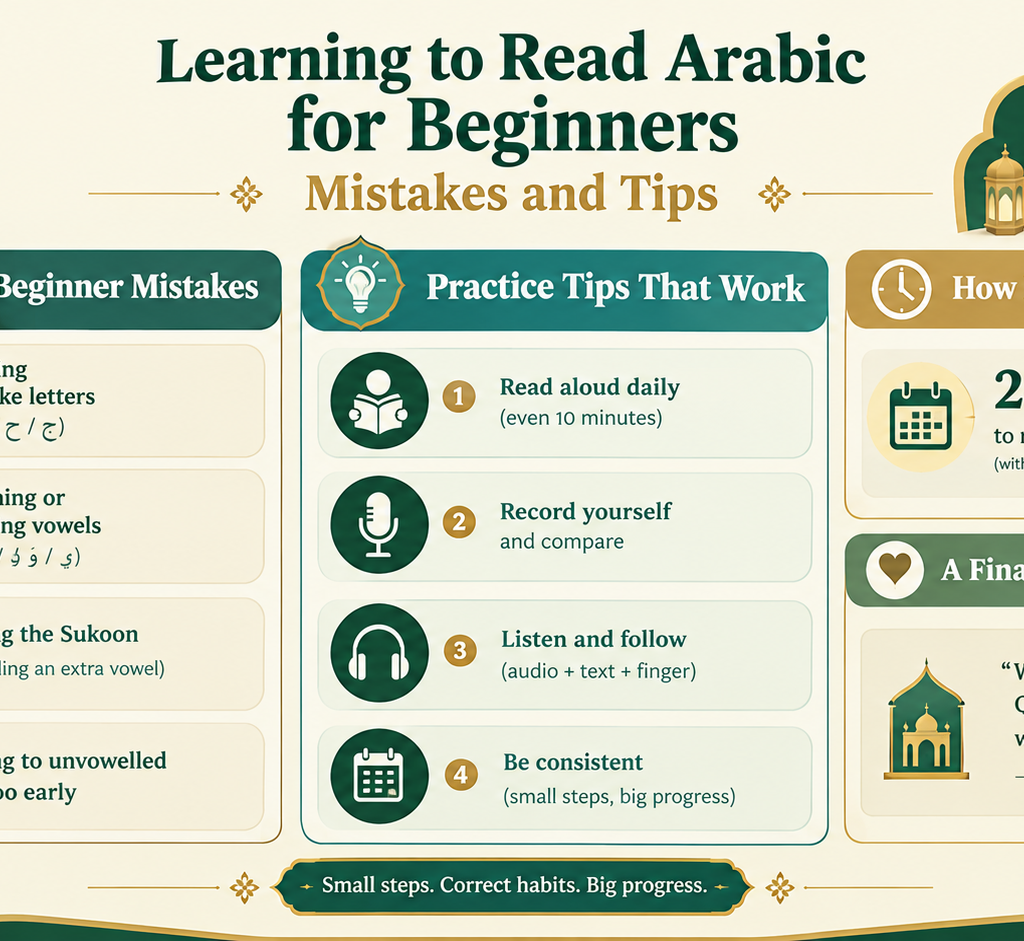
Mistakes are a normal part of learning, so do not let them discourage you. What matters is catching them early, before they turn into habits that become hard to break later on. Most setbacks when learning to read Arabic for beginners come from four habits:
- Confusing look-alike letters such as ج / ح / خ, which differ only by dots.
- Shortening long vowels or stretching short ones.
- Ignoring the Sukoon and adding an extra vowel at a word’s end.
- Jumping to unvowelled texts too early.
Most of these errors are easy to fix with a teacher who listens closely to every word. A trained tutor notices a missing Sukoon or a shortened Madd instantly and shows you exactly how to correct it.
Practice Tips That Work
Read aloud daily, even for ten minutes, so your tongue learns the correct sounds. Reading one page three times beats reading three pages once.
Record yourself and compare it with your teacher’s reading. This is one of the smartest habits for how to read Arabic for beginners.
Listen to a slow recitation of short surahs while following the text with your finger. Linking what you hear to what you see is one of the fastest ways to master how to read in Arabic for beginners.
How Long Does It Take to Read Arabic?
Many students who follow our plan for how to read Arabic for beginners can read fully vowelled text within two to three months. That includes the Quran, as long as they practice daily with a qualified teacher.
If it feels hard, remember the Prophet’s ﷺ promise that whoever reads the Quran with difficulty earns a double reward (Sahih Muslim 798). Once your reading is steady, the Learn Quran Online Course takes you from reading to Tajweed-correct recitation with Ijazah-certified teachers.
Start Reading Arabic and the Quran With Confidence Today
You now know how to read Arabic for beginners, but fluency comes from practice with a teacher who corrects every sound. At Kalimah Center, every lesson is live, one-on-one, and built around your level.
Our native tutors teach how to read Arabic for beginners, kids, and adults. They also teach Noorani Qaida, Tajweed, and Quran recitation, all on a schedule that fits your week.
Explore Our Courses:
- Online Arabic Course: Tailored to your level, our comprehensive Arabic program includes 16 teaching levels and 400+ hours of personalized sessions.
- Online Quran With Tajweed Course: Perfect for non-Arabic speakers, our course spans 13 levels and equips you with Tajweed mastery from beginner to advanced.
- Online Arabic Course For Kids: Nurture your child’s love for Arabic with our engaging and structured program, available in 24 levels for primary, intermediate, and secondary stages.
Book a free trial lesson today and read your first Arabic words in your very first class. Places with our top tutors fill quickly, so reserve your slot now.
Master Arabic with Kalimah Center
Join our expert-led online classes and start your journey toward Arabic fluency today.
Book Your Free TrialConclusion
Learning how to read Arabic for beginners rests on three foundations: reading right to left, recognizing the 28 letters in all their shapes, and mastering the vowel marks that bring each letter to life.
Next, the roadmap for how to read Arabic for beginners moves to long vowels, Sukoon, Shadda, and Tanween. Then you blend words and start reading the Mushaf. Kids need playful sessions, while adults need steady daily practice.
The key takeaway: go step by step, read aloud every day, and have a qualified teacher check your pronunciation. That is how to read Arabic for beginners and reach the Quran with confidence.
FAQs
Here are quick answers to the questions beginners ask most about reading Arabic.
Can I learn to read Arabic on my own?
Yes, you can learn how to read Arabic for beginners alone with books and apps. However, a teacher is vital for throat letters like ع and ح.
What is the easiest way to learn the Arabic alphabet?
Learn letters in groups that share a shape, such as ب ت ث, and practice each with its three short vowels. Daily reading aloud makes the shapes stick.
Is reading Arabic harder than speaking it?
For most beginners, reading comes first. Vowelled Arabic is very phonetic, so once you know the marks, you can read words correctly before you understand them.
Should I learn Noorani Qaida before reading the Quran?
Yes, for most learners. It trains letters, vowels, and joining rules in the order Quran reading requires, which makes it an ideal bridge to the Mushaf.
How long should a beginner practice each day?
Fifteen to thirty minutes a day is enough. Short daily practice is the real secret to read Arabic for beginners.