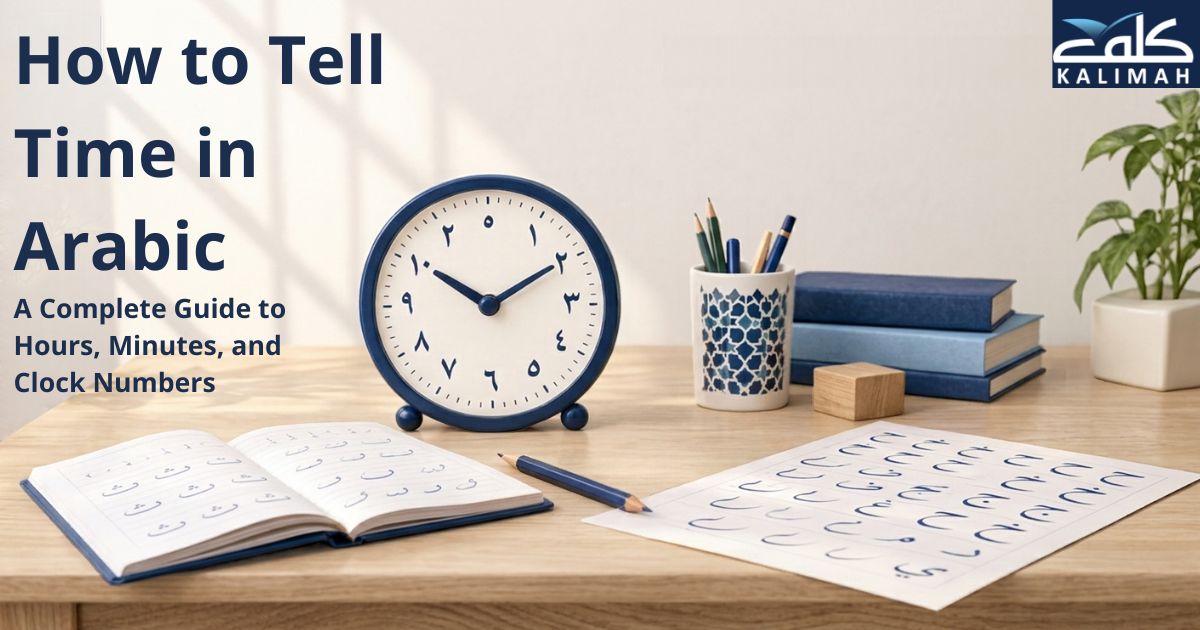
Have you ever looked at an Arabic clock or heard someone mention an appointment in Arabic and wondered what time they meant? Learning how to tell time in Arabic helps you understand everyday conversations, organize your schedule, and communicate more confidently with Arabic speakers.
In Modern Standard Arabic (MSA), telling the time follows a few useful patterns. You begin with السَّاعَة (as-sāʿah), meaning “the hour” or “the clock,” then add the hour and, when needed, the minutes.
This guide explains how to tell time in Arabic step by step, with Arabic script, English transliteration, clear examples, and practical exercises. Whether you are an adult beginner, a parent helping your child, or a Quran learner building Arabic vocabulary, you can use these expressions in everyday life.
1. Asking for the Time in Arabic
To tell time in Arabic, use السَّاعَة (as-sāʿah) followed by the appropriate hour expression. Add وَ (wa, “and”) to express minutes past the hour, or إِلَّا (illā, “except”) to express the minutes remaining before the next hour.
For example, السَّاعَةُ الثَّالِثَةُ means “three o’clock,” while السَّاعَةُ الثَّالِثَةُ وَالنِّصْفُ means “half past three.” To ask about the time, the most common Modern Standard Arabic question is:
كَمِ السَّاعَةُ؟
Kam as-sāʿah? — What time is it?
To make the question more specific, you can say:
كَمِ السَّاعَةُ الآنَ؟
Kam as-sāʿah al-āna? — What time is it now?
You can also use this polite expression when speaking to someone:
مِنْ فَضْلِكَ، كَمِ السَّاعَةُ؟
Min faḍlik, kam as-sāʿah? — Excuse me, what time is it?
Learning these expressions gives children and adults a practical starting point for using Arabic in real conversations.
2. How to Read Arabic Time: Hours from 1 to 12
In MSA, the hour is generally expressed using a feminine ordinal form because سَاعَة (sāʿah), meaning “hour,” is grammatically feminine. One o’clock conventionally uses الوَاحِدَة, while the following hours use forms such as الثَّانِيَة and الثَّالِثَة.
| Time | Arabic | Transliteration |
| 1:00 | السَّاعَةُ الوَاحِدَةُ | As-sāʿah al-wāḥidah |
| 2:00 | السَّاعَةُ الثَّانِيَةُ | As-sāʿah ath-thāniyah |
| 3:00 | السَّاعَةُ الثَّالِثَةُ | As-sāʿah ath-thālithah |
| 4:00 | السَّاعَةُ الرَّابِعَةُ | As-sāʿah ar-rābiʿah |
| 5:00 | السَّاعَةُ الخَامِسَةُ | As-sāʿah al-khāmisah |
| 6:00 | السَّاعَةُ السَّادِسَةُ | As-sāʿah as-sādisah |
| 7:00 | السَّاعَةُ السَّابِعَةُ | As-sāʿah as-sābiʿah |
| 8:00 | السَّاعَةُ الثَّامِنَةُ | As-sāʿah ath-thāminah |
| 9:00 | السَّاعَةُ التَّاسِعَةُ | As-sāʿah at-tāsiʿah |
| 10:00 | السَّاعَةُ العَاشِرَةُ | As-sāʿah al-ʿāshirah |
| 11:00 | السَّاعَةُ الحَادِيَةَ عَشْرَةَ | As-sāʿah al-ḥādiyah ʿashrah |
| 12:00 | السَّاعَةُ الثَّانِيَةَ عَشْرَةَ | As-sāʿah ath-thāniyah ʿashrah |
One effective way to learn how to tell time in Arabic is to associate each hour with a familiar activity, such as starting school at eight o’clock or having dinner at seven. These everyday examples make Arabic hour expressions easier to remember.
When learning Arabic time expressions, pay attention to how the hour changes depending on the context and sentence structure. Practising each hour aloud and connecting it with familiar daily activities, such as waking up, eating breakfast, or going to school, can help you remember the correct expressions more easily.
Practise saying the hours aloud while looking at an analogue clock. If you are unfamiliar with Arabic numerals, review Arabic numbers from 1 to 1000 before moving on to minutes.
3. Telling Time in Arabic Using Minutes
Once you know the hours, you can describe more precise times. Arabic commonly uses وَ (wa), meaning “and,” to connect the hour with the minutes that follow.
Here are some common expressions:
| Time | Arabic | English meaning |
| 3:05 | السَّاعَةُ الثَّالِثَةُ وَخَمْسُ دَقَائِقَ | Five past three |
| 5:15 | السَّاعَةُ الخَامِسَةُ وَالرُّبْعُ | Quarter past five |
| 3:30 | السَّاعَةُ الثَّالِثَةُ وَالنِّصْفُ | Half past three |
| 7:20 | السَّاعَةُ السَّابِعَةُ وَالثُّلْثُ | Twenty past seven |
As you practise how to tell time in Arabic, start with simple expressions such as half past three and quarter past five before moving on to less familiar minute combinations. This gradual approach helps you understand the sentence patterns and use them more confidently.
The word رُبْع (rubʿ) means “a quarter,” or 15 minutes, while نِصْف (niṣf) means “half,” or 30 minutes. Another useful expression is ثُلْث (thulth), meaning “a third,” which represents 20 minutes in these clock expressions.
For beginners, it is often easier to master the quarter and half first, then practise expressions involving individual minutes. If you want to progress beyond recognizing time, you can explore the Online Arabic Course and find a learning path suited to your current level.
Experience Kalimah Center Classes
Watch real excerpts from our live sessions at Kalimah Center and see how we bring learning to life. These clips highlight our interactive, student-centered teaching approach across all our courses—designed to keep learners engaged, motivated, and actively involved every step of the way.
Master Arabic with Kalimah Center
Join our expert-led online classes and start your journey toward Arabic fluency today.
Book Your Free Trial4. Reading Arabic Time Using إِلَّا (Illā)
When the time is approaching the next hour, Arabic can express the remaining minutes using إِلَّا (illā), meaning “except.” The hour named is the upcoming hour, not the hour currently shown on the clock.
For example:
| Time | Arabic | English meaning |
| 3:45 | السَّاعَةُ الرَّابِعَةُ إِلَّا رُبْعًا | Quarter to four |
| 6:50 | السَّاعَةُ السَّابِعَةُ إِلَّا عَشْرَ دَقَائِقَ | Ten to seven |
| 7:55 | السَّاعَةُ الثَّامِنَةُ إِلَّا خَمْسَ دَقَائِقَ | Five to eight |
An important step in learning how to tell time in Arabic is recognising which hour comes next when using إِلَّا (illā). Practise with a clock by moving the minute hand forward and saying how many minutes remain until the next hour.
To become more confident with إِلَّا (Illā), practise reading times that refer to the minutes remaining before the next hour. For example, السَّاعَةُ الثَّامِنَةُ إِلَّا عَشْرَ دَقَائِقَ means “ten minutes to eight.” Comparing these expressions with digital clock times will help you recognise the difference between saying how many minutes have passed and how many remain.
Notice the difference between 3:45 and 4:45. The first is expressed as “four except a quarter,” whereas 4:45 is “five except a quarter.” This is one of the most important patterns to practise when learning how to tell time in Arabic.
5. Reading Arabic-Indic Time in English
Arabic clocks may display Eastern Arabic numerals (٠، ١، ٢، ٣، ٤، ٥، ٦، ٧، ٨، ٩), while digital devices may also use Western digits (0–9). Here is a quick reference:
| Eastern Arabic numeral | Western digit | English |
| ٠ | 0 | Zero |
| ١ | 1 | One |
| ٢ | 2 | Two |
| ٣ | 3 | Three |
| ٤ | 4 | Four |
| ٥ | 5 | Five |
| ٦ | 6 | Six |
| ٧ | 7 | Seven |
| ٨ | 8 | Eight |
| ٩ | 9 | Nine |
Knowing Arabic numerals makes it easier to learn how to tell time in Arabic when reading digital clocks, class timetables, and appointment reminders. Practise converting times such as ٨:١٥ and ٦:٣٠ into Western digits before saying each time aloud.
A useful way to improve this is to write several digital times using both numeral systems, then read each one aloud in English and Arabic. This exercise builds number recognition and makes reading Arabic clocks, schedules, and timetables easier.
For example, ٣:٣٠ represents 3:30, or half past three. The digits can be read in the same numerical order as their Western equivalents, even though Arabic text generally runs from right to left. If you want to read Arabic digital time in English, practise recognising each digit first, then combine the hour and minute values.
6. Using AM and PM in Arabic
Arabic speakers can clarify whether an event takes place in the morning or evening by using expressions related to the time of day. For example, صَبَاحًا (ṣabāḥan) means “in the morning,” while مَسَاءً (masāʾan) means “in the evening.”
These expressions are especially useful when arranging appointments, discussing school schedules, or distinguishing between two events that happen at the same hour. To distinguish morning from evening, add a time-of-day expression after the hour.
| Arabic expression | Transliteration | Meaning |
| صَبَاحًا | Ṣabāḥan | In the morning |
| ظُهْرًا | Ẓuhran | At noon |
| بَعْدَ الظُّهْرِ | Baʿda aẓ-ẓuhr | In the afternoon |
| مَسَاءً | Masāʾan | In the evening |
| لَيْلًا | Laylan | At night |
To use what you learn about how to tell time in Arabic in everyday situations, practise describing your morning routine, afternoon activities, and evening plans. Adding expressions such as صَبَاحًا (ṣabāḥan) and مَسَاءً (masāʾan) helps make the intended time clear. For example, السَّاعَةُ السَّابِعَةُ صَبَاحًا means “seven o’clock in the morning,” while السَّاعَةُ التَّاسِعَةُ مَسَاءً means “nine o’clock in the evening.”
Arabic uses both 12-hour and 24-hour clock formats. In everyday conversation, context and expressions such as صباحًا and مساءً help clarify the intended time.
7. Practising Telling Time in Arabic
The best way to remember Arabic time expressions is to connect them with activities you already do every day. Check the clock in the morning, name your lesson time, or describe when you read, eat, or sleep.
Parents can make the activity enjoyable by drawing a clock with movable hands and asking children to say each time in Arabic. Adults can practise by writing the time in digits, converting it into Arabic words, and reading the answer aloud.
If you want to build a stronger foundation, explore Kalimah Center’s online Arabic course, which covers reading, listening, speaking, and writing through structured lessons. Regular teacher-guided practice can help you improve pronunciation and use new vocabulary confidently.
Inside Kalimah Center: Moments from Our Courses
Get a glimpse into the vibrant learning experience at Kalimah Center. These snapshots capture real moments from our live classes—where students engage deeply, connect with passionate instructors, and grow in a welcoming, supportive environment.
Master Arabic with Kalimah Center
Join our expert-led online classes and start your journey toward Arabic fluency today.
Book Your Free TrialHow to tell time in Arabic: Tips for Children and Adults
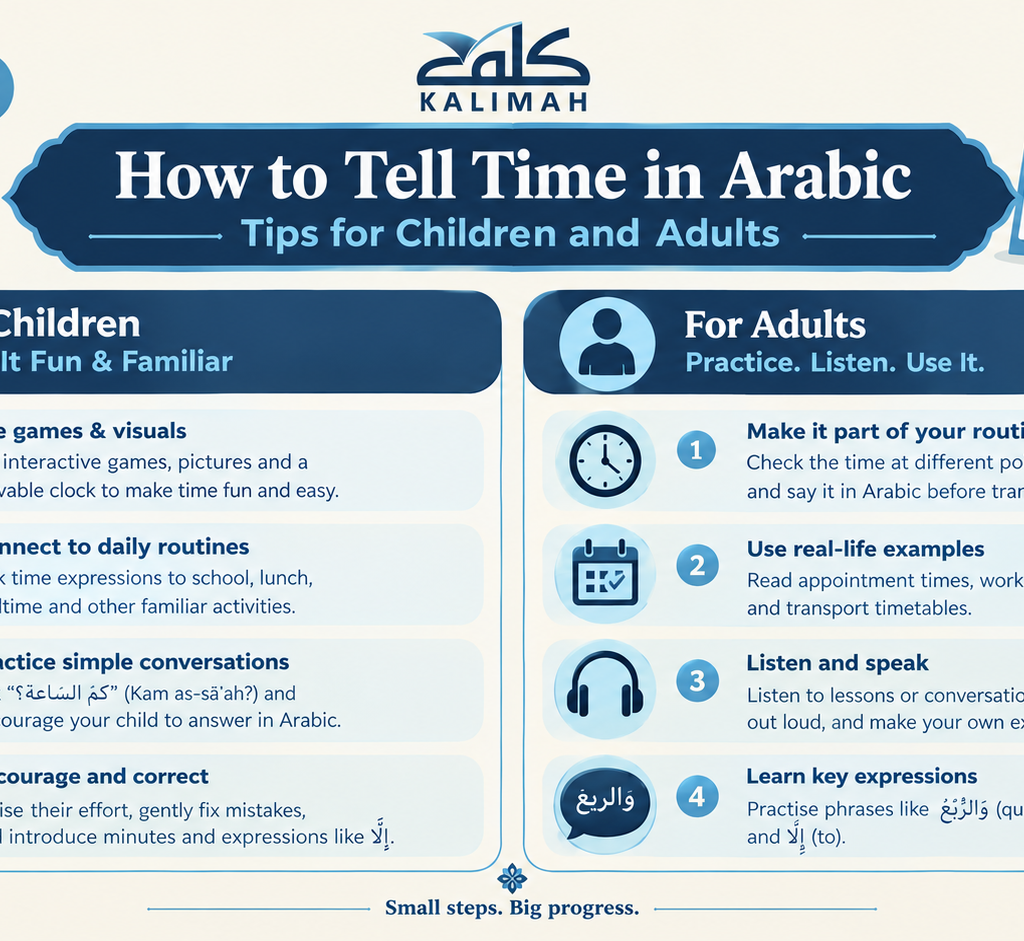
Whether you are teaching children or learning Arabic as an adult, the right approach can make telling time easier and more enjoyable. These practical tips will help you practise Arabic time expressions, remember them more effectively, and use them in everyday conversations.
Tips for Teaching Children to Tell Time in Arabic
Children learn Arabic time expressions more easily when lessons include games, pictures, and familiar routines. Use a movable teaching clock to demonstrate different hours, ask your child to match each time with an Arabic expression, and connect the answers to daily activities such as school time, lunchtime, and bedtime. Short, enjoyable practice sessions can help children remember the expressions without feeling overwhelmed.
Parents can make learning how to tell time in Arabic fun by using picture cards, toy clocks, and short guessing games. For example, show a time on the clock and let the child choose the matching Arabic expression from two or three options.
Parents can also introduce Arabic time through everyday conversations. Ask simple questions such as كَمِ السَّاعَةُ؟ (Kam as-sāʿah?) when looking at a clock together, and encourage children to answer using the Arabic expressions they have learned. Praise their effort, gently correct mistakes, and gradually introduce minutes and expressions such as إِلَّا (Illā) as their confidence grows.
Tips for Adults Learning to Tell Time in Arabic
Adults can improve their Arabic time-telling skills by incorporating short exercises into their daily routines. Check the clock at different points throughout the day and say the time in Arabic before translating it into English. Practise reading appointment times, work schedules, and transport timetables to develop practical vocabulary while becoming more familiar with Arabic numbers and sentence patterns.
Another helpful technique is to practise listening and speaking together. Listen to Arabic lessons or conversations that include time expressions, repeat the phrases aloud, and create your own examples using full hours, minutes, and expressions such as وَالرُّبْعُ (quarter past) and إِلَّا (to). Regular practice with real-life examples will help you respond more naturally when asking for or giving the time in Arabic.
Practise Arabic Time Expressions with Kalimah Center
Learning how to tell time in Arabic becomes easier when you combine grammar, listening, and speaking practice. Start with the twelve hours, learn the expressions for half and quarter, and gradually add more complex minute patterns.
For children and adults who also want to strengthen their Quran reading, accurate recognition and pronunciation of Arabic letters provide a useful foundation. Kalimah Center offers an online Quran course with Quran recitation and Tajweed instruction, helping learners develop their skills through guided practice.
Explore Our Courses:
- Online Arabic Course: Tailored to your level, our comprehensive Arabic program includes 16 teaching levels and 400+ hours of personalized sessions.
- Online Quran with Tajweed Course: Perfect for non-Arabic speakers, our course spans 13 levels and builds Tajweed mastery from beginner to advanced.
- Online Arabic Course for Kids: Nurture your child’s love for Arabic with our engaging and structured program, available in 24 levels for primary, intermediate, and secondary stages.
You can also explore the Arabic speaking course to build confidence using Arabic in everyday conversations. Choose a learning path that suits your current level, practise consistently, and turn the vocabulary you learn into a skill you can use.
Master Arabic with Kalimah Center
Join our expert-led online classes and start your journey toward Arabic fluency today.
Book Your Free TrialConclusion
Learning how to tell time in Arabic becomes easier when you understand Arabic numbers, hour expressions, and the phrases used for minutes. With regular practice, you can recognise Arabic-Indic numerals and understand everyday time expressions more confidently.
Whether you are a beginner, a parent teaching a child, or an adult learning Arabic, start with full hours before moving on to minutes, quarter hours, and expressions using إِلَّا (Illā). Taking small steps will help you build a strong foundation.
Make Arabic time practice part of your daily routine by reading clocks, asking simple questions, and describing your schedule in Arabic. These small activities can turn what you learn into a practical communication skill.
With patience and consistent practice, you can improve your ability to read and express time in Arabic naturally. Keep practising with real-life examples, and use every opportunity to strengthen your Arabic language skills.
FAQs
Here are answers to common questions learners ask about reading and expressing time in Arabic.
1. How do you say “What time is it?” in Arabic?
You can say كَمِ السَّاعَةُ؟ (Kam as-sāʿah?), meaning “What time is it?” To ask what time it is now, add الآن (al-āna), meaning “now.”
2. How do you say 12 o’clock in Arabic?
Twelve o’clock is السَّاعَةُ الثَّانِيَةَ عَشْرَةَ (As-sāʿah ath-thāniyah ʿashrah). Add صباحًا for twelve in the morning or مساءً when referring to twelve at night, depending on the intended time.
3. How do you say half past and quarter past in Arabic?
Half past uses وَالنِّصْف (wa an-niṣf), while quarter past uses وَالرُّبْع (wa ar-rubʿ). For example, 4:30 is السَّاعَةُ الرَّابِعَةُ وَالنِّصْفُ.
4. What is the difference between وَ (wa) and إِلَّا (illā)?
و means “and” and connects the hour with the minutes past it. إِلَّا means “except” and expresses the minutes remaining before the next hour, as in السَّاعَةُ الرَّابِعَةُ إِلَّا رُبْعًا for 3:45.
5. Do Arabic speakers use a 12-hour or 24-hour clock?
Both formats are used. The 12-hour format is common in conversation, often with words such as صباحًا and مساءً, while the 24-hour format is also used for schedules and other contexts where precision matters.
6. Is learning to tell time in Arabic useful for Quran learners?
Yes. It builds general Arabic vocabulary and can help learners discuss lesson schedules and daily routines. Quran reading itself also requires focused practice with Arabic letters, pronunciation, and Tajweed.